
Quick Answer
Start by setting ownership and filing readiness before legal interpretation: appoint a single accountable lead, confirm the submission channel, and verify UTR plus account reactivation status. In the HMRC example, notification is due by 5 October 2025 for 6 April 2024 to 5 April 2025, and late notice may trigger penalties. Then maintain a monthly evidence bundle tied to underlying transaction support, and escalate unresolved VAT treatment points instead of treating internal assumptions as final policy.
What Brexit Changed for UK VAT#
For a non-UK platform dealing with UK VAT after Brexit, start with ownership, deadlines, and evidence before you debate edge cases. This section uses HM Revenue and Customs (HMRC) process examples to set that baseline. It does not claim to state post-Brexit UK VAT law.
The pattern is simple: exact triggers carry exact consequences. In the Self Assessment context, HMRC says you must tell HMRC by 5 October 2025 if you need to complete a return for the previous tax year, 6 April 2024 to 5 April 2025. Late notification could lead to a penalty.
That pattern supports three practical controls for non-UK platforms as well, especially when you are documenting place-of-supply positions, registration ownership, and HMRC-ready evidence packs:
- Assign clear ownership for each tax decision so issues do not sit between teams.
- Keep evidence, not just conclusions. HMRC's own process guidance stresses records such as bank statements or receipts.
- Treat scope and channel checks as control points. HMRC notes returns may be delayed if an account is not reactivated, and the online Self Assessment service cannot be used for some cases, including partnership returns.
Read the sections that follow as a control checklist: decide, document, and escalate early when the facts or filing path are uncertain.
How to choose the right UK VAT controls for a non-UK platform#
For a non-UK platform, start with the controls that show who owns registration, place-of-supply decisions, timing, and records. Those are the clearest checkpoints in the material. The VAT law questions still need separate review.
Use a simple filter: if a control does not show who decided, by when, and with which records, treat it as process polish, not a core compliance control.
- Deadline ownership. Assign one named owner for HMRC notification and filing timeline checks. The checkpoint is clear: if a return is needed for the previous tax year and this is your first return, or you did not submit one last year, HMRC must be told by 5 October 2025 for 6 April 2024 to 5 April 2025, and late notification can trigger a penalty.
Why it matters: date-led accountability catches exposure early.
- Evidence-pack discipline. Keep the records behind what was reported, not only the final figures. HMRC's examples include bank statements or receipts.
Why it matters: a usable evidence pack supports return accuracy and later review.
- Filing-path verification. Validate filing-route readiness before deadlines, including account status and filing method. Filing without reactivating an existing Self Assessment account may delay the return, and some cases cannot use the online service, including partnership returns. A pending UTR can slow filing.
Why it matters: this avoids the failure mode where decisions are made but filing cannot proceed.
- Early uncertainty escalation. If status is unclear, escalate early and document the escalation date and owner. HMRC's practical trigger is explicit: if you are not sure whether you are trading, contact HMRC for advice.
Why it matters: ambiguity becomes a tracked action instead of an undocumented internal assumption.
Compare the control options before you implement#
Before you implement UK-facing flows, prioritize the controls that prevent expensive-to-unwind errors. In practice, I would put decision discipline and evidence ahead of SOP cleanup or tooling tickets.
| Control | Best for | Core terms involved (issue flags for specialist review unless explicitly supported below) | Implementation effort | Failure mode | Owner | Do first |
|---|---|---|---|---|---|---|
| Flow classification gate | Mixed goods/services flows, B2B and B2C journeys, changing payout models | UK VAT, place of supply, reverse charge | Medium | A flow goes live before the treatment is classified, so cleanup starts after billing or payout | Tax with product and legal | 1 |
| Border responsibility and contract check | Goods routes, merchant-of-record changes, UK-border fulfillment | import VAT, EORI number, Delivered Duty Paid (DDP) Incoterms | Medium to high | Commercial terms assign border obligations the team did not operationalize | Legal with logistics and tax | 1 (goods routes) |
| Registration decision and entity owner log | Multi-entity groups assigning UK-facing activity | VAT registration, UK VAT | Medium | Activity starts under the wrong entity or no owner is accountable for the decision | Tax with finance controller | 2 |
| Evidence pack discipline | Teams that can decide a position but struggle to prove it later | UK VAT, import VAT, reverse charge | Low to medium | Figures are filed without usable supporting records and decision history | Finance ops with compliance | 2 |
| Filing-path and escalation check | Lean teams relying on one portal, one advisor, or one access holder | HM Revenue & Customs, account status, filing method | Low | Deadline arrives and access, account status, or filing-route limits block submission | Finance ops | 3 |
Read this table with one caution#
Several terms here are issue flags, not resolved VAT conclusions. Place of supply, reverse charge, VAT registration triggers, import VAT liability, EORI requirements, and DDP obligations are not established here. Treat them as items to surface for specialist review and documented sign-off.
Priority sequence to apply now#
The sequence matters more than the labels. First stop the errors that are expensive to unwind, then lock down ownership and proof, and only then make filing faster.
- Irreversible-error controls first. Stop misclassified live treatments and unclear border ownership before launch.
- Ownership and evidence next. Name a decision owner, decision date, and record set for each treatment.
- Speed controls last. Improve filing throughput only after judgment and records are defensible.
Verification checkpoints worth lifting now#
A few checks from HMRC's examples are worth lifting straight into your process, even though they come from Self Assessment rather than UK VAT analysis.
- Keep records behind what is reported, including examples like bank statements or receipts.
- Confirm filing-route readiness early. Filing without reactivating an existing account may delay a return, and some cases, including partnership returns, cannot use the online service.
- Apply explicit deadline ownership as a control pattern. If a return is needed for the previous tax year, HMRC must be told by 5 October, and late notification can trigger a penalty. This is a Self Assessment example, not a UK VAT deadline.
- Escalate uncertainty with an owner and date. If you are not sure whether you are trading, contact HMRC for advice.
If capacity is limited, implement controls in that order: prevent wrong live treatment, lock ownership and proof, then improve speed.
Related: A Guide to VAT MOSS for UK Freelancers Selling Digital Services to the EU.
Before locking SOPs, run your highest-risk flows through the VAT reverse charge checker to surface treatment assumptions for legal review.
Control 1 map every money flow that creates UK VAT exposure#
Map every money movement leg by leg before you debate treatment. On non-UK platforms, that is often the fastest way to see where a UK VAT after Brexit question may exist and where teams are reading too much into one aggregate ledger line.
Use this as an internal control, not a VAT method prescribed by HMRC. Place of supply, import VAT treatment, EORI requirements, DDP obligations, and Brexit-specific outcomes are not established, so keep them as review flags rather than conclusions.
Separate each money leg before classification#
Map each leg as its own line item, even if settlement appears on one statement. At minimum, capture:
- who contracts with whom
- who charges or invoices whom
- who receives cash first and who keeps or remits it
- where commercial terms create unresolved tax or border questions for specialist review
This helps stop one visible payment trail from being treated as if it were the full legal and commercial flow.
Make the map evidence-ready from day one#
A usable map should work across tax, legal, finance, and payments ops. For each leg, record the entity, counterparty type, contract reference, billing event, payout event, and the underlying record you can retrieve.
Keep the evidence links practical. HMRC guidance says you need records, for example bank statements or receipts, so returns can be completed correctly. Structure the map so each row points to that proof.
Run filing-readiness checks in parallel#
Do not wait until deadlines to validate filing access. HMRC guidance warns that filing without reactivating an existing Self Assessment account may delay a return, and missed deadlines can trigger penalties.
Even though those excerpts are about Self Assessment, you can still use the pattern as a general readiness check. Confirm account status, access holder, and submission path early, alongside the flow map.
Flag the failure mode early#
One common risk is a contract-flow gap, not spreadsheet math. If contract path, collection path, and payout path sit with different teams, mark the route as needs review, assign one owner, and require a dated decision note plus supporting records before launch.
Related reading: How a UK LTD Should Invoice an EU Business on VAT Post-Brexit.
Control 2 classify each flow by goods or services and customer type#
Before you launch, classify each mapped money leg so uncertainty is visible and reviewable, not rediscovered after go-live. The point is control discipline, not a claim that this material settles the VAT outcome.
Start with two working labels for each leg from Control 1: what is supplied, goods or services, and who the customer appears to be, B2B or B2C. Do not leave rows as vague labels like "platform sale" or "fee" when the underlying journey varies.
Use a working matrix with clear uncertainty states:
- working label: goods or services
- working label: B2B or B2C
- contracting entity and billed entity
- status:
known,unknown, orneeds review - review flags for unresolved VAT questions, for example place of supply, reverse charge, and Use and Enjoyment
- evidence link and approver
Treat unknown as a valid state until review is complete. If a revenue-critical row is still unresolved, hold launch for legal sign-off as an internal risk control.
Make the matrix evidence-ready. The practical checkpoint here is recordkeeping, for example bank statements or receipts. Each row should link to retrievable supporting records.
When status is unclear, escalate early instead of filing first and fixing later. HMRC says to contact them if you are not sure whether you are trading. In operational planning, confirm filing-access paths early too. Filing without reactivating an existing account may delay a return, and the online filing service is unavailable in some cases, including if someone lived abroad as a non-resident.
Control 3 set place-of-supply and special-rule decisions in writing#
Write each decision down, including uncertainty, so product, finance, and legal work from one operating position. The goal is control quality, not a claim that this material resolves every UK VAT rule.
The HMRC guidance here does not provide UK VAT place-of-supply, Use and Enjoyment, or reverse-charge decision logic. Treat those as review items, not settled conclusions here.
Once you finish Control 2, a common failure mode is inconsistency. Teams apply different assumptions, but no one can show what was reviewed, who approved it, or what is still open.
What belongs in the decision log#
Keep a durable record for each material flow with, at minimum:
- flow ID and linked row from your classification matrix
- status:
approved,needs review, orblocked - contracting entity, billed entity, and customer type
- internal legal basis reference used for the working position, where applicable
- flags for place of supply, Use and Enjoyment, and reverse charge as review items
- whether the position is an assumption, an internal view, or externally advised
- approver, decision date, next review date, and evidence links
Use evidence links that point to retrievable records. HMRC guidance says you need records such as bank statements or receipts to complete returns correctly. Link each entry to the underlying contract, invoice or checkout artifact, and settlement support for that flow.
Treat uncertainty as a status, not a gap#
If a tax-sensitive flow is unresolved, mark it explicitly and assign an escalation owner. That is safer than letting an undocumented assumption become the live billing and reporting position.
Record operational dependencies in the same place. Where a filing may be needed, capture access and timing alongside the decision. First-time filers must register before using the online filing service. Previously registered users may need reactivation, and filing without reactivating an existing account may delay processing.
One practical review rule#
Review this log whenever you change market coverage, contract flow, or invoice design. Then run a fixed checkpoint monthly or before a filing cycle:
- sample three high-volume or high-risk flows
- confirm the log matches live contract and billing behavior
- verify evidence links still resolve
- check whether any
needs reviewitem affects current filing or registration steps
If status is still unclear, escalate early. HMRC guidance explicitly says to contact HMRC for advice when status is uncertain, and your record should show when the issue was identified, what was reviewed, and who escalated.
Control 4 build VAT registration and filing ownership by jurisdiction#
Assign one named owner per filing scenario for registration, filing, data, and review. Do not leave this as shared responsibility. This is an operational-accountability control. This gives you filing-ownership checkpoints, not VAT-by-jurisdiction legal rules.
Use the same ownership pattern across your scenarios. Centralized ownership can improve consistency; local ownership can improve response time for filing issues. If you centralize, add a local reviewer. If you localize, keep one group-level accountable owner.
Use a scenario table, not a narrative memo#
Keep this table operational. If you run multiple scenarios, keep separate rows even when your current working position is the same, so assumptions are checked explicitly.
| Scenario label | Registration owner | Filing owner | Data source owner | Reviewer | Mandatory check |
|---|---|---|---|---|---|
| First-time Self Assessment filer | Named legal-entity owner and backup | Named filer, not only a team alias | Billing or ledger owner | Tax or legal reviewer | Confirm HMRC notification ownership by 5 October for the previous tax year |
| Previously registered Self Assessment filer | Named owner for account status and reactivation | Named filer | Checkout, invoicing, or settlement owner | Independent reviewer | Confirm account reactivation is complete before filing to avoid delays |
| Filer outside HMRC online-service scope | Entity owner plus advisor contact where used | Central or local filer using the correct channel | Local finance data owner | Local reviewer or advisor | Confirm whether filing must use commercial software or other forms |
The point is to prevent handoff failures where no one clearly owns registration status, filing access, source data, or escalation.
Four roles to assign the same way every time#
- Registration owner
Owns entity assignment, status checks, and the first escalation when status is unclear. The output should be written ownership, not implied ownership.
- Filing owner
Owns submission readiness, account access, deadlines, and filing channel. HMRC Self Assessment guidance is a useful operational warning pattern: previously registered users may need account reactivation, filing without reactivation may delay a return, and some filers must use commercial software or other forms instead of the online service.
- Data source owner
Owns the numbers and the evidence trail used for filing. HMRC guidance says records such as bank statements or receipts are needed to complete returns correctly, so your table should point to the underlying ledger and supporting artifacts for each row.
- Reviewer
Must be independent from the filing owner. Their job is to confirm the entity, filing path, and evidence pack still match live operations, and to block submission when material assumptions remain unresolved in Control 3.
The checkpoint that catches real failures#
Before filing week, confirm the named filing owner can actually file and can access the required records. For Self Assessment, HMRC states notification by 5 October for the previous tax year, for example 5 October 2025 for 6 April 2024 to 5 April 2025, filing on or after 6 April, payment by 31 January, and use of a UTR for sign-in. Do not treat those as VAT deadlines. Use them as an ownership-discipline model for early notification, access readiness, and identifier control.
The red flags are familiar in practice: shared ownership with no backup, or a filing owner who cannot control data inputs. If you use external advisors, keep internal accountability explicit so ownership is not delegated by accident.
For a step-by-step walkthrough, see VAT and SEPA: How European Platforms Combine Tax Compliance with Automated Euro Payouts.
Control 5 add contract and Incoterm checks before go-live#
Give the Control 4 owner a real launch veto. If the signed contract language and operating ownership do not match, stop and escalate before go-live. Use DDP Incoterm terms, customs responsibility language, handoff changes, or import-VAT wording as internal escalation triggers, not proof of the VAT answer.
This section does not establish a specific UK VAT-after-Brexit rule for those terms. What the HMRC guidance does support here is process readiness: confirm registration status, check whether an existing account needs reactivation, confirm the filer has the UTR, verify the filing route, and confirm records are in place.
What this control is really catching#
This control catches a practical mismatch: signed obligations move, but filing readiness does not. If a contract shifts responsibility while your internal notes still show the old owner, treat the signed document as the higher-risk signal and resolve ownership before launch.
You do not need a final VAT conclusion at this gate. You need a clear owner, a documented review, and an explicit escalate-or-clear decision.
The minimum pre launch checks#
Use this gate to confirm ownership, access, and evidence are aligned before anything goes live.
- Contract red-flag scan
Review the final signed version, not just summaries. Flag DDP language, customs responsibility, import-VAT wording, and handoff changes for escalation.
- HMRC process readiness check
For first-time filing through the online service, registration is required first. For previously registered users, confirm whether reactivation is needed, because filing without reactivation may delay the return. Confirm the filer has the UTR needed for online filing access.
- Filing route check
Do not assume the standard online service is available for every filer type. Confirm the actual filing route before go-live.
- Records check
Confirm the filing owner can access required records, for example bank statements or receipts, and that the evidence location is documented.
The failure mode to watch#
The common failure is not legal interpretation. It is launch before readiness. A route goes live, then the filing owner discovers inactive access, a missing UTR handoff, or the wrong filing channel.
This gate adds pre-launch friction and legal-review demand. Keep the evidence pack light and explicit: final contract, flagged clauses, named owner signoff, filing-access confirmation, and record location.
Control 6 build evidence packs for HMRC and internal audit#
Once ownership and filing access are clear, build HMRC evidence packs that make each period easy to support. A monthly pack is a practical internal control because it can speed up HMRC or audit responses and reduce repeat data pulls.
Keep it lightweight and reviewable. HMRC guidance is clear on one baseline: keep supporting records, for example bank statements or receipts. For internal review, keep enough context that another reviewer can follow what was filed and why.
What a usable pack looks like#
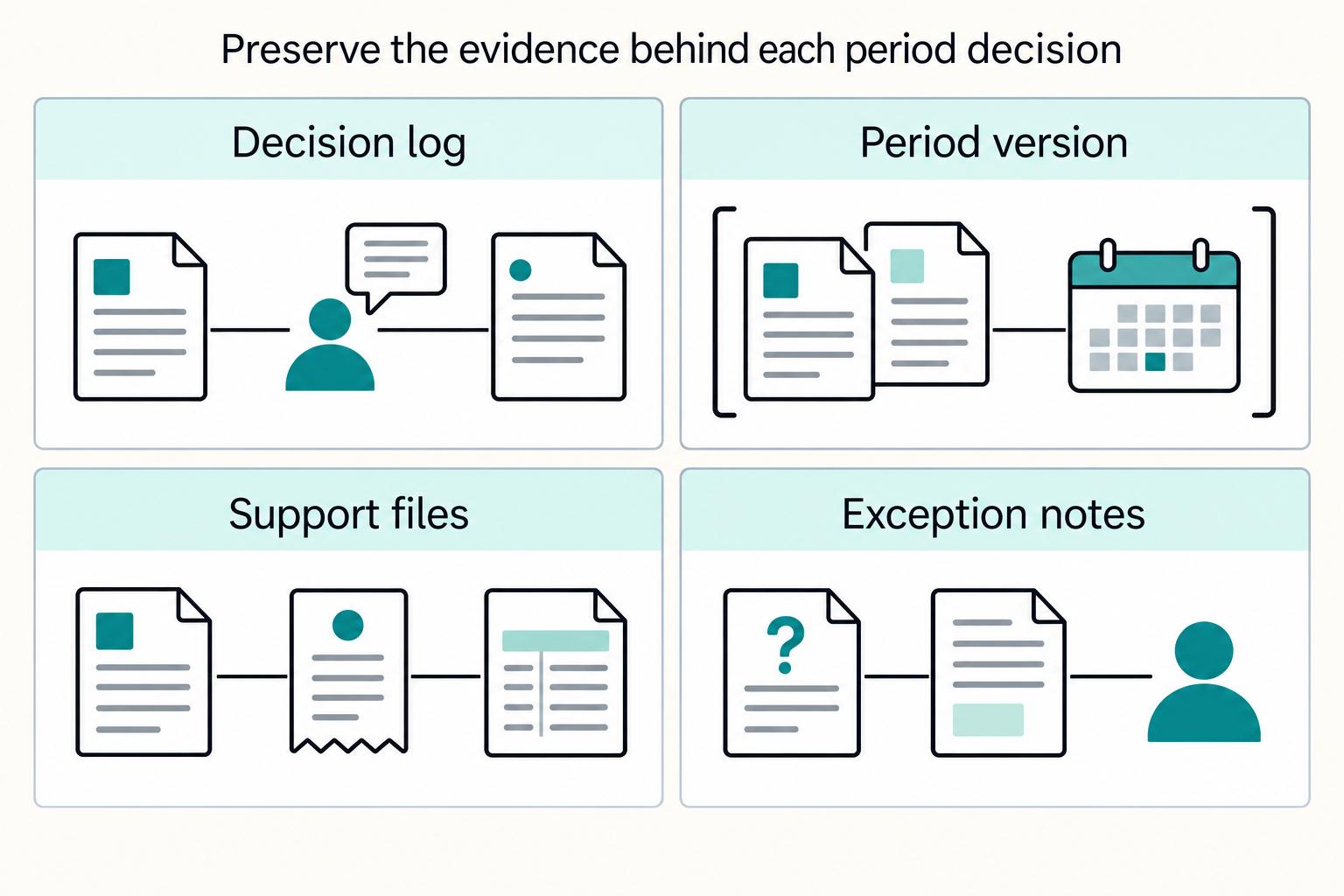
For each month, keep one pack with:
- Decision log
Record the current filing position, who approved it, when it was approved, and which flows it covers. If anything changed, note what changed.
- Position snapshot
Save the exact version of the matrix or memo used for that period. Avoid relying only on live links that can be overwritten later.
- Filing support files
Keep the transaction extract, reconciliation, and underlying records used for filing. For online filing, include the access details used at the time, including the UTR, and, where relevant, confirmation that a previously registered account was reactivated. If the standard online route was not used, note the route used.
- Exception notes
Capture out-of-pattern items, who reviewed them, and how they were resolved.
The checkpoint that matters most#
Each pack should answer three questions without a meeting: who approved the position, what changed, and which flows were affected. If one answer is missing, the pack is not review-ready.
The failure modes to watch#
Common operational gaps are scattered files, weak naming, and no frozen versions. HMRC notes that filing without reactivating an existing account may delay the return, and the standard online service does not cover every case, for example partnerships. Deadline control matters as well, because HMRC states missing the filing deadline can trigger a penalty.
Need the full breakdown? Read DAC7 for Platform Operators: Scope, Seller Data, and Controls for EU and Non-EU Platforms.
Control 7 define escalation triggers for legal and tax advisors#
Write the escalation triggers down so issues move on risk, not on whoever wins the internal debate. Keep the list narrow and tie it to decisions that can block filing, change which HMRC process applies, or leave you unable to prove what you did.
| Trigger | Escalate when | Operational note |
|---|---|---|
| Unclear position that affects filing | The team cannot state the current treatment in one plain sentence and show the facts behind it | Require a short brief before external review: entity, transaction path, relevant contract text, and one sample transaction |
| HMRC route or account uncertainty | You are unsure whether you are trading, whether the standard online service applies, whether a first-time filer has registered for Self Assessment, whether the UTR is missing, or whether an existing account may need reactivation | Treat this as a timing risk, not a drafting issue; returns may be delayed if filed without reactivating an existing account, and some cases must use commercial software or other forms |
| Hard deadline approaching with no settled position | An open issue remains close to a filing or payment deadline | In this HMRC context, the previous tax year runs from 6 April 2024 to 5 April 2025; telling HMRC after 5 October 2025 can lead to a penalty, and payment is due by 31 January |
| Records gap for a material decision | The team cannot produce the records needed to complete the return correctly before filing | HMRC expects supporting records such as bank statements or receipts; treat this as an evidence-control failure, not a technical interpretation exercise |
Use the table as the default rule set. The notes below show how to apply each trigger in practice.
- Unclear position that affects filing
If you cannot state the current treatment in one plain sentence and show the facts behind it, escalate. Before external review, prepare a short brief with the entity, transaction path, relevant contract text, and one sample transaction.
- HMRC route or account uncertainty
Escalate immediately if you are unsure whether you are trading, whether the standard online service applies, whether a first-time filer has registered for Self Assessment, whether the UTR is missing, or whether an existing account may need reactivation. Treat this as a timing risk, not a drafting issue. HMRC states returns may be delayed if filed without reactivating an existing account, and some cases must use commercial software or other forms.
- Hard deadline approaching with no settled position
Escalate the same day when an open issue remains close to a filing or payment deadline. In this HMRC context, the previous tax year runs from 6 April 2024 to 5 April 2025; telling HMRC after 5 October 2025 can lead to a penalty, and payment is due by 31 January. Assign a named owner and response deadline. Do not run extra internal review loops.
- Records gap for a material decision
Escalate before filing if the team cannot produce the records needed to complete the return correctly. HMRC expects supporting records such as bank statements or receipts. Treat this as an evidence-control failure, not a technical interpretation exercise.
If the issue affects filing route, account readiness, deadlines, or evidence sufficiency, escalate. If it is only wording cleanup, keep it in-house.
Conclusion#
For non-UK platforms dealing with UK VAT after Brexit, the practical path here is control order, not false certainty. Use what is verified, and escalate what is not established.
-
Map flows and classify decisions, but mark unresolved tax points clearly. Use transaction mapping to show who contracts with whom, how money moves, and what changed. If the legal basis for a UK VAT position is not established by your current material, treat that point as unknown, label it unresolved, and escalate it instead of letting an assumption become policy.
-
Anchor filing ownership to explicit HMRC checkpoints. If you need to complete a return for the previous year, HMRC says you must notify by 5 October 2025 for the 6 April 2024 to 5 April 2025 example period, and late notification can lead to a penalty. Before filing, confirm in order: the filing route is correct for the case, the filer has a Unique Taxpayer Reference (UTR), and any existing Self Assessment account has been reactivated, since filing without reactivation may delay the return.
-
Treat records as part of compliance, not post-filing cleanup. HMRC says you need to keep records such as bank statements or receipts to complete returns. Keep an evidence pack that shows the filing basis and supporting records so the decision is defensible when reviewed later.
-
Check route exceptions early to protect deadlines. HMRC notes some cases, including partnerships, trusts and estates, and some non-resident scenarios, may need commercial software or other forms instead of the standard online route. Keep timing controls explicit: online filing opens on or after 6 April, and payment is due by 31 January.
Gruv can help on the operational side, where supported: compliance gates, audit trails, and reconciliation surfaces can improve visibility and control execution. That can help with defensibility, but it does not replace unresolved legal or tax judgments.
We covered this in detail in What Non-Compliance Costs Gig Platforms Before Market Expansion.
If you are turning this control framework into live payout and reconciliation workflows, talk to Gruv to confirm market coverage, compliance gating, and audit-trail requirements for your setup.
Frequently Asked Questions
What changed after Brexit for UK VAT if we are a non-UK platform?
The supplied HMRC excerpts do not establish Brexit-specific UK VAT changes for non-UK platforms. What they do confirm is filing-readiness: if you need to complete a return, HMRC says you must tell HMRC by 5 October 2025 in the example period. They also state a return may be delayed if an existing Self Assessment account is not reactivated first.
Does the Free Trade Agreement (FTA) simplify UK VAT obligations?
This is not settled by general guidance. Whether the UK-EU Free Trade Agreement, VAT simplifications, or Brexit relief apply to platforms is not established. Treat this as a point for legal or tax escalation, not inference.
Are post-Brexit VAT changes mainly about goods or services?
The distinction between goods and services treatment in post-Brexit VAT terms is not addressed here. If this distinction affects a live filing or registration decision, escalate it early rather than waiting for deadline pressure around 31 January.
What is the first step in deciding place of supply for our services?
Escalate for a confirmed legal or tax treatment before settling on a place-of-supply method.
When does reverse charge treatment apply, and what evidence should we keep?
When reverse charge applies and what reverse-charge evidence is required are not defined here. Do not treat this section as authority for reverse-charge positioning. The only supported evidence point here is general recordkeeping: HMRC expects records such as bank statements or receipts to complete returns correctly.
What minimum controls should we implement first if resources are limited?
A definitive minimum UK VAT control set is not established. For immediate HMRC filing readiness, start with three basics: confirm whether you need to register for Self Assessment before filing online, confirm your account status and Unique Taxpayer Reference (UTR), and confirm the filing route fits your case. HMRC also notes the standard online service is not suitable in some cases, where commercial software or other forms may be required.
Try a related tool
Researched and edited by the Gruv editorial team. Gruv builds cross-border billing, payouts, and finance-operations software for global businesses.
Sources
Includes 2 external sources outside the trusted-domain allowlist.
Educational content only. Not legal, tax, or financial advice.
Related Posts
How to Manage a Multi-Country European Tour and Stay Schengen Compliant
A **multi-country Schengen tour** works best when you treat it as one regional operation with one evidence trail, not a string of loosely connected stops. The payoff is simple: better route decisions, fewer documentation gaps, and less backtracking if an airline, consulate, or other authority asks what you planned and what you actually did.
VAT MOSS and Non-Union OSS for UK Freelancers Selling to the EU
If you sell digital services from the UK to EU customers, treat UK VAT MOSS as historical and [Non-Union OSS](https://vat-one-stop-shop.ec.europa.eu/one-stop-shop_en) as the current route to assess. You cannot use UK VAT MOSS for sales made from 1 January 2021 onwards. For UK sellers who are not established and have no fixed establishment in the EU, the relevant OSS branch is the **Non-Union scheme**.

GDPR for Marketplace Platforms: How to Handle Contractor and Seller Personal Data Compliantly
Treat this as an operating decision, not a policy exercise. If you own compliance, legal, finance, or risk for a platform, your job is to decide who owns each GDPR duty. You also need to define what evidence must exist, what your team reviews on a recurring basis, and which issues need escalation before a launch or vendor change goes live.