
Quick Answer
Start by running your multi-country schengen tour as one documented workflow, not a chain of city stops. Build one master record, log every crossing and route change the same day, and verify the current Schengen counting rule before you commit to each next leg. Structure travel with a stable hub plus purpose-driven spokes, then keep work activity in a low-risk visitor pattern. If plans involve client-office dependence, local selling, or unclear VAT treatment, pause and get country-specific advice before departure.
The Schengen Zone Reimagined: From Tourist Destination to Your Operational Theater#
A multi-country Schengen tour works best when you treat it as one regional operation with one evidence trail, not a string of loosely connected stops. The payoff is simple: better route decisions, fewer documentation gaps, and less backtracking if an airline, consulate, or other authority asks what you planned and what you actually did.
Before you start#
Get the recordkeeping right before you book the second stop. That one decision makes the rest of the trip much easier to manage.
Step 1. Build one trip file before you book the second stop. Keep a single folder structure for itinerary versions, bookings, insurance, transport receipts, and ID pages. Think of it as one record set for the whole tour, not scattered screenshots across apps. Verification point: check current guidance on official EU pages where available (europa.eu), then match it against the relevant consulate or carrier instructions.
| Moment | What to capture | Where to store it | Why it matters |
|---|---|---|---|
| Before departure | Passport ID page, visa page if any, first itinerary draft | Trip master folder | Establishes your starting record |
| Each crossing event | Any official crossing confirmation you receive (for example, a stamp image if provided), plus transport proof | Border log subfolder | Helps reconstruct travel timing if questions come up |
| Each major route change | Updated itinerary, rebooked ticket, lodging change | Itinerary versions folder | Shows why your path changed |
| Weekly | One dated summary note of where you were | Trip log | Helps reconcile gaps later |
Step 2. Verify how travel records are documented on your route. Documentation methods can vary by country, carrier, and timing, so confirm the current process before departure. Save any official confirmation you receive with the related boarding pass, rail ticket, or ferry receipt. Red flag: waiting until the end of the trip to reconstruct crossings.
Step 3. Align your visa documentation if a visa is required. Your declared purpose, planned itinerary, and supporting bookings should tell the same story. After verifying current consular wording, mirror it in your application form, cover letter, and bookings. If those pieces do not match, fix the plan before you file.
Once that setup is clean, the next risk is not paperwork volume. It is day tracking, especially once your route starts moving faster than your spreadsheet.
If you want a deeper dive, read the 2026 Global Digital Nomad Visa Index.
The Compliance Catastrophe: Why Your Spreadsheet Puts Your Business at Risk#
Your spreadsheet becomes a business risk when route changes outpace your recordkeeping. One bad date or one missing update can ripple into travel decisions, meeting schedules, and delivery timelines.
| Risk layer | What usually goes wrong | Business effect |
|---|---|---|
| Immediate travel risk | You cannot reconcile your count with your latest itinerary when plans change | Delayed decisions, rebooking pressure, missed meetings |
| Medium-term mobility risk | Entries, exits, and route changes no longer form one consistent record | Future planning slows down because your own tracking is no longer reliable |
| Business continuity risk | Time shifts from client work to record repair | Deadlines slip and client confidence can drop |
Step 1. Verify the legal rule first, then count against that rule#
Before you calculate anything, verify the current official Schengen stay rule and counting method. This article does not validate the exact Schengen threshold, so confirm it against official sources before using it to plan a route.
- Current threshold: confirm the current Schengen stay limit from official sources.
- Counting method: confirm the current counting method from official sources.
Use A Guide to the Schengen 90/180 Day Rule as a refresher on the logic, then confirm the legal details on official sources before travel.
Step 2. Replace fragile spreadsheet habits with a compliance-safe workflow#
| Spreadsheet habit | Compliance-safe workflow |
|---|---|
| Updating only when you remember | Log every entry, exit, and material route change the same day |
| Treating the count as a fixed block | Recalculate using the verified legal method before each new leg |
| Keeping dates in one place and proof elsewhere | Store each log entry with its matching travel evidence |
| Rebuilding from memory at the end | Reconcile each crossing while records are still easy to verify |
Step 3. Use recurring controls, not ad hoc counting#
| Control | Action |
|---|---|
| Standardize your log format | Keep one date format, one timezone convention, and one row per crossing or material route change |
| Verify after each crossing | Match your log entry to saved travel evidence immediately |
| Run two recurring checks | Do a pre-trip check before each new entry and a post-trip check after each exit |
Once you see where tracking breaks, the next fix is structural: design a route pattern that reduces counting stress and evidence gaps. That is where the hub-and-spoke model comes in.
For a step-by-step walkthrough, see How to Plan a Cross-Country Road Trip.
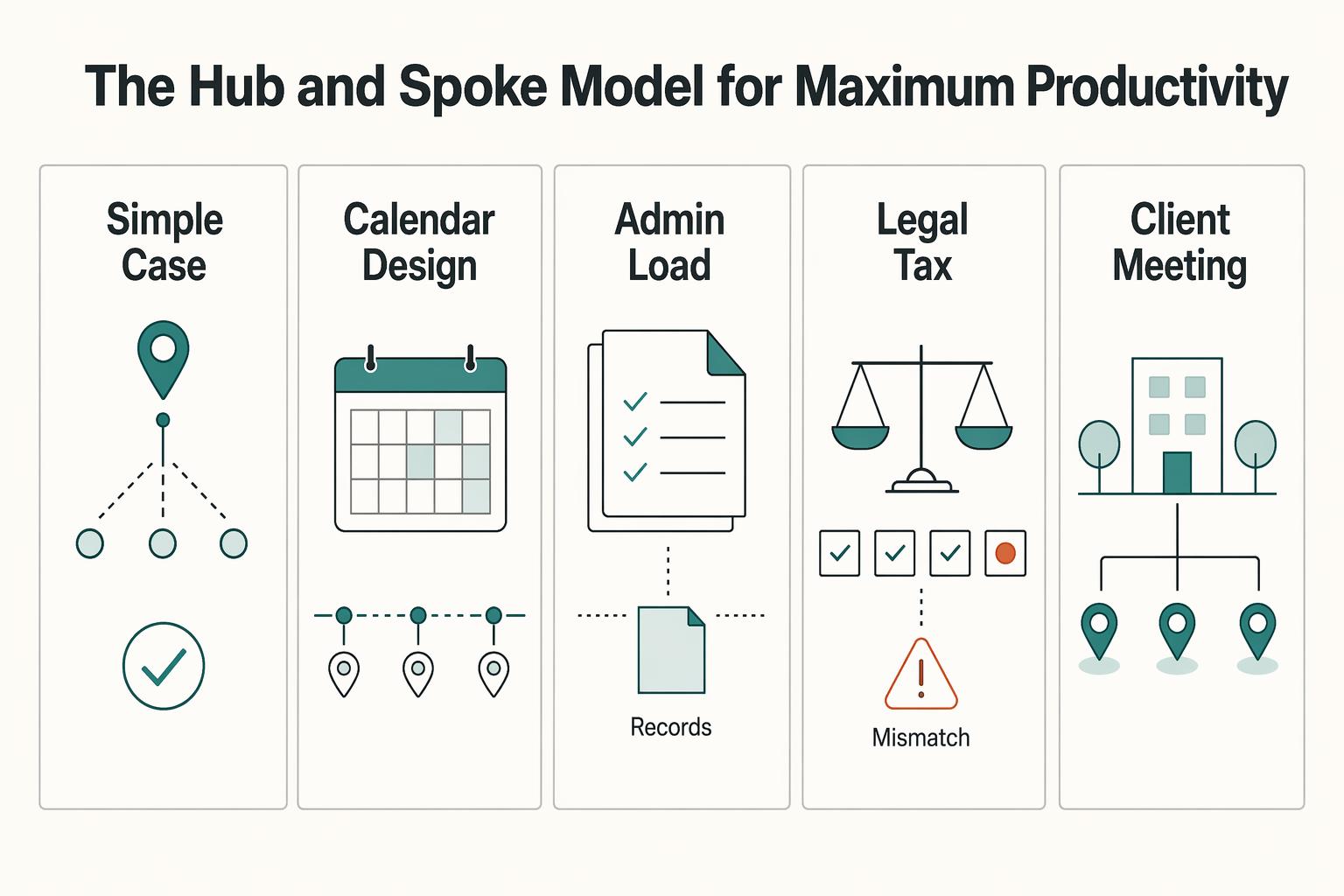
How to Architect Your Tour: The "Hub and Spoke" Model for Maximum Productivity#
Use a hub-and-spoke plan as an execution system: one stable base, then short trips with a single business purpose each. It improves planning clarity, but it is not a legal shortcut by itself.
Step 1. Pick your hub with operational criteria first. Choose the base that protects your delivery rhythm, then layer travel around it.
| Criterion | Hub inside Schengen | Hub outside Schengen | Who this fits |
|---|---|---|---|
| Weekly workflow | Simpler regional movement once you are set up | Clearer separation between base weeks and travel weeks | Inside if you want fewer moving parts during active weeks; outside if you want stricter separation |
| Calendar design | Best for dense meeting clusters in one region | Best for mixed-region calendars with explicit transitions | Inside for concentrated regional schedules; outside for split-region planning |
| Admin load | Fewer border transitions to coordinate | More transition points to manage intentionally | Inside if you want lower coordination overhead; outside if you run trips as distinct blocks |
| Legal/tax checkpoints | Verify immigration, work-status, and tax assumptions separately before relying on them | Verify immigration, work-status, and tax assumptions separately before relying on them | Anyone who wants predictable compliance workflows |
Step 2. Define each spoke before booking it. If you cannot state the trip outcome in one line, do not book yet.
| Spoke intent | Required documents to keep together | Day-tracking checkpoint |
|---|---|---|
| Client meeting block | Invite/calendar hold, contract or SOW, transport booking, accommodation invoice | Log entry and exit dates the same day route is finalized |
| Conference attendance | Registration confirmation, agenda, badge receipt, return booking | Confirm dates in your log before and after the event |
| Partner or sales visit | Meeting calendar, working notes, transport and stay records | Reconcile route changes in your log on the day they happen |
Step 3. Set return cadence, then pre-book only continuity-critical items. Decide your reset rhythm first, whether after each trip or after a cluster, then lock only what protects work continuity: hub stay, first spoke, and fixed business events. Keep low-certainty meetings flexible.
Step 4. Choose rail vs air by workday risk, not just fare.
| Decision factor | Rail | Air |
|---|---|---|
| Reliability on your specific route | Check route consistency and transfer complexity | Check connection fragility and rebooking paths |
| Disruption impact | Usually easier to keep moving through city-center networks | Missed legs can compound quickly on tight same-day plans |
| Baggage and work setup | Often easier for work gear and in-transit laptop time | Better when distance or reach time is the primary constraint |
| Meeting-day suitability | Strong when you need a smoother arrival day | Strong when timing is the non-negotiable priority |
Step 5. Use a book/no-book accommodation screen.
Must-have: confirmed internet quality, workable desk/table, check-in terms that match arrival window, invoice/receipt availability.Nice-to-have: laundry, elevator, extra monitor options, walkable transit.No-book: vague internet answers, unclear workspace evidence, ambiguous cancellation terms, unresolved access logistics.
Save the booking confirmation, address, invoice, and host messages that confirm internet/access details. Keep that file with your travel log so your compliance and expense workflows stay auditable.
This architecture helps productivity, but legal posture still needs separate controls for work status, contract setup, and tax exposure. For EU VAT admin, the checkpoints are separate: the cross-border SME path requires one prior notification in your Member State of establishment, and use starts only after the EX number is granted; the process target is 35 working days but can run longer if investigations are needed. OSS is optional, OSS returns are additional and not a replacement for domestic returns, and if you opt into a scheme you must report all supplies under that scheme through OSS.
If you want the travel-side risk clearer, see What Happens if You Overstay the Schengen 90/180 Day Rule?.
The "Work" vs. "Tourism" Tightrope: How to Stay Legal While Working Remotely#
Treat each stop as a risk screen before you travel: keep activity in a low-risk visitor pattern, and pause for country-specific advice as soon as plans look locally established or locally commercial.
Use this quick self-check before booking:
| Activity type | Why it triggers scrutiny | Safer alternative |
|---|---|---|
| Remote delivery for existing clients from your own accommodation or a neutral coworking space | Still requires country-specific permission analysis, but presents fewer local-market signals | Keep scope to existing remote delivery and keep proof of independent business activity |
| Conferences, short meetings, or partner catchups | Can drift into on-site delivery or active local selling | Attend with a clear agenda and registration trail; avoid turning the stop into local service delivery |
| Regular work from a client office | Can look like integration into a local operation | Work from your own base or neutral workspace |
| Negotiating or signing contracts on behalf of a client | Can signal authority to bind the client locally | Route binding approvals and signatures through the client's home team |
| Local marketing, local hiring, or services aimed at the local market | Looks like local labor-market/commercial participation | Stop and get country-specific immigration and tax advice before travel |
If you cannot describe a stop in one sentence without local hiring, local customer acquisition, or client-office dependence, treat it as outside the low-risk pattern.
Permanent Establishment (PE) risk is the next control point. PE tests are country- and treaty-specific, so do not rely on generic day-count folklore. Use an operator checklist:
- Contract authority limits: confirm your agreement says you are independent and do not have authority to conclude contracts or legally bind the client.
- Work location discipline: avoid routines that make you look like a fixed part of one local team.
- Continuity signals: treat repeated client-site presence or long uninterrupted country stays as escalation triggers.
- Evidence of independent setup: keep business registration, invoices, contract terms, and a dated travel/work calendar together.
- PE threshold or trigger: pending applicable treaty, local tax guidance, and source-record verification.
Keep VAT process separate from immigration permission. VAT registration mechanics do not by themselves make you immigration-compliant.
- A taxable person can request a VAT Cross Border Ruling in a participating EU country where they are VAT-registered.
- If multiple companies are involved in a CBR request, one company should file on behalf of the others.
- For the cross-border SME scheme, file one prior notification in the Member State of establishment; use starts only after an EX number is granted.
- The SME registration process should not take longer than 35 working days, but it can take longer where anti-evasion checks are required.
- The SME scheme includes one quarterly report covering turnover across 27 Member States and requires eligibility checks, including the EUR 100 000 Union turnover cap.
- OSS is optional, uses one Member State of identification, and return cadence depends on scheme type, quarterly for Union/non-Union and monthly for import.
Run your records as a trip-segment workflow so each segment can be verified quickly:
- Use a dedicated business account/card for work expenses.
- Capture and label receipts the same day by segment.
- Tag calendar blocks as client work, admin, conference, transit, or personal.
- Store segment folders with bookings, invoices, invites, registrations, and relevant contract/SOW files.
Decision trigger: if your plan includes regular client-site work, contract-signing authority, local customers, local hiring, long single-country continuity, or unresolved VAT treatment, stop and get country-specific legal and tax review before departure.
Conclusion: Take Control - Your European Tour, Your Rules#
If most of the open questions are already resolved, your next move is not more research. It is turning your cross-border operations into a recordkeeping setup you can actually maintain while moving. A workable multi-country plan runs on three things: clear eligibility checks, a proof pack that matches reality, and a filing rhythm you can keep.
| Path | Requirement | Timing |
|---|---|---|
| Cross-border SME scheme | Union turnover must not exceed EUR 100,000 in the current and previous calendar year; file one prior notification in your Member State of establishment | VAT exemption starts from the date the EX number is granted; one single quarterly report; the process should not take longer than 35 working days, but it can take longer in specific anti-evasion investigations |
| OSS | Choose your Member State of identification carefully | That choice can bind you for that year plus the next two calendar years; OSS returns by scheme cadence |
| VAT Cross-border Ruling | Can be requested for envisaged complex cross-border transactions | The request must follow the national VAT-ruling conditions in the EU country where it is introduced |
Step 1. Confirm your registration assumptions. Lock the first version of your compliance path: whether you qualify for the cross-border SME scheme, where you will register, and which scheme you will use for reporting. For the SME cross-border scheme, Union turnover must not exceed EUR 100,000 in the current and previous calendar year, and you file one prior notification in your Member State of establishment. If you use OSS, choose your Member State of identification carefully, because that choice can bind you for that year plus the next two calendar years.
Step 2. Verify activation checkpoints before treating supplies as exempt. Do not rely on old screenshots or secondhand summaries. Build your plan around official confirmations. A practical checkpoint is EX-number confirmation from the Member State of establishment, because VAT exemption under the cross-border SME scheme starts from the date that EX number is granted. Also plan buffer time: the process should not take longer than 35 working days, but it can take longer in specific anti-evasion investigations.
Step 3. Set your tracking method before day one. Use one live record for notifications, confirmations, invoices, and filing deadlines, then reconcile it on a fixed cadence. The goal is boring consistency: if someone asks for your timeline, you can show the same story across your calendar, transaction records, and filings. Keep the reporting cadence explicit in your workflow, for example one single quarterly report in the cross-border SME flow, and OSS returns by scheme cadence.
Step 4. Prepare the business proof documents now. Keep contracts, invoices, registration records, EX-number confirmations, and filing outputs in one folder structure. If VAT treatment is unclear, solve that before invoicing. A VAT Cross-border Ruling can be requested for envisaged complex cross-border transactions, and the request must follow the national VAT-ruling conditions in the EU country where it is introduced.
That is the real advantage here. You are not hoping the plan works. You are making choices you can verify, defend, and adjust with confidence.
Frequently Asked Questions
How do I track my Schengen days without making a mess of it?
Keep one live log for every entry, exit, cancellation, and route change, then reconcile it against bookings and your calendar records. If your records conflict or your route changes late, verify the current official position before you keep traveling. For a planning format, read How to Track Your Schengen Days: A Practical Guide.
What are the main business implications of a multi-country Schengen tour?
The upside is mobility. The real exposure is immigration uncertainty, VAT admin drift, and weak documentation. For VAT questions, assess whether they point to a VAT Cross-border Ruling (CBR), the cross-border SME scheme, or OSS. CBR requests are filed in the participating EU country where you are VAT-registered and must follow that country’s national VAT-ruling conditions; if multiple companies are involved, one company should submit on behalf of the others. For the cross-border SME scheme, one prior notification is filed in the Member State of establishment (MSEST), and VAT exemption starts only after the EX number is granted and confirmed for selected Member States.
Can I work remotely for non-EU clients while traveling?
Treat this as country-specific and get immigration and tax advice before working while traveling.
How do I keep the trip productive without disrupting my business?
Use a structure you can document consistently. Constant movement creates record gaps and weakens focus. Pick one stable base, batch deep work there, and make shorter trips with a defined business purpose. At the end of each segment, keep one folder that explains where you were, what work you did, and which expenses were business.
What if I think I may have overstayed?
Treat it as an immediate timeline check, not a guess. Rebuild your dates from bookings and calendar records, and verify the current official position. If you cannot reconcile the timeline quickly, get professional advice before your next border crossing.
Should I base myself inside or outside the Schengen Area?
Base choice is a tradeoff between convenience, record-keeping pressure, and the kind of work you need to do. If your base choice affects visa status, local work permissions, or VAT registration questions, get country-specific advice before committing to a long stay.
Try a related tool
Researched and edited by the Gruv editorial team. Gruv builds cross-border billing, payouts, and finance-operations software for global businesses.
Sources
Educational content only. Not legal, tax, or financial advice.
Related Posts

The 2026 Global Digital Nomad Visa Index for 50+ Countries
Start with legal fit, not lifestyle filters. The practical order is simple: choose a route you can actually document, then decide where you want to live. That single change cuts a lot of wasted comparison work and stops you from falling in love with places that were never a real filing option.
A Guide to the Schengen 90/180 Day Rule
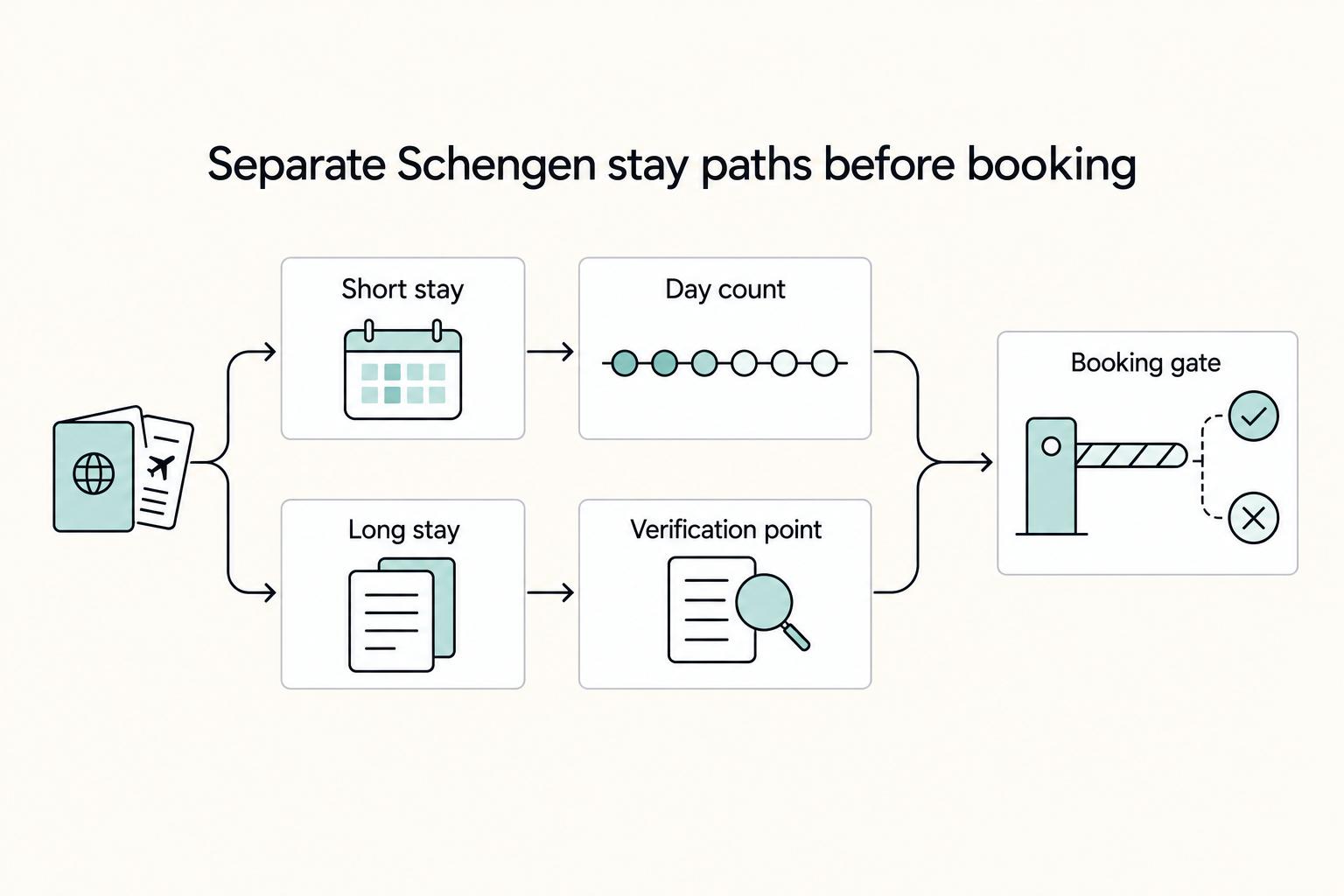
**Treat Schengen short-stay limits as an operating constraint, then run every movement decision through one repeatable system.** If you treat Europe travel like a chain of bookings, you create avoidable risk. Run it like operations, and you protect flexibility, reduce stress, and keep your visa compliance posture clean across the Schengen Area.

How to Track Your Schengen Days: A Practical Guide
**Use a repeatable weekly system to track Schengen days, validate your math, and protect your plan under the 90/180 rule before each border move.**