
Quick Answer
Choose one policy and enforce it end to end: either apply subscription downgrade proration credits during the current period or defer the lower price to renewal. Then verify where value appears (next invoice adjustment or application credit), when it becomes usable, and which event triggers entitlement changes. In Stripe and Shopify setups, most disputes come from timing drift, not arithmetic. Keep downgrade and cancellation rules separate, and do not confirm completion until billing state is durable enough for finance reconciliation.
Step 1: Define the billing event before you debate policy#
Step 1: Define the billing event before you debate policy. Downgrade proration credits sound simple: a customer moves to a cheaper plan mid-cycle, and you may credit the unused value. In practice, the hard part is usually not the math. It is deciding which subscription changes should affect the current billing cycle at all.
Stripe gives you a useful starting point: only changes that affect billable amounts for the current billing cycle create prorations. That gives you an immediate verification check. Before you ship any downgrade policy, test a few real plan edits in your stack. Confirm which ones create a proration adjustment, which ones wait until renewal, and where the credit actually appears on the bill.
Step 2: Choose the constraint you are optimizing for. A downgrade can create a credit for unused subscription value, but that is not the only valid model. Some billing setups defer the lower price to the next subscription cycle and issue no immediate credit or charge.
The tradeoff is timing. Immediate proration can feel fairer to customers who expect the cheaper plan to start now. Next-period changes avoid immediate credits or charges and reduce proration edge cases. If your biggest priority is immediate price alignment for the customer, you may accept more billing complexity. If your tighter constraint is fewer edge cases, defer the change to renewal and say that plainly in product copy and support macros.
Step 3: Keep billing and access tied to the same customer promise. This guide is for founders, revenue leaders, product teams, and finance operators who need one downgrade policy that works across proration logic, bill behavior, and entitlement timing.
The failure mode is drift. Billing state and customer-facing expectations can move out of sync. Another risk is payment failure in an immediate proration flow. Documented provider behavior shows that if payment fails, the subscription can remain unchanged. That means you should not tell a customer their downgrade is complete until your billing engine confirms the state you intend.
The practical question running through the rest of this guide is simple: where does the value from a downgrade go, when does it land, and how do you prove it later? By the end, you should be able to choose a policy that customers understand, support can defend, and finance can reconcile without billing and access drifting apart. Related: How to Handle Billing Mid-Cycle: Proration Upgrades Downgrades and Refund Logic.
What to prepare before you lock a downgrade policy#
Start with platform behavior, not policy language. Downgrade disputes usually come from mismatched assumptions about how your billing stack applies changes.
| Platform | What to confirm | Key note |
|---|---|---|
| Stripe | Which subscription item changes on downgrade and whether it affects billable amounts in the current cycle | That determines proration behavior |
| Shopify | Whether billing uses RecurringApplicationCharge | One recurring charge per app on an independent 30-day app cycle; REST Admin API is legacy as of October 1, 2024, and new public apps must use GraphQL Admin API starting April 1, 2025 |
| Caimera | How downgrade math is calculated | Based on remaining time in the current billing period |
| Polar | What happens on the failure path | Subscription updates apply only if payment succeeds |
- Inventory your billing rails and constraints.
In Stripe, confirm which subscription item changes on downgrade and whether that change affects billable amounts in the current cycle, because that determines proration behavior. In Shopify, confirm whether you use RecurringApplicationCharge (one recurring charge per app on an independent 30-day app cycle). If Shopify billing code is in scope, note the timing risk now: REST Admin API is legacy as of October 1, 2024, and new public apps must use GraphQL Admin API starting April 1, 2025. In Caimera, confirm that downgrade math is based on remaining time in the current billing period. In Polar, plan for the failure path: subscription updates apply only if payment succeeds.
- Capture the minimum decision inputs in one place.
Document your Billing cycle, customer-facing Subscription cycle, current Prorated credit behavior, and where value lands after a downgrade. In Shopify flows, that may be Application credit applied to future app charges. Then run one real or test downgrade per platform and log three outcomes: where the credit appears, when it can be redeemed, and whether it shows on the current bill or a later charge.
- Set clear ownership before launch.
Decide who owns entitlement timing, who owns invoice treatment, and who reconciles credits in Ledger journals. If access changes immediately but billing defers, you create avoidable disputes. Keep the output simple: a short decision sheet with platform behavior, owner names, and one escalation rule for exceptions. Need the full breakdown? Read Subscription Billing Platforms for Plans, Add-Ons, Coupons, and Dunning.
Pick the downgrade timing model your economics can support#
Choose downgrade timing based on the constraint that actually binds, not abstract fairness. If trust and churn pressure are highest, immediate mid-cycle handling with Prorated credit is usually the better fit; if margin predictability and operational simplicity are tighter, apply the downgrade at the next Subscription cycle renewal.
Step 1 Choose between immediate proration and renewal-time change#
| Decision point | Immediate mid-cycle downgrade with Prorated credit | Downgrade at next Subscription cycle renewal |
|---|---|---|
| Customer experience | Unused time on the higher plan can become credit value | Price change waits for the next cycle boundary |
| Cash timing | Credit can reduce a later invoice or offset future charges | Current-cycle pricing stays in place until renewal |
| Engineering shape | Billing, entitlement timing, and credit posting must stay aligned | Simpler if billing and entitlements both change at renewal |
| Credit destination | Typically appears as a future-invoice credit/adjustment path | May have no current-cycle credit, or may post as account-level credit depending on provider |
| Finance visibility | Invoice-linked credit is usually easier to trace during reconciliation | Account/application credit needs explicit tracking until consumed |
Mismatch is the main risk. If access changes now but price changes later, customers can feel shorted. If price changes now but premium access stays until cycle end, finance may accept it, but support and product inherit the inconsistency.
Step 2 Match the model to the constraint that actually matters#
Use platform precedent as proof a mechanic exists, not proof it fits your economics.
Stripe documents that downgrades can generate a credit applied to the next invoice. It also supports an immediate proration path with proration_behavior=always_invoice, and it allows a no-proration path with proration_behavior=none. Those are distinct policy shapes: credit later, invoice proration adjustments now, or no proration.
Shopify has a different pattern. The Shopify Help Center states that mid-cycle paid-app downgrades can produce Application credit that can be used for future app-related charges. Shopify developer docs also state that charges and credits can be prorated, and charges can be deferred. Supported app subscription cycles are 30-day and annual, and a new approved recurring charge replaces the existing subscription.
Step 3 Verify where the credit lands before launch#
Before you publish policy language, confirm where the value appears and when it can be redeemed.
Run one downgrade in test or on an internal account and record:
- old plan and new plan
Billing cycleandSubscription cycle- approval timestamp (if approval is required)
- resulting invoice or app charge outcome
- final credit destination (invoice-linked credit/adjustment or
Application credit)
If credit lands as account/application credit instead of reducing the current charge, state that plainly in customer-facing policy and in finance reconciliation steps.
Define credit and refund rules before you ship UI copy#
Set the money policy before you publish the button label. If your UI says "refund" but your billing behavior creates credit on a later invoice or keeps value on account, support inherits a preventable dispute.
Step 1 Set a single credit-to-refund hierarchy#
Use one ordered rule set across product, support, and finance: downgrades create a Prorated credit by default, and only named exceptions allow cash refunds. In Stripe, negative prorations are not automatically refunded, and downgrades typically create a credit applied to the next invoice. That means your default customer language should usually be credit-first.
A practical hierarchy:
- Mid-cycle downgrade creates prorated value.
- Value lands as invoice credit or account credit based on provider behavior.
- Cash refund is manual and limited to a short, pre-approved exception list.
Be explicit about destination in customer-facing copy. "Credit on your next bill" and "credit on account for future charges" are different outcomes, so verify which one actually happens before launch.
Step 2 Separate downgrade policy from cancellation policy#
Keep downgrade and cancellation rules separate in writing, even if they share a screen. Downgrade behavior can create credit, but cancellation behavior can be different, and blending them into "refund" language creates escalation risk.
Stripe's proration behavior supports this distinction. Shopify makes it even clearer for app billing: uninstall cancels the subscription, and no credit is applied for the remaining billing period. If you support both flows, support macros and UI copy should mirror that boundary exactly.
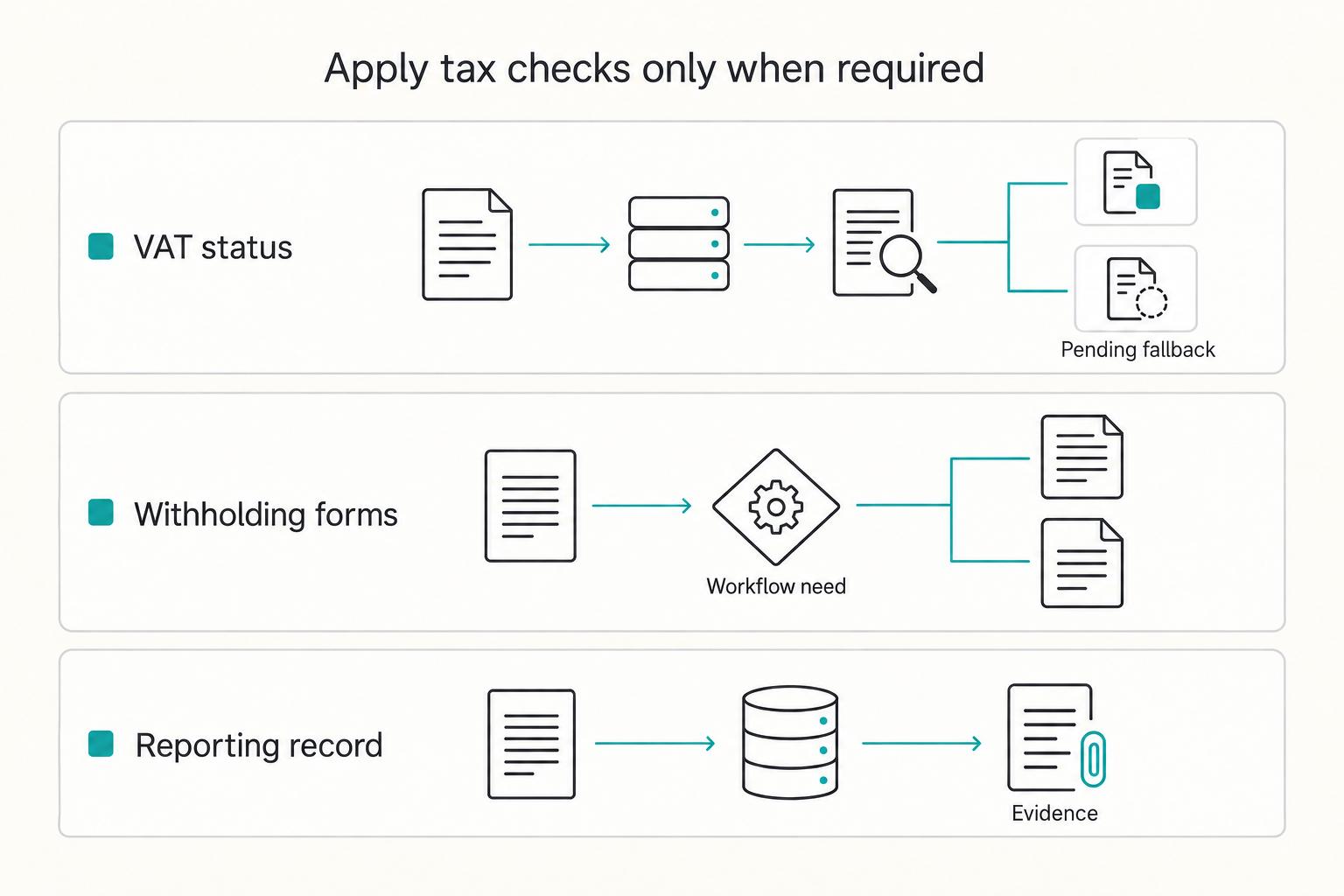
Step 3 Add tax and evidence checks before launch approval#
Add compliance checks only where your process requires them, then document them consistently. If VAT treatment depends on business status, validate through VIES and record the result; VIES can return valid/invalid status, and national-database updates may not appear immediately, so define a pending-verification fallback instead of ad hoc overrides.
| Check | Use when | Note |
|---|---|---|
| VIES | VAT treatment depends on business status | Can return valid/invalid status; national-database updates may not appear immediately |
W-9 | Your withholding or reporting workflow requires it | For correct TIN collection |
W-8 BEN | Requested by a withholding agent or payer | Collect only when that workflow requires it |
1099-NEC | Your withholding or reporting workflow requires it | To report nonemployee compensation |
For payer documentation, collect IRS forms only when your withholding or reporting workflow requires them: W-9 for correct TIN collection, W-8 BEN when requested by a withholding agent or payer, and 1099-NEC to report nonemployee compensation. These are not automatic downgrade requirements, but they should be in the evidence pack when an exception affects financial reporting.
If exceptions grow beyond a short, pre-approved list, stop launch and simplify. Exception-heavy credit logic is where reconciliation errors start.
Align billing events and entitlements so customers never lose trust#
Trust holds when billing state and access state move in a single, auditable order. If access downgrades before the billing result is durable, you create disputes; if credit posts while premium access remains, you create reconciliation noise.
Step 1 Define one enforceable order of operations#
Use one sequence in code and operations: downgrade request accepted, billing engine computes Proration, credit/debit posts, entitlements change, then confirmation is sent. Treat this as your implementation rule, not a universal provider rule.
Keep access unchanged until the billing mutation is durable enough to audit. This is especially important when your provider applies subscription updates only after successful payment, or changes plans immediately after payment succeeds. Even in downgrade flows that usually create credit, do not trigger entitlement changes from request events alone when billing can still fail, retry, or lag.
For each downgrade path, log and verify: request timestamp, billing transaction ID, entitlement-change timestamp, and customer-notice timestamp.
Step 2 Map billing events to entitlement actions and customer-visible state#
Use one shared reference for product, finance, and support:
| Billing event | Finance view | Entitlement action | Customer-visible state |
|---|---|---|---|
| Downgrade request accepted | Pending change, no posted credit yet | No access change | Downgrade requested, status pending |
| Bill updated with proration result | Proration result recorded on billing document | No access change until billing is confirmed | Bill impact shown as pending/preview |
Application credit or customer invoice balance posted | Credit transaction recorded | Move entitlement to lower tier per policy | Credit will apply to the next finalized invoice |
| Entitlement change committed | No new billing entry unless reversal is needed | Access changes to downgraded plan | New limits/features now active |
| Confirmation sent | Final bill/credit reference available | No further access change | Final notice matches effective timing |
If you use Stripe customer balance, treat it as append-only in practice: corrections are reversing transactions, not silent edits. Your internal transition log should mirror that behavior and tie entries to external billing object IDs.
Step 3 Surface mismatch states early, especially in MoR flows#
Retries and webhook lag can split billing and entitlement state. Expose clear statuses (for example: pending billing update, credit posted, downgrade complete) so support and customers can see what is happening without event forensics.
In Merchant of Record (MoR) flows, explicitly align contract, tax, and entitlement effective timing. Do not assume they align automatically. MoR scope includes tax handling and related compliance duties, so timing drift can become both a trust issue and an operational cleanup issue.
If you cannot align billing, tax, and access timing for a flow, keep the downgrade visibly pending until you can.
You might also find this useful: Subscription Billing for SaaS: How to Handle Trials Upgrades Downgrades and Annual Prepay.
Calculate and post credits in an auditable sequence#
Keep downgrade credits auditable by separating responsibilities: one authority calculates proration, and one authority posts the accounting entry.
Step 1 Use one canonical source for proration math. Use the provider preview as your calculation authority before you commit the downgrade. On Stripe, the preview path is designed for proration, and subscription updates can prorate both price and quantity changes. Store the preview inputs and returned proration result with the internal change request so support and finance can reproduce the number.
Step 2 Post once through one journal path, with idempotency. After you accept the amount, post the credit through a single service into Ledger journals. Do not let API handlers, webhooks, and admin tools each write credits independently. Use idempotency keys on provider-facing retries so repeated requests do not duplicate side effects, and persist the external object ID, idempotency key, customer ID, and internal downgrade request ID on the journal entry.
Step 3 Reconcile asynchronously when webhook data lags or arrives out of order. Assume webhook payloads can be outdated, partial, out of order, or duplicated, and account for automatic redelivery for up to three days. When UI projections and ledger state diverge, treat journaled posting state as the source of truth, show a clear pending-reconciliation status, and re-fetch provider records to resolve. Keep the last 30 days event-list window in your incident runbook for manual undelivered-event processing.
Step 4 Verify after every deployment with scenario samples. Run downgrade checks across single-plan changes, seat-only reductions, and mixed plan-plus-seat transitions. For each scenario, confirm the previewed amount, posted journal entry, provider transaction record, and customer-visible balance agree. If UI and posted credit differ, pause rollout and fix the sequence before broader traffic.
Explain invoice impact in plain language before support gets flooded#
Clear invoice expectations reduce avoidable support tickets, even when your proration math is correct.
Step 1 Name exactly where downgrade value will appear. Do not stop at "you'll receive a prorated credit." Tell customers where they should look in your setup: an Invoice adjustment, a credit on a later Billing cycle invoice, or account-level Application credit. Keep this provider-specific. For example, Stripe notes a downgrade can create a credit applied to the next invoice, and price switches do not normally change billing dates or create an immediate charge on their own.
Step 2 Separate plan-change timing from invoice timing. Say this directly before confirmation: a plan can change now while the credit appears on a later statement. A plain-language line works: "Your plan change takes effect now; any prorated credit appears based on your billing configuration."
Step 3 Use the same Subscription cycle language everywhere users can act. Downgrade and cancellation screens should use the same timing terms, or support inherits the ambiguity. Keep copy aligned to actual billing behavior, then keep it aligned over time with approved UI strings, sample invoices, and matching support macros.
Common downgrade mistakes and how to recover without revenue leakage#
Fix billing truth first, then access, then customer communication. In most downgrade incidents, leakage comes from sequencing, retries, and policy drift rather than the proration math.
| Mistake | Recovery |
|---|---|
| Entitlements change before billing confirmation | Gate plan access on billing confirmation so the subscription stays unchanged if payment fails; if access already changed too early, roll it back, recompute Proration, and republish the corrected invoice before applying new limits |
| Credits are posted twice during retries | Treat duplicate webhook delivery as normal, deduplicate by processed event ID, and require idempotency keys for retryable credit writes; if a duplicate credit is already posted, reconcile Ledger journals so one canonical credit remains tied to the original event and bill |
| Compliance controls are applied blindly in cross-border cases | Run KYC, KYB, and AML gates only where your market/program model requires them, then reissue customer-facing billing detail so the correction matches the reviewed account state |
| Credit expiration or usage terms are ambiguous across teams | Publish one finance-approved policy source for credit behavior, then sync downgrade UI copy, billing copy, and support macros to the same language |
For deeper handling patterns, read How to Handle Mid-Cycle Upgrades and Downgrades Without Double-Charging Customers.
Conclusion#
If you are shipping downgrade credits, do not treat the launch as finished when the math looks right. The real pass condition is simpler: billing, access, tax, and customer communication all resolve to the same effective date and survive retries without duplicate credits.
-
Lock your timing model. Choose either immediate proration or a next-cycle downgrade, then write that choice into product copy, support macros, and finance handling. If you use payment-gated changes, confirm your provider can hold the update until payment succeeds. Your verification point is a previewed proration amount before the change goes live, not a guessed result after the fact.
-
Define your credit policy in one place. Decide how downgrades create and apply credits, whether any cash refund is ever allowed, and how cancellation is handled separately. This is where teams create avoidable disputes, because "credit" and "refund" are often treated as if they mean the same thing. If your exception list keeps growing, stop and simplify before launch, because exception-heavy logic can make reconciliation harder.
-
Sequence billing before entitlement changes. Your order should be explicit: accept the change, compute billing impact, post the billing result, update entitlement, then send the customer notice. Do not let access change rely only on the request event when your billing stack is asynchronous. Entitlement changes should follow durable billing or entitlement signals, not assumptions. The failure mode here is trust-damaging: the customer loses features before payment or credit posting is settled.
-
Harden retries and reconciliation. Every create or update call that can post money movement should use an
Idempotency key. Reconciliation should assume duplicate and out-of-order webhooks, so fetch current object state before processing rather than trusting event order. After deployment, verify billing and ledger records with representative downgrade scenarios before broad rollout. -
Match customer language to actual invoice behavior. Tell users exactly where they will see the value: on the next bill, as account credit, or not as cash unless policy allows it. Also say whether the plan price change affects the billing date, because switching prices does not normally reset billing dates. If you calculate tax automatically, verify that the customer location inputs you depend on are present before the billing change is finalized. If your program uses
KYC,KYB,AML, orVAT validationgates, make sure they are configured where supported before the change is completed. Want to confirm what's supported for your specific country/program? Talk to Gruv.
Frequently Asked Questions
What is a subscription downgrade proration credit in plain terms?
It is the value created when a customer moves to a cheaper plan before the current billing period ends. In practice, that value often becomes a credit applied to a later bill, not cash sent back immediately.
Do downgrade credits become cash refunds or only future invoice credits?
Usually, they stay as future credits unless your policy says otherwise. Stripe’s documented behavior is that a downgrade generates a credit applied to the next bill, and negative prorations are not automatically refunded. If you issue a credit note, the outcome also depends on bill state. For an open one it reduces the amount due, while for a paid one the value can go to customer balance or be refunded outside Stripe.
Why did my downgrade happen now but the credit appears on a later invoice?
The plan change date and the billing document date do not always match. Stripe supports downgrade value landing on the next bill, and Shopify notes that app charges can run on a separate 30-day billing cycle, so the visible charge or credit can show up later than the in-product change. Your checkpoint is simple: confirm the effective downgrade timestamp matches the credit reference and the next billing document, not just the UI state.
How should we calculate credits when seat count and plan tier change together?
Treat price and quantity as one change event with one effective timestamp. Both are proration triggers, and if you change a subscription item’s price without explicitly sending quantity, Stripe can set quantity to 1 by default, which can distort the math. A possible failure mode is expecting a 20-seat downgrade credit while billing recalculates as a 1-seat change.
Can a downgrade create a negative or offsetting balance, and is that acceptable?
Yes. In Stripe, credits are negative values that reduce what the customer owes on the next bill, so an offsetting balance is normal and not inherently an accounting error. What matters is that the balance is tied to an auditable ledger entry and not treated as an undocumented support concession.
Should we apply downgrades immediately or only at the next renewal date?
Use immediate proration when you want the adjustment recognized during the current period. If you want to avoid mid-cycle proration charges or credits, schedule the downgrade for renewal. Some platforms support exactly that model, where the new plan simply takes effect on renewal with no proration credits or charges.
What records should finance keep to defend proration decisions in audits?
Keep the immutable transaction trail, not just screenshots. At minimum, save the original downgrade request time, old and new plan or seat values, effective date, resulting bill or credit note reference, customer balance or ledger transaction ID, and the customer notice that explained where the credit would land. That matters because customer-balance adjustments are ledger-based and auditable, and after creation you should preserve history rather than editing it in place.
Try a related tool
Researched and edited by the Gruv editorial team. Gruv builds cross-border billing, payouts, and finance-operations software for global businesses.
Sources
Includes 1 external source outside the trusted-domain allowlist.
- docs.stripe.com/billing/subscriptions/prorationstrusted
- docs.stripe.com/api/subscriptions/updatetrusted
- ecfr.gov/current/title-31/subtitle-B/chapter-X/part-1...trusted
- europa.eu/youreurope/business/taxation/vat/check-vat-n...trusted
- irs.gov/forms-pubs/about-form-w-9trusted
- irs.gov/forms-pubs/about-form-w-8-bentrusted
- stripe.com/resources/more/merchant-of-recordtrusted
- help.shopify.com/en/manual/your-account/manage-billing/billin...external
Educational content only. Not legal, tax, or financial advice.
Related Posts
How to Handle Mid-Cycle Upgrades and Downgrades Without Double-Charging Customers
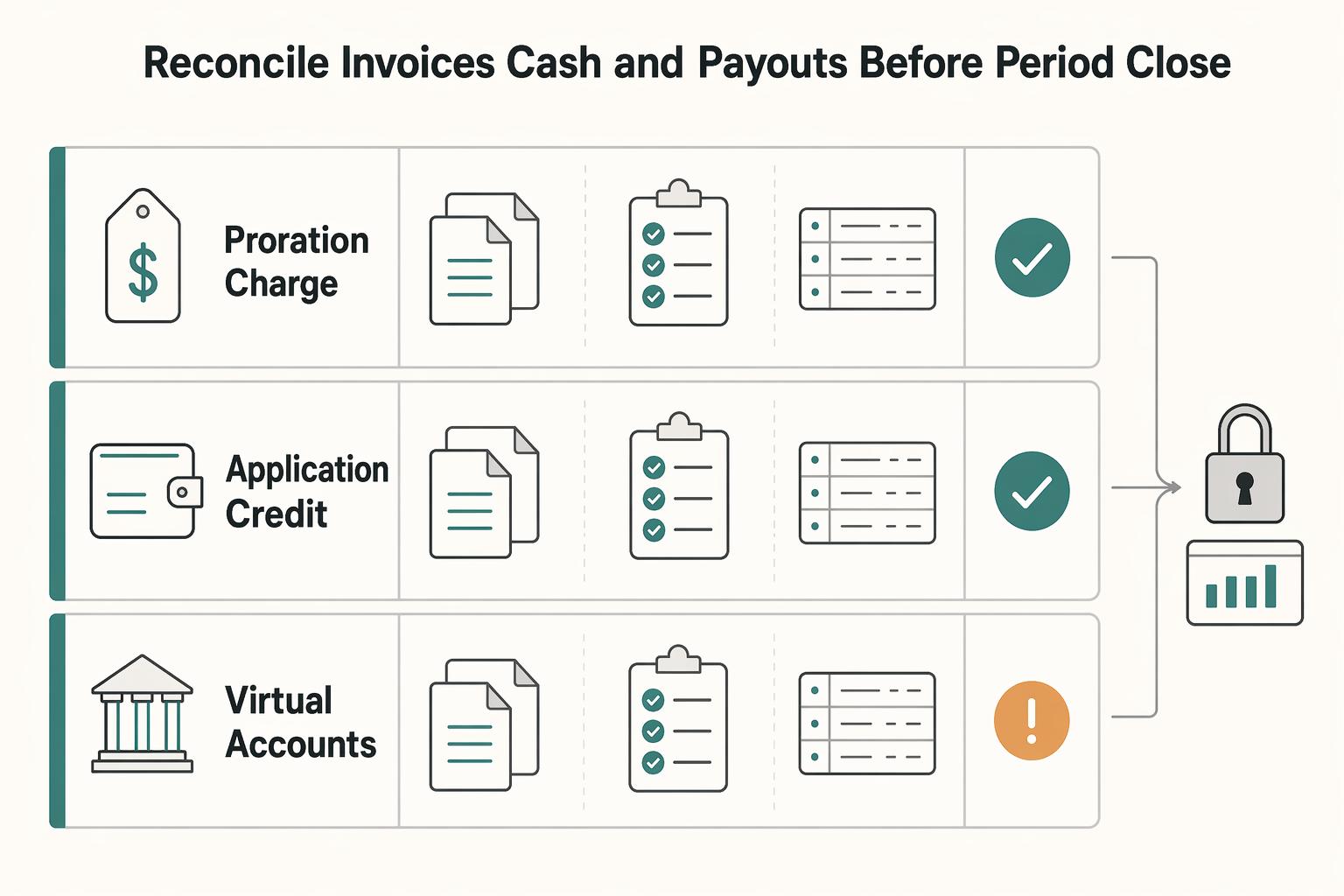
Mid-cycle upgrades, downgrades, and prorated billing stay clean when you pick one timing model and follow it all the way through. The hard part is not the arithmetic. It is choosing one control path for invoice timing, event handling, and customer communication, then using it consistently enough that one plan change does not turn into two charges or a charge plus a stray credit.
Billing Mid-Cycle Proration Upgrade Downgrade Refund Logic
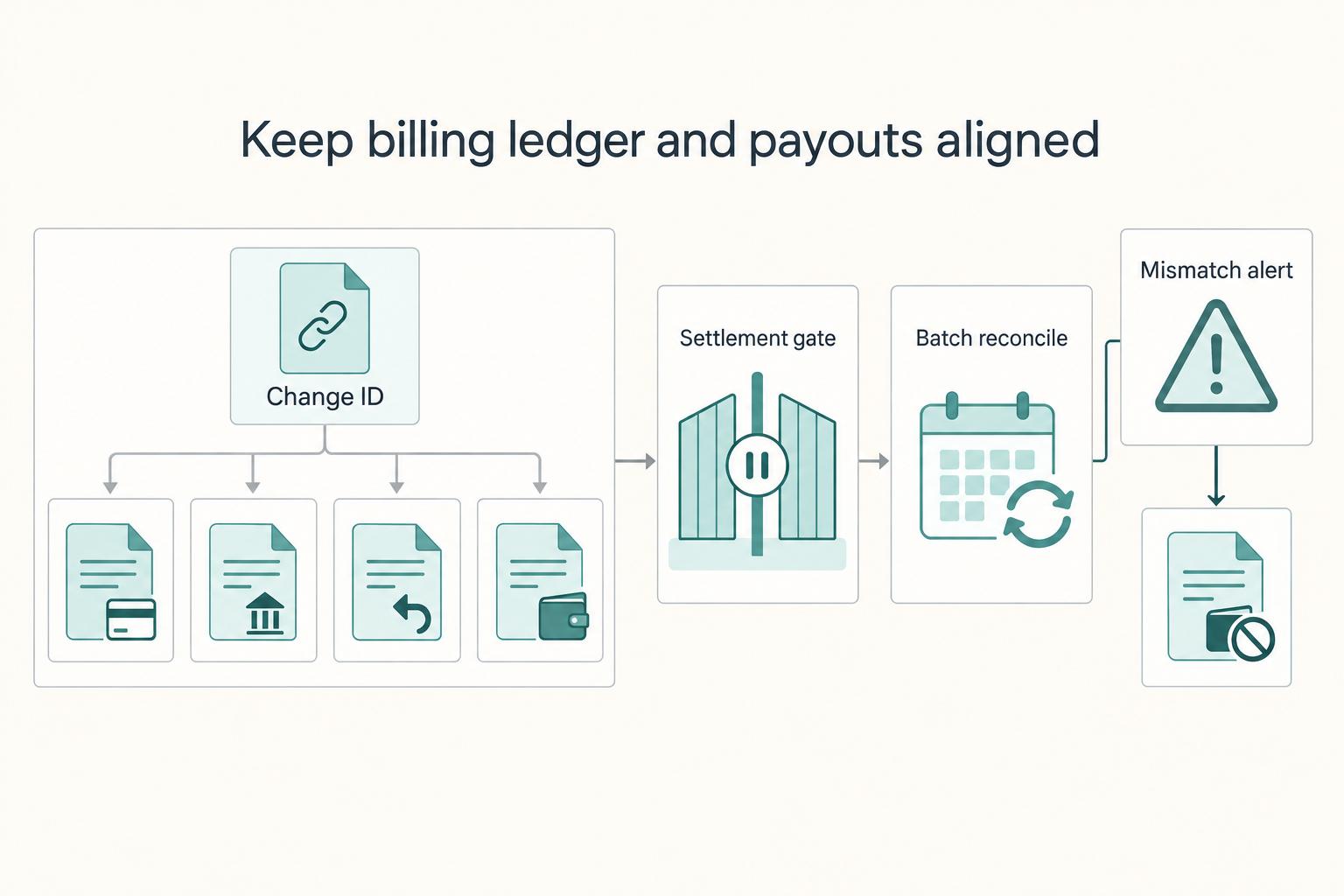
You need one written decision model for every **Mid-Cycle Plan Change**. Without it, product can optimize for customer experience, finance can optimize for revenue timing, and engineering can optimize for whatever the billing stack does first. That is how mid-cycle billing turns into case-by-case judgment calls instead of a repeatable policy.
Subscription Billing for SaaS Teams Handling Trials and Plan Changes
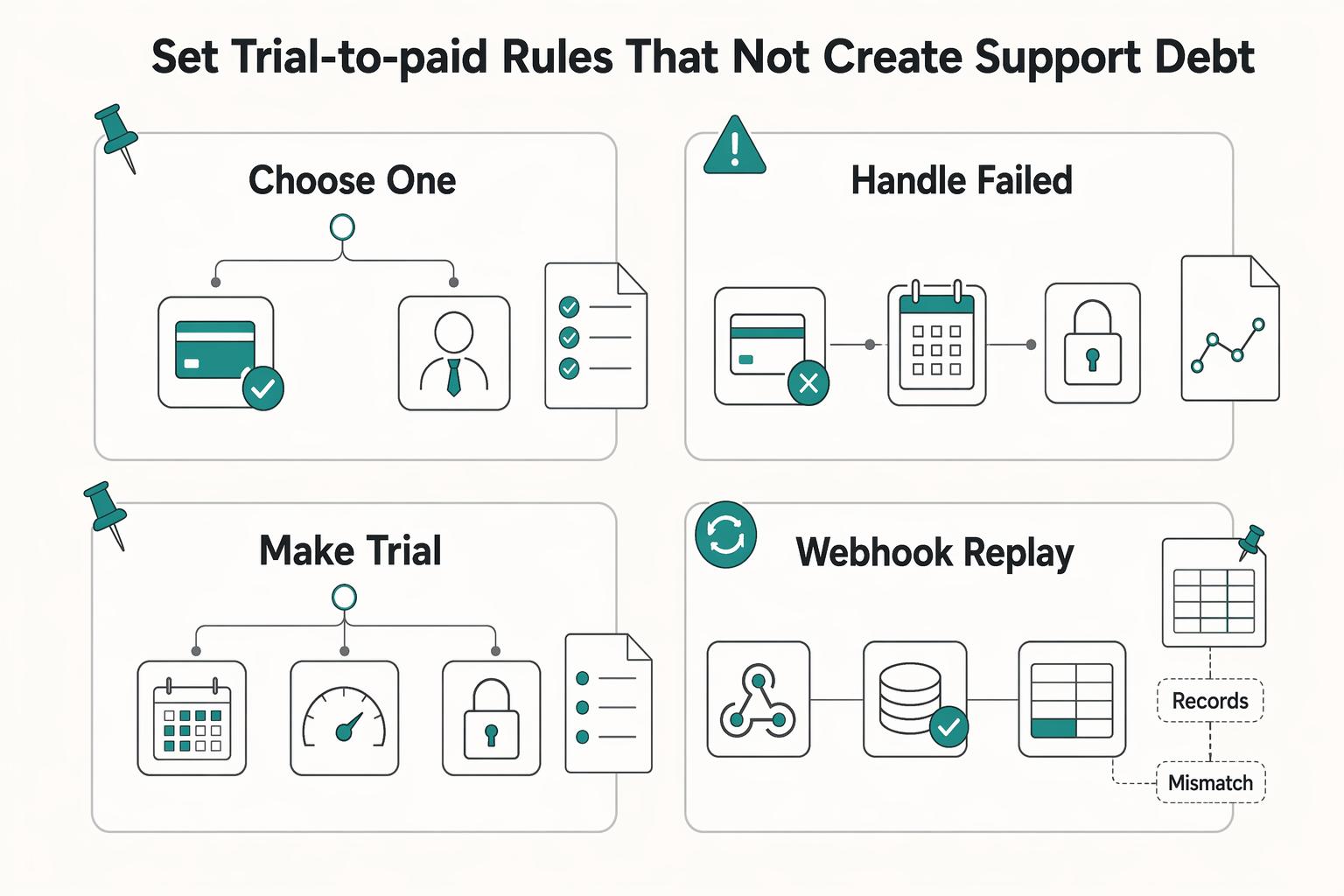
Treat subscription changes as an operating decision first, not a pricing page edit. The moment a customer upgrades mid-cycle, adds services, or switches to annual prepay, you are coordinating product access, invoicing, and accounting at the same time.