
Quick Answer
Yes. Start with one written policy, then execute every change in the same order: calculate unused old-plan value, calculate the new-plan partial amount, net the result, and post a single Subscription Invoice outcome. Treat downgrade negatives as account credit by default, and allow cash return only through an approved exception path. Before launch, run one upgrade and one downgrade test and confirm request ID, invoice ID, and ledger posting all tie to the same final amount.
Why Mid-Cycle Billing Goes Wrong Without One Policy#
You need one written decision model for every Mid-Cycle Plan Change. Without it, product can optimize for customer experience, finance can optimize for revenue timing, and engineering can optimize for whatever the billing stack does first. That is how mid-cycle billing turns into case-by-case judgment calls instead of a repeatable policy.
Step 1 Write one rule set that every team uses#
A plan change workflow is the set of steps a customer takes to upgrade or downgrade inside your product. If that workflow is loose, the math can still be right while the experience still fails. You see it when a customer asks why they were charged, credited, or not refunded, and support has to piece together an answer from invoice fragments.
The goal is not just a correct calculation. You need one source of truth for both the number and the explanation. A simple checkpoint is this: if two support agents would explain the same invoice differently, your policy is not ready. That inconsistency creates trust problems before it creates accounting ones.
Step 2 Decide which conflict wins when tradeoffs appear#
Mid-cycle billing usually breaks when four priorities pull in different directions. In most teams, those are:
- customer fairness
- revenue timing
- support load
- reconciliation accuracy
You usually cannot maximize all four at once. Immediate Prorated Billing may feel fairer on an upgrade because access changes right away, but it can also create more support questions and more invoice activity to reconcile. Deferring a downgrade to renewal may reduce confusion, but some customers will expect the value change now, not later.
That tension gets sharper around cycle boundaries. A common operator question in Shopify communities is how to preserve a 30 day interval when a customer upgrades 20 days into the cycle, while still keeping the original end date after the remaining 10 days. If your team has not decided that rule in advance, each exception ticket can become a policy debate.
Step 3 Set scope before tooling choices narrow your options#
Your policy needs to cover more than upgrades and downgrades. Set scope now for cancellations, Subscription Credit, Credit Balance, and Cash Refund outcomes. A negative mid-cycle result does not, by itself, tell you how settlement should happen. You still need an explicit rule for whether the value stays as account credit or returns as cash.
A useful checkpoint here is a one-page decision tree that names the default result for each change type and who can approve an exception. Include the customer-facing wording too. Poorly designed plan change workflows can increase frustration and churn risk, while clear handling of billing and account changes helps build trust. The rest of this guide uses that single policy lens so you can configure billing tools to match it instead of inventing rules after invoices are already out.
If you want a deeper dive, read Subscription Billing for SaaS: How to Handle Trials Upgrades Downgrades and Annual Prepay.
Set the Policy Decisions Before You Touch Configuration#
Write the policy first, then configure tools to match it. If you configure Stripe Billing or Recurly first, default behavior becomes policy by accident.
Step 1 Lock the four defaults in writing#
For each Mid-Cycle Plan Change, publish one shared table with the four defaults below so support, finance, and engineering use the same rule set.
| Default | What to decide |
|---|---|
| Effective date | When the change takes effect in the billing cycle |
| Proration method | How charges are adjusted to service actually used |
| Settlement path | Whether value is applied as credit or returned as cash |
| Customer message | The exact explanation customers see |
Be explicit about fee assumptions in that same policy. If you model with Stripe Standard domestic card pricing (2.9% + 30¢), or with Stripe Connect "you handle pricing" ($2 per monthly active account and 0.25% + 25¢ per payout), state whether proration is calculated on gross plan value or net of those costs. If Managed Payments applies, note that its 3.5% fee is additive to standard processing fees.
Step 2 Choose the money source of truth#
Define one primary system of record for money movement between each Subscription Invoice and ledger posting, then route reporting and support explanations back to that record. Treat derived balances as projections until they reconcile to the invoice and ledger entry.
Use a practical check before launch: validate one upgrade and one downgrade where request ID, invoice ID, and ledger posting all resolve to the same net result.
Step 3 Assign owners and keep config from overruling policy#
Set ownership boundaries in writing: product for customer-facing policy, finance for reconciliation controls, and engineering for idempotent execution. That split is an operating choice, but it prevents support copy, invoice math, and retry behavior from drifting apart.
If tooling behavior conflicts with written policy in Stripe Billing or Recurly, update configuration before launch. Recurly notes that non-proration alternatives can overcharge customers or leave money on the table. If you want a quick next step, try the free invoice generator.
Prepare the Inputs and Evidence Your Team Needs#
Define your input pack and evidence pack before launch, or mid-cycle changes will become hard to explain and harder to reconcile.
Step 1 Gather the approved source inputs#
Use one current plan catalog as the source of truth, not screenshots or memory. For each active plan, keep the plan name or code, billing period rule, price, effective-date rule, and the exact refund policy text your team is allowed to send. Keep two distinct message templates: one for Subscription Credit (stays on account) and one for a Cash Refund (returns through the payment path).
Version these inputs with an approval date and owner so you can prove what policy and wording applied when the request was processed. Before launch, test one upgrade and one downgrade and confirm a reviewer can answer: what changed, when it takes effect, and which customer message should go out.
Step 2 Build the evidence pack before you need it#
For each mid-cycle request, keep a minimum evidence pack that connects the request, invoice, and ledger outcome. At minimum, store:
| Evidence item | What to store |
|---|---|
| Request reference | request ID and account or subscription reference |
| Provider and invoice IDs | provider reference and invoice ID |
| Human-friendly invoice ID | human-friendly invoice ID (if available) |
| Invoice status and dates | invoice state and lifecycle dates (finalized, issued, due, paid) |
| Ledger linkage | linked ledger entry IDs |
| Adjustment records | any Credit Note or other adjustment records |
This standard matters because raw billing exports may not map cleanly to decision-grade revenue views. A reviewer who was not part of the change should be able to reconstruct the net result from the evidence pack alone.
Step 3 Add compliance and tax fields for exception handling#
If billing changes can affect downstream payouts or withdrawals, track exception statuses for KYC, KYB, and AML in structured fields so teams can decide whether billing proceeds while payout actions are paused or escalated. Do not leave this in chat or free-text notes.
Apply the same structure to tax and jurisdiction data your ops team may need later, including country or tax jurisdiction and VAT Validation, W-8, and W-9 status where your product supports those fields. For a step-by-step walkthrough, see How to Check the Status of Your Federal Tax Refund.
Choose Effective Timing Now or at Renewal#
Choose one default timing policy and keep exceptions narrow: use immediate proration when access changes now, and defer complex downgrades to renewal when mid-cycle adjustments create avoidable operational overhead.
Step 1 Set one timing default your team can enforce#
Use this as an internal operating rule, not a vendor-mandated standard. The goal is consistent execution across support, finance, and engineering.
| Timing option | Customer fairness | Support burden | Reconciliation complexity | Best fit |
|---|---|---|---|---|
| Immediate proration | Strong when access or value changes right away | Higher, because you must explain partial-period charges or credits | Higher, because you introduce extra invoice activity inside the cycle | Upgrades, seat increases, feature unlocks, usage-tier jumps |
| Defer to renewal | Strong when access does not materially change until next cycle | Lower, because the customer sees one clean change at renewal | Lower, because changes land on the normal renewal event | Downgrades, plan simplification, cases requiring manual review |
Avoid "case by case" as the default. Map each change type to one timing rule, one exception owner, and one approved customer message.
Step 2 Include fee mechanics in the timing decision#
Timing is not only a UX choice; it can also change transaction cost. Stripe's standard pricing states no setup, monthly, or hidden fees, and lists 2.9% + 30¢ per successful transaction for domestic cards. If immediate proration creates an extra successful charge, that is an extra billable transaction event.
| Pricing model | Listed fees | Article note |
|---|---|---|
| Stripe standard pricing | 2.9% + 30¢ per successful transaction for domestic cards | No setup, monthly, or hidden fees; an extra mid-cycle charge is an extra billable transaction event |
| Managed Payments | 3.5% per successful transaction | In addition to standard Stripe processing fees; additional mid-cycle charges can stack standard processing with the Managed Payments layer |
| Connect (you handle pricing) | $2 per monthly active account and 0.25% + 25¢ per payout sent | Active account means one active in months where payouts are sent; part of the cost model when plan changes affect payout activity |
If you use Managed Payments, Stripe support states a 3.5% fee per successful transaction, and that fee is in addition to standard Stripe processing fees. In practice, additional mid-cycle charges can stack standard processing with the Managed Payments layer.
For Connect setups where you handle pricing, Stripe lists $2 per monthly active account and 0.25% + 25¢ per payout sent, and defines an active account as one active in months where payouts are sent. That does not dictate timing policy by itself, but it should be part of the cost model when plan changes affect payout activity.
Step 3 Add a pre-launch finance check for both paths#
Before rollout, run two controlled tests: one immediate-change scenario and one deferred-change scenario. Finance should be able to tie the billing artifacts for each test to the expected accounting outcome using your standard records.
Use a hard go-live gate: if either path still requires ad hoc explanation to reconcile, the timing policy is not production-ready.
Related reading: How to Get a Refund of Over-Withheld US Taxes as a Foreigner.
Calculate and Post Net Proration in the Correct Order#
Set one internal posting order and use it every time: calculate unused old-plan value, calculate the new-plan prorated amount for the same period, net them, then post the result to the Subscription Invoice. This keeps support, finance, and engineering working from one approved calculation.
Step 1 Compute the net before posting#
Treat the invoice as the output, not the calculator. First calculate the remaining value on the old plan, then the prorated amount on the new plan, and only then compute the net result.
If your tooling creates multiple artifacts, keep one approved net calculation as the source of truth and attach the effective date, request ID, and approver. If two reviewers get different signs or dates for the same change, pause posting and fix the policy math first.
Step 2 Post one explicit outcome#
Once net is final, post it as a single clear billing outcome under your policy. A positive net is a charge event; a negative net should follow your documented credit or refund path.
Cost impact matters here. Stripe pricing lists 2.9% + 30¢ per successful domestic card transaction, and Managed Payments adds 3.5% per successful transaction on top of standard processing fees. Splitting one net outcome into multiple successful charges can increase transaction cost.
Step 3 Keep records traceable end to end#
Define traceability rules so one mid-cycle change can be followed from calculation to final billing outcome without log forensics. At minimum, confirm the posted total matches approved net math, billing status is final before customer messaging, and ledger entries are complete and tied to the billing artifact IDs.
A common failure mode is that billing updates but ledger linkage lags. That creates avoidable month-end cleanup and dispute risk. For a deeper mechanics pass, see this related guide.
Decide Credit Balance or Cash Refund With Explicit Rules#
Set one default and apply it consistently: treat downgrade or cancellation negatives as Subscription Credit in Customer Balance, and use Cash Refund only when an approved exception applies.
Step 1 Set the default in customer-facing and internal policy. Use plain language: "Downgrade or cancel credits are usually applied to future invoices. Cash refunds are handled separately under our refund policy." Then enforce the same rule in billing operations so the Subscription Invoice and ledger show an actual credit entry before support messages the customer.
Step 2 Define refund exceptions as approvals, not ad hoc decisions. Use one exception rule: approve cash out when there is a clear legal obligation or a documented retention decision; otherwise keep value in Credit Balance for future invoices. Require an approval pack with request ID, invoice ID, original charge/provider reference, refund amount, full vs partial flag, and reason code.
Step 3 Use Stripe tools for execution, not policy. Decide credit vs refund before anyone uses Stripe Dashboard or the Stripe API. For refunds, verify linked prior charges and approved amounts in your own records first, especially if one subscription term maps to multiple historical charges. Exact Stripe partial-refund steps are not defined here, so document those only after validating your current Stripe configuration and docs.
Step 4 Keep customer messaging aligned with posted artifacts. Give support two approved outcomes: "credit applied to a future invoice" or "cash refund approved and processing." Do not promise automatic cash return when the system posted Subscription Credit.
If you run on Connect, review the commercial model while setting exception volume: Stripe distinguishes "Stripe handles pricing" and "You handle pricing," and Managed Payments adds 3.5% per successful transaction on top of standard processing fees, calculated on the full transaction amount including indirect taxes.
Implement Controls Across Billing, Ledger, and Payout Surfaces#
After you choose credit first or cash refund, focus on control: each change request should resolve to one billing outcome, one ledger outcome, and one payout decision. If those surfaces drift, mid-cycle changes turn into reconciliation debt.
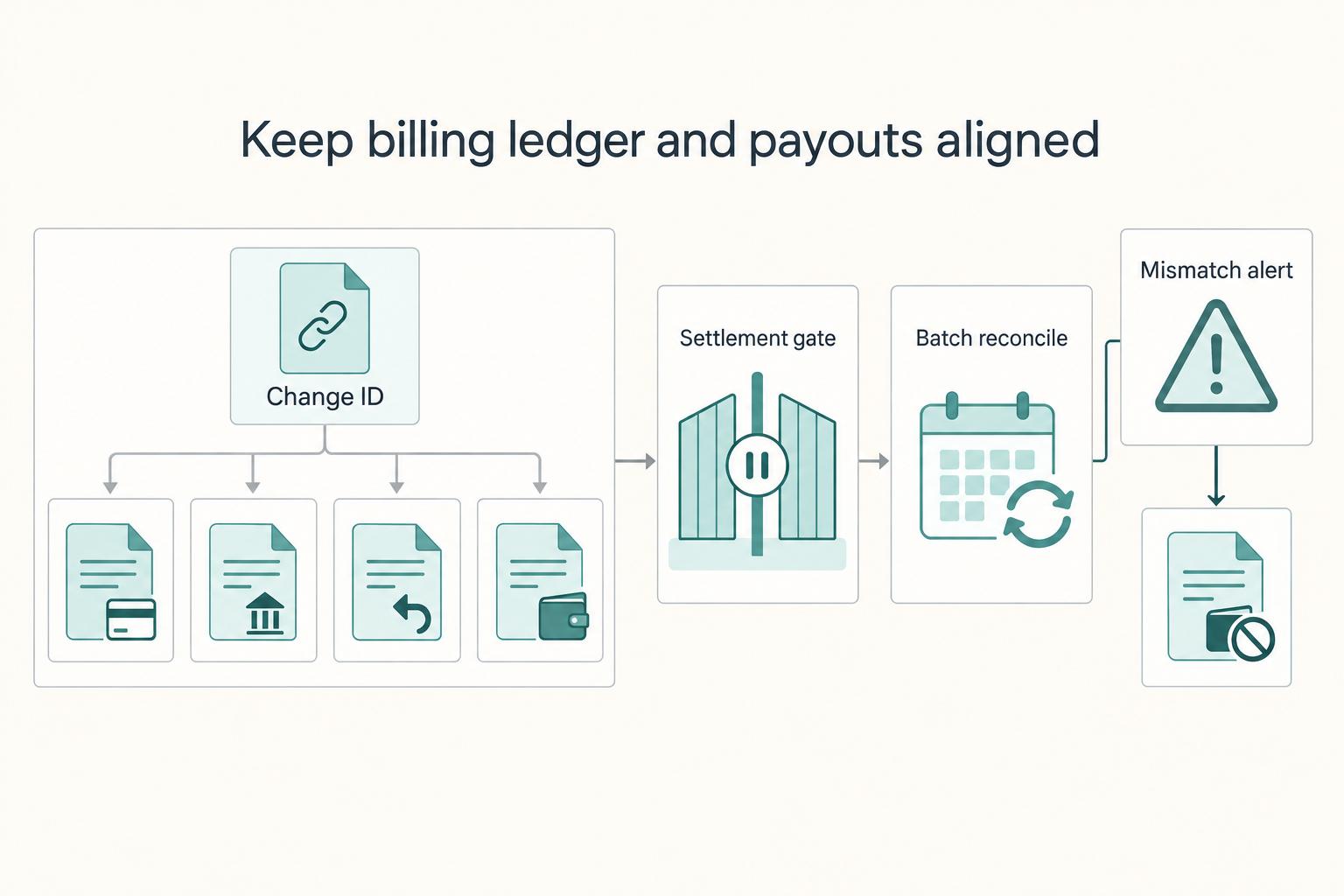
Step 1 Assign one immutable change ID and reuse it on retries. Create one request ID for every upgrade, downgrade, cancellation, or refund before it touches Stripe Billing, your ledger, or payout logic. On retry, reuse that same ID and check whether the intended Subscription Invoice result, Customer Balance movement, or credit artifact already exists. The control target is simple: one request ID maps to one billing outcome and one journal effect.
This becomes essential at scale. Manual processes that worked with a handful of customers often break when operations grow to hundreds or thousands of accounts, especially during timeouts or support handoffs.
Step 2 Gate settlement actions through your operating model. Do not release withdrawals or settlements from stale billing state when an adjustment changes who is owed money. Define your Merchant of Record (MoR) boundary clearly, including how much billing logic lives in your app versus vendor workflows, and make payout release use the same status fields billing and finance use.
In practice, check the latest invoice outcome, whether credit is sitting in Customer Balance, and whether an approved cash refund is still pending. This can slow release, but unclear billing rules make downstream cost more expensive.
Step 3 Reconcile adjustments before releasing Payout Batches. For marketplace flows, hold Payout Batches until mid-cycle adjustments reconcile across billing artifacts and ledger entries. A credit posted in billing without a matching ledger entry, or a refund approval without the billing artifact, is enough to pause a batch. If you use Virtual Accounts or another settlement layer, document whether payout release depends on settlement confirmation and who can approve exceptions.
Use an unresolved-adjustments report tied to each batch. If it is not empty, either hold the batch or record explicit approval with request IDs, invoice IDs, batch ID, and reason.
Step 4 Alert on cross-system mismatches, not only hard failures. Monitor for divergence between invoice status, Customer Balance, ledger posting, and payout state transitions, not just outright errors. Investigation data should include request ID, invoice ID, ledger journal reference, payout batch reference (if any), and current MoR or settlement status.
Operational rule: if billing shows credit but payouts still treat funds as fully withdrawable, stop release first and investigate second. For duplicate-change edge cases, see How to Handle Mid-Cycle Upgrades and Downgrades Without Double-Charging Customers.
Related: Recurring Billing for Marketplaces: How to Charge Buyers and Pay Sellers on the Same Cycle.
Recover From Common Mid-Cycle Failures Fast#
Recover faster by stopping retries first, then proving one consistent outcome across billing, ledger, and payout before you act again.
| Failure case | First action | Resolution check |
|---|---|---|
| Double charge after an upgrade | Pause retries for that request ID and confirm which Subscription Invoice is the valid one | Close when the customer sees one corrected total and one clear invoice story |
| Refund promised but not executed | Verify the refund record against the original charge and approved amount, then confirm the final status before touching residual Credit Balance or Customer Balance | Close when the refund evidence and customer message match the same corrected outcome |
| Stale compliance state before payout retry | Re-check the account's current compliance state and any active merchant notices, including PCI DSS requirements where applicable, before retrying payout | Close when billing correction and compliance status both show clear release conditions in your operating flow |
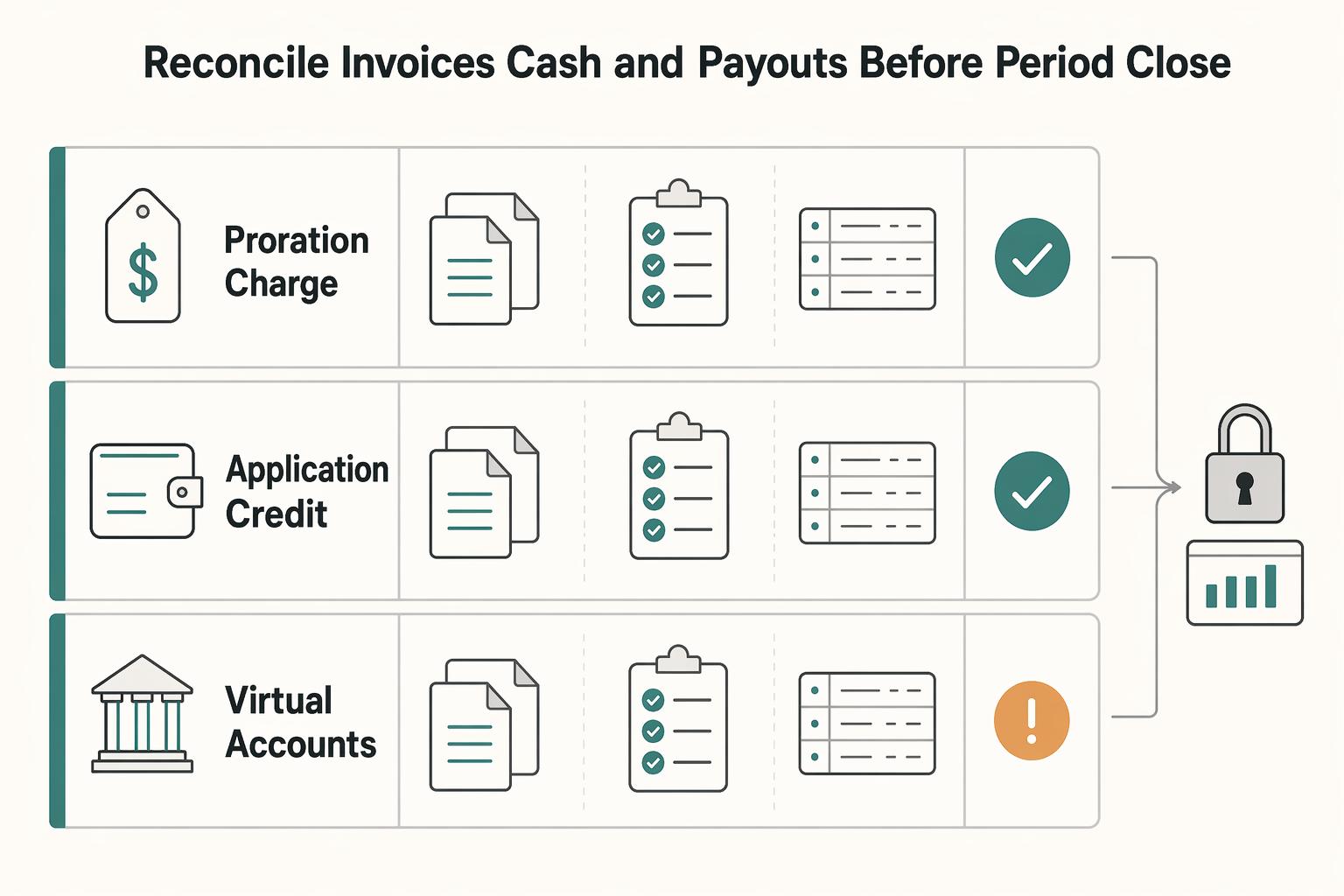
| Month-end reconciliation gaps | Reconcile each adjusted Subscription Invoice line to its ledger posting and related correction artifact before period close | If any adjusted line is still unmatched, hold close or record an explicit exception with the linked IDs |
Double charge after an upgrade: Pause retries for that request ID, confirm which Subscription Invoice is the valid one, then apply your approved correction artifact to the duplicate path only. Close when the customer sees one corrected total and one clear invoice story.
Refund promised but not executed: Verify the refund record against the original charge and approved amount, then confirm the final status before touching residual Credit Balance or Customer Balance. Close when the refund evidence and customer message match the same corrected outcome.
Stale compliance state before payout retry: Re-check the account's current compliance state and any active merchant notices, including PCI DSS requirements where applicable, before retrying payout. Close when billing correction and compliance status both show clear release conditions in your operating flow.
Month-end reconciliation gaps: Reconcile each adjusted Subscription Invoice line to its ledger posting and related correction artifact before period close. If any adjusted line is still unmatched, hold close or record an explicit exception with the linked IDs.
Copy and Use This Mid-Cycle Billing Checklist#
Use this as a release gate: each plan-change request should produce one billing outcome your support team can explain and your finance team can verify.
- Confirm policy defaults in writing.
Decide and publish the same rules across product copy, support macros, and billing settings: when changes take effect, how proration works, how negative amounts are handled (credit vs cash refund), and the exact customer message. A grounded pattern is immediate plan-change effect, unchanged renewal date, prorated upgrades, and downgrade differences kept as in-house credit for future invoices.
- Verify your execution sequence and proof points.
Use one internal sequence for every change and validate the result each time: calculate unused old-plan value, calculate remaining-term new-plan charge, net the result, then confirm the invoice artifact and balance movement match. If you use a Subscription Invoice, verify status and line items tell one coherent story.
- Validate refund handling against your published policy.
Default to Credit Balance only when that is your stated policy, and treat Cash Refund as an exception with clear ownership and triggers. Avoid support language that says "refund" when the system is actually issuing future-use credit.
- Reconcile before close, especially for exceptions.
Tie each request to its invoice artifact, any credit record (including Credit Note if you use one), and the resulting balance or payout impact. Also confirm renewal behavior after payment failure: auto-renew may be default, and a failed renewal can include a seven-day grace period with continued access.
- Ship only after full-path testing matches policy and money movement.
Test upgrade, downgrade, and cancellation paths end to end, then verify customer messaging, invoice outcome, credit behavior, and reconciliation trail for each. Include an edge case where access changes immediately while renewal date stays the same.
Frequently Asked Questions
What is mid-cycle proration for upgrades and downgrades?
Prorated billing means you adjust charges so the customer pays only for the portion of the billing period actually used. In practice, proration lets you change a contract during the current cycle instead of waiting for renewal. A simple version is: Prorated Charge = (Full Period Price ÷ Days in Billing Cycle) × Days Used. Using the example math, a $90 monthly plan over 30 days with 21 days of use comes to $63 for that period.
Do customers get a refund or a credit after a downgrade?
This guide covers proration mechanics, but it does not establish a universal downgrade outcome for cash refunds versus account credits. In practice, that decision depends on your policy and billing setup, so the customer message should clearly state what happens in your flow.
Should we apply plan changes immediately or at renewal?
Proration is commonly used to adjust charges when a contract changes during the current cycle instead of waiting for renewal. Beyond that, this guide does not prescribe one timing rule for every case, so your policy should stay consistent and easy to follow. If your plan change workflow is hard to follow, the result can be frustration, churn, and negative brand perception.
Can we invoice the net amount right away?
The sources here explain proration concepts and math, but they do not establish a universal rule for immediate net invoicing. Whether to invoice immediately or at renewal depends on your billing product and internal policy.
What is the minimum audit trail we should keep?
Do not assume a universal legal minimum applies. Treat audit-trail requirements as an internal policy decision and define them explicitly in your billing and accounting process.
How do we avoid double charges during retries?
Retry controls and idempotency standards are not spelled out here. To avoid double charges, define internal safeguards and verification steps in your own billing workflow.
Try a related tool
Researched and edited by the Gruv editorial team. Gruv builds cross-border billing, payouts, and finance-operations software for global businesses.
Sources
- congress.gov/114/plaws/publ113/PLAW-114publ113.htmtrusted
- docs.stripe.com/global-payouts/pricingtrusted
- fcc.gov/sites/default/files/Data-Cap-Complaints-Reda...trusted
- ncleg.gov/statutes/generalstatutes/html/bychapter/chap...trusted
- sec.gov/Archives/edgar/data/1668010/0001144204160898...trusted
- sec.gov/Archives/edgar/data/2062583/0001628280260128...trusted
- stripe.com/connect/pricingtrusted
- stripe.com/pricingtrusted
Educational content only. Not legal, tax, or financial advice.
Related Posts
How to Handle Mid-Cycle Upgrades and Downgrades Without Double-Charging Customers
Mid-cycle upgrades, downgrades, and prorated billing stay clean when you pick one timing model and follow it all the way through. The hard part is not the arithmetic. It is choosing one control path for invoice timing, event handling, and customer communication, then using it consistently enough that one plan change does not turn into two charges or a charge plus a stray credit.
Subscription Billing for SaaS Teams Handling Trials and Plan Changes
Treat subscription changes as an operating decision first, not a pricing page edit. The moment a customer upgrades mid-cycle, adds services, or switches to annual prepay, you are coordinating product access, invoicing, and accounting at the same time.
Recurring Billing for Marketplaces: How to Charge Buyers and Pay Sellers on the Same Cycle
**Recurring billing in a marketplace works best when buyer charges, seller payouts, and finance close follow aligned cycle logic.** When checkout timing, payout timing, and finance close are designed separately, you can end up with charges that succeed, payouts that stall, and records that only make sense after manual cleanup.