
Quick Answer
Start by selecting one timing path for mid-cycle upgrades downgrades proration platform billing, then execute every change with one event ID from request through ledger posting. Use immediate charging when access changes now, and use deferred next-cycle handling when same-day charges create avoidable confusion. Confirm plan updates from webhooks before finalizing invoice state, and keep credits distinct from cash refunds. At close, reconcile invoice effects to a single journal chain so one request cannot produce duplicate money movement.
Set Clear Rules for Mid-Cycle Plan Changes#
Mid-cycle upgrades, downgrades, and prorated billing stay clean when you pick one timing model and follow it all the way through. The hard part is not the arithmetic. It is choosing one control path for invoice timing, event handling, and customer communication, then using it consistently enough that one plan change does not turn into two charges or a charge plus a stray credit.
Start with one decision before you touch live subscriptions: pick your timing model. Do not let support, product, and finance each apply their own interpretation of what "change now" means. If one team expects an immediate invoice and another expects the adjustment on the next cycle, you will create confusion even when the proration math is right.
-
Choose a timing rule and name it clearly. You generally have two supported patterns: invoice now or defer to the upcoming invoice. Polar documents both "next invoice" and "invoice immediately." Stripe is similarly explicit:
proration_behavior=always_invoicecharges an upgrade immediately, whilecreate_prorationscreates proration items without automatically invoicing them. If your team uses the labelnext_period, make sure everyone means the same thing: defer the charge or credit to the next invoice, not "calculate it now and maybe bill later." -
Anchor execution on provider events, not assumptions. Stripe states that subscription events happen whenever a subscription is created or changed, and those events should be processed at a webhook endpoint. That matters because your app can believe a plan changed before the billing platform has finalized it. After a change request, verify that the webhook event reflects the expected plan, quantity, and effective timing before you finalize invoice state or treat the update as complete.
-
Define what complete evidence looks like before close. For each subscription change, you should be able to trace one customer request, one provider event, one invoice outcome, and one linked record in your audit trail. If you cannot tie those together quickly, close week turns into exception handling. A common failure mode is updating entitlement immediately, then applying a second adjustment path before the billing event lands. That can create inconsistent proration outcomes and customer confusion.
There is no universal winner between immediate proration and a deferred next-invoice approach. Immediate charging can be cleaner when access changes right away and you want the billing effect visible now. Deferral can be easier to explain when a same-day charge would feel surprising. This guide is about making that choice explicitly, executing it in the right order, recovering cleanly when a step fails, and leaving an audit trail that still makes sense at period close.
For a step-by-step walkthrough, see How to Calculate the Cash Conversion Cycle for a Service Business.
What to prepare before changing any live subscription#
Before you change anything live, set up four controls: one source of truth across the state chain, confirmed billing primitives, cleared account gates, and a reusable evidence pack. That keeps upgrades and downgrades from splitting into conflicting states across product, support, and finance.
Define one source of truth#
A change is only real when the full state chain is complete. Document the exact sequence your team trusts: change request submitted, provider confirms the subscription change, webhook received, journal posted. Do not treat an app-level plan field update as completion. Finance should be able to trace one provider event to one journal reference.
Confirm your billing primitives#
Only offer change paths your billing primitives actually support. In Shopify GraphQL, AppSubscriptionReplacementBehavior supports both APPLY_IMMEDIATELY and APPLY_ON_NEXT_BILLING_CYCLE. If you still use legacy RecurringApplicationCharge, each shop can have only one recurring charge per app, and activating a new one cancels and replaces the existing charge. For downgrade handling, ApplicationCredit is for future app purchases, so do not treat it as a blanket refund substitute.
Lock account prerequisites#
Clear verification gates before you change entitlement. Stripe Connect requires KYC fulfillment before connected accounts can accept payments and send payouts, and non-empty requirements.currently_due can restrict capabilities. If your program also applies AML or customer due diligence checks, clear those gates first. Otherwise, you can complete the subscription change but still fail downstream payment or payout steps.
Prepare a reusable evidence pack#
Build one evidence packet template and use it every time. Include the customer notice, internal change ticket, invoice preview snapshot, and exported audit trail. Stripe supports upcoming invoice previews, so capture one before the change when timing or proration could be disputed. If you cannot assemble this packet quickly, pause rollout until you can.
Related: Subscription Billing for SaaS: How to Handle Trials Upgrades Downgrades and Annual Prepay.
Pick your proration timing model with explicit decision rules#
Pick one timing model per change path and keep it consistent across product copy, support replies, and reconciliation. If entitlement can wait, defer to next cycle; if entitlement must change now and usage risk is real, apply the financial change now.
Map each change to one timing model#
In Shopify, AppSubscriptionReplacementBehavior gives two explicit paths: APPLY_IMMEDIATELY (replace now) and APPLY_ON_NEXT_BILLING_CYCLE (replace at next cycle start). Polar's next_period is the same deferred pattern: schedule the update for renewal, with no immediate proration charge or credit.
Immediate timing is usually clearer when access changes right away. Deferred timing is usually clearer when your main ticket pattern is "why was I charged today?"
Use explicit decision rules#
Use these rules instead of case-by-case interpretation:
- If support tickets cluster around same-day billing surprises, prefer next-cycle timing.
- If access must change now and delaying creates usage or abuse risk, prefer immediate charging or crediting.
- If invoice timing is likely to feel disconnected from plan timing, prefer deferring commercial impact to the next invoice and state the effective dates clearly.
Stripe documents an immediate-upgrade path by setting proration behavior to always_invoice, which is useful when you want billing and entitlement to move together.
A common confusion pattern in Shopify community discussion is expectation mismatch around mid-cycle credit stacking. If you allow immediate changes, say explicitly whether the customer will see a same-day charge, a prorated credit, or no immediate money movement.
| Criteria | Immediate adjustment | Deferred change with next_period / next cycle |
|---|---|---|
| Entitlement urgency | Use when access must change now | Use when current access can continue until renewal |
| Refund/credit complexity | Higher: same-cycle proration and credits need tighter explanation | Lower: no immediate proration in Polar next_period |
| Reporting lag tolerance | Lower tolerance: access and billing shift together | Higher tolerance: billing impact lands at renewal |
| Period-close effort | Higher: more current-period deltas to reconcile | Lower: fewer current-period deltas |
Check invoice timing edge cases#
If you use Stripe billing_thresholds for usage-based subscriptions, invoices can trigger when accrued usage hits the threshold (documented minimum: 50 currency units). That can make timing feel surprising if plan changes happen mid-cycle.
Practical rule: when threshold-driven invoice timing plus plan timing may confuse customers, defer commercial impact to renewal and make cycle boundaries explicit in the notice.
For mid-cycle changes, consistency wins: one model per segment, one explanation style, and one traceable billing story end to end.
Define your charge and credit policy in ledger terms#
After you pick immediate or deferred timing, define one ledger rule for every subscription-change event: post a linked charge, credit, or reversal entry, and do not rewrite the original billed record. That keeps invoice history, customer balance, and your ledger journal traceable when support or finance reviews a case.
Write canonical posting rules#
Define posting rules by event type, not by plan name. For upgrades, specify whether the event creates an immediate charge, a scheduled future change, or a credit that reduces a later invoice. For downgrades, specify when you issue cash back versus when you post an application credit (customer balance).
Keep the revenue-side treatment consistent: retain the original billed transaction and post a separate adjustment or reversal tied to the same subscription-change event. That matches Stripe's immutable customer balance ledger model and Paddle's adjustment model for billed or completed transactions. Your checkpoint should be one change request mapped to one invoice artifact and one journal chain, with no off-book manual netting.
When you issue credits, state clearly that they remain in a balance bucket until applied. In Stripe, credits reduce what is owed on the next finalized invoice via customer balance. If you issue an application credit, do not present it as cash already returned.
Set refund-versus-credit boundaries#
Set refund-versus-credit boundaries explicitly for Merchant of Record (MoR) flows. The MoR is responsible for payments and refund obligations, so your policy should define approval responsibility and where each outcome appears.
- Refund: return funds to the original payment method.
- Credit balance: reduce a future or issued invoice instead of returning cash.
- Payout offset: use only when your MoR setup explicitly supports it.
Do not label a credit as a refund in finance or support workflows. They are different artifacts and should reconcile differently.
Map policy to product constraints#
Align policy to product constraints before automation. In Shopify, each app/shop has one active recurring app charge, and a new charge replaces the existing one. Your policy and journal logic should therefore model replacement, not parallel active charges.
Red-flag rule: do not post the charge in one system and the credit in another unless both are tied to the same subscription-change event with idempotent handling. Stripe supports idempotent requests, and Shopify documents duplicate webhook delivery risk. If both sides cannot prove the same event identity, pause and reconcile before posting.
If your team is reviewing tooling support for plan changes, see Subscription Billing Platforms for Plans, Add-Ons, Coupons, and Dunning.
Execute the mid-cycle change in a strict order of operations#
Run every mid-cycle change through the same controlled sequence: validate eligibility, submit the change once, wait for provider confirmation, post financial entries, then send customer-facing updates. Keeping that order prevents duplicate charges, orphaned credits, and reconciliation gaps.
Step 1. Validate eligibility and policy gates before changing entitlement or billing state. Check account status before any plan or entitlement update. In payout-enabled flows, KYC can be a prerequisite before users can be paid out; apply KYB or AML checks only where your own policy requires them. Record the outcome (pass, fail, or manual review) on the same subscription-change event ID used downstream. Checkpoint: state updated. Eligibility status, timestamp, and operator or service decision are stored on the request.
Step 2. Apply the plan-change command once, enforce idempotency, and wait for provider confirmation. Submit one retry-safe write for the change using the subscription-change event ID as the idempotency key. Do not finalize invoice state from the immediate API response alone: provider events can arrive asynchronously, and webhook deliveries can be duplicated. Match the confirmation event to the original request and suppress duplicate event processing. In Shopify app billing, enforce replacement logic because only one recurring app charge can be active per app at a time. Checkpoint: event received. The confirming event is matched, stored, and processed exactly once.
Step 3. Post financial entries in sequence: proration, charge or application credit, then ledger journal confirmation. After confirmation, calculate proration and use a preview when available to verify expected results before posting. Then create the correct billing artifact for the event: an immediate charge or an application credit that reduces later billing. Keep that distinct from a cash refund. Finally, confirm the internal ledger journal entry linked to the same event and billing artifact. Checkpoint: journal posted. One event maps to one proration result, one charge-or-credit artifact, and one journal chain.
Step 4. Update customer-visible artifacts last. Publish customer-facing records only after billing and ledger state is settled. Show the invoice preview or invoice detail, explain the cycle boundary, and include the expected posting date if your stack uses deferred next_period handling. If relevant, call out cycle details (such as Shopify's independent 30-day app cycle) so timing is clear. State plainly whether the outcome is a charge now, a future invoice credit, or no immediate billing change. Checkpoint: customer comms sent. Customer notice, cycle explanation, posting date, and charge-versus-credit wording are saved.
For a deeper look at proration, upgrades, downgrades, and refund logic, see How to Handle Billing Mid-Cycle: Proration Upgrades Downgrades and Refund Logic.
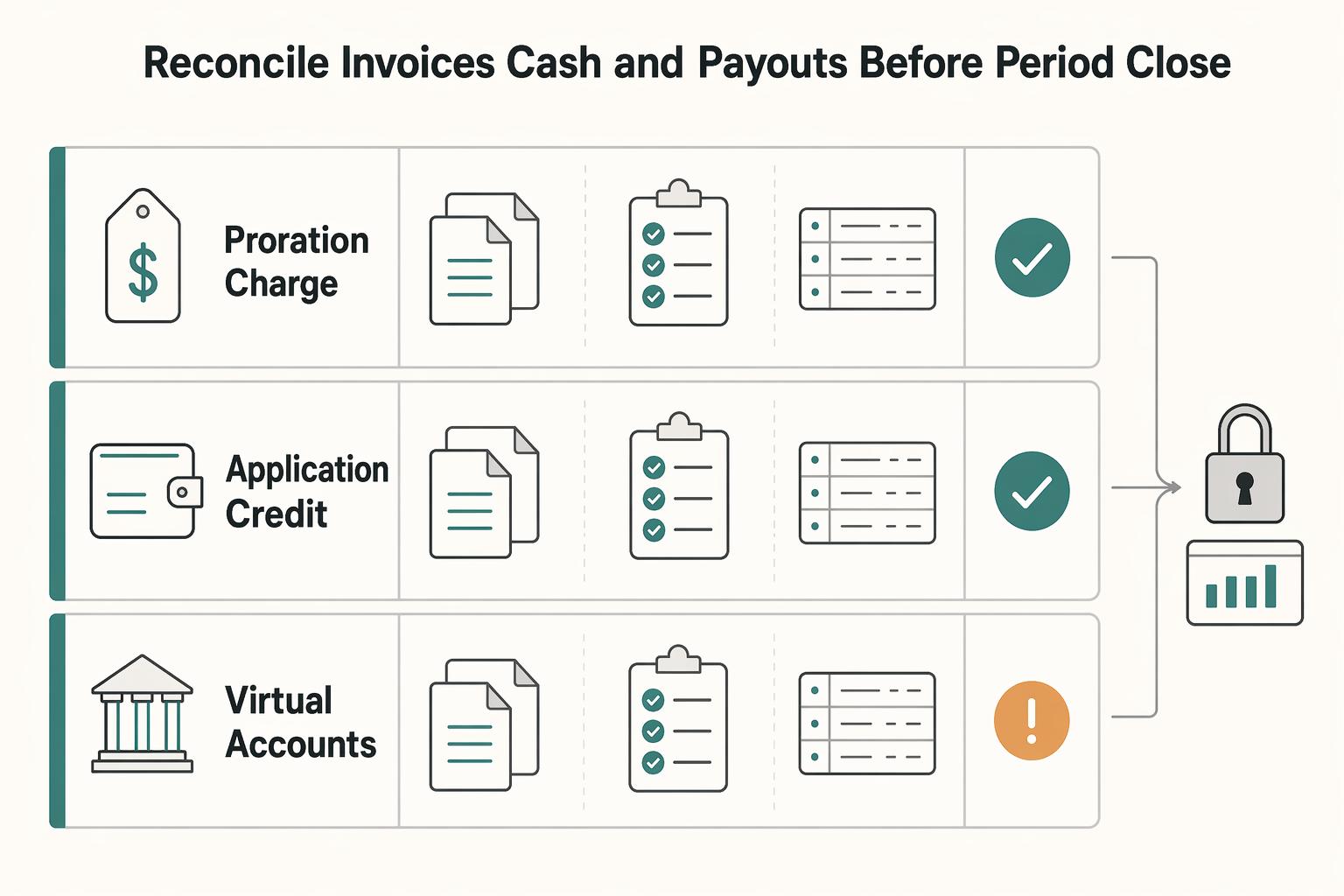
Reconcile invoices, cash, and payouts before period close#
Before you close the period, reconcile invoice deltas, cash movements, and payout batches as one control, and hold payouts under your internal policy when unresolved variance or missing evidence remains.
Step 1. Tie each invoice delta to one subscription-change event and one ledger journal path. Start from the invoice preview and compare it to the finalized invoice result. Stripe's preview shows pending charges before invoice creation, so it gives you the expected baseline for close checks. For each subscription-change event ID, confirm there is no duplicate proration line and no second journal chain from retries.
Stripe also notes that incorrect subscription item replacement can leave both old and new prices active on the same subscription. Treat that pattern as a reconciliation exception until explained. Checkpoint: one event ID maps to one invoice delta set, one charge or application credit outcome, and one journal path.
Step 2. Reconcile asynchronous cash paths before payout release. Do not treat webhook-driven cash updates as secondary. Bridge virtual-account events include a unique deposit_id, and event status can change later, including funds delivered or refund issued. Reconciliation should use both status and transaction linkage fields.
For payout-side controls, review settlement batches in the payout reconciliation report. Stripe's report is built to match bank payouts to the batches they settle and includes failed automatic payouts. If unresolved billing variance or failed payout items remain unexplained, hold related payouts under your internal policy.
| Variance check | Expected source | Posted source | What to flag |
|---|---|---|---|
| Proration charge | Invoice preview | Finalized invoice and ledger journal | Amount mismatch or duplicate proration lines |
application credit | Downgrade decision and credit calculation | Customer credit balance ledger | Credit created but not yet applied to the next finalized invoice |
| Virtual Accounts cash movement | Webhook expectation by deposit_id | Cash event status and payout batch | Delivered, returned, or refunded status not reflected in reconciliation |
Step 3. Build a close variance view by account and cycle. Keep one close table with expected charges, posted charges, unapplied credit, and unresolved items for each account and billing cycle. Stripe's customer credit balance is ledger-backed and auto-applies to the next finalized invoice, so open credit can be a timing item, not necessarily an error.
Use the provider day boundary consistently. Stripe defines report-day activity as 12:00 am to 11:59 pm. If your internal cutoff differs, document the bridge adjustment in the evidence pack.
Step 4. Apply an explicit payout-block rule and preserve audit evidence. Set an internal tolerance for unresolved proration variance and enforce it consistently. If variance exceeds tolerance, or evidence is incomplete, block the payout batch until the trail is complete across invoice preview, finalized invoice details, processed webhook records, and payout reconciliation drilldown.
Handle failure modes that cause double charges#
Double charges usually come from event sequencing and duplicate processing. Treat same-cycle changes as one ordered flow and block parallel charge paths.
- Preserve event order for multiple same-cycle changes.
If a customer upgrades and then downgrades before renewal, do not calculate the second change from an earlier webhook payload. Stripe notes payloads can be outdated, partial, or out of order, so recalculate from current provider state after fetching the latest subscription and invoice objects. In your books, keep both changes in one ledger journal chain, or use a reversal-plus-replacement chain that clearly nets to one outcome. In Shopify, this control is stricter because only one active recurring charge per app is allowed. Checkpoint: request timestamps, provider event IDs, and final subscription state all match the winning change.
- Gate recalculation around invoice timing and
billing thresholdinvoices.
A billing threshold can trigger an off-cycle invoice before the normal billing date, so a later plan change may appear on a later invoice. Make this explicit in customer-facing timing language: include the effective timestamp and whether post-threshold changes move to the next invoice. Also confirm invoice state before posting downstream entries or sending customer comms, since subscription invoices can remain draft for about 1 hour.
- Make webhook replay and retries side-effect safe.
Stripe documents that webhook endpoints can receive the same event more than once. Log processed event IDs and skip duplicates, and use an idempotent key on your internal change command so API retries do not create a second charge path. Checkpoint: one customer action ID maps to one provider mutation, one invoice delta, and one journal result.
- Recover in a fixed order: stop, correct, then communicate.
When a double charge is likely, pause further plan changes on that account first. Reverse the incorrect ledger entry, regenerate the invoice view from current provider data, then notify the customer with a corrected timeline of what posted, what was reversed, and what appears next. Save the request record, processed event IDs, reversal reference, regenerated invoice view, and customer notice for close evidence.
Related reading: How Freelance Developers Use Linear to Control Scope and Billing.
Build compliance evidence without slowing operations#
Keep compliance evidence lean and traceable. Each mid-cycle change should be auditable from request to posted entry without storing unnecessary sensitive data.
| Area | Keep | Key note |
|---|---|---|
| ASC 606 period treatment | Effective timestamp, old and new service period, invoice delta, final ledger journal ID | One change request ID should trace to invoice lines and the posted journal |
| VAT validation | VAT number checked, validation timestamp, source (for example, VIES) | A VIES check is not complete VAT compliance |
| W-9 / W-8BEN | Status, received date, masked document reference | Do not store full TINs in event payloads |
| 1099 / FBAR / FEIE scope | Flag only where that program scope exists | FBAR relevance starts when aggregate foreign financial accounts exceed $10,000 at any time in the year |
| Operational logs | Internal account ID, country, document status, validation result, event ID, masked references | Exclude full tax forms, bank details, and unmasked identifiers |
- Map each proration change to
ASC 606period treatment.
Record the effective timestamp, old and new service period, invoice delta, and final ledger journal ID so revenue treatment stays tied to transfer of promised goods or services and expected consideration. Checkpoint: one change request ID traces cleanly to invoice lines and the posted journal.
- Link tax and identity artifacts by status and reference, not full raw data.
For VAT validation, keep the VAT number checked, validation timestamp, and source (for example, VIES). For US tax forms, keep W-9 or W-8BEN status, received date, and a masked document reference. Red flag: treating a VIES check as complete VAT compliance, or storing full TINs in event payloads.
- Enable cross-border records only where that program scope exists.
If you run cross-border flows, flag accounts that may intersect with 1099, FBAR, or FEIE handling, and leave that flag off by default otherwise. FBAR relevance starts when aggregate foreign financial accounts exceed $10,000 at any time in the year; FEIE questions are individual tax matters (including Form 2555), not universal account requirements.
- Apply data minimization in logs while preserving audit linkage.
Keep only fields needed for operations and auditability: internal account ID, country, document status, validation result, event ID, and masked references. Exclude full tax forms, bank details, and unmasked identifiers from webhook archives and support exports.
Copy/paste closing checklist#
Use this as a stop-or-go gate before payouts or period close: if any check fails, hold the account, document the exception, and keep the audit trail complete.
- Confirm proration timing model by segment.
Write one decision rule per segment: use Invoice Immediately when entitlement changes now; use Apply on Next Period (next_period) when the change should start next billing period. If your stack supports Next invoice, mark it as allowed or disallowed. Verify that each segment's configured model matches the customer notice.
- Confirm one event, one posting, one outcome.
Require one idempotency key per subscription change and one final ledger journal chain. Webhook duplicates can happen, so retries must not create a second outcome. For a sample change, trace request ID, provider event, invoice effect, and journal posting with no duplicate proration lines.
- Confirm customer-facing billing clarity before posting.
Generate an invoice preview and confirm it shows pending charges, including taxes or discounts where applicable. Make sure the preview or notice states service-period boundaries, whether the change is a charge or credit, and the expected posting date, especially for next_period. A non-finance reviewer should be able to answer, "Why this amount now?" from that view alone.
- Confirm close readiness across invoices, ledger, and payouts.
Reconcile each invoice delta to its posted journal entry, then resolve or hold any exception. Reconcile each payout against included batch transactions after settlement; for manual payouts, reconcile against transaction history. Each changed subscription should have a complete audit trail of who changed what and when.
- Confirm governance and recovery readiness.
Where required, verify KYC/AML gates (including CIP procedures when applicable) before payout or settlement flow continues, and link required tax artifacts your process depends on. Document a recovery path for charge errors so operators can correct entries and customer communication in order. For country- or program-specific coverage, Talk to Gruv.
Frequently Asked Questions
How do we prevent double-charging when a customer upgrades mid-cycle and then changes again before renewal?
Use one subscription-change event ID end to end. Send billing API calls with an idempotency key so retries do not perform the same operation twice. If your provider can deliver the same webhook more than once, log processed event IDs and ignore repeats. For one account and one cycle, keep an auditable event order and one final proration outcome in the journal chain.
Should we use immediate proration or `next_period` for most accounts?
Pick immediate proration when entitlement changes now and you want the price difference charged or credited at change time. Pick next_period when customer clarity matters more than real-time billing, because the change is scheduled for renewal and no mid-cycle proration charge or credit is issued. If support tickets often start with "why was I charged today," deferred changes are usually easier to explain.
Do downgrades create refunds or `application credit`, and when should each be used?
Downgrades commonly create a credit proration for unused time in the current billing period. Whether that amount is applied as application credit or refunded depends on your policy and billing stack behavior. The red flag is mixing refund logic and credit logic across different tools, because that is how one downgrade turns into both a refund and a later credit.
Why did a proration line appear on a later invoice instead of the current one?
Start with two checks: whether the change actually affected current-cycle billable amounts, and whether you used next_period. Only changes that affect the current billing cycle create prorations, so some edits will not generate a line immediately. A later line can also happen when invoice timing is driven by other billing events rather than the exact moment of the plan change.
How do `billing threshold` invoices change what customers see after a plan change?
A billing threshold can trigger an invoice once accrued usage reaches a monetary amount, which means invoice timing may no longer line up neatly with the plan-change date. In Stripe, the configured monetary threshold must be at least 50 currency units, so check that value before you explain timing to customers. If you use thresholds, include the service-period window in the invoice preview or customer notice, because a proration or usage amount may surface on a threshold-triggered invoice instead of the invoice the customer expected.
What minimum checks should finance run before closing the period after many mid-cycle changes?
Reconcile every invoice delta to a posted journal entry and confirm there is no duplicate proration line for the same subscription event. Then inspect the processed-event log for duplicate webhook receipts and reconcile payouts against the transactions included in each payout batch. If any account is missing the change request, invoice effect, and final posting link, hold it out of close until the evidence chain is complete.
Try a related tool
Researched and edited by the Gruv editorial team. Gruv builds cross-border billing, payouts, and finance-operations software for global businesses.
Sources
Includes 2 external sources outside the trusted-domain allowlist.
- docs.stripe.com/billing/subscriptions/usage-based/thresholdstrusted
- docs.stripe.com/webhookstrusted
- ecfr.gov/current/title-31/subtitle-B/chapter-X/part-1...trusted
- federalregister.gov/documents/2016/05/11/2016-10567/customer-due...trusted
- irs.gov/forms-pubs/about-form-w-9trusted
- irs.gov/businesses/small-businesses-self-employed/re...trusted
- asc.fasb.org/layoutComponents/getPdfexternal
- help.shopify.com/en/manual/your-account/manage-billing/billin...external
Educational content only. Not legal, tax, or financial advice.
Related Posts
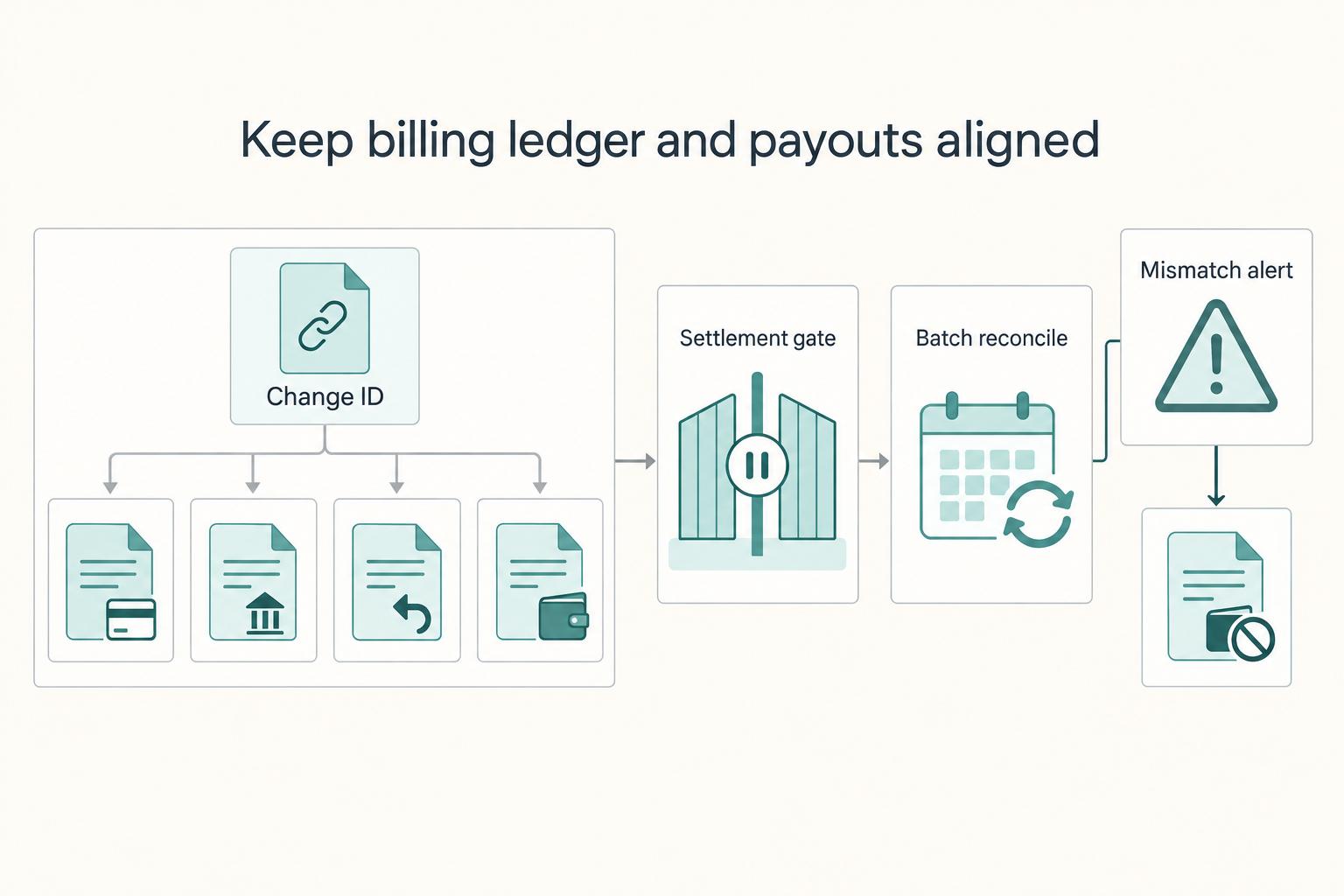
Billing Mid-Cycle Proration Upgrade Downgrade Refund Logic
You need one written decision model for every **Mid-Cycle Plan Change**. Without it, product can optimize for customer experience, finance can optimize for revenue timing, and engineering can optimize for whatever the billing stack does first. That is how mid-cycle billing turns into case-by-case judgment calls instead of a repeatable policy.
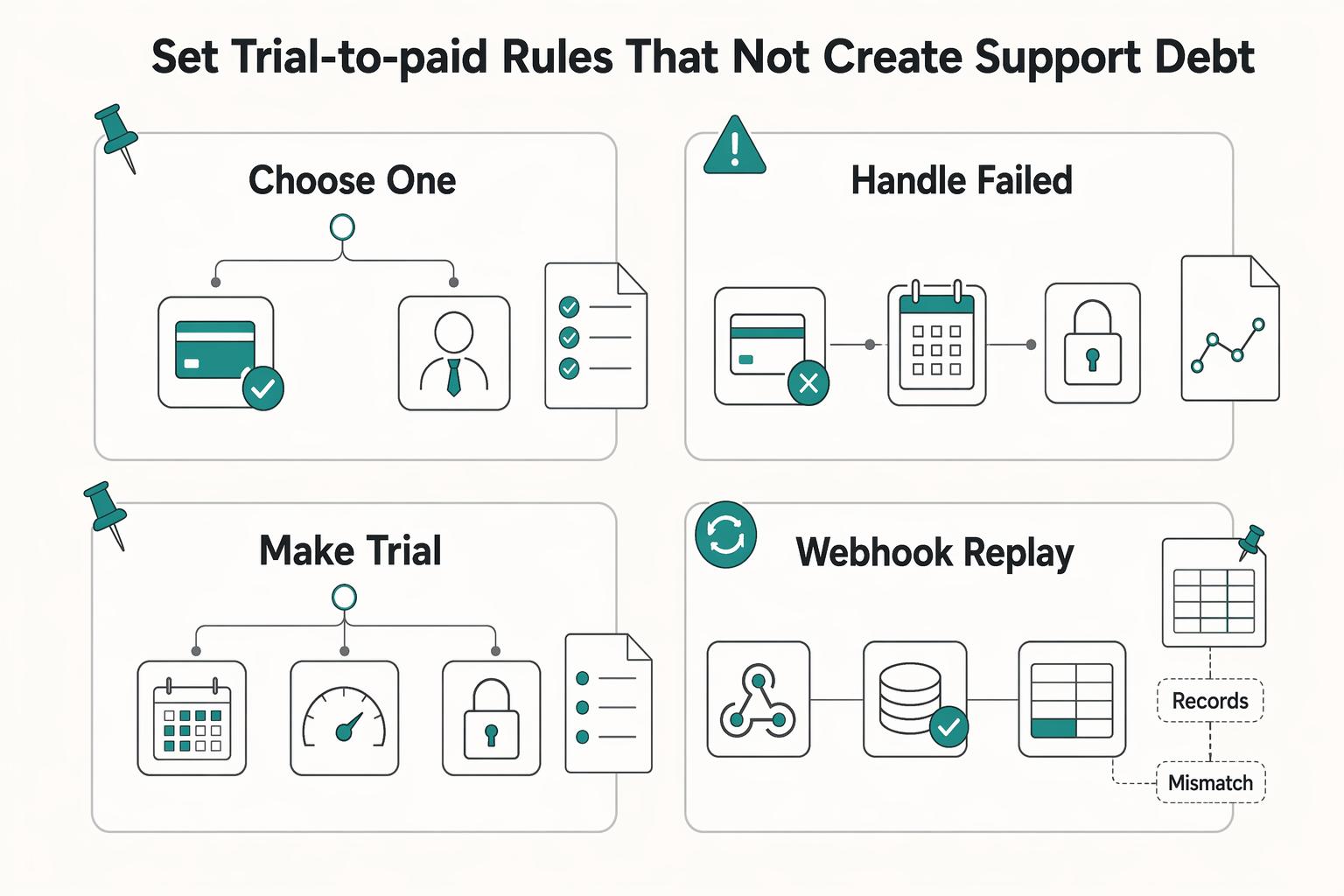
Subscription Billing for SaaS Teams Handling Trials and Plan Changes
Treat subscription changes as an operating decision first, not a pricing page edit. The moment a customer upgrades mid-cycle, adds services, or switches to annual prepay, you are coordinating product access, invoicing, and accounting at the same time.
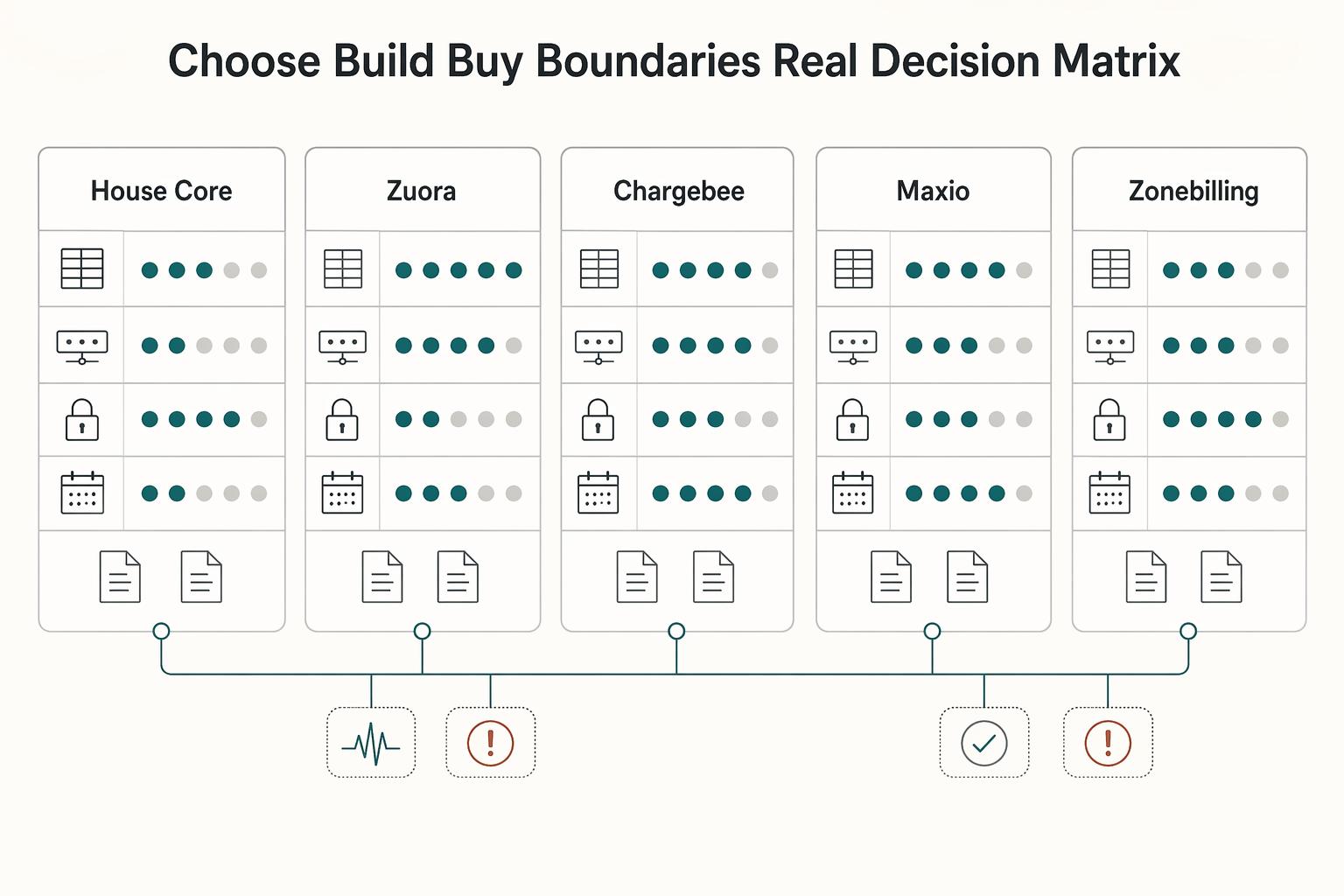
How to Build a Subscription Billing Engine for Your B2B Platform
If you are designing a B2B subscription billing engine, get the close and reconciliation model right before you chase product flexibility. A durable sequence is to define recurring billing scope (plans, billing periods, usage, and trials), then map settlement and payout reconciliation to transaction-level settlement outputs, and finally tie that discipline into month-end close controls. The real test is simple: finance should be able to trace invoices, payments, and payouts from source events through settlement records into reconciled close outputs without ad hoc spreadsheet rescue.