
Quick Answer
Use Where’s My Refund? on IRS.gov or IRS2Go to check a standard federal return, and switch to Where’s My Amended Return? for Form 1040-X. Enter SSN or ITIN, filing status, tax year, and the exact whole-dollar refund amount from your filed return. Review status once daily, then act only on clear triggers: no movement past normal windows, a reduced payment, or an IRS notice in your Online Account or mail.
Your Refund Isn't a Windfall - It's Your Operating Capital#
Your refund is your own cash coming back, not a bonus. If you freelance or consult, treat that money like a receivable you manage closely, because it can affect both business obligations and personal draw.
Use that mindset from the start:
| Mindset | Typical behavior | Result |
|---|---|---|
| Bonus mindset | Wait, refresh constantly, hope | More stress, less clarity |
| Receivable mindset | Track filing date, check official status checkpoints, keep documentation organized | Better control, clearer decisions when something changes |
Use IRS timing as your first filter:
24 hoursafter e-filing a current-year return before status may appear3 daysafter e-filing a prior-year return4 weeksafter filing a paper return- Most refunds arrive within
21 days, but some take longer - Mailed returns may take
6 or more weeks
If you are still inside those windows and the tracker is moving through Return received, Refund approved, and Refund sent, treat that as normal variance. Shift into diagnostic mode when timing runs past the baseline, the status stalls, or the refund amount changes unexpectedly, including possible debt offsets through TOP.
Check once a day. The IRS updates the tracker once daily, usually overnight, and calling does not speed processing. Use a simple sequence: confirm status, read what it actually means, then respond with the right documents if something is off.
We covered this in detail in What to Do If You Haven't Received Your Tax Refund.
Stage 1: The Baseline Status Check (The 5-Minute Essential)#
Start with IRS-owned channels and enter your details exactly as filed. This cuts down on false "not found" results and unnecessary troubleshooting.
Before you start#
Use your filed return, not memory or a draft. You need:
| Field | What to enter | Key detail |
|---|---|---|
| SSN or ITIN | Taxpayer identifier matched to the return | If you filed with an ITIN, enter that exact ITIN |
| Filing status | Enter the status exactly as filed | Such as Single or Married Filing Jointly |
| Exact refund amount | Use the exact whole-dollar refund amount from the return | Not an estimate or bank deposit guess |
| Tax year | Choose the same tax year used on that return | Use your filed return, not memory or a draft |
Pull these fields from the filed return itself. Small mismatches, especially filing status or refund amount, can cause a failed lookup.
Check timing before you troubleshoot:
24 hoursafter e-filing a current-year return3 daysafter e-filing a prior-year return- About
4 weeksafter filing a paper return
Pick the right IRS channel first#
Use IRS channels and verify identity before entering tax data. Confirm the IRS.gov domain or the official IRS2Go app listing.
| Channel | Security check | Availability if your usual method is unavailable | Escalation readiness | Best use |
|---|---|---|---|---|
| Where's My Refund? on IRS.gov | Confirm IRS.gov | Use if IRS.gov is accessible on your device/location | Low (status only) | Default first check |
| Signed-in IRS account on IRS.gov | Confirm IRS.gov before sign-in | Use if you can complete account sign-in | Medium | Good when you want an IRS account path |
| IRS2Go app | Confirm official IRS app listing | Useful when mobile access is easier | Low (status only) | Mobile alternative to website |
Automated refund line 800-829-1954 | Use IRS-listed number | Useful if web/app access is blocked | Low (status only) | Fallback channel |
Confirm the exact-match lookup#
Small input mismatches can fail a lookup even when the return is in process. Once the system recognizes your return, record the date and status phase:
- Return received
- Refund approved
- Refund sent
Run a fixed check cadence#
A fixed cadence keeps you from reacting to noise. Check once daily on a set schedule, since the IRS updates status once a day, usually overnight. Repeat checks the same day do not add new information.
Track four fields in a simple log:
- Date checked
- Channel used
- Status phase
- Any refund amount change
Use normal timing as your baseline. Most refunds are issued within 21 days. Many e-filed returns are around 3 weeks, and mailed returns can take 6 or more weeks.
Keep a ready-to-call pack#
If status stalls, changes unexpectedly, or stays unavailable beyond normal timing, prepare this before escalating. Calling the IRS won't speed processing, but this makes follow-up easier:
- Identity details and copy of the filed return
- Filing method and filing date
- Exact refund amount and tax year used in lookup
- Prior status log, including notes or screenshots
- IRS mail notice history
If the IRS needs more information, it contacts you by mail. Once this baseline check is clean, move to Stage 2 and interpret what the current status is actually telling you.
If you want a deeper dive, read our guide to a defensible 2026 filing plan.
Stage 2: The Diagnostic - What Your Refund Status Really Means#
The tracker helps only if you read it as a triage signal. Each message tells you what is confirmed, what is still pending, and whether you should wait, verify, or escalate.
| Tracker signal | What is confirmed | What is still pending | Possible freelancer/consultant causes | Risk level | Escalation posture |
|---|---|---|---|---|---|
| Return Received | IRS has your return in processing. | Review is still in progress; refund is not approved. | Normal processing, including returns with business income and estimated-tax entries. | Low | Wait if you are still within normal timing baselines (about 3 weeks e-file, 6 or more weeks mailed; 21 days is a common e-file processing baseline). |
| No movement beyond your expected window | Refund is not approved yet. | IRS may still be correcting or reviewing the return. | Estimated-tax payment differences, third-party information mismatch, or broader return review. | Medium | Verify inputs, monitor IRS mail, and prepare documentation for escalation. |
| Refund Approved | IRS approved the refund and is preparing to send it. | Payment delivery is still pending. | Standard transition from processing to payment. | Low | Record expected payment details; do not treat funds as usable yet. |
| Refund Sent or refund amount changed | IRS issued payment, or adjusted amount before issuance. | Deposit or postal delivery and final amount confirmation. | Treasury Offset Program reduction, tax-debt application, or delivery lag. | Medium | Confirm receipt; if reduced, review notice details and follow the notice path. |
For amended returns, use Where's My Amended Return? instead of the standard tracker. That process generally runs 8 to 12 weeks and can take up to 16 weeks.
How to act on each signal#
- Return Received
What it means: acknowledgment, not clearance. Possible causes: normal processing, including returns with business income reporting. Your next move: check once daily, keep your status log, and avoid calling just to speed processing.
- No movement beyond expected window
What it means: unresolved processing, not a final verdict on your return quality. Possible causes: correction or review flow, estimated-payment differences, or third-party mismatch. Your next move: re-verify filed inputs, gather proof of estimated payments, 1099s, and Schedule C, then watch for mail notices because those identify the actual issue.
- Refund Approved
What it means: the IRS is preparing to issue payment. Possible causes: standard progression after review. Your next move: take it as a strong positive signal, but keep cash-flow assumptions conservative until disbursement completes.
- Refund Sent / amount changed
What it means: payment left IRS control or was adjusted before release. Possible causes: posting delay, mail lag, or offset for qualifying debts through TOP. Your next move: confirm bank or mail receipt first. If the amount is lower, read the notice and follow that resolution path.
Operational rule: keep refund funds provisional until they are approved, and treat them as usable only after they are sent and received. If status stalls, the amount changes, or delivery fails, move to Stage 3 and work the exception path.
You might also find this useful: How to Prepare for an IRS Audit.
Stage 3: The Action Plan - Responding When Things Go Wrong#
Once the tracker stops helping you decide what to do next, switch to a notice-first escalation path. Check mail and your IRS Online Account before you call, because Where's My Refund? updates daily and calling does not speed processing.
Confirm the right channel before you escalate#
Start by making sure you are using the correct status tool for your return type.
| Tool or path | Use for | Key detail |
|---|---|---|
| Where's My Refund? (WMR) | Primary refund tracker | Only shows Return received, Refund approved, and Refund sent |
| IRS Online Account | Second check for refund status, tax records, and amended return status | Check mail and your IRS Online Account before you call |
| IRS notices and letters | Notice-led cases | Follow the letter's instructions first |
| Treasury Offset Program (TOP) | Cases where part of a refund may be applied to qualifying debt | Part of a refund may be applied to qualifying debt |
| Amended return tracking | Amended return cases | Separate because the IRS compares the original return and the amended return |
| Document Upload Tool | Submitting documents | Used when a notice or letter asks you to submit documents |
Use that table as your routing guide: standard refunds go to WMR first, notice-led cases follow the letter, amended returns use their own tracking path, and document requests go through the Document Upload Tool when the notice allows it.
Before you escalate, confirm you are past basic visibility timing. Current-year e-filed returns can appear after 24 hours; another IRS-related source says about 48 hours. Prior-year e-filed returns can appear after 3 days, and paper returns after 4 weeks.
Match your case to the trigger and work it in order#
Match your case to the trigger, then work it in order.
| Scenario | Trigger | First checks | When to escalate | What to document |
|---|---|---|---|---|
| Status stalled | WMR stays unchanged beyond expected progress | Check IRS mail, then IRS Online Account. Reconfirm filing status, refund amount, and return type used in the tracker. | Escalate if a notice tells you to respond or call, or after repeated checks still show no movement. | Date-stamped status log, filed return copy, notice numbers, and copies of IRS letters. |
| Refund lower than expected | Issued refund is less than filed amount | Confirm actual amount received, compare with filed return, then review notices for adjustment or offset details. | Escalate once notice details are in hand, especially if you dispute the offset or amount. | Expected vs. received amount, deposit or check record, notice copy, debt correspondence. |
| Amended return case | You filed an amended return | Use amended-return tracking, not standard WMR, and check IRS Online Account. | Escalate if a notice requests action or if your status remains unclear after those checks. | Original return, amended return, supporting schedules, submission proof, update timeline. |
Most delays still come from routine issues such as return errors, incomplete information, or fraud and identity-theft screening. If the IRS needs more information, it contacts you by mail.
Be call-ready before you contact IRS#
If a notice tells you to call, use the number on that notice. For automated status lines, the IRS lists 800-829-1954 for refund status and 866-464-2050 for amended return status.
| Bring | Include | Key detail |
|---|---|---|
| Identity details | SSN or ITIN, filing status, current mailing address | Bring these if a notice tells you to call |
| Filed return copy | Exact return and claimed refund amount | Have the claimed refund amount ready |
| Payment records | Estimated payments, withholding, and related confirmations | Bring related confirmations |
| Notice history | All IRS letters in date order, plus what you already submitted | Use the number on the notice if a notice tells you to call |
| Status log | Dates and messages from WMR and any amount changes | Bring dates and messages from WMR |
| Follow-up script | "What is my next required action, and when should I follow up if nothing changes?" | Ask this on the call |
Have this in front of you before the call so you can answer verification questions quickly and leave with a clear next step.
If you are asked for documents, respond promptly and use the Document Upload Tool when the notice allows it.
Know when to involve a tax professional#
Bring in a CPA, EA, or tax attorney when this stops being a basic status issue. That includes unresolved income or payment mismatches, disputed offsets, repeated stalls after repeated status checks, or cross-border filing complexity. Also escalate when fraud or identity-theft screening is involved or when corrections require an amended return.
If the delay creates serious financial hardship, TAS may be able to expedite a refund. The published number is 877-777-4778.
Protect cash flow until resolution#
Until the funds are received and any notice issue is resolved, treat the refund as provisional operating capital. Keep it out of near-term commitments until the case is closed.
For a step-by-step walkthrough, see How to Make a 'Safe Harbor' Estimated Tax Payment.
If your refund case needs escalation, keep your travel and residency timeline organized so your tax context is easier to defend and document with the Tax Residency Tracker.
The Global Professional's Toolkit: Checking Your Refund From Abroad#
From abroad, the operating rule is the same: start with the IRS tracker, not the phone. The phone line has the same refund status data as the tracker, so call when the tool tells you to or when your case is past normal timing windows.
| Path | Use it when | Have this ready | Main failure points |
|---|---|---|---|
| Where's My Refund? | You want status on a standard individual federal return | SSN or ITIN, filing status, exact whole-dollar expected refund | Input mismatch, checking before status is available, trying to track an amended return here |
| IRS2Go app | You want the same tracker check on mobile | Same three inputs as the web tracker | Same limits as web, no extra detail, rechecking multiple times per day does not add new data |
| International phone support | The tool tells you to call, or you are past normal timing after notice/account checks | Your return details and any IRS notice details | Same refund status data as tracker, some issues may be too complex by phone, confirm the current international contact route before you rely on it |
Start with the correct channel#
Pick the correct channel first. Status availability starts around 24 hours after a current-year e-file, 3 days after a prior-year e-file, and 4 weeks after a paper return. The tracker and IRS2Go update once daily, usually at night, so repeated same-day checks will not change the result.
If you filed Form 1040-X, switch to Where's My Amended Return?.
Separate cross-border context from refund problems#
Cross-border forms are context, not automatic evidence of a problem. Form 2555 is for the foreign earned income exclusion and housing exclusion or deduction, if eligible, and Form 1116 is for claiming the foreign tax credit.
Use this decision line:
- Expected delay: you are still within normal timing, your tracker inputs match exactly, and no IRS notice appears.
- Potential issue: status stays unchanged beyond typical timing, about 3 weeks for e-filed returns or 6 or more weeks for mailed returns, or your IRS Online Account shows a notice.
Escalate in order from abroad#
Check IRS Online Account notices first. Then re-verify SSN or ITIN, filing status, and exact refund amount against your filed return. If status still does not move after a normal review window, contact international support.
IRS pages list 267-941-1000 for overseas taxpayers. Confirm the current international contact route and support hours before you call. If the case stays stuck after those checks, consider working with a CPA or EA.
Related: Do I Have to Pay State Taxes While Living Abroad as a Digital Nomad?.
Conclusion: Run Refund Tracking as a Repeatable Process#
The takeaway is simple: treat your refund like operating capital and manage it with a repeatable process. Verify status, monitor notices, document changes, and escalate only when you have hit a real trigger.
Set one daily check cadence#
Set one daily check cadence and stick to it. Where's My Refund? and IRS2Go refresh every 24 hours, usually overnight, so extra checks do not produce newer information. Before each check, use the same three fields from your filed return: Social Security number, filing status, and the refund amount you expect.
First verify that status should be available at all. That is about 24 hours after a current-year e-file, 3 days after a prior-year e-file, or 4 weeks after a paper return.
Treat delays like a managed variable#
Treat delays as a managed variable, not a surprise. Most refunds are issued in less than 21 days, and some take longer because of additional review.
| Reactive move | Controlled move |
|---|---|
| Refresh the tracker multiple times a day | Check once daily and log the date and result |
| Assume "still being processed" means a problem | Stay in monitoring mode unless you are past 21 days after e-file, more than 6 weeks after mailing, or the tool tells you to call |
| Watch only physical mail | Check your IRS Individual Online Account for refund or amended-return status and digital notices, and monitor mail |
| Treat a smaller refund as unexplained | Reconcile expected vs. paid amount and review any BFS offset notice |
Escalate only after you verify your inputs and hit a published trigger. In your own SOP, keep that trigger explicit and current.
Keep an evidence pack ready#
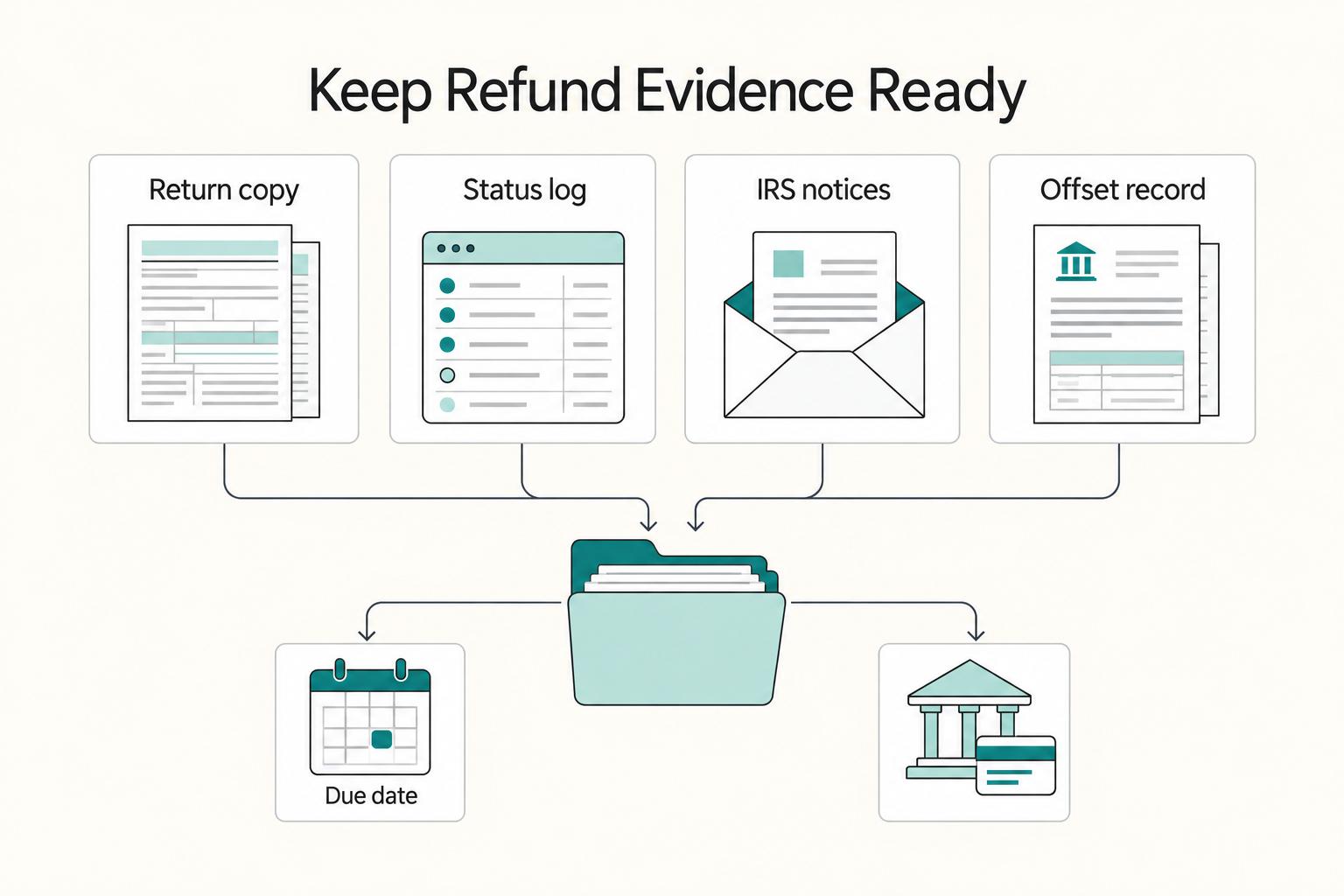
Keep an evidence pack ready for any stall, change, or notice. At minimum, keep your filed return copy, dated status-check notes or screenshots, IRS notices or letters, and any BFS offset notice. If the IRS asks for a response, keep the letter and act by the due date.
Route issues to the right channel before you call. For offset debt disputes, contact the agency listed on the BFS notice. For amended returns, use Where's My Amended Return? instead of the standard tracker.
Use this closeout checklist:
- Status-check cadence: once daily max, after status eligibility.
- Notice monitoring: IRS Individual Online Account plus physical mail.
- Documentation habit: one folder for return copy, tracker log, notices, and offset details.
- Cash-flow planning: plan for typical timing and for delay past your verified escalation trigger.
Run this process each filing season, and let verified thresholds drive action so refund tracking stays controlled and out of your core work time.
This pairs well with our guide on Filing a Dual-Status Alien Tax Return Without Mismatched Forms.
Before your next filing cycle, tighten your operator stack with practical calculators and generators built for global freelancers in one place: Gruv Tools.
Frequently Asked Questions
What does “still being processed” mean?
It means your return has not moved to Refund approved or Refund sent yet. Check once daily, then review your IRS Online Account and mail for notices, since the IRS will contact you by mail if it needs more information. Treat it as normal review while you are within typical timing. It can signal a potential issue when you are beyond about 3 weeks after e-file or 6 or more weeks after a mailed return.
Why is my refund taking longer than expected?
A longer timeline usually means corrections or further review, and identity theft or fraud can also cause delays. Re-verify your return details exactly as filed. Also make sure you are checking only after status becomes available, about 24 hours after a current-year e-file, 3 days after a prior-year e-file, or 4 weeks after paper filing. If status still does not move after typical timing, escalate through IRS support.
How do I check my refund from abroad?
Use Where's My Refund? on IRS.gov or IRS2Go first, then check your IRS Online Account for notices, tax records, and amended return status. Keep your filed return open so you can enter your details exactly as filed. Escalate only after verified checks and normal timing are exhausted, and confirm the current contact channel before calling from overseas.
Why is my refund smaller than I expected?
That usually means the IRS made a correction or applied part of your refund to a qualifying debt through the Treasury Offset Program (TOP). Compare your filed refund amount to what was paid, then check IRS mail or your online account for the explanation. Escalate if the numbers do not reconcile or the offset appears unfamiliar.
Can I track an amended return the same way?
No. Use the amended return status channel or call 866-464-2050 instead of the standard tracker for amended returns. Escalate when that channel still does not provide a clear update, or when you receive a notice you cannot match to your amendment.
Try a related tool
Researched and edited by the Gruv editorial team. Gruv builds cross-border billing, payouts, and finance-operations software for global businesses.
Sources
Educational content only. Not legal, tax, or financial advice.
Related Posts

Digital Nomad Taxes in 2026 With a Defensible Filing Plan
With digital nomad taxes, the first move is not optimization. It is figuring out where you may be taxable, where filings may be required, and what proof supports that position.

Do I Have to Pay State Taxes While Living Abroad as a Digital Nomad?
Living abroad does not end `state income tax` exposure by itself. The first decision is practical: choose a filing position your facts can support, then build records that support the same story all year.
How to Prepare for an IRS Audit
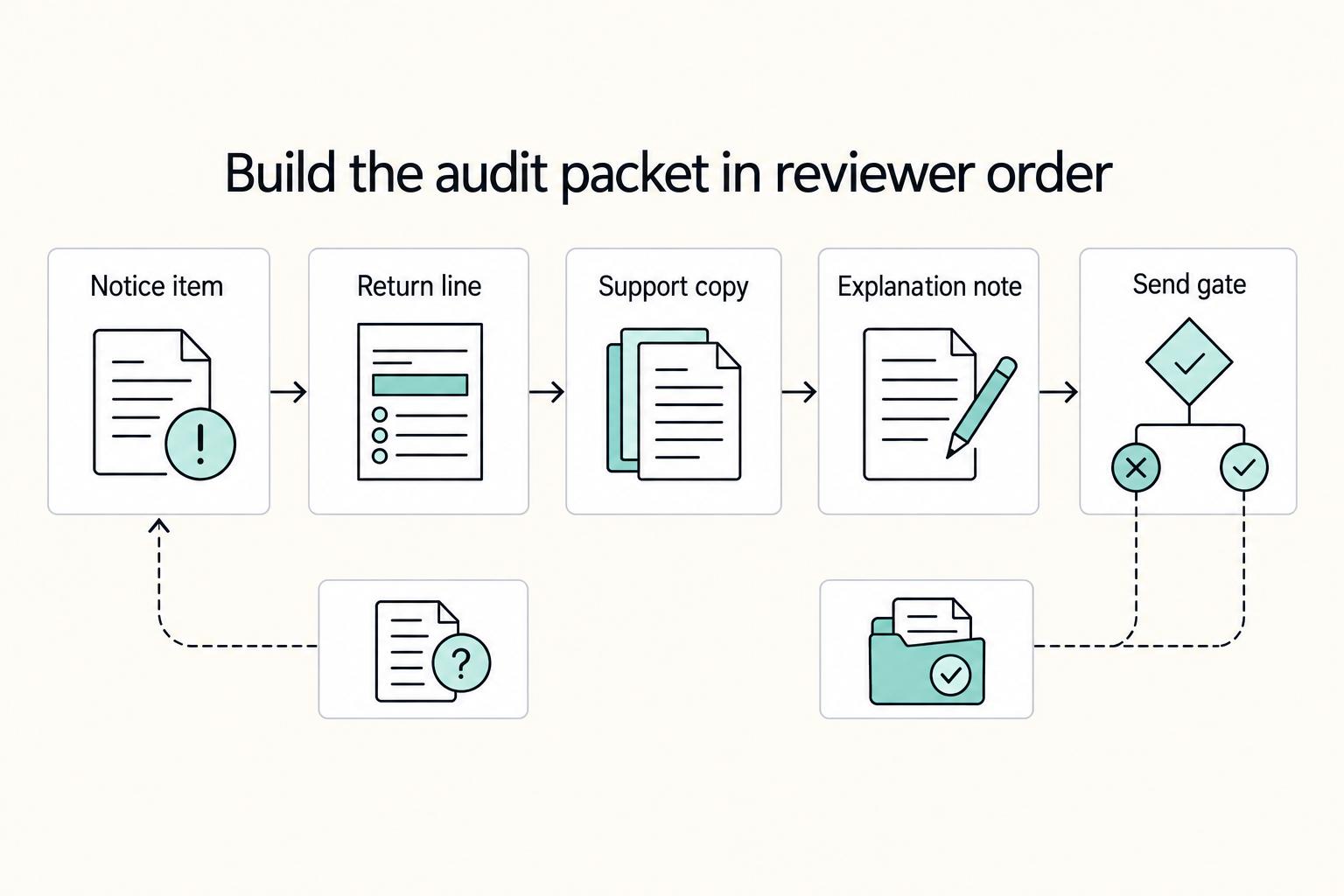
Treat an IRS audit as a records check, not a contest. Your job is to show, item by item, how what you filed ties back to the records behind it.