
Quick Answer
Start with rail qualification instead of marketing language: to receive international payments Brazil teams should confirm transfer method, required recipient fields, and the BRL settlement path before launch. Build one payer template per approved route, then run a controlled pilot that logs conversion and final credit as separate checkpoints. Treat missing fee detail, vague return handling, or unmatched references as no-go conditions until resolved.
Why receiving payments in Brazil gets misread in expansion plans#
Brazil expansion plans often go off course when teams treat inbound receipts as a generic LATAM or "global transfers" problem instead of a Brazil-specific operations decision.
Before you start
Use this as an inbound operations brief: money coming into Brazil for a Brazilian recipient, with clear BRL settlement expectations.
Step 1 Define the scope before you compare providers#
Define the scope before you compare providers. Content about Brazilians paying abroad, consumer checkout, or broad international card acceptance can help with context, but it is not enough on its own to validate an inbound receivables launch into Brazil.
This is where assumptions usually break down. LATAM may offer scale, but it is not operationally uniform, and payment execution in Brazil is shaped by local behavior, infrastructure, and expectations. Use a simple filter: if the documentation does not clearly show the relevant inbound flow, recipient experience, and settlement outcome, treat it as unverified.
Step 2 Assess routes through an operator lens#
Assess routes through an operator lens before you spend on go-to-market. Focus on rail fit, recipient experience, how conversion and settlement are described where relevant, and how exceptions are handled.
Consumer payment context can help, but do not overread it. For example, one cited Brazil source says Pix became the most-used method in 2025, with 76.4% consumer usage versus 51.6% for credit cards. That supports the point that local behavior can differ from card-first assumptions, but it does not validate an inbound B2B receipt design on its own.
Step 3 Prioritize local execution reliability over cross-border defaults#
Prioritize local execution reliability over familiar cross-border defaults. A cited Brazil payments source notes that international card paths can add friction, including extra fees, more complex checkout, and lower approval rates, and that even localized card strategies can still miss demand.
Before you sign off, require an explicit operating brief: exact use case, intended recipient in Brazil, expected settlement outcome, and fallback path if the primary route fails. If those four items are not clear, the launch plan is not operationally ready.
If you want a deeper dive, read How to Receive International Payments in the Philippines: Rails Fees and Compliance.
Define the rails before you evaluate providers#
Define the payment path first, then compare providers. For inbound payments to Brazil, treat the international transfer leg, BRL conversion step, and final local credit as separate stages rather than one blended rail.
Step 1 Separate cross-border and Brazil-side rails in your operating language#
Separate cross-border and Brazil-side rails in your operating language. SWIFT is a global messaging network for payment instructions and often appears in cross-border bank transfers outside regional schemes, but it does not itself move funds. Keep local rail labels, including PIX and SITRAF, in a different bucket from SWIFT and any foreign-currency transfer requirement.
Use one written check with each provider: how the payer initiates the transfer, and how the recipient in Brazil is finally credited. If those answers blur together, your operating view is still incomplete.
Step 2 Map the funnel in order and label each stage#
Map the funnel in order and give each stage one label:
- payer initiation
- conversion into BRL, if conversion happens
- final credit to the local account
This matters because "Brazil coverage" can still mean an international transfer first, then FX, then local settlement. Where SWIFT is involved, intermediary banks may add fees and processing time, and timing can range from same day to several days. That is operationally different from PIX's always-on, seconds-level behavior inside Brazil.
Step 3 Set one documentation rule before sales commitments#
Set one rule before sales commitments: if onboarding requires international transfer details, do not assume ACH or pre-converted BRL paths are supported without provider-specific documentation. This does not prove those paths always fail, but it does signal that the setup is built around international receipt handling, not a generic domestic transfer flow.
Step 4 Document rail definitions on one internal page#
Document rail definitions on one internal page and make sure product, ops, finance, and sales use the same terms. For each rail, note where it appears in the funnel, who controls that step, and what the recipient in Brazil actually sees. That page prevents avoidable handoff errors when teams use the same rail names for different stages.
You might also find this useful: How to Receive International Payments in Pakistan: RAAST Alternatives and FX Tips.
Gather the minimum data and documents before launch#
Before you send payer instructions, lock the beneficiary data pack, the account-model owner, and U.S. reporting ownership. Common failure points here are field mismatches, mixed account profiles, and late reporting handoffs.
Step 1 Assemble a receiver data pack#
Create one canonical beneficiary record for each recipient or account route. Keep this as your internal minimum pack: legal name, account identifiers, routing details, and tax ID fields required by the route and provider.
| Field group | Check | Note |
|---|---|---|
| Legal name | Verify against the source account record | Create one canonical beneficiary record |
| Tax ID fields | Verify against the source account record | Required by the route and provider |
| Routing details | Run a second check before approval | Keep one evidence item per approved record |
| Account identifiers | Run a second check before approval | Keep one evidence item per approved record |
Treat this as an operating standard, not a claim that every provider or rail always requires every field. In practice, verify legal name and tax ID against the source account record, then run a second check on routing and account identifiers before approval.
Avoid copying beneficiary details from invoices, chats, or CRM entries that were never tied to the receiving account. Store one evidence item per approved record, such as a bank account screen or onboarding record, so support can resolve issues without guesswork.
Step 2 Classify the account model by segment#
Decide upfront whether each segment receives into a personal account, business account, or another provider-specific account model. Do not collapse these into one generic "Brazil account" label, because account holder naming, tax ID type, and payer instructions may differ by model.
Use a strict rule: one segment, one approved account model, one instruction template. For provider-specific paths, keep setup assumptions marked unverified until you confirm receiving details and eligibility in the live product flow or provider documentation.
Keep a short matrix: recipient segment, account owner, account model, and payer template. If a recipient may appear as both personal and business, treat that as a review exception, not a payer choice.
Step 3 Draft payer-facing bank instructions#
Build payer instructions from the approved beneficiary pack, not from memory. The instruction sheet should match the exact transfer form and state whether intermediary bank details are needed for that specific route.
Depending on the route, forms may ask for intermediary bank fields or may not, so your instructions should tell payers what to complete and what not to improvise.
Validate with a mock completion: have someone outside treasury fill the form using only your instructions. If they pause on beneficiary IDs, routing fields, or intermediary bank inputs, revise the sheet before launch.
Step 4 Assign U.S. reporting ownership before volume ramps#
If your parent entity or control structure is U.S.-based, assign ownership early for FBAR (FinCEN Form 114) and Form 8938 exposure checks. Do not leave this to year-end.
FBAR is FinCEN Form 114. FinCEN states an FBAR must be filed if a single-account maximum or aggregate maximum exceeds $10,000, and each account is valued separately. Use FinCEN's maximum account value guidance when you document the valuation method and retained exchange-rate source. FinCEN also defines maximum account value as a reasonable approximation of the greatest value during the calendar year, and allows another verifiable exchange rate, with the source retained, if Treasury FMS rates are unavailable.
Form 8938 should also be in scope because, when filing is required, the IRS says financial accounts maintained by a foreign financial institution must be reported. Assign regular balance capture, exchange-rate source retention, and filing accountability now so you are not reconstructing values before the April 15 FBAR due date, with automatic extension to October 15.
Compare Brazil inbound options side by side before committing#
Start with a comparison matrix, not provider positioning. In this review set, only Wise has explicit evidence of receiving flows. The other options remain unverified for inbound receipt mechanics into Brazil, and Wise still needs Brazil-specific receive-route confirmation before launch.
| Provider | Rail or receive path evidenced in cited material | Recipient data evidenced | Timing evidenced | Settlement behavior in BRL vs foreign currency | Fit for purpose | Known constraints from cited material | Unknowns you must verify |
|---|---|---|---|---|---|---|---|
| Wise | Yes. Pricing separates receiving flows, including "Receiving domestic payments (non-Swift / non-wire)" and "Receiving USD wire and Swift payments." | Not specified in cited pricing pages. | Not stated. | Not stated. Do not assume BRL settlement or foreign-currency holding behavior from pricing alone. | Best-evidenced starting point for inbound comparison because receive flows are explicit, but Brazil-specific receive mechanics should be verified with the provider before launch. | Separates send, receive, convert, and card pricing. The Business plan shows a one-time setup fee of 31 USD. Receive line items include 6.11 USD (USD wire/Swift), 2.16 GBP (GBP Swift), 2.39 EUR (EUR Swift). | Full fee stack beyond quoted line items, Brazil-specific receive mechanics, Brazil-specific compliance depth, exact recipient fields, exception policy, settlement path. |
| Nomad/Husky Payments | Unverified in provided material. | Unverified. | Unverified. | Unverified. | Candidate only after live receiving instructions and eligibility are confirmed. | Confirm supported constraints with the provider. | Full fee stack, rail support, compliance depth, exception policy, recipient fields, settlement behavior. |
| Western Union | Unverified in provided material. | Unverified. | Unverified. | Unverified. | Keep unapproved for inbound business receipts until exact receiving instructions are confirmed. | Confirm supported constraints with the provider. | Full fee stack, rail support, compliance depth, exception policy, recipient fields, settlement behavior. |
| PagBrasil | Cited material discusses B2B payment operations in Brazil, not a confirmed inbound international receive route. | Not specified. | Not stated. | Not stated. | Useful operational signal, but not enough on its own to approve cross-border inbound receipt use. | Describes manual bank-transfer operations, initiation, confirmation, reconciliation, and frames outdated processes as technical debt and a growth bottleneck. | Full fee stack, cross-border receive mechanics, compliance depth, recipient fields, exception policy, settlement behavior. |
Use the fit-for-purpose column as a hard filter. Do not compare receive, send, and card use cases as if they answer the same question. Here, Wise clears the first filter because receiving is explicitly described, but that is still not final approval.
Then apply the account-type filter. The Business plan includes a one-time setup fee, 31 USD, while personal pricing presents free account registration, so keep business and personal assumptions separate in your matrix.
Treat unknowns as launch gates, not side notes. If the full fee stack, Brazil-specific receive mechanics, compliance depth, exception policy, or BRL-versus-foreign-currency settlement behavior is still unresolved, keep the provider in pilot and model both reconciliation cases until evidence closes the gap.
Related: How to Receive International Payments in India: UPI NEFT and Cross-Border Options.
Choose your primary route by use case not by marketing claims#
Choose the route that proves inbound receiving mechanics, not the one with the broadest cross-border pitch. Among the routes covered here, Wise is the only option with explicit receiving categories and fee checkpoints, so it is the first route to evaluate for business receipts. The others stay unverified until they provide live inbound instructions.
Step 1 Match the provider to the actual receive path#
Start by confirming the receive method your payer will use, then check whether the provider documents that method as a distinct receiving flow. Wise explicitly separates "Receiving domestic payments (non-Swift / non-wire)" from "Receiving USD wire and Swift payments," which makes method-level review possible before launch.
Use a simple launch gate: do you have payer-facing instructions that clearly show the transfer method, required recipient data, and fee type? If not, you are still reviewing marketing language, not an operating route.
Step 2 Evaluate Wise first when documentation quality is the priority#
Wise is the clearest first review because pricing is separated by feature, and receiving appears as its own category. The same pricing surface also states receiving account details in 24 currencies, shows fixed Swift receiving fees (6.11 USD, 2.16 GBP, 2.39 EUR), and includes a separate Wise Business path.
In your review pack, save the pricing capture and the option labeled "View in the regulator's standardized format." If inline Swift fee detail is missing, treat that as a launch gate, because some costs require extra lookup: "You can see how much they cost here."
Do not mix send-money terms into inbound-receiving decisions. The 25,000 USD discount trigger that "Resets on the first" is send-money pricing, not evidence about inbound receiving behavior.
Step 3 Keep other providers in pilot until receive details are evidenced#
Inbound receiving mechanics are not evidenced here for Nomad or Husky Payments. Keep both in pilot until they provide concrete receiving instructions, required recipient fields, and written fee handling for real payer flows.
If those details remain incomplete, keep the provider unverified.
We covered this in detail in How Platforms Choose International EFT Payments Across Borders.
Send payer instructions that prevent first-transfer failures#
First-transfer failures usually come from unclear or incomplete instructions. Use one route-specific template, name the exact transfer method at the top, and require a traceable payment reference before you treat a payment as in flight.
| Field | When to include | Note |
|---|---|---|
| Ordering/originating customer account number | If the route requires it | Use one route-specific template |
| Ordering/originating customer full name and full address | If the route requires it | Use one route-specific template |
| Beneficiary bank full name | If the route requires it | Align to standard payment-information blocks |
| Beneficiary bank address | If the route requires it | Align to standard payment-information blocks |
| Beneficiary bank SWIFT BIC | For international wire routes | State the transfer method in the first lines |
| Intermediary bank SWIFT BIC | When an intermediary bank is part of the route | Include those details directly in the template |
Step 1 Build one payer template and reuse it#
Issue one standardized template for each verified receive route and keep it versioned, because payment guidance can change.
Include only the fields your route requires, such as:
- ordering/originating customer account number
- ordering/originating customer full name and full address
- beneficiary bank full name
- beneficiary bank address
- beneficiary bank SWIFT BIC for international wire routes
- intermediary bank SWIFT BIC when an intermediary bank is part of the route
This keeps your instructions aligned to standard payment-information blocks and reduces avoidable delays or returns caused by missing data.
Step 2 State the transfer type in plain language#
Put the transfer method in the first lines of the instructions so the payer does not have to guess. If your setup requires it, say plainly that they must use an international wire and include the required SWIFT details.
If an intermediary bank is involved, include those details directly in the template. Avoid vague wording like "bank transfer accepted," which invites the wrong rail.
Step 3 Add a route-specific "do not use" block#
Add a short block telling the payer which rails not to use for that route. Keep it conditional: if your instructions require specific international wire fields, tell the payer not to use methods that are not listed for that payment.
The point is not to create a universal rule for Brazil. It is to stop payer improvisation when your receive path depends on a specific wire setup.
Step 4 Require proof before release or reconciliation#
Before release or reconciliation, require a confirmation screenshot or payment reference from the payer. At minimum, collect sender name, date, amount, and a bank reference or confirmation number your ops team can trace.
Do not accept "paid" without a traceable reference. That single control turns exception handling from a long email chain into a quick verification step.
Run the first live transfer with explicit checkpoints#
Treat the first live payment as a controlled go or no-go pilot, not a production rollout. Run one transfer end to end, from payer initiation to BRL credit, so you can validate route behavior before scaling.
Step 1 Freeze route and pricing assumptions before send#
Lock one route, one payer, one currency, and one account model for the pilot. Testing multiple variants at once makes failures harder to diagnose.
If you are using Wise, verify and save the relevant view from Fees at a glance before launch. It separates Receiving domestic payments (non-Swift / non-wire) from Swift or wire receiving, and that classification changes fee assumptions. The same pricing page shows fixed receiving fees for some Swift cases in the excerpt, including 6.11 USD for USD wire or Swift, 2.16 GBP for GBP Swift, and 2.39 EUR for EUR Swift.
Resolve known uncertainty before launch. The provider references Receiving Swift payments in an additional 19 currencies without listing all those fees inline. Confirm the exact fee if your pilot currency falls in that group. Keep account type consistent as well: the Wise Business pricing page shows All in for 31 USD, while personal pricing says Register for a Wise account Free.
Step 2 Log conversion and settlement as separate checkpoints#
Track checkpoints separately so timing and economics stay auditable. At minimum, log: payer initiated, provider marked funds received, conversion completed if applicable, and BRL credited.
Keep conversion distinct from settlement even when they happen close together. The send-money pricing states Nothing but the mid-market rate, which supports an FX-stage check, not a guaranteed BRL credit timeline. Use the pilot to establish your real timing baseline instead of promising settlement speed from pricing excerpts alone.
Step 3 Define pass/fail criteria before launch#
Mark the pilot as passed only if all core controls are true:
- receiver details exactly match your approved payer instructions
- status progression matches what you expected in provider tracking
- fee treatment and net outcome match your preflight check
- no exception remains unclassified at close
- the transfer is traceable from payer proof to provider reference to final BRL credit
If any control fails, treat the pilot as failed even if funds eventually arrive.
Step 4 Pause on field-mismatch failures and fix instructions first#
If the first transfer fails because of a field mismatch or wrong route mapping, stop expansion immediately. Correct payer instructions, revalidate receiver data, and rerun the same pilot conditions.
Do not scale volume until the path is clean and traceable under repeat conditions.
Related reading: How Platforms Reconcile Foreign Contractor Payments in QuickBooks Online.
Reconcile funds and exceptions with audit-ready records#
Once the pilot works, the next gate is traceability. Someone outside the launch team should be able to follow one payment from request to BRL credit without guesswork. For reliable inbound receipts into Brazil, design reconciliation around identifiers first, then balances.
Cross-border reconciliation is more than matching debits and credits. In practice, it also means normalizing file formats, resolving exceptions, and tracking activity across banks and time zones, so record design is part of core operations.
Step 1 Build one trace chain per payment#
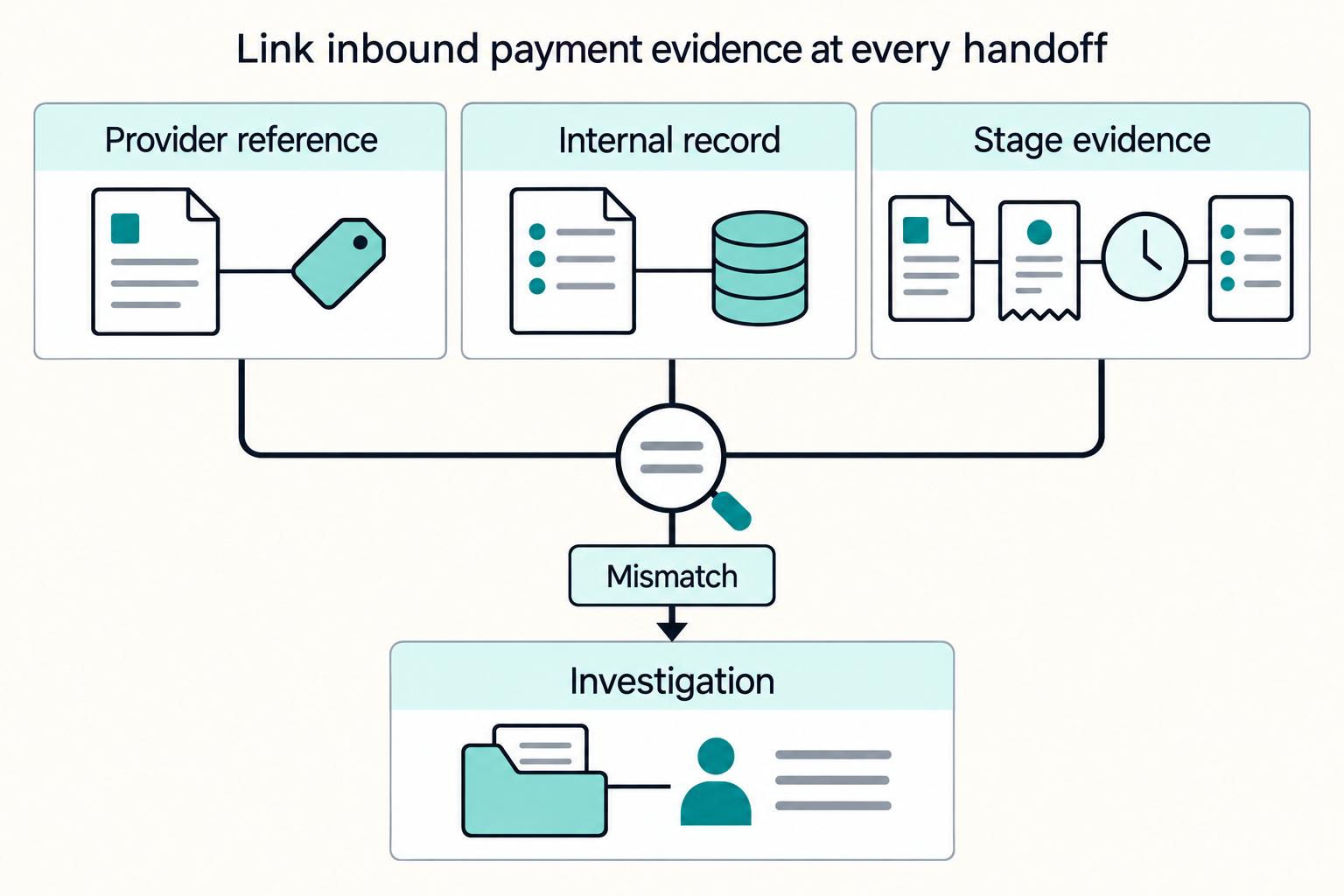
Create one internal record per receipt that links the payer request, provider reference, internal ledger entry, and finance reconciliation export. If one link lives in a separate inbox or CSV without a shared identifier, exceptions take longer to resolve.
Store these fields together at minimum:
- internal payment ID
- provider transaction ID
- request or correlation ID returned by the API
- payer proof or request reference
- currency sent, currency credited, and credited amount in BRL
- credited account or wallet destination
- final reconciliation batch or export name
Use one practical test: starting from a payer screenshot or provider reference, can someone on your team find the matching ledger line in minutes?
Keep transaction IDs and correlation IDs separate in your model. In Mastercard-style flows, transaction IDs identify each transaction, while correlation IDs are transient request-match identifiers. Also account for retries: if an attempt fails, a retry requires a new transaction ID.
Step 2 Reconcile from the ledger outward#
Use posted ledger entries as your balance source of truth, then verify against provider events. This helps keep webhook or order-status updates from being treated as final balance movement before records line up.
If supported in your Gruv setup, use idempotent handling, webhook status updates, and ledger-first reporting so duplicate deliveries or reordered events do not create false postings.
For a settled receipt, verify:
- one and only one ledger credit event exists
- duplicate webhook deliveries do not post duplicates
- the provider reference on the ledger matches the finance export reference
Step 3 Classify exceptions by state, not ticket wording#
Run a small internal state model so triage starts from operational status, not complaint phrasing.
| Internal state | What it usually means | Primary owner | First check |
|---|---|---|---|
| Credited | Funds appear to have reached destination, but reporting or reference mapping may still be incomplete | Finance ops | Match ledger entry to export and payer proof |
| Held | Provider or bank has not completed the flow yet | Payments ops | Review provider status history and missing fields |
| Returned | Funds were rejected or moved back | Payments ops with treasury visibility | Confirm return reference and net amount impact |
These are internal operating labels, not a Brazil-specific standard. Each queue needs clear ownership and response targets.
Step 4 Separate funds-location issues from metadata issues#
When a payment appears missing, first decide whether funds are actually missing or whether the reference chain is incomplete. That changes urgency, owner, and escalation path.
If provider records show receipt and balances moved, investigate mapping and reference integrity. If no matching transaction ID or settlement evidence exists, treat it as a funds-location issue.
In Brazil-facing flows, PIX can include an end-to-end ID that supports reconciliation. If PIX is in your path, store that ID in the same record as the provider reference and ledger entry.
Step 5 Minimize PII in ops views and keep an evidence pack#
As an internal control, keep support views PII-minimized by masking CPF or CNPJ in standard views, with full values limited to restricted investigations when needed. Preserve complete evidence in controlled access for audits and disputes.
For each exception, retain:
- masked recipient details in standard views
- full identifier only in restricted access when needed
- payer proof
- provider status history
- ledger movement
- final resolution note
For high-volume PIX operations, CPF or CNPJ validation is also described as a way to reduce rejects and fraud.
For the full breakdown, read How Graphic Designers Protect Cross-Border Payments and Cash Flow.
Keep PIX claims in context so scope does not drift#
To keep scope tight, treat PIX as context unless a provider shows exactly where it sits in your settlement path.
Step 1 Anchor PIX to the exact role it plays#
The grounded claim is narrow: PIX is Bacen's faster payment system, and it is referenced in an interoperability context with existing payment systems. That helps with framing, but it does not by itself prove PIX is your inbound international receipt rail.
Use one check: where does PIX appear in the money path: payer initiation, an internal step, or final credit? If that role is not stated clearly in provider documentation, treat PIX as context, not coverage.
Step 2 Separate provider messaging from your receiving use case#
Do not treat payer-side or merchant-facing messaging as proof of receiver-side operations. This is where scope usually slips.
For any provider page, validate inbound collection details directly: beneficiary requirements, settlement currency, payout destination, and reconciliation reference. If those receiver-side details are not explicit, mark the claim as unconfirmed.
Step 3 Keep PIX references only when they change your settlement path#
Keep PIX in your internal requirements only when it materially changes how funds settle for your implementation.
If a claim blends payer experience with receiver operations, flag it as a scope risk until confirmed in writing. Your safest filter is simple: documented flow, documented currency, and documented reconciliation reference.
For a step-by-step walkthrough, see Xero + Global Payouts: How to Sync International Contractor Payments into Your Accounting System.
Recover quickly from common failure modes#
When an inbound transfer to Brazil breaks, diagnose before you act. Classify the issue first, then apply the fix that matches it. In Brazil-focused flows, payment-experience mismatches can lead to abandonment.
| Issue | How to classify it | First response |
|---|---|---|
| Rail mismatch | The payer used a different transfer setup than your receiving instructions | Re-send the exact beneficiary instructions and ask the payer to confirm what they will submit |
| Data error | Revalidate the full beneficiary instruction set from your approved source | Ask the payer or payer ops to confirm the entered details before resubmission |
| Information gap | The transfer is held for review or the payer bank asks for more routing data | Resend the exact route-specific details and show where each required value belongs in the payer form |
| Delay vs true failure | Confirm when the payment was actually executed before resetting timelines | Update treasury expectation from that execution point and communicate status accordingly |
Step 1 Correct rail mismatches before retry#
If the payer used a different transfer setup than your receiving instructions, treat that as a routing mismatch first. Re-send the exact beneficiary instructions, call out the required transfer type in plain language, and ask the payer to confirm what they will submit.
ACH is an electronic fund transfer channel under EFTA, but it is not automatically interchangeable with every cross-border receiving setup. If remittance-transfer disclosures or error-resolution handling are part of your route, review the Regulation E remittance transfer rule before reusing a domestic template. The practical check is whether the payer is using the fields required by your route, not whether they are reusing a prior template.
Step 2 Revalidate the full beneficiary instruction set#
For data errors, do not patch one field in isolation. Revalidate the full beneficiary instruction set from your approved source and ask the payer, or payer ops, to confirm the entered details before resubmission.
Focus on consistency across the full record, including beneficiary identity, account details, and bank identifiers for that route. This helps reduce repeat failures from stale copies, partial edits, or formatting issues introduced during manual entry.
Step 3 Remove routing ambiguity in payer-side forms#
If the transfer is held for review or the payer bank asks for more routing data, treat the case as an information gap and resend the exact route-specific details clearly.
Show where each required value belongs in the payer form so the resubmission is complete.
Step 4 Separate delays from true failures#
Not every late credit is a failed payment. Confirm when the payment was actually executed before you reset timelines.
Then update your treasury expectation from that execution point and communicate status accordingly. This classification step matters operationally because you should not handle delays and failures the same way.
Decide go or no-go with a Brazil readiness scorecard#
Treat this as a gated operating decision, not a confidence exercise. If fees or exception handling are still unverified, stay in pilot and do not scale.
Step 1 Score only verified evidence#
Score each route only on evidence your team has validated in live operations, not provider copy.
| Criterion | What counts as verified | Red flag |
|---|---|---|
| Rail compatibility | You have payer-facing instructions that explicitly match the selected route | Teams still label the flow as generic "bank transfer" |
| Receiver data quality | Your approved beneficiary pack contains the exact fields used by that route, including route-specific identifiers where applicable | Ops is patching beneficiary fields after failures |
| Timing predictability | You track pilot timestamps from payer execution to BRL credit | Timelines come from provider messaging, not your own receipts |
| Reconciliation readiness | Finance can match payer reference, provider reference, and internal ledger entry for each BRL receipt | Funds arrive but cannot be matched cleanly to source records |
If you rely on regulatory artifacts, verify against the official govinfo PDF rather than treating FederalRegister.gov XML as final legal evidence. Keep traceable references in your pack, for example Document Number 2020-10278, citation 85 FR 34870.
Step 2 Apply one hard no-go rule#
If fee transparency is unknown or exception handling is vague, remain in pilot. That includes unclear return handling, missing escalation paths, or support language that does not explain what happens when a transfer is held, returned, or misrouted.
Step 3 Set the production threshold#
Use an internal production threshold, for example two consecutive BRL receipts completed successfully with clean reconciliation. If receipts arrive but reconciliation fails, treat that as a pilot failure, not a pass.
Step 4 Log unresolved risks with owner and deadline#
Before launch approval, keep a short risk register with each open risk, owner, and closure or re-review date. If intercompany flows are in scope, include tax review: Law 14,596/23 is effective from January 1, 2024, and cross-border intercompany transactions are framed around the arm's length principle.
Before scaling, run your provider matrix through a simple scenario model to pressure-test fee and settlement assumptions: compare payment fee scenarios.
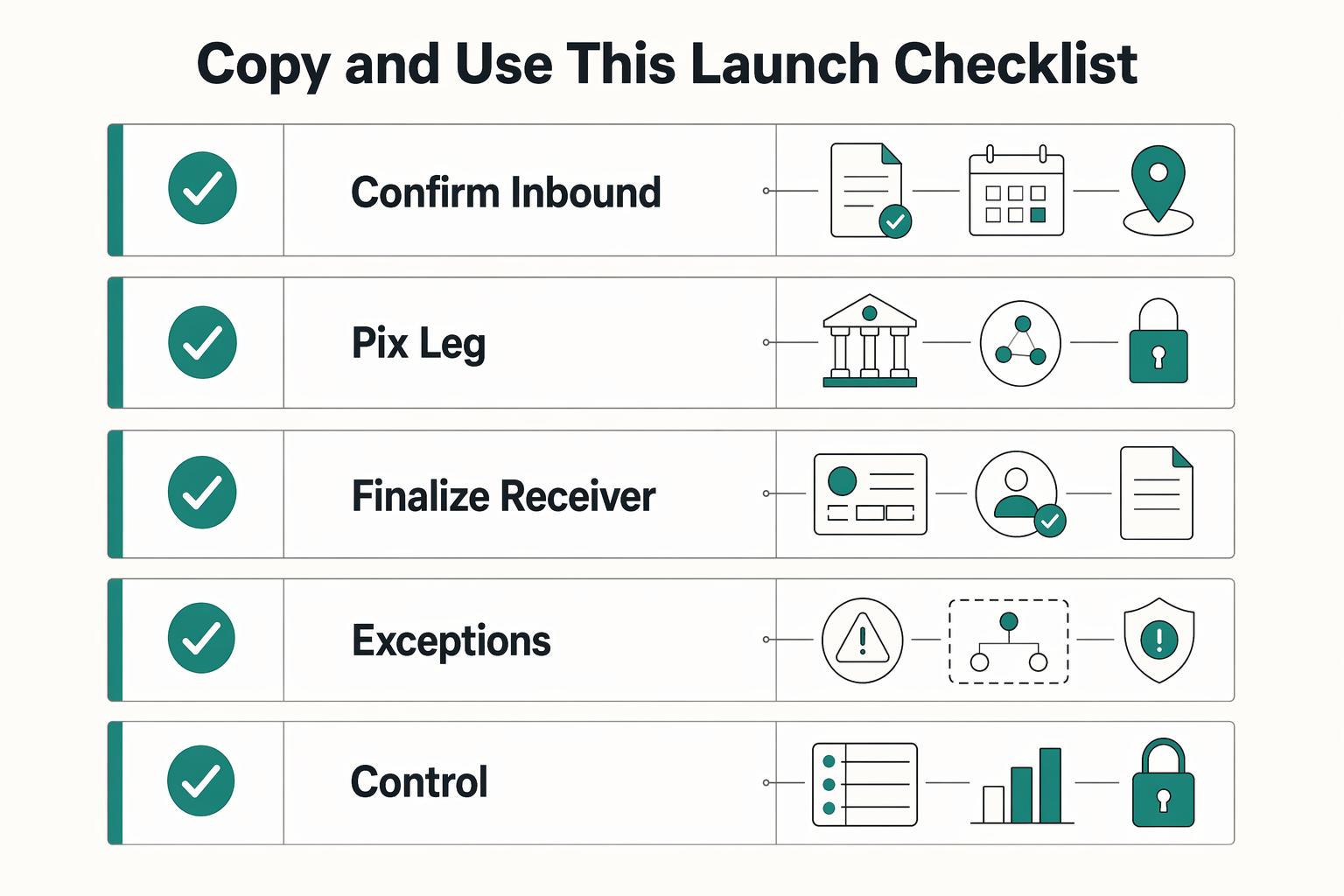
Copy and use this launch checklist#
Use a gated checklist: define the exact receiving route, prove it in pilot, and scale only when results are repeatable.
- Confirm your inbound route in plain language, list methods your provider has not approved for this flow, and note whether direct Pix participation is in scope (it has Central Bank eligibility criteria).
- If a Pix leg is part of the flow, state exactly what the payer should use (
Pix keyorQR code) and where that Pix leg starts and ends. - Finalize receiver data from the provider's receiving requirements, then QA field labels and formatting against the payer-facing transfer flow.
- Publish payer instructions with one worked example, any prohibited methods, and a clear escalation contact with an owner.
- Run controlled pilots and log checkpoints from payment initiation to recipient visibility. Treat timing as provider-specific: Pismo describes immediate visibility for Pix, while Stripe's Pix page also shows a
2 business daystiming value. - Store both the provider reference and your internal ledger reference for each pilot where available, and treat mismatches as reconciliation gaps first.
- Document unresolved items, compliance review depth, exception handling, and access constraints, and keep scale gated until they are verified.
- If your route depends on restricted access, treat that as a launch gate. For example, Stripe marks Pix for Brazil-based businesses as invite-only.
- Move to production only when pilot outcomes are repeatable and exception handling is operationally owned.
This pairs well with our guide on How Independent Contractors Should Use Deel for International Payments, Records, and Compliance.
If your pilot passes, use a compliance-gated and audit-ready implementation path for collection, status tracking, and reconciliation workflows in Gruv docs.
Frequently Asked Questions
Can you receive international payments in Brazil through **ACH**, or must it be **SWIFT**?
You should not assume ACH will work or that SWIFT is always required. Wise separates domestic receiving (non-Swift / non-wire) from wire or SWIFT receiving, which indicates the rail type affects how receipts are handled. Before a payer sends funds, have them confirm the exact rail against your receiving instructions.
What payer details are mandatory for BRL transfers, and when are **CPF** or **CNPJ** required?
This guide does not establish one mandatory BRL field set for all cross-border receipts. It only supports that CPF/CNPJ can be used as a Pix address key type, not that it is always legally required in every inbound BRL case. Treat your provider's receiving instructions as the source of truth and validate them before launch.
When does **PIX** help in cross-border scenarios, and when is it the wrong rail for inbound receipts?
Pix can help when the receiving leg is local in Brazil and the flow is Pix-compatible. PagBrasil describes Pix receipts via address key or QR Code, notes dynamic QR Codes must include amount, and states transactions occur in under 10 seconds, 24/7. The same source also says immediate transfers from abroad are not yet possible through Pix, so Pix alone does not cover the inbound cross-border leg.
How do **Wise** and **Nomad/Husky Payments** differ for business operators receiving funds in Brazil?
This guide supports limited, provider-specific signals rather than a full comparison with Nomad or Husky. Wise shows a fixed 6.11 USD fee for receiving USD wire or SWIFT payments, and the Wise Business pricing page shows "All in for 31 USD," indicating product-level pricing differences. For Nomad or Husky, request written details on receiving rail, required receiver data, fee components, and return handling before comparing options.
What should operators verify before trusting claims from pages like **Western Union** or **PagBrasil**?
Verify operational evidence, not marketing copy. At minimum, confirm rail type, required receiver data, fee disclosure, and what happens when a transfer is held or returned. If a page does not clearly show payer instructions and exception handling, treat it as unverified for launch decisions.
How should teams handle delays between conversion and final settlement in **Brazilian real**?
Track FX conversion and final BRL posting as separate checkpoints. This guide does not establish one standard delay window across providers, so use provider-specific status markers for each stage. Consider storing both payment references in your ledger to help reduce false "missing funds" incidents during reconciliation.
Try a related tool
Researched and edited by the Gruv editorial team. Gruv builds cross-border billing, payouts, and finance-operations software for global businesses.
Sources
- bis.org/publ/bppdf/bispap152_c.pdftrusted
- bis.org/publ/cpss97_br.pdftrusted
- bsaefiling.fincen.gov/docs/XMLUserGuide_FinCENFBAR.pdftrusted
- congress.gov/bill/114th-congress/house-bill/2029trusted
- fdic.gov/consumer-compliance-examination-manual/vi-2-...trusted
- fdic.gov/risk-management-manual-examination-policies/...trusted
- federalregister.gov/documents/2025/01/16/2025-00592/securing-the...trusted
- federalregister.gov/documents/2020/06/05/2020-10278/remittance-t...trusted
Educational content only. Not legal, tax, or financial advice.
Related Posts

How to Receive International Payments in the Philippines Without Reconciliation Gaps
If you need to receive international payments in the Philippines at scale, choose rails for control and recovery, not speed claims alone. Start with the option your team can explain, reconcile, and support when a payout fails, then expand based on recipient access needs.

Receive International Payments in India: SWIFT, UPI, and NEFT
If you want to receive international payments in India without month-end confusion, map the rail in the right order. The cross-border leg, the India settlement leg, and the documentary proof are three separate things.
How to Receive International Payments in Pakistan: RAAST Alternatives and FX Tips
If you want to **receive international payments in Pakistan** without creating finance issues later, choose the rail that fits your operating model, not the provider name your team recognizes first. Pakistan is a multi-rail market. Bank transfers are common, mobile-wallet routes are common, and MTOs are also used in practice. The right setup depends on who is sending, how often they pay, and how much control you need over FX and reconciliation.