
Quick Answer
Start by freezing one segment, one core customer job, and one GTM motion, then score PMF with both behavior and economics. Use a Sean Ellis survey, treat the 40% "very disappointed" result as directional, and exclude "N/A, don’t use" responses. Map Acquisition, Activation, Retention, Referral, and Revenue to concrete events, and only count activation when meaningful action appears in product data. Make scale, hold, or pivot calls at scheduled checkpoints instead of reacting to a single spike.
What Product-Market Fit Looks Like in B2B Payments#
Product-market fit is a decision gate, not a story you tell too early. It means your product meets the needs of a specific market at a level that can sustain growth and profitability.
A common mistake is calling it too early. No single metric proves PMF, so treat it as a cross-functional judgment. Use quantitative signals such as growth, engagement, and repeat purchase behavior, along with qualitative feedback such as customer satisfaction and reviews.
False confidence is the main risk. Teams often push growth or upsell too early, before willingness to pay is really validated, and that can backfire. A practical checkpoint is retention. If your retention metrics compare poorly with competitors, you are likely not at PMF yet.
Before you start#
Before you score anything, keep these constraints in view:
- Judge PMF for a specific market, not for everyone.
- Bring both numbers and narrative. Metrics alone or feedback alone can mislead.
- Make PMF a shared call. Achieving PMF is a shared responsibility across the company.
This guide is practical. You will build a decision-ready scorecard using quantitative and qualitative operating evidence that teams can review together. The goal is simple: decide what to scale, what to fix, and what to stop with fewer blind spots.
Step 1 Prepare the inputs before measuring anything#
Freeze the scope before you measure. Pick one target segment and keep that definition fixed for this measurement pass. If the target and framing change at the same time, the signal becomes harder to trust. Write that scope in one sentence at the top of the review doc, then use the same wording in your survey filter and dashboard title so you are not comparing different groups as if they were the same cohort.
| Input | What it is | Note |
|---|---|---|
| Sean Ellis-style PMF survey | Survey with fixed response options | Treat as decision input, not proof |
| PMF score | Share of respondents who select "very disappointed" | 40% is a useful rule-of-thumb signal to investigate |
| "N/A, don't use" responses | Excluded from the PMF score | Do not include them in the calculation |
| Open-ended responses | Why customers answered the way they did | Use them alongside the survey result |
| Behavior signals | Show stickiness, not just willingness to pay | Revenue alone can hide weak stickiness |
Then gather a minimum evidence pack before you score PMF:
- A Sean Ellis-style PMF survey with fixed response options
- A PMF score calculated as the share of respondents who select "very disappointed"
- Exclusion of "N/A, don't use" responses from that PMF score
- Open-ended responses on why customers answered the way they did
- Behavior signals that show stickiness, not just willingness to pay
Treat this pack as decision input, not proof. A 40% "very disappointed" result is a useful rule-of-thumb signal to investigate, but survey output alone can produce false positives and does not prove product-market fit. Revenue alone can also hide weak stickiness.
Step 2 Choose the PMF unit you will judge#
Judge product-market fit with a specific unit of analysis, not only as a single company-wide verdict. In sales-led B2B motions, you usually get a more useful read when you define one unit clearly and track leading indicators for that unit. Once Step 1 is in place, lock the PMF unit for this cycle:
- One target segment
- One core customer job
- One fixed GTM motion
If you serve multiple buyer types, score them separately. If different stakeholders buy and use the product, review their signals separately so one strong signal does not dominate the PMF read.
Define one core repeat behavior per segment that represents adoption, not just early interest. Signups, demos, and one-time onboarding events can add context, but they are usually directional rather than decisive on their own. Use this quick check before you lock that behavior:
- It repeats in normal usage, not only during setup.
- It reflects value delivered, not mostly assisted activity.
- It is observable in your product data.
Set a no-drift rule for the measurement window. As a practical heuristic, avoid changing segment, package, and pricing at the same time. If you need to test one, hold the other two steady so the signal is easier to interpret.
Step 3 Map the payment journey to measurable AARRR events#
Now turn that unit into something you can observe. If you count an AARRR stage with clicks or handoffs instead of real outcomes, PMF signals will look better than they are.
Build one event table for the chosen payment job#
Use one table where each stage points to a behavioral event in-product, an outcome that confirms value happened, and the context needed to interpret the result.
| AARRR stage | Event to track | Verify before counting |
|---|---|---|
| Acquisition | Source that brought the account into this exact segment and use case | Source is attached to the account, and the account matches your Step 2 segment definition |
| Activation | First meaningful action for the payment job | Action is observable in product data and clearly meets your meaningful-action definition |
| Retention | Repeat use of the same payment job over later periods | Usage repeats in normal operations and reflects completed value, not one-off setup |
| Referral | Customer-driven introduction of another qualified account | Referred account is identifiable and reaches your same activation definition |
| Revenue | Fees actually realized from completed cohort activity | Revenue is tied to completed usage, not quoted pricing or expected volume |
If teams classify the same account differently, tighten the event definitions before you trust the output.
Tie retention to real outcomes, not activity alone#
Retention should show repeat value, not just repeat interface activity. Product analytics can explain what users do and why, but for PMF you still need evidence that the core job is being repeated in practice.
Use your own payment-event labels for this map. What matters is consistency. Your retention event should reflect repeat operational value, not page visits.
Add failure states before trusting success counts#
AARRR already warns about activation that looks like sign-up activity without meaningful action. Include explicit failure states so sign-up-only behavior is not counted as success.
- Count the customer action as behavioral evidence.
- Count activation only when that action meets your meaningful-action definition.
- Keep sign-up-only activity in a separate failure bucket, not in activation totals.
If activation cannot be verified as meaningful action in product data, do not treat that cohort as activated.
Keep the map strict, but interpret with judgment#
This map is there to keep vanity metrics out of the PMF discussion. Use it as a strict scorekeeper for this segment and cycle: one segment, one payment job, five stages, and clear success definitions. Then interpret results with judgment, since data can only measure what already exists.
For a step-by-step walkthrough, see How Platform Operators Triage Late B2B Payments Before Market Entry.
Step 4 Build a scorecard that links adoption to margin#
Put adoption and economics in the same view. PMF is not a single metric, and one good chart can hide contradictions between user pull and unit economics.
Pair behavior and economics in one table#
Build rows that combine quantitative behavior, qualitative feedback, and economic outcomes so the signals can converge instead of competing in separate reviews.
| Scorecard row | Behavior signal | Economic pair | How to use it |
|---|---|---|---|
| Retention | Repeat use of the core payment job | Revenue and retention outcomes for that same cohort | Read as stronger only when repeat usage and economics improve together |
| Referral / organic pull | Customer-driven introductions that reach activation | CAC context for the same segment and period | Distinguish qualified pull from low-conversion referrals |
| Sean Ellis Test | Responses in the Sean Ellis 40% Disappointment Test | Retention or revenue outcomes for that same respondent cohort | Use as one PMF checkpoint alongside behavior and economics |
| Net Promoter Score (NPS) | Sentiment and advocacy intent | Retention and realized usage for the same cohort | Interpret with behavior and economics rather than as a single PMF verdict |
| Monetization | Adoption by pricing or routing path | Unit-economics outcomes for the same cohort and period | Compare options against observed outcomes in your own cohorts |
| Executive decision | Combined product signals | Combined finance signals | Record a decision state (for example, scale, hold, or pivot) with explicit conditions |
If a row is not tied to the same cohort and period, keep it out of the decision.
Keep sentiment tied to outcomes#
Use the Sean Ellis Test and NPS to explain why customers stay or refer, but anchor the decision in retention, acquisition efficiency, and realized usage. That keeps qualitative evidence useful without letting sentiment outrun actual behavior.
Add explicit decision conditions before review#
Define your decision conditions before looking at results. That reduces post-hoc interpretation and makes tradeoffs visible when adoption improves but economics weaken.
If you include acquisition efficiency, compute CAC as total sales and marketing spend divided by new customers in the same period. If you include LTV:CAC, use B2B SaaS references such as 3:1 and 4:1+ as context, not universal pass-fail rules for every payment platform.
Related: Platform-to-Platform Payments: How to Build B2B Settlement Between Two Marketplace Operators.
Step 5 Set clear decision gates for scale hold or pivot#
Once the scorecard exists, make a written call at each checkpoint: scale, hold, or pivot. Scale when signals strengthen together, hold when they conflict, and pivot when the same motion keeps weakening across reviews. Use a 30/60/90-day cadence so decisions are time-boxed and comparable.
| Decision | What you need to see | What to do next |
|---|---|---|
| Scale | Your current motion keeps improving across checkpoints | Increase distribution in a controlled way and keep the same review cadence |
| Hold | Signals are mixed or unclear | Keep spend contained and fix the weak point before expanding |
| Pivot | The same motion keeps losing force across repeated reviews | Change the motion (for example, your channel mix) instead of forcing more budget |
A common miss is treating top-of-funnel momentum as enough. If inbound lead flow drops, for example from 50 to 15 per month, while paid media gets more expensive and conversion declines, reassess the motion instead of pushing more budget through it.
If a pivot is needed, treat it as strategy maturity, not failure. In practice, that can mean moving from an inbound-only approach to a mix of inbound and outbound, with outbound used for early, targeted outreach.
Step 6 Run a 90 day measurement cadence with small samples#
In low-volume B2B contexts, directional consistency matters more than false precision. Treat each 90-day cycle as a controlled test.
| Window | What to do | Purpose |
|---|---|---|
| Baseline window | Keep GTM motion, pricing, and onboarding stable where possible | Capture a starting point |
| Intervention window | Introduce planned changes | Document what shifts |
| Confirmation window | Keep the approach consistent | Check whether the same direction holds in the next cohort |
If it helps, run the cycle in those three windows:
- Baseline window: keep GTM motion, pricing, and onboarding stable where possible to capture a starting point.
- Intervention window: introduce planned changes and document what shifts.
- Confirmation window: keep the approach consistent and check whether the same direction holds in the next cohort.
Use benchmarks as comparison points, not quotas, and keep assumptions explicit in every review note. Long cycles and lumpy deals can make small samples noisy, so call out channel mix changes, segment shifts, or outlier accounts instead of hiding them in averages.
If your scorecard tracks multiple metrics, compare direction across the same cohort rather than chasing week-to-week spikes. The goal is pattern recognition, not statistical theater.
Run a weekly pipeline-style operating review against one shared dashboard. Align on interpretation so you do not scale a motion before you can explain why it worked. If a metric moves, note whether the change came from volume, mix, or conversion so the next checkpoint starts with diagnosis rather than debate.
Step 7 Instrument evidence finance and ops will trust#
If you cannot trace a customer action from request to settled funds, do not treat that cohort as clean PMF evidence. Your Step 6 cadence is only reliable when product, finance, and ops can reconcile the same transaction history.
Tie every request to money movement and settlement#
Set a minimum standard: request -> event -> funds movement -> settlement batch. Webhook payloads provide event records, and event data can include the API request ID. Balance transactions show funds movement. Reconciliation should reach your internal ledger journal entry plus final payout or settlement status.
| Evidence item | Where it fits | Note |
|---|---|---|
| API request reference | Request | Keep it when available |
| Webhook event ID and type | Event | Event data can include the API request ID |
| Provider payment or transaction reference | Provider payment or transaction | Keep it in the sampled transaction evidence pack |
| Balance transaction, or equivalent funds-movement record | Funds movement | Shows funds movement |
| Internal ledger journal entry ID | Internal ledger journal entry | Reconciliation should reach this entry |
| Payout or settlement batch reference and final status | Settlement batch | Reconciliation should reach final payout or settlement status |
For each sampled transaction, keep this evidence pack:
- API request reference, when available
- Webhook event ID and type
- Provider payment or transaction reference
- Balance transaction, or equivalent funds-movement record
- Internal ledger journal entry ID
- Payout or settlement batch reference and final status
In each review, trace one successful flow and one failed flow end to end for every segment under review. Orphaned webhook events, unmatched journal entries, or UI-visible transactions missing from settlement-batch reconciliation usually indicate instrumentation debt before demand weakness.
Treat compliance friction as product evidence, not back-office noise#
Track compliance friction by segment as a core signal, including customer identity checks, AML holds, and legal-entity beneficial ownership verification. CIP requires risk-based identity verification, and legal-entity onboarding for covered institutions can require identifying and verifying beneficial owners, so these controls can affect activation speed and retention.
Do not leave onboarding in a single "pending review" bucket. Track hold rate, time to clear, resubmission rate, and abandonment after document requests so PMF discussions separate onboarding friction from true demand signals.
Add tax-document readiness before cross-border volume grows#
For cross-border flows in U.S. reporting or withholding context, add tax-readiness checkpoints early. Form W-9 supports correct TIN collection for information returns, and Form W-8BEN-E is used by foreign entities to establish foreign status.
If Form 1099-NEC applies, filing is due January 31, so missing tax data should be surfaced before year-end workflows. Treat FBAR as applicability-based, not universal. FinCEN Form 114 applies when aggregate foreign financial accounts exceed $10,000 during the year. It has an April 15 due date and an automatic extension to October 15.
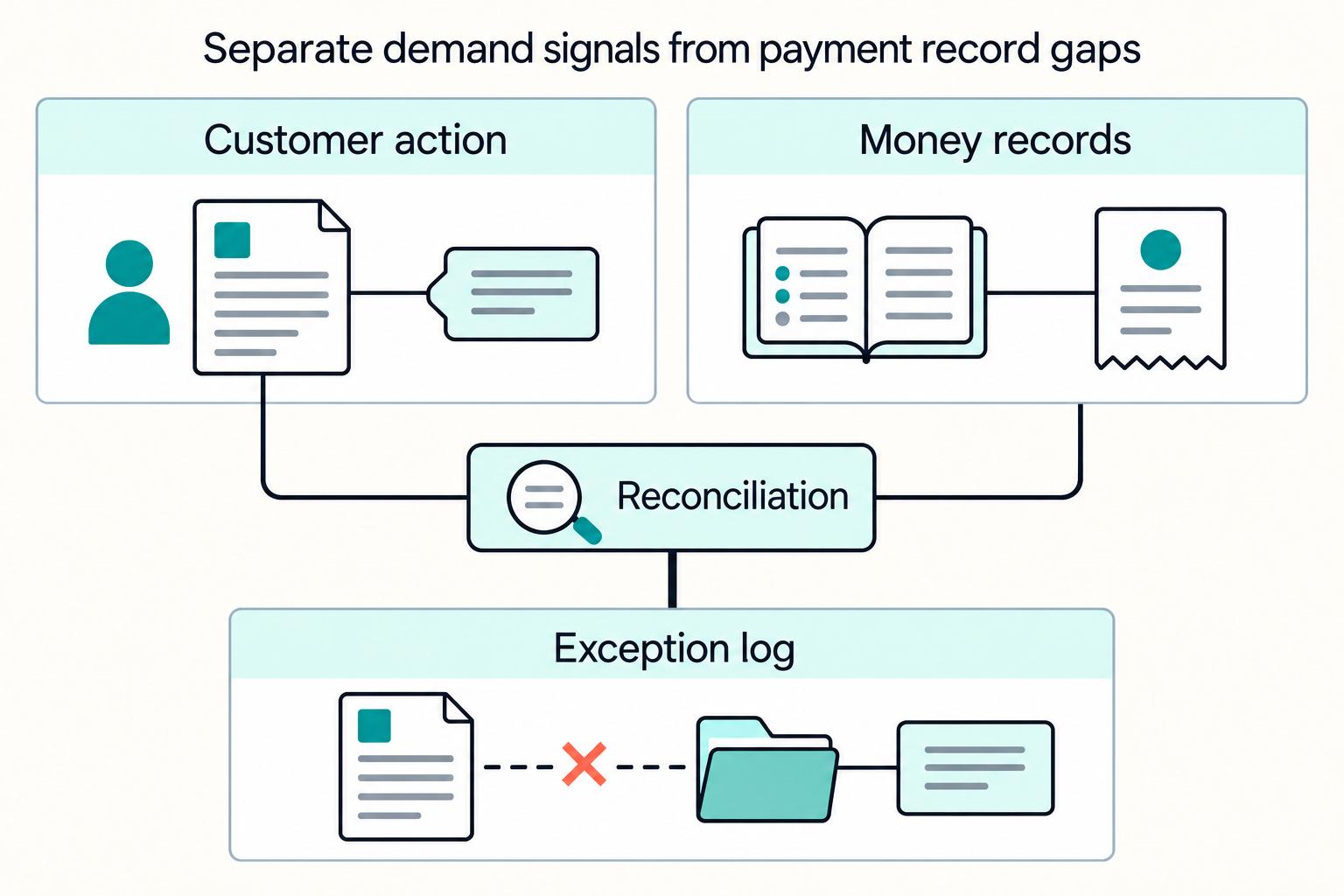
Build an exceptions log that separates demand from breakage#
Your exceptions log should capture both root cause and trigger so trend analysis is usable. Avoid a single "payment failed" bucket when detailed decline reasons are available.
Before attributing a conversion or activation drop to product demand, check whether unresolved operational failures increased. Examples include webhook delivery failures, reconciliation mismatches, AML review holds, or tax-document stalls. PMF calls in payments should be based on finance-grade evidence, not conversion charts alone. For the systems behind those checks, see How to Build a Finance Tech Stack for a Payment Platform: Accounts Payable, Billing, Treasury, and Reporting.
Step 8 Compare monetization designs before declaring fit#
Before you declare product-market fit, choose the monetization design that stays clear to buyers, protects margin after real delivery cost, and operates cleanly as you scale. Check that it still works as you move from 10 customers to 1,000.
Choose a charge metric buyers can understand#
Start with a charge metric customers can explain back to you. This is a strategic choice, not just billing mechanics, and it shapes adoption.
If your value story is still soft, willingness to pay drops quickly. When pricing certainty is low, a hybrid model can be a safer test. A base subscription plus usage or outcome tier can give you a predictable floor without forcing a fully outcome-based contract too early.
Use a simple checkpoint: sales, customer success, and finance should each be able to explain one sample invoice without founder intervention. If they cannot, complexity is already eroding fit.
Compare model shapes with evidence, not preference#
Treat design choices as testable hypotheses, not assumptions. If you are comparing multiple monetization designs, score each option on the same evidence set.
| Design option | Adoption clarity check | Margin durability check | Operating load check |
|---|---|---|---|
| Any model under test | Do buyers understand what they are paying for and why? | Does margin hold after delivery and support cost? | Does the model stay manageable as customer count grows? |
Do not call a winner based on early signup lift alone. Prefer the model that keeps value legible and operating effort predictable as usage expands.
Track true costs from day one#
Track true cost from day one, including compute or inference, support effort, and founder time. Delivery cost is not near-zero by default, so hidden support and exception work can invalidate early pricing conclusions.
Avoid the complexity trap. If the model needs constant explanation or manual intervention at small scale, that friction usually grows with volume rather than disappearing.
Prefer the model that gets simpler as usage matures#
Choose the design that becomes more operationally stable as usage grows. If two options produce similar activation, favor the one with clearer cost visibility, fewer manual workarounds, and pricing customers can understand without extra translation.
Before locking a scale decision, run a quick scenario check with the payment fee comparison tool to pressure-test margin assumptions.
Step 9 Spot false positives and recover quickly#
A common PMF mistake is reading a GTM spike as market pull. If a campaign lifts signups or demos but retention curves and organic growth do not improve for that cohort, treat it as distribution performance, not fit.
Separate promotion lift from product pull#
After every GTM push, compare the promoted cohort against baseline on repeat behavior and retention, not just acquisition. If users return only when paid traffic is active, you are looking at a paid growth mirage.
Do not let one survey signal carry the decision. The 40% "very disappointed" test can help, but behavior should confirm it. A stronger corroborating sign is support demand shifting from "How do I?" to "Can you also?"
Kill activation theater early#
Activation theater is setup completion without recurring use. Define one recurring behavior that counts as real adoption, then verify that it repeats. If that repeat event is missing, do not mark the account as activated.
Escalate operational friction before changing strategy#
Some apparent growth drops are operational friction, not weak demand. In payments, risk controls and checkout friction need to stay balanced, and fraud checks that run longer than 1 second can increase abandonment.
When conversion or repeat usage softens, confirm the customer journey across stakeholders before rewriting GTM, pricing, or segment strategy. PMF can be lost, so keep monitoring instead of treating one good period as permanent.
Step 10 Benchmark peers without copying their model blindly#
Use peer benchmarks as directional context, not targets. Company context changes outcomes, so your own recent cohort cycles should carry more weight than market averages.
A useful example is revenue per employee. In one private B2B SaaS sample of 83 startups, about $200K to $20M ARR, the median was $167,500 and the mean was $212,200. That is a sanity check, not a payments benchmark, and the mean can be skewed by a small group of highly efficient companies.
Compare against your own prior cycles first#
Start by fixing your comparison method, then evaluate trendlines. Keep one attribution model consistent across cycles so channel shifts do not create fake performance changes.
Run a KPI audit before you act on benchmark narratives. Keep the executive scorecard to 5-7 KPIs tied directly to revenue objectives. Teams can track 30+ KPIs and still lack decision-grade metrics. If your benchmark story needs heavy caveating, your internal baseline may be too loose.
Use competitors to sharpen hypotheses, then verify them#
Use competitor references to sharpen differentiation hypotheses, not to copy their model. Define what you believe you can win on in your segment, then test it with your own cohort and margin data.
If a change improves top-of-funnel activity but not your core decision metrics, treat that as a messaging signal rather than proof of product-market fit. When benchmarks are missing for your segment or geography, label the gap explicitly as unknown instead of importing a mismatched average.
Conclusion and copy paste operator checklist#
Your last job is to make a clean decision, not admire a dashboard. If your PMF read still depends on caveats, mixed definitions, or one lucky cohort, hold and keep tightening the evidence. Use this checklist before you add spend, expand scope, or declare product-market fit.
- Fix scope before you read signals.
Confirm one target segment, one core user job, and one GTM scope for the cycle. If multiple variables moved at once, your result is not decision-grade.
- Map the journey with AARRR and define each stage concretely.
Use the 5 stages: Acquisition, Activation, Retention, Referral, and Revenue. Make Activation a true first value moment, not a setup click or technical activity.
- Run one scorecard for behavior and economics together.
Track stage behavior and unit economics in the same cohort view, including CAC, LTV, and payback. This keeps you from over-reading usage gains that do not improve business quality.
- Set action gates before the next readout.
Decide in advance what patterns trigger scale, hold, or further diagnosis. AARRR gives teams a common language to diagnose bottlenecks, and predefined actions make those diagnoses easier to act on.
- Keep evidence, not just summary slides.
Document each decision with the underlying cohort view and supporting operating context. If the team cannot reconcile the story behind the trend, the PMF call is weaker than it looks.
- Filter vanity metrics and check downstream effects.
Avoid declaring progress from surface activity alone. Weak early-stage quality can propagate downstream, so treat activation, retention, and revenue signals as connected.
If you keep scope fixed, define AARRR stages clearly, and tie decisions to cohort evidence plus unit economics, you will get a cleaner PMF read with fewer false positives.
Related reading: Building a Referral-Based Payment Incentive Platform for Viral Growth Through Payouts.
If your scorecard is pointing to scale but coverage is still uncertain, talk with Gruv to validate fit for your operating model.
Frequently Asked Questions
What are the first PMF signals for a B2B payment platform?
Look for convergence across desirability, retention, economics, and organic pull rather than one "first" metric. A flattening retention curve is one concrete checkpoint for durable value. For a B2B payment platform specifically, this guide does not establish a universal first signal.
Is NPS enough to prove PMF?
Whether NPS alone is sufficient or insufficient for PMF decisions isn't settled. The stronger approach is to use qualitative and behavioral evidence together instead of relying on a single metric. If you use survey evidence, the Sean Ellis question is PMF-specific, and the 40% "very disappointed" mark is directional rather than a full diagnosis.
How do we measure PMF with small B2B samples?
Expect ambiguity early: weak signals, conflicting data, and false positives can happen. Use repeat readouts instead of overreacting to one noisy result. For the Sean Ellis check, survey active users, for example those who used the product at least 2 times in the past 2 weeks, and aim for about 30-40 respondents.
When should we scale and when should we hold?
Scale when PMF evidence is converging across multiple dimensions, not when one metric spikes briefly. Premature scaling is a known failure mode when fit is still weak. If retention is unstable or evidence is still mixed, hold and keep testing before adding spend.
How does compliance affect PMF signals?
How KYC, KYB, or AML friction affects PMF signals in this context isn't established. Treat compliance-specific impact as unknown until you validate it with your own PMF measurement data.
What if referrals are strong but margins are weak?
Treat this as incomplete fit rather than full PMF. Strong referrals can indicate organic pull, but PMF still requires economics to work alongside that pull. If organic demand rises while economics lag, delay aggressive scaling until the economics are stronger.
Try a related tool
Researched and edited by the Gruv editorial team. Gruv builds cross-border billing, payouts, and finance-operations software for global businesses.
Sources
Includes 1 external source outside the trusted-domain allowlist.
- business.uc.edu/programs-degrees/graduate/specialized-master...trusted
- com.miami.edu/career-connections/career-postingstrusted
- ecfr.gov/current/title-31/subtitle-B/chapter-X/part-1...trusted
- ecfr.gov/current/title-31/subtitle-B/chapter-X/part-1...trusted
- irs.gov/businesses/small-businesses-self-employed/re...trusted
- irs.gov/forms-pubs/about-form-w-9trusted
- stripe.com/resources/more/what-is-product-market-fit-wh...trusted
- ainna.ai/resources/faq/product-market-fit-faqexternal
Educational content only. Not legal, tax, or financial advice.
Related Posts

State of Platform Payments Benchmark Report for B2B Marketplace Expansion
This article translates broad payments narratives into expansion decisions: where a B2B marketplace operator should launch first, what to delay, and what to validate before committing product and GTM budget in 2026.

Platform-to-Platform Payments: How to Build B2B Settlement Between Two Marketplace Operators
If you need to stand up operator-to-operator settlement quickly, optimize for a controlled launch, not maximum speed on day one. This guide focuses on platform-to-platform B2B settlement for marketplace operators. It keeps the tradeoffs, control points, and recovery paths explicit for delayed, returned, or mismatched payments.
Payoneer Marketplace Payments Review: Test Channels, Costs, and Controls First
Payoneer can be the right payout layer when marketplaces drive most of your inflow. It can also create avoidable cleanup work if you treat broad coverage statements as route-level proof. The practical move is simple: test your exact channels first, then decide.