
Quick Answer
Start with wallet balances plus payout rails, then add account-like features only after your team can explain every hold, return, and status change. For this decision, use UK Self Assessment readiness as an early test, including UTR-dependent online filing access and the 5 October notification date in the cited tax-year example. If those basics are not handled consistently, defer embedded account claims and keep the launch promise narrower.
A Practical Order for Rolling Out Contractor Accounts#
The core decision is whether to offer contractor-facing bank account experiences now, or start with wallet balances plus payout rails and add account-like features after launch evidence supports it. If your immediate goal is payouts, clear balances, and keeping money movement inside your product, the narrower start is often the safer choice.
| Term | Definition | Scope note |
|---|---|---|
| Embedded finance | Financial services integrated into a nonfinancial platform | Broad category |
| Embedded banking | Banking-related services | Inside your platform |
| Embedded payments | Money movement as a native product step | No redirects or handoffs |
Embedded finance is the broad category: financial services integrated into a nonfinancial platform. Embedded banking is banking-related services inside your platform. Embedded payments is narrower: money movement as a native product step, with no redirects or handoffs. For many contractor marketplaces, that narrower scope solves the first urgent problem without taking on every expectation that comes with account language.
This guide is for the teams who live with day-two reality: product, payments ops, and finance. The goal is not vendor theater about becoming a one-stop destination. It is to choose scope you can support, where risk is visible early, and where support and reconciliation debt does not get dressed up as innovation.
The hidden cost often appears after the demo. Payments are operationally messy and full of edge cases, and expectation gaps can surface quickly in support queues, finance close, and compliance workload. If the product promise is broader than actual money movement behavior, your team absorbs that gap.
Start with a launch plan, then monitor and iterate. Define what you will promise contractors now, what you will not promise yet, how funds move through the product, and which exceptions get reviewed frequently during early launch. A practical checkpoint is simple: only expose balances and payout states your ops and finance teams can explain consistently.
A common failure mode is using account language before account behavior is reliable. If your current setup cannot deliver predictable arrival, visibility, and movement outcomes, keep the label and scope tighter. The sections ahead focus on how to launch with discipline and expand based on evidence, not ambition.
Start with the right product model for your contractor base#
Start with the model you can explain and support in plain language. Keep product copy tied to what contractors actually receive, what records they can access, and what support can clarify when issues appear.
Terms like embedded account, wallet, IBAN, BaaS, and virtual accounts can help internal planning, but naming alone does not prove a contractor-facing promise. Set scope based on what contractors actually need to do after they get paid.
Start from contractor obligations, not vendor naming#
Use onboarding and support design to reflect real contractor obligations. In the UK, that includes registration, filing status, and recordkeeping, so those checkpoints should shape your copy, statements, and help flows early.
A sole trader is a business owned and run by one person. A limited company is a separate legal entity, and the owner is not personally responsible for the business's debts. That distinction affects what records users expect and what questions your support team must answer.
Collect only the minimum facts you need up front: business type, country, whether they already file Self Assessment, and whether they are new to that process. That keeps scope practical without overpromising.
Use UK checkpoints as a pressure test#
For UK users, HMRC says people who need to complete a return for the previous year must tell HMRC by 5 October. In the cited guidance, that is 5 October 2025 for the tax year from 6 April 2024 to 5 April 2025.
HMRC also says users should keep records such as bank statements or receipts to complete returns correctly. So whatever model you launch, make payout and transaction records easy to retrieve and export.
| Contractor signal | What to verify in product | Grounded UK checkpoint | If missed |
|---|---|---|---|
| New UK sole trader | Whether registration guidance is visible at the right time | Must tell HMRC by 5 October if they need to complete a return for the previous year | Preventable support load around missing tax-readiness guidance |
| Previously filed but inactive | Whether users are prompted to use the right account state | Filing without reactivating an existing Self Assessment account may delay the return | Users may attribute filing delays to your payment records |
| Limited company contractor | Whether records are clearly tied to the right entity context | Limited company status means a separate legal entity | Misunderstood record ownership and support confusion |
| Partnership or multi-person setup | Whether help content points to the right filing route | GOV.UK online filing service is not available for partnership returns | Users are sent to a flow that does not apply |
Keep the first promise narrow and auditable. Focus on clear records, clear support handling, and clear guidance around filing checkpoints. Expand product language only after those basics are reliable in daily operations.
If spend controls are part of your next phase, read How to Offer Spending Accounts to Your Contractors: Embedded Debit and Spend Management.
Map the contractor journey before choosing infrastructure#
Choose infrastructure only after you can map the first contractor journey from signup to usable records and filing readiness. If blocked states, required actions, and tax-readiness steps are unclear, support load can rise regardless of provider.
Turn the journey into visible checkpoints#
Your provider can run parts of onboarding, but the user experience is still yours. A contractor should be able to see what action is needed, whether filing setup is complete, and how to export records.
For UK users, early readiness can center on filing status. People starting self-employment may need to report income to HMRC. First-time filers must register for Self Assessment before using the online filing service, and users need a UTR to use that service. Previously registered users may need to reactivate their Self Assessment account. Filing without reactivation may delay the return.
Use UK filing steps as a pressure test#
Anchor your journey map to real HMRC checkpoints. In HMRC guidance, users who need to complete a return for the previous tax year must tell HMRC by 5 October 2025 for the tax year 6 April 2024 to 5 April 2025. They can file on or after 6 April following the end of the tax year, and the tax bill is due by 31 January.
Users should be able to find and keep records such as bank statements or receipts. Your support flow should also avoid sending partnerships into the GOV.UK online Self Assessment filing service, because that service cannot be used for partnership returns.
Do not force one market flow onto every user#
Do not hard-code one universal onboarding script across markets before validating what applies locally. The same applies to tax form prompts from other markets. Confirm applicability before adding them to onboarding copy.
A practical filter is simple: choose the infrastructure that lets your team explain blocked states, next actions, and filing-readiness steps in plain language from day one.
If payout setup is still a blocker, How Platforms Validate Bank Accounts Before Mass Payouts covers the bank verification layer in more detail.
Draw the compliance boundary before writing product specs#
Set the compliance boundary before you write product behavior. If contract language does not clearly assign a check, artifact, or escalation path, treat that area as platform risk until proven otherwise.
That matters because your journey map only works when every blocked state has an owner. If a user cannot progress, your team needs clear answers. Who requests more information, who can view the case record, and who is allowed to contact the user all need to be explicit.
Do not infer ownership from provider branding#
Do not write product behavior from branding labels, sales decks, or country lists. A program description alone does not define operational ownership.
Write from signed responsibility language, then test whether support, ops, and finance can retrieve the evidence behind a blocked state. Use one shared matrix, and have legal, compliance, product, and support review the same version.
Confirm ownership splits for identity checks, business checks, monitoring, and suspicious-activity handling with your provider.
| Area | Who performs the check | Who stores artifacts | Who owns remediation | Evidence you should be able to pull |
|---|---|---|---|---|
| HMRC notification timing for Self Assessment | Name who confirms whether notification is required for the relevant year | State where the deadline rule is documented | State who handles late or incorrect guidance | Notice history and rule version used |
| UTR and online filing readiness | Name who verifies required details for online filing | State where required details are stored | State who resolves missing details | Readiness status and user-facing next steps |
| Filing path exceptions | Name who identifies users who cannot use the online filing service | State where exception handling steps are documented | State who routes users to alternative filing methods | Exception decision and next-step message |
| Recordkeeping access | Name who ensures users can access records needed for returns | State where statements or receipts are available | State who fixes missing records | Export/access path and support resolution notes |
| Existing-account reactivation checks | Name who verifies whether reactivation is needed before filing | State where account-state checks are tracked | State who resolves reactivation blockers | Account-state result and remediation trail |
| Payment-date messaging | Name who maintains payment-date copy | State where that copy is controlled | State who fixes outdated payment messaging | Copy revision history and notice snapshots |
Use the UK Self Assessment steps from the previous section as a pressure test for user-readiness messaging. In the guidance excerpt, users may need to tell HMRC by 5 October 2025 for the previous tax year (6 April 2024 to 5 April 2025), and telling HMRC after that date could lead to a penalty. They may need a UTR to use the online service, can file on or after 6 April, may need commercial software or other forms in some cases, and must pay by 31 January.
Two checks before build starts#
Before build starts, run a sample blocked case end to end. Can your team see the status reason, next action, and stored artifacts without opening a provider ticket?
Then verify record retrieval for items users may need later, including bank statements or receipts. Freeze product specs until each supported compliance step has a named owner, a visible evidence trail, and a remediation path your team can explain in plain English.
Design the money lifecycle as an auditable system#
Treat your internal ledger as the money source of truth, and treat wallet balances and provider dashboards as views of that record. Embedded finance aims to keep money actions inside the same software context as day-to-day operations, but reconciliation can still break down when teams rely on disconnected systems or delayed matching. Design for an internal audit trail first, then project that state to wallets, ops tools, and user status.
Start with ledger truth and derive the wallet#
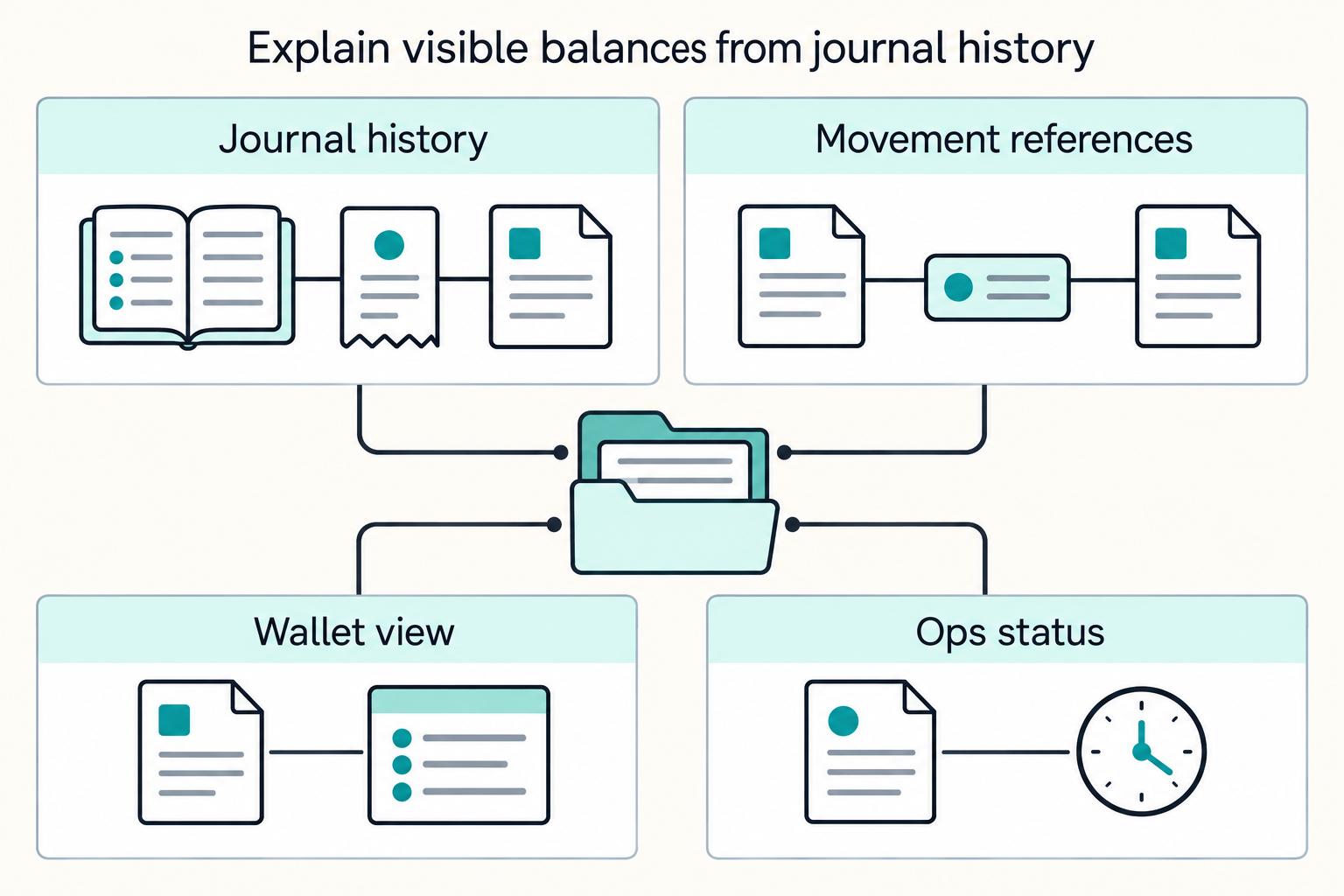
Use a ledger-first model: journal history defines money state, and wallet balances are derived from that record. This gives support and finance one place to explain what happened when updates pass through multiple systems.
At minimum, make each visible balance explainable from journal history plus linked movement references. If a contractor asks why funds are on hold, the answer should come from your internal record, not from stitching together multiple dashboards.
Use explicit operational checkpoints#
Document the key checkpoints in your flow and keep them consistent. A common B2B sequence includes purchase order, invoice creation, and internal approvals before payment execution, with execution sometimes happening in a separate portal or banking system.
| Stage | Core output | Audit question |
|---|---|---|
| Pre-payment controls | Purchase order, invoice, and approval record | Can you show who approved what before money moved? |
| Payment execution | Payment instruction and external confirmation | Can you connect execution back to the same internal record? |
| Reconciliation | Matched internal and external records | Can finance explain any mismatch without guessing? |
| Status communication | Ops and user-facing status update | Does the visible status match reconciled state? |
Make exception handling explicit#
When transactions are grouped and uploaded in bulk, add clear checks for missing or mismatched records before finalizing status. This reduces the risk of unresolved items lingering across teams.
A practical checkpoint is a recurring reconciliation review so unresolved movements are investigated and closed, especially because reconciliation in legacy setups can take days or weeks.
Where workflow integration usually breaks#
A common failure point is the handoff between core operating tools and separate payment or banking systems. Contradictions appear when one system advances status before records are fully matched in the other.
Use a simple control: define investigation paths for unmatched items and avoid presenting a movement as final until reconciliation checks are complete. "Automatic" or "instant" reconciliation is a useful target state, not a guaranteed baseline.
For a step-by-step walkthrough, see Accounts Receivable Cycle for Marketplaces: How to Track Buyer Payments Through to Seller Disbursement.
Evaluate providers with operator-grade due diligence#
Treat provider selection as an evidence gate, not a feature contest. Compare Gemba, Stripe Connect, and similar options with one diligence sheet, and treat every claim as unproven until it is supported by contract terms, API docs, and a live test in your flow.
The core comparison is operational ownership and failure behavior:
- Who owns which compliance actions, decisions, and records.
- What account primitive you are actually getting.
- How payouts behave beyond the happy path, including returns, reversals, and failure handling.
Verify connectivity before roadmap promises#
If onboarding, bank linking, or verification depends on a third-party aggregator, test that dependency before signing. The key check is whether your contractor bank mix can be connected in your target launch markets during testing, not whether a demo says connectivity is available.
Run a short bank and entity test list through sandbox and pilot access if available. Confirm whether aggregator usage is required, what fallback exists when a bank is unavailable, and how failures surface in your product and ops flow.
Use market narratives as discovery input only#
Directory lists, rankings, and market narratives are useful for sourcing candidates, not for launch decisions. They can show direction, but they do not prove provider fit for your users, escalation model, or reconciliation design.
Embedded financial services are growing, and adjacent services are expanding with them. Bain estimated embedded financial services accounted for $2.6 trillion (nearly 5%) of total US financial transactions in 2021. It projected more than $7 trillion by 2026, based on research that included over 50 interviews. Useful context, but not a substitute for contract-backed diligence.
Must confirm before signing#
Before you sign, get the basics in writing and review them as one evidence pack across finance, ops, and engineering. If a candidate will not confirm these points in writing, treat that as product risk.
| Area | What to confirm | Evidence to request | Why it matters |
|---|---|---|---|
| Country coverage | Exact supported countries and entity types for your launch | Written country matrix and onboarding restrictions | Broad regional claims may not match your actual cohort |
| Eligibility rules | Who can open and use the product, and under which conditions | Current eligibility policy and sample outcomes | Hidden rules can appear only in real onboarding |
| Account limits | Balance, inbound, outbound, and transaction limits | Limits documentation and escalation path | Limits can break user expectations and support workflows |
| Webhook behavior | Delivery, retries, duplicates, ordering caveats, outage handling | API docs, sample events, incident process | Your ledger and state logic depend on known behavior |
| Incident response | Contacts, escalation path, severity definitions | Support terms and named escalation route | Slow escalation increases operational and user risk |
Sequence the launch in controlled phases#
Use a phased rollout as an internal operating choice, not as a validated industry Phase 1/2/3 standard. BaaS can let non-bank platforms launch embedded financial products without their own banking license, and a provider may handle licensing, KYC/AML, and transaction processing, but partner choice still affects compliance readiness.
Phase 1. Start narrow with the flow your partner contract supports#
Start with a narrow launch around the core embedded payment flow your partner contract clearly supports (for example, payouts). Keep the promise tight and visible in product.
Be precise in product copy. If capabilities are limited, avoid calling it a full bank account experience. Exit Phase 1 using internal criteria: ops and support can consistently identify blocked, ready, and exception states.
Phase 2. Expand only after reconciliation and support handling are predictable#
Expand only after reconciliation and support handling are predictable. Then add partner-supported capabilities (for example, debit or prepaid card support) and any added compliance controls required by your integration partner.
Treat this as an operations-first expansion, not just a feature release. Product behavior, internal records, and support scripts should stay aligned as scope increases. Exit Phase 2 using internal criteria: reconciliation outcomes are stable, exception handling is manageable, and user-facing copy still matches actual behavior.
Phase 3. Treat adjacent modules as a separate expansion decision#
If you add adjacent modules, treat that as a separate expansion decision. Sequence any modules such as Merchant of Record (MoR) by documented ownership, compliance boundaries, reporting responsibility, and escalation paths.
Exit Phase 3 using internal criteria: finance, ops, and product can trace money movement and responsibility boundaries without ad hoc interpretation.
| Phase | Scope focus | Exit signal |
|---|---|---|
| 1 | Core embedded payment flow supported by partner contract | Status and exception visibility is reliable (internal criterion) |
| 2 | Additional partner-supported capabilities (for example, debit/prepaid cards) | Reconciliation and support handling are stable (internal criterion) |
| 3 | Adjacent modules not sequenced by this evidence (for example, MoR timing is unknown) | Ownership, reporting, and escalation are operationally clear (internal criterion) |
Across all phases, set entry and exit criteria before launch, and treat them as internal controls rather than externally validated benchmarks.
Related: Paying the Unbanked: How Platforms Reach Contractors Without Bank Accounts in Developing Markets.
Prevent the hidden costs that sink launches#
The launch risk is not the clean withdrawal path. Hidden cost often shows up when your product records and partner systems stop staying in sync.
Embedded finance can still recreate older payment fragmentation inside a newer interface. Payment activity can end up separated from core operating tools, teams may fall back to grouped transaction uploads, and reconciliation can drift into delays that last days or even weeks.
The failure modes to plan for early#
Plan for the cases that force manual work, not just the happy path:
- Workflow fragmentation: payment activity lives outside the tools teams use to run day-to-day operations, creating disconnected handoffs.
- Approval-chain bottlenecks: purchase orders, invoice creation, and internal approvals stack up before payment can begin.
- Batch-processing fallback: transactions get grouped and uploaded together, which delays issue detection and correction.
- Extended reconciliation lag: matching records can take days or even weeks, increasing support and finance pressure.
These patterns can increase support and finance workload even when overall volume is still manageable.
Controls that keep exceptions contained#
Containment matters more than elegance once volume starts. Put a few controls in place early:
| Failure mode | Operational effect | Early control |
|---|---|---|
| Workflow fragmentation | Payment activity lives outside the tools teams use to run day-to-day operations, creating disconnected handoffs | Keep payment workflows connected to core operating tools |
| Approval-chain bottlenecks | Purchase orders, invoice creation, and internal approvals stack up before payment can begin | Map and monitor the pre-payment chain so blockers are visible before payment execution |
| Batch-processing fallback | Transactions get grouped and uploaded together, which delays issue detection and correction | Reduce reliance on large batch uploads and increase the cadence of transaction review |
| Extended reconciliation lag | Matching records can take days or even weeks, increasing support and finance pressure | Set clear reconciliation ownership and a routine review cycle |
- Keep payment workflows connected to core operating tools so activity does not split across disconnected processes.
- Map and monitor the pre-payment chain (purchase order, invoice, approvals) so blockers are visible before payment execution.
- Reduce reliance on large batch uploads and increase the cadence of transaction review to catch mismatches earlier.
- Set clear reconciliation ownership and a routine review cycle so multi-day delays do not become normal.
Clean flow vs fragmented flow
| Scenario | What happens operationally |
|---|---|
| Integrated flow | Payment steps stay connected to core operating tools, and handoffs are easier to track. |
| Fragmented flow | Activity is split across disconnected processes, batch handling increases, and reconciliation can stretch to days or weeks. |
If you design these controls before volume arrives, exceptions stay manageable instead of turning into recurring reconciliation and support debt.
Build finance controls that survive month-end close#
Month-end close breaks when unresolved exceptions accumulate, not when the happy path is unclear. If you hold wallet-style balances outside banks, control quality matters more because the cited open-banking model notes those balances are not FDIC insured.
| Cadence | Focus | Key actions |
|---|---|---|
| Daily | Make every delta explainable before it ages | Compare the internal ledger view against provider-reported balances and movement reports; open a tracked item for every break; review exception aging |
| Weekly | Remove repeat failure patterns and review backlog health | Group payout failures by practical causes; review KYC or KYB backlog health and AML-hold trend quality; check for missing required artifacts |
| Monthly | Confirm close readiness and keep the audit pack complete | Confirm tax and entity records are present and linked to the correct contractor entity; keep reconciliation summaries, open-break logs, payout-hold evidence, approval history, and current policy versions |
Daily controls#
Run same-day reconciliation so every delta is explainable before it ages. Compare your internal ledger view, including cash positions, pending payouts, held amounts, and unresolved inbound funds, against provider-reported balances and movement reports.
For every break, open a tracked item with:
- clear accountability
- next action
- supporting references
- current status finance can rely on
Review exception aging in the same pass. Unmatched deposits, AML-held withdrawals, and returned payouts can become close-time AP or AR issues when they sit unresolved.
Weekly controls#
Use weekly reviews to remove repeat failure patterns, not just clear tickets. Group payout failures by practical causes, for example compliance holds, payee-detail errors, and other recurring process issues, then fix the upstream product or ops step where recurrence is highest.
Review KYC or KYB backlog health and AML-hold trend quality:
- identify queues that are aging or bouncing between teams
- check for missing required artifacts
- make sure case notes are strong enough for finance and compliance to share one view of restricted funds
Monthly controls#
Treat monthly controls as readiness checks for close and review. Confirm required tax and entity records are present, linked to the correct contractor entity, and retrievable before close pressure starts.
Keep the audit pack complete and easy to validate:
- reconciliation summaries
- open-break logs
- payout-hold evidence
- approval history
- current policy versions used by ops and compliance
Apply strict data discipline: retain only transfer-related data that is necessary, and structure retention so AML-law compliance is supportable without bloating the evidence set.
Use decision checkpoints to scale safely#
Use UK tax-filing readiness as a hard checkpoint before you scale this cohort.
Before expansion, confirm your onboarding and support flow can consistently handle the basics contractors need for Self Assessment. Check that:
- first-time filers are told to register for Self Assessment before using online filing
- users are told online filing requires a Unique Taxpayer Reference (UTR)
- users are told to keep records such as bank statements or receipts
- existing Self Assessment users are told to reactivate their account before filing, since skipping reactivation can delay a return
- business structure is captured clearly, whether sole trader, limited company, or partnership, and partnership users are not routed to the online service that cannot file partnership returns
- timing guidance is present and easy to find: file on or after 6 April, pay by 31 January, and for the cited year context, tell HMRC by 5 October 2025 in first-time/reactivation cases for returns needed for 6 April 2024 to 5 April 2025 (late notification can lead to a penalty)
Set one explicit launch rule for this checkpoint:
- No go if your product or support journey cannot deliver the items above reliably and consistently.
- Go only when those answers are accurate, current, and easy for both contractors and support teams to retrieve.
Related reading: How to Scale a Gig Platform From 100 to 10000 Contractors: The Payments Infrastructure Checklist.
Conclusion#
The right choice is the one your team can run reliably when compliance questions, reconciliation exceptions, and support escalations all happen at once, not the most account-like feature set.
Embedded finance is compelling because it brings financial activity into the platform where people already work, without forcing system switching. But it also brings added responsibility for compliance, security, partner governance, and risk management. If your team cannot carry that load yet, a narrower operating model is usually the stronger call than a broad account promise.
Use a strict execution order:
- Choose the product model for the real job to be done.
- Lock ownership boundaries with your provider before customer-facing commitments.
- Prove controls in production under real exception handling.
- Expand region and feature scope only after operations are stable and auditable.
Before committing roadmap promises, build two artifacts: a provider comparison table and a launch-phase checklist. Then validate market and program coverage, operating responsibilities, and exception paths in writing. Expand only when the current model is stable, auditable, and supportable under real load.
Before committing new-country rollout promises, validate your go/no-go checklist against real integration and status-flow requirements in the Gruv docs.
Frequently Asked Questions
Can a marketplace legally offer embedded bank accounts to contractors?
Potentially, but there is no blanket yes across all markets. Embedded finance can let a nonbank offer financial services through integrated partner infrastructure rather than building all regulated infrastructure or holding approvals itself. The legal answer still depends on jurisdiction and program structure, so treat legal, regulatory, and supervisory clarity as a launch gate before calling the feature an account.
What is the practical difference between a contractor bank account and a platform wallet?
In practice, labels and user expectations can differ by market and provider model, so validate legal framing before making customer-facing promises.
Which checks are required before contractors can withdraw funds?
There is no single universal checklist that applies to every country and provider. Define withdrawal release gates with your provider and jurisdiction-specific requirements, then make hold reasons visible to both support teams and contractors. If a payout is blocked, your system should show a clear status and reason instead of a generic failure state.
What is the minimum feature set to launch safely without creating reconciliation debt?
A safe minimum is operational control, not just account-like UI. At minimum, define who owns exception handling and how unresolved items are tracked. Because embedded payments are regulated and operationally messy, launch only when edge-case handling is clearly defined.
What usually breaks first at scale: compliance, payouts, or ledger consistency?
There is no single universal answer. The first break can vary by jurisdiction, provider model, and how clearly responsibilities are defined across product and operations.
How do we reconcile contractor balances daily when provider events are asynchronous?
There is no single prescribed reconciliation method. The practical requirement is a consistent internal record that can be compared against provider outcomes, with timing differences handled as explicit exceptions instead of forced matches. Replay safety matters: late or duplicate provider events should not create duplicate financial outcomes.
What should we confirm with providers before promising account availability in new countries?
Confirm the exact country-and-product combination in writing before making availability claims. Validate who is eligible, what functionality is actually supported, which limits or holds may apply, and who owns issue resolution. Do not rely on broad discovery-stage coverage claims when setting customer-facing promises.
Try a related tool
Researched and edited by the Gruv editorial team. Gruv builds cross-border billing, payouts, and finance-operations software for global businesses.
Sources
Includes 1 external source outside the trusted-domain allowlist.
- business.gov.uk/support/business-structures-governance-and-e...trusted
- documents1.worldbank.org/curated/en/099063023143036796/pdf/P1743620c3...trusted
- federalreserve.gov/secrs/2015/april/20150410/r-1479/r-1479_0317...trusted
- federalreserve.gov/aboutthefed/files/bstfinaccountingmanual.pdftrusted
- hks.harvard.edu/sites/default/files/centers/mrcbg/Final_AWP_...trusted
- home.treasury.gov/sites/default/files/2018-08/A-Financial-Syst...trusted
- oecd.org/content/dam/oecd/en/topics/policy-sub-issues...trusted
- bain.com/insights/embedded-financeexternal
Educational content only. Not legal, tax, or financial advice.
Related Posts

The Freelance Payment Penalty: A Modeled Audit of Platform Fees, FX Spreads, and Payout Delays
The money rarely disappears through a single, easy-to-spot fee. The real loss is stacked. A marketplace takes its commission, a processor adds a charge for international cards, a bank or payment company converts the currency at a spread, a platform holds the funds before release, and a wire sheds a little to intermediaries on the way in. Each layer looks defensible on its own, but the worker feels the combined result as a smaller deposit and a later payday.
How to Respond to a Subpoena for Business Records
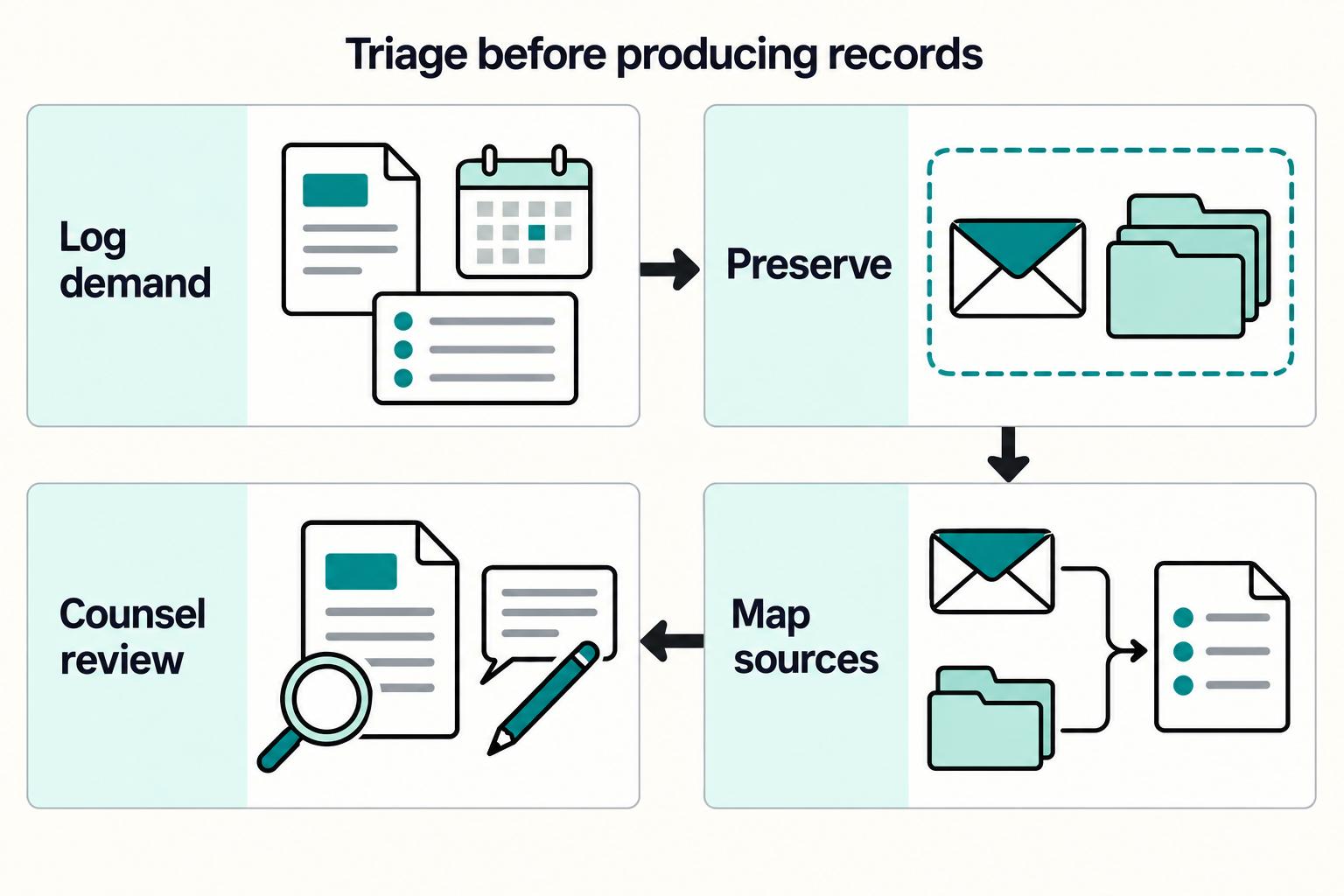
Move fast, but do not produce records on instinct. If you need to **respond to a subpoena for business records**, your immediate job is to control deadlines, preserve records, and make any later production defensible.
A US Expat's Guide to Investing in UCITS ETFs to Avoid PFIC Issues
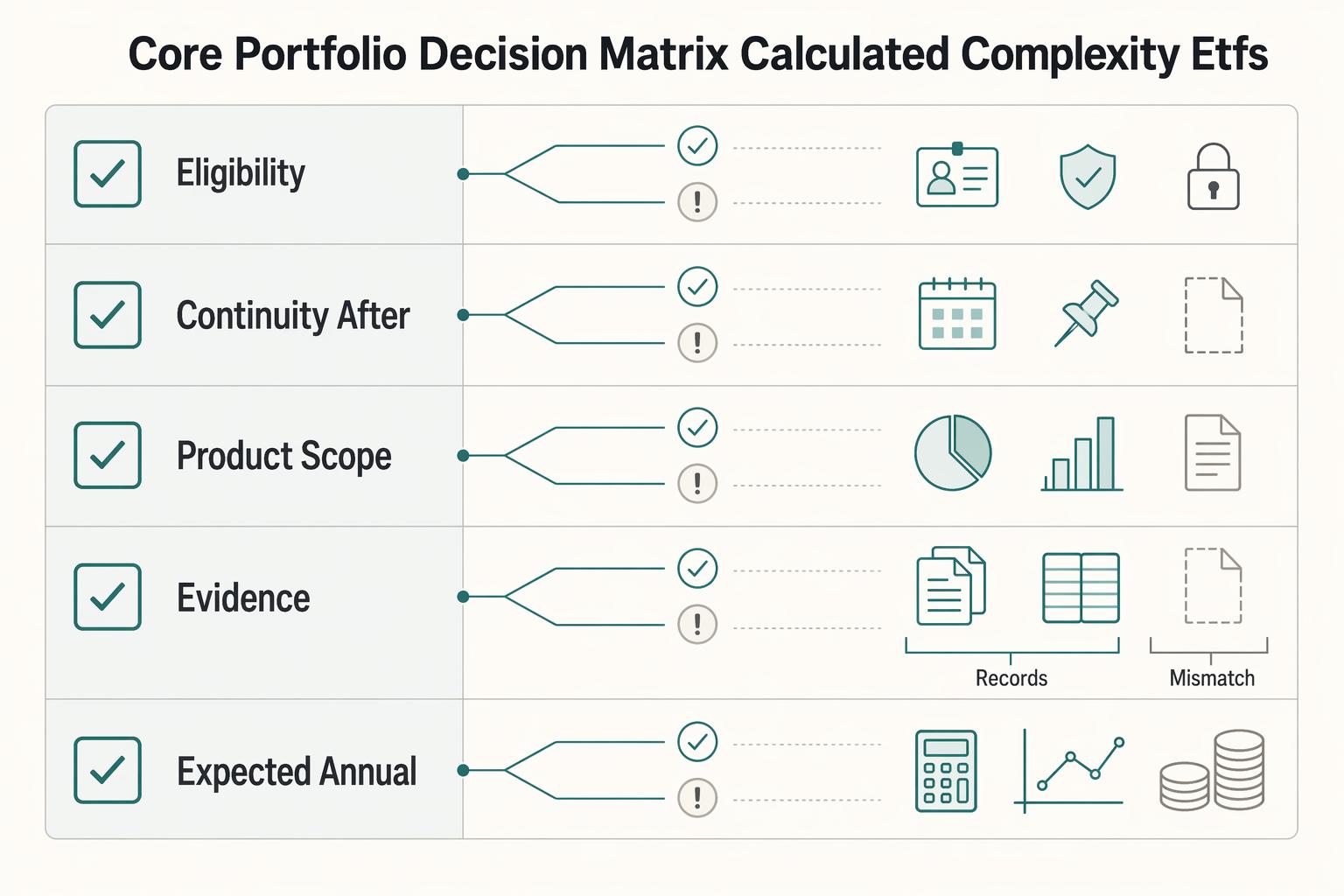
The real problem is a two-system conflict. U.S. tax treatment can punish the wrong fund choice, while local product-access constraints can block the funds you want to buy in the first place. For **us expat ucits etfs**, the practical question is not "Which product is best?" It is "What can I access, report, and keep doing every year without guessing?" Use this four-part filter before any trade: