
Quick Answer
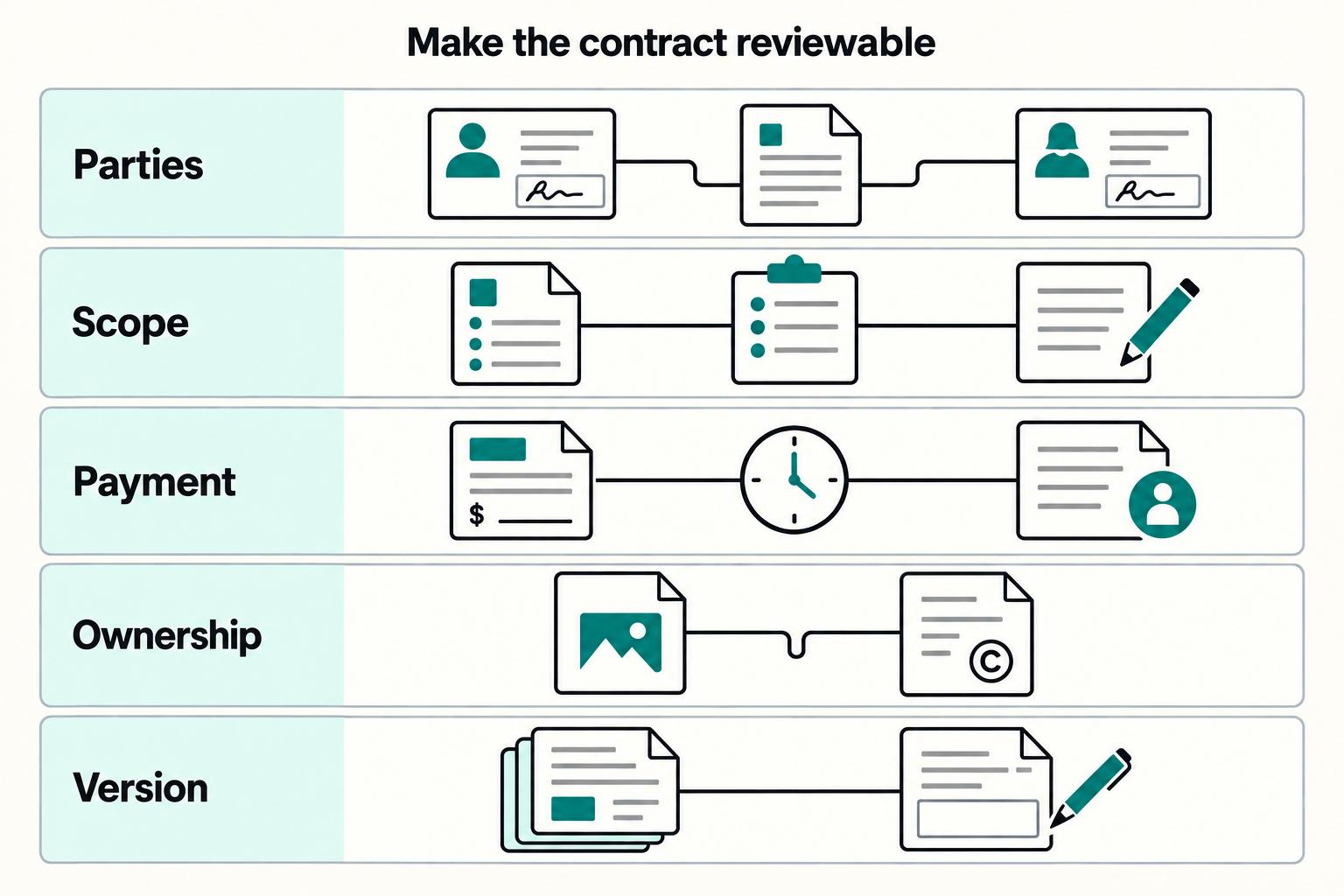
A freelance contract template works best as a controlled starting point, not a file you download and forget. Choose the template based on whether the work is one-off or recurring, then define scope, payment terms, ownership, confidentiality, termination, and acceptance before work starts. Keep the final written and signed agreement set in one place so the accepted version is easy to trace.
Freelance contract templates are useful only when you treat them as a control, not a file you download and forget#
Freelance contract templates are useful only when you treat them as a control, not a file you download and forget. A template gives you reusable language. The real protection comes from how you use it: who approves it, what has to be defined before work starts, which clauses can change, and what record you keep when the Hiring Party and Freelance Worker sign.
Most failures start in operations and only later turn into legal disputes. Payments slip, and small "quick edits" become larger work without extra pay. Once work starts before the terms are clear and signed, both sides take on more risk of non-payment, liability, and avoidable conflict.
The clean way to think about drafting is in two layers: reusable terms and engagement-specific details. Reuse the clauses that should stay the same, but require every project to complete the basics before kickoff, especially scope and payment terms. If those stay vague, disputes are much harder to resolve.
A practical way to do this is with modular terms. Keep a core set that appears every time, then add project-specific modules when the engagement changes. That helps you avoid using a lightweight agreement for work that needs a stronger structure.
The sections that follow focus on clause coverage and process checkpoints that change risk in practice. The point is not to custom-negotiate every deal. It is to make sure higher-risk terms get reviewed before work starts.
Start with one baseline rule: keep everything written and signed in one place. If you use a proposal plus attached terms and conditions, store them together as the binding agreement. That makes scope, payment timing, and the accepted version easy to trace if a dispute comes up.
Template providers also note that templates are not legal advice. Use them to standardize judgment, not to replace legal review, especially for higher-risk engagements.
Indemnity deserves early attention because it can quietly move unlimited risk into an otherwise simple template: How an 'Indemnification' Clause in an MSA Can Create Unlimited Liability.
Build the right mental model before picking a template#
Start with the work and approval process, then pick the paper. Freelance contract templates are only starting text, and control comes from how you use them.
Keep the contract focused on the terms that connect work to payment. In the New York City model, terms 1 through 3 are mandatory under that law: party details, scope, and payment. Even outside NYC, that can be a solid baseline because vague scope can lead to disputes and scope creep.
Be specific enough that both sides can tell what work is owed for the agreed amount. Name both parties, include usable contact information, and identify a contact person who can coordinate completion and payment. Set payment timing and payment method clearly as well. In the NYC sample, if those are not stated, payment is due within 30 days after completion.
Choose a document structure that matches the relationship. For one-off work, a single project agreement may be enough. For ongoing relationships, use a service agreement for the general terms and separate SOWs for each project. Get each SOW agreed and signed before work starts.
A signed agreement does not fix unclear scope. Use International Freelance Contract Clauses for Payment and Dispute Control to pressure-test payment and dispute terms before work starts.
Match each project type to one of 10 template structures#
Once scope and payment are defined, choose the document shape first. For repeat engagements, MSA + Scope of Work (SOW) is often the cleaner base. For one-off work, a standalone freelance agreement can be enough. In practice, separating baseline terms from project terms is often what reduces negotiation friction.
A Master Service Agreement (MSA) sets the baseline legal and commercial rules for an ongoing relationship, and each SOW or order form defines the specific project. Use the table as a working match guide, not as a universal taxonomy.
| project type | payment model | key clauses to set clearly | escalation trigger | payout checkpoint |
|---|---|---|---|---|
| Fixed-scope deliverable Base: standalone freelance agreement | Fixed fee | Scope, acceptance criteria, revision limits, delivery date, ownership handoff | Scope or acceptance language is vague | Written acceptance of final deliverable |
| Hourly specialist Base: standalone if one-off; MSA + SOW if recurring | Hourly | Rate, time approval method, cap or estimate, change rule, invoice cadence | No named approver for hours or no cap on open-ended work | Approved timesheet and invoice match |
| Retainer advisory Base: MSA + SOW | Monthly retainer | Included services, response expectations, out-of-scope rule, term and termination | Retainer starts absorbing delivery work that should be separate | Monthly service summary approved |
| Milestone build Base: MSA + SOW | Milestone payments | Milestone definitions, dependencies, stage acceptance, change control, handoff terms | Milestones depend on client inputs or third parties but responsibility is unclear | Signed milestone acceptance |
| Maintenance/support Base: MSA + SOW | Recurring fee with overage or hourly add-ons | Support scope, exclusions, response targets, access rules, issue logging | Service expectations expand without clear exclusions | Ticket closure record and period approval |
| Creator licensing Base: standalone if single campaign; MSA + SOW if ongoing | License fee or staged fee | Usage rights, approval rights, delivery format, payment timing, takedown or revision handling | Exclusivity, broad buyout, or reuse rights are unclear | Asset delivery plus rights confirmation |
| Data-processing vendor Base: MSA + SOW | Recurring or milestone | Scope, confidentiality, security addendum, data-use limits, return or deletion terms | Data handling or security terms are introduced mid-deal | Signed SOW and required security documents on file |
| Performance marketing Base: MSA + SOW | Base fee plus performance component | KPI definition, attribution source, spend approval, reporting cadence, payout logic | KPI or attribution source can be changed after launch | Locked performance report approved |
| Localization/content ops Base: MSA + SOW | Per word, per item, or monthly volume | Volume assumptions, QA standards, glossary or style guide, rework rule, turnaround | High-volume queue starts without agreed QA and rework rules | Batch QA report or accepted delivery batch |
| Marketplace batch work Base: standalone for single batch; MSA + SOW for repeated batches | Per task or per batch | Task spec, acceptance sampling, rejection rule, payout timing, rework handling | Rejection rates rise or task specs change mid-batch | Batch completion log and sampled acceptance |
When the standalone agreement is enough#
A standalone agreement can be enough when the work is self-contained, acceptance is straightforward, and the relationship is unlikely to keep generating new projects. If that "one-off" document starts collecting recurring service terms, multiple project add-ons, or operational and security appendices, it is usually time to shift to an MSA + SOW model.
Where MSA + SOW earns its keep#
MSA + SOW is often the better fit when you expect repeat projects or changing project terms and do not want to renegotiate the full boilerplate each time. It works best when paired with detailed project and operating documents, such as SOWs, order forms, service-level agreements, and security addenda where needed.
Verification points that matter#
The real control point is not just "contract signed." It is "the right base document signed, the current project document signed, and acceptance evidence defined before work starts."
For repeat engagements, review the framework from time to time so it stays aligned as services and compliance or security expectations change. For payout control, keep the acceptance artifacts with the signed contract set, such as approved timesheets, milestone signoff, QA records, or rights confirmation. If your process includes e-sign audit trails, keep those with the agreement package too. Pair that evidence file with the red-flag checklist in 10 Freelance Contract Red Flags That Scream 'Run Away'.
Lock the non-negotiable clause stack before legal polishing#
Lock the minimum clause stack before anyone starts polishing language. Weak contracts often break on the basics: scope creep, late payment, and ownership disputes. Treat the template as a starting point, then confirm these controls before you spend time on wording edits.
| Area | What to confirm |
|---|---|
| Identity and contractor status | Legal names, addresses, and tax identifiers where applicable; state the relationship as Independent Contractor |
| Scope of Work | Deliverables and acceptance criteria clear enough to check off; include an approval-and-record step so scope changes are documented before they are treated as agreed |
| Payment Terms | Choose a payment structure that fits the project; define invoicing rules and approval workflow; tie payment triggers to clear acceptance events that can be tracked later |
| Risk clauses | Keep clauses that define ownership and contractor status in every reusable template version |
| Pre-sign checkpoint | Confirm which template version was used and keep signature tracking throughout signing |
Start with identity and contractor status#
Get party identity right first. Clearly name the Hiring Party and Freelance Worker with legal names, addresses, and tax identifiers where applicable. Confirm those details before signature.
State the relationship as Independent Contractor, not employment. Keep that label in place, but do not assume the label alone protects you if day-to-day working practices look like employment.
Put dispute control into the Scope of Work#
The Scope of Work is where many disputes are either prevented or invited. Make deliverables and acceptance criteria clear enough to check off. Clear scope and acceptance terms reduce ambiguity and lower dispute risk.
Include a simple approval-and-record step in the same project pack so scope changes are documented before they are treated as agreed.
Lock Payment Terms before negotiation expands#
Finalize Payment Terms early. Choose a payment structure that fits the project, then define invoicing rules and approval workflow so billing stays predictable. As a practical rule, tie payment triggers to clear acceptance events that can be tracked later.
Keep the risk clauses in every version#
Keep baseline risk clauses in every reusable template version, including the clauses that define ownership and contractor status. Consistency across versions matters as much as wording quality, because silent clause drops create avoidable exposure.
Add a real pre-sign checkpoint#
Use one pre-sign verification step and keep an audit trail. A practical checkpoint is to confirm which template version was used and keep signature tracking throughout signing. Version control and signature tracking answer the questions that matter later: what was signed, what changed, and when approvals happened.
For a step-by-step walkthrough, see 7 Freelance Contract Negotiation Clauses to Redline Before You Sign.
Turn your approved clause stack into a working first draft your team can redline faster with the Freelance Contract Generator.
Choose payment structure with risk tradeoffs in plain view#
Choose the payment structure based on what you can actually verify at payout time. If deliverables are objective and easy to check, milestone-based payouts can make acceptance and release criteria easier to define. If scope is fluid, hourly models need strict change approval and approval records.
Payment terms do more than set the price. They define how and when work gets paid. Terms like "upon completion" are too thin unless "completion" is clearly defined in the attached Scope of Work.
| Payment structure | Cashflow predictability | Dispute risk | Operational load | Control precondition |
|---|---|---|---|---|
| Hourly | Depends on approval cadence and any hour limits | Depends on scope boundaries, time records, and approval discipline | Timesheet review + change control | Clear time logging and pre-approval rules |
| Fixed-fee | Depends on how tightly scope and revision limits are defined | Depends on deliverable clarity and acceptance criteria | Front-loaded scoping + acceptance workflow | Explicit outputs and revision boundaries |
| Milestone Payments | Tied to staged release points | Lower when each milestone has objective acceptance evidence | Stage review and release each cycle | Verifiable milestone triggers |
| Retainer Clause | Depends on defined availability and included work | Depends on clarity of included work, availability, and rollover rules | Usage, capacity, and renewal tracking | Explicit service boundaries and renewal terms |
Pick the structure that matches verifiable triggers#
Use a simple test: can you name a specific, verifiable payout trigger?
"Release when milestone 2 assets are delivered in the agreed format and approved by the named reviewer" is controllable. "Release when the project is done" is not.
For hourly models, keep a written change-order rule. Added work, added hours, or deadline shifts should be approved before they become billable. This helps prevent workflow failures where work expands without a shared approval record.
Use fee clauses only for named exposure#
Do not stack fee clauses by habit. Use a Late Fee Clause, Cancellation Fee Clause, or Kill Fee Clause only when each one covers a specific and explainable risk.
| Clause | Define in writing |
|---|---|
| Late Fee Clause | When an invoice is valid and what acceptance event starts the clock |
| Cancellation Fee Clause | Which reserved time or capacity it covers |
| Kill Fee Clause | What partial work qualifies and how it is measured |
- If you use a Late Fee Clause, define when an invoice is valid and what acceptance event starts the clock.
- If you use a Cancellation Fee Clause, define which reserved time or capacity it covers.
- If you use a Kill Fee Clause, define what partial work qualifies and how it is measured.
If setup and dependency exposure is low, you may not need every clause.
Keep payout release aligned with policy gates#
Payment control breaks down when legal approval and finance checks drift apart. If your process uses identity or compliance gates, reflect that in the payout workflow so acceptance and policy clearance move together.
Different services may need different checks, and there is a real tradeoff between onboarding speed and platform safety. As contractor volume grows, version control and audit-trail discipline become payment controls, not just admin work. A practical release record includes both:
- acceptance evidence, such as an approved deliverable, named reviewer signoff, or milestone confirmation
- policy clearance status where your process requires it
The failure mode to avoid#
Paying before you have acceptance proof weakens your position if delivery quality is disputed later. It is not automatically unlawful, but it is a weak control choice when the output can still be challenged or revised.
Also watch for a quieter failure: the contract legal approved is not always the version that gets signed. For any payment-structure change, keep version control, log approved deviations, and confirm that the signed contract, attached Scope of Work, and payout setup all match.
Set explicit escalation triggers for legal and compliance review#
Write the escalation rules down before contracts go out. Ops can handle unchanged standard paper. Counsel should review non-standard IP terms and cross-border fee assumptions, and any liability language that falls outside your standard position.
Treat liability asymmetry as a routing rule#
Use this as an internal trigger, not a universal legal test. Route to counsel when Indemnification Clause or Limitation of Liability language is changed from your standard terms.
For each escalation, log the redline and why it changed: who indemnifies whom, what losses are covered, whether there is a cap, and what sits outside the cap. That makes review more consistent and usually faster.
Escalate IP when your business needs ownership, not only usage rights#
Do not treat IP language as boilerplate. In the WordFields template, assignment of deliverable IP happens only after full payment, and freelancer Background IP stays freelancer-owned with a non-exclusive, perpetual license for incorporated material.
Escalate the IP Protection Clause and Ownership Clause when your use case depends on transfer timing or limits on embedded pre-existing materials. Confirm in writing when rights transfer and what remains Background IP.
Run external templates against internal standards before use#
If you import outside templates, compare them clause by clause to your internal standards before signature.
Include payment-cost language in that check. Wise states fees vary by currency, and additional Swift fees may apply when a transfer is converted to euros and the recipient is outside SEPA. If a template assumes fixed transfer costs or assigns fees without route or currency review, escalate to legal or compliance with finance input.
Write the approval matrix down#
Keep a short matrix so exceptions stay consistent.
| Draft condition | Ops can approve | Counsel must approve |
|---|---|---|
| No clause edits, standard paper, standard payout method | Yes | No |
| Edits limited to dates, contacts, or defined invoice stages | Usually | No, unless another trigger appears |
| Liability language changed from your standard terms | No | Yes |
| Any change to Ownership Clause, IP Protection Clause, transfer timing, or Background IP treatment | No | Yes |
| Any cross-border payment-fee assumption without route/currency review | No | Yes |
Require the redline, approver record, and signed version to match the matrix decision. Related: A Biotech Consultant's Guide to IP Protection in Contracts.
Handle cross-border compliance fields without guesswork#
Treat payout readiness as an intake control, not a contract footnote. Put cross-border tax and jurisdiction fields into your operating record, assign an owner, and define which checks have to clear before payout release.
| Intake field | What to record |
|---|---|
| Expected onboarding tax document | Expected onboarding tax document for the program |
| Document status | Received and checked for completeness |
| VAT validation or self-billing review | Whether VAT validation or self-billing review is required |
| Jurisdiction signals | Signals that may change template assumptions |
| Internal approver | The internal approver who can clear or block payout |
Many templates capture the commercial terms but miss the compliance handoff. At minimum, your intake should record:
- expected onboarding tax document for the program
- document status, meaning received and checked for completeness
- whether tax-document or customer-issued invoice review is required
- jurisdiction signals that may change template assumptions
- the internal approver who can clear or block payout
Put tax-document status into the operating record#
Keep the contract readable and keep document control in operations. If your program requires onboarding tax documents, track what is expected and whether it was received and checked for completeness in the intake file instead of overloading the contract with tax detail.
A practical pattern is to state in the agreement that payment is subject to required onboarding and tax documents, then track exact status in intake. It also helps to attach supporting documents to invoices, such as acceptance notes, a short delivery summary, or proof-of-work links, to reduce payment disputes when review delays payout.
Treat customer-issued invoice workflows as a real review gate#
If the customer or platform prepares invoices on behalf of the freelancer, treat that workflow as a release gate, not a checkbox. The contract should say who issues the invoice, what approval evidence must exist, and when finance or tax review is required before money moves.
In practice, keep records of contractors who allow customer-issued invoices, review the arrangement on a regular schedule, and make sure the invoice file matches the contract, service acceptance, and tax-document record before payment.
Watch the failure mode here. If the invoice owner changes, tax status changes, or required invoice fields no longer match the operating setup, pause and route the file to finance or tax review before the next payout. Do not reuse one country-specific invoicing rule as if it applies everywhere.
Flag local-law variance before someone reuses the wrong paper#
Local law can change what a template can safely assume, even when the commercial terms look standard. Use jurisdiction as an explicit intake field, and flag local requirements that could change template assumptions.
Say this plainly in your template guidance: template language is a starting point, not legal advice. Enforceability, tax treatment, and filing obligations vary by country and program, so route unfamiliar jurisdictions to legal review instead of reusing assumptions from another market.
Make Governing Law, Jurisdiction, and Dispute Resolution operational#
Do not leave governing-law, jurisdiction, or dispute terms as placeholders. In your process, treat them as completion checks before signature, like scope and payment terms.
Governing Law is a standard freelance-contract element, and contracts can include dispute-resolution mechanisms. Your record should show what was selected in the signed version: which law applies and which dispute-resolution method the clause uses.
Use a simple verification checklist:
- confirm the governing-law field is completed, not left as default template text
- record each party's principal place of business with the signed agreement
- keep the final written and signed contract in one place
On dispute handling, be explicit. The source material supports having a dispute mechanism, but it does not establish one required sequence or one required forum. If your team wants a particular sequence, define it in the clause and make sure it gets internal approval.
This is a practical control, not a theory point. Payment delays and clients disappearing after delivery can happen, and a signed contract helps only if the final terms are clear and easy to retrieve. Keep the usual boundary in place as well: template language is a starting point, not legal, tax, or business advice.
Design Termination logic before the project starts#
Set termination logic before the effective date and before work starts, then lock it into the signed contract. Separate termination for cause from termination for convenience, with clear notice mechanics and clear payment outcomes.
A termination clause should state how the agreement ends and how many days' notice are required, especially when there is no fixed end date. Before signature, confirm that the final version is fully customized and clearly states who can invoke each path.
Split the exit paths#
Treat the two paths as different events with different consequences:
| Exit path | What to define in the contract |
|---|---|
| Termination for cause | Trigger conditions, such as breach or nonperformance, whether a cure period applies, and what happens if the issue is not fixed |
| Termination for convenience | Notice requirement, who can invoke it, and what work remains payable at exit |
Contracts are negotiable until signed, so align this language to your real workflow. If you bill by milestones, tie exit rules to Milestone Payments. If you bill in phases or time-based intervals, define how in-progress Installment Payments are treated.
Price early exit by project stage#
If you use a Cancellation Fee Clause or Kill Fee Clause, tie it to project stage rather than a generic flat number. Stage-based kill fees are a practical way to handle client pullout, so map fees to documented progress.
When writing this section, clarify:
- what the client receives at each stage
- which fee applies at each stage
- how partial deliverables affect payment at exit
That helps reduce disputes over unpaid extra work when cancellation happens mid-project.
Decide unfinished payment handling in writing#
Early termination exposes weak payment language fast. Resolve these points in the contract:
- whether a completed but uninvoiced milestone is still payable
- how partially earned Installment Payments are calculated through the termination date
- whether in-progress work triggers payment, and under what documented checkpoint
Do not leave this for post-termination email interpretation.
Keep a closeout record#
A closeout checklist can help avoid confusion. Keep one retrievable record with the signed contract that can capture:
- final files or partial deliverables transferred
- access changes for shared systems and accounts
- confidentiality or NDA reminders at exit
- payment reconciliation artifacts, such as the final invoice and approval record
That record can make later disputes over deliverables, access, or balances easier to sort out.
For cap language, use How to Write a Limitation of Liability Clause for a Freelance Contract to check whether the limitation clause actually matches the engagement risk.
Negotiate Limitation of Liability and Indemnification without creating dead deals#
Once termination terms are set, the next negotiation is about downside allocation. The goal is a Liability Clause that the Hiring Party can approve and the Freelance Worker can actually absorb, without vague unlimited exposure.
Cap liability to the deal you are actually signing#
Set the cap to contract value and realistic risk, not to a copied number. One workable formula is the greater of total consultant compensation under the agreement or the amount of recoverable insurance.
Use the same discipline for carve-outs. Some clauses preserve liability for confidentiality obligations, indemnity obligations, and gross negligence or intentional or willful misconduct. Keep only the exceptions you can justify in plain language.
Before treating the contract as effective, confirm that both parties have signed and that the signed draft still contains the negotiated cap formula and carve-outs. Liability language can shift in late redlines.
Keep indemnity tied to controllable conduct#
Indemnification works best when it is narrow and tied to causation. A common approach is mutual indemnity only to the extent each party's own misconduct or negligence causes liability to the other party.
Treat broad language as a risk signal. Phrases like "any claims arising out of the project" or "all losses related to the services" can create open-ended exposure, especially when third-party or affiliate losses are pulled in without clear limits. If indemnity is one-way, uncapped, or broader than the operating risk, escalate instead of treating it as routine line editing.
Where multiple entities are involved, ring-fence the obligations. Some agreements expressly state that one entity is not liable for claims against another, and the same approach can help prevent silent expansion to sister companies, users, or unnamed partners.
Make liability, IP, and confidentiality read together#
Review the IP Protection Clause, confidentiality terms, and Liability Clause as one package, not as isolated clauses. If those provisions do not line up, you can end up with exposure that is much broader than the business intent.
Run the same coherence check on damage exclusions. Some templates exclude lost profits or revenues, loss or interruption of use, and lost or damaged data. Those exclusions can sharply limit recoverable remedies, so test them against the actual project risk, not just the clause heading.
Keep an approval record with the final redline, the agreed cap position, and a short rationale for carve-outs or indemnity asymmetry. If liability allocation is materially asymmetric, route it to counsel before procurement sign-off.
For technical AI/ML work, A Guide to Liability Clauses for Freelance AI/ML Engineers shows how liability language changes when model behavior and data handling are in scope.
Build an audit-ready evidence pack for every signed template#
A written contract is the core record for each engagement; without one, misunderstandings are common. An audit-ready pack should show what was agreed and when it became valid.
Keep the signed freelance contract and the final terms for job requirements and payment terms in one folder or system record. The contract is valid on the Effective Date, meaning when both Parties have signed, so keep the fully signed version as the record copy. Send the agreement before any work starts, then retain that signed record.
Generic freelance contract templates are a useful starting point, but they are not legal advice and may not replace legal review. If you get legal or business review on a clause, keep that decision with the contract record for traceability.
Keep payment-readiness artifacts next to the contract#
If your payout process depends on additional compliance checks, store those artifacts in the same engagement record. Treat them as internal controls tied to your process, not universal requirements defined by the template sources.
Assign ownership before money moves#
If your team uses ownership or payout checkpoints, define them clearly before disbursement and for renewals or extensions where relevant. Treat those checkpoints as internal process choices rather than requirements set by the template sources. Related reading: How to Write an Arbitration Clause for a Freelance Contract.
Conclusion#
Do not treat this as a one-template decision. Match the template type to the work, then apply the same control layer every time: clear scope, usable payment terms, and an explicit independent contractor classification decision before work begins.
That is what makes a contract workable, not just complete on paper. A usable agreement sets expectations, responsibilities, timeline, deliverables, revisions, payment schedule, and any special requirements up front. When those terms stay vague, teams end up arguing about what was agreed instead of delivering work.
If you standardize one thing, standardize both the clause stack and the execution checks. The core checkpoint is simple: keep the final agreement written and signed in one place, with approved wording intact for scope, payment, and classification. Avoid vague "completion" language by defining deliverables, revisions, and timing clearly.
Treat classification with the same rigor. "Independent contractor" is a worker-status decision with tax implications, and making an educated classification determination is a critical employer step. Also keep the legal context current: one classification source is dated April 23, 2012, so use it as background, not as current cross-jurisdiction legal advice.
A practical rollout is to pilot this on one contractor category first:
- Choose one recurring use case with repeatable deliverables.
- Lock core fields: scope, timeline, deliverables, revisions, payment schedule or amounts, and any NDA or other special requirement.
- Set one approval rule for template edits and one storage rule for signed agreements.
If that pilot reduces avoidable disputes, promote the approved template set into your default contracting process.
If you want contract approvals and payout controls to run in one operational flow, review how Payouts can fit your process.
Frequently Asked Questions
What must every freelance contract template include to be operationally usable?
At minimum, include scope of work, payment terms, IP ownership, confidentiality, and termination terms before work starts. Keep scope specific to reduce unpaid scope expansion, and keep the final agreement written and signed in one place. At higher scale, unmanaged template edits become a version-control and audit-trail risk.
Which Payment Terms reduce disputes most in cross-border projects?
Payment terms reduce disputes most when they rely on specific, verifiable triggers. Avoid vague language like completion unless the contract defines what completion means and what evidence proves it. Tie payment to documented events defined in the contract.
When should you use hourly pricing versus Milestone Payments or a Retainer Clause?
The article does not give a universal rule. Use the pricing model you can define clearly and verify at payout time in the contract and records. If deliverables are objective, milestone payouts can make acceptance easier to define, while hourly models need strict change approval and approval records when scope is fluid.
Which clauses are optional, and which are high-priority risk controls?
Treat scope, payment, IP ownership, confidentiality, and termination as high-priority risk controls. These are core terms, not optional polish. Use caution with non-compete language, because it carries worker-classification risk in freelance agreements.
When does a template require legal review instead of ops approval?
Route a template to legal when the signed version drifts from the approved version or when liability language changes from your standard terms. Escalate changes to ownership, IP protection, transfer timing, Background IP treatment, or cross-border payment-fee assumptions without route or currency review. The article does not set a fixed ops-versus-legal threshold.
How should Governing Law, Jurisdiction, and Dispute Resolution change for cross-border engagements?
Do not treat governing law, jurisdiction, or dispute resolution as auto-filled defaults in cross-border engagements. The article says these are deliberate legal choices, and enforceability depends on local law. Complete those fields in the signed version and route unfamiliar jurisdictions to legal review instead of reusing assumptions from another market.
Researched and edited by the Gruv editorial team. Gruv builds cross-border billing, payouts, and finance-operations software for global businesses.
Sources
Includes 6 external sources outside the trusted-domain allowlist.
- iicl.law.pace.edu/sites/default/files/cisg/cross-border_contra...trusted
- nyc.gov/assets/dca/downloads/pdf/workers/Model-Contr...trusted
- aceseditors.org/news/2019/what-you-need-to-know-about-freela...external
- afterpattern.com/clauses/limitation-of-liabilityexternal
- aiga.org/sites/default/files/2023-11/Standardformofag...external
- contractbook.com/templates/freelance-contractexternal
- juro.com/contract-templates/freelance-agreementexternal
- nation1099.com/freelance-contract-how-to-write-statement-of...external
Educational content only. Not legal, tax, or financial advice.
Related Posts

The Freelance Payment Penalty: A Modeled Audit of Platform Fees, FX Spreads, and Payout Delays
The money rarely disappears through a single, easy-to-spot fee. The real loss is stacked. A marketplace takes its commission, a processor adds a charge for international cards, a bank or payment company converts the currency at a spread, a platform holds the funds before release, and a wire sheds a little to intermediaries on the way in. Each layer looks defensible on its own, but the worker feels the combined result as a smaller deposit and a later payday.

How to Respond to a Subpoena for Business Records
Move fast, but do not produce records on instinct. If you need to **respond to a subpoena for business records**, your immediate job is to control deadlines, preserve records, and make any later production defensible.

A US Expat's Guide to Investing in UCITS ETFs to Avoid PFIC Issues
The real problem is a two-system conflict. U.S. tax treatment can punish the wrong fund choice, while local product-access constraints can block the funds you want to buy in the first place. For **us expat ucits etfs**, the practical question is not "Which product is best?" It is "What can I access, report, and keep doing every year without guessing?" Use this four-part filter before any trade: