
Quick Answer
Flag msa indemnification clause risk early when a draft combines “any and all claims,” defense-cost obligations, and no clear cap linkage. Check the MSA and SOW together, limit triggers to your breach or conduct, and require written controls for counsel, settlement, survival, and claim deadlines. If indemnity sits outside the limitation section, negotiate a separate cap before signing.
You can sign MSAs faster without accepting open-ended risk#
Use this as a first-pass screen. Decide whether the risk allocation language is acceptable, fixable, or a pause or walk away issue based on the full Master Services Agreement (MSA), not one paragraph in isolation. The goal is to make the right call early, then move into focused redlines instead of debating the same baseline terms over and over.
Anchor the MSA before you judge indemnity. Before you redline this clause, make sure the baseline MSA is clear enough to support a practical risk call. A Master Services Agreement (MSA) sets the terms for an ongoing business relationship before specific projects are approved, and it is meant to cover future work, not just one project. Start with the basics:
- Scope of service should define the services with concrete checkpoints, including deliverables and milestones.
- Payment terms should state how much, how often, and by what payment method.
If either is vague, fix that first. Loose scope and fuzzy payment mechanics make this language harder to evaluate consistently.
Use a practical outcome bucket. Do not try to perfect the whole contract in one pass. What you need from a first review is a short list of redline priorities, plain negotiation language, and a reusable checklist. A practical screen usually lands in one of three buckets:
- Acceptable: the clause appears aligned with the work, and the rest of the contract is specific enough to support review.
- Fixable: the issue is narrow and can be handled with targeted edits.
- Pause or walk away: the clause is too broad, too disconnected from the services, or too unclear for a fast review.
Speed here means deciding well early, not saying yes faster.
Keep the boundary clear. This is a practical review screen, not legal advice. Keep your review anchored to the contract text itself. Once the MSA baseline is clear on scope, milestones, and payment mechanics, your redlines become faster and easier to repeat across future work.
Gather these documents before you redline#
Do not redline this language in isolation. Pull the full contract set first so you can review definitions, liability mechanics, and project scope together.
| Item | Review focus |
|---|---|
| Current Master Services Agreement (MSA) | Get the current MSA; it sets the general relationship terms |
| Active statement of work (SOW) | Get the active SOW; it carries engagement-specific scope and delivery timelines |
| Attachment or exhibit on this topic | Pull any attachment or exhibit on this topic if one exists |
| Capitalized terms in the clause | Confirm they are defined and consistent across documents |
| Limitation of liability clause / Exclusion of liability clause / Liability cap references | Review them together as one connected set |
| Survival language / claim-filing deadlines | Identify where the obligation ends and when a claim must be brought |
Pull the full contract set. Get the current Master Services Agreement (MSA), the active statement of work (SOW), and any attachment or exhibit on this topic if one exists. The MSA sets the general relationship terms, while the SOW carries engagement-specific scope and delivery timelines, so you need both before you can judge risk. Then verify the defined terms. If the clause uses capitalized terms, confirm they are defined and consistent across documents, because those definitions control when obligations start.
Collect claim categories and compare them across related clauses. Pull the claim categories named in the contract into the same review set. If categories are handled differently across related liability terms, mark that gap for negotiation instead of assuming the clauses align.
Mark the liability structure as one connected set. Before you edit any sentence in this section, find the Limitation of liability clause, any Exclusion of liability clause, and every Liability cap reference. Review them together. This avoids false confidence from partial edits, especially in long paper, where related cap language is easy to miss.
Find the clock on post-signature exposure. If the contract includes survival language or claim-filing deadlines, identify them before redlining. Your checkpoint is simple: can you point to where the obligation ends and when a claim must be brought? If you cannot answer that from the documents in front of you, pause redlining until you can.
How unlimited liability gets created in routine client paper#
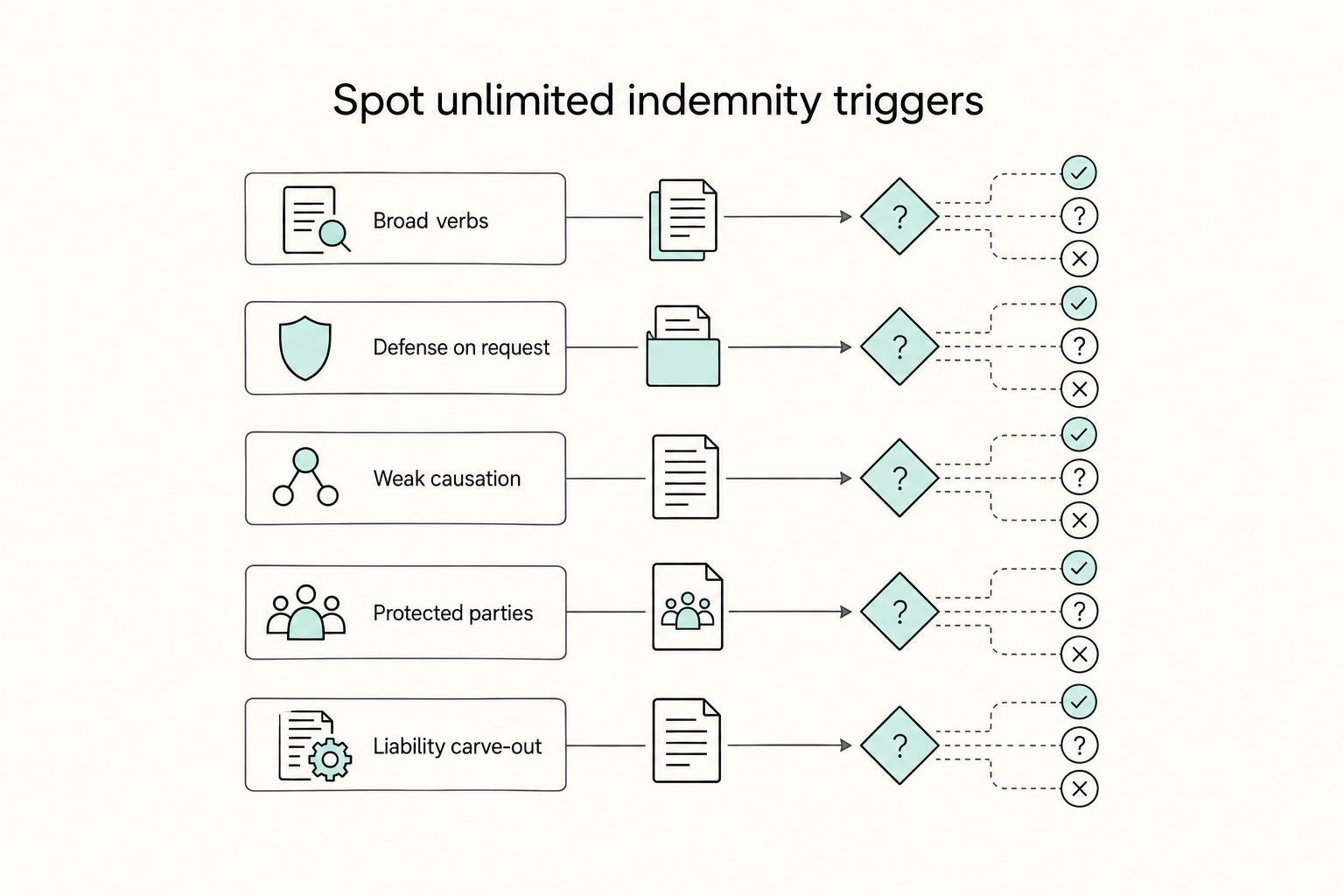
Open-ended exposure can come from stacking, not one word by itself. A common stack is a broad trigger, a defense obligation, and no effective cap.
| Risk driver | What to check | Why it matters |
|---|---|---|
| Broad operative verbs and loss language | Mark every operative verb, not just "indemnify"; check for bundled wording and "any and all claims" | Attorneys' fees and costs can be pulled into the obligation and exposure can widen |
| Defense on request | Check whether you must defend on request, not after fault is proven | Cash exposure can start early and grow quickly |
| Weak fault or causation link | Check whether the clause has a clear negligence, breach, or causation standard | Losses can reach conduct only loosely connected to your work |
| Broad protected-party definition | Read the defined term and count who sits inside "Client Indemnitees" or the equivalent | Protection may extend beyond the signatory client |
| Carve-out from Limitation of liability | Check whether the obligation is carved out of the Limitation of liability clause | Your cap may not apply at all |
Mark the stack that creates open-ended exposure. Start by marking every operative verb, not just "indemnify." Clauses often bundle "protect, defend, hold harmless, and indemnify," then define covered losses to include attorneys' fees and costs. That can pull legal spend into your obligation before final liability is decided.
If you, as Indemnitor, are on the hook for "any and all claims" or similarly broad loss language, treat it as high risk even on a small SOW. Also check whether this obligation is carved out of the Limitation of liability clause. If it is, your cap may not apply at all.
Check whether defense costs start before fault is decided. The key question is whether you must defend on request, not after fault is proven. Under California Civil Code § 2778(3), indemnity against claims can include defense costs. Section 2778(4) states the indemnifying party is bound to defend on request of the indemnified party. Enforcement varies by jurisdiction, so governing law controls the real effect.
When defense obligations and attorneys' fees apply at the claim stage, cash exposure can start early and grow quickly.
Test the fault and causation link. A weak fault link expands risk. If the clause lacks a clear negligence, breach, or causation standard, it can reach losses only loosely connected to your work.
Be especially careful with "arising out of" phrasing, which is often interpreted broadly in many jurisdictions. A safer structure ties coverage to losses directly caused by your acts or omissions.
Confirm who is protected by the indemnity. Do not assume the Indemnitee is only the signatory client. Many definitions extend protection to officers, directors, managers, employees, agents, attorneys, control persons, and affiliates.
Read the defined term and count who sits inside "Client Indemnitees" or the equivalent. If the protected group is broader than what you scoped and priced, narrow it before you proceed.
Build an indemnification scope you can actually carry#
A practical way to reduce this risk in an MSA is to narrow the claims that trigger the obligation, then make sure the rest of the clause matches that scope.
Limit the trigger to risks you actually control. Start with the trigger list, because it sets the boundary of what you may have to reimburse. Keep it tied to claims connected to your own work under the agreement, not open-ended wording like claims merely "related to" services.
In many MSA structures, the core legal terms sit in the MSA and project details sit in each SOW. So if the MSA trigger is broad, a narrower SOW may not fix it by itself.
Narrow who is protected and what losses count. Use the same four-part review each time: who indemnifies, who is covered, what payments are reimbursable, and which claims trigger the obligation.
Then tighten the protected-party definition and loss language. If Indemnitee expands beyond the signing client, or reimbursable losses are written as an all-in bucket, exposure can increase. Small wording changes here can materially change financial exposure.
Require a clear claim-to-conduct link. If the clause does not clearly connect a claim to your conduct, scope control is weak. Ask for plain wording that makes the trigger-to-conduct link explicit, so you can explain what actually activates payment. If you cannot summarize the trigger in one sentence, the clause is probably still too loose.
Define defense process terms in writing when they apply. If the clause includes a duty to defend, spell out the process in writing instead of relying on assumptions.
Reciprocal wording alone does not solve risk. The trigger list and clause details are what manage risk. That is the difference between a manageable obligation and an open-ended one under an indemnification clause.
Keep Limitation of Liability connected to indemnity#
Treat the Limitation of Liability clause and this provision as one connected set, or your cap can lose practical value. In an MSA, that matters even more because one master set of terms can apply across multiple SOWs.
Cross-reference indemnity to the LIMITATION OF LIABILITY section. Do not assume the cap applies just because both clauses appear in the same agreement. Use explicit text that ties this provision to the LIMITATION OF LIABILITY section.
The redline is simple. If the clause does not expressly point to the cap, add that cross-reference in the clause itself. If any claims are meant to be handled differently, name those claim buckets directly instead of carving out the entire section.
Verification point: read both sections together and answer this in one sentence: "Is indemnity subject to the LIMITATION OF LIABILITY section?" If not, answer this too: "Which exact claims are excluded?" If you cannot answer from the text, tighten the draft.
Whether indemnity is capped depends on the exact drafting. If the text does not clearly apply the cap, treat that as a warning sign, not a detail to sort out later.
If indemnity is carved out, negotiate a separate cap. If the client will not place this obligation fully under the general cap, ask for a separate Liability cap for it. Tie it to a defined base in the contract, such as the whole MSA or the current SOW.
Decision rule: if it is uncapped, propose a second cap immediately. Otherwise, the general cap may have limited practical effect.
Verification point: confirm what the cap is measured against, whether the whole MSA, the current SOW, or another defined base. If the contract is silent, ask for the measurement base to be stated.
Align Exclusion of Liability with indemnity. Make sure the Exclusion of liability clause and this section do not conflict. If loss types are excluded in one section, avoid reintroducing them through broad wording unless the contract clearly states a specific exception.
Use a compact comparison table in draft comments to speed approval:
| Client asks | Your fallback | Why this is commercially reasonable |
|---|---|---|
| All indemnity is outside the general cap | Indemnity is subject to LIMITATION OF LIABILITY, except a named bucket with its own cap | Preserves cap value while allowing narrow special treatment |
| Broad "all losses" indemnity language | Keep indemnity consistent with excluded loss types unless explicitly listed | Prevents back-door expansion of exposure |
| No clear end date for indemnity claims | Add a survival period and a claim time limit | Gives both sides a defined risk tail |
Add a clear end date for exposure. Set both a Survival period and a Claim time limit if you want to avoid open-ended exposure. A defined duration is a negotiation point, not a legal rule.
Cross-check this with term and termination language. Term, termination, survival, and claim mechanics can be split across sections and need to be read together. If the other side resists a hard claim cutoff, ask at minimum for a defined survival period.
For a step-by-step walkthrough, see Freelance Liability Clauses That Limit Risk Without Stalling the Deal.
Lock defense-cost mechanics before a claim exists#
Silence on defense mechanics can get expensive. The grounded excerpts do not provide default rules for when a duty to defend begins. They also do not say who controls counsel or settlement. If the contract is silent, you may be leaving cost and control disputes for later.
Define the defense trigger in the contract text. State exactly when any defense obligation starts and which claims it covers. If you accept a duty to defend, tie it to defined claim categories and clause scope rather than open-ended allegations.
If the other side will not narrow the trigger, narrow the claim categories and tie them to services under the relevant SOW or work order.
Tie defense obligations to the right project document. In an MSA structure, connect defense obligations to the project record so scope is traceable. A grounded checkpoint is that the work order should reference the executed MSA and identify project variables such as project name, work order date, parties, scope, schedule, and budget.
Also verify the full defined Agreement package, not just the main body, because terms may be split across appendices, exhibits, attachments, and SOWs.
Set counsel control before fees start running. Because default counsel-control rules are not provided here, define them in the contract text. If one party is paying defense costs, set clear counsel-selection, approval, and process boundaries up front.
If the client selects counsel, add cost and process guardrails so spend and control are not unlimited in practice.
Set settlement control terms explicitly. Default settlement-control mechanics are not provided here, so define them in writing. Consider guarding against settlements that impose admissions, non-monetary duties, or ongoing restrictions without written consent.
If full consent rights are rejected, consider a narrower fallback, such as limiting no-consent settlements to monetary outcomes with a full release.
Practical rule: if one side controls counsel and settlement while the other side pays, add explicit spend and scope boundaries.
Choose one-sided or mutual indemnity by deal reality#
Start with mutual indemnity as a negotiating test, then narrow by risk type. Consider a one-sided structure only after the scope is tight and the liability structure addresses the added downside.
Use mutual indemnity as a fairness anchor, not a legal default. Use mutual indemnity first to test whether the clause is allocating risk or simply shifting it. Mutual indemnification means each party covers the other for losses caused by that party's breach, which is a defensible baseline.
Treat reciprocal language as a scope check. If the other side resists taking the same obligations, that can expose overbroad drafting. Before debating direction, confirm the clause is focused on third-party claims. If it is drafted to cover virtually any loss between the parties, narrow that scope first.
Assign indemnity by who controls each risk. There is no single correct direction in every deal. A practical rule is to assign this obligation to the party better positioned to manage the specific third-party risk.
Keep roles explicit for each category so there is no ambiguity about Indemnitor and Indemnitee:
| Risk category | Who should usually indemnify | Drafting check |
|---|---|---|
| IP claims tied to provided work | Party supplying that work | Name both roles directly |
| Third-party injury/property claims tied to performance | Party controlling the relevant activity | Name both roles directly |
| Confidentiality breaches (if included) | Party responsible for the breach scenario | State direction explicitly |
If you cannot identify the indemnitor and indemnitee for each category, the clause is not ready.
Price one-sided indemnity as real downside. One-way language is common, so seeing it is not unusual. The real issue is scope. Broad wording can shift exposure to you even when the other side is partly or fully responsible, and it can become practically uncapped if not limited.
If the client insists on one-sided terms, assess the package as a whole: risk scope and whether the liability cap still operates for that bucket. If those do not align, narrow the clause instead of accepting boilerplate.
Scale indemnity burden to actual control over risk. Engagements with different levels of control over risk-creating activity should not carry the same burden by default. The more control you have over the risk-creating activity, the stronger the case for targeted provider-side protection. The less control you have, the stronger the case for mutual and narrower scope.
Use this decision rule in practice. Low control over third-party risk supports mutual and narrow language. Higher control can justify narrower one-sided terms only with clear scope boundaries and an operative liability cap.
Governing Law Jurisdiction Dispute Resolution and Termination shape real risk#
Once you settle direction and scope, the next question is practical burden. This risk is not set by one clause alone. It is shaped by that clause plus the contract's governing rules and what survives after termination.
Read forum clauses together, not one at a time. Review Governing Law, Jurisdiction, and Dispute Resolution in the same pass as Indemnification. This is where contract wording can become workload, timing, and cost.
The goal is simple: identify which law applies, where disputes are handled, and whether that path lines up with your notice and defense wording. If you cannot explain that in one sentence, the draft is not ready.
Do not leave this to the end of negotiation. A documented failure mode is delay from unresolved governing rules, including negotiations that stall when key terms are not aligned upfront.
Confirm how the dispute path can change defense pressure. Make a commercial call, not a long memo. Ask: if a third-party claim arrives next month, who acts first, through what process, and at whose expense?
If the answer is unclear, tighten the clause and related procedure language before debating broader legal theory. A provision can look acceptable on scope but still create early pressure if process and defense obligations are misaligned.
Verification point: the dispute clause, notice clause, and defense wording should not pull in different directions.
Trace termination and post-termination duties line by line. Check Term and Termination, Transition Services, and Effect of Termination against this language. In at least one public SEC-filed MSA, these are separate sections, which is a useful drafting cue.
Use that structure as a reminder to confirm whether termination language creates post-exit duties, and whether those duties may keep payment or defense obligations alive after services end. Watch for open-ended wording in effect-of-termination text. If obligations continue without a clear boundary, the risk tail can extend after revenue stops.
Align survival and claim deadlines across the whole contract. Compare every Survival period and Claim time limit reference across the MSA, SOW, and exhibits. Do not assume all timing language sits in one place.
Your redline target is consistency: no conflicting survival text, no accidental open tail, and no post-termination obligation that continues because sections conflict. The practical outcome is clear closure on known terms, not indefinite carryover.
Strike these red flags first then propose fallback edits#
Start this pass by cutting the biggest spend triggers, then offer fallback language in the same redlined version so each edit can be accepted, rejected, or adjusted quickly.
Remove the open trigger. Treat broad phrases like "any and all claims" as a red flag when you are the Indemnitor and the trigger is not clearly tied to defined events (for example, your breach or your acts). Broad triggers can create ambiguity, so tighten the trigger before you debate edge cases.
Verification point: confirm where Indemnitor and Indemnitee are defined before editing. In some MSAs, definitions appear in the main agreement or the SOW, so role terms can shift if you review only one document.
Delete losses you should not be carrying. Flag language that leaves losses open-ended, such as sweeping loss categories or uncapped Attorneys' fees. If there is pushback, use fallback language that narrows covered losses to claims directly tied to your work and aligns cost exposure with the rest of the contract.
Keep the negotiation record tight here. Use one current redlined version and track what changed, who changed it, and when, so clause decisions do not get lost across version churn.
Rewrite defense mechanics before they become a cash drain. If the draft uses absolute Duty to defend wording, propose conditional fallback language and clarify Counsel control and Settlement control checkpoints. If defense costs may sit with you, lock in decision points before final wording is accepted.
Practical fallback: if the client wants full counsel and settlement control, narrow the defense trigger instead of leaving a broad defense obligation in place.
Insert the cap cross reference in the same round. If the clause is silent on a Liability cap, consider adding a cross-reference to the Limitation of liability clause in the same redline round. Then read both clauses together and confirm exposure is clearly bounded in the draft.
Before sending redlines, draft a clean fallback clause set in the Freelance Contract Generator so procurement sees precise alternatives instead of vague objections.
Use these scripts when procurement says this is non-negotiable#
When procurement says the paper is fixed, start with document control, not debate. Confirm what the Master Services Agreement (MSA) includes: the main agreement, annexures, Statements of Work, and exhibits. Then tie every ask back to that text.
- Anchor scope to defined terms
Use: "Before we accept this language, let's confirm where each capitalized term is defined and which document controls." Then verify where capitalized terms are defined. If an amendment says undefined capitalized terms keep their Master Agreement meaning, read the amendment, MSA, and SOW together before accepting "standard" wording.
- Tie requested changes to amendment mechanics
Use: "If this point needs to change, let's update it expressly in the amendment." If procurement will not edit the body, ask for an amendment that expressly replaces the relevant section or exhibit. If language is not expressly changed, prior terms can remain in force.
- Push indemnity and defense points into actual text
Use: "Please point us to the exact clause, annexure, or exhibit that states these obligations." Do not accept "handled elsewhere" without a section reference. Require the exact clause, annexure, or exhibit reference in the agreement.
- Get term changes onto the calendar
Use: "Let's confirm the effective date, option term period, and any amended expiration date in the same document chain." Check amendment dates and term changes with the same rigor. If an amendment changes the term, confirm related sections and exhibits are updated in that same chain.
Related reading: How to Handle a 'Liquidated Damages' Clause in a Contract.
Common mistakes and recovery options after signature#
If you already signed, recovery can start with the next document you control, often the next SOW, renewal, or amendment. Before you touch language, fix the contract record so you know which version actually governs.
| Mistake | Recovery |
|---|---|
| Reviewing only the signature page | Audit the full contract set as one package |
| Editing one clause but not the definitions that drive it | Check every capitalized term used in the fix against both the main Agreement and the relevant SOW |
| Missing scope expansion through entity definitions | Recheck who is covered before you sign an addendum |
| Relying on a "clean" copy without version control | Confirm the operative signed version, effective date, and attachment set before proposing edits |
| Assuming unresolved indemnity, insurance, or dispute terms will sort themselves out later | Treat those as open items and reopen them in writing during the next renewal or SOW cycle |
| No evidence trail | Keep one clean folder with signed documents, SOW versions, approvals, invoices, and payment records |
- Mistake: reviewing only the signature page.
Recovery: Audit the full contract set as one package. In the cited MSA structure, the "Agreement" includes the base MSA, annexures, and SOWs, so your review should cover all of them together.
- Mistake: editing one clause but not the definitions that drive it.
Recovery: Check every capitalized term used in the fix against both the main Agreement and the relevant SOW, since definitions can sit in either place.
- Mistake: missing scope expansion through entity definitions.
Recovery: Recheck who is covered before you sign an addendum. Terms like "Affiliates" can expand scope beyond the named counterparty.
- Mistake: relying on a "clean" copy without version control.
Recovery: Confirm the operative signed version, effective date, and attachment set before proposing edits. Date mismatches can create post-signature confusion.
- Mistake: assuming unresolved indemnity, insurance, or dispute terms will sort themselves out later.
Recovery: Treat those as open items and reopen them in writing during the next renewal or SOW cycle instead of relying on assumptions.
- Mistake: no evidence trail.
Recovery: Keep one clean folder with signed documents, SOW versions, approvals, invoices, and payment records so you can prove scope and sequence if a claim is raised later.
If unclear indemnity terms and payment operations are both creating risk, use Contact Gruv to pressure-test a setup with clear approvals, traceable records, and payout visibility.
Copy-paste pre-sign checklist for MSA indemnification#
If your packet is only an excerpt or a table of contents, indemnity is not cleared. Treat missing operative text as UNKNOWN, not acceptable. Gather the full text set first, use only PASS, FAIL, and UNKNOWN, and require sentence-level proof for every item. If you cannot point to the exact sentence, mark UNKNOWN.
| Checkpoint | What you verify in the operative text | Status |
|---|---|---|
| Indemnity mechanics | UNKNOWN from excerpt-only materials. Do not clear this item until the full indemnity clause text is available | PASS / FAIL / UNKNOWN |
| Cap interaction | UNKNOWN from excerpt-only materials. Do not infer any limitation-of-liability interaction from headings alone | PASS / FAIL / UNKNOWN |
| Defense control | UNKNOWN from excerpt-only materials. Do not infer duty-to-defend, counsel control, or settlement control from headings alone | PASS / FAIL / UNKNOWN |
| Party-scope risk | Confirm that 5.2 CONTRACTUAL LIABILITY is present; defer detailed interpretation until full text is available | PASS / FAIL / UNKNOWN |
| Payment-risk interaction | Confirm that 4.6 NO PAYMENT UPON MATERIAL BREACH is present; defer detailed interaction analysis until full text is available | PASS / FAIL / UNKNOWN |
| Tail exposure | Confirm that 6.0 TERM AND TERMINATION, 6.6 EFFECT OF TERMINATION, and 6.7 NO LIABILITY are present; defer effect analysis until full text is available | PASS / FAIL / UNKNOWN |
| Cross-clause completeness | UNKNOWN from excerpt-only materials. Do not clear governing law, jurisdiction, dispute resolution, survival, or claim time-limit language without full text | PASS / FAIL / UNKNOWN |
If two or more items are FAIL or UNKNOWN, pause signature and request a focused redline call before accepting commercial terms.
Related: How to Write a Master Service Agreement (MSA) for Long-Term Client Engagements.
Frequently Asked Questions
What is MSA indemnification clause risk in plain English?
In plain English, MSA indemnification clause risk is the risk that your contract shifts someone else's claim costs onto you. Indemnity is a promise to compensate the other party for specified loss or damage, so the real issue is scope: which claims, losses, parties, and costs are included. Review this language together with defined parties and the limitation of liability clause, not on its own.
Can an indemnity clause create unlimited liability even with a small project fee?
Potentially, yes. It can happen if the clause is not tied to your fee and is carved out of any liability cap. A small SOW value does not protect you if the language covers broad third-party claims, attorneys' fees, and defense obligations. Price does not control this risk; contract language does.
What indemnity terms should a freelancer refuse immediately?
There is no universal "refuse immediately" list that is correct across all jurisdictions. Treat very broad language like "any and all claims" as a hard stop for legal review, especially where fault, causation limits, or caps are unclear. Also confirm whether the indemnitee definition includes affiliates, customers, or downstream users, because that can expand exposure.
Is mutual indemnity always safer than one-sided indemnity?
No. Mutual wording is safer only when both sides actually cover comparable risks. If your obligations are broad, for example defense obligations, and theirs are narrow, "mutual" can still be one-sided in practice.
What does duty to defend usually cost in practice?
There is no reliable fixed number to use, but the exposure can be significant because attorneys' fees are often the largest litigation cost component. In the U.S., each side usually pays its own fees unless a contract or statute changes that default. Depending on contract text and governing law, defense obligations can shift that cost. In California default rules, indemnity against claims can include defense costs and may be triggered on request.
Should indemnity always have a liability cap and claim deadline?
Not always as a universal rule, but you should generally ask for both so exposure is not disconnected from contract value or left open longer than expected. There is no universal deadline that fits every jurisdiction, but you want a finite claim window and clear language on whether the liability cap applies to this obligation. If the MSA and SOW conflict or stay silent, resolve that before signing.
How do Governing Law and Jurisdiction change indemnity risk in cross-border deals?
They can materially affect enforceability and cost. Governing law selects which law applies, and that choice is generally honored, while forum selection can be binding and hard to escape. In cross-border deals, an exclusive court clause can implicate the Hague Choice of Court Convention. Arbitration clauses can benefit from New York Convention enforcement of arbitral awards across Contracting States.
Try a related tool
Researched and edited by the Gruv editorial team. Gruv builds cross-border billing, payouts, and finance-operations software for global businesses.
Sources
- apps.dot.illinois.gov/eplan/DESENV/052413/60R30-012/60R30-012.pdftrusted
- courts.ca.gov/system/files/2024-12/lpa-journal-technologie...trusted
- documents.dps.ny.gov/public/Common/ViewDoc.aspxtrusted
- doit.maryland.gov/contracts/DoIT-Contracts/Data-Telecommunicat...trusted
- ecfr.gov/current/title-42/chapter-IV/subchapter-B/par...trusted
- federalreserve.gov/boarddocs/supmanual/cch/200806/cch200806.pdftrusted
- govinfo.gov/content/pkg/FR-2012-05-15/xml/FR-2012-05-15.xmltrusted
- govinfo.gov/content/pkg/FR-1975-04-09/pdf/FR-1975-04-09.pdftrusted
Educational content only. Not legal, tax, or financial advice.
Related Posts

Germany Freelance Visa Application Path for Freiberufler and Gewerbe
Choose your track before you collect documents. That first decision determines what your file needs to prove and which label should appear everywhere: `Freiberufler` for liberal-profession services, or `Selbständiger/Gewerbetreibender` for business and trade activity.

Master Service Agreement for Freelancers in Long-Term Client Engagements
If you expect repeat work with the same client, set the contract architecture first: one reusable MSA for standing terms, then project documents for each engagement. The point is not just speed. It is making sure your baseline terms are set before they repeat across future projects. Treat each document as a separate layer:

The Freelance Payment Penalty: A Modeled Audit of Platform Fees, FX Spreads, and Payout Delays
The money rarely disappears through a single, easy-to-spot fee. The real loss is stacked. A marketplace takes its commission, a processor adds a charge for international cards, a bank or payment company converts the currency at a spread, a platform holds the funds before release, and a wire sheds a little to intermediaries on the way in. Each layer looks defensible on its own, but the worker feels the combined result as a smaller deposit and a later payday.