
Quick Answer
Build ip protection for biotech consultants around three controls: document your Background IP before calls, negotiate split ownership so clients own defined deliverables while you retain reusable methods, and enforce daily segregation so client data does not contaminate reusable assets. Use dated records, a named Background IP Schedule, and focused NDA redlines to keep boundaries provable. Approve reuse only after sanitization and provenance logging.
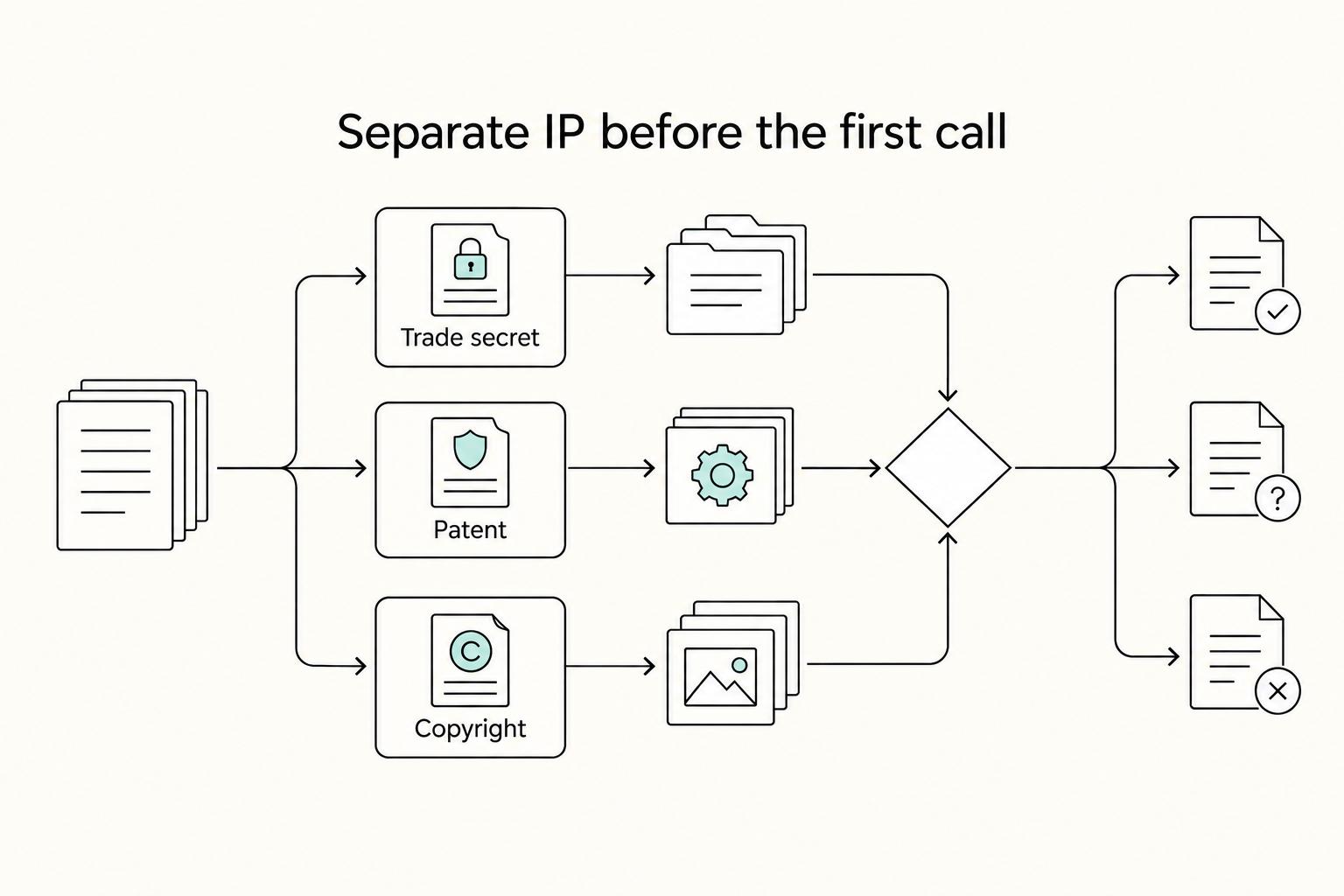
Stage 1: Document and Separate Your IP Before the First Call#
For biotech consultants, protection starts before any contract markup. The job is straightforward: document what you already own, control what you disclose, and separate reusable IP from client-paid outputs before the first call.
1. Inventory your background IP before you pitch#
Start by separating what you bring to an engagement from what you create for a specific client. In biotech consulting, reusable assets often include methods, formulas, processes, scripts, programs, analysis logic, screening criteria, templates, and curated datasets or other compilations. Those categories can fit trade secret treatment when they have economic value from secrecy and you take reasonable steps to keep them secret.
Use a simple test: if you could reuse it for another client after removing client-specific details, list it as Background IP. If it exists only because this client paid for that specific output, treat it as a likely deliverable and allocate it in the contract later.
2. Build evidence records you can actually defend#
A dated inventory matters only if you can back it up. Keep a private, date-stamped record in an access-controlled system, mark sensitive material as confidential, limit access, and use NDAs where appropriate before sharing sensitive details. Those are real secrecy measures, not just paperwork.
For each asset, keep a short description and enough history to show it existed before the engagement. For compilations, preserve your selection and arrangement logic. For methods, preserve the core decision logic and assumptions.
Control disclosure in proposals and early calls. Once trade-secret information becomes public, practical control is gone. If an asset may be patent-relevant, be especially careful. The U.S. has a one-year grace period after first public disclosure, but many countries do not, and European novelty rules treat public availability as prior art.
3. Convert the record into a contract-ready schedule#
Your inventory becomes more useful when you turn it into something you can attach to the deal. Create a short attachment, such as Schedule A or Background IP Schedule, that identifies pre-existing and reusable assets without giving away the secret itself. Keep entries plain and specific, for example:
Template for biomarker market review (excluding client-specific content)Python scripts for assay-data normalizationDecision tree for target triageCurated literature compilation and tagging structureStatistical analysis workbook with reusable formulas
That schedule also helps when transfer language shows up. Copyright transfers require a signed writing, and work-made-for-hire terms can change authorship when statutory conditions are met. If needed, use Work for Hire vs. Assignment of Rights: A Freelancer's Guide to Owning Your IP as a companion.
4. Classify each asset by protection strategy#
Not every asset needs the same kind of protection, so pick the route before you disclose it or assign rights. For most consultants, reusable know-how is usually a trade-secret management issue first, not a copyright issue.
| Protection route | Best fit in consulting | What it can protect | Main risk if misclassified |
|---|---|---|---|
| Trade secret | Reusable methods, formulas, processes, code, datasets, analysis logic, internal criteria | Scientific, technical, or business information kept secret with reasonable measures | Public disclosure or weak access controls can destroy practical control; trade secrets do not give patent-style exclusion rights against all third parties |
| Patent | Novel technical inventions where exclusivity matters | Patentable inventions if filed and granted (term is generally up to 20 years from filing) | Pre-filing disclosure can break novelty in many countries; relying only on U.S. grace timing can hurt cross-border strategy |
| Copyright | Reports, decks, original text and visuals, software expression, some compilations | Original expression | It does not protect underlying ideas, procedures, processes, or methods; blank forms used only to record information may not qualify |
Pre-call checklist#
Before you share a proposal, sample, or draft clause, confirm the basics:
- Each reusable asset is listed in your Background IP record with a contract-ready description.
- Sensitive files are private, access-limited, and marked confidential where needed.
- Any external sharing is covered by appropriate confidentiality terms, including NDAs where needed.
- You removed client-specific data and examples from anything you plan to reuse.
- You know which items are reusable Background IP and which are client-funded deliverables.
- You are not disclosing patent-relevant details before confirming filing strategy.
Do this and Stage 2 gets much easier, because you are negotiating from a documented position instead of memory.
Stage 2: The Gatehouse - Negotiate Your Contract from a Position of Power#
An inventory protects you only if the contract preserves it. Start with the IP terms, because gray areas tend to matter most. Residual-rights language, carve-outs, and cross-document conflicts are common places where ownership boundaries get blurry.
Review in this order#
Read the controlling agreement stack in order: master agreement, statement of work, NDA, then any order form or exhibit. Before you redline, confirm two points:
- Ownership is allocated the way you intend.
- No later document quietly overrides that allocation.
Then check term consistency across documents. If one document protects Background IP but another assigns all materials created in connection with the services, your carve-out is exposed. Attach your Background IP Schedule to the signed deal, or reference it clearly by name and date.
Push for split ownership, not a full transfer#
A workable starting position is split ownership rather than a full transfer: the client owns defined project deliverables, you retain Background IP, and the client gets the rights needed to use deliverables that include your underlying tools. Clear ownership allocation matters in incomplete contracts, and vague rights can increase misappropriation risk.
| Ownership model | Background IP | Project deliverables | Derivative improvements to your methods/tools | Your control and reuse | Dispute risk |
|---|---|---|---|---|---|
| Client owns everything | Can be pulled into assignment unless carved out | Client owns | May be claimed by client | Low control, low reuse | Higher |
| Split ownership + client use rights to embedded assets | You retain | Client owns defined deliverables | Typically stays with you unless separately agreed | High control, strong reuse | Lower |
| Joint or unclear ownership | Ambiguous | Ambiguous or shared | Ambiguous | Depends on later consent or interpretation | Higher |
If you see broad transfer language, narrow it to project-specific outputs and add explicit carve-outs for pre-existing and reusable assets. Treat improvements to your tools as a separate line item, not implied spillover.
Clause checklist for redlines#
Do not redline everything. Focus on the clauses most likely to collapse the boundary between your reusable assets and the client's paid-for outputs.
| Clause | Redline focus |
|---|---|
| IP assignment | Limit assignment to defined deliverables; exclude scheduled pre-existing and reusable assets. |
| License-back | If ownership language stays broad, require explicit rights for you to keep using general methods, templates, and know-how. |
| Residuals | Flag memory-based use language; it can blur boundaries around know-how. |
| Confidentiality scope | Protect client confidential information without absorbing your independent, pre-existing, or generally applied skills. |
| Non-compete spillover | Where applicable, remove wording that turns confidentiality into broad market restrictions. |
| Subcontractor or affiliate access | Allow access only with matching confidentiality obligations passed through. |
Keep your negotiation script calm, specific, and easy to escalate#
How you say it matters. Keep the conversation practical, not ideological, and give the other side an easy way to escalate internally if needed.
| Position | Suggested language |
|---|---|
| Primary position | You can own the defined deliverables. I retain my Background IP, reusable methods, and general improvements. |
| Fallback position | If you need broader rights, let's use a limited license for deliverable use rather than a transfer of underlying tools. |
| Escalation | Can counsel confirm whether this clause is intended to cover only project outputs, or also pre-existing materials and reusable methods? |
If template terms are "non-negotiable," ask to place carve-outs in the SOW, IP exhibit, or rider. Exact enforceability and final wording are jurisdiction- and deal-specific, so confirm with counsel.
Keep portfolio rights in writing and scope them tightly#
Do not assume you have a portfolio right unless it is written into the deal.
If portfolio use is allowed, scope it narrowly in writing, for example: client name, service type, and a high-level nonconfidential description, and tie timing to public release or written approval in the contract. If named use is restricted, ask for an anonymized version with written approval conditions.
Related: How to Protect Your Intellectual Property as a Strategic Consultant.
Before you send redlines, run your NDA language through this checklist-style tool. It helps you catch ownership and residual-use risks early: Use the NDA Generator.
Stage 3: The Operations - Prevent IP Cross-Contamination in Your Daily Workflow#
Good contract language is not enough on its own. If your day-to-day handling does not match the ownership split you negotiated, the paper boundary between Background IP and client deliverables starts to blur.
Trade secret protection depends on reasonable secrecy measures, and misappropriation can turn on duties to keep information secret or limit its use. So if your contract says you keep Background IP and the client owns defined deliverables, your tools, access, and handoffs need to reflect that split every day.
Run a before, during, after routine#
Treat each client as a separate operating lane, and make that separation visible in your records.
Before work
- Open only that client's setup: dedicated browser profile, client-specific folders, and approved communication channel.
- Confirm current access lists and remove people who no longer need access.
- If regulated records or data are involved, check the contract, NDA, and client security instructions before any upload or share.
During work
- Apply least privilege: each person gets only the access needed for assigned tasks.
- Use role-based access control so permissions follow role, not convenience.
- Keep work in the client lane; do not move drafts, datasets, or methods into shared libraries mid-project.
After work
- Verify where files were saved, who can access them, and what was sent externally.
- Record any exceptions and handoff notes so your operations match the ownership and confidentiality terms from Stage 2.
| Workflow domain | Risky behavior | Safer alternative | Why it matters |
|---|---|---|---|
| Workspace setup | Single browser profile and catch-all storage | Separate browser profiles, client-specific folders, encrypted storage for sensitive work | Reduces accidental mixing of sessions, files, and drafts |
| Communication channels | Personal email, text, or ad hoc apps | Client-approved portal, secured email, or encrypted channel | File exchange commonly happens through email and sharing tools, so these are common exposure paths |
| Access control | Shared logins or broad access for everyone | Least-privilege permissions with role-based sharing | Limits exposure and supports confidentiality duties |
| File transfer | Sending attachments without access checks | Approved transfer channels with encryption in transit and at rest | Encryption at rest and in transit is a critical defense |
| Offboarding | Keeping former collaborators active "just in case" | Disable, remove, or modify access when roles change or work ends; log the change | Supports account lifecycle control and reduces later disclosure risk |
Add an access-governance layer for biotech work#
In biotech work, access controls can determine whether your contract position holds up in practice. Where 21 CFR §11.10 applies, your controls should match it: authorized-user access, authority checks, and secure time-stamped audit trails for create, modify, and delete actions. Not every biotech engagement falls under Part 11, so confirm applicability per client and project.
Where HIPAA applies, use the minimum necessary approach under 45 CFR 164.502(b) and 164.514(d). Tie access to role and job duty, not broad "might need it" access.
Use a clear incident trigger. If you verify unapproved sharing, wrong-recipient access, or data in the wrong workspace, pause reuse and sharing, preserve logs and screenshots, and escalate to legal or compliance after verification. Follow the incident response plan as soon as signs of compromise appear.
Reuse only after a documented rebuild#
Reuse can create risk when boundaries are unclear. Do not treat renaming and moving a file as sanitization. Use this sequence every time:
| Step | Action |
|---|---|
| 1 | Classify the artifact: deliverable, draft, method, dataset, script, or general know-how. |
| 2 | Strip client identifiers, confidential terms, and embedded data. |
| 3 | Rebuild reusable parts as neutral components instead of copying the original file forward. |
| 4 | Document provenance: source project, removals, rebuild steps, and contract basis for reuse. |
| 5 | Approve reuse only after review is complete. |
Sanitization is not a blanket release from confidentiality or trade-secret duties. If PHI is involved and HIPAA applies, de-identification requires no reasonable basis to believe a person can be identified. Removing obvious identifiers alone may not be enough.
Proof Before the Deal, Precise Terms, and Discipline After#
The formula is straightforward: proof before the deal, precise terms in the deal, and operating discipline after the deal.
Each stage gives you a specific advantage. In Blueprint, you show what was yours before the engagement with a Background IP dossier, dated files, version history, and reuse boundaries. In Gatehouse, you negotiate from documents instead of assumptions. If ownership transfers, it should be explicit, written, and signed. If the client needs use rights, push for a license and define scope such as purpose, field of use, and territory. In Operations, you make those terms real with confidentiality labels, access limits, and documented handling and provenance practices before reuse.
| Stage | If you skip this stage | If you implement this stage |
|---|---|---|
| Blueprint | A client treats your pre-existing data model or method as project output, and you lack dated proof to separate it. | You can show dated records and prior-use history that distinguish Background IP from deliverables. |
| Gatehouse | Broad work made for hire or assignment language can expand beyond the SOW and create reuse disputes. | You limit ownership to defined deliverables, carve out pre-existing assets, and convert some asks into scoped licenses. |
| Operations | Client A material appears in Client B workflows, or a reused tool still contains confidential elements. | You run separate workspaces where appropriate, restrict access, mark confidentiality, and keep provenance logs for reused assets. |
The core risk is also simple: if secrecy controls lapse, trade secret protection can fail. Repeatable controls are what make your contract position credible in practice. In some regulated electronic-records contexts, limiting access to authorized individuals and maintaining secure, time-stamped audit trails are explicit control requirements.
Before your next contract cycle, do three things: prepare your asset list, mark negotiable versus non-negotiable clauses, and enforce the operational controls you commit to in the contract.
If you want a cleaner starting point for your next biotech consulting engagement, build a draft you can adapt to your IP boundaries and negotiation stance. Open the Freelance Contract Generator.
Frequently Asked Questions
Who owns the IP in a consulting agreement?
Ownership depends on what your contract actually says, not what either side assumes. Read the ownership, assignment, and license language together, then redline anything that blurs pre-existing materials into client-owned property. Next, match those clauses to your records so you can show what existed before the engagement. | Asset | Define this in the contract | Keep this in your records | |---|---|---| | Background IP | Your pre-existing methods, templates, scripts, data structures, and know-how | Dated versions and prior-use history | | Deliverables | The specific outputs you are paid to produce for that client | SOW, acceptance criteria, handoff records | | Derivative tools or rebuilt components | Whether reuse is allowed after sanitization or rebuild | Sanitization notes, provenance log, approval trail |
How do I protect my existing IP as a consultant?
Start before signing. Document your Background IP in dated records and reference that boundary in the contract. State clearly whether pre-existing assets are excluded from transfer unless separately licensed. In daily operations, pair NDAs with strict access controls and training so trade-secret protection is operational, not just written.
What are the biggest red flags in a consultant's NDA?
A major red flag is treating the NDA as your only protection control. Define confidential information and permitted use clearly, then align those terms with strict access controls and training in daily operations. For cross-border work, run a jurisdiction check with counsel because IP rules can vary by country.
What's the difference between a patent and a trade secret for a consultant?
A patent protects an invention for a defined period, typically 20 years, while a trade secret keeps value only if confidentiality is actively protected. That distinction should shape your contract posture, because disclosure-sensitive work needs tighter controls and cleaner boundaries. If you work across jurisdictions, confirm local patentability standards before relying on one strategy.
Can I use the knowledge I gained from one client project for another client?
Do not assume reuse is allowed just because you remember it. Treat client confidential information as restricted unless your contract clearly permits specific reuse. Rebuild neutral components rather than forwarding old files, and log provenance before reuse.
What is a work for hire clause and is it bad for me?
A broad work-for-hire clause can be a negotiation trigger because it may blur ownership boundaries. Narrow it to clearly defined deliverables and carve out your pre-existing IP and tools in writing. If you need the ownership mechanics side by side, use Work for Hire vs. Assignment of Rights: A Freelancer's Guide to Owning Your IP.
Try a related tool
Researched and edited by the Gruv editorial team. Gruv builds cross-border billing, payouts, and finance-operations software for global businesses.
Sources
- cisa.gov/reporting-cyber-incidenttrusted
- congress.gov/114/plaws/publ153/PLAW-114publ153.pdftrusted
- copyright.gov/register/se-hire.htmltrusted
- copyright.gov/circs/circ30.pdftrusted
- csrc.nist.gov/glossary/term/least_privilegetrusted
- csrc.nist.gov/glossary/term/role_based_access_controltrusted
- ecfr.gov/current/title-21/chapter-I/subchapter-A/part...trusted
- ecfr.gov/current/title-45/subtitle-A/subchapter-C/par...trusted
Educational content only. Not legal, tax, or financial advice.
Related Posts

Work for Hire vs Assignment of Rights for Freelancers
A freelance agreement is not just about price and scope. It decides who controls the rights in the work. If the ownership language is loose, rights can move earlier than you expect, cutting down your control once the work is delivered or used.

Limitation of Liability Clause for Freelance Software Developers
Start by setting the structure, not just a number. Liability terms allocate risk, so your first move is to define how risk is organized before you negotiate the cap amount. Use these terms consistently from round one:

How to Protect Your Intellectual Property as a Strategic Consultant
**Build a repeatable IP system that defines ownership scope, sets confidentiality rules, and makes governing law and dispute forum explicit before work starts.** As the CEO of a business-of-one, your IP is not "nice to have." It is core operating value. You are not trying to lawyer up every project. You are setting safe defaults so deals move fast and preventable disputes stay contained.