

Quick Answer
Use product-specific rates and the same merchant market, currency, ticket distribution and payment mix. Calculate percentage and fixed fees per transaction, apply caps per eligible debit, then add FX, dispute, payout, minimum and operating costs under the actual terms. The fee tool compares entered assumptions; its 4% Planning model is not Gruv business pricing.
Compare Fees and Operational Fit#
If you run platform finance or payments ops, headline rates are only the first input. The choice that holds up is the one you can still defend when volume grows, payment mix shifts, and month-end close gets more complex.
| U.S. product or fee component | Published standard figure | Scope |
|---|---|---|
| Stripe online domestic cards | 2.9% + US$0.30 | Successful domestic card transactions |
| Stripe manual/international/FX additions | +0.5% / +1.5% / +1% | Apply only the relevant additions |
| Stripe ACH Direct Debit | 0.8%, capped at US$5 | Bank debit, not a generic ACH credit/wire price |
| PayPal Advanced Credit and Debit Card Payments | 2.89% + US$0.29 | Named domestic online card product |
| PayPal Checkout | 3.49% + US$0.49 | Domestic USD commercial checkout |
| PayPal invoice Pay Later | 4.99% + US$0.49 | Specified invoicing payment path |
| Adyen | Processing fee + payment-method fee | Method/country pricing; minimum invoice can apply |
| Gruv business accounts | Quote for the actual collection/payout mix | Calculator 4% is an example, not a business tariff |
This comparison looks at Stripe, PayPal, Gruv, and Adyen across two layers: visible processing fees and the operational cost that shows up later in reconciliation, exceptions, and audit support. A lower posted rate can still end up being more expensive if money movement is hard to trace.
The examples above use U.S. merchant/product pricing checked on October 5 local time. Stripe charges vary by card origin, entry method and conversion; PayPal rates differ by the exact checkout/card/invoice product. Adyen publishes method-level pricing rather than one universal flat rate. Gruv business pricing uses a quote for the actual mix. Keep collection and outbound payout costs separate: a card-acceptance rate does not price a contractor disbursement.
What you should compare beyond rates#
Treat processing fees as one line item, not the whole model. When you review Stripe, PayPal, Gruv, and Adyen, pressure-test three things:
- How cleanly transactions map to settlements and payouts
- How clearly your team can explain exceptions and retries
- What evidence behind your assumptions you can preserve for finance, procurement, and engineering review
Preserve the pricing page or quote, merchant market, product name, currency and effective date with every input. PayPal's U.S. merchant page is last updated October 1, 2026; a consumer fee page does not price your merchant checkout. Stripe and Adyen offer custom terms, so record whether a public rate or signed contract governs the account.
Use the merchant account's market and the exact product classification. Domestic versus international treatment can depend on merchant/card or sender/recipient geography, and FX can occur in acceptance, settlement or withdrawal. Do not import a regional consumer-payment exception into a U.S. merchant checkout model.
Use public rates as baseline assumptions, then validate operational fit before you recommend a provider.
Stripe vs PayPal vs Gruv vs Adyen at a glance#
Each provider has a different pricing structure and service scope. Use the table to build the correct cost rows and identify the operating evidence required for your own account; it does not select an overall winner.
| Comparison item | Stripe | PayPal | Gruv | Adyen |
|---|---|---|---|---|
| Core commercial model | Public standard online card and bank-debit rates; custom/IC+ options | Product-specific merchant rates and fixed fees | Business collection/payout quote based on actual mix | Fixed processing plus payment-method fee; custom options |
| Card assumptions | Separate domestic, international, manual-entry and FX additions | Name Advanced Cards, Checkout or invoice path; rates are not interchangeable | Confirm collection method and contractual charge | Identify card brand, region, interchange/scheme components and markup |
| Bank-payment assumptions | ACH Direct Debit has its own cap; credits/wires are different methods | ACH Services and invoice Pay by Bank have different pricing | Quote the exact local/cross-border route and bank deductions | Select the actual method/country row and settlement currency |
| Additional costs | Product add-ons, disputes, payouts and FX under applicable terms | International/FX, disputes, withdrawal and selected services | Setup/monthly commitments, FX and payout charges in quote | Other products priced separately; minimum invoice may apply |
| Settlement and reconciliation test | Obtain payment-to-balance-to-payout example for the actual account | Obtain transaction/fee/withdrawal records for the selected product | Obtain receipt/payout/fee/ledger/export sample for the contracted flow | Obtain settlement details and bank payout mapping for the chosen setup |
| Decision evidence | Confirm account eligibility, signed price and failure/recovery behavior | Confirm market/product eligibility, signed terms and exception workflow | Confirm program coverage, quote and operational evidence | Confirm method coverage, pricing components, minimum and reporting |
Where the table is already useful#
The table is most useful as a screen for modelability, not as a price ranking. It shows which providers give you enough public structure to build a defensible first-pass model now.
Stripe and PayPal provide standard rates for named U.S. products. Adyen provides method-level components and explains interchange/scheme pass-through, while Gruv business accounts require a mix-specific quote. Capture those structures without assigning zero cost to missing fields.
What not to fake precision on#
Do not treat Stripe's 2.9% + 30¢ as universal when it is scoped to successful domestic card transactions and has listed uplifts. Do not reuse a PayPal figure across markets when published rates are tied to the listed resident market or region.
Keep settlement visibility, reconciliation effort, and audit trail quality unrated until each provider supplies traceable reporting artifacts for finance review. At this stage, the disciplined move is simple: model what is public, log what is unknown, and make contract confirmation part of the comparison.
Normalize inputs before you compare anything#
Do not compare providers until your input sheet is normalized. If one provider is modeled on US online card volume and another on mixed cross-border checkout assumptions, the result can look precise without being comparable.
Lock the same fields for every provider: monthly volume, average ticket, payment mix, geography split, and whether you are modeling public standard pricing or a custom contract path.
Separate online card acceptance, bank debit, bank credit/transfer and contractor payouts. Stripe's 0.8%/US$5 cap applies to ACH Direct Debit, so labeling it simply ACH bank transfer would misprice other rails. Use transaction-level ticket sizes for capped methods rather than charging one fee on the entire month's aggregate.
| Input bucket | Keep separate | Why it matters |
|---|---|---|
| Online card | Domestic versus international, and currency conversion exposure | A base card rate alone can understate cost when uplifts apply |
| ACH Direct Debit | Each successful debit amount and count | 0.8% with a $5.00 cap behaves differently than card pricing |
| PayPal checkout path | Exact product path in your flow | PayPal shows different published rates across checkout paths and products |
| Geography split | Market page used and domestic versus international treatment | PayPal pages are market-scoped, and some markets are grouped for international calculations |
Record one source or signed quote, merchant market, exact product, currency and effective/as-of date for each assumption. Keep PayPal's merchant October 1, 2026 update distinct from consumer fees and record future policy changes separately.
Reconcile observed statement fees to the approved model and investigate differences by method, count and uplift. An observed effective rate can describe a completed period; it cannot establish missing contractual terms or serve as a universal future tariff.
Price components that move total cost the most#
Once your inputs are locked, isolate the fee buckets that actually move total cost. The number worth optimizing is your effective rate after each bucket is applied to your real payment-method mix, geography mix, and checkout path.
| Cost bucket | Usually obvious up front | What makes it move | What to verify |
|---|---|---|---|
| Percentage fee | Yes | Card type, channel, and whether pricing is flat-rate or interchange-plus | Exact product path, market, and card-not-present versus other flow |
| Fixed per-transaction fee | Yes | Average ticket and count of successful transactions | Ticket assumptions and whether the model is based on successful payments |
| Plan or platform fee | Sometimes | Plan tier, add-ons, implementation, training, and overages | Contract exhibit, order form, or plan page with as-of date |
| Cross-border uplift and FX | Often partly hidden | International card share and currency conversion exposure | Domestic versus international split and where conversion happens |
| Implementation and scaling costs | Often partly hidden | Integration work, training time, and scaling needs | A standardized comparison artifact that captures costs that show up during implementation |
Stripe is a good example of why this bucket view matters. Standard pricing is pay-as-you-go with no setup or monthly fees, and the visible domestic-card headline is 2.9% + 30¢. But total cost moves with mix: +0.5% for manually entered cards, +1.5% for international cards, +1% when currency conversion is required, and ACH Direct Debit priced at 0.8% with a $5.00 cap.
Headline rate vs effective-rate drift#
Worked example: 200 successful domestic U.S. online card payments of US$100 give US$20,000 gross volume. Stripe standard cost is 20,000 × 2.9% + 200 × 0.30 = US$640, or 3.20%. PayPal Advanced Credit and Debit Card Payments at 2.89% + 0.29 gives US$636, or 3.18%, for that named product; PayPal Checkout at 3.49% + 0.49 gives US$796, or 3.98%. These calculations exclude refunds, disputes, FX, international additions and other services, and do not prove equal acceptance or eligibility. A four-dollar difference between the first two rows is readily outweighed by operational cost.
The fixed fee makes smaller tickets more expensive as a percentage. For a US$10 Stripe domestic card payment, 2.9% + 0.30 is US$0.59, or 5.9%. For ACH Direct Debit, a US$100 debit costs US$0.80 and a US$1,000 debit reaches the US$5 cap; calculate each debit before summing the month. Compare a normal month and a low-volume month when minimum commitments apply.
Why "flat rate" calculators can mislead#
Quick calculators are useful for screening, but they are still assumption-driven. Flat-rate views can hide variability because interchange, assessment, and processor markup are bundled into one number. Interchange-plus can make markup more explicit, but it also passes variable interchange through to the merchant.
For the payment fee comparison tool, enter a representative payment amount, choose currencies and add a custom row for each named provider/product. Enter the percentage, fixed fee and FX-markup assumptions from your own source. Its Planning model uses an assumed 4% plus a 1% adjustment when currencies differ; this is not a Gruv business quote. The tool does not replace a transaction-mix model, capped-fee calculation, interchange/scheme breakdown or contracted FX rate. Keep those items in the monthly comparison sheet.
Score operational cost, not just processing fees#
After the fee math, operational handling can materially change total cost. Do not let the lowest processing line win by default if reconciliation and close are already painful. For teams under month-end pressure, clearer audit trails and status reporting can be worth a slightly higher nominal fee.
Use an ops scorecard before you pick a winner#
A pricing model can look clean while downstream handling is expensive. The real test is whether your team can reconcile settlements, explain payout movement, and clear exceptions without side spreadsheets. A useful scoring lens is how well the option holds up across policies, internal controls, risk assessment, management reporting, and audit.
| Ops criterion | What strong looks like | What weak looks like | What to verify |
|---|---|---|---|
| Reconciliation complexity | Few joins, stable reference keys, export fields map cleanly to your ledger | Manual matching, changing reference formats, frequent off-platform notes | Sample export and one worked reconciliation example |
| Settlement traceability | You can follow a transaction from request to settlement event to bank movement | Settlements are aggregated with no drillback path | Whether settlement IDs, payment IDs, and timestamps are preserved end to end |
| Payout status clarity | Distinct states with timestamps for initiated, pending, paid, failed, returned | One generic status that hides where the payout stopped | Status definitions and a sample failed payout record |
| Cost monitoring signals | You can spot trends in transactions and interchange, including mix shifts | Mix and interchange trends are only visible after close | Access to trend views by transaction type and geography mix |
| Exception handling visibility | A predictable, reviewable queue with reasons and owners | Exceptions discovered only during close or via bank mismatch | Expected mismatch types and how they are surfaced |
Include analyst time and funding costs beside processing charges, while keeping them separate from the provider's invoice. Interchange/scheme components depend on the card and routing; do not count them again on top of a flat rate that already includes them. For an interchange++ quote, identify the pass-through components and processor markup explicitly.
Check ledger integrity from request to export#
Ask one core question: can you trace a payment from request, to internal ledger entry, to export, to the bank line where cash moved? If that chain depends on manual naming conventions, you are already carrying operational cost even if fees look lower.
This check matters even more when your workflow spans multiple payment methods and payout cycles. You want IDs and references to stay linked through ingestion, posting, export, and investigation so cash and liability views stay aligned.
Request the same evidence pack from each option before approval:
- One sample payment event record
- One settlement or payout export file
- One failed or reversed transaction example
- One field dictionary for IDs, statuses, and timestamps
If exports cannot map back to originating events and ledger entries, treat that as operational risk, not a documentation issue.
Score failure handling, not just happy paths#
A lot of hidden work shows up in failure paths. Score each option on three things: exception visibility, unmatched-deposit investigation, and trend monitoring.
For unmatched deposits, require a documented investigation path that starts from bank reference, amount, and date, then maps back to settlement or payout identifiers and the underlying transactions. For trend monitoring, make sure your team can track transaction mix and interchange over time so cost shifts are visible early.
Also test by payment method, not only by provider. Transaction and settlement behavior varies by product, and cost and risk patterns differ across card-present, card-not-present, domestic card, cross-border card, and bank-transfer flows.
If close is already a bottleneck, prioritize cleaner exports, preserved IDs, and structured statuses even when another quote is slightly cheaper on headline fees. Small fee deltas are visible early, while reconciliation overhead can build over time.
For a step-by-step walkthrough, see How to Show Fee Transparency to Contractors: Building a Clear Payment Breakdown UI.
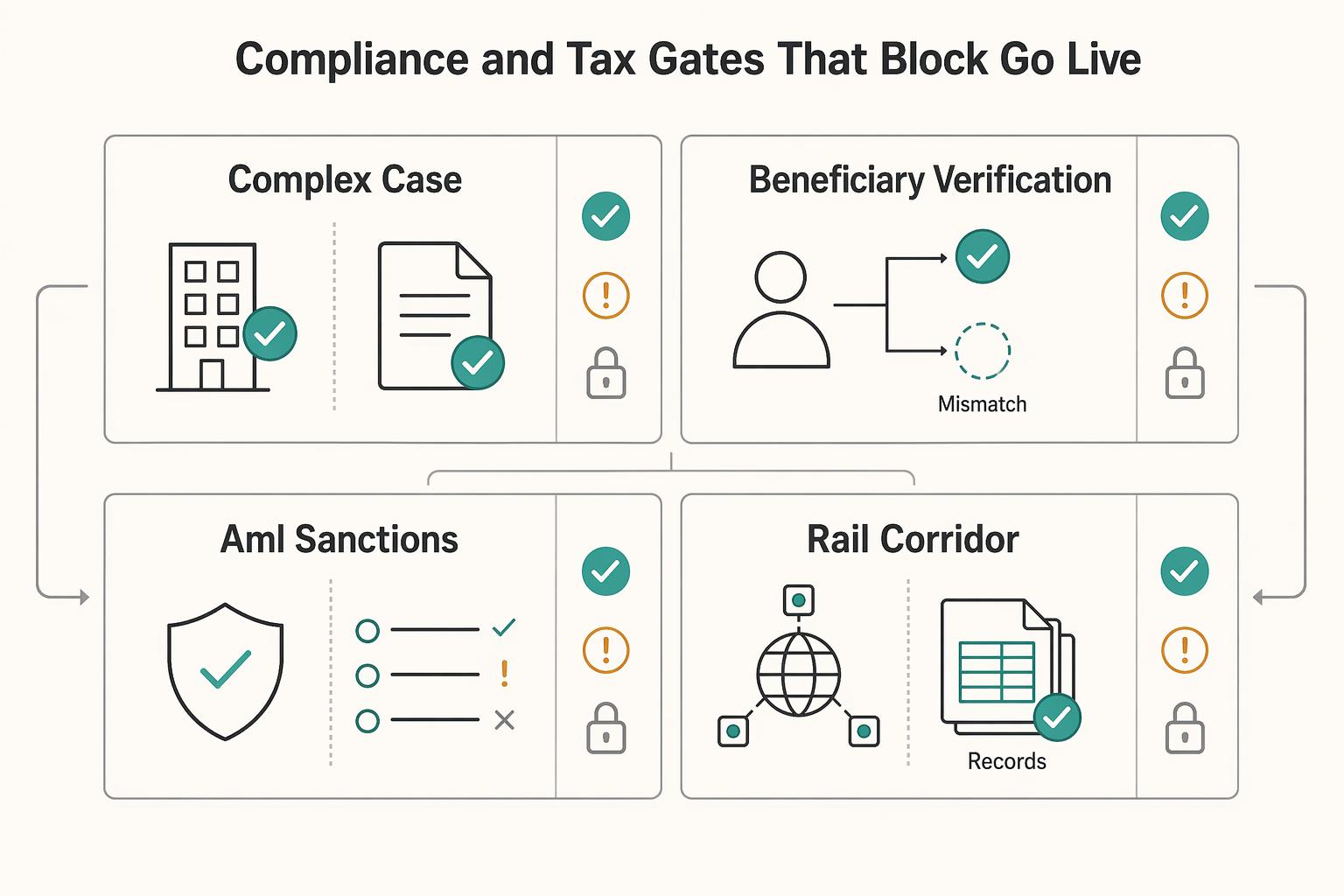
Compliance and tax checks that can block go-live#
A lower-fee option is not enough for go-live if compliance and tax ownership are unclear. Treat this as a launch gate: define owners, decision points, and evidence retention before engineering marks the build complete.
Turn compliance into a launch gate, not a later ticket#
A processor rate does not establish account eligibility or legal authority to operate your model. Map the merchant/platform role, countries, products, beneficiaries and actual provider requirements. Mandatory legal obligations are not optional internal policy choices.
| Control area | Gate question before launch | Evidence to request | Typical block at go-live |
|---|---|---|---|
| Merchant/platform eligibility | Does the provider approve the actual business model and markets? | Account contract, approvals and capability status | Unapproved use or unavailable required feature |
| Identity/business verification | Which merchant, representative, owner and recipient checks apply? | Provider requirements and dated completion/exception records | Required verification missing |
| AML/sanctions responsibilities | Which duties belong to the platform and regulated partner? | Role map, screening/monitoring and lawful hold/escalation workflow | Unresolved lawful payment basis |
| Tax reporting and withholding | Who is payer/seller and what payment facts trigger duties? | Scoped documentation, reporting and withholding rules | Required tax treatment not implemented |
| Fund and settlement ownership | Who owns receipts, balances, reserves and payout obligations? | Contract, ledger mapping and availability rules | Customer funds treated as free corporate cash |
Map seller, payer and fund ownership before choosing a cheaper route#
A Merchant of Record arrangement assigns the covered seller-of-record duties under its contract; it does not eliminate every platform, recipient or income-tax obligation. A payment processor alone is not that seller. Document who issues customer invoices, handles indirect tax, funds refunds/disputes and pays contractors, then price the services actually included.
Where VAT is relevant, determine supplier role, place of supply, customer status and the applicable registration/invoicing treatment. A valid VAT number is one evidence item, not proof that every sale is exempt or reverse charged. Likewise, W-8/W-9 and reporting workflows follow actual payer/payee and income facts, rather than a universal processor checklist.
Do not assume MoR or VAT validation solves ownership gaps#
Compare the contractual allocation of seller, merchant, refund, dispute, tax and reporting responsibilities with your direct-processing alternative. Lower processing cost can reflect fewer included services; use the same responsibility scope before comparing total operating cost.
Use a narrower internal test instead: who collects data, who validates it, who handles exceptions, and who retains evidence by market. Related reading: How to Calculate Payment Processing Fees: A Total Cost of Ownership Framework for Platforms.
Choose by operating model, not brand preference#
Choose for your highest operating risk, not the brand your team already knows. If your top risk is a fast go-live for standard card acceptance, a checkout-first path is usually the better first step. If your top risk is payout control, reconciled ledgers, and audit evidence, prioritize setups with stronger lifecycle visibility.
| Scenario | Primary decision lens | Practical fit at a glance | Key checkpoint before commit |
|---|---|---|---|
| Early-stage marketplace | Speed to launch standard card acceptance with low upfront engineering overhead | Stripe or PayPal (flow-mix dependent) | Model costs by payment flow and transaction traits, not one headline rate |
| Mid-scale platform with global payouts | Payout lifecycle visibility, reconciliation, exception handling, audit-ready records | Gruv or a deeply integrated enterprise setup, validated directly | Verify concrete payout, ledger, and audit artifacts in product and contract review |
| Enterprise with custom contracting | Negotiated commercial terms, multi-region operating control, explicit ownership | Stripe custom-commercial lane, and assess Adyen explicitly | Document routing, settlement mapping, and contract-change ownership up front |
Early-stage speed and launch-first modeling#
For a standard online card launch, compare the supported checkout and card products, account approval, integration effort and domestic/international mix. Stripe's U.S. standard rate is a usable baseline; it does not establish that Stripe is universally fastest or cheapest.
For PayPal, name the selected product in the model: Advanced Credit and Debit Card Payments, Checkout, an invoicing path or an in-person product. Do not apply one product's percentage or fixed fee to another. The worked example above shows why Advanced Cards and Checkout produce different totals for the same USD volume.
Mid-scale payout operations with a bias toward control surfaces#
When payouts become core, control quality can matter more than checkout convenience. At that stage, Gruv or a deeply integrated setup can be a fit if you need explicit lifecycle controls, compliance-gated flows, traceable records, and reconciliation-ready outputs.
Keep the decision evidence-based: review sample payout statuses, exception states, and export and audit artifacts before you commit. If those surfaces are weak, plan for manual exception handling.
Enterprise control only works with explicit ownership#
Adyen publishes processing plus payment-method pricing, including interchange++ structures for relevant cards, and says other products are priced separately. Its FAQ says a minimum invoice can apply by industry/business model despite no setup or monthly fee. Obtain the actual merchant quote and minimum; public components are enough to structure the model, not enough to assume your total or eligibility.
For every enterprise quote, record the merchant entity/market, methods, regions, funding/settlement currencies, reserves, minimum invoice and repricing terms. Keep the quoted responsibility scope beside the price so a processor and a broader service bundle are compared fairly.
Common mistakes that make fee tools unreliable#
Fee-tool outputs are unreliable when inputs are not comparable. If your model mixes jurisdictions, blurs payment-method mix, or skips reconciliation checks, treat the output as an estimate, not a decision record.
Price-only comparisons are incomplete too. Use a documented cost model and a complete list of included costs before you compare totals.
Keep AU and US models separate#
Do not combine AU and US assumptions in one model and treat the result as like-for-like unless you have verified the assumptions are directly comparable.
Use one model per resident market. Lock jurisdiction, currency, domestic and international treatment, and rail assumptions at the top so reviewers can verify exactly what was modeled.
Do not blur method mix or plan effects#
If a payment method is material, model it explicitly instead of folding it into one blended payments line. Do the same for plan tiers or custom-commercial lanes. Mark any unconfirmed input as assumed or unknown until it is confirmed in writing.
The practical check is simple: another operator should be able to open the file and see method-level assumptions without asking the model owner.
| Mistake | Why it breaks comparisons | Minimum checkpoint |
|---|---|---|
| Mixing AU and US assumptions | Different market context makes totals non-comparable | One jurisdiction per model |
| Ignoring material methods | Blended rates hide margin-sensitive flows | Method-level rows |
| Accepting calculator totals as final | Exclusions and custom placeholders distort comparisons | Annotate exclusions and unknowns |
| Skipping reconciliation tests | Gaps appear at close, not at approval | Run statement-to-ledger test before go-live |
Normalize exclusions, placeholders, and contract terms#
Treat vendor calculators as estimate tools, not contract summaries. Before you compare totals, normalize exclusions, custom placeholders, and sales-dependent fields across options.
Also review non-fee contract terms. Fee percentages alone are incomplete if fraud or nonpayment risk and dispute allocation differ across agreements.
Reconcile before launch, not at close#
A costly failure is operational: a model gets approved, then statements do not map cleanly to internal ledgers. In distributed fintech stacks, root-cause analysis can be slow once something breaks.
Before approval, run a sample close and verify that finance ops can reproduce totals from provider statements and internal ledger entries. If that fails, the cleaner-looking fee output is not ready for a decision.
If payout rails are part of the decision, see Payout Method Comparison Tool for Platform Operators Across ACH, SEPA, PIX, and UPI.
Build your decision checklist and evidence pack#
Freeze a dated evidence pack before approval. If someone who did not build the model cannot reproduce totals and exception paths from your model, treat the comparison as a draft.
Use four artifacts, and timestamp each one so reviewers can verify what was known at approval time.
| Artifact | What it must contain | What to verify before sign-off |
|---|---|---|
| Normalized input sheet | The shared inputs and assumptions used across the comparison, plus a timestamp | One like-for-like input set, with no hidden logic that changes totals |
| Provider assumption log | Unknowns, vendor-supplied assumptions, and every addendum or revision with date and owner | Revisions are captured as part of the record, not buried in email threads |
| Legal/compliance checklist | Document name, version or date, and the verification path to an official version where relevant | Informational copies are flagged as unofficial, and official versions are checked when needed |
| Verification trail sample | Sample lines and exception handling that let a reviewer trace totals end to end | A reviewer can trace totals end to end and explain unmatched items |
Record each contract addendum or clarification with its effective date, approving party and cost/control impact. A sales explanation changes contractual obligations only when incorporated through the applicable agreement process.
Require one non-author review before approval. The reviewer should rerun totals and test exception paths, not just the happy path.
For final approval, include sign-off and acknowledgment fields in the approval record, plus unresolved risks and named owners, so accountability is explicit.
Use the fee tool to compare entered per-payment assumptions, then attach the monthly transaction-mix model and evidence pack. Verify capped methods, refunds, retained fees, disputes, minimums and settlement deductions outside a simple percent-plus-fixed calculator.
Verify the decision in the first 90 days#
Treat the first 90 days as a validation window, not a final verdict. Re-run live results against the dated assumptions in your evidence pack so you can spot effective-cost drift early.
| Checkpoint | What to track |
|---|---|
| Effective-rate drift | Versus your approved model, broken out by the fee components you modeled |
| One-variable comparison checks | Which single input change is driving movement |
| Reconciliation cycle time | From statement receipt to ledger-close readiness, if this is part of your control plan |
| Settlement mismatch count | Requires manual investigation, if this is part of your control plan |
| Payout exception backlog | Backlog and aging, if this is part of your control plan |
Track these checkpoints on a regular cadence with finance and payments ops:
- Effective-rate drift versus your approved model, broken out by the fee components you modeled
- One-variable comparison checks so you can isolate which single input change is driving movement
- Reconciliation cycle time from statement receipt to ledger-close readiness, if this is part of your control plan
- Settlement mismatch count that requires manual investigation, if this is part of your control plan
- Payout exception backlog and aging, if this is part of your control plan
Set explicit pass/fail thresholds for each checkpoint based on your own transaction mix, contract terms, and control design, not generic benchmarks. If a control misses threshold, trigger a defined remediation path, document the decision, and re-check the model.
Conclusion#
A payment fee comparison tool is most useful when it helps you choose the option that balances fee efficiency with operational fit, controls, and auditability. It can save time and improve pricing decisions, but outcomes are only reliable when your assumptions are explicit and your evidence is preserved.
Before approval, run a normalized comparison table, complete a dated evidence pack, and separate confirmed inputs from unresolved items. Verify key regulatory points against official editions and effective dates, then approve only after compliance checks pass with artifacts that can be checked again later.
If your final decision depends on payout controls, policy gating, and reconciliation clarity, request a coverage and integration review before rollout.
Frequently Asked Questions
What should a payment fee comparison tool include to be decision-ready for platform teams?
A decision-ready tool should include a normalized input sheet and a dated source log, not just headline rates. Lock volume, average ticket, payment-method mix, refund assumptions, and geography so another operator can reproduce the total. Save the exact pricing artifact you used, not just a URL. For PayPal, that can include the printable PDF and the Policy Updates Page as change-control checkpoints.
Why do Stripe, PayPal, Adyen, and other calculators produce different totals for similar inputs?
Different totals often come from unstated defaults, not just math errors. Standardize market scope, domestic versus international treatment, payment-method mix, and whether pricing inputs are published or still unresolved. PayPal explicitly scopes fee pages by market or region, defines domestic and international by sender and receiver market, and notes that some markets are grouped for international rate calculations. If teams use different resident-market assumptions, they can model the same volume and still get different totals.
Is the lowest processing fee usually the best choice for finance and operations teams?
Not always. A lower published rate can lose its advantage if teams spend more time tracing settlements, matching deposits, and resolving statement-to-ledger breaks. When options are close on price, prefer the one finance can verify and close cleanly each month with fewer unresolved exceptions.
How do I fairly compare providers when one or more has custom enterprise pricing?
Keep published pricing and custom enterprise pricing separate until custom terms are confirmed in writing. Mark custom items as unresolved rather than filling gaps with assumed numbers. If leadership needs a recommendation now, present a published-terms base case plus an explicit unknowns section.
Which assumptions should I lock before sharing a recommendation with leadership?
Lock merchant jurisdiction, product, currency, payment-method mix, transaction counts/ticket distribution, international/FX classification and the exact signed rate or dated public artifact. PayPal's U.S. merchant page was last updated October 1, 2026. Review its policy updates separately and do not price merchant acceptance from a consumer rate page.
What are the first warning signs that a "good" pricing decision is creating reconciliation debt?
The first signs are usually operational drift: effective-rate drift versus the approved model, longer statement-to-ledger-close cycles, more settlement mismatches needing manual review, and a growing payout-exception backlog. A practical red flag is when headline commercial results still look acceptable but finance cannot consistently explain why. If repeated spreadsheet fixes or manual deposit matching become routine, revalidate assumptions and routing instead of defending the original choice.
Try a related tool
Researched and edited by the Gruv editorial team. Gruv builds cross-border billing, payouts, and finance-operations software for global businesses.
Sources
Includes 2 external sources outside the trusted-domain allowlist.
- paypal.com/us/business/paypal-business-feestrusted
- paypal.com/us/webapps/mpp/ua/upcoming-policies-fulltrusted
- stripe.com/us/pricingtrusted
- adyen.com/pricingexternal
- gruv.ai/pricingexternal
Educational content only. Not legal, tax, or financial advice.
Related Posts

How to Calculate Payment Processing Fees: A Total Cost of Ownership Framework for Platforms
If you compare options on processing rates alone, your cost model is incomplete. The better lens is **Total Cost of Ownership (TCO)**: the full financial impact over time, not just the visible fee line on a pricing page or invoice.
Payout Method Comparison Tool for Platform Operators Across ACH, SEPA, PIX, and UPI
Use this comparison matrix as a decision worksheet for ACH, bank wires, SEPA, Pix and UPI. Swift messaging may support a bank wire; it is not itself the settlement rail. Choose a corridor/currency and eligible recipient first, then compare timing, total cost and operational fit.
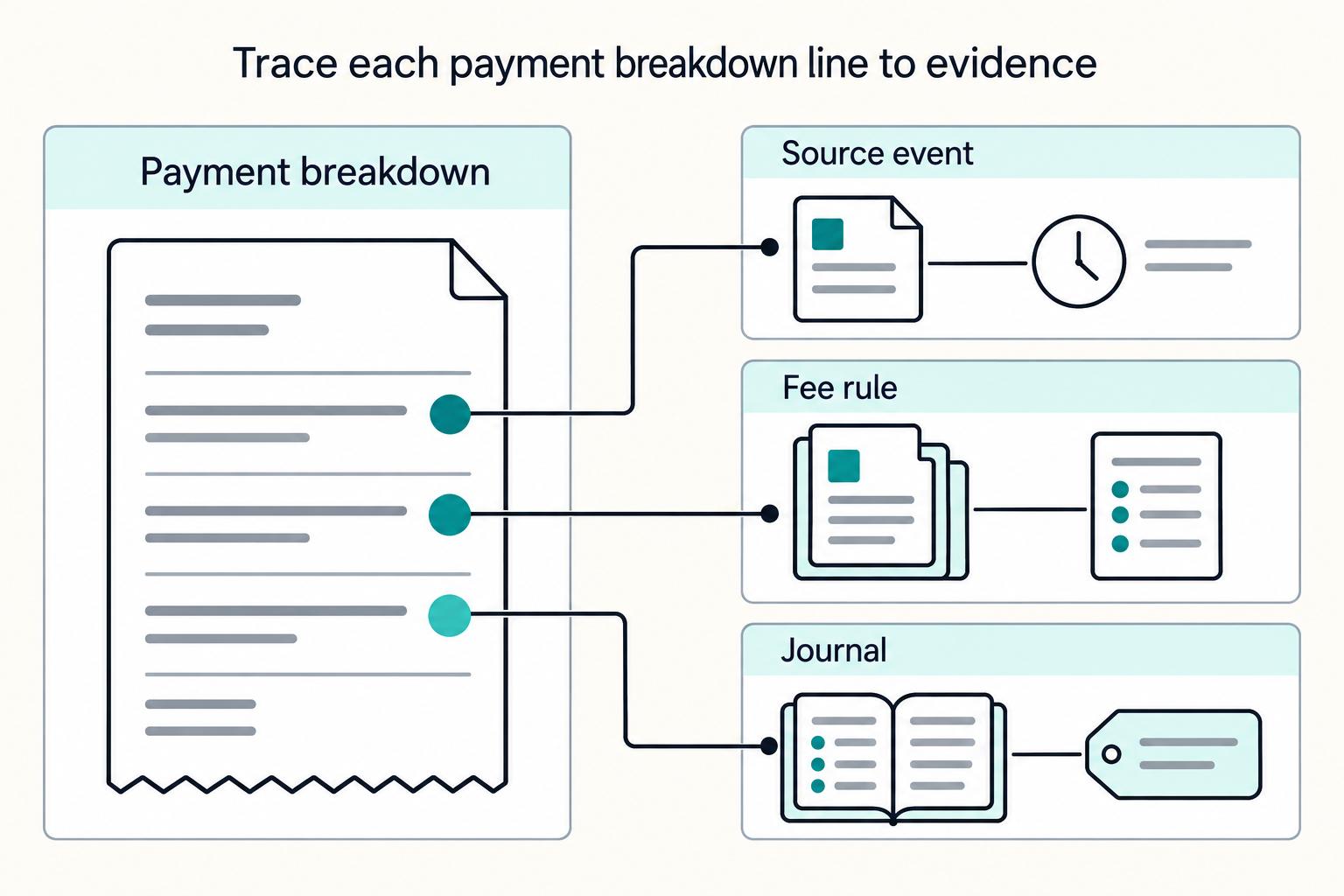
How to Show Fee Transparency to Contractors: Building a Clear Payment Breakdown UI
Your payment breakdown UI should answer two questions at a glance. Contractors should be able to see how an invoice turns into a net payout. Finance should be able to close the payout without manual cleanup. If the recipient view cannot be traced back to approval and accounting records, it is not transparent enough to run.