
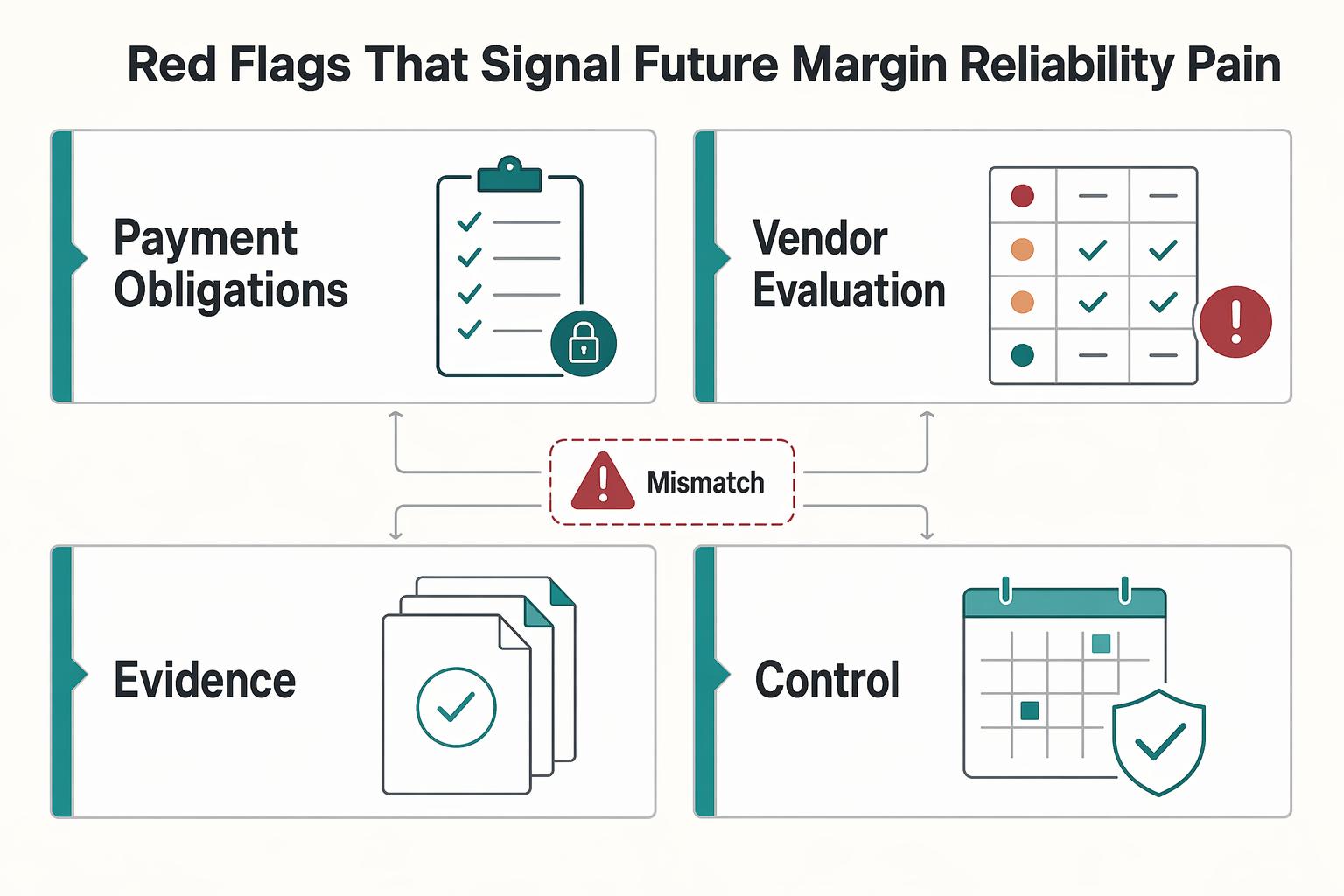
Quick Answer
Prioritize sequence over headline fees: confirm the Offeror is one legal entity, lock scope and risk terms, then negotiate payment mechanics, and only then finalize price. Use a stop/go gate for unresolved remedy and dispute language, and do a final document check so each concession is written in signed text across the main agreement, order form, or SLA terms. If a promise sits only in calls or email, treat it as open.
What to lock down before you sign#
Your goal is to sign a payment platform contract that protects margin, uptime, and exit flexibility without slowing launch. The practical way to do that is to negotiate pricing, SLA commitments, and exit rights as one connected set of tradeoffs, not as separate workstreams.
This guide is for platform teams making infrastructure decisions across founders, product, finance, legal, and engineering. It covers the operating contract behind payments: the signing entity, order form and payment terms, SLA legal terms, amendment control, notice handling, and offboarding rights. It is not about one-off freelancer contracts.
Start by confirming who is actually signing before you debate economics. In formal contract workflows, the contract is formed with the entity identified as the Offeror, and that Offeror must be a single, distinct legal entity. If the counterparty is labeled as a brand, division, or branch rather than one legal entity, you create avoidable ambiguity around notices, administration, and enforcement.
Before you start, run a few basic checks.
- Confirm the exact legal entity that will sign and receive the contract award.
- Confirm routing details for operations, including notice and payment addresses where listed.
- Confirm which draft version is current, especially if amendments or modifications exist.
- Confirm ownership on your side for legal review, finance approval, support obligations, and final exceptions.
These checks matter because process failures erase leverage. A signed offer form can be required for a valid submission, and missing an amendment acknowledgment deadline can lead to rejection. Just as important, amendments are scoped changes, so terms not expressly changed can remain in full force and effect.
This guide is also explicit about what is not universal. The guidance here does not establish a single uptime target, service-credit formula, or exit notice window you can safely copy into every payment platform deal. Use decision rules and verification checkpoints to negotiate terms that are measurable, enforceable, and operationally owned in your environment.
Keep one current draft and map every concession back to that document set. Amendment chains can move dates and terms across versions, and stale drafts can create mismatches. The sequence throughout is simple: define service scope and risk boundaries, negotiate payment terms, pressure-test SLA commitments and remedies, then close renewal and exit protections before implementation starts.
For a related workflow, read QuickBooks Online + Payout Platform Integration: How to Automate Contractor Payment Reconciliation.
What to prepare before the first vendor call#
Before the first call, build your buyer-side review set: your operating evidence, the documents you expect to redline, and a clear approval path. That keeps the discussion tied to real risk instead of generic sales promises.
Build a minimum evidence pack first. Pull from your own operations: incident records, support tickets, and escalation logs. Use that pack to review pricing and payment structure, SLA commitments, including uptime, support, and issue resolution, and how you will monitor performance instead of relying only on vendor-reported data.
Each item needs an owner and a traceable source, such as tickets, postmortems, or escalation logs. If you only revisit SLA terms after incidents, you risk finding evidence gaps or carve-outs that weaken enforcement.
Bring the exact contract documents you plan to redline. Treat the provider's initial proposal as a starting draft, not a finished deal. Put pricing and payment terms, SLA commitments, and data, privacy, ownership, and exit terms into one shared review set.
Keep legal, finance, and ops on the same version. If a commercial promise is not in the proposal or contract draft, treat it as uncommitted until it is written in.
Name internal approvers before negotiation starts. Set a legal owner, finance owner, support or ops owner, and one final exception path. This helps prevent redline loops where teams review in different sequences with different priorities.
Each open issue should have one approver, one deadline, and one escalation route.
Flag compliance boundaries early, but mark specifics as unknown when needed. If KYC, KYB, AML, or VAT validation requirements are not already cleared internally, record them as open items instead of stating exact thresholds or jurisdiction rules.
If the vendor onboarding flow or data flow appears to conflict with those controls, route it to your compliance owner before you advance commercial terms.
For a step-by-step walkthrough, see How to Build a Finance Tech Stack for a Payment Platform: Accounts Payable, Billing, Treasury, and Reporting.
Set your negotiation sequence before discussing headline fees#
The sequence matters. Run it after market assessment and supplier selection. If you start with headline fees, risk can come back through weaker service commitments or slower dispute handling. Lock scope and risk first, then payment terms, then final price.
| Order | Focus | Rule |
|---|---|---|
| First | Scope, service levels, and remedies | Treat commitments that exist only in a call and not in contract language as unresolved |
| Then | Payment terms | If the vendor asks for firmer payment terms, ask for added scope, faster onboarding, or stronger technical support in return |
| Before final price sign-off | Remedy terms and dispute-resolution mechanics | If those terms are still open, hold final commercial approval and implementation commitments |
| Throughout | Must-have now vs. negotiable later | Require reciprocal value for every concession |
Define scope, service levels, and remedies before you discuss rate cards. This is where risk allocation gets set, not just price. For a payment platform contract, confirm vendor responsibilities, your dependencies, and how KPI, SLA, and liability terms hold under demand or supply shocks. If a commitment exists only in a call and not in contract language, treat it as unresolved.
Keep a shared redline list of open scope items, risk owners, and where each term belongs, whether in the order form, main agreement, or SLA terms.
Negotiate payment terms before final commercial pricing. Use this stage to settle mechanics such as when payments begin and how credits are handled, then trade those terms for operational value. If the vendor asks for firmer payment terms, ask for added scope, faster onboarding, or stronger technical support in return.
That keeps tradeoffs explicit instead of debating price in isolation.
Before final price sign-off, use an internal approval gate for remedy terms and dispute-resolution mechanics. This is buyer discipline, not a universal legal requirement. If those terms are still open, hold final commercial approval and implementation commitments. A lower fee is less valuable if escalation and mediation steps are still unclear.
Treat these terms as stop-or-go items with one owner, one decision date, and one escalation route.
Split asks into must-have now and negotiable later, and require reciprocal value for every concession. This keeps short-term fee wins from weakening core protections.
- Must-have now: terms tied to launch risk, service performance, dispute handling, and remedy/liability coverage.
- Negotiable later: convenience or economics that do not change your core risk position.
If the vendor resists SLA remedies, ask for stronger service credits or a tighter escalation path with predefined dispute steps. If they hold on price, ask for better payment terms, added support, or faster issue-response commitments in the contract text.
We covered this in detail in How to Maximize Your Xero Investment as a Payment Platform: Integrations and Automation Tips.
Build a pricing and payment terms sheet your team can trade#
Put every commercial give-and-get into one shared sheet before numbers start moving. When pricing, payment terms, and SLA remedies are split across emails, call notes, and redlines, hidden costs and weak renewal terms are much easier to miss.
Build one table that captures each negotiable item, the vendor position, your ask, and the trade you require in return. A structured checklist can surface hidden fees and unclear responsibilities before commitment.
| Item | Capture in the sheet | Trade rule to prewrite |
|---|---|---|
| Fixed fees | What the fee covers, when it starts, where it appears in the contract or order form | If fixed fees stay high, require added support scope or clearer implementation responsibilities |
| Variable fees | Unit basis, exclusions, volume assumptions, where calculation language sits | If variable pricing is not improved, require tighter billing transparency or review rights |
| Minimum commitment | Trigger, duration, what happens if volume misses | If minimum stays, require better renewal terms or stronger SLA remedies |
| Invoice timing | When invoicing starts, milestone or recurring trigger, dispute window | If payment timing is less favorable, require pricing protection or operational concessions |
| Late-payment handling | Cure process, suspension rights, fees if any, notice mechanics | If suspension rights are broad, narrow them or add service continuity language |
| Credits | Service credits, billing credits, application mechanics, expiry if any | If credits are capped or narrow, ask for stronger escalation terms or renewal flexibility |
Tie every line item to its document location: main agreement, order form, or SLA. That prevents "we already agreed that" claims that never make it into signed text.
Track every concession in one system of record and require legal and finance sign-off before you treat it as final. That reduces fragmented commitments and lowers the risk of surprises during delivery.
Use the same record for non-standard asks, but route them through a single exception path. Log who requested the exception, what issue it is meant to solve, what review it needs, and whether it belongs in contract language.
Write decision rules before the final round so your team trades consistently instead of improvising line by line.
- If the vendor keeps a minimum commitment, require better renewal terms or stronger SLA remedies.
- If invoice timing starts before operational readiness, require implementation obligations and acceptance criteria in writing.
- If late-payment language gives broad suspension rights, require notice and cure language that protects live operations.
- If credits are narrow or difficult to claim, do not count them as meaningful value in exchange for price firmness.
Include renewal mechanics in the same sheet. Contractual lock-in often comes from notice-period landmines and auto-renewal traps. Treat the renewal notice window as a commercial risk checkpoint, not a separate legal footnote.
Run a final redline checkpoint before signature. No pricing or payment assumption should live outside signed documents. If a term exists only in a deck, email, or meeting note, treat it as unresolved.
Use four final checks:
- Does every commercial promise in the sheet appear in signed contract text?
- Does every exception term have explicit legal and finance approval?
- Are billing triggers, credits, and minimums stated in contract language, not implied?
- Are any "to be confirmed" items removed if they could change costs after launch?
By signature, you want one approved commercial sheet, one matching redline set, and no floating assumptions about fees, credits, payment timing, or renewal exposure.
You might also find this useful: Freemium vs. Paid Tiers: Which Pricing Model Works for Payment Platforms?.
Decide which SLA legal terms to push and which to stop debating#
Once the pricing sheet is stable, move to SLA definitions, remedies, and accountability. Focus on contract language that changes your exposure, not on arguments about a vendor's internal process design.
Your Service Level Agreement should clearly state performance and availability expectations, and it can include security provisions. If the language is vague, enforcement gets harder when incidents happen.
Separate process descriptions from legal levers you can actually evaluate and trade. Prioritize the terms that define what failed, what is excluded, and what happens next.
Use a side-by-side review:
| SLA area | What to compare | What to push for | Verification checkpoint |
|---|---|---|---|
| Uptime definition | What counts as available service and downtime | Measurable definitions tied to real service impact | Confirm your team can validate performance with accessible evidence |
| Maintenance window | How planned work is treated and how notice is handled | Clear notice mechanics and explicit planned-downtime treatment | Confirm notices reach the internal owner who must act |
| Service credits | Trigger, claim process, application, and expiry | Credits that are operationally claimable | Confirm the exact claim steps and document location |
| Exclusions | Events carved out from SLA failure | Specific exclusions instead of broad catch-all language | Check whether exclusions remove most practical coverage |
| Escalation path | Severity handling and response route | Defined escalation path with accountable roles | Confirm named functions can execute during incidents |
Use a threshold rule to stop low-value redlining loops. If the remedy is too weak to offset business impact, route the issue through your exception approval path.
Test each clause with two questions:
- What business impact does this failure create for your platform?
- Does the proposed remedy meaningfully offset that impact?
If the answer is no, treat it as a decision item for explicit risk acceptance, stronger language, or a trade elsewhere.
State unknowns directly and negotiate from your own risk profile. Public material supports SLA concepts and a monitoring, management, and enforcement checkpoint, but it does not give you universal uptime targets, default maintenance durations, or standard credit formulas.
Some public references in this area are AI-generated and warn that they may contain errors or omissions. Another candidate source was unavailable because of a gateway timeout. Do not use that material as a benchmark source for hard market numbers. Use your incident history, customer commitments, and operational tolerance to set priorities.
Map every final SLA promise to accountable teams before signature. If monitoring, management, enforcement, escalation, or credit claims are agreed, both sides need clear owners and executable steps.
For each final commitment, record:
- Vendor owner and internal owner
- Evidence used to verify compliance
- Response and claim workflow
- Contract location for that obligation
Your final test is operational: can your team prove failure, trigger escalation, and execute the remedy without improvising? If not, tighten the language or log an approved exception before signing.
Related: Accounts Payable Document Management: How Platforms Organize Invoices Contracts and Payment Records.
Create an exception approval path across product, legal, support, and finance#
Set a default path that keeps most deals within pre-approved SLA terms and escalates only real exceptions. That helps avoid week-long redline loops and reduces undocumented promises that create delivery risk later.
Build a small tiered SLA clause library with approved variants for core modules. Focus on uptime definition, support response, maintenance windows, service credits, exclusions, and measurement. For each module, define:
- Standard clause
- Fallback clause
- What triggers an exception request
Use an approval matrix so reviewers can route asks consistently while keeping threshold values company-specific.
| Tier | Meaning | Typical handling |
|---|---|---|
| Tier 0 | Within policy | Use pre-approved clause with no escalation |
| Tier 1 | Managed exception | Route to named approver for limited deviation |
| Tier 2 | Material exception | Require cross-functional review and explicit tradeoff |
| Tier 3 | Executive exception | Escalate when risk or economics move outside normal bounds |
A reviewer should be able to map any vendor ask to one module and one tier without inventing new language.
Route each non-standard term through one owner and one escalation path. Use a single accountable approver per exception type to prevent ambiguous ownership and loopbacks.
Define exception request rules before live deals. Each request should include:
- Trigger
- Lowest approver role
- Definition of complete
- Proposed clause text
- Business impact
- Reciprocal trade
- Internal owner
- Contract location
If you use timers, define who owns the clock and where expired requests escalate. Do not assume a universal approval timebox.
Manage redlining in one contract system of record so redlines and final negotiated terms stay together. Whatever tool you use, the requirement is one shared workspace.
After redlining, extract final SLA commitments into an internal SLA record, such as a standard spreadsheet, and capture final obligations and ownership. That handoff helps prevent contract surprise during incidents.
Use an internal stop-or-go check before signature. As an operating rule, have legal, support, and finance confirm they are aligned on the same obligations and recovery responsibilities before final signature. This is not a universal legal requirement.
The signed contract, system of record, and internal SLA record should match. If they do not, you are carrying delivery risk even if the contract is executed.
Negotiate exit and renewal terms before implementation starts#
Use the same exception path here. If replacement will be difficult, do not treat renewal or termination language as paperwork for later. Settle them before you issue the purchase order, approve implementation work, or let integration become the reason you cannot leave.
| Topic | Signed docs | Checkpoint |
|---|---|---|
| Renewal path | How renewal and non-renewal are handled | Evaluate the full renewal path, not only the first term |
| Termination and transition | Which terms govern termination and transition | If the answer exists only in memory or email, you do not have a reliable position yet |
| Notice and data handoff | Where notice handling and any agreed transition or data-handoff expectations are documented | A verbal promise to help with migration is not an exit plan |
| Document precedence | Which document controls if terms conflict | Document priority can change what is enforceable |
| Purchase order | Renewal and exit terms are in their governing documents before the PO is issued | Use purchase-order control as a final checkpoint when applicable |
Treat renewal and termination language as a go-live gate, not an end-of-term clean-up task. A vendor can be easy to buy and hard to exit once your product, finance, and support teams are built around its payment flows.
Use the same stop-or-go discipline you used for SLA exceptions. One public contract set paired a one-year initial term with four one-year renewal options, extending the potential commitment through August 30, 2030. That is not a universal standard, but it is a useful reminder to evaluate the full renewal path, not only the first term.
Before implementation starts, your team should be able to answer from signed documents how renewal and non-renewal are handled, and which terms govern termination and transition. If those answers exist only in memory or email, you do not have a reliable position yet.
Write offboarding expectations into governing documents, not meeting notes. You do not need to assume a standard notice window to do this, but you do need clear contract placement for what happens at exit.
At minimum, define where notice handling and any agreed transition or data-handoff expectations are documented. In one contract set, the papers included a template statement of work, a default SLA, and an order-level negotiated SLA that could supersede the default SLA on conflict, while still being governed by the order of precedence. That structure matters because document priority can change what is enforceable.
Map each exit commitment to one signed document, then confirm which document controls if terms conflict. A verbal promise to "help with migration" is not an exit plan.
Tie exit language to the dependencies most likely to make replacement difficult before engineering work begins. If your setup relies on hard-to-replace payment or integration dependencies, treat renewal lock-in and exit drafting as implementation risk, not admin clean-up.
Use a simple rule: as dependency and switching complexity rise, push for stronger exit protection and fewer renewal lock-ins before launch approvals. Poor handling of SaaS agreement clauses can create financial and legal downside, so this is a place to negotiate early, not after integration.
Use purchase-order control as a final checkpoint when applicable. If payment requires a purchase order, do not issue the PO until renewal and exit terms are in their governing documents.
If you want a deeper dive, read Procurement Data Management for Platforms: How to Centralize Vendor Contracts and Payment Terms.
Map contract promises to operational controls in your system of record#
A contract is not operational until each material promise is mapped to an internal control with a clear owner, evidence trail, and response duty. Treat this as a go-live gate so delivery teams are not forced to interpret redlines during an incident.
Extract final SLA commitments into an internal SLA record before launch. Do not leave commitments spread across redlines, email, and PDFs. If a promise has no named owner and no defined response path, it is not executable yet.
Keep obligations, approvals, and exceptions in one system of record. Each commitment should link to the final signed term, the approval path, any exception decision, and the evidence you would rely on if performance slips.
This control helps prevent stalled redlines, informal promises, and later contract surprise. Before go-live, spot-check a few critical commitments from signed document to owner to evidence, and close any broken links.
Confirm key dependencies are executable in production workflows, not just present in vendor materials. Verify ownership, status visibility, exception routing, and retained evidence in your own process.
The goal is operational clarity, not restating legal rules. If the only answer is "the vendor handles it," treat that as a readiness gap.
Add handoff checks that match your signed obligations and incident paths. Validate the controls in your implementation plan before go-live, then log the expected response flow in the same system of record.
Run one cross-functional failure walkthrough with engineering, support, and finance. If alert ownership, escalation, and fallback decisions live only in memory, you still have handoff risk.
This pairs well with our guide on How to Set Up a Healthy PO System for a Platform: From Requisition to Payment in 5 Steps.
Before sign-off, sanity-check that your controls match real integration behavior in the Gruv docs.
Red flags that signal future margin or reliability pain#
The clearest warning sign is imbalance: your payment obligations are precise, but failure handling is vague. Treat that as a stop signal until the contract and your operating controls line up.
| Signal | Risk | Response |
|---|---|---|
| Payment obligations are precise, but failure handling is vague | You may be accepting reliability risk without a usable recovery path | Treat it as a stop signal until the contract and your operating controls line up |
| Vendor evaluation starts before internal needs are defined | A weak RFP creates ambiguous proposals and makes objective comparison difficult | Start evaluation with clear needs and a strong RFP |
| Call promises are outside the contract system of record | Legal terms govern, and informal assurances do not supersede signed terms | Treat them as non-binding until they are in the contract system of record |
| Control work has no named operator | Ownership, evidence retention, and escalation are unclear | Name the owner, approval path, and retained evidence now, or treat go-live as premature |
Treat the contract language as a risk control, not a checkbox. If failure handling is vague while your obligations are strict, you may be accepting reliability risk without a usable recovery path.
Pressure-test one likely failure event: where it is defined, what remedy applies, and who can prove impact from the signed term. If those answers are split across emails, calls, and memory, route the issue through a formal approval path before signing.
Start evaluation with clear needs and a strong RFP. If vendor evaluation starts before internal needs are defined, the process is already flawed. A weak RFP creates ambiguous proposals and makes objective comparison difficult.
Use a simple symmetry check: if your obligations are firm, your controls for approval, oversight, and risk management should also be clear enough to use in practice.
Treat call promises as non-binding until they are in the contract system of record. Legal terms govern, and implementation details or informal assurances do not supersede signed terms.
If commercial or support promises matter, capture them in signed language or a linked approval record with dual-control approvals and an immutable audit trail.
Flag control work with no named operator. If your workflow requires pre-settlement verification and risk management controls but ownership, evidence retention, and escalation are unclear, reliability risk is already present.
Run a blunt readiness check: name the owner, approval path, and retained evidence now, or treat go-live as premature.
Related reading: Digital Nomad Payment Infrastructure for Platform Teams: How to Build Traceable Cross-Border Payouts.
Recovery moves when negotiations stall or redlines loop#
When redlines stall, stop debating wording in isolation and force each open issue back to business impact, ownership, and decision authority.
Re-anchor every disputed clause to the failure it is meant to control. If SLA language is contested, ask what breaks, who owns the fallout, and what signed term addresses it. That keeps the discussion on accountability, not preference.
Use one commercial term sheet or contract system of record as the reference point for every open item. If an issue is scattered across email threads, call notes, and draft comments, or no business owner is named, it is not ready for concession.
Move open items into three lanes: accept, reject, or escalate through the exception approval path. Do not leave items in a vague "discussing" state when they actually need an internal risk decision.
Because negotiation is iterative and new information can reopen earlier assumptions, assign an owner and review timer to each item. Track clause family, business impact, fallback position, approver, and draft location so version drift does not create late surprises.
When one clause family deadlocks, trade within the same risk bucket. If broader SLA terms do not move, negotiate stronger service credits, tighter escalation mechanics, or narrower exclusions tied to the same outage scenario.
Use scenario mapping to test one likely incident, then confirm the concession still protects that exact case before you accept it.
Treat implementation commitments as conditional until the exit clause and core SLA terms are explicitly settled. Planning can continue, but avoid firm kickoff dates, engineering effort, or launch milestones while failure and offboarding terms remain open.
Adding scenario-specific language can add time to signature, but that delay may be lower risk than integrating first and discovering later that recovery terms were never enforceable.
Conclusion#
Use this pre-signature checklist. The contract is ready when pricing, SLA terms, and exit rights are clear enough for legal, finance, support or ops, and engineering to execute.
- Confirm the negotiation sequence and named approvers.
Confirm scope, risk boundaries, service protections, exit protections, and final pricing in a defined order. Make sure each function owner, plus an exception approver, is visible in the final approval trail.
- Finalize pricing and payment terms in a signed tradeoff sheet.
Reconcile headline price with renewal mechanics, potential price increases, and hidden fees. Treat anything that exists only in email or sales decks as unresolved.
- Lock executable SLA legal terms with measurable remedies.
Remove vague or unclear uptime language, and confirm measurable commitments and remedies your team can actually claim.
- Close termination and auto-renewal gaps before signature.
Confirm notice windows, termination rights, and data portability expectations. Assign clear ownership for renewal notices early.
- Map every signed obligation into your operating controls and system of record.
Assign an owner for each obligation and link it to evidence you can produce later, such as approval logs, incident records, remediation timelines, and renewal notices. The contract is ready when it is clear enough to run, not just clear enough to sign.
If you want a second pass on your pricing/SLA/exit tradeoff sheet before implementation starts, contact Gruv.
Frequently Asked Questions
What should we negotiate first in a payment platform contract: price, SLA, or exit?
Prioritize SLA terms and termination or renewal protections before you finalize price. Focusing on price first can lead to concessions that matter later when service levels miss or offboarding becomes difficult. Before final approval, confirm measurable uptime commitments, remedy terms, and the termination path are all in the signed contract set.
Are SLAs actually negotiable?
Often, at least in part. In many SaaS-style deals, teams negotiate measurable uptime commitments and real penalties, even if core operations stay fixed. If procedure language does not move, negotiate clearer accountability and stronger remedies around it.
How do we stop sales promises from bypassing delivery reality?
Use one system of record and treat anything outside it as non-binding until it is drafted. Use CLM records to benchmark proposed language against past agreements and flag exceptions before approval. The key control is simple: if a promise is not in the paper, it is not committed.
What are the biggest renewal traps?
A common trap is negotiating only price while missing auto-renewal language, notice controls, and practical termination rights. Start renewal discussions well before the notice window closes so urgency does not drive the outcome. If auto-renewal stays, push for explicit notice ownership and a clear stop process in the signed documents.
How do we handle missing public SLA benchmarks?
Do not invent uptime targets or credit formulas when public benchmarks are missing. Negotiate against your own incident costs, customer commitments, and recovery capacity. If the proposed remedy would not meaningfully offset likely harm, escalate instead of accepting vague language.
When should we escalate internally instead of continuing redlines?
Escalate when a term materially changes risk, economics, or operational feasibility and remains unresolved after initial review and redlines. This usually includes measurable uptime commitments, termination rights, auto-renewal lock-in, and pricing assumptions that can drive value leakage. Bring exact language, an acceptable fallback, a named owner, and the business impact so the decision can be made quickly.
Try a related tool
Researched and edited by the Gruv editorial team. Gruv builds cross-border billing, payouts, and finance-operations software for global businesses.
Sources
- apps.sceis.sc.gov/SCSolicitationWeb/attachmentDisplay.dotrusted
- cdt.ca.gov/services/wp-content/uploads/sites/2/2022/07/...trusted
- michigan.gov/dtmb/-/media/Project/Websites/dtmb/Procureme...trusted
- michigan.gov/-/media/Project/Websites/dtmb/Procurement/Co...trusted
- transparency.ri.gov/contracts/bids/3717560_3717560.pdftrusted
Educational content only. Not legal, tax, or financial advice.
Related Posts
Procurement Data Management for Platforms: How to Centralize Vendor Contracts and Payment Terms
Treat every vendor contract and supplier agreement as a payment control, not a filing task. If a term can change approval, payout timing, or a payment hold, it needs to work inside your payment process, not sit in a PDF or get split across systems.
Choosing Accounts Payable Document Management for Invoices, Contracts, and Payment Records
Choose an accounts payable document management platform for control, not storage alone. You need a traceable path from intake to approval, posting, and payout without pushing teams back into manual handoffs.
Freemium vs Paid Tiers for Payment Platforms
For a payment platform, this is not an abstract free versus paid debate. The real question is whether freemium or paid tiers create the customer mix you want at a cost and revenue pace your business can sustain. In practice, the choice comes down to growth quality, support load, and when monetization starts.