
Quick Answer
GMV measures transactions; platform revenue measures earned consideration. An agent usually earns a fee rather than the entire merchant sale. Calculate take rate using a consistent revenue numerator and GMV denominator, then show costs and cash settlement separately.
Why GMV and Net Revenue Diverge#
In marketplace finance, GMV measures transaction activity, not the platform’s revenue or profit. Finance connects that activity to earned fees or sales revenue, then separately explains expenses and cash settlement.
This is not just a definitions walkthrough of Gross Merchandise Value (GMV), Gross Revenue, Net Revenue, and Take Rate. It is a decision guide for how a Platform Finance Team uses these metrics together in reporting and performance review.
GMV tracks merchandise value transacted over a defined period. Teams often compare it month-over-month, quarter-over-quarter, and year-over-year. Define completed orders, cancellations, refunds, shipping, and taxes explicitly: platforms do not all use the same basis. GMV excludes the question of how much revenue the platform earns and what it costs to operate.
Gross-versus-net revenue presentation first depends on the platform’s role. A principal generally recognizes the consideration for goods or services it controls before transfer; an agent recognizes its fee for arranging another party’s supply. Applicable refunds, discounts, and credits can reduce that recognized revenue. Seller proceeds, processor fees, chargeback losses, and other operating costs are not all interchangeable revenue deductions.
Use one practical checkpoint throughout this guide: if GMV is up but net revenue is flat or down, verify deductions before drawing conclusions. Start with refunds and discounts, then confirm return and other completed-sale adjustments.
This guide is platform and marketplace first, where the gap between transaction volume and retained revenue is often most visible.
The thread through the sections ahead is simple: GMV shows activity, revenue shows earned consideration under the applicable accounting treatment, and margin shows the result after specified costs. A cash bridge answers a separate settlement question. Related: Platform Revenue Split Calculator: Model Marketplace Take Rates.
For a hypothetical commission marketplace whose arranging service is complete, $500,000 GMV at a 12% commission produces $60,000 in fees before applicable fee reversals. If $8,000 of merchant sales is refunded and the platform also refunds its commission, the fee reversal is $960, leaving $59,040—not $52,000. A further $2,000 chargeback must be assigned under the contract and accounting policy: a merchant-funded loss, platform expense, and reversal of an earned fee have different effects. Track the merchant sale amount separately from platform revenue.
We use examples like that to keep finance, ops, and product on the same denominator before arguing about performance.
At-a-glance comparison of the four metrics#
Keep the split straight. GMV is throughput; revenue, profit, and cash are separate measures. Define management metrics consistently, and support accounting presentation with the contract, performance obligations, and principal-versus-agent assessment.
| Comparison point | GMV | Gross Revenue | Net Revenue | Take Rate |
|---|---|---|---|---|
| Definition | Transaction value on a documented inclusion basis | Revenue before applicable revenue reductions; gross presentation depends on principal role | Revenue after applicable revenue reductions, distinct from profit and cash | Recognized platform revenue divided by the defined GMV |
| Formula inputs | Order values plus stated inclusion/adjustment rules | Recognized consideration for the platform’s own performance obligations | Recognized revenue less applicable revenue reductions, not all operating costs | Same-period revenue numerator / same-scope GMV; label any margin-based variant separately |
| Suggested working owner | Data/product owner for transaction definitions | Accounting for recognition and role assessment | Accounting with finance ops for supported adjustments | Finance analytics with pricing/product for ratio definitions |
| Example review cadence | Weekly monitoring and monthly comparison | Monthly close with earlier exception alerts | Monthly close with earlier exception alerts | Monthly monitoring; pricing review when evidence warrants |
| Common misuse | Treating GMV as money kept by the business; ignoring returns, refunds, cancellations, discounts, or margins. | Treating it as the final retained outcome. | Treating it as self-explanatory without clear deduction definitions. | Treating the ratio alone as proof of healthy revenue outcomes. |
| Audit evidence to keep | Sales totals plus clear handling of returns, refunds, and cancellations. | Definition and inclusion support based on internal policy. | Deduction definitions and reconciliation support based on internal policy. | Fee/commission rules, numerator build, and tie-out to the GMV base. |
| Income Statement vs dashboard | Operating metric rather than revenue | Presentation follows recognition requirements and principal-agent facts | Revenue line distinct from expense and cash-flow lines | Management ratio, not an accounting line |
| Decision use | Demand and throughput tracking; not sufficient alone for retained-revenue conclusions. | Pre-reduction trend checks and bridge analysis. | Retained-revenue decisions once deductions are clearly defined and supported. | Pricing/commission design and GMV-to-retained-revenue conversion checks. |
In practice, read the table left to right: confirm activity with GMV, test capture with take rate, then explain the outcome through defined deductions.
In a hypothetical commission-only marketplace, ₹10 crore GMV at a 10% commission implies ₹1 crore in platform fees before applicable fee reversals. That amount is neither the seller’s proceeds nor platform profit: operating costs and recognition timing still need separate treatment.
Map the metric stack from transaction to income statement#
Use this stack to separate transaction activity, recognized platform revenue, profitability, and cash. The same transaction can contribute to GMV now, produce revenue when the service is performed, and settle later.
Start with the source signal#
On an e-commerce platform or marketplace, GMV is a transaction-value measure. For example, Shopify’s 2025 filing defines GMV net of refunds and inclusive of shipping, handling, duty, and VAT. That is a company-specific definition, not a universal formula. Document your own inclusion rules before comparing platforms.
If you track multiple top-line volume metrics, document your inclusion logic early. Misaligned definitions around completed sales, returns, and refunds create avoidable reporting noise later.
Move from volume to retained outcome#
Move from GMV to the revenue earned by the platform’s actual role. For an agent, that may be commission or another arranging fee rather than the customer’s entire purchase. Then show revenue reductions, expenses, and cash timing in distinct layers so a revenue trend is not mistaken for a profit or bank-balance trend.
| Stack layer | Primary metric | Best use | Main risk if used alone |
|---|---|---|---|
| Transaction activity | GMV | Throughput and growth trend monitoring | Mistaking volume for retained value |
| Pre-reduction revenue view | Gross revenue | Gross-to-net bridge analysis | Underestimating deduction impact |
| Recognized revenue view | Revenue after applicable revenue adjustments | Assess earned monetization; examine margin/cash separately | Mistaking revenue for profit or settled cash |
Read the stack together#
Review GMV, gross, and net side by side for the same period and scope. Returns, refunds, and other deductions can materially change what is retained, so using GMV alone can lead to weak profitability decisions and misread gross-to-net translation risk. If you need a quick pricing-side view while reviewing that gap, Platform Revenue Split Calculator: Model Marketplace Take Rates is a practical companion.
If you want one screen test before a pricing or payout decision, ask:
- did GMV move on the same period and population as gross and net
- did your deduction classes change, or did only volume change
- can your team explain the bridge without rebuilding the month from scratch
Build a bridge model from GMV signal to net revenue reality#
Build the bridge from your transaction records and contracts. Show GMV on its stated basis, expected fees or principal sales, recognition and revenue adjustments, then separately show costs and settlement timing. This is a suggested management workflow; the accounting result follows the applicable recognition requirements.
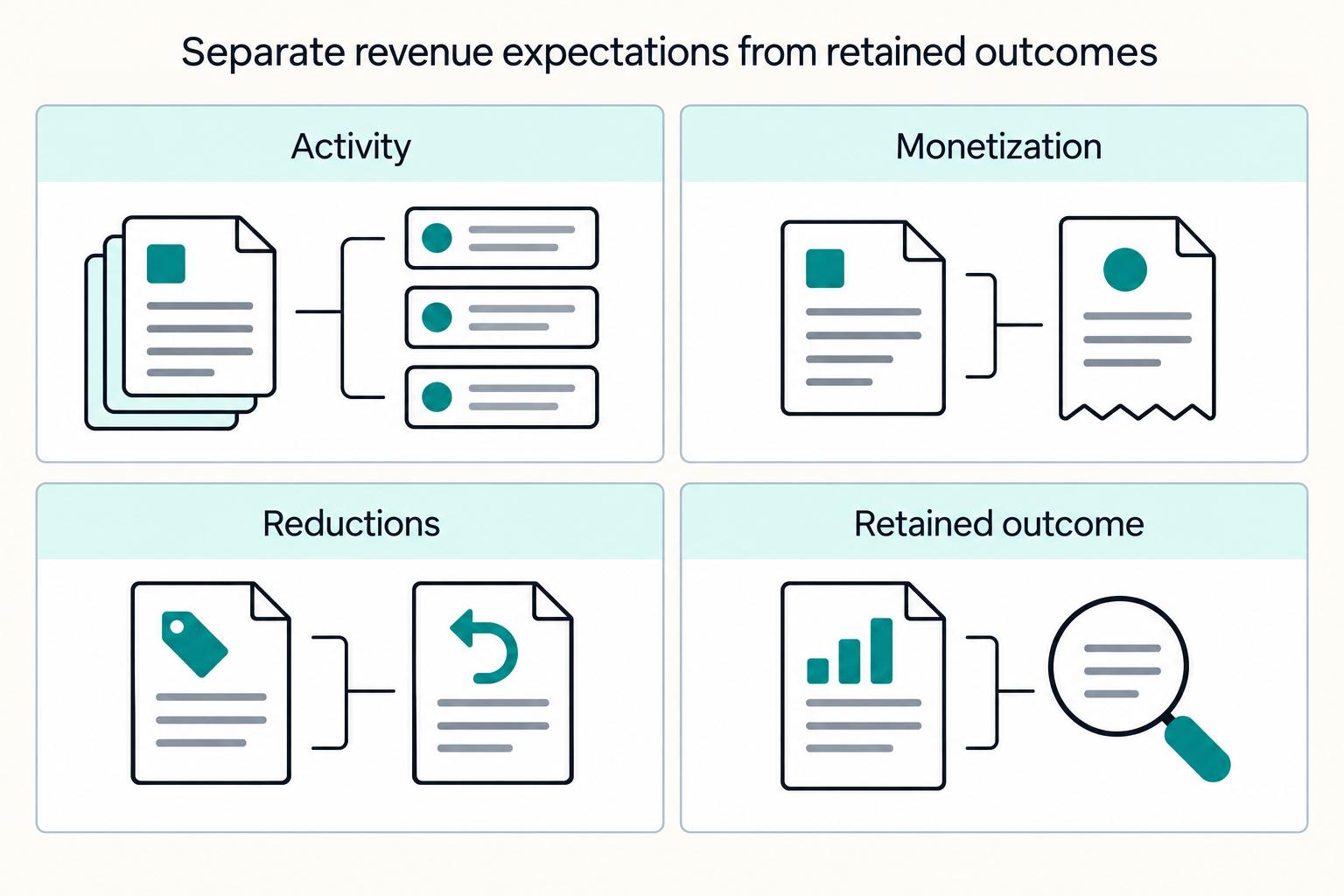
Keep expected monetization separate from retained outcome#
Label expected monetization separately from recognized revenue. Under IFRS 15, revenue reflects performance obligations satisfied by transferring promised goods or services, at a point in time or over time. A commission estimate and an uncompleted settlement do not independently determine that result.
It keeps three review questions visible:
- Did activity change?
- Did monetization pattern change?
- Did reductions or exceptions change?
Use a stable line taxonomy#
Use labels that reflect the underlying business. Liquidity Services’ 2025 filing distinguishes purchased-inventory sales recognized as principal from consignment commissions recognized as agent. A single GMV percentage cannot describe both populations without that distinction.
| Bridge line | What it represents | Review focus | Common mix-up |
|---|---|---|---|
| GMV | Transactions under stated refund/tax/shipping rules | Scope and period consistency | Calling total marketplace purchases platform revenue |
| Expected monetization | Contracted fee estimate or principal sales estimate | Rates, eligible population, role | Calling estimate booked revenue |
| Revenue reductions | Applicable fee refunds, credits, or discounts | Contract and recipient classification | Subtracting full merchant refund from agent fee revenue |
| Return activity | Merchant transaction reversal and any platform-fee reversal separately | Original transaction and refund policy | Treating both amounts as one revenue deduction |
| Costs and incentives | Operating costs or rewards classified by arrangement | Funding and customer/noncustomer relationship | Calling every expense contra revenue |
| Settlement differences | Receivables, payout liabilities, timing or unexplained exceptions | Balance support and cash mapping | Calling every payout delay lost revenue |
| Recognized revenue | Earned consideration after applicable adjustments | Performance obligations and ledger support | Confusing it with margin or cash |
Attach verification artifacts each month#
Keep a versioned transaction extract, contract/rate references, recognition and adjustment support, and a separate ledger-to-settlement reconciliation. Assign an owner and record explanations for open differences so the next reviewer can reproduce the bridge.
Apply a simple triage rule#
Start with scope or rate-version mismatches, then test fee reversals and recognition timing, and finally investigate unexplained exceptions. Use records to distinguish an actual commercial change from a reporting error.
Set decision rules for discounts, returns, and take rate changes#
After you build the bridge, do not treat every deduction as a pricing failure. Separate discount intent, return-control issues, and take-rate decisions with clear internal rules.
Classify discounts by evidence, not by optimism#
For management analysis, label a discount as planned acquisition spending only when its purpose and funding are documented. Keep campaign dates, target cohort or channel, funding owner, and a short outcome note. This analytical label does not decide its accounting classification: a discount reducing customer consideration and a marketing reward paid to a noncustomer may belong in different lines.
| Condition | Review treatment |
|---|---|
| Approved before launch with clear support | Keep in a planned acquisition cost bucket |
| Support is missing | Treat as margin pressure in bridge commentary |
| Discount becomes broad | Treat as margin pressure in bridge commentary |
| Discount becomes persistent | Treat as margin pressure in bridge commentary |
If that support is missing, or the discount becomes broad or persistent, treat it as margin pressure in bridge commentary. That keeps the retained-outcome view honest.
A primary Q2 2025 example from eBay separates the metrics clearly: $19.5 billion GMV, $2.730 billion net revenue, $369 million GAAP net income from continuing operations, and negative $307 million operating cash flow. These historical figures show why volume, revenue, profit, and cash should not be read as the same outcome; they do not by themselves establish a coupon or pricing problem.
Review returns alongside take rate changes#
Use this as a house triage prompt, not an external threshold: when return activity rises and GMV is flat or rising, review return controls and take-rate assumptions in the same decision cycle.
| Check | What to review |
|---|---|
| Return-window settings | Recent policy changes |
| Reason-code mix | By merchant, category, or buyer segment |
| Posting cutoff and cash timing | For reversals |
| GMV definition | Whether it includes shipping fees and taxes |
That definition check matters. If GMV is inclusive of shipping fees and taxes, GMV can rise without a matching increase in kept sales value. Keep model logic separate when you decide interventions.
Compare the policy levers by revenue model#
Compare the levers against the platform’s revenue role and the direct seller’s economics. Keep contractual fee changes separate from sale-price, cost, and working-capital effects.
| Decision area | Platform business model (internal lens) | Linear business model (internal lens) | First verification |
|---|---|---|---|
| Discounts | Check commission and marketplace-growth goals | Check top-line selling economics | Campaign approval, funding owner, target cohort |
| Return activity | Check policy and reversal quality before repricing | Check product, fulfillment, and gross-to-net retention drivers | Return-window log, reason codes, cash tie |
| Take rate change | Anchor on platform revenue as a percentage of GMV | Anchor on price or discount effects on gross and net outcomes | Same-population pre and post view and definition consistency |
Choose a review cadence that supports pricing decisions#
Avoid repricing from a single noisy week. One practical cadence is weekly demand monitoring, monthly financial review, and a quarterly pricing review, with earlier action when reliable evidence warrants it. Test like-for-like populations and metric definitions before attributing a change to pricing. If a definition changes, preserve a comparable historical view or explain the break.
| Review area | Cadence | Decision rule |
|---|---|---|
| Demand | Example: weekly | Monitor noise and cohort changes |
| Financial health | Example: monthly | Review recognition, margin, and cash separately |
| Take-rate changes | Planned review plus material-change triggers | Act when like-for-like evidence supports the change |
When discounts or return activity move, test the relevant controls and commercial explanation. Adjust take rate when the evidence supports the decision; a quarterly calendar is a planning choice, not a mandatory waiting period.
For a step-by-step walkthrough, see Platform Take Rate Optimization: How to Set Marketplace Fees Without Losing Liquidity.
Design reconciliation and settlement checkpoints that survive scale#
Close quality does not survive scale by accident. Use a fixed reconciliation sequence, keep the evidence pack consistent each cycle, and avoid final net revenue postings that rely only on ad hoc spreadsheets.
Use the sequence below as a control template. Separate revenue-recognition support from balance and cash reconciliation: earned revenue can be recognized before settlement, and advance cash may instead be deferred revenue.
Use one order of operations and make breaks visible#
A consistent order makes variances interpretable. If you jump from transaction close straight to cash confirmation and cash does not tie, you cannot tell where the break is: the Ledger, provider file, or timing.
| Checkpoint stage | What must be validated | Minimum evidence kept | Common failure mode | What to do if it fails |
|---|---|---|---|---|
| Transaction close | Closed-period transaction totals and cutoff population are frozen | Closed total by source, period cutoff note | Late transactions or cutoff drift | Review late items against the correct accounting cutoff; adjust the affected period when required or document the supported exception treatment |
| Ledger journal validation | Ledger journals reflect the same population and direction of entries | Journal totals tied to the closed population | Missing reversals, duplicate journals, wrong-period posting | Resolve material recognition/journal differences or document supported accrual and timing treatment before sign-off |
| Processor or provider file match | External processor or provider files match internal recorded activity | File totals, unmatched-item list, file date and reference | File lag, bad mapping, missing fee or reversal lines | Match differences to related receivables, liabilities, fees, or exceptions; assess any actual revenue correction separately |
| Cash confirmation | Cash or provider confirmation aligns with the reconciled file population | Cash report or confirmation tied to matched totals | Timing gaps mistaken for revenue loss, partial payout, route-specific delay | Explain timing and supported outstanding balances; do not equate delayed settlement with unearned revenue |
| Exception queue | Remaining breaks are categorized, owned, and aged | Aging by cause, owner, expected resolution path | Old items rolling forward with no owner or false manual cleanup | Escalate material unsupported differences and record the required accounting treatment; retain supported timing items with owners |
Define a minimum evidence pack for every close#
Check population consistency across source totals, the Ledger, the provider file, and cash confirmation. If one layer includes late reversals or excludes a route that another layer includes, the pack can look clean but be wrong.
Keep the evidence pack small but complete, and assign ownership in the Platform Finance Team:
- reconciled totals
- unmatched-item log
- aging by cause
- sign-off owner
Adapt the baseline to the accounts and risks in your close. Record known timing differences as receivables, liabilities, or other supported balances rather than treating every unsettled item as unearned revenue.
If you want one stable monthly bridge pack, keep:
- your frozen source total for the close period
- your Ledger tie-out with journal direction confirmed
- your provider or settlement file with file date and control owner
- your cash confirmation plus the open exception count
Keep a consistent file order so reviewers can spot missing support or a changed population quickly.
Age exceptions by cause: timing, mapping, provider-file lag, reversals, or policy issues. Record the affected account and period as well as the owner, so an operational delay is not silently reclassified as a commercial deduction.
Treat spreadsheet-only final adjustments as high risk#
Where appropriate, use a simple internal rule: do not post final net revenue adjustments from an ad hoc spreadsheet unless each adjustment has traceable source references.
Spreadsheets can support analysis, but they should not serve as sole evidence for final retained revenue. If an adjustment cannot be traced to source records already recognized in the close pack, keep it in the exception queue.
This distinction matters when growth slows as well as when it accelerates. A delayed payout can coexist with correctly recognized revenue; an unsupported fee reversal can require a revenue correction even after cash has arrived.
Add a documented risk checkpoint before volume or route expansion#
Before you add providers, payout routes, or cross-border markets, document what can break reconciliation, what evidence proves balances are final, and who signs off in the Platform Finance Team.
Document the actual new-route risks: event mapping, cutoff, fee reversals, currency handling, receivable or payout liability tracking, and exception ownership. Test these before relying on the route in production.
Escalate material unsupported recognition or ledger differences before sign-off. Documented settlement delays can remain as supported receivables or payout liabilities; unconfirmed cash alone does not make earned revenue provisional. Related reading: Upskilling Platform Finance Teams for Payments Compliance and Automation.
If you're formalizing close controls, use the Gruv docs to map webhook events, idempotent retries, and ledger-aligned reconciliation flows into your runbook.
Prevent payout execution failures from distorting revenue reporting#
Treat payout-related exceptions as a revenue-quality risk, not just ops noise. Define a consistent internal policy for how unresolved items are tracked until they are reconciled.
GMV is a throughput metric, not a profitability metric. Revenue reductions and operating costs can weaken economics even as volume grows. Keep the two classes separate so the bridge explains both recognized revenue and the margin remaining after costs.
Use a metric matrix, then assign an internal reporting posture#
Align Finance Ops and Accounting on which metrics are activity signals versus profitability signals, so top-line growth is not mistaken for retained performance.
| Metric or view | What it means | Internal reporting posture |
|---|---|---|
| GMV, orders, AOV | Foundational activity metrics | Track for throughput, not as a standalone profitability signal |
| Revenue adjustments and operating costs | Separate classes affecting revenue or profit | Classify each against contract and accounting facts |
| Order/revenue dashboard vs ads dashboard | Separate systems can create blind spots | Compare campaign economics when relevant; revenue close follows recognition and ledger support |
| Contribution margin per creator per SKU | Unit-level profitability signal | Use as a checkpoint for decision-making |
For close, support recognized revenue and the related ledger balances. Reconcile campaign and unit-margin views when they inform the decision, but do not make every ads-dashboard match a precondition for accounting recognition.
You should label each view before sign-off:
- GMV as transaction throughput
- Revenue as earned consideration after applicable revenue adjustments
- Margin and cash as distinct outcomes with their own cost and settlement support
We treat dashboard speed and close certainty as different jobs, even when your team sees both on the same day.
Separate operational visibility from profitability conclusions#
Show exceptions and activity quickly on operational dashboards, but do not treat visibility as proof of final performance. If order/revenue data and ads engagement data sit in separate dashboards, blind spots are easy to create.
Add a profitability checkpoint before close-ready reporting#
Add a separate profitability view after the revenue bridge. Show the selected costs and allocation basis, such as processing or fulfillment costs, so a contribution-margin figure is reproducible and does not get relabeled net revenue.
Keep metric definitions stable while reconciling#
Use consistent metric definitions while reconciliation is underway. Changing both the population and the measurement logic at the same time makes period-to-period performance harder to interpret.
If you are also designing payout logic, see our guide to choosing a gross-to-net payout model for platform disbursements.
Choose the right metric by operating scenario#
Pick the metric that matches the decision. Use GMV for transaction scale, revenue for earned consideration, margin for economics after defined costs, and settlement balances or cash reports for payout decisions.
| Scenario | What to watch first | What can mislead you | Default recommendation |
|---|---|---|---|
| High-growth Marketplace launch | GMV and the GMV-to-Net Revenue bridge | Rising volume with weaker conversion to retained revenue | Track growth and the revenue bridge; analyze available data with labelled gaps and scope commitments to material uncertainties |
| Mature Customer-to-Customer (C2C) Platform | Net Revenue quality and GMV-to-Net Revenue consistency | Raw GMV growth masking leakage, reversals, or refund timing effects | Run decisions on retained revenue quality first; use GMV as a secondary health signal |
| Mixed model with direct sales + third-party flows | Separate direct-sales and third-party reporting | Blended reporting that mixes different economics | Split populations before analysis and compare like with like |
For a high-growth Marketplace, compare GMV across consistent periods and track match rate and unsuccessful matches, or “zeros,” alongside it. Investigate an unstable revenue bridge and label the affected uncertainty. Early pricing analysis can use available data and stated gaps; hold a specific commitment only when a material unresolved issue undermines that decision. Platform Take Rate Optimization: How to Set Marketplace Fees Without Losing Liquidity gives a practical framework.
For a mature Customer-to-Customer (C2C) Platform, prioritize retained revenue quality over raw volume. GMV is often calculated before fees or expenses, and refund treatment can differ by platform, so a clean GMV trend can hide weaker retained results. Review GMV and retained outcomes together when reversals or returns increase.
For mixed models, keep direct sales and third-party flows separate in reporting. Blended dashboards can hide different economics and accounting roles. Document whether each GMV view is net of refunds or preserves original order value with later reversals shown separately; do not assume the two bases are comparable.
Assign ownership and reporting cadence across finance, ops, and product#
Assign ownership to the team that can fix the issue. A weekly operational review and monthly close review can work as a starting cadence, adjusted for volume and risk. GMV can obscure cancellations or unprofitable sales, while revenue alone omits operating costs.
| Control area | Core question | Suggested owner lens | Example review rhythm | Evidence to retain |
|---|---|---|---|---|
| Event capture and metric logic | Did the transaction event fire correctly and land in reporting as intended? | Assigned owner with control over event instrumentation and metric definitions | Weekly KPI review, with monthly roll-up | Event counts, change log, metric definition note |
| Reconciliation and cash outputs | Do internal totals align with provider or cash outputs, and what remains unmatched? | Assigned owner for reconciliation outputs and exception workflows | Weekly and monthly review | Reconciliation summary, unmatched-item log, cash reference |
| Income statement classification | What belongs in gross, net, contra revenue, or another line? | Assigned close reviewer for classification decisions | Monthly close review | Journal support, classification rationale note |
Standardize the weekly and monthly split. Use weekly review to catch drift in take rate, deductions, and exceptions before close. Use monthly review to confirm classification decisions.
Set payout checks at the frequency needed for your volume and risk. Escalate aged exceptions to named owners, and preserve definition versions so an analytical change does not hide an unresolved balance.
At close, keep a short handoff record so exception ownership does not get lost between teams, but treat exact checklist fields as an internal process choice rather than a prescribed standard. If you're tightening the operating handoff around disbursements, Choosing a Gross-to-Net Payout Model for Platform Disbursements can help frame the ownership split.
Red flags that mean your metric stack is drifting#
Treat these as investigation triggers, not diagnoses. GMV measures transactions on its declared basis; agent revenue may be only a fee, while principal revenue follows its sales obligations. Operating expenses then affect profit separately, so these measures need not move in lockstep.
| Red flag | What it signals | First check |
|---|---|---|
| GMV rises while net revenue stays flat | Throughput and retained economics may be on different bases | Confirm both views use the same period, included sales, and return treatment |
| GMV and net revenue trends diverge across period views | Measurement basis may be inconsistent across cuts | Recheck the same period across month-over-month, quarter-over-quarter, and year-over-year views, including return handling |
The first pattern is the easiest to misread. GMV is sales price times units sold before fees or expenses, and some methods remove returns while others do not. So when GMV rises and retained revenue does not, verify basis consistency before treating it as an economics problem.
Set a practical stop-and-fix trigger in your own operating model. If an unexplained variance keeps repeating, prioritize reconciling period definitions, included sales, and return handling so the team can reproduce the metric and explain the gap clearly.
Check your basis in this order:
- your period cutoff and included sales population
- your return, refund, and chargeback handling
- your deduction labels in the gross-to-net bridge
- your sign-off owner for the unresolved exception queue
When we see repeated drift, we freeze the definition before we debate pricing or demand.
The goal is not perfect alignment between GMV and net revenue. The goal is a repeatable, evidence-backed explanation for why they differ.
Conclusion#
Use GMV for throughput, revenue for earned consideration, and separate cost and settlement bridges for profit and cash. Explicit definitions and reproducible support make the differences explainable.
If you want a close-ready action set, use this:
- document consistent GMV and revenue definitions before comparing take rates
- tie applicable revenue adjustments and separate expense classes to their reporting populations
- support recognition and ledger balances, with cash timing differences explained separately
Make uncertainties visible, then scope each decision to what the evidence supports.
| Metric | Useful for | Misleading if used alone | What should back it up |
|---|---|---|---|
| Gross Merchandise Value (GMV) | Tracking platform throughput and growth across periods | It is calculated before fees or expenses, so it does not show retained revenue | Period-over-period checks, month-over-month, quarter-over-quarter, and year-over-year, plus a documented definition |
| Gross revenue | Seeing total revenue before deductions | It can be mistaken for marketplace purchases or profit if the principal-agent role is unclear | A clear gross-to-net bridge with deduction classes shown separately |
| Net revenue | Earned revenue after applicable revenue adjustments | It does not measure profit after operating costs or cash settled | Recognition and adjustment support plus a separate settlement bridge |
GMV still matters. In platform contexts, it represents the total monetary value of goods sold over a period, and trend comparisons can show growth or health. But because GMV is before fees or expenses, it can obscure issues when treated as an earnings signal.
Before scaling volume, make your gross-to-net checkpoints explicit and repeatable so the bridge from activity to retained revenue stays reliable. A practical check is simple: can you trace transaction totals to gross, then to net, and explain each deduction without guesswork?
In the next close cycle, implement the comparison table, the bridge model, and red-flag triggers for unexplained gaps between throughput and retained revenue. Then tighten the model based on variance results.
When your team is ready to tighten payout operations while keeping audit traceability, review Gruv Payouts and validate fit for your market/program.
Frequently Asked Questions
What is the practical difference between Gross Merchandise Volume (GMV) and Net Revenue for a platform finance team?
GMV measures merchandise transactions on a documented basis, including your treatment of refunds, shipping, and taxes. Platform revenue reflects earned consideration under the applicable recognition rules: a principal generally recognizes its controlled supply gross, while an agent recognizes its arranging fee. Net revenue can reflect applicable reductions of that revenue; it is not revenue minus every expense or the cash already settled.
How should a team calculate GMV versus Gross Revenue on a Marketplace?
For a simple order-value example, 200 units at $50 equals $10,000 before the stated GMV adjustments. Define refunds, cancellations, shipping, and taxes consistently. Marketplace revenue is separate: an agent’s 12% fee on that eligible value would be $1,200 before fee reversals, while a principal assesses its own sales obligations and gross recognition. Do not rename total marketplace purchases gross platform revenue automatically.
Why does `Take Rate × GMV` still fail to predict final Net Revenue in many months?
A stated commission multiplied by eligible GMV estimates fees only when the rate, population, and recognition period match. Tiered rates, subscriptions, advertising, fee refunds, credits, and timing can change the result. An observed take rate defined as recognized revenue divided by the same GMV will reproduce that numerator by construction; it is not an independent forecast. Keep processor costs and platform-borne losses in their correct expense or revenue-adjustment lines.
Are GMV and Take Rate useful for a Linear Business Model, or mostly for platform models?
GMV and take rate are especially useful for an intermediary whose platform handles purchases by other parties. A direct seller can usually start with sales revenue, returns, cost of goods, and margin. If a mixed business uses GMV, split principal sales and agent transactions and define each ratio before comparing them.
When should Returns and Discounts be treated as operational noise versus a pricing problem?
Test return reasons, cohorts, policy changes, campaign funding, and repeat behavior. A planned discount may still pressure margin, while a reporting cutoff mismatch may explain an apparent reversal spike. Classify the revenue or expense effect under the actual arrangement, then adjust pricing when the commercial evidence supports it.
What minimum reconciliation evidence should exist before signing off Net Revenue?
Retain the transaction population and cutoff, contract/rate and principal-agent assessment, recognition calculations, adjustment support, ledger tie-out, and explanations for material open balances. Reconcile provider files and cash to the related receivables or liabilities. A supported settlement delay does not postpone earned revenue; unsupported material recognition differences require resolution or a documented accounting treatment before sign-off.
Try a related tool
Researched and edited by the Gruv editorial team. Gruv builds cross-border billing, payouts, and finance-operations software for global businesses.
Sources
Includes 3 external sources outside the trusted-domain allowlist.
- sec.gov/Archives/edgar/data/1235468/0001193125260388...trusted
- sec.gov/Archives/edgar/data/1594805/0001594805260000...trusted
- ifrs.org/issued-standards/list-of-standards/ifrs-15-r...external
- ifrs.org/news-and-events/updates/ifric/2022/ifric-upd...external
- investors.ebayinc.com/investor-news/press-release-details/2025/eBa...external
Educational content only. Not legal, tax, or financial advice.
Related Posts

The Freelance Payment Penalty: A Modeled Audit of Platform Fees, FX Spreads, and Payout Delays
The money rarely disappears through a single, easy-to-spot fee. The real loss is stacked. A marketplace takes its commission, a processor adds a charge for international cards, a bank or payment company converts the currency at a spread, a platform holds the funds before release, and a wire sheds a little to intermediaries on the way in. Each layer looks defensible on its own, but the worker feels the combined result as a smaller deposit and a later payday.

How to Respond to a Subpoena for Business Records
Move fast, but do not produce records on instinct. If you need to **respond to a subpoena for business records**, your immediate job is to control deadlines, preserve records, and make any later production defensible.

A US Expat's Guide to Investing in UCITS ETFs to Avoid PFIC Issues
The real problem is a two-system conflict. U.S. tax treatment can punish the wrong fund choice, while local product-access constraints can block the funds you want to buy in the first place. For **us expat ucits etfs**, the practical question is not "Which product is best?" It is "What can I access, report, and keep doing every year without guessing?" Use this four-part filter before any trade: