
Quick Answer
Choose REST first for money-moving commands, then add GraphQL for read-heavy surfaces after webhook delivery and replay handling are stable. The recommended sequence is to harden command contracts, validate event behavior, and only then introduce query composition where clients are over-calling endpoints. Keep verification explicit through contract tests, logging, and clear ownership of error and cache behavior so each integration surface is easy to operate.
Why this comparison matters for payment platform teams in 2026#
Do not force a single winner across your platform. Match GraphQL or REST to each API job. That choice affects contract clarity and the client complexity you carry forward.
The real comparison is job fit, not ideology#
Start from a simple baseline: API choice depends on the use case, and a mix of both can be right. GraphQL is designed for precise data requests, while REST is an architectural style for web services built around an endpoint, HTTP method, headers, and body. If the debate starts with which one should replace the other everywhere, you are solving the wrong problem.
Where this article stays practical#
We keep this to four API jobs so the discussion stays tied to implementation factors that actually affect API choice: integration ease, developer productivity, performance expectations, and scalability.
- onboarding flows
- money movement commands
- reporting reads
- operational event handling over
HTTP
What to check before you commit#
Before you commit, make sure another engineer can verify the contract without guessing. For REST, that usually means a clear endpoint, HTTP method, headers, and body. For GraphQL, the equivalent check is whether clients actually benefit from requesting exactly the fields they need.
A common early mistake is choosing for first-integration convenience alone. Out of the box, REST can mean multiple requests and overfetching, while GraphQL lets clients request precise field selection. The better choice is the one that keeps the contract clear for the specific surface you are designing.
What you should get from the rest of this comparison#
You should leave with a decision sequence, failure-mode checks, and a practical implementation order for payment-facing HTTP APIs. We are not trying to crown a universal winner. We are matching each pattern to the job.
If you want a deeper dive, read OAuth 2.0 Scopes for Platform Payment APIs: Design Patterns.
At-a-glance GraphQL vs REST for payment platform API jobs#
Use REST when you want simpler, standardized patterns. Use GraphQL when clients need flexible reads with exact fields from a single endpoint. Still, payment-critical requirements such as retries, webhook reliability, reconciliation, or auditability are not established, so treat those as separate design decisions.
| Criterion | REST | GraphQL | Payment-platform takeaway |
|---|---|---|---|
| API shape | Multiple endpoints per resource with standard HTTP methods | Single endpoint for operations | Choose based on whether resource endpoints or client-shaped queries fit your use case. |
| Read flexibility | Fixed data per endpoint; can require multiple calls | Client asks for exact fields through a single endpoint | GraphQL is designed for flexible read aggregation. |
Error semantics (HTTP status codes vs payload errors) | Uses HTTP status codes like 200-level, 400-level, 500-level to signal outcomes | Often shown with 200 plus errors in payload (implementation-specific) | Make sure clients and monitoring inspect the same success or failure signal. |
| Caching | Typically aligns with standard HTTP caching behavior | Commonly needs a custom caching strategy | Do not assume caching behavior is automatic in GraphQL. |
| Versioning | Commonly /v1, /v2 URL versioning | Commonly schema evolution | Decide early how consumers detect and adopt changes. |
| Operational observability | Verify with your observability tooling | Verify with your observability tooling | Evaluate logging and traceability separately from API style. |
Idempotent retries | Verify with your observability tooling | Verify with your observability tooling | Design replay safety explicitly; no payment-specific standard is established here. |
Webhooks reliability | Verify with your observability tooling | Verify with your observability tooling | Retry, ordering, and delivery guarantees are not documented here. |
Reconciliation workflows | Verify with your observability tooling | Verify with your observability tooling | Reconciliation requirements are not documented here. |
Audit traceability for Payout batches | Verify with your observability tooling | Verify with your observability tooling | Payout-batch auditability requirements are not documented here. |
The source material presents REST as simpler and more standardized, and GraphQL as more flexible and efficient. That still does not make either style automatically better for money-movement commands.
Related: ERP Integration Architecture for Payment Platforms: Webhooks APIs and Event-Driven Sync Patterns.
Start with API job boundaries before picking a pattern#
Define your API jobs first, then choose REST or GraphQL for each surface. If you pick the pattern first, you can end up with client fan-out and cross-team coupling.
| Assurance area | Type | What to define or validate |
|---|---|---|
| Duplicate prevention | Non-negotiable | How duplicate requests and events are detected and verified |
| Traceability | Non-negotiable | Which request, event, and log records reconstruct a timeline |
| Confidentiality | Non-negotiable | Which fields are exposed and which entities are authorized to access them |
| Contract testing | Operational checkpoint | Consumers can verify compatibility as contracts evolve |
| Monitoring and logging | Operational checkpoint | Failures are diagnosable without cross-team guesswork |
In practice, we would split them this way:
- Command surfaces for state changes.
- Query surfaces for read models shaped to client needs.
- Async event surfaces for after-the-fact status propagation.
Use bounded nouns so each surface keeps a clear scope. Fine-grained APIs can force clients to call multiple services, and different clients need different data shapes, so think through aggregation needs up front.
Before you choose a style, define the non-negotiables for each surface:
- duplicate prevention, including how duplicate requests and events are detected and verified
- traceability, including which request, event, and log records reconstruct a timeline
- confidentiality, including which fields are exposed and which entities are authorized to access them
Then verify two operational checkpoints before you debate protocol details:
- contract testing, so consumers can verify compatibility as contracts evolve
- monitoring and logging, so failures are diagnosable without cross-team guesswork
Lock jobs, nouns, and assurance checks first. Pick REST or GraphQL only after that boundary map is explicit.
For a step-by-step walkthrough, see Payout API Design Best Practices for a Reliable Disbursement Platform.
Keep money movement commands on REST unless you can prove equivalent controls#
Default state-changing money movement commands to REST unless a GraphQL mutation layer can prove equivalent controls. For these commands, explicit URI resources and HTTP methods usually make command intent easier to review and operate.
This is about control clarity, not ideology. A payment command is both a write and part of the operational record during incident review. REST exposes resources as endpoints and actions through methods, so intent is visible in the contract. With GraphQL, many operations can share one endpoint, so you rely more on mutation naming and logging discipline.
| Control question | REST command surface | GraphQL mutation surface |
|---|---|---|
| Is command intent obvious from transport? | Usually yes, via resource path + method | Depends on mutation naming and logging discipline |
| Are retry and replay rules explicit and tested? | Must be explicit per command endpoint | Must be explicit per mutation |
| Is audit review straightforward from request logs? | Often easier when endpoint and method separate command classes | Can be harder when many operations share one endpoint |
| Is caching behavior explicit and manageable? | URL-based caching can leverage endpoint-specific URLs | Caching can be trickier on a shared POST endpoint; large queries without limits can overload servers |
Do not assume idempotency keys or replay semantics come for free in either style. Require explicit duplicate-prevention behavior for each money movement command, then prove it with contract tests and monitoring and logging evidence before production.
Treat command APIs as evidence, not just transport. Each request should leave a traceable record that supports integrity and non-repudiation during incident review.
That said, GraphQL mutations are still viable for commands, but only if you can show parity before rollout:
- mutation-level idempotency and replay tests
- contract testing for stable inputs and outputs
- monitoring and logging that clearly show mutation and outcome
- authorization checks scoped to each mutation's effect
- query limits or equivalent safeguards to prevent oversized operations from overloading services
Keep the default on REST for money movement until you can demonstrate that parity.
Use GraphQL where read complexity hurts product velocity#
When read requirements keep spawning new REST endpoints, GraphQL can earn its keep. Use it on those read paths to reduce endpoint churn.
Still, do not move every read. If a view maps cleanly to one resource with a stable shape, a simple GET endpoint is usually easier to operate. The case for GraphQL gets stronger when teams keep adding custom endpoints for minor shape changes and read composition starts slowing delivery.
| Read situation | REST read surface | GraphQL read surface | Recommendation |
|---|---|---|---|
| Single resource detail with stable shape | Clear resource path and response | Works, but can add unnecessary surface | Keep REST |
| Dashboard that combines many entities | Often multiple calls or another aggregation endpoint | One query can request only needed fields | Prefer GraphQL |
| Views with frequent field-shape changes | Can become repetitive as complexity grows | Better fit for varied client field selection | Lean GraphQL |
| Data with separate source owners | Ownership is explicit per endpoint | Convenient, but ownership can blur if unmanaged | Use GraphQL with explicit boundaries |
A practical signal is repetition, not ideology: if the recurring answer to new read requests is "we need another endpoint," your read layer is becoming a bottleneck.
In complex products, this often shows up in blended operator views that combine data from multiple resources on one screen. A composed read layer can reduce repeated endpoint work.
Before you roll it out, define guardrails and test them with real queries. Also document non-happy-path behavior (errors, rate limiting) and keep docs aligned with implementation, because drift there slows debugging quickly.
Design webhook and event contracts before schema polish#
Once you know where GraphQL helps on reads, design your webhook and event contract before you polish endpoint schemas. Webhooks are HTTP callbacks sent automatically when specific events occur, so treat them as part of your production operating surface, not a later documentation task.
The key tradeoff here is less about REST versus GraphQL and more about sequence. If event behavior stays undefined until late, polished request and response shapes can still leave you with production issues that are hard to triage.
| Decision area | Define early | Defer until later | Verification question |
|---|---|---|---|
| Event envelope | Shared structure and identifiers are explicit | Producers drift into inconsistent payloads | Can teams identify event type and correlation context quickly from logs? |
| Retry behavior | Delivery and retry expectations are documented | Retries are implicit or unclear | Can operators tell delayed delivery from failed delivery during incidents? |
| Replay and deduping | Consumer handling rules are documented | Duplicate handling becomes ad hoc | Can consumers safely handle repeated or out-of-order events? |
| Incident evidence | API and event logs are designed to work together | Timeline reconstruction is manual | Can you explain an end-to-end state change without manual forensics? |
Standardize what operators need first#
You do not need every schema detail to make an event contract usable. You do need clarity on identity, correlation, and retry or replay handling so consumers implement consistent handling instead of guessing per integration.
Make production monitoring part of the contract#
Webhook reliability has to show up in live operation, not only in pre-release tests. Use a focused monitoring loop: measure, detect, triage, and improve. Track a small set of signals tied to real risk so subtle failures are easier to catch and diagnose.
Keep command and event docs aligned#
For async workflows, document how command actions map to later state updates, and keep shared identifiers aligned where possible. That alignment can reduce manual reconciliation across request logs, webhook payloads, and operational dashboards.
You might also find this useful: A Guide to GraphQL for Modern Web APIs.
Build compliance and data protection into the contract surface#
Treat compliance and tax handling as explicit contract states early, not as notes or ad hoc ops steps. If your platform includes compliance checks or tax-document workflows, represent them as durable states across API reads, writes, and webhooks.
Protocol choice does not remove ambiguity on its own. Clear state modeling does. The test is whether integrators and operators can see what is blocked, what action comes next, and what changed.
| Decision area | Explicit contract state | Hidden or ad hoc handling | What to verify |
|---|---|---|---|
| Compliance checks | Status and reason fields are documented and stable | Meaning is inferred from missing fields or support messages | Can clients see current status and required next action without manual escalation? |
| Data handling | Expected fields are documented by surface | Field expectations drift across requests, reads, and events | Can teams identify which fields are expected in a sample request, response, and webhook? |
| Tax documents | Collection and review outcomes are lifecycle states | Files are treated as one-time uploads | Can teams see document state, reviewer outcome, and next action? |
| Timeline exceptions | Deadline changes are state updates | Dates are hardcoded in UI copy or templates | Can operators update timelines without breaking client integrations? |
Treat tax documents as lifecycle evidence, not just upload moments. For the tax workflows you support, keep states durable so product, ops, and integrators share one version of truth.
The FEIE example makes the point concrete. The IRS states the exclusion applies only to a qualifying individual with foreign earned income, and that income is still reported on a U.S. tax return. The cited IRS practice unit points to Form 2555 or Form 2555-EZ, while also stating that the document is not an official pronouncement of law.
When eligibility depends on measurable checkpoints, keep those checkpoints in the review model. For the IRS physical presence test, the quoted threshold is 330 full days in 12 consecutive months, and a full day is 24 consecutive hours. The 330 days do not have to be consecutive; failure to meet the threshold fails the test regardless of reason; and waivers may apply for adverse conditions.
Model filing-timeline exceptions as stateful updates too. FinCEN's FBAR page includes dated extension notices, including an additional extension dated 10/11/2024.
Plan versioning, caching, and error semantics as operating policy#
Set these policies before launch so clients, operators, and monitoring interpret behavior the same way. In this comparison, REST is commonly versioned by path, such as /v1 and /v2, while GraphQL changes through schema evolution.
For versioning, treat the contract artifact itself as part of policy. In this comparison, REST can use an optional schema artifact such as OpenAPI, while GraphQL uses a mandatory, strongly typed schema. If you use schema evolution, document how deprecations and removals will work instead of leaving change handling implicit.
For errors, align transport and business-failure handling before production. The same comparison shows REST using HTTP status codes, while GraphQL is often represented as HTTP 200 with errors in the payload. Your operating policy should make retries, alerting, and client fallback depend on one shared interpretation.
For caching, pick a strategy by surface. REST supports built-in HTTP caching because responses can be marked cacheable or not, while GraphQL requires a custom caching strategy, so cache ownership and freshness checks should be explicit.
| Area | Policy owner | Enforcement mechanism | Verification signal |
|---|---|---|---|
| Versioning | Define internally before launch | Document REST path versioning (for example /v1, /v2) and GraphQL schema-evolution handling | Integrators can identify the active version or schema change path without support escalation |
| Error semantics | Define internally before launch | Publish shared handling for HTTP status outcomes and GraphQL payload errors | Alerts, retries, and client behavior classify the same failure consistently |
| Caching | Define internally before launch | Apply HTTP cache controls for stable REST reads and define the GraphQL caching approach | Teams can explain whether returned data is fresh, stale, or bypassed on each surface |
If priorities are tight, start where ambiguity is highest. A poor API-style fit compounds technical debt as client count grows.
Need the full breakdown? Read ACH API Integration to Programmatically Initiate and Track Transfers in Your Platform.
Hidden costs teams miss in GraphQL and REST adoption#
The biggest cost often shows up after launch, not in the first design review. GraphQL can move cost into query and caching behavior, while REST can move cost into endpoint growth and client orchestration.
| Surface | Hidden cost that shows up later | Typical trigger | What to verify before launch |
|---|---|---|---|
| GraphQL | Operational cost and performance risk from flexible query patterns | One endpoint supports many read shapes and query patterns expand over time | For core queries, confirm field ownership and cache behavior are explicit and reviewable without digging through resolver internals |
| REST | Endpoint sprawl and brittle multi-call client flows | New product views keep adding purpose-built resources | Map key read journeys end to end. If clients need many calls or frequent client-side stitching, orchestration cost is already rising |
| Both | Hard-to-control scaling cost if hardening is deferred | Teams treat launch architecture as final instead of evolving it | Define an explicit hardening path: full-response caching, then field-level caching, then event-driven replication, then a decentralized edge data layer where needed |
GraphQL is strong when clients need exactly the fields they need from a single endpoint, but that same flexibility can create hidden operational cost at scale. A concrete failure mode is caching: dynamic queries can reduce traditional cache effectiveness and increase origin fetches, egress, and latency.
REST is often favored for simplicity and reliability in straightforward flows, but complex experiences can push teams into building, maintaining, and versioning many endpoints. Clients then compensate with multiple calls or over-fetching and local parsing, which increases latency and integration complexity.
Treat this as a tradeoff, not a winner-take-all decision. In practice, reliability comes from choosing the right surface for each job and planning hardening stages early, before query growth or endpoint growth becomes harder to unwind.
Migration sequence that avoids platform debt#
Use this order to reduce integration debt: stabilize commands first, validate event delivery second, add GraphQL for read composition third, then publish contracts before you expand surfaces.
| Step | Default choice | Why this order helps | What to verify before moving on |
|---|---|---|---|
| 1 | REST for command operations | REST is a common default starting point for most applications, and it keeps state-change behavior explicit through HTTP resource semantics | Core command behavior is covered by repeatable API tests that run in CI/CD on each commit |
| 2 | Event delivery paths (including webhooks where used) | Unclear event delivery creates ambiguity for downstream consumers | Critical delivery scenarios are tested early, and outcomes are visible before release |
| 3 | GraphQL for read composition | Add it when read paths still require too many calls or repeated client-side joins | Painful read journeys are identified, and resolver behavior and cache expectations are tested |
| 4 | Published API contracts with consumer verification | Expansion risk rises when contracts live only in code or team memory | Contracts are published, consumer checks run in CI/CD on each commit, and docs are generated from real test scenarios |
Most teams should put the most discipline into Steps 1 and 2. If core command or event behavior is still ambiguous, a richer query layer will only scale that uncertainty.
GraphQL is a strong Step 3 tool when operator dashboards are fragmented. This often shows up as read paths that turn into many requests, for example 12 requests at 200 to 500 ms each, or when clients keep rebuilding the same joins. Adopting it too early can bring known operational issues like N+1 query patterns, harder caching, and slower debugging.
Step 4 is where architecture decisions get safer to scale. Published contracts and continuous consumer verification help move change risk from production incidents into review and test cycles.
This pairs well with our guide on Payment Decline Reason Codes for Platform Engineers.
Decision checklist for CTOs and solution architects#
A practical hybrid path keeps explicit command-style operations REST-first and adds GraphQL where read composition is the bottleneck. Choose based on consumer type, performance needs, and team expertise.
Yes or no before you choose#
| Decision signal | If the answer is yes | Lean |
|---|---|---|
| Command criticality | Client actions change state in ways that are costly to unwind | REST first |
| Audit needs | You need request and response behavior documented and reviewable in a stable contract artifact | REST with OpenAPI/Swagger discipline |
| Client read variability | Teams repeatedly need different field and entity combinations and clients keep stitching joins across calls | Add GraphQL for reads |
| Team skill depth | Team is small or mixed in API depth (grounded heuristic: < 10 engineers) | REST first |
| Incident tolerance | You can absorb higher server-side complexity to gain flexible queries | GraphQL is viable for read paths |
If you are scoping effort by endpoint count alone, treat that as a risk signal. One cited model frames endpoint lists as about 40% of real API work, with the other 60% in authentication, rate limiting, error handling, versioning, documentation, and integration work.
Scenario rules that hold up in review#
- If your first pain is state-change consistency, choose REST first.
- If your first pain is fragmented reads, add GraphQL on top of existing services instead of replacing command surfaces.
Require evidence before exceptions#
| Required evidence | Article detail |
|---|---|
| Consumer map | Public API, mobile app, or microservices |
| Versioning and deprecation plan | Client impact |
| Documentation contract and ownership plan | OpenAPI/Swagger for REST |
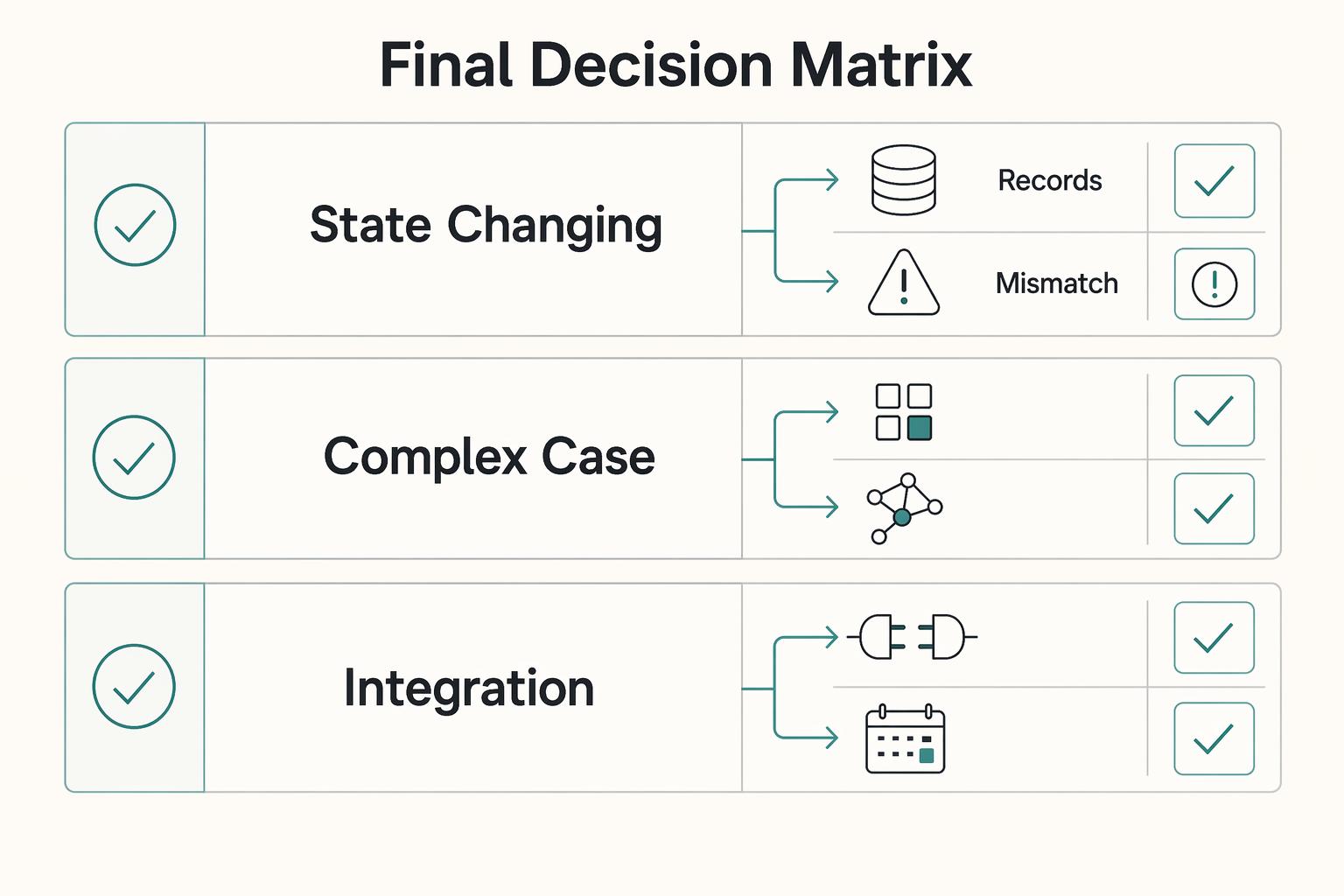
Final decision matrix#
| Platform job | Default pattern | Main caveat | Owner |
|---|---|---|---|
| State-changing commands | REST | Versioning and deprecation lifecycle friction requires contract discipline | Platform API lead |
| Multi-entity product and ops reads | GraphQL on top of existing services | Flexible queries increase server-side complexity | Product engineering lead |
| Public API contract docs | REST with OpenAPI where applicable | Docs drift if not tied to change review | Developer platform or architect |
| APIs with frequent version evolution | Keep lifecycle planning explicit before adding read layers | Deprecation burden grows when clients remain on older versions | Integration or API owner |
For this comparison, prefer REST when state-change ambiguity is the bigger risk. Prefer GraphQL when client-side orchestration is the bigger tax. Use both when both risks are active.
For related guidance, see Payment API Documentation for Reliable Integration Decisions. Before you lock your API pattern, pressure-test your command and read surfaces with an implementation checklist and the Gruv docs.
Choose patterns by API job, not by ideology#
Choose the pattern that reduces failure and rework for the job in front of you. No single API style is universally best, so pick the approach that fits your context and outcomes. Better here means fewer brittle rewrites once operators and customers depend on the contract.
Judge each surface on outcomes, not preference. We are not naming a single winner in the GraphQL-versus-REST debate for payment platforms. We are choosing what fits your current context, then verifying it before you scale it across the platform.
Make the default do the least damage#
A REST API uses HTTP methods and URLs to structure requests. That gives you explicit request surfaces to review, test, and debug. If an action maps cleanly to an HTTP method and a named resource, the contract is usually easier to reason about.
GraphQL shifts more responsibility into schema design and governance. GraphQL versioning usually happens by deprecating old fields and adding new ones, so deprecation discipline is required. Without upfront planning, a clean schema can become brittle and expensive to maintain.
Compare the job, not the brand#
Use a short evaluation sheet across 5 core dimensions before you decide.
| Dimension | REST is the stronger default when | GraphQL is the stronger default when | Verification checkpoint |
|---|---|---|---|
| Primary job | HTTP methods and URL resources already map cleanly to the surface | You have a clear, outcome-based reason to use a schema-driven layer | Can a reviewer explain the contract's purpose in one sentence without extra translation? |
| Contract shape | HTTP methods and URL resources make the action obvious | Schema ownership, deprecation rules, and consumer communication are defined upfront | Is there a written reason this surface needs a graph schema instead of endpoint contracts? |
| Change model | Contract changes stay explicit at the HTTP level | You can evolve schema by deprecating old fields and adding new ones | Is there a named owner for deprecations and consumer communication? |
| Performance risk | Endpoint behavior is reviewed as part of API governance | Query flexibility is paired with active guardrails | Do you enforce query guardrails such as depth or complexity limits? |
| Ongoing ownership | Resource review is already staffed and routine | You can support edge-case planning and performance management at scale | Can the platform team show who owns schema review and query performance? |
A practical red flag: if you cannot name owners for GraphQL deprecations, query guardrails, and performance management, pause expansion. Unguarded queries can crater performance, and weak upfront planning can leave the schema brittle and expensive to maintain.
Treat this as a phased architecture choice: classify surfaces by job, score them across 5 core dimensions, then adopt where evidence is strongest. Then validate your current surfaces against the checklist from the previous section. Confirm platform ownership constraints, especially deprecation handling and query guardrails where needed.
Related reading: Choosing OAuth 2.0, JWT, or API Keys for Production APIs. If you want a second pass on rollout sequencing and control coverage for your payment flows, contact Gruv.
If you are making the call now, keep the next steps short:
- classify each surface as command, query, or event
- keep money movement commands REST-first unless you can prove control parity
- add GraphQL where read fan-out is already slowing delivery
- publish versioning, error, and caching policy before launch
- verify command, event, and read contracts in CI/CD
Frequently Asked Questions
Which should we choose first for a payment platform, GraphQL or REST?
If your immediate need is predictable HTTP-native behavior (like status-code semantics, URL versioning, and built-in caching), REST is often the simpler starting point. If your main bottleneck is assembling multi-entity reads across many calls, add GraphQL for those read paths because one query can reduce round trips. You can combine both when command and read needs diverge.
Can GraphQL fully replace REST in payment APIs?
GraphQL can replace some read surfaces, but full replacement is context-dependent. The tradeoff is broader than endpoint shape: GraphQL can simplify client reads, but it also shifts complexity into schema and resolver governance. Treat replacement as a surface-by-surface decision, not a default assumption.
How do versioning approaches differ in practice?
REST commonly versions contracts through URL paths such as /v1 and /v2. GraphQL usually keeps one endpoint and evolves the schema over time. That makes deprecation and schema governance a core operational discipline.
How do error semantics differ for operators?
REST uses HTTP status codes as the primary error signal. GraphQL responses can return HTTP 200 while still carrying errors in the payload, so operators and clients need to inspect response bodies as well as status codes. Monitoring that checks only transport status can miss failures.
Which model is better for caching in production?
REST aligns naturally with built-in HTTP caching patterns. GraphQL can still cache well, but it typically needs an explicit custom caching strategy. The practical difference is handling varying query shapes and field selections.
What are the biggest integration risks teams underestimate?
Teams often underestimate governance and multi-call read risks more than endpoint style. In GraphQL, weak schema and resolver governance can become hard to maintain at scale. In REST-heavy read use cases, assembling one view from multiple resource calls can increase client complexity and failure points.
Try a related tool
Researched and edited by the Gruv editorial team. Gruv builds cross-border billing, payouts, and finance-operations software for global businesses.
Sources
Educational content only. Not legal, tax, or financial advice.
Related Posts

The Freelance Payment Penalty: A Modeled Audit of Platform Fees, FX Spreads, and Payout Delays
The money rarely disappears through a single, easy-to-spot fee. The real loss is stacked. A marketplace takes its commission, a processor adds a charge for international cards, a bank or payment company converts the currency at a spread, a platform holds the funds before release, and a wire sheds a little to intermediaries on the way in. Each layer looks defensible on its own, but the worker feels the combined result as a smaller deposit and a later payday.

How to Respond to a Subpoena for Business Records
Move fast, but do not produce records on instinct. If you need to **respond to a subpoena for business records**, your immediate job is to control deadlines, preserve records, and make any later production defensible.

A US Expat's Guide to Investing in UCITS ETFs to Avoid PFIC Issues
The real problem is a two-system conflict. U.S. tax treatment can punish the wrong fund choice, while local product-access constraints can block the funds you want to buy in the first place. For **us expat ucits etfs**, the practical question is not "Which product is best?" It is "What can I access, report, and keep doing every year without guessing?" Use this four-part filter before any trade: