
Quick Answer
Use a split decision: keep employee payroll on global payroll software, and use a payout platform for contractor, creator, or marketplace disbursements. Start by separating worker classifications, then assign Human Resources, Finance Ops, and Engineering owners before any vendor demo. Require written country and worker-type coverage, plus evidence fields such as request ID, status history, and reconciliation output. Launch one corridor first, keep traditional payroll as fallback, and expand only after exception ownership and close-cycle checks are complete.
When a payout platform works better than global payroll#
If you are paying people across countries, worker types, and currencies, payroll can stop feeling like one finance process and start feeling like multiple jobs: compliance ownership, money movement, and proof. Payroll in fiat currencies is still the standard for a reason. It is predictable, regulated, and tied closely to banking and tax infrastructure. But once your payee base is global, that model can start to strain.
- Step 1: Recognize where traditional payroll starts to break
Traditional payroll is generally straightforward when you are paying employees from a business bank account into local, government-issued currencies such as USD, EUR, or JPY. The strain usually shows up when you need to pay overseas contractors across countries and currencies while staying compliant. Cross-border wires can be slow, exchange rates can be unpredictable, and banking access is uneven.
As those variables stack up, the operation gets harder to run.
- Step 2: Frame the decision around your operating model, not vendor labels
The real question is not just which global payroll tool to buy. It is how your operating model maps to the way money actually needs to move.
That is the core of the decision: whether a global payroll alternative payout platform instead of traditional payroll fits how your money needs to move.
If most of your population is employees, traditional global payroll may still fit. If you are paying contractors across multiple countries and currencies, compare alternatives based on how they handle payment operations and compliance.
- Step 3: Evaluate options with an operator's checklist from day one
Before feature pages sway you, use a simple test: compare cost, speed, and compliance from day one.
Those checkpoints help you narrow the field to models your team can run reliably.
This guide is for founders, Finance Ops, Product, and Engineering teams. The sequence matters: choose the model, set compliance boundaries, then roll out in phases.
The goal is practical: fewer surprises, clearer ownership, and a defensible answer to whether you need global payroll software, a payout platform, or a split model that keeps some traditional payroll in place. Moving away from cross-border wires can reduce friction, but it does not remove your compliance obligations.
For a step-by-step walkthrough, see How to Hedge FX Risk on a Global Payout Platform.
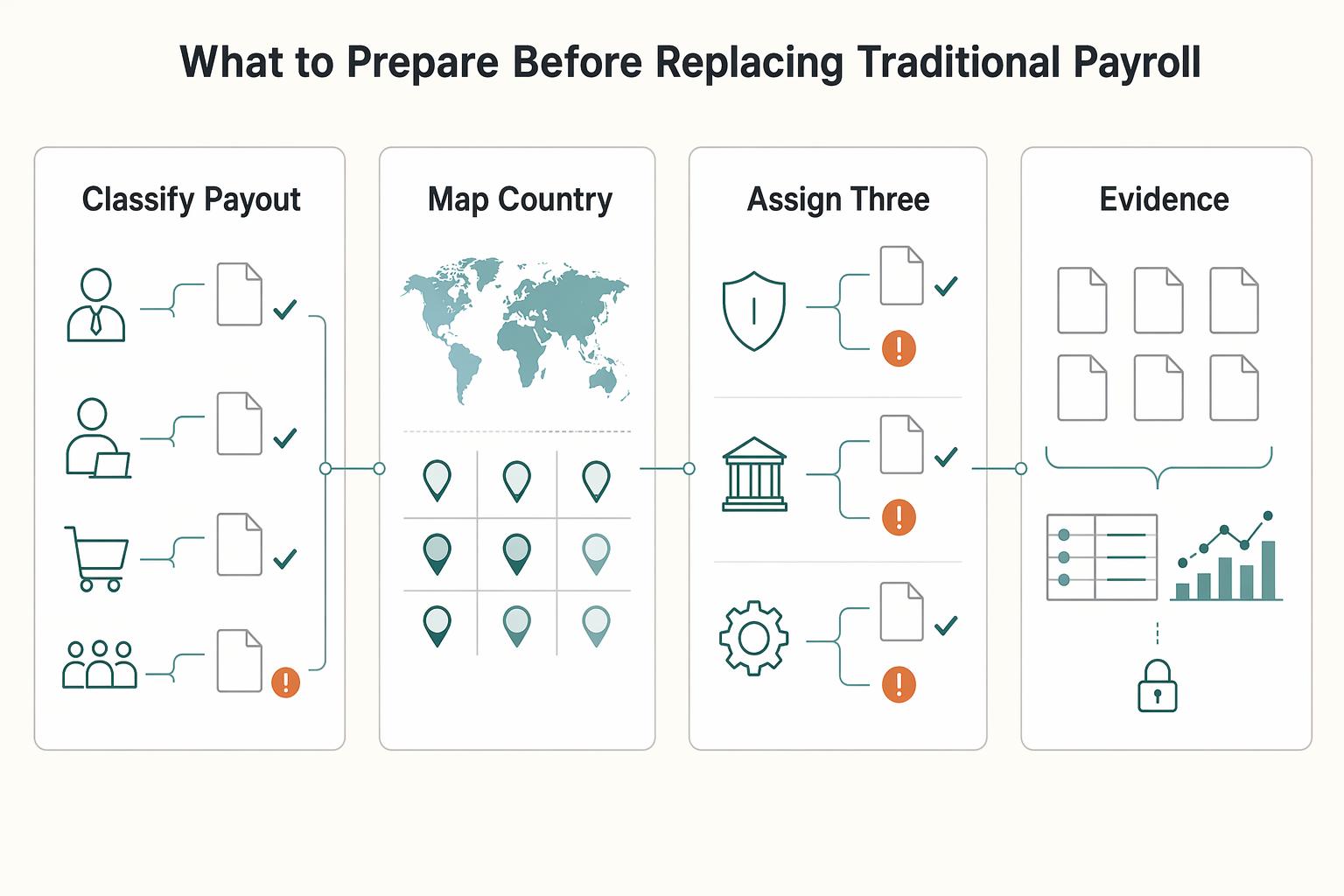
What to prepare before replacing traditional payroll#
Prepare your operating model before you compare vendors. If worker types and current failure points are not clearly separated, you will evaluate global payroll software and payout platforms against the wrong problem.
| Step | Focus | Checkpoint |
|---|---|---|
| Classify your payout population first | Separate employees from contractors, creators, sellers, and other non-payroll payees before tooling discussions | Each payee group has a named legal relationship, a source of pay data, and a clear approval path |
| Map country and jurisdiction exposure | Build a country list, then mark where tax regulation, currency exchange, and local-entity setup create the highest risk | A one-page matrix reviewed by Human Resources and Finance Ops; if compliance ownership is unclear by jurisdiction, do not cut over yet |
| Assign three decision owners | Name one owner each in Human Resources, Finance Ops, and Engineering | Approve scope, controls, and cutover dates together |
| Assemble a source document pack | Collect current payout flows, failure logs, reconciliation pain points, compliance exceptions, and current employee records before vendor talks | Trace one payment end to end, from source record to final confirmation |
- Step 1: Classify your payout population first
Separate employees from contractors, creators, sellers, and other non-payroll payees before tooling discussions. Employees typically fit a traditional payroll or global payroll path, while platform-style disbursements often fit a payout platform.
Minimum check: each payee group has a named legal relationship, a source of pay data, and a clear approval path. If one spreadsheet or approval chain mixes employee payroll with contractor payouts, separate that first.
- Step 2: Map country and jurisdiction exposure
Build a country list, then mark where tax regulation, currency exchange, and local-entity setup create the highest risk. Country-by-country requirements get harder to manage as legislation changes.
A practical output is a one-page matrix reviewed by Human Resources and Finance Ops. If compliance ownership is unclear by jurisdiction, do not cut over yet.
- Step 3: Assign three decision owners
Name one owner each in Human Resources, Finance Ops, and Engineering, and have them approve scope, controls, and cutover dates together. This keeps commercial pace aligned with operational readiness.
A common failure pattern is Finance signs, Human Resources assumes records are clean, and Engineering has not confirmed required data fields or payout status outputs.
- Step 4: Assemble a source document pack
Collect current payout flows, failure logs, reconciliation pain points, compliance exceptions, and current employee records before vendor talks. When HR and payroll data stay disconnected, audit risk and compliance exposure increase.
Validate the pack by tracing one payment end to end, from source record to final confirmation. If you cannot do that now, a platform change alone will not close the control gap.
Related: Using Deel for Payroll for a US Company with Canadian Employees.
Compare global payroll software and payout platform models#
Choose the model before the brand. Your worker mix and control needs should decide the lane first.
Step 1. Sort by solution type before you compare brands#
Side-by-side comparisons are useful only when you compare similar solution types. Traditional payroll, global payroll software, and payout platforms can all move money, but they solve different operating problems.
| Model | Typical worker mix | Typical integration depth | Control ownership |
|---|---|---|---|
| Traditional payroll | Employees, often in one country or where local setup is already stable | Lighter integrations, often payroll file imports, HR exports, and journal outputs | Mostly your employer team plus payroll processor |
| Global payroll software | Employees across multiple countries, sometimes with Employer of Record (EOR) services | Medium to deep integrations across HR, time, payroll, and finance data | Shared between your HR and Finance teams and the provider or local partners |
| Payout platform | Contractors, creators, sellers, affiliates, or other non-payroll payees at scale | Deeper API, webhook, approval, and ledger integration needs | More control stays with Product, Engineering, and Finance Ops |
Use this table to eliminate bad-fit models quickly. If an option forces employee payroll and non-payroll payouts into one path, treat that as a red flag.
Step 2. Use provider lists as shortlist input, not as the answer#
Provider lists are a starting point, not the decision. Market scans often group Deel, Remote, Rippling, Oyster, Papaya Global, Globalization Partners (G-P), Velocity Global, and Multiplier, but that does not mean equal scope, pricing, or control design.
Cross-border compliance is usually where differences become expensive operationally: tax, social security, and reporting rules in each country where your team works. If your main challenge is paying employees across jurisdictions, start with global payroll software and get written confirmation of country, worker-type, and compliance coverage.
If your main challenge is high-volume non-employee disbursements, confirm early that you can get the payout status, approval events, and ledger detail your ops team needs.
Rippling is commonly described as a unified HR/IT/payroll/spend suite that also offers EOR services. That can help when hiring is blocked by local-entity setup, but it does not automatically make an EOR-led suite the right fit for creator or marketplace payout operations.
Step 3. Decide how much control you need to keep#
All-in-one suites can reduce vendor count, especially for employee onboarding, payroll processing, and country coverage. The tradeoff is less flexibility for custom ledger mapping, approval routing, or webhook-level status handling.
Modular payout infrastructure takes more design work up front, including beneficiary states, failure handling, and finance outputs. The return is tighter operational control when payouts are product-triggered, approval logic is custom, or reconciliation depends on detailed transaction states.
Your output here should be a model-based shortlist, not a logo winner. A practical checkpoint is a one-page comparison with payee group, chosen model, control owner, and rejection reason for each non-selected model.
Set compliance and liability boundaries before integration#
Before integration, define liability in writing so your team does not assume the provider owns risk it does not actually own.
| Step | Requirement | Evidence or gate |
|---|---|---|
| Assign obligation owners in writing | Build an ownership matrix with three lanes: your team, the platform, and any local partner | Map each obligation to a trigger and a required evidence artifact |
| Split employee and contractor paths early | Keep employee payroll and contractor payouts on separate operational paths | Each new payee must fit one path only, with separate approval logic and separate evidence outputs |
| Treat Certified payroll and Prevailing wage as exception lanes | Route Certified payroll or Prevailing wage work as an exception instead of standard flow | Exception record includes worker classification decision, jurisdiction or project tag, reviewer and approval date, and payout eligibility decision with source document reference |
| Add an internal hard stop before go-live | No production launch until Legal, Finance, and Operations approve the ownership matrix and evidence requirements | Capture approvals in a signed or ticketed record that lists open exceptions, owners, and payout pause conditions |
Step 1. Assign obligation owners in writing. Cross-border pay is complex, and moving money is only part of the job. Build an ownership matrix with three lanes: your team, the platform, and any local partner. Map each obligation (tax handling, payout eligibility, identity checks, AML/KYC-related controls, and local labor-law support claims) to a trigger and a required evidence artifact. If a provider says it manages KYC/AML processes on your behalf, confirm what proof you receive back, for example status, timestamp, reference ID, rejection reason, or audit record.
Step 2. Split employee and contractor paths early. Keep employee payroll and contractor payouts on separate operational paths. They may both be cross-border, but control points differ across tax handling, labor-regulation support, approval routing, and payee eligibility. Use one clear checkpoint: each new payee must fit one path only, with separate approval logic and separate evidence outputs.
Step 3. Treat Certified payroll and Prevailing wage as exception lanes. If a jurisdiction or project touches Certified payroll or Prevailing wage, route it as an exception instead of standard flow. Do not assume default coverage from payroll-first suites or payout platforms. A practical exception record includes:
- worker classification decision
- jurisdiction or project tag that triggered the exception
- reviewer and approval date
- payout eligibility decision and source document reference
For deeper operational detail, see Construction and Skilled Trades Platforms: Certified Payroll and Prevailing Wage Compliance.
Step 4. Add an internal hard stop before go-live. Set an explicit internal release gate: no production launch until Legal, Finance, and Operations approve the ownership matrix and evidence requirements. Capture approvals in a signed or ticketed record that lists open exceptions, owners, and payout pause conditions. Without this gate, compliance issues usually surface after funds move, when remediation is slower and more expensive.
Need a terminology refresher for payout rails and bank fields? See Bank Code vs. Routing Number vs. Sort Code: A Global Platform Payout Reference Guide.
Design the money movement architecture your teams can audit#
Make every money-state change visible from collection to final status, or you will not have real control. The architecture should let Finance and Engineering reconstruct each payout path without treating a provider dashboard as the system of record.
Step 1. Map the exact order of operations before you build any integration. Write the payout flow as a state chain: collection event, balance update, currency exchange step, payout initiation, provider status updates, and reconciliation export. For each transition, keep one internal record and identify which system created it.
If you use multiple PSPs or rails, treat workflow fragmentation as a design risk from day one. Add a provider identifier to each event so ownership and traceability stay intact across providers.
Step 2. Define replay behavior and duplicate controls in evidence terms. Do not rely on assumptions about retries. Define how repeated requests are handled and what records prove whether a replay created a new payout or referenced an existing one.
Your minimum check should include: internal request ID, provider reference, and final ledger posting outcome. If you cannot tie those together consistently, pause launch.
Step 3. Assign failure-state ownership for every break in the chain. Returned transfers, held funds, and unmatched bank-rail deposits should not sit in one generic queue. Assign owners by failure type, with clear decision authority and escalation rules.
A practical split is: Finance owns decisions that change money ownership, Operations or Compliance owns payout-eligibility decisions, and Engineering owns record-integrity and status-visibility fixes.
Step 4. Make payout audit artifacts mandatory. For every payout, retain a minimum evidence set that remains usable across provider changes: internal request ID, provider reference, ledger posting IDs, status history, and exception notes with reviewer and timestamp.
API integration can improve transaction visibility and support real-time processing, but real-time status alone is not enough. You still need reconciliation exports Finance can match directly to your ledger.
We covered this in detail in Payout Error Rates in Contractor Payroll Teams Can Actually Reduce.
Build finance controls and reconciliation evidence from day one#
Once your event trail exists, lock release controls before payouts move. Finance should set approval gates by amount, corridor, and beneficiary type so higher-risk disbursements get explicit review.
| Control | Required detail | Checkpoint |
|---|---|---|
| Approval gates | Include beneficiary type, destination corridor, funding source, currency exchange decision, and internal request ID before payout initiation | Reviewers can judge risk before release |
| Monthly reconciliation pack | Tie every payout record to the ledger journals for liability and cash movement, the FX event or applied rate, and the bank or provider confirmation; minimum pack: payout ID, provider reference, journal IDs, FX evidence, bank confirmation, exception note | Finance can defend the pack |
| Recurring verification checks | Run sample-based payout trace reviews across corridors and beneficiary types, track aging on unresolved exceptions, and compare duplicate-detection logs to final ledger postings | For a sampled payout, Finance can trace approval through posting, FX, and final confirmation without hand-edited gaps |
| Pause rules | Define when Finance and Engineering must pause a corridor, assign the owner, document root cause, and resume only after the missing status or evidence is restored | Pause a corridor until the missing status or evidence is restored |
Step 1. Define approval gates before payout initiation. Do not gate on amount alone. Require each approval view to include beneficiary type, destination corridor, funding source, currency exchange decision, and internal request ID so reviewers can judge risk before release.
Step 2. Build a monthly reconciliation pack Finance can defend. Tie every payout record to the ledger journals for liability and cash movement, the FX event or applied rate, and the bank or provider confirmation that shows settled, failed, or returned status. If a provider advertises faster settlement in some corridors, reconcile to the confirmation you actually received, not the speed claim.
Minimum pack:
- payout ID
- provider reference
- journal IDs
- FX evidence
- bank confirmation
- exception note
Step 3. Add recurring verification checks, not just month-end total checks. Run sample-based payout trace reviews across corridors and beneficiary types, track aging on unresolved exceptions, and compare duplicate-detection logs to final ledger postings. The pass/fail test is simple: for a sampled payout, can Finance trace approval through posting, FX, and final confirmation without hand-edited gaps?
Step 4. Set pause rules for missing statuses or missing artifacts. In international workforce payments, status gaps and delays are an operational and reputational risk. Define when Finance and Engineering must pause a corridor, assign the owner, document root cause, and resume only after the missing status or evidence is restored.
This pairs well with our guide on Scaling a Global Payout Platform from 100 to 10000 Monthly Payments.
Roll out in phases with explicit go and no-go checkpoints#
Expand in phases, and move forward only when the prior phase is clean on reconciliation and compliance evidence. For this kind of switch, the rule is simple: no clean close, no expansion.
Step 1. Start with one corridor and one worker segment. Run a narrow pilot: one jurisdiction pair, one beneficiary type, and a limited approval group. If employees are in scope, keep employee payroll separate from contractor or other payout flows. Payroll complexity increases with scale and changing labor laws, so keep your first phase small enough for Finance, Ops, and Engineering to review exceptions end to end.
Use a clear go/no-go check: complete one full cycle, confirm traceability from approval to ledger to provider or bank outcome, and close or assign any open exceptions before expansion.
Step 2. Build a cutover matrix before adding another country. Keep a fallback lane in traditional payroll while the payout lane stabilizes. If employee payroll is managed in a centralized HR/payroll system (such as PeopleSoft Payroll), keep that system authoritative for pilot populations until ownership, status visibility, and reconciliation are stable.
| Phase | Scope | Primary lane | Fallback lane | Go/no-go checkpoint |
|---|---|---|---|---|
| Pilot | One corridor, one segment | Payout platform | Traditional payroll ready | Reconciliation evidence is complete; exceptions are closed or explicitly owned |
| Limited expansion | Add one new jurisdiction or one new segment | Payout platform for approved scope | Traditional payroll for excluded or rollback cases | No recurring status-handling or duplicate-processing issues |
| Broader rollout | Add countries sequentially | Payout platform by approved jurisdiction | Fallback retained for break-glass cases | Prior phase closes cleanly with owner sign-off |
Name who decides go/no-go, what system is authoritative, and what triggers rollback.
Step 3. Freeze expansion when exceptions exceed agreed tolerance. Define tolerance before launch and treat it as a stop rule. If unresolved exceptions or processing failures exceed that agreed line, pause country expansion, fix root causes, and verify containment before proceeding.
Step 4. Validate US-Canada constraints early. For a US company paying Canadian employees, treat this as a distinct rollout case. Confirm early what your team owns, what your provider owns, and what evidence each function needs before cutover. If core scope or ownership questions are still unresolved during pilot, keep Canada on fallback until those decisions are settled.
Common mistakes and how to recover quickly#
Most rollout failures come from treating assumptions as facts. Recover fastest by narrowing scope, confirming production reality in writing, and requiring evidence before each expansion step.
Step 1. Mistake: treating coverage pages as production truth. Recovery: confirm scope in writing before launch. A coverage page is a starting point, not a launch decision. Ask the provider to confirm in writing the exact country, program, worker type, compliance scope, exclusions, local partner dependencies, and audit or reconciliation artifacts for your lane.
This matters because country-level tax, labor, and reporting rules change, and a public page is not the same as launch-ready scope. Treat public pages like informational regulatory pages: useful context, but not final authority. If support cannot confirm a lane clearly, keep it on fallback.
Step 2. Mistake: mixing employee payroll and contractor payouts in one process. Recovery: split flows and controls by worker classification. If you combined employees and contractors, separate the flow before the next cycle. In practice, that means separate intake fields, approvals, and exception queues by worker type.
A quick control check: each payment record should clearly show worker classification, entity context, approval owner, and required document set. If those are not visible from the record itself, the process is still too blended.
Step 3. Mistake: optimizing only for speed. Recovery: prioritize traceability and exception ownership. Faster pay cycles matter only if Finance and Ops can trace and close issues. Require request IDs, provider references, ledger postings, status history, and a named owner for every exception before expanding further.
If successful sends are increasing while returns, holds, or unmatched deposits remain unresolved, pause expansion. Your go signal is a complete trace sample from approval to payout confirmation to ledger impact, plus an exception report by age and type.
Step 4. Mistake: assuming listed alternatives are equivalent. Recovery: score providers against your operating model. Deel, Remofirst, Atlas HXM, Plane (formerly Pilot), Boundless, and Skuad are a place to start, not proof of equivalence. Evaluate them against your actual requirements: worker mix, country scope, reconciliation exports, payout status visibility, multi-entity controls, role-based approvals, and fallback support to traditional payroll.
If a provider is strong on brand but weak on must-have controls, move it down the list until gaps are proven closed.
For a Finance lens, you might also find this useful: How CFOs Evaluate a Global Payout Platform.
Final decision checklist before you switch#
Switch only when all five checks are green: model fit, compliance ownership, technical behavior, finance evidence, and launch control.
-
Confirm model fit first. Decide whether you need execution, orchestration, or both. If your operating model is employee-heavy across countries, an EOR or global payroll path may fit better; if your volume is mainly contractors, creators, or marketplace sellers, prioritize payout operations. Do not assume one model fits both equally.
-
Confirm compliance boundaries in writing. Document who owns tax-regulation decisions, identity checks, payout eligibility, and jurisdiction-specific obligations before implementation starts. Keep "payment processing" separate from "employer liability" in contracts and operating docs. For mixed employee and contractor flows, keep ownership and process boundaries explicit.
-
Confirm technical readiness with failure testing, not demos. Validate idempotent API behavior, webhook monitoring, payout-status visibility, and recovery paths for failed or delayed payouts. Test retries with the same request ID and confirm duplicate disbursements do not occur. If exception states are unclear, you are not ready to switch.
-
Confirm finance readiness with audit-ready evidence. Define approval gates and exception handling before money moves. Reconciliation should tie payout requests to provider references and final status outcomes. If Finance cannot trace a sample batch end to end, close-week risk is still high.
-
Confirm launch readiness with phased rollout and explicit sign-off. Start with a low-risk corridor and segment, and keep a fallback path during stabilization. Plan for onboarding risk where an EOR component is involved, since implementation can take months. Final go/no-go should be explicit across Finance, Ops, Product, and Engineering, with coverage/model fit, integration complexity, fee transparency, and contract terms already reviewed; reassess if acquisition changes alter provider context.
Related reading: How to Build a Global Accounts Payable Strategy for a Multi-Country Platform.
Frequently Asked Questions
What is a global payroll alternative payout platform instead of traditional payroll in practical terms?
In practice, it is a payout layer used to move money across countries without running every payment through a full employee payroll process. It is usually aimed at disbursement operations rather than full employer administration. If you are paying employees, treat that as a separate legal path.
How is a payout platform different from global payroll software for contractor-heavy businesses?
The main difference is legal and operational scope. Payroll providers process payroll payments, but they do not become the legal employer. An Employer of Record does, and handles compliance and HR responsibilities. For contractor-heavy models, a payout platform can be a better fit when your core problem is disbursement operations, while global payroll software fits better when you are actually running employee payroll.
When should we keep traditional payroll and add a separate payout platform instead of replacing everything?
Keep traditional payroll when employee payroll is still valid and stable, but contractor or marketplace payouts are creating manual work or weak traceability. That split is often sensible if Finance needs separate approvals and cleaner reconciliation by worker type. If your employee path already works, do not force unlike payment flows into one model.
What risks remain after switching away from bank wire transfers and manual payout operations?
You may reduce some correspondent-bank fee exposure by using local-currency rails, but provider fees can still apply. A major operational risk does not disappear: bad input data still drives payroll errors. Your checkpoint is pre-run payroll data validation, meaning you verify input data is complete, accurate, and compliant before payments start.
Which compliance and tax obligations stay with our team even if we use a platform?
You still need to know whether the provider is acting only as a payroll processor or as an EOR, because those models do not carry the same legal responsibility. Your team should keep clear ownership of internal controls, including source-data quality and approval governance. Review contracts carefully so "we process payments" is not mistaken for "we assume full employer liability."
What should we validate before signing any provider agreement for cross-border payouts?
Get written confirmation of the exact countries, worker types, payout methods, and compliance scope the provider will cover. Confirm what records you will receive for audit and reconciliation and how exceptions are reported. If you need anything outside fiat-first payroll, such as token compensation, verify it explicitly because many platforms were designed for fiat-only payroll and conventional equity, not those edge cases.
Try a related tool
Researched and edited by the Gruv editorial team. Gruv builds cross-border billing, payouts, and finance-operations software for global businesses.
Sources
Includes 6 external sources outside the trusted-domain allowlist.
- federalregister.gov/documents/2024/12/31/2024-30593/use-of-elect...trusted
- govinfo.gov/content/pkg/PLAW-114publ113/html/PLAW-114pub...trusted
- alcor.com/omnipresent-alternativesexternal
- bitwage.com/en-us/blog/simplifying-payroll-for-global-re...external
- bitwage.com/en-us/blog/traditional-payroll-vs.-crypto-pa...external
- ge.mba/research/the-strategic-evolution-of-global-p...external
- getontop.com/blog/deel-alternativesexternal
- globalbankingandfinance.com/the-financial-infrastructure-behind-internat...external
Educational content only. Not legal, tax, or financial advice.
Related Posts
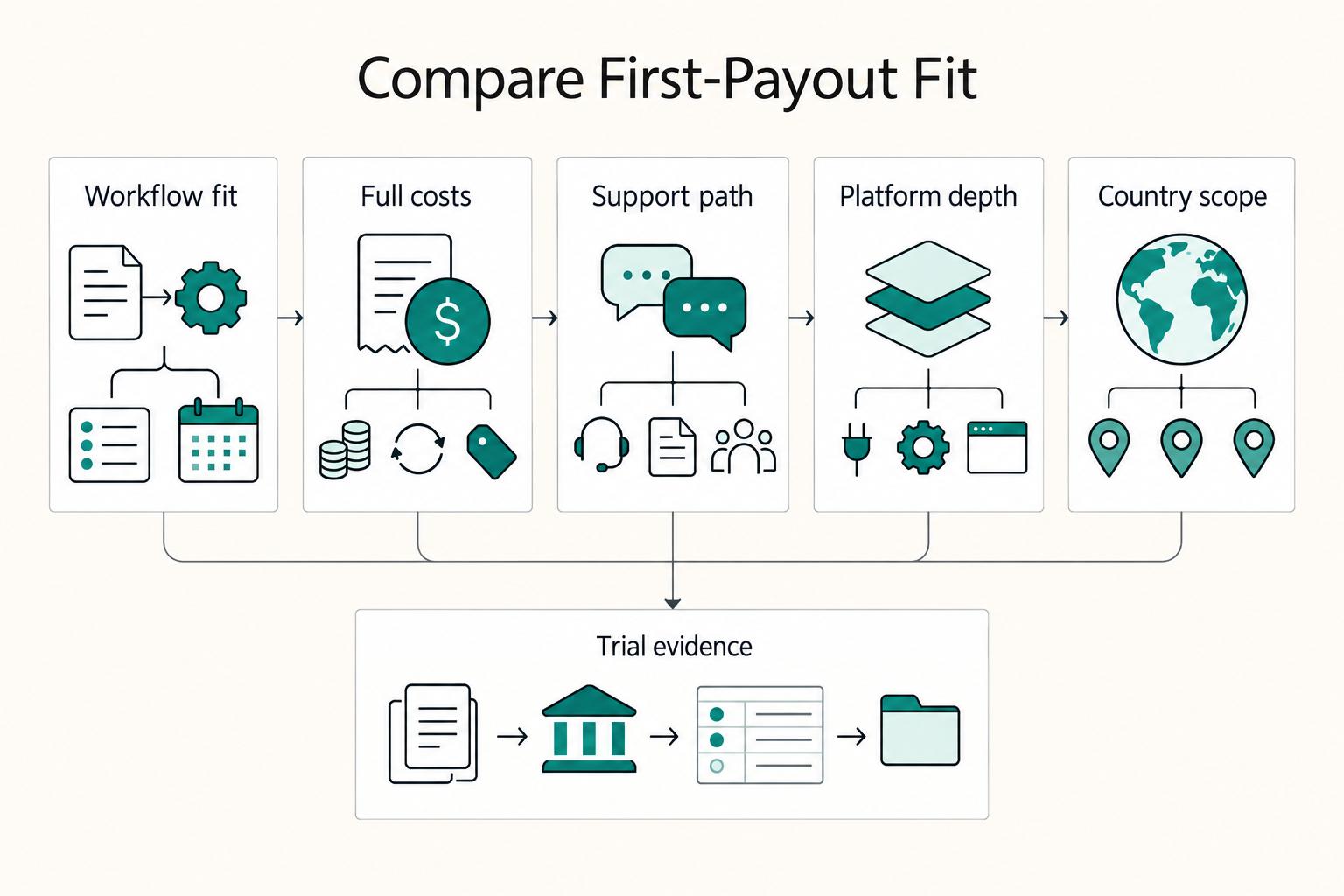
Deel vs Remote for Freelancers Who Need a Clear First-Payout Decision
Choose the platform that makes your first payout cycle predictable and your contracts easier to defend. This is an operating decision, not a brand contest.
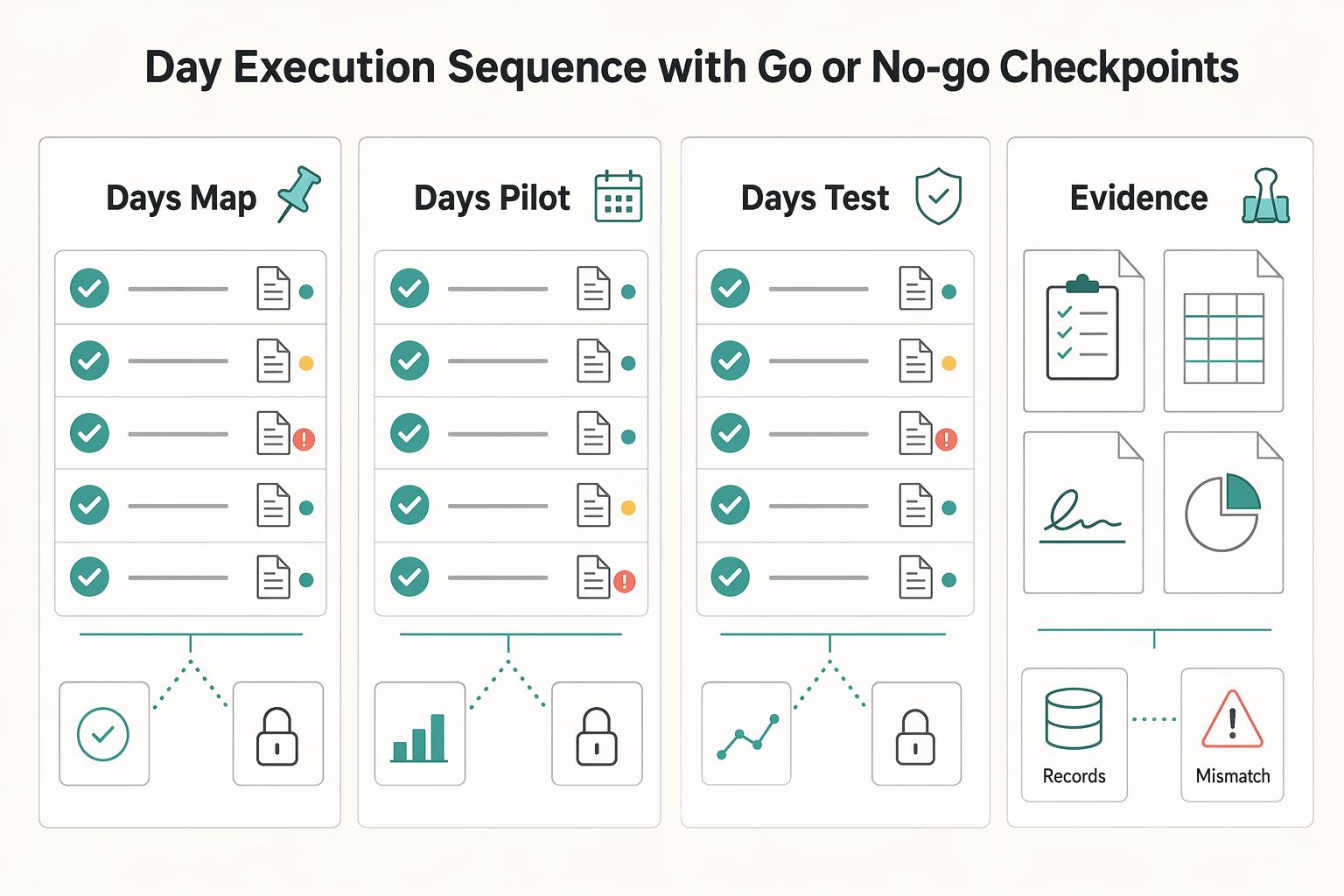
Choosing Construction Platform Payouts for Certified Payroll Compliance
Even milestone-based payments still turn on project progress, which is why release logic and evidence matter. A useful checkpoint before any GTM push is this: can you show, in one place, the approved amount, any retained amount, the document state, and the settlement state for a single payout event?
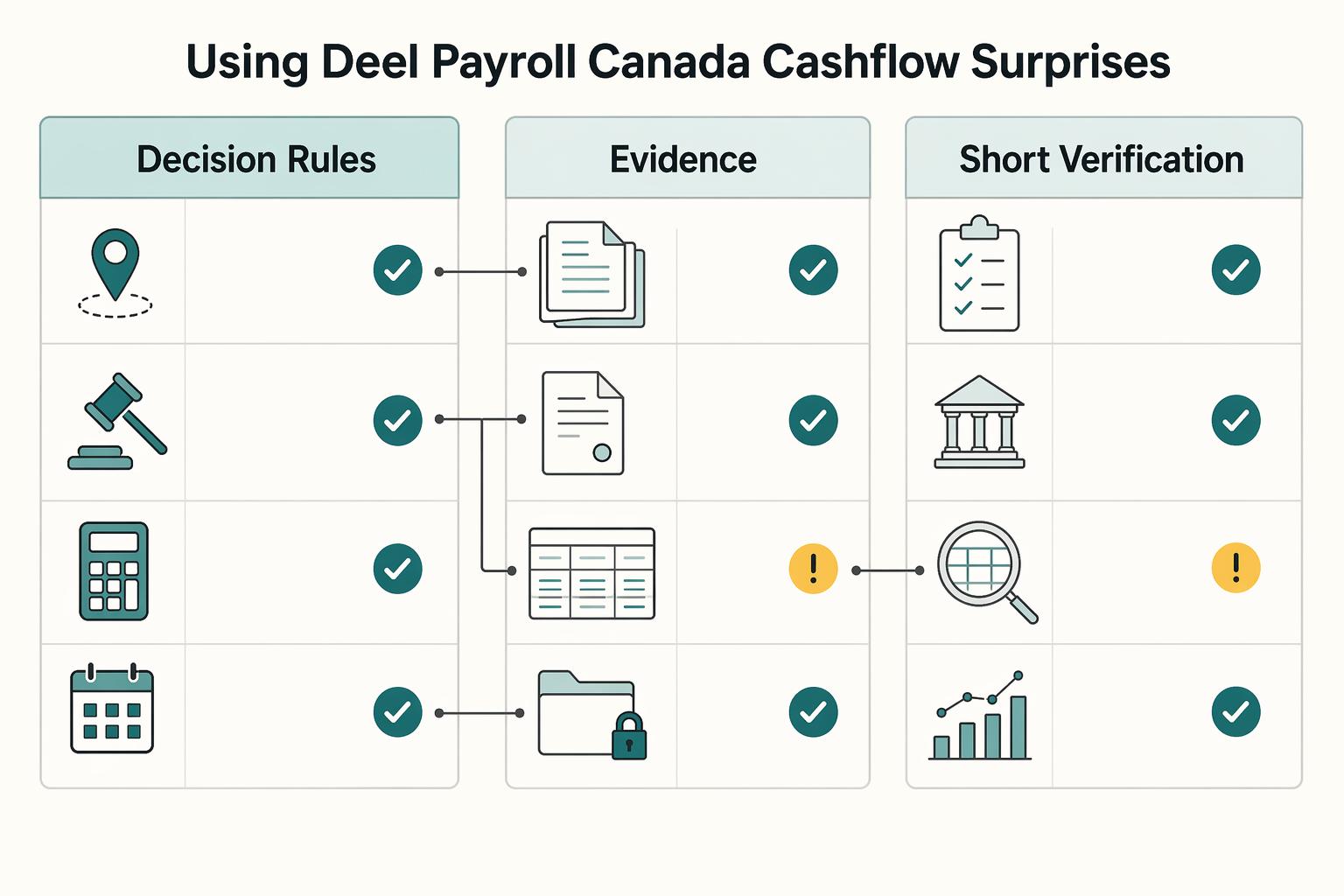
Using Deel for Payroll for a US Company with Canadian Employees
If your goal is simple - pay Canadian employees on time from a United States company without avoidable delays, fees, or compliance cleanup - start with one assumption: provider materials are a useful starting point, not the whole answer. Cross-border hiring here is common, even without a local entity. It still brings real tax, legal, and payroll complexity.