
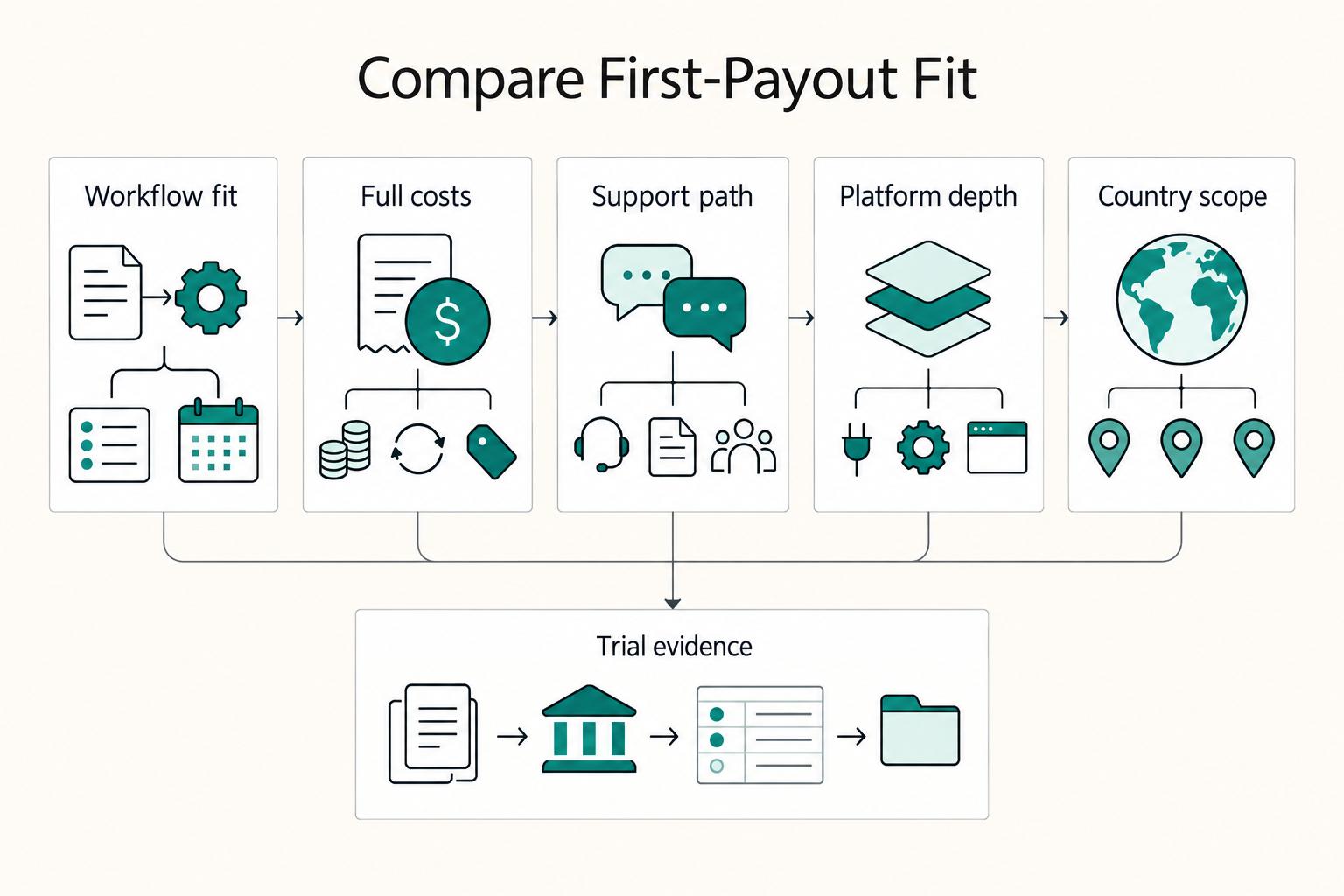
Quick Answer
For a freelancer, compare the supported payout route, currencies, fees and the client’s approval and funding schedule. Standard company subscriptions are $49 per contractor per month for Deel and $29 for Remote in published USD pricing, but those are not your automatic payout deductions. The client may choose the platform; confirm your agreement and usable destination.
Compare the payout you will receive, not the client’s subscription alone#
For a freelancer being paid through Deel or Remote, the key questions are contract terms, client funding, available payout methods, currency conversion and support when a payment stalls. The client often chooses the platform. If you are choosing a service to pay other contractors, compare the client-side plans separately.
This guide covers independent-contractor payments. Standard contractor management, Contractor of Record and Employer of Record are different services. EOR involves an employee relationship; it is not a more advanced withdrawal plan for a freelancer. A platform label does not determine whether the underlying work is correctly classified.
The comparison uses provider pricing and help pages checked on October 3, 2026. It is not a hands-on reliability ranking. We have not measured which platform pays faster, resolves tickets better or has fewer rejected transfers.
Before accepting the client’s setup, establish the following practical details:
- Who signs the agreement with you and who owes the payment?
- Which invoice currency, due date and approval process were agreed?
- Which bank or other supported destination can you actually use?
- Which fees and conversion charges do you bear, and where can you see their estimate?
- Who can resolve missing approval, incomplete funding or a sent transfer that has not arrived?
If the client has already chosen a platform, use these questions to confirm whether you can be paid through it. You may be able to agree a different currency or supported method without asking the client to replace its entire contractor system.
Deel vs Remote at a glance for freelancers#
Both publish contractor-management workflows. The meaningful differences for a freelancer are the available route, who funds and approves the payment, and the net amount reaching the destination—not an EOR entity count.
| Question | Deel published workflow | Remote published workflow |
|---|---|---|
| Company’s standard management price | USD $49 per contractor/month | USD $29 per contractor/month |
| Freelancer payment flow | Available Deel balance can be withdrawn by a supported method | Client approves and funds invoice before contractor payout |
| Payout cost | Depends on withdrawal method, currency and destination | Depends on currency setup and local versus non-local payout |
| Different legal service | Contractor of Record and EOR listed separately | Management, Plus, Contractor of Record and EOR distinct |
| What neither comparison proves | Universal fastest payout or best support | Universal fastest payout or best support |
A lower subscription price benefits the hiring company; it does not automatically increase the freelancer’s net receipt. Likewise, a larger platform feature list is not evidence that its bank-transfer path is faster for your country.
Use the current account screens and applicable agreement to confirm the specific method before a live withdrawal. Some features, currencies or guarantees depend on the account and country. A public feature list is useful for discovery, but the route you can actually select matters.
What happens between invoice and bank receipt#
First distinguish the amount the client owes under the contract from platform approval, client funding and the transfer to your bank. A client marking an invoice approved is not the same event as money arriving at the provider or your destination.
Deel’s contractor withdrawal guidance explains moving an available balance through a selected method. Confirm how your contract creates the payment, when the client funds it and what remains to be done before withdrawal. An available platform balance and a completed bank credit are distinct.
Remote’s invoicing guidance allows contractors to create or upload invoices. The company administrator approves and pays, and Remote pays out after receiving the client’s money. The client’s funding method affects the end-to-end timeline.
For example, that Remote page lists ACH direct debit at four business days for client funds to reach Remote, followed by one to three business days for contractor payout. Its five-to-seven-business-day end-to-end range is guidance for that route, not a universal arrival guarantee or a comparison with every Deel method.
Agree when the invoice must be submitted and approved to meet the contractual payment date. A due date written on a contract is not proof that the client has already funded the provider. If timing is critical, ask the client about its approval and funding schedule before the payment becomes late.
You generally need an active agreement and completed onboarding before a real payment can be tested. Use documentation and a demo to evaluate before commitment, then monitor the first authorized payment. “Test a real payout before signing anything” is not a workable universal sequence.
Separate company subscriptions from freelancer payout costs#
The following are published U.S.-dollar client-side prices, not charges automatically deducted from each freelancer’s invoice. Use the applicable quote for plan scope, tax, billing activity and any other charges.
Deel’s pricing page lists standard contractor management at $49 per contractor per month. Remote’s pricing page lists Contractor Management at $29 per contractor per month. Those plans can be compared for a company hiring contractors; their $20 difference does not establish a freelancer’s withdrawal cost.
For a company using ten contractors in a billable month, a simple subscription comparison is $490 versus $290, or $200 difference before other charges. This assumes the published standard plans apply to all ten and excludes the contractors’ compensation, payment costs, taxes and optional services. It is a price illustration, not a total-cost quote.
Check which activity makes a contractor billable
- The provider’s rules for active or billable contractor activity.
- Standard management versus Plus, Contractor of Record or employment services.
- Actual payment, FX, tax and optional-service costs.
- Termination and renewal terms in the applicable order.
Compare like-for-like plans
- Compare the same number of contractors and billable months.
- Keep contractor compensation separate from the company subscription.
- Include fees only for the routes and optional services you intend to use.
Remote’s billing guidance distinguishes standard pay-as-you-go Contractor Management from fixed-monthly Contractor Management Plus at $99. Its Contractor of Record fee is 15% of the monthly invoice or a $325 minimum, whichever is higher. Those are different scopes and billing rules, not substitutes for the standard $29 plan.
For paying a team, compare the service you need and your actual billing pattern. For a freelancer receiving money, focus next on the payment currency and destination. The broader operating checklist is How to Pay International Contractors With Fewer Delays and Disputes.
Withdrawal methods and currency can change your net receipt#
Deel’s fee guidance lists different charges by method. Local bank transfer has no Deel charge, although provider fees can apply in some currencies and your bank can charge separately. Same-currency cross-border withdrawals can carry a $5 fee; a zero local-transfer fee is not a promise that every bank destination is free.
The same page lists SWIFT withdrawal charges of $5 to $10 from Deel, with possible intermediary fees outside its control. It also lists withdrawal minimums, including $10 for local bank transfer and $100 for SWIFT. Confirm the displayed estimate, method and destination rather than carrying one fee into every route.
Remote’s currency setup affects who bears the costs
A currency label alone does not identify the transfer rail. Confirm the bank destination and local-currency eligibility before relying on a published zero-fee category.
Remote’s payout-fee guidance says same-currency local payouts have no contractor fee. If the invoice is in the contractor’s currency and paid to a matching local bank account, the client bears the FX and transaction costs. If the invoice uses the company’s currency and the contractor withdraws another currency, the contractor bears those costs from the funded amount.
Remote also distinguishes a non-local-currency SWIFT payout, such as USD to a bank outside the United States. Provider and correspondent fees can apply. Do not compare that route with a same-currency local payout and conclude that the platform itself has changed its base subscription price.
Work a net-receipt example
Suppose your agreed invoice is USD 1,000 and you want to keep USD in your destination account. Before selecting a route, confirm whether it is local, cross-border or SWIFT and which costs the screen includes. If a hypothetical route deducts $5 and a receiving bank deducts $15, the bank receipt is $980. The $15 is an illustration, not a measured fee for either provider.
If you instead receive EUR, record the applicable USD-to-EUR rate, the fee, the expected EUR amount and who bears each cost. A cheaper company subscription does not settle this comparison. Also check whether the currency matches the bank account; a bank may convert or reject a mismatched transfer.
Check contract scope without borrowing employee-service claims#
Standard contractor management helps administer a client–contractor relationship. Contractor of Record involves direct provider engagement under its particular terms. EOR involves employment. Read the agreement and service description for the plan actually offered to you.
Remote’s billing guidance explicitly states that its Contractor of Record contract is between Remote and the contractor, unlike standard Contractor Management and Plus. Deel separately lists Contractor of Record in its pricing. Do not describe every contractor-management account as an Agent of Record arrangement or use EOR owned-entity coverage to infer contractor liability.
If the client promises classification protection or an indemnity, ask which party receives it and what conditions apply. A protection marketed to the hiring company is not automatically a freelancer benefit. Standard templates and software do not settle a disputed legal classification by themselves.
Before accepting the engagement, confirm:
- The client or provider contracting entity and the specific service model.
- Scope, acceptance, payment obligations and ownership or licensing of the work.
- Any required onboarding and the account or destination you can use.
- How the parties handle a classification concern or unpaid amount.
If the actual work arrangement may be employment rather than independent contracting, address that arrangement instead of choosing a cheaper contractor-payment plan. For the freelancer’s next steps, see What to Do If You Have Been Misclassified.
Support and first-payment checks#
A freelancer usually needs to know whether an issue belongs with the client, platform or receiving bank. Start with the last confirmed event and the relevant invoice or transfer reference. Do not post complete account numbers or identity documents in a general client chat.
| Last confirmed event | First question |
|---|---|
| Invoice submitted | Has the client approved it? |
| Invoice approved | Has the client funded the provider? |
| Funds available or payout ready | Is a withdrawal or other action required? |
| Transfer sent | What reference and bank delivery status are available? |
| Bank credited less than expected | Was there conversion, a provider charge or a receiving-bank fee? |
For example, if an invoice is submitted but not approved, ask the client’s approver. If approved but funding is incomplete, ask the client about funding. If the provider shows a sent transfer without a bank credit, contact platform support with the reference and check the receiving bank as appropriate.
Ask support about a hypothetical failure path when evaluating a provider. Do not deliberately change valid bank details just before cutoff, create a rejected payout or submit a fabricated classification concern to score ticket performance. A walkthrough or available test environment can explore the procedure without risking an earned payment.
For a studio buying the platform, assess an integration only if you need it: identify the exact contract, invoice or payment data the workflow uses and review permissions and failure handling. A solo freelancer normally does not need an API or Zapier test to receive a payment.
Choose according to the decision you actually control#
If your client chooses Deel, check the available withdrawal path, shown fee and bank destination. If it chooses Remote, confirm invoice currency, approval and funding flow and the payout method. Either can be workable; published product claims do not establish a universal first-payout winner.
If you are choosing a standard contractor-management service for a small team, Remote has the lower published baseline in this comparison. Deel may fit an existing company workflow or particular supported method. Confirm scope and the features you actually use rather than declaring Deel inherently more automated or Remote inherently simpler.
| Your situation | Practical next step |
|---|---|
| Client uses Deel | Confirm withdrawal currency, method, fees and available-balance timing |
| Client uses Remote | Confirm invoice currency, funding and the applicable payout-cost arrangement |
| Studio comparing standard management | Compare $49/$29 baseline with actual billable activity and needed features |
| Different service or disputed classification | Identify the legal model and resolve the concern before relying on plan labels |
| Migrating outstanding invoices | Assign each invoice to one paying system and retain old records |
Once onboarding and terms are settled, observe the first authorized payment. Record invoice submission, approval, provider funding if visible, transfer initiation and bank receipt. One successful cycle confirms that particular setup; it does not prove future reliability or country-wide performance.
For a switch, retain access to old invoices and statements, identify outstanding money and confirm the new agreement, funding and payout destination. Agree which system will pay each invoice to avoid duplicates. If a phased first payment is available, use it as practical evidence after the required setup—not as a promise that both vendors offer a no-commitment payment trial.
Keep licensing and ownership terms in the actual service contract. A platform switch does not resolve rights in deliverables; for that separate subject, see A Freelancer’s Guide to Content Licensing and Syndication.
Use the agreement and actual payout route to decide#
For a freelancer, check net receipt and timing through the client’s chosen platform. For a company hiring contractors, compare like-for-like plan prices and the required workflow. Keep contractual payment obligations distinct from platform statuses and use the first authorized cycle to confirm the setup.
Frequently Asked Questions
Is Deel or Remote cheaper for freelancers in practice?
For companies buying standard contractor management, published USD prices are $49 per contractor per month for Deel and $29 for Remote, subject to applicable terms. Those are client-side subscription prices. A freelancer’s net receipt depends on the actual method, currencies and provider or bank charges; the $20 subscription difference is not automatically a payout saving.
Which platform is better for simple overseas contractor payments?
Compare the available route to your bank, invoice and withdrawal currency, who bears fees, client approval and funding timing and support for an exception. The client may choose the platform. There is no measured reliability ranking here; either may fit if the actual route and agreement work.
Do freelancers need Employer of Record (EOR) or just contractor tools?
An independent-contractor engagement can use contractor management or, where agreed, Contractor of Record. EOR is for an employment relationship and is not limited to full-time work. If the work may legally be employment, resolve the classification rather than treating EOR as an optional payment-feature upgrade.
What should I verify before switching from one platform to the other?
Confirm the new contract, onboarding, accepted bank destination, invoice currency and funding schedule. Preserve old records and identify which system will pay each outstanding invoice. Observe the first authorized payment after setup; do not assume a real payout can happen before any agreement is signed.
How much do support and integrations matter for a solo freelancer?
Clear issue routing and usable records matter. Check the invoice or transfer reference and distinguish client approval, funding, provider transfer and bank receipt. Integrations matter when they remove an actual repetitive task; a solo freelancer need not conduct an enterprise automation trial to receive payment.
When do legal model differences affect payout risk and compliance?
The plan determines who contracts with you and what the provider undertakes. Standard management, Contractor of Record and EOR have different roles. Read the actual agreement and any protection’s conditions; a broad country count or employer indemnity is not proof of your own rights or correct classification.
Try a related tool
Researched and edited by the Gruv editorial team. Gruv builds cross-border billing, payouts, and finance-operations software for global businesses.
Sources
Includes 6 external sources outside the trusted-domain allowlist.
- deel.com/pricingexternal
- help.letsdeel.com/hc/en-gb/articles/14391381019537-About-Withd...external
- help.letsdeel.com/hc/en-gb/articles/7338494928913-How-Contract...external
- remote.com/pricingexternal
- support.remote.com/hc/en-us/articles/4406809545613-What-are-the...external
- support.remote.com/hc/en-us/articles/4410700827021-How-contract...external
Educational content only. Not legal, tax, or financial advice.
Related Posts

What to Do If You've Been Misclassified as an Independent Contractor
If a business calls you an independent contractor but directs your work like an employee, check the rules for the rights you need to recover. A contract label, LLC or Form 1099 does not decide every legal status. Federal wage law, federal employment taxes and state employment laws can use different tests and provide different remedies.

A Freelancer's Guide to Content Licensing and Syndication
A finished article can have value beyond its first publication. Before offering it again, establish which rights you own and what permission the first client already has.
How to Pay International Contractors With Fewer Delays and Disputes
Reliable contractor payments begin with verified payee details, clear terms and the checks required for the actual engagement. Separate the payer’s release and withholding obligations from the contractor’s own tax-registration and filing tasks.