
Quick Answer
Require a freelancer bank account policy that defaults to business accounts when payout operations move beyond occasional solo income. Keep personal-account use as a narrow exception with documented approval, account-terms validation, and clear migration ownership. Before go-live, confirm one sample payout can be traced from request to export and that your tax-reporting path supports IRS Form 1099 outputs, including the cited $600 and post-2025 $2,000 threshold context.
Why Platforms Need a Clear Bank Account Policy#
For platform teams, the choice between a Business bank account and a Personal bank account is a controls decision, not a personal finance preference. Keeping those accounts separate makes records cleaner and cuts avoidable noise during bookkeeping and tax prep.
| Headline example | Grounded condition |
|---|---|
| 1.30% APY example | Applies up to $250,000 with terms |
| $0 monthly fees | Depend on eligibility requirements |
| $500 bonus | Depends on eligibility requirements |
The basic case is simple. Keeping business and personal finances apart makes tax-season review and documentation easier. Mixing income and expenses in one personal account is often described as a tax-time headache.
Policy should be practical, not absolute. The guidance is not fully uniform. One view holds that a separate account is needed for LLC operators, while another holds that separate accounts are not mandatory in every case but are still strongly recommended. This guide treats separation as an operating decision that matters more as business structure formalizes and tax-time workload grows.
Before rollout, verify provider claims against current materials. Eligibility and offer terms vary, and headline offers can be conditional. If a comparison page points you to pricing, open the provider page directly, such as Wise Business pricing, before you treat an offer as launch-ready. A cited 1.30% APY example applies up to $250,000 with terms, and claims like $0 monthly fees or a $500 bonus depend on eligibility requirements.
Use comparison content to build a shortlist, not to set policy. For legal or research-sensitive points, confirm against official publications such as IRS Publication 334, since summary or prototype pages can be incomplete and may need verification against an official edition.
Freelancer bank account vs personal account at a glance#
Use a Personal bank account only as a narrow exception for low-complexity, single-operator flows. If you need a cleaner close, clearer entity separation, or repeatable tax evidence, require a Business bank account.
| Criteria | Business bank account | Personal bank account | Decision rule |
|---|---|---|---|
| Onboarding friction | Not defined in the cited materials; verify provider requirements directly. | Also not defined here; convenience does not create separation. | Use personal only when speed is critical and the payee is truly low complexity and solo. |
| ACH / Wire transfer readiness | Not established; confirm rails, limits, and eligibility with your provider/program. | Also not established; do not assume parity with business accounts. | Do not decide based on assumed ACH/wire support. Verify before rollout. |
| Team permissions | Permission controls are provider-specific and unsupported here; a dedicated account still keeps business activity in one lane. | Unsupported here, and mixed personal activity makes shared review harder. | If anyone beyond the payee touches finance ops, move to a separate business account. |
| Dispute handling | Easier to reconstruct when business income and spending run through one dedicated account. | Harder to reconstruct when transactions are mixed; statements are not designed for storytelling. | If you expect exceptions, reversals, or manual investigations, separate now. |
| Month-end close effort | Less manual sorting when all business income and spending are already separated. | More manual sorting because business and personal activity must be split after the fact. | If close is noisy, separation is a fast control win. |
| Compliance gates such as KYC, KYB, AML | Specific gate requirements are not defined here. | May be acceptable in limited single-operator cases if your program allows it. | Set this by documented program policy; do not infer gate requirements from this article. |
| Tax ops including W-8, W-9, and Form 1099 | Separation supports cleaner tax evidence. The IRS support here is substantive for Form 1099 reporting, not W-8/W-9 rules. Payers file Forms 1099 with the IRS and furnish them to recipients. | Account type does not remove tax document obligations, and mixed flows make substantiation harder. | If recurring 1099 reporting is in scope, separate accounts even where not strictly required. |
The real dividing line is operating complexity plus legal structure, not personal preference. In the cited material, a sole proprietorship is described as having no legal requirement for a separate account, while a single-member LLC is described as a separate legal entity from its owner. That is not a universal rule across all jurisdictions, but it is a practical trigger for stricter separation.
For tax operations, the IRS guidance here says payers file Forms 1099 and provide them to recipients. Start that workflow from the IRS Form 1099-NEC FAQ, then map the threshold changes into your policy notes. The cited threshold for certain business payments, including nonemployee service payments, is $600 and increases to $2,000 for payments made after December 31, 2025. A dedicated business account does not replace document collection, but it does give you a cleaner audit trail for reconciliation and reporting.
If you keep a one-account exception, control it tightly with business-only spending methods and weekly review. For recurring contractor payouts or any program where cleaner tax evidence matters, set Business bank account as the default.
What actually changes when you separate accounts#
Record clarity usually changes first, not payment speed. When business activity runs through a separate account, it is easier to follow the trail from invoice to receipt to reconciliation.
A Business bank account is used solely for business finances, while a Personal bank account is intended for personal spending. In practice, that means less manual sorting because the account is already narrowed to business inflows and outflows.
| Operational moment | Separate business account | Mixed personal account | Practical effect |
|---|---|---|---|
| Invoice to receipt matching | Incoming funds are business-related by design | Business receipts sit beside personal activity | Less manual filtering before posting and review |
| Expense and payout review | Outflows are easier to classify as business use | Outflows must be split line by line first | Cleaner month-end handling with less manual separation |
| Exception handling | Statement is already business-scoped evidence | Review starts by removing personal transactions | Clearer internal reconstruction of what happened |
| Entity boundary | Better supports distinct business finances | Mixing blurs business and personal lines | Higher risk where legal or entity separation matters |
Separation also changes failure recovery on your side. It does not, by itself, prove better ACH or wire outcomes. It can still reduce investigation friction because you can work from a business-only statement instead of untangling mixed personal activity first.
There is also a legal structure angle. The cited guidance states that a limited company is a separate legal entity and, in that context, is legally required to use a business bank account for business expenses. The same source states sole traders are not legally required to open one. That is why personal account use may be an exception for some solo operators, but a weak default for entity-based programs.
What to verify before keeping any exception#
If you allow a personal account exception, check the account terms first. Some personal accounts prohibit business transactions, so low volume alone is not a valid reason to keep that exception.
Where VANs and MoR fit#
Treat separation as a baseline control, not a full attribution or marketplace audit solution. If payer-level matching is still messy, evaluate options like Virtual Account Numbers for Freelancers: How to Protect Your Bank Details as a separate design decision. Do not assume separation alone covers Merchant of Record evidence needs.
Decision thresholds for requiring business accounts#
Make separation the default once operations stop being simple. Require a Business bank account when entity boundaries, international activity, or compliance checks make mixed funds hard to operate and review. Keep Personal bank account use as a narrow, documented exception for low-complexity sole proprietors.
Practical triggers#
| Trigger | Personal-account exception workable? | When to require a Business bank account | Why this threshold matters |
|---|---|---|---|
| Occasional income, sole proprietorship, simple operations | Sometimes, with controls | Not yet, as a documented exception | One source states sole proprietors are not legally required to keep a separate account, and a sole proprietorship does not create a separate legal entity |
Entity structure (for example, single-member LLC) | No | At onboarding | A single-member LLC is a separate legal entity; mixing funds weakens that boundary |
| Cross-border collections or international vendors | Rarely | When international activity becomes part of normal flow | International payments may need capabilities beyond basic personal banking, such as multi-currency support |
| Mixed funds create repeated tax or audit friction | No | As soon as that friction is visible | Mixing personal and business funds can make tax filing harder and increase audit risk |
Use the same threshold logic anywhere commingled funds are creating avoidable operational pain: move to a dedicated business account before that risk compounds.
If-then rules for policy#
If the payee is structured as a single-member LLC, require a Business bank account as a policy rule. If income is occasional and the payee is a sole proprietor, allow a limited Personal bank account exception only with controls. Those controls should include no entity wrapper such as an LLC and a recorded approval reason so exceptions do not linger after the facts change.
Jurisdiction and market limits#
Do not treat this as a universal legal rule across all jurisdictions. This is a narrower point. Some guidance indicates sole proprietors are not legally required to keep a separate account, while LLC-structured freelance businesses are legally required to have one.
For U.S.-linked programs, include sanctions review before you approve market-specific exceptions. OFAC rules can prohibit certain financial transactions unless authorized or exempted, so policy exceptions should be checked against the relevant OFAC regulations and sanctions program pages. As a freshness check, the cited OFAC FAQ material was updated on August 21, 2024. See also The Best Business Bank Accounts for Freelancers.
Scenario choices for founders, ops, and engineering#
Use a stage-based policy. You can keep Personal bank account use as a narrow early exception, then standardize on Business bank account as payout operations become repeatable.
| Scenario | Recommended account policy | Control stack | Operator checkpoint | Main failure if policy stays loose |
|---|---|---|---|---|
| Early solo creator | Allow limited Personal bank account exception only at very early stage with occasional income | Account-terms check plus documented exception approval | Recheck monthly and remove exception as hiring or entity complexity increases | Cash timing stress before expected funds land |
| Growing marketplace | Default to Business bank account for regular participants as operations become repeatable | Documented payout-detail verification and exception handling | Review monthly and retire remaining exceptions as volume grows | Recurring operational friction that compounds as you grow |
| Mature platform with high payout volume | Standardize on Business bank account for normal flows; personal-account use is temporary and explicit | Auditable account-policy decisions and account-change history | Monthly policy review tied to projections and close readiness; no undocumented exceptions in high-volume cohorts | Month-end close drag and weaker diligence readiness |
Early solo creator#
A personal account can work only as a controlled exception at the earliest stage. If account terms do not support the operating model, require a business account.
Keep the exception formal. Record the approval reason, retain verification evidence, and review it monthly. Revenue on paper does not solve cash pressure until funds actually land in the account, especially with longer payment terms. Use three planning scenarios, conservative, realistic, and optimistic, so you can retire the exception before cash pressure compounds.
Growing marketplace#
At marketplace stage, default to business accounts and make exceptions rare, individually approved, and time-bounded.
Operationally, treat verified payout details and exception handling as gating controls. That upfront friction is usually cheaper than recurring exception handling once volume grows.
Mature platform with high payout volume#
At high volume, separation becomes an operating requirement. A standardized business account policy supports cleaner close processes and more defensible diligence readiness.
Tie account policy to finance evidence. Mature teams need to produce high-level financial statements, so keep onboarding decisions, verified account details, and change history auditable. Refresh payout and cash projections monthly so timing gaps are visible before they turn into incidents.
Provider fit and geographic constraints#
Once your policy is clear, provider selection becomes a product comparison exercise, not a brand decision. Compare each bank product's specific features and benefits before you encode policy.
For example, one published comparison lists 125 vs 100 monthly transactions, $0 vs $15 monthly maintenance fee, a Chase maintenance-fee waiver at a $2,000 average monthly balance, and up to $2,500 monthly cash deposits for US Bank Silver. Use that kind of product-level check in your own selection process.
If geography or eligibility affects your rollout, verify those constraints directly in current product terms before launch rather than assuming coverage.
Migration sequence from mixed accounts to separated accounts#
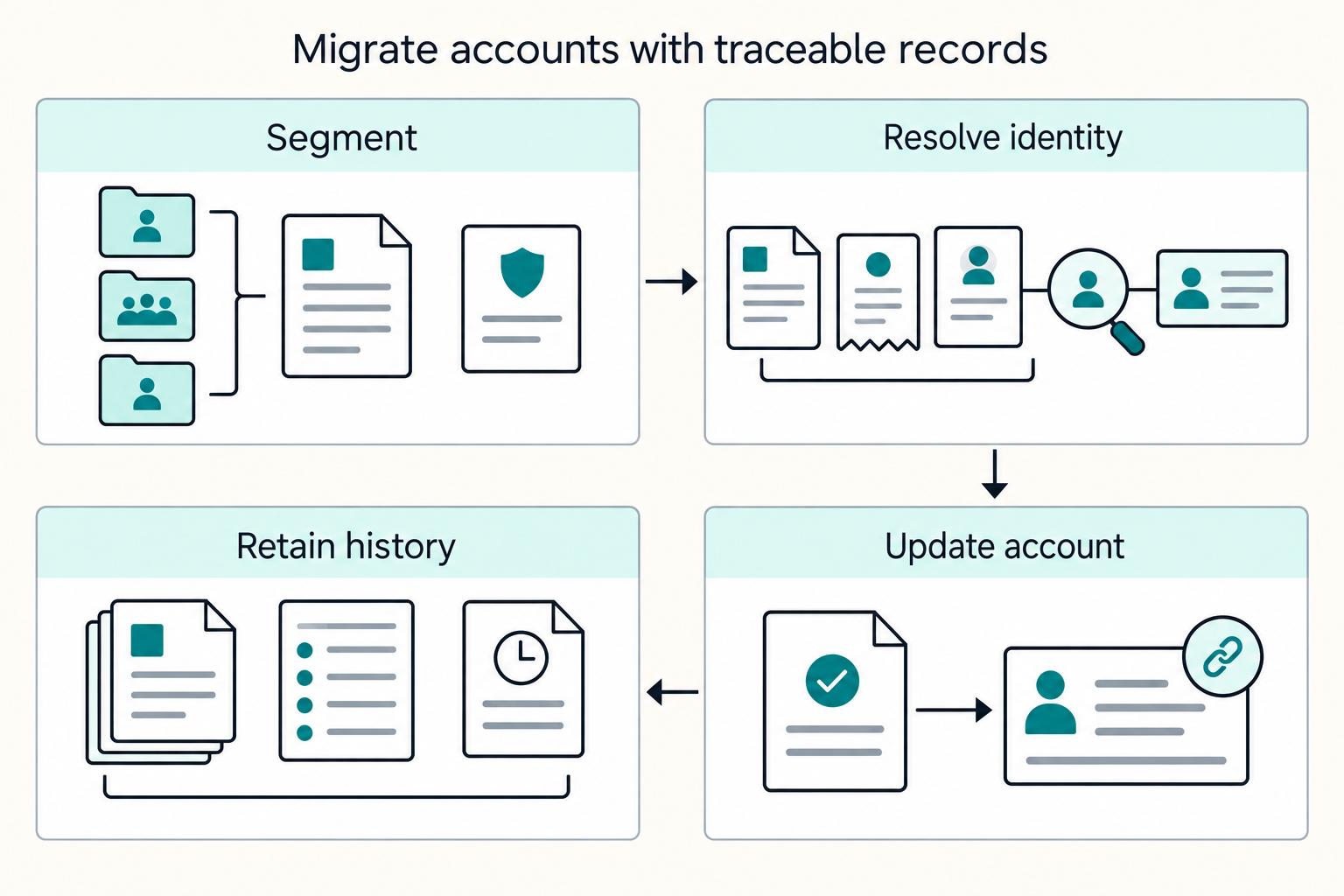
Treat migration as a record-quality project first. A practical approach is to stop new commingled setups, then clean existing records by risk and traceability. The goal is to reduce future exposure while keeping enough evidence to explain prior payout history.
Start by segmenting payees by entity structure and by how hard their history will be to unwind. One source notes that separation expectations can differ by structure. It also says that a single-member LLC is a separate legal entity from its owner. Apply stricter review to entity-based records without turning that into a universal legal rule across jurisdictions.
| Payee segment | What to confirm in the record | Evidence to retain | Priority |
|---|---|---|---|
| Sole proprietor | Legal name and whether destination is personal or business account | Payee identifier in your record, current payout details, dated exception approval (if any) | Medium |
| LLC or other entity-based payee | Registered business identity is used consistently across profile and payout details | EIN where applicable, account details tied to business record, change log | High |
| Unknown or mixed | Mismatches across contract name, invoice name, and payout destination | Historical statements and transaction exports needed to reconstruct activity | Highest |
Before you change payout details, confirm identity consistency in the payee record. IRS Publication 334 references identification number checkpoints, including an EIN and "other payee" identifiers. If your record cannot clearly identify the payee, changing the destination account will not fix the real problem.
Roll out in controlled cohorts and keep a clear audit trail of what changed and when. Use one written policy for migration decisions so support and operations are not improvising case by case in the middle of rollout.
Treat long-running commingling as a separate risk event, not a routine update. A practitioner example reported mixed personal and business activity for 2 years and flagged it as a serious problem. When you see that pattern, preserve statements and exports so finance can reconstruct activity and prepare a Profit and Loss statement if needed.
For operational exceptions, define ownership and decision rules internally before launch. Clear controls and records are supported, but a single workflow is not prescribed here.
Related reading: How to Open a Bank Account in Malaysia as a Foreigner.
Compliance and tax evidence your finance team will ask for#
Separation only helps if each payout is provable from start to finish, not just marked as "sent." For every payee and payout, keep three linked records: onboarding, payout approval, and account verification history.
For cross-border tax flags, keep these grounded anchors in view:
| Item | Grounded rule | Handling note |
|---|---|---|
| FEIE | Applies only to qualifying individuals with foreign earned income; the person still files a U.S. return reporting that income | If FEIE is raised, record the review basis, for example Form 2555, and keep the relevant date-range evidence |
| Physical presence test | Requires 330 full days during 12 consecutive months | A full day is 24 consecutive hours beginning and ending at midnight |
| FBAR | FinCEN frames it as reporting foreign bank and financial accounts | Timing can change through posted relief notices, so avoid hard-coding a universal deadline |
For payout operations, finance will still want the record chain below:
| Flow artifact | Minimum record | Why finance needs it | Red flag |
|---|---|---|---|
| Onboarding record | Legal payee name, individual/entity status, country, and tax-document status where applicable | Ties payout identity to the tax classification used downstream | Tax status is only in email, or identity fields do not match the payee profile |
| Payout approval trail | Approver, timestamp, amount, currency, destination account version, and exception reason | Shows the payout was approved for a specific payee state | Destination account changed after approval with no re-review |
| Account verification history | Verification timestamp, method, result, and mismatch/retry notes | Explains why funds were sent to that account | "Verified" is a free-text note with no method or time record |
For tax documents, store a retrievable status trail tied to the payee record, not a loose yes-or-no field. If payee identity or account type changes, re-check document state in the same workflow.
Treat cross-border tax items as review flags, not operational assumptions. FEIE applies only to qualifying individuals with foreign earned income, and the person still files a U.S. return reporting that income. If FEIE is raised, record the review basis, for example Form 2555, and keep the relevant date-range evidence.
Do not mark FEIE as satisfied without day-count support. The physical presence test requires 330 full days during 12 consecutive months, and a full day is 24 consecutive hours beginning and ending at midnight. If you use the IRS practice unit material on Form 2555, treat it as a review aid because it states that it is not an official pronouncement of law.
Keep FBAR in that same cross-border lane. FinCEN frames it as reporting foreign bank and financial accounts, and timing can change through posted relief notices, so avoid hard-coding a universal deadline.
Final checkpoint: you should be able to explain each payout from request to approval to ledger posting to finance export pack. If that chain breaks, the issue is not mainly policy. It is your evidence chain.
Hidden costs and common failure modes teams miss#
A common miss is pricing to a headline number instead of your actual usage conditions. A provider can show a live mid-market rate plus upfront fees and still cost more in practice once your flow hits receive fees, monthly thresholds, or per-withdrawal rules.
| What teams compare | Headline number | Condition that changes the math | What to check before rollout |
|---|---|---|---|
| Send pricing | From 0.57% | Discount pricing starts only after 25,000 USD in volume and resets on the first of the month | Model monthly volume, not annual assumptions, before you count on discount tiers |
| Business setup and receive path | 31 USD setup | Some receive flows are charged a fixed fee, including receiving USD wire and Swift payments at 6.11 USD per payment | Price outbound and inbound paths together so receive-side fees are not missed |
| Card cash access | Low or no fee at first glance | After 2 free withdrawals, a 1.5 USD fee applies per withdrawal, plus 2% of any amount over 100 USD per month | Check whether your operating pattern depends on withdrawals that trigger these charges |
Another failure mode is approving from a summary page instead of the full fee schedule. Before rollout, include the regulator-standardized fee format in your procurement pack so finance and ops are reviewing the same conditions that will apply in production.
How to evaluate providers without falling for listicle claims#
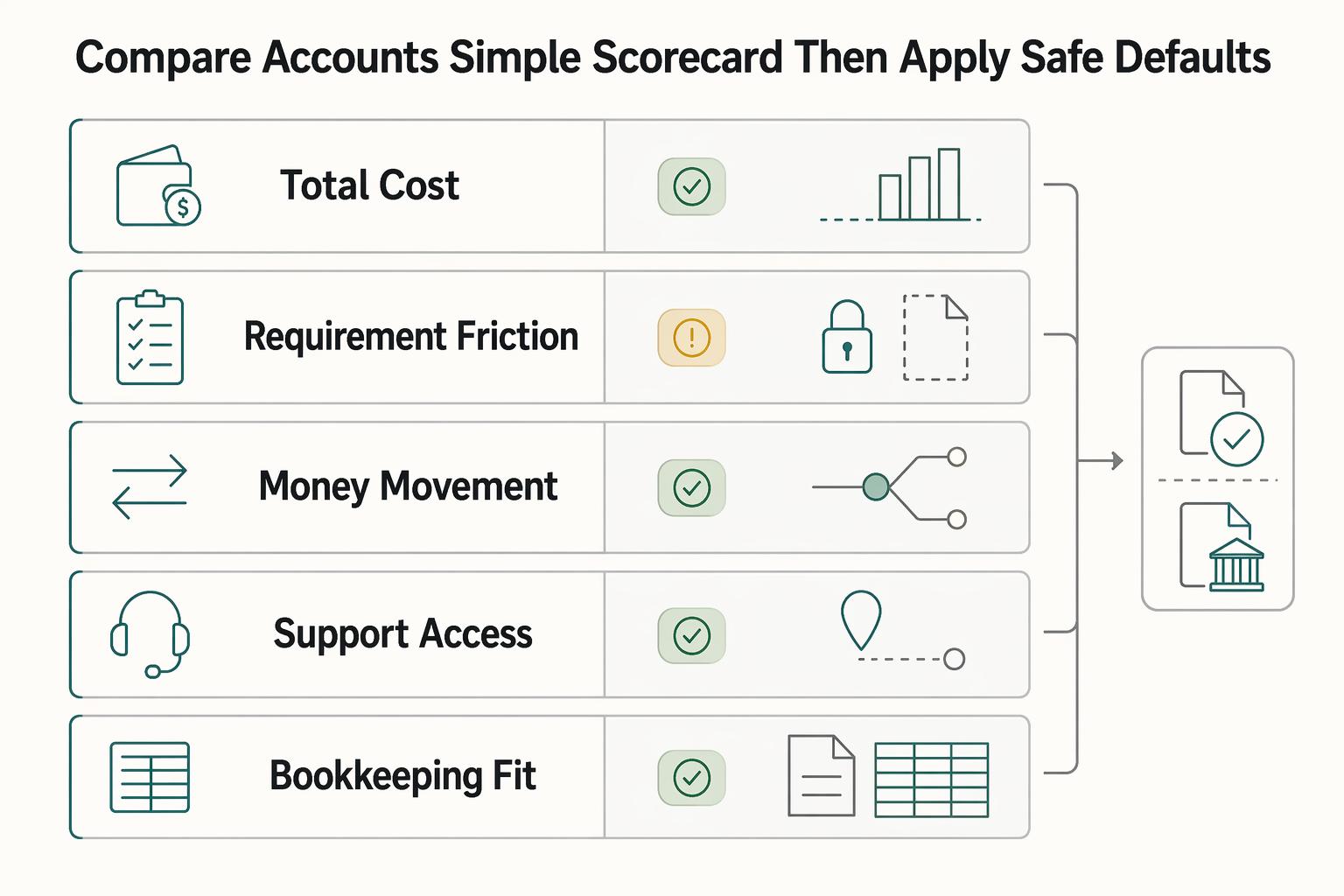
Use listicles for discovery, not selection. For this decision, score only what you can verify in primary pricing and product documents, then label every unresolved gap before you shortlist.
The practical evaluation comes down to four checks: account eligibility, rail support (ACH and Wire transfer), reconciliation exports, and compliance controls. Keep proven facts separate from unverified claims so rankings do not hide rollout blockers.
| Provider | Verifiable from this review pack | Still unverified here | Pre-shortlist action |
|---|---|---|---|
| Wise Business | Pay-as-you-go pricing with no subscription plans; business features framed as a one-time 31 USD setup; send pricing shown from 0.57%; discount after 25,000 USD with monthly reset; receiving USD wire/Swift can be 6.11 USD fixed fee per payment; regulator-standardized fee document is available | Account eligibility detail, ACH specifics, reconciliation export formats, and KYC/KYB/AML fit | Pull the regulator-standardized fee document, capture threshold/reset rules, and get written confirmation on rails, exports, and compliance handling |
| Novo | Confirm with the relevant authority | All four criteria unverified | Do not accept listicle claims until product, pricing, and eligibility docs are collected |
| Bluevine Business Checking | Confirm with the relevant authority | All four criteria unverified, including any APY conditions | Verify any promoted yield against qualification rules before comparing providers |
| Amplify Credit Union | Confirm with the relevant authority | All four criteria unverified | Confirm eligibility and operating fit from primary docs before procurement review |
Wise is a good example of why this process matters. Headline pricing can look strong, but the real cost changes when threshold and rail conditions apply. If you assume discounts before crossing 25,000 USD, or ignore receive-side wire and Swift fees of 6.11 USD, your model is wrong. Card pricing follows the same pattern. Two free withdrawals each month apply only within stated conditions, then 1.5 USD per withdrawal and 2% over 100 USD can apply.
Known unknowns to flag early#
- Incomplete fee conditions: if you only have headline pricing, your comparison is incomplete. Verify threshold triggers, receive-side fees, and reset timing.
APYrequirements: treat yield claims as unverified until qualification rules are documented.- Unclear ranking methodology: if weighting is not explicit, do not let the ranking drive procurement.
Procurement checkpoint#
Before implementation, require one evidence pack per provider: current pricing page, full fee schedule, regulator-standardized fee format where available, dated threshold and reset captures, and written responses to KYC/KYB/AML policy gate questions. If a provider cannot produce primary-document proof for eligibility, rails, exports, and compliance handling, keep it off your shortlist.
| Evidence item | What to collect | Decision use |
|---|---|---|
| Pricing page | Current pricing page | Part of one evidence pack per provider before implementation |
| Fee schedule | Full fee schedule | Use it instead of relying on headline pricing alone |
| Regulator-standardized fee format | Regulator-standardized fee format where available | Keeps finance and ops reviewing the same conditions |
| Threshold captures | Dated threshold and reset captures | Checks threshold triggers and reset timing |
| Compliance answers | Written responses to KYC/KYB/AML policy gate questions | If proof is missing for eligibility, rails, exports, and compliance handling, keep the provider off the shortlist |
Connecting account policy to Gruv money movement#
Treat account separation policy and money movement as separate controls until implementation is confirmed in writing. This guidance is not Gruv product documentation, so treat Gruv behavior as unverified and validate collections, wallet projection, FX conversion, and payouts as distinct rollout checkpoints.
| Flow area to validate | What separation should preserve | What you need to verify | Failure mode if you skip it |
|---|---|---|---|
| Collections | Clear distinction between a Business bank account and a Personal bank account at receipt time | Whether payer and account identifiers stay attached to the transaction record through downstream exports | Receipts land, but finance cannot prove which account policy applied |
| Wallet projection | Balance views that do not blur restricted or entity-specific funds | Whether projected balances can be traced back to the original collection record and account class | Teams approve payouts off projected balances they cannot later explain |
| FX conversion | Source and destination records that still show the original account context | Whether conversion history preserves pre-FX and post-FX references for reconciliation | FX creates an audit gap between collection and payout |
| Payouts | Beneficiary controls aligned to the approved account type | Whether payout instructions retain the approved bank-account classification and status history | Exceptions get worked manually because the payout trail is incomplete |
Do not assume Virtual Account Numbers (VANs) or Merchant of Record (MoR) flows are available without written confirmation. Use one practical test: can you follow a payment from collection reference to wallet view to payout record without losing the account type decision? If not, the policy is stronger than the implementation.
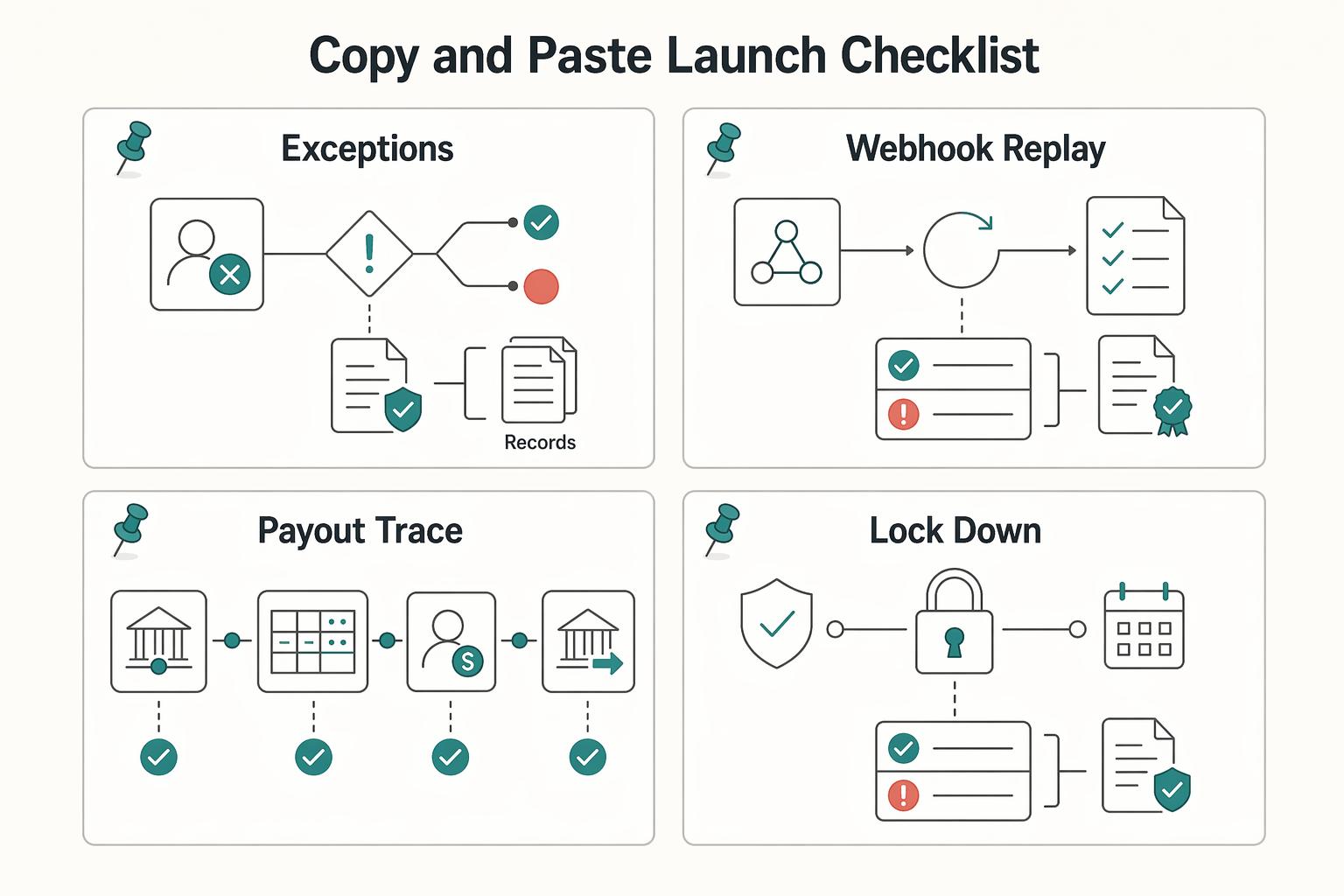
If ACH or Wire transfer rails are in scope, apply the same standard before you go live. Get written confirmation that retries are idempotent, so status retries do not duplicate movement, and that status history remains auditable through exception handling. If either point is unclear, pause rollout. Mixed account policies plus weak retry controls turn small payout issues into month-end reconciliation debt.
For a step-by-step walkthrough, see Opening a UAE Bank Account as a Non-Resident Freelancer.
The 10 point decision checklist for this week#
Do not launch this week unless each payee type has a named cohort, owner, rail path, and reporting output, and your reconciliation evidence pack passes on real samples. Use five gates with a go or hold decision for each:
| Gate | Go this week if | Hold this week if |
|---|---|---|
| Payee cohorts | You have a named list of payee cohorts, any temporary account-routing exceptions are documented, and each exception has an owner. | Cohorts are still broad labels with no owner or timeline. |
| Policy docs | Compliance and tax statuses you actually use are mapped to payout decisions, and you can export status history for a sample payee. | Statuses exist, but you cannot show which status approved or blocked payout. |
| Rails and exceptions | Rail paths you plan to use are documented per cohort, and failed payout handling has a clear owner. | Rail handling is assumed, or exception response is ad hoc. |
| Tax and reporting | You can separate employee and nonemployee reporting paths in stored records. Form W-2 is for employees, while Form 1099-NEC and Form 1099-MISC cover specified nonemployee and other business payment cases. | Your records cannot reliably reproduce which reporting path applied. |
| Reconciliation pack | For one sample payment, onboarding, approval trail, payout record, and exports match end to end. | Finance must manually stitch screenshots to explain one payout. |
Treat Form 1099 output as a hard checkpoint. The IRS excerpt here states that payers file Form 1099-NEC and Form 1099-MISC with the IRS and provide them to recipients. It also cites thresholds of $600 ($2,000 for payments made after December 31, 2025), $10, and $5,000 for specific reporting paths. If you cannot show how classification and totals feed those outputs, hold launch.
For VAT validation requirements, KYC/KYB/AML documentation rules, W-8/W-9 requirements, and rail-specific readiness standards, keep status as unknown until sample exports and workflow evidence confirm what is actually supported. Use the same rule for account-separation rollout: an incomplete evidence pack means you are not ready.
If your checklist flags recurring exceptions or unclear ownership, align your rollout with Gruv Payouts so status tracking, retries, and controls are defined before cutover where enabled.
Conclusion#
Separate business and personal accounts as a control decision, not a preference. It simplifies accounting and gives you clearer statement-level evidence for income and expenses. This is usually recommended rather than universally mandatory, so if you allow personal account payouts, keep them as a named exception with clear ownership and a migration path.
From here, apply your thresholds and checklist in phases, then confirm provider coverage, fee structure, and policy-gate fit before rollout. Before launch, confirm market coverage and policy-gate fit for your exact flow with Gruv.
Frequently Asked Questions
Do freelancers need a business bank account, or is a personal account acceptable?
This guide does not establish a universal rule that every freelancer must use a business account. A personal account may be acceptable as a controlled exception, but it should be scoped and owned rather than left as an open default. If you keep that exception, define when and how users must migrate.
What changes operationally when a platform enforces business-account separation?
If a platform enforces separation, payout policy shifts from accepting mixed account setups to requiring business account alignment before release. That can make decisions more explicit because account type and payout approval are checked together. It can also mean more upfront review work and potentially fewer ambiguous payout exceptions later.
When should a platform require a business account for payouts?
Consider requiring separation when mixed account handling starts creating repeated exceptions or unclear payout decisions. It matters most when your team needs consistent approval and reporting evidence across many payouts. If you cannot reliably explain who was paid, through which path, and under which decision logic, require business account separation.
What minimum controls are required if some users still receive funds to personal accounts?
Keep a named exception cohort with a clear owner. Maintain account verification history, payout approval records, and one end-to-end sample evidence trail from onboarding to payout record to export. If that evidence cannot be reproduced quickly, your controls are not yet sufficient.
How do fees, integrations, and international support affect payout reliability?
Reliability depends on route and usage details, not headline pricing alone. Wise states usage-based pricing with no subscription plans, shows a 31 USD Wise Business setup fee, and lists sending and converting from 0.57%, while actual cost still depends on route and currency. It also lists 6.11 USD for receiving USD wire and Swift payments, and card fees are per account per month with 2 free withdrawals up to 100 USD/month, then 1.5 USD per withdrawal plus 2% over 100 USD. Payment method availability can vary by country or currency, so verify your actual corridors before rollout.
What should teams verify before selecting providers like `Wise Business`, `Novo`, or `Bluevine Business Checking`?
For Wise Business, verify the exact routes you will use, check whether volume may cross the 25,000 USD monthly discount threshold, confirm the discount is cumulative across transfers, and note that it resets on the first of the month. Keep the regulator-standardized fee document in your procurement pack so stakeholders review the same artifact. For Novo and Bluevine Business Checking, treat fees and eligibility as unknown until each provider supplies current documentation and sample outputs.
Try a related tool
Researched and edited by the Gruv editorial team. Gruv builds cross-border billing, payouts, and finance-operations software for global businesses.
Sources
- dol.gov/agencies/oalj/PUBLIC/DOT/REFERENCES/DOTINDUtrusted
- federalregister.gov/documents/2021/01/07/2020-29274/independent-...trusted
- fincen.gov/report-foreign-bank-and-financial-accountstrusted
- in.gov/che/cte/files/NLPS-Review-Doc_Update_9.6.24.pdftrusted
- irs.gov/faqs/small-business-self-employed-other-busi...trusted
- irs.gov/individuals/international-taxpayers/figuring...trusted
- ofac.treasury.gov/faqs/all-faqstrusted
- ofac.treasury.gov/faqs/addedtrusted
Educational content only. Not legal, tax, or financial advice.
Related Posts
When Virtual Account Numbers Protect Freelancer Bank Details
If your goal is to protect freelancer payout bank details, focus on the receiving bank detail, not card-masking tools. In practice, the question is whether to give payers a purpose-built receiving detail, often a virtual bank account number, instead of exposing the underlying account behind your payout setup.
The Best High-Interest Checking Accounts for Freelancers
Stop optimizing for the highest advertised rate. Optimize for net yield plus predictable money movement, because that is what keeps your freelance cashflow stable. If you run a business-of-one, treat checking like your cashflow control panel, not an investment product. Once checking becomes a system, you can choose a setup that survives late invoices, odd payout timing, and vendor auto-bills. Then interest becomes a bonus instead of a trap.

The Best Business Bank Accounts for Freelancers
APY can break a tie. It should not drive your shortlist. If you are comparing the best business bank accounts for freelancers, start with the setup that keeps money moving, records clean, and month-end work manageable.