
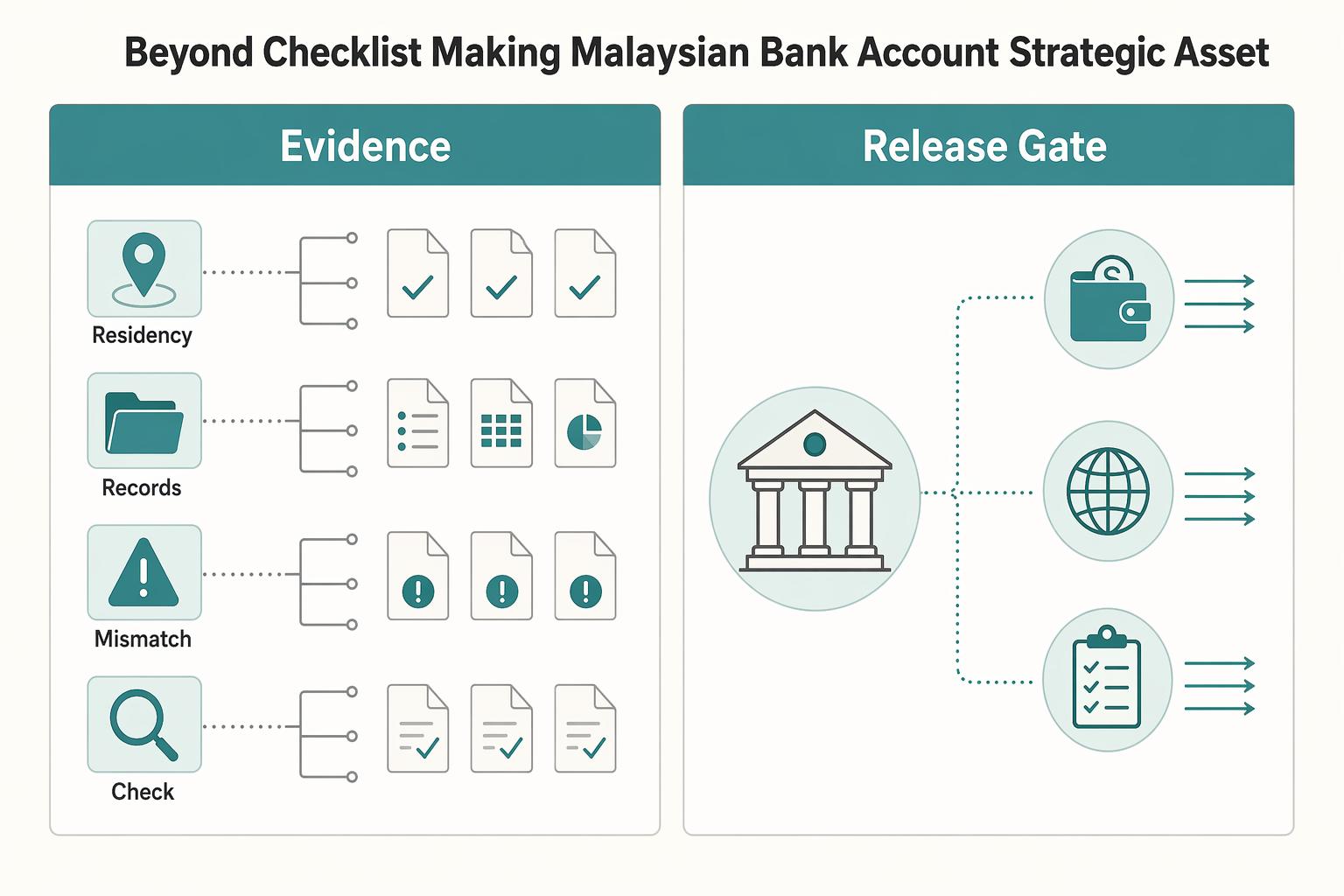
Quick Answer
Foreign applicants need a valid passport and documents showing their purpose and status in Malaysia. Use the selected bank’s checklist: CIMB publishes branch requirements, while HSBC offers an eligible foreign-passport app route that can still require branch activation. Confirm account eligibility and funding before applying, then test receipts, transfers and statement access.
Choose your account and application route first#
Treat opening a Malaysian account as a cashflow and risk decision, not an admin task. Your bank choice affects how you get paid, what account data may be collected and exchanged across borders, and how much rework you face if the bank asks for follow-up documents.
Three terms matter throughout this guide, because they shape the document checks, bank comparison, and reporting steps later:
- Bank due diligence: the identity, status and purpose checks the bank uses when deciding whether to open and maintain the account.
- Reporting exposure: the chance that your non-resident account data is collected and exchanged with foreign tax authorities.
- Operational bank partner: a bank you choose for day-to-day execution quality, especially online banking and transfer capability.
Malaysia is part of the CRS reporting flow. Financial institutions collect and report certain account data to IRBM, and IRBM exchanges non-resident information with participating foreign tax authorities. Malaysia states it has committed to exchanging CRS information since 2018, and CRS reports for January-to-December data are submitted to IRBM by 30 June of the following year.
Keep that separate from U.S.-specific duties. FATCA is a U.S. regime, and FBAR is a separate U.S. filing requirement tied to foreign financial accounts, generally accounts outside the United States. The IRS FBAR page states a trigger for U.S. persons when aggregate foreign account value exceeds $10,000 at any point in the year. If your filing obligations are outside the U.S., verify the applicable local thresholds and filing rules.
| Checklist mindset | Strategic mindset |
|---|---|
| Bring a passport and assume the checklist is complete | Expect extra document requests; banks can ask for additional supporting documents |
| Focus only on opening day | Confirm branch-only steps and whether proof of Malaysian address or status-specific documents are needed |
| Choose the first approval | Choose for daily transfers, online usability, reporting clarity, and long-term fit |
First confirm the account and applicant category, then prepare its documents. Compare daily payments and record access as well as opening requirements so the account supports your actual use after approval.
Prepare documents for your bank and applicant status#
Prepare your file before you book the branch visit. One weak item - passport, status evidence, address proof, or the document that explains why you are in Malaysia - can stall the process.
Before you start#
Check application and activation separately. CIMB publishes a branch checklist for foreign applicants. HSBC offers a foreign-passport app route for eligible Premier applicants. New-to-HSBC non-Malaysians must activate at a branch within 30 days of opening. Ask which originals and supporting documents are needed for your chosen route.
Step 1 Gather your document matrix#
Build your pack so you can show identity, status route, Malaysian address, and supporting context in one pass. Quick check: can you prove identity, status, address, and purpose without digging through your phone or email?
| Document type | Why the bank asks for it | Primary acceptable proof | Fallback proof if primary is unavailable |
|---|---|---|---|
| Identity | To confirm your identity | Original valid passport; CIMB specifies at least 6 months remaining at account opening | No true substitute. Bring photocopies of the photo page and pass page for speed, but expect the original passport to be required |
| Immigration or residency status | To verify your legal status category in Malaysia | The pass and supporting documents for your employment, study, dependent or other qualifying status | If your case is unusual, call the branch first and ask what interim proof it will review |
| Proof of Malaysian address | To verify your residential address and resolve mismatches | The address evidence requested by your chosen bank, such as a stamped tenancy agreement or utility bill | Ask the bank which alternatives it accepts for your status |
| Purpose or supporting context | To support the status route you are applying under | Employment letter, student ID, or other status-linked supporting document | Be ready for extra document requests beyond baseline lists |
Step 2 Verify your eligibility route#
Use the status you can document now. CIMB’s published employment route includes a work pass, employment letter and proof of salary of at least RM10,000, except for CIMB@Work payroll customers. Its student route requires a student pass, student ID and university confirmation; foreign students are limited to savings accounts. Dependent and MM2H applicants have their own supporting-document routes.
CIMB specifies at least 6 months validity for passports and the listed work, student and dependent passes. These are CIMB requirements, not a universal rule for every Malaysian account. For DE Rantau or another status, confirm the bank’s accepted evidence before booking a visit.
If your immigration status or pass is changing, confirm which document the bank can accept now. A pending visa application and an approved pass can require different supporting evidence.
Step 3 Audit your proof of address#
This can be a failure point, so check it in order: name match, address match, and document freshness. For name match, the document should show your name. For address match, use the same address format you will enter on the application. For freshness, do not assume one universal window across all banks or products. Confirm the current recency window with the bank or provider before relying on it.
If address details do not align, banks may request proof of residential address and may apply additional validation to your supporting document.
Step 4 Check your file before you go#
Before your appointment, run this self-audit:
- Match your name exactly across passport, pass, and application form.
- Print clean copies and pack originals separately for quick access.
- Pair status evidence with supporting context, for example EP plus employment letter, or Student Pass plus student ID.
- Call the branch to confirm whether your selected account is branch-only and what extra documents are commonly requested for your status.
If one item is weak, fix it before you go. That is easier than restarting after a document mismatch.
You might also find this useful: A Guide to the Malaysian Digital Nomad Visa (DE Rantau).
Pillar 1: Is Your Bank Built for Daily Execution? (Operational Efficiency)#
Once your documents are ready, the next decision is practical: pick the bank that makes daily execution easy. If getting paid, moving funds, downloading records, or fixing a transfer problem takes too much effort, the account will create cashflow drag long after onboarding.
Before you start#
Compare banks against your real payment pattern, not generic international banking claims. Write down:
- your main incoming currency
- your main transfer corridor
- the largest amount you may need to move in one day
Use these terms consistently during comparison so you do not end up mixing cost, route, and support issues:
- FX spread: the gap between quoted buy and sell prices; it is a core transfer-cost component.
- Transfer corridor: a country-to-country payment route; pricing and delivery conditions can differ by corridor.
- Support escalation path: the documented sequence of who handles your issue first and what happens if it is not resolved.
Step 1 Test day-to-day operations before opening#
Treat this as a branch interview sheet and app test list. You are not just checking whether the bank can open the account. You are checking whether you can actually use it without friction.
| Feature | Why it matters | How to test before opening | Red flag |
|---|---|---|---|
| Digital reliability | You need to approve payments, check balances, and react quickly when money lands | Test app and web access flow, then confirm your exact account tier has the digital access you need at onboarding | Core actions still require branch visits, or digital access is unclear for your tier |
| Cross-border transfer transparency | Total cost includes more than the posted fee | Ask for a live quote on your main corridor and request a cost breakdown: fee, FX basis, and possible intermediary charges | Only a flat fee is quoted, with no clear FX or intermediary-charge explanation |
| Accounting/export compatibility | Reconciliation slows down if statements are hard to retrieve or use | Confirm available statement formats for your exact account and test date range and detail download flow | Format support is vague, or only limited-history statements are available |
| Support model | Resolution speed affects cashflow when transfers stall or transactions look wrong | Ask for first contact, escalation steps, and whether your tier includes a named contact | "Call the hotline" is the only path, with no documented escalation |
Use bank examples as checks, not conclusions. Verify them at your branch and for your account tier. CIMB states SpeedSend is available 24/7 via OCTO App and CIMB Clicks, and it allows side-by-side comparison of Foreign Telegraphic Transfer and SpeedSend rates. HSBC Malaysia states international transfers to over 150 countries and regions. Maybank's live chat page states business-hours availability, so do not assume every support channel is 24/7.
Step 2 Check transfer economics, not just headline fees#
Compare the amount you send with the amount expected to arrive, using a quote for your currency and destination. Include the bank fee, any currency conversion and possible intermediary deductions. Keep the quote date so later transfers are compared on the same basis.
| Checkpoint | Article detail | What to verify |
|---|---|---|
| Bank fee | Headline fees do not always show the real cost | Request a cost breakdown, not just the posted fee |
| FX spread | The FX spread is the gap between quoted buy and sell prices; it is a core transfer-cost component | Test at least one corridor that matches your real workflow |
| Intermediary charges | CIMB notes that foreign TT can include agent or third-party charges | Check whether intermediary deductions can apply on your route |
| SST | CIMB states remittance fees or charges are exclusive of 8% SST | Check whether your quote includes SST |
| Daily limit | CIMB SpeedSend materials show up to RM200,000/day for Preferred customers and up to RM50,000/day for other non-Preferred customers | Confirm your limit for your exact account and channel on application day |
CIMB notes that foreign TT can include agent or third-party charges, and stated remittance fees or charges are exclusive of 8% SST. Also verify operational limits. CIMB SpeedSend materials show up to RM200,000/day for Preferred customers and up to RM50,000/day for other non-Preferred customers. Confirm your limit for your exact account and channel on application day.
Step 3 Verify statement exportability before relying on bookkeeping#
If statement access is weak, everything downstream gets harder, so confirm statement retrieval before opening, not after.
Ask for your exact account's available formats, downloadable history, and transaction-detail depth. CIMB documents downloadable eStatements and states they are password-protected and accessible on common devices. That supports secure retrieval, but it does not by itself confirm every account has every export format. If format support is unclear, assume reconciliation will be slower.
Step 4 Trace the escalation path before something fails#
A payment issue is the worst time to learn how support works. Map the full sequence now: first-line contact, escalation trigger, and formal resolution route.
| Stage | Who or what | Article note |
|---|---|---|
| First contact | Relationship Manager, customer service, or branch | HSBC Malaysia documents these as starting points |
| Bank escalation | Customer Resolutions | HSBC Malaysia documents escalation to Customer Resolutions if needed |
| External dispute route | FMOS | First complain to the financial institution. Eligible unresolved disputes can go to FMOS within 6 months of its final decision, or after 60 days without a response; FMOS targets 3–6 months after complete documents arrive. |
Start with the bank’s complaint channel and retain its reference and final response. For eligible disputes, FMOS provides an independent, free resolution route: normally refer the case within 6 months of the bank’s final decision, or after 60 days without a response. Its 3–6 month resolution target starts when complete documents are received.
Choose the bank that proves reliable operations for your corridor and tier in practice. Once that part is covered, the next question is whether the same account will stay easy to document at tax and reporting time.
Pillar 2: Can You Prove Account Facts at Filing Time? (Risk Mitigation)#
Build a clean, repeatable compliance process from day one. You are not trying to avoid reporting; you are making sure you can prove account facts quickly when filing time comes.
Step 1 Define the reporting job before you open#
Start by separating the reporting systems you may deal with, so you do not mix them later.
- Tax residency: apply Malaysia’s full residence tests, including linked-year and prior-year rules; fewer than 182 days in one year does not automatically mean non-resident treatment.
- Automatic information exchange (AEOI/CRS): annual cross-border exchange of predefined financial account data between tax authorities.
- Reporting obligation: your legal duty to file required reports and keep required records for reportable foreign accounts.
In Malaysia's CRS framework, financial institutions collect and report non-resident account information to IRBM, and IRBM exchanges that information with participating foreign tax authorities. Malaysia's CRS rules took effect on 1 January 2017, and Malaysia states it has committed to exchanging CRS information from 2018.
Step 2 Complete CRS self-certification like an evidence document#
Treat CRS self-certification as a control point, not routine paperwork. You are declaring tax-residency jurisdiction or jurisdictions and TIN details, and CRS includes due-diligence procedures.
Before signing, confirm the form captures the basics you will later need to verify:
- your tax-residency jurisdiction or jurisdictions
- your TIN details
- the exact legal account-holder name
Keep a copy of the completed form, account-opening pack, and first statement together. That archive makes it easier to verify ownership and account details later if questions come up.
IRBM states CRS reports for January to December data are due by 30 June of the following year. That does not by itself create a tax bill, but it does mean your account can enter a formal reporting cycle quickly.
Step 3 Verify record access before opening#
Do not accept "you can download statements" as a generic promise. Confirm the exact fields and history you will need, then verify them against the account you are actually opening.
| Compliance task | What data you need from the bank | How to verify before opening |
|---|---|---|
| CRS and general tax records | legal account-holder name, account number, bank identity, opening records, annual statements | Review sample statement fields in digital banking and confirm ownership details are clearly shown |
| Annual bookkeeping and return prep | downloadable full-year transaction history and statements | Test transaction-history and statement download flow for your exact account tier |
| U.S. FBAR preparation | account name, account number or designation, foreign bank name and address, account type, greatest value during reporting period | Confirm dated balance history is available, not only current balance, and check how far back statements remain downloadable |
| Form 8938 support | filing-year balance and ownership records | Confirm prior-period retrieval without branch escalation |
CIMB publicly states users can check balances, view transaction history, and download eStatements in digital banking. HSBC Malaysia materials also describe some eStatement access as the past 12 months, so verify retention depth before opening.
Step 4 Separate global baseline duties from U.S.-specific filings#
The baseline is simple: your account may be reported under CRS, and you may also have personal filing duties under your home-country rules. Those duties are related, but they are not the same.
| Regime | Who handles it | Article note |
|---|---|---|
| CRS | Malaysian financial institutions report non-resident account information to IRBM, and IRBM exchanges it with participating foreign tax authorities | Malaysia's CRS rules took effect on 1 January 2017, and Malaysia states it has committed to exchanging CRS information from 2018 |
| FBAR (FinCEN Form 114) | A U.S. person files it; it is not filed with the IRS | Generally triggered when aggregate foreign account value exceeds $10,000 at any point in the year |
| Form 8938 | It is attached to the annual U.S. tax return | Separate from FBAR |
If you are a U.S. person, keep two separate tracks in mind:
- FBAR (FinCEN Form 114) and Form 8938 are separate regimes.
- Form 8938 is attached to your annual U.S. tax return.
- FBAR is not filed with the IRS.
FBAR and Form 8938 use different thresholds and filing conditions. Check each obligation separately against your status and account holdings; the bank’s reporting does not replace your own filing.
- For FBAR, consider financial interests and signature authority across foreign accounts, including the aggregate $10,000 trigger.
- For Form 8938, check the threshold for your filing status and whether you qualify as living abroad, rather than reusing the FBAR limit.
Choose the bank that lets you retrieve required identity, ownership, and balance-history fields without friction. That is the real win here. You can explain residency status, produce records, and complete filings without rebuilding the year from memory.
If your Malaysia account will sit alongside other foreign accounts, sanity-check your reporting workflow with the FBAR calculator before you finalize your bank choice.
Pillar 3: Can This Bank Grow With You? (Long-Term Scalability)#
Opening speed matters, but switching friction later matters more. Long-term scalability means you can add investing, credit, or business banking without starting from zero each time.
Step 1 Define your next upgrade before you open#
Go into the branch or onboarding call with one concrete 12-24 month move in mind. That could be starting investing, preparing for a future credit review, or opening a company account after incorporation.
Ask two direct questions before you open:
- Which team handles that next step?
- What documents should you prepare now so the handoff is smoother later?
If the answers are vague, or you get bounced between personal and business teams, expect friction later.
Two labels affect progression, so keep them straight from the start:
- MM2H (Malaysia My Second Home): a long-stay pathway for eligible foreign participants.
- Sdn. Bhd. (Sendirian Berhad): a private company form in Malaysia.
These are not just background terms. They can change document requirements as you move from personal banking to longer-stay or company banking.
| Bank route | Strength when you scale | Tradeoff to verify now | Best fit if you are |
|---|---|---|---|
| Local bank with business products, for example CIMB | Local entity coverage and documented onboarding requirements, including Sdn. Bhd. at CIMB | Business onboarding may require in-person signatories and governance documents | Planning Malaysia-based personal and company banking |
| International bank, for example HSBC Malaysia | An eligible non-Malaysian can apply for a Premier Everyday Global Account through the HSBC Malaysia app | Confirm relationship-balance requirements and whether branch activation is needed | Moving across countries and wanting cross-border continuity |
| Bank with digital business onboarding flow, for example UOB Malaysia | A digital application can reduce form-filling and document handoffs | Digital start still requires company documents and approval checks | Prioritizing onboarding speed once your entity is ready |
Step 2 Verify the wealth lane with product and protection checks#
Do not assume "wealth management" means meaningful access for your profile. For investing, verify the actual product path available to your status.
Bank Negara Malaysia states non-resident investors may open ringgit or foreign-currency accounts with licensed onshore banks. It also states transactions through an External Account are allowed with documentary evidence and bank due diligence.
Keep the protection boundary clear before you commit to any wealth product:
- Treat unit trusts as investments, with their own minimum subscriptions, risks and redemption terms.
- PIDM protects eligible deposits up to RM250,000 per depositor per member bank.
- PIDM does not protect unit trusts, stocks, or shares.
Ask the banker to separate deposit products and investment products clearly so you do not assume one protection regime covers both.
Step 3 Test the credit lane by forcing eligibility clarity#
For foreigners, credit access varies enough that transparency matters as much as the answer itself. Ask the bank:
- Which visa or pass statuses it accepts for your profile.
- Which documents it uses at first review and at later reviews.
Ask about the specific credit product rather than assuming account opening establishes borrowing eligibility. Confirm which pass, income history, documents and collateral requirements apply before choosing a bank for future credit.
Step 4 Stress-test the business path before you need it#
Personal-to-business is often a fresh onboarding process with entity and governance checks, so you want to see that path before you depend on it.
CIMB states business current account eligibility includes structures such as sole proprietorships, partnerships, LLPs, and Sendirian Berhad / Berhad. Its guidance also states required signatories must be present at branch and may require board resolution documents. UOB's flow allows an online start, but its FAQ still lists constitution documents for private limited companies where applicable. CIMB also flags FATCA particulars for U.S. persons in business onboarding.
Step 5 Choose your path#
Use this checklist before you commit, based on the next step you are most likely to take:
- Prioritize immediate usability if your main goal is fast, clean onboarding for your current visa or pass profile.
- Prioritize near-term credit building if the bank can clearly explain status-based eligibility and future document refresh points.
- Prioritize company banking continuity if you expect to form a Sdn. Bhd. and want clear rules for signatories, governance documents, and team handoff from personal to business banking.
Conclusion: Choose a Partner, Not Just a Provider#
Choose the bank that gives you verifiable answers, not the best pitch. In practice, a real banking partner can mean fewer payment frictions, a clearer compliance process, and a credible path into whatever you may need next.
If a bank cannot explain your onboarding path, statement workflow, and escalation process in concrete terms, treat that as a no-go.
| Decision area | Transactional provider | Partner you can verify |
|---|---|---|
| Onboarding clarity | Says "bring your documents" without mapping your profile | Confirms whether opening is in-branch, lists required documents, and maps your status to the right evidence, for example visa or pass plus work or study proof |
| Reporting-ready digital tools | Shows balances but no clear records process | Shows where to download eStatements and how long they stay available; this supports reporting recordkeeping and, for U.S. persons, FBAR tracking if foreign accounts exceed $10,000 in aggregate |
| Escalation quality | Routes you to generic support with no target timeline | Gives a complaint channel, reference process, and stated response target, plus formal next steps if unresolved, including where applicable FMOS |
| Continuity into future services | Stops at a basic account | Shows a credible path to what you may need next: business portals, cross-border transfer features, and lending or working-capital options where available |
- Choose your primary use case first: international client receipts, compliance visibility, or growth into business banking.
- Ask the same four questions in every branch conversation: in-person or document requirements, exact statement-download flow, complaint timeline, and add-on products later.
- Document the answers and choose the bank that lowers ongoing friction. Note who confirmed each requirement, what timeline they gave, and what tools they demonstrated. If deposit protection matters to you, verify PIDM membership, since eligible deposits are protected up to RM250,000 per depositor per member bank.
After opening, verify one receipt and one transfer, download the first statement and save the account-opening documents. That confirms the account works for your payment pattern and gives you the records to start reconciliation.
Frequently Asked Questions
Which bank is best if you are a U.S. expat?
There is no single best bank for every U.S. person. Use practical criteria: onboarding reliability, documentation clarity, international transfer usability, statement quality, and support continuity after opening. FBAR is your U.S. foreign-account report, FinCEN Form 114, when your aggregate foreign-account value exceeds $10,000 at any point in the year, due April 15 with an automatic extension to October 15. In practice, that means choosing the bank that makes balance tracking and clean statement downloads easy all year.
Can you open a Malaysian bank account online as a foreigner?
Some banks offer a digital route. HSBC permits eligible non-Malaysians with a passport and supporting purpose documents to apply for a Premier Everyday Global Account through its app. New-to-HSBC non-Malaysians must activate at a branch within 30 days of opening. An existing global HSBC customer based outside Malaysia can activate after verification without visiting a Malaysian branch. Check your account and status before planning travel.
What are the tax implications of opening an account?
CRS (Common Reporting Standard) is the cross-border tax-information exchange framework where Malaysian financial institutions report non-resident account data to IRBM for exchange with participating foreign tax authorities. FBAR is separate: it is your U.S. reporting duty, not the bank's. The practical takeaway is simple: give accurate tax-residency details at onboarding and keep your account records aligned with what you declare.
Can you open a business bank account in Malaysia as a foreigner?
It may be possible, but do not treat it as a no-branch process. CIMB shows business eligibility across multiple entity types, including Sdn Bhd (Sendirian Berhad, a Malaysian private company limited by shares), and its process includes branch attendance and document verification. You should also expect signatory and company-document checks, which can include items like board-resolution paperwork and CRS or FATCA entity self-certification forms. In practice, confirm your entity type, signatories, and required originals before anyone travels to the branch.
What is the minimum deposit to open an account?
It depends on the product. CIMB’s Regular Savings Account currently lists an initial deposit of RM250, subject to its account-opening checks. Other products can require a higher average or relationship balance. Ask separately about the opening deposit, ongoing balance and fees if you fall below it.
Which banks are most foreigner-friendly?
"Foreigner-friendly" is a process test, not a brand label. Focus on whether the bank can clearly explain your documents, handle CRS or FATCA self-certification cleanly when required, provide usable statements, and keep support consistent as your needs change. MM2H means Malaysia My Second Home, a renewable social visit pass for eligible international participants, but it is not an automatic approval guarantee. Choose the bank that can map your exact status to a clear, repeatable onboarding path.
Try a related tool
Researched and edited by the Gruv editorial team. Gruv builds cross-border billing, payouts, and finance-operations software for global businesses.
Sources
- financialmarkets.bnm.gov.my/investing-in-malaysiatrusted
- hasil.gov.my/en/international/automatic-exchange-of-infor...trusted
- hasil.gov.my/en/international/automatic-exchange-of-infor...trusted
- irs.gov/businesses/small-businesses-self-employed/re...trusted
- irs.gov/newsroom/how-to-report-foreign-bank-and-fina...trusted
- mm2h.gov.mytrusted
- oecd.org/en/publications/automatic-exchange-of-inform...trusted
- oecd.org/en/publications/peer-review-of-the-automatic...trusted
Educational content only. Not legal, tax, or financial advice.
Related Posts
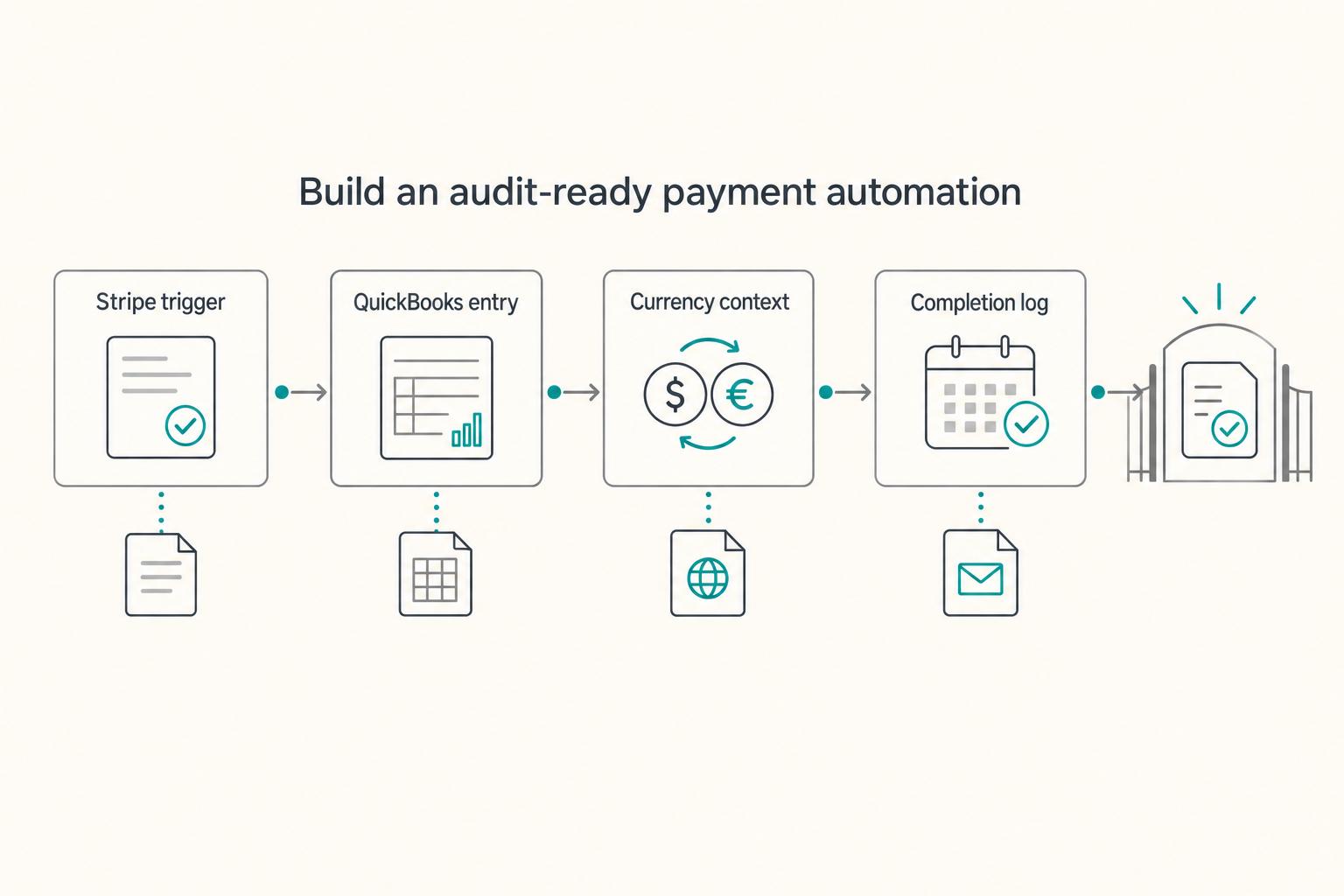
Automating Your Freelance Finances: A Zapier Workflow for Connecting Stripe, QuickBooks, and Wise
Start with one payment flow you understand, then automate its accounting record without losing the source reference. Stripe captures payments, QuickBooks holds the books, Zapier connects the selected steps, and Wise records any separate cross-border balance or conversion activity.

London, UK: A Guide for Expats and Remote Workers
Get two calls right early and the rest of the move gets easier: how you'll be in the UK, and where you'll work when conditions are less than ideal. Make those decisions before you lock dates or prepay a long stay. If you book first and sort the basics later, admin and work reliability usually collide in your first week.
Planning Your Move With the Malaysia Digital Nomad Visa (DE Rantau)
Treat this as a verification-first playbook, not a travel pitch. If you cannot confirm current rules from official Malaysian sources, the best move is to pause before planning anything else.