
Quick Answer
Yes, some UAE banks accept non-resident savings applications. That does not guarantee approval or permission to receive recurring freelance business payments. Choose the correct individual or business route, disclose your payment pattern, and confirm the product’s documents, permitted use, charges and activation steps before directing clients to it.
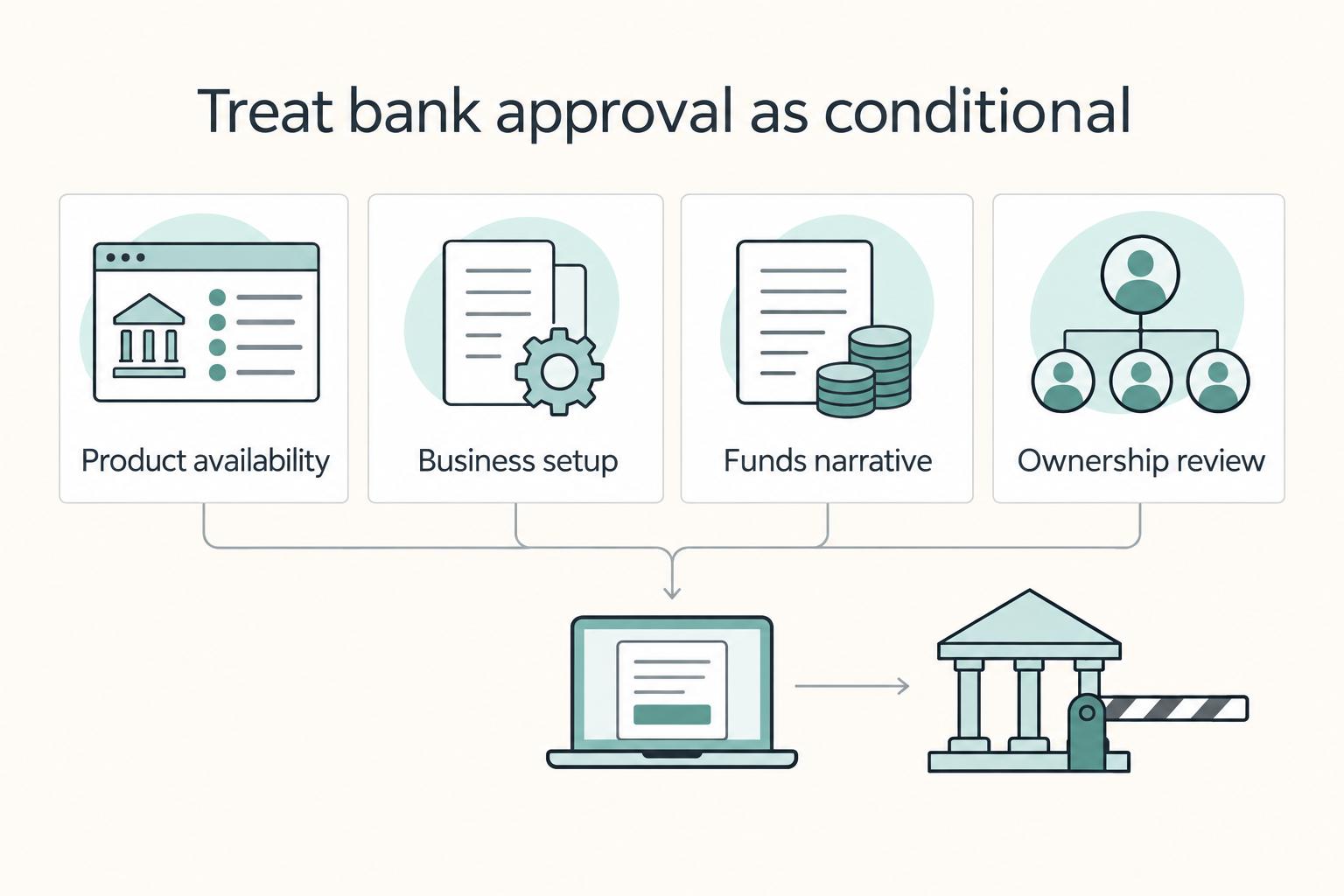
Treat approval as conditional from day one#
Non-residents can apply for certain UAE savings products, including published options at Emirates NBD and ADCB Islamic Banking. That establishes a possible personal banking route, not automatic approval or permission to collect freelance business income. Choose the applicant and account purpose first, then ask the bank to assess your actual payment pattern.
If you are overseas or planning to move to the UAE, distinguish banking eligibility from permission to live or work there. Opening an account does not itself authorize freelance work. Keep your personal application separate from any licence or business-account application.
Before you apply, use these checkpoints:
- Confirm the bank is currently reviewing non-resident applications for your account type.
- Confirm your UAE business setup and valid trade licence are in place if the bank requires them before review.
- Prepare a clear, consistent source-of-funds and revenue-flow explanation.
- Treat online document submission or status tracking as process convenience, not proof of fast or fully remote approval.
- If ownership is complex, for example multi-layered legal entities, expect a different application route and potentially additional review.
What non-resident status changes in UAE banking#
Non-resident status mostly changes two things: which account products you can access and how your file is reviewed. In UAE banking, non-resident commonly means someone without a UAE residence visa. A bank's own resident or non-resident classification can still differ from immigration status, so treatment remains bank-specific.
Compare the exact product rather than the bank name. Non-resident savings eligibility does not establish access to a current account, chequebook or every currency and transfer feature. Request the applicable key facts statement and fee schedule before committing funds.
Compliance review usually drives the process. KYC and CDD checks on identity and residency are core requirements, and the depth of review can vary by bank policy. Ask up front: "Will you assess me as non-resident, and is this application for a current account or a savings account?"
Non-resident applications can face higher scrutiny, so expect closer review of documentation. If you do not have a standard salary trail, lead with a clear income explanation and supporting documents. Plan for uncertainty too. Eligibility, fees, and timelines can vary by bank, and if your status changes later, notify the bank because reclassification usually requires updated documents.
Choose the right account path before you apply#
First decide who will own the account: you personally, a licensed freelance business or a company. For business receipts, ask for a business product that accepts that structure and activity. Do not infer permission to receive recurring client payments from personal savings eligibility.
Emirates NBD and ADCB Islamic Banking publish non-resident savings options. Their document requirements differ, and neither product page alone confirms your proposed freelance receipt pattern. Give the bank the expected payer countries, currencies and monthly volume and ask whether that use is permitted.
Compare the paths before you file anything#
| Account type | Who it fits | Likely friction points | What to confirm in writing before applying |
|---|---|---|---|
| Business bank account tied to freelance activity | Licensed freelance operations or companies seeking an account in the correct business name | Deeper source-of-funds and business-activity review; possible request for ownership evidence and recent business banking records | Whether your freelance profile is accepted, required business documents, whether overseas start is allowed, and whether a UAE entry visa is required |
| Personal savings account under a non-resident setup | Individuals who need a personal non-resident account to hold funds, not run business operations | Identity and proof-of-address checks; visa requirement varies by bank; risk if later used for business receipts | Whether the product is savings-only, supported currencies, accepted proof-of-address documents, and whether business-related incoming payments are permitted |
| Personal current account request as a non-resident | Applicants seeking day-to-day transaction features without UAE residency | Eligibility can be unclear until bank review | Whether you will be assessed for a current-account route, any non-resident limits, and whether the bank will redirect you to savings instead |
The decision rule that avoids rework#
For a licensed freelance business or company, start with the business-account requirements. For personal savings, use the individual application route and disclose the source of the money. Account ownership and permitted use should match the contracts and invoices behind any client receipts.
A bank assesses the purpose and expected activity of an account through customer due diligence. If you describe personal savings but then route recurring business collections through it, the activity can conflict with that profile. Obtain permission for the intended use before sending clients payment instructions.
Overseas application access is a process feature. It does not establish non-resident eligibility or business-use permission. A product aimed at people relocating with a UAE work visa can have different requirements from one aimed at non-resident savers.
What to verify before you commit to one path#
Use the selected product’s checklist. For example, Emirates NBD’s savings page lists a passport with visa page and one of several supporting documents for non-residents. ADCB Islamic Banking lists a visit-visa and entry-page requirement for its non-resident savings route. Confirm how those requirements apply to your nationality and entry status before travel.
| Application | Published starting evidence | Before submitting |
|---|---|---|
| Individual non-resident | Passport and the selected bank’s address, visa or entry evidence | Use the product’s exact document checklist |
| Licensed business | Licence, applicable formation/authority documents and owner/signatory identification | Confirm non-resident owner and signatory treatment |
| Source of funds and activity | Statements, contracts and invoices relevant to the declared use | Ask which periods and documents the bank needs |
For a business application, request a checklist for your legal structure. Emirates NBD’s published business-account requirements include a valid licence, applicable formation and authorization documents, shareholder or partner identification and tenancy evidence. Confirm how the bank handles non-resident owners and which signatory documents it requires in your case.
If a bank cannot clearly confirm account type, accepted use, and required documents before you apply, treat that path as unresolved. Ask:
- Will you assess me as non-resident, and is the product savings or current?
- If my income is freelance services, should I apply through a business account route?
- Do you require a UAE entry visa for my profile?
- Which exact documents do you require for identity, proof of address, and business activity?
Eligibility triage before you spend time on applications#
Use this triage to decide whether to apply now or pause. It is not a prediction of approval. Because requirements can vary by bank and branch, treat this as a planning checklist, not a rulebook.
Start by mapping your current status: residence visa status, work visa status, and whether you already hold a valid freelance permit. Treat these as planning inputs, not proof that you will be approved or declined.
Use a simple proceed-or-pause rule#
- Proceed to pre-checks when you can clearly explain your current status, intended account use, and the documents you can provide now.
- Pause and use an interim collection route when your status is still changing, key documents are pending, or you cannot meet the branch steps the bank confirms for your case.
If in-person verification in Dubai comes up, do not assume it is always required or always optional. Apply only when the branch confirms what it expects and you can actually meet it.
Confirm branch-level requirements before travel#
Before booking travel or paying setup costs, get branch-level confirmation in writing where possible. Keep your questions short and specific:
- Will this branch assess my case as non-resident?
- Do I need to appear in person in Dubai for verification?
- If my income is freelance services, should I apply only after permit issuance?
- Which passport and proof-of-address documents do you accept for my profile?
Do not move forward on vague answers. Save dated replies and message history so you can resolve conflicts if requirements change later.
Make the passport + proof-of-address pairing explicit#
Do not assume that a generic "passport + proof of address" label is enough. Ask each bank to confirm whether your specific passport and your specific address document combination is acceptable for your case.
Build a document pack that passes first review#
First-pass review usually depends less on any one document than on whether the whole file is clean and internally consistent. Submit one document pack that matches the application fields exactly.
A practical starting pack is:
- identity documents requested for applicants or shareholders
- UBO declarations, where requested
- proof of source of funds, where requested
- business rationale documents, where requested
This is not a universal checklist for every bank. It is a working pack you can adapt to the branch requirements you already confirmed.
Build the pack in order#
- Start from originals, then create clean digital copies.
- Check image quality before upload: full page, no cropped edges, and all key details readable.
- Map each file to the exact form field requested. Do not combine files if the form asks for separate uploads.
- Keep one final submission folder with clear file names.
If a bank uses digital identity verification, poor image quality can create ID proofing issues and extra review.
Run a consistency check before submission#
Check name consistency across your submitted records before you submit. If spelling, order, or transliteration differs, confirm acceptable formatting with the bank first.
Also confirm that each file matches its field and shows valid, readable details. Small mismatches create avoidable back-and-forth. Automated onboarding can include ID proofing, similarity, and liveness checks, so your files and live verification should align.
Keep follow-up context ready#
If your application is treated as higher scrutiny, keep compliance context ready to send. Higher-scrutiny cases can trigger additional KYC or AML follow-up, including requests tied to business rationale or source of funds.
Requirements, fees, and processing times can vary by institution. Some applications can stall for weeks, and some banks may still require in-person verification or physical card collection in the UAE.
Failure mode to avoid#
The common failure mode is a long, unclear review cycle after follow-up requests. Incomplete or inconsistent files and unclear scans create avoidable back-and-forth and can slow review.
Compare published routes for your applicant status#
Use a verification-first rule: choose the route you can confirm in writing for your exact profile and intended account use, not the one with the strongest marketing page.
The options below answer different questions. Personal savings eligibility, relocation banking and licensed business banking are separate routes. Published requirements are a starting point for a bank assessment, not a promise of approval.
| Route | Published eligibility or requirement | What it does not establish |
|---|---|---|
| Emirates NBD savings | Non-resident checklist: passport with visa page plus a utility bill or bank statement no more than three months old, or a home-bank reference with the listed relationship and address details. The savings page lists AED 5,000 minimum balance. | Approval, the applicable package charges and permission for recurring freelance receipts still need confirmation. |
| ADCB Islamic savings | Savings account available to residents and non-residents in AED. Non-resident checklist includes original passport, visit visa and entry stamp/e-gate evidence, a three-month stamped bank statement and introduction from an ADCB customer with more than one year’s relationship. | Its Special Savings product has different eligibility; obtain the applicable relationship balance and fees. |
| Wio Personal: new to UAE | The relocation route starts with a UAE work visa and passport. | It is not a general non-resident saver route or evidence of permission to collect business receipts. |
| Emirates NBD business banking | Separate licence, formation, owner/signatory and address requirements. | Individual savings eligibility does not satisfy business-account onboarding. |
Judgment rule#
Treat any "smooth" or "open fast" claim as unverified until you have written confirmation of:
- Your exact non-resident freelancer eligibility.
- Accepted documents for your case.
- Whether the account can be used for the freelance income pattern you described.
If eligibility or permitted use remains unclear, resolve it before moving client collections. Keep the bank’s answer with your application record.
Application day sequence in Dubai#
On application day, your goal is simple: leave knowing what was submitted, what account type is being processed, and what can still hold the file up.
| Step | Action | Record |
|---|---|---|
| 1 | Submit the full document set in one pass | Use the full document pack |
| 2 | Describe the actual purpose and source of funds | Distinguish personal savings transfers from permitted client collections |
| 3 | Confirm the account type being opened | Current or savings |
| 4 | Ask whether any compliance review, extra upload, or post-application verification is still pending | Clarify what is still pending |
| Before leaving | Get a status checkpoint | Confirm whether the file is submitted and whether additional review is still pending |
| Record immediately | Submission timestamp, staff contact point or channel, and pending document requests | Requirements can vary, so ask for handoff details in writing |
Bring the product-specific documents and describe the actual use. For personal savings, explain the source of accumulated funds and planned transfers. For client collections, disclose the business activity and confirm that the proposed account permits it. Record the individual or business account type being assessed.
Confirm that the product matches the applicant and use. A personal non-resident savings application is different from a resident current account or a business account owned by a licensed operation. Record the applicable balance requirement, receiving currencies, transfer access and any remaining activation conditions.
Get a submission reference and the next decision or verification step. A business-account marketing timeline does not establish a turnaround for a non-resident personal application. Keep your existing approved receiving route operational until the new account is active for the intended transactions.
Record the submission timestamp, staff contact or channel, and pending document requests. Ask for the next handoff or decision step in writing.
Red flags that cause delays, holds, or rejection#
The biggest red flag is inconsistency. If your identity, residency status, and account-use story do not line up, a bank can pause operations until verification is complete. In practice, that can block access to money and transactions, and those controls are there for compliance protection, not just punishment.
Identity and residency mismatches get noticed#
Outdated KYC information is a common trigger for delays or holds. A renewed passport that is not updated in bank records can create a mismatch, and inconsistent identity or residency details across your file can do the same.
Update the bank when your passport, address or residency status changes. Ask whether the change affects eligibility, product type or required documents. Do not assume that immigration updates automatically amend the bank’s records or that one visa-cancellation grace period applies to every applicant.
Your money story has to match the account you asked for#
If your file is vague about what you do and how the account will be used, expect extra compliance questions. Make it specific and document-backed: what work you do, that payments are freelance income, and which documents support that activity.
For freelancers, valid business authorization matters. If authorization is missing, expired, or inconsistent with account purpose, fix that before re-submitting.
Account restrictions can affect payment reliability#
Any account restriction can affect how reliably you receive freelance payments. Confirm operating conditions in writing before you rely on the account for client cashflow.
When to pause and re-file#
Pause and re-file when gaps touch identity, residency, or authorization, especially if:
| Pause trigger | Gap to resolve | Action |
|---|---|---|
| Outdated passport data | Passport data in the file is outdated | Fix the file before re-submitting |
| Identity or residency mismatch | Identity or residency details are inconsistent across documents | Pause and re-file |
| Visa status issue | Status has changed and the bank’s recorded profile or product eligibility needs review | Pause and re-file after fixing the gap |
| Authorization problem | Freelancer or business authorization is missing, expired, or inconsistent with account purpose | Fix authorization before re-submitting |
Push forward only when the missing item is minor and the bank confirms in writing that the application stays active pending that single document. If the issue is KYC, visa status, or authorization, fixing the file first is usually safer than repeating the same compliance failure.
What to do if your application is declined#
Treat a decline as a diagnosis, not a verdict. Reapply only after you fix the gap that caused it.
Use this recovery sequence:
- Ask for the decline reason, or at least the broad category they can share.
- Map that feedback against what you actually submitted.
- Fix document or eligibility gaps first.
- Reapply only when something material has changed.
Rebuild the file before you reapply#
If the issue is fixable evidence, rebuild the file before submitting again. Check that your submission is complete and internally consistent, and that your account-use explanation matches your freelance activity and account purpose.
If business authorization is the missing item, confirm the licence or permit with the issuing authority and ask the bank which final document it needs. Licence approval and bank approval are separate decisions; a licence application milestone does not mean the banking file is ready.
If the issue is structural, split short-term cashflow from long-term banking#
If the decline is structural for your current status, pause local account reapplication and use a temporary receivables route while you resolve the underlying eligibility gap. This can keep invoicing moving while your long-term UAE banking path catches up.
Keep client collection separate from your pending local account setup, and avoid mixing freelance business flows with personal banking when your setup calls for a business account. Validate compliance, account-use fit, and payout clarity for any temporary route before relying on it.
Keep an evidence log#
For each attempt, log:
- bank name, channel, and submission date
- contact name or reference number
- documents accepted, questioned, and rejected
- decline reason provided, including verbal wording
- what you changed before the next attempt
This prevents repeat errors and gives you a clean base for the next submission cycle.
Keep cashflow moving while banking eligibility is uncertain#
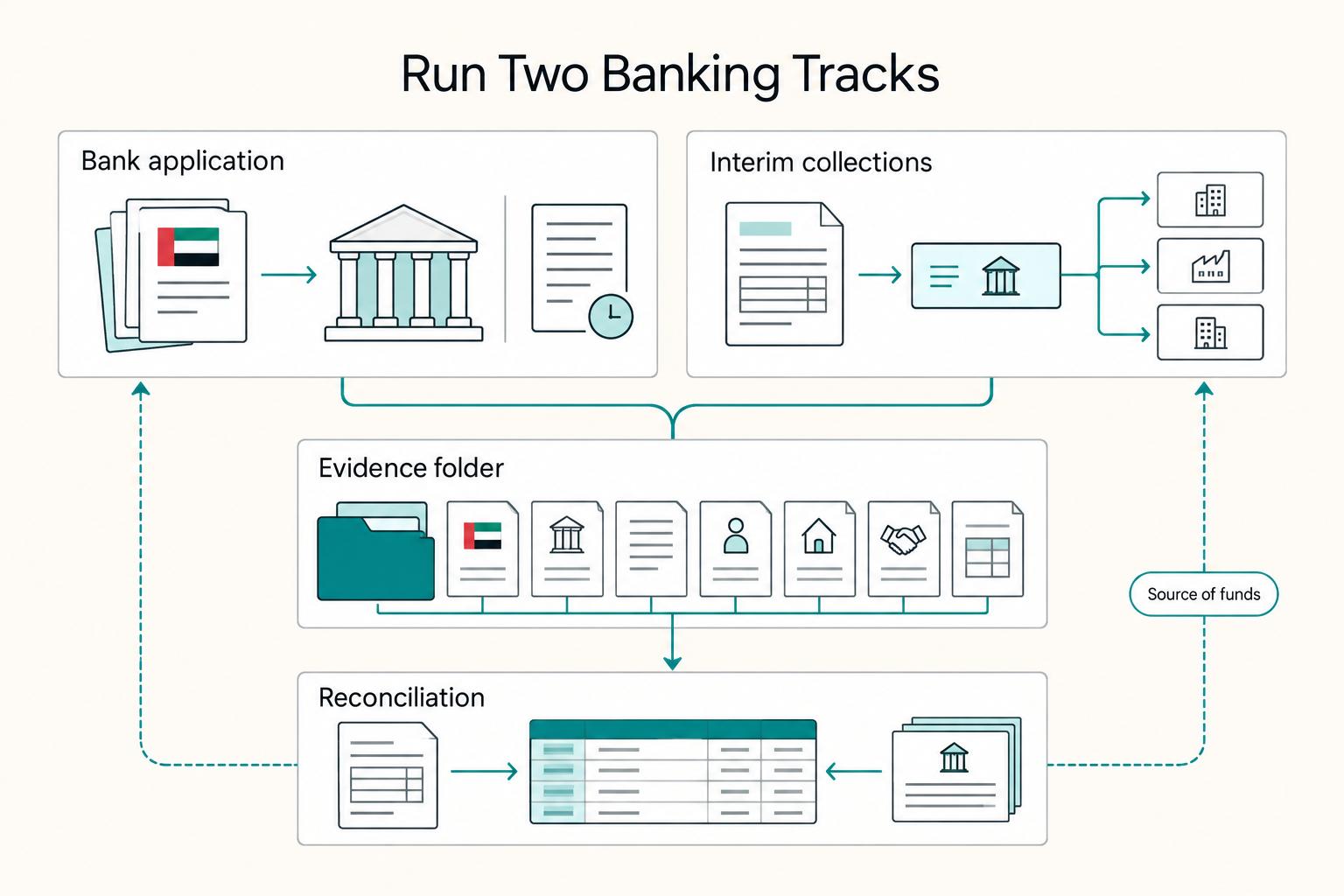
If your local account path is still uncertain, set up two lanes now: one for interim collections and one for local settlement once your business bank account is fully operational.
Keep receipts traceable while onboarding runs. A transfer marked sent may still be in transit, and cross-border transfers can incur intermediary fees or compliance review. Match the eventual booked receipt to the invoice and explain deductions.
Build both lanes before pressure hits#
Use lane one for interim receiving while your local banking application is pending or being reworked. Use lane two as your permanent settlement route once your business account is live for incoming client funds.
Keep those lanes separate in your records from day one. For each payment, log invoice ID, payment date, currency, expected amount, deductions, and the transfer into your permanent route. Poor invoice tracking creates cashflow blind spots and compliance issues later.
Use an interim route only when its provider accepts your applicant status and intended business receipts. Low volume or temporary use does not make an otherwise prohibited personal-account use acceptable. Preserve invoice, fee and transfer references from the first receipt.
Reduce friction at invoice level#
Make invoice instructions explicit: where to pay now, what currency to use, and which reference to include. If a predictable settlement currency is available for your route, use it consistently to reduce avoidable back-and-forth.
Use these controls on every invoice:
- show one receiving route, not multiple fallback options
- require the invoice number in the transfer reference
- ask for remittance confirmation when payment is initiated
That gives you visibility while funds move through multiple systems and may arrive later than expected.
Protect traceability when switching to the permanent route#
When you switch receiving accounts, reconcile each client receipt to its invoice, fees and any later transfer. Check that you have recorded the same cash once, rather than treating the transfer between your accounts as new revenue.
If you are evaluating Gruv for collections and payouts, confirm coverage, account ownership, permitted use and available export records for your setup before relying on it. Keep the invoice-to-receipt-to-payout trail in your own records.
Pick tools for reconciliation, not just speed#
Choose an interim route that preserves stable references, clear payout status, and exportable records you can tie back to invoices. Convenience without traceability usually creates more work when you move to your permanent setup.
If you plan to move into a UAE Free Zone company structure, optimize for reconciliation now. Keep payer names consistent with invoices, avoid mixing business inflows with unrelated personal transfers, and keep fee and payout records intact. For the next step, see Opening a Business Bank Account for a UAE Free Zone Company.
If onboarding is still pending, keep collections organized with the Free Invoice Generator so each client payment stays easier to trace and reconcile.
Operating checklist after account opening#
Treat account opening as the start of operations, not the finish line. Banks may run AML or KYC reviews and enhanced due diligence around onboarding and later reviews, so weak records can create friction later.
Run a regular internal review from a single tracking log so you can check activity, documents, and bank notices in one place.
| Check | What to review | Evidence to keep | Escalate if |
|---|---|---|---|
| Incoming payment pattern | Payer names, currencies, amounts, and references against invoices | Invoice, remittance confirmation, transfer reference, reconciliation note | Routine client payments start getting queried, delayed, or returned |
| Document consistency | Name spelling and entity details across passport, Emirates ID (if issued), permit, invoices, and bank profile | Latest copies of each document plus date of last bank update | A payment arrives under a different legal name and you cannot explain it quickly |
| Product or policy notices | Any email, app alert, or branch message affecting account usage | Screenshot or PDF of the notice and your follow-up question | The notice suggests the current product no longer fits how you receive freelance income |
| Status change review | Visa progress, Emirates ID issuance, address changes, and residency profile updates | Old and new status documents, case note, bank confirmation | You assume the bank profile is updated but have no written confirmation |
Keep client records aligned with account activity#
If multiple clients pay you, make sure every credit maps cleanly to a contract, invoice, and service description within your documented business scope. Do not wait for a review request to discover mismatches in payer names, invoice references, or payment descriptors.
Keep a compact evidence pack per active client. Include the signed contract or SOW, current invoices, payer legal name, and a short mismatch note when the sending account name differs from the invoiced party. A key failure point is paperwork that does not match statement activity.
Recheck your setup when your documents change#
Recheck your setup when status documents change, especially after Emirates ID issuance or visa updates. Do not assume the bank will automatically adjust records or product fit.
Ask in writing whether updated status changes onboarding records, whether fresh documents are required, and whether a face-to-face ID check is needed. Because requirements vary by bank and company type, keep this part of your checklist bank-specific and store each response in your tracking log.
Use repeated friction as a decision trigger#
Repeated friction can indicate the setup may not fit, not just a temporary inconvenience. If the same routine invoices keep triggering review questions, repeated document requests, or account-use notices that conflict with your real payment pattern, stop patching it case by case.
Escalate to a better-fit route. Where business activity is persistent, reassess whether those transactions should move through a corporate account that aligns more clearly with your operating structure.
Choose a route you can actually use#
Start with a product that accepts your applicant status, then confirm its permitted use, documents and full costs. A personal savings approval is useful only if it serves the purpose you applied for.
For example, an overseas designer with an established home-country business account can keep approved client receipts there while assessing a UAE personal savings product. If the designer later establishes a licensed UAE operation, that creates a separate business-banking application. Transferring personal savings and collecting invoices for the new business should not be treated as interchangeable uses.
When you are ready to turn this checklist into an operating workflow, contact Gruv to confirm market coverage and the right setup for your use case.
Frequently Asked Questions
Can a non-resident freelancer open a bank account in the UAE?
Certain UAE savings products accept non-resident applications. Approval remains bank-specific, and personal savings eligibility does not automatically permit recurring freelance business receipts. For a licensed operation, ask about the matching business-account route.
Do I need to be physically present in Dubai to open the account?
Do not assume the process is always remote or always in person. Banks require identity documents for KYC and AML compliance, and they may request additional documents. Confirm the exact onboarding process with your chosen bank before you plan around it.
Can I use a personal bank account for freelance business income?
Ask the bank whether your exact client-payment pattern is permitted under the proposed product and declared account purpose. Personal savings eligibility alone does not answer that question. A business product may be required for a licensed freelance operation or company.
What documents are usually requested for non-resident freelancers?
Follow the product-specific checklist. Expect passport and status or address evidence for an individual application; a business application also needs applicable licence, ownership and authorization documents. Banks can request additional evidence of your activity and source of funds.
If I do not yet have full UAE residency documents, what account options are realistic?
Start with products that explicitly accept non-resident savings applications, such as the options compared above. Minimums differ by product and package, so use the bank’s current key facts statement and applicable fee schedule. A relocation product requiring a UAE work visa is a separate route.
How should I choose between a bank account option and a multi-currency option for receiving client payments?
Start with the features you actually need, then match them to what the account really provides. Some non-resident account options are reported to have limited features, and multi-currency functionality may be limited or unavailable in some cases. Confirm eligibility, feature availability, and document requirements before choosing your main receiving route.
Try a related tool
Researched and edited by the Gruv editorial team. Gruv builds cross-border billing, payouts, and finance-operations software for global businesses.
Sources
Includes 6 external sources outside the trusted-domain allowlist.
- adcb.com/en/islamic/personal/accounts/savings-account...external
- centralbank.ae/media/nphlwxs5/guidance-for-lfis-on-digital-...external
- emiratesnbd.com/en/accounts/savings-and-deposits-account/sav...external
- emiratesnbd.com/en/help-and-support/documents-to-open-an-acc...external
- rulebook.centralbank.ae/en/rulebook/431-core-elements-customer-due-d...external
- wio.io/new-to-uaeexternal
Educational content only. Not legal, tax, or financial advice.
Related Posts
Opening a Business Bank Account for a UAE Free Zone Company
A usable company account supports client receipts, expenses and traceable records. Separate eligibility, approval and activation: a trade licence does not guarantee banking access, and an issued account number does not necessarily mean its balance is spendable.

The Freelance Payment Penalty: A Modeled Audit of Platform Fees, FX Spreads, and Payout Delays
The money rarely disappears through a single, easy-to-spot fee. The real loss is stacked. A marketplace takes its commission, a processor adds a charge for international cards, a bank or payment company converts the currency at a spread, a platform holds the funds before release, and a wire sheds a little to intermediaries on the way in. Each layer looks defensible on its own, but the worker feels the combined result as a smaller deposit and a later payday.

How to Respond to a Subpoena for Business Records
Move fast, but do not produce records on instinct. If you need to **respond to a subpoena for business records**, your immediate job is to control deadlines, preserve records, and make any later production defensible.