
Quick Answer
Start by treating freelance translator rates as non-comparable until each quote has a clear unit, scope, and date. Convert only when workload assumptions are explicit, such as the ProZ utilization logic that separates translating time from non-translation work. Then screen sources with one evidence check and keep weak inputs directional, not policy-setting. Approve expansion cohorts only when language pair, specialization, buyer channel, and conversion assumptions are all documented.
Why this article exists for operators, not freelancers#
This is a market entry piece for people building or expanding platforms that hire freelance translators and freelance interpreters. It is not a personal pricing guide for someone quoting their next job. Your job is different: you need enough signal to decide which language pairs, service lines, and sourcing channels are worth entering, without pretending the public data is cleaner than it is.
The goal is practical. You should leave with a decision-ready view of rates through three lenses that actually affect margin and rollout risk: language pair, specialization, and channel reliability. A legal translator sourced through an agency, a generalist found through a marketplace, and an interpreter working under hourly terms are not one market just because they all sit under "language services."
That distinction matters because many public benchmarks are useful only for rough direction. Older survey summaries can show how earnings are distributed across segments. But none of them, on their own, give you a clean answer by language pair, specialization, buyer channel, and pricing unit at the same time.
A good example is the often-cited ATA compensation survey summary. One referenced summary says "the average full-time freelancer makes a little over $60,000," and also notes a split of $72,000 for certified translators versus $53,000 for non-certified. Useful context, yes. But the same source explicitly warns that these figures "are not specific enough to individual situations," and even flags that "the dates here are a little confusing." For an operator, that is the point. Broad earnings data can shape your questions, but it should not become your payout policy.
What counts as usable evidence#
Before you trust any public rate signal, check for four basics:
| Check | What to capture | If missing |
|---|---|---|
| Pricing unit | Per word, hourly, or salary | Directional only |
| Worker type | Freelancers, employees, or both | Directional only |
| Language pair and specialization | Whether they are actually named | Directional only |
| Date, geography, buyer context | The date, geography, and buyer context behind the number | Directional only |
If one or more of those fields is missing, treat the benchmark as directional only. The common failure mode is blending unlike things into a single "market average." A cited BLS figure of about $38,000 in May 2008 for translators and interpreters may be real in its original context. The same goes for over $69,000 for the highest 10 percent. But those figures, by themselves, are not enough for current cross-border payout assumptions.
So the stance of this article is simple: use public numbers to narrow the search, not to fake precision. Your evidence pack should keep the source link, capture date, exact quote, stated segment, and what is missing. If the source cannot tell you who the buyer was, what work was included, or how the rate was expressed, do not build expansion math on it. Related: How to Price AI-Assisted Freelance Services. If you need a quick next step, browse Gruv tools.
Define pricing units before you compare countries or verticals#
Start here: per-word, hourly, and daily/monthly prices are not directly comparable. Treat each as a separate economic unit until you have enough inputs to normalize safely.
A per-word figure only maps cleanly to an hourly figure when you also know production speed and translation-time share. The ProZ rate calculator makes those required inputs explicit: yearly business-related costs, desired yearly personal income, and translation utilization rate. It also reminds you to include non-translation work in utilization, with a clear example: 6/8 = 75% translating time.
| Source type | Capture the unit as stated | What you need before normalizing | If missing |
|---|---|---|---|
| Upwork | Hourly, fixed price, or any output unit named in the post/profile | Scope, expected output, revision load, timing assumptions | Not decision-safe |
| Translation and Interpreting | The exact unit named in the article or guidance | Buyer context, service scope, language pair | Directional only |
| r/Upwork / Reddit | The unit the poster actually uses, not what you infer | Whether it is asked rate, won rate, or realized earnings | Not decision-safe |
| United Nations page | Record the compensation unit exactly as published | Contract terms and work expectations needed for comparison | Not decision-safe |
Use one checkpoint across all sources: if speed, utilization, costs, or workload assumptions are missing, do not force a normalized number. Mark it not decision-safe, keep the original unit in your evidence pack, and move on. We covered the same discipline in Freelance Crypto Payments That Protect Cashflow and Reduce Disputes.
Rank evidence quality before trusting any benchmark#
Not all rate evidence is decision-safe, and weak benchmarks can create false confidence in expansion plans.
Use evidence tiers and weight them differently#
Keep source types separate, then rank them by what they actually disclose.
| Source type | What it can do well | Main risk to assess | Confidence signal to record |
|---|---|---|---|
| Institutional publication | Useful macro context | Eurofound source is from 2018, so it is limited for current rate-setting | Publication year |
| Structured survey | Stronger benchmark input when sample and timing are explicit | Transferability risk if respondent mix is concentrated | Sample size, geography, publish/update dates |
| Editorial benchmark summary | Helpful orientation | Date labeling can be inconsistent and not specific to individual situations | Method/date clarity notes |
| Anecdotal community answer | Useful for hypotheses | Not statistically strong; page state can be unstable | Mark as anecdotal only |
Score every source with the same four checks#
Use one rubric for each benchmark candidate:
- Representativeness: who is in the sample, and who is missing?
- Geographic transferability: does the respondent mix fit your target market?
- Methodology transparency: are sample, dates, and scope explicit?
- Recency: are publication and underlying data dates clear?
The Inbox Translation survey is stronger because it reports 2,803 respondents across 107 countries, with publish/update dates of 8 December 2023 and 11 December 2023. But it still needs transferability caution because 34% of respondents are UK-based. By contrast, the ATA-related summary explicitly flags date confusion and references tables marked 2006, which should lower confidence for current pricing decisions.
Pause when anecdote is carrying the decision#
If two high-impact markets are supported mostly by anecdotal signals, pause expansion and collect primary data before committing payout or launch assumptions. Use anecdotal inputs to generate questions, not to set benchmarks.
For a step-by-step walkthrough, see Freelance Client Retention: Weekly Systems for Repeat Work and Long-Term Relationships.
Compare language pair and specialization without pretending to know more than the data#
Treat this section as a decision filter, not a leaderboard: if you cannot name the language pair, specialization, buyer channel, pricing unit, and evidence quality in one row, the signal is directional only.
| Language pair | Specialization | Buyer channel | Pricing unit | Confidence tier | Decision note |
|---|---|---|---|---|---|
| Not disclosed | Unclear | Public marketplace or anecdotal post | Often unclear or mixed | Low | Discovery only; not decision-safe |
| Not disclosed | Unclear | Editorial or survey summary | Annual income / broad earnings | Low for pricing | Context only; do not set payouts from this |
| Named | Named | Direct quotes or supplier outreach | Comparable unit (for example per word or hourly) | Medium | Pilot candidate if scope/date/sample notes are documented |
| Any missing key field | Any missing key field | Any | Any | Low | Mark as unknown until completed |
Treat specialization as scope risk, not assumed premium#
ProZ states rates depend on multiple operating factors and explicitly says to include non-translation activities when estimating productive time. So if a benchmark does not show scope details, such as research, formatting, revisions, or QA expectations, treat it as incomplete before you compare rates. The Training for Translators source also warns benchmark surveys may not fit individual situations, so broad income figures are context, not pair-level pricing rules.
Prioritize executable cohorts, not just high visible numbers#
Broader language coverage can expand supply, but it can also raise screening and QA complexity for agencies and platforms. Use a simple gate: keep cohorts where pair, specialization, unit, timing, and scope are documented; mark the rest as unknown instead of forcing precision. That discipline is usually more reliable than chasing the highest visible rate in thin evidence.
If you want a deeper dive, read Raising Your Rates: How to Do It Without Losing Clients.
Treat Machine Translation Post-Editing as a separate market lane#
Treat Machine Translation Post-Editing (MTPE) as a separate service lane if quality risk, payout policy, and dispute handling matter in your rollout. Do not merge it into the same rate card or acceptance standard as full human translation just because both produce translated output.
MTPE is a distinct commercial model built on post-editing machine output, with different pricing dynamics from full human translation. The evidence base is still limited, but it does support two operational signals: MTPE is an important part of commercial translation, and pricing design can affect translator motivation and recruitment. That means payout design can change supply behavior, not just margins.
Use Reddit for hypotheses, not policy#
Community discussion channels such as Reddit can help you spot hypotheses to test. They are not enough for final pricing policy when scope, unit, edit depth, QA target, and revision burden are not clearly comparable.
Use a hard filter: if a community signal is not tied to a named scope, pricing unit, and quality target, keep it in discovery only. Do not use it to set production payouts, margin assumptions, or launch sequencing.
Keep QA and payout rules separate#
If QA expectations are strict, do not run one blended compensation policy for MTPE and full human translation. In practice, blended policies either underpay rewrite-heavy work or tolerate lower output quality because the task was priced as if post-editing were always light-touch.
A useful frame here is Cost of Poor Quality (COPQ): translation quality requires investment. When machine output quality is uneven, blended policies can push costs into rework, reviewer time, credits, disputes, and supplier churn instead of removing them.
For launch design, keep the controls separate:
- Define task type (light post-editing, full post-editing, or rewrite-level work).
- Use a distinct QA rubric with clear pass/fail and revision ownership.
- Review sample jobs by language pair and domain before scaling.
Decision rule: if buyer QA standards are high and dispute cost is high, launch human-only first. Add MTPE later with separate pricing, acceptance criteria, and performance tracking.
Choose buyer channel strategy before setting payout and margin assumptions#
Set channel strategy before you set payout floors or margin targets. After you split MTPE from human translation, the next decision is where demand comes from, because economics change by channel.
The basic distinction is straightforward: you can run as a direct specialist freelancer or as a small agency model that manages translators and reviewers. Both can work, but the right choice depends on your constraints and scaling approach.
| Buyer channel | Commercial shape | First validation check |
|---|---|---|
| Direct client demand | You sell your own service directly | Verify contract terms, approval flow, and quality sign-off expectations before locking pricing |
| Agency-led demand | You deliver into another layer that manages parts of workflow | Confirm revision ownership, acceptance criteria, and dispute path before assuming margin |
| Open marketplace demand (such as Upwork) | Outcomes depend heavily on proposal conversion and positioning | Treat conversion as uncertain until you have your own data, and independently verify platform and contract terms |
For marketplace-led acquisition, do not build assumptions from headline rates alone. One proposal guide explicitly says win rates can vary widely with proposal quality, relationship strength, pricing strategy, and positioning, and it also warns that pricing and contract terms should be independently verified before use.
Finance targets can still help as planning inputs. One KPI article cites goals such as gross margin above 75% and a starting 2026 CAC figure of $150, but those numbers should be treated as prompts, not universal norms. Practical rule: choose channel first, then test your own acquisition cost, revision load, and dispute burden against margin reality. This pairs well with our guide on Freelance Finance Automation With Zapier and Stripe Controls.
Pressure-test country rollout constraints that SERP pages skip#
A country is not launch-ready just because rate signals look strong. If payout execution, tax artifacts, or compliance gates are unclear, defer launch and keep that market in research mode.
Even with a strong channel opportunity, margin can still break down when onboarding is messy, settlement is unreliable, or tax documentation is handled late.
| Readiness area | What to verify before launch | Red flag |
|---|---|---|
| Payout coverage | Confirm you can pay the target country through your chosen provider for the needed currency and recipient type, using a live test. | Coverage looks available, but the required payout method or entity type is not supported in practice. |
| Onboarding friction | Map steps, required fields, and review holds for new payees, including individuals and companies if both are in scope. | Approval depends on repeated manual follow-up, repeated document requests, or review queues you did not model. |
| Tax documentation | Define which forms or certifications may be needed by market and payee type, and who owns collection, storage, and refresh. | The plan is to request forms later only if issues appear. |
| Settlement reliability | Test first-payment success, exception handling, and settlement consistency on a small batch. | Initial payout succeeds, but retry and rejection handling has no clear owner. |
For compliance gates, treat KYC, KYB, AML, and VAT validation as explicit launch checks, not assumptions pulled from generic SERP summaries. Readiness should be documented operationally: who is verified, by whom, with which documents, and when in the payout flow.
Apply the same standard to W-8, W-9, Form 1099, and FBAR. This section's grounding does not support universal filing rules for those items, so keep them as verification points in your country evidence pack rather than fixed assumptions.
FEIE is the one tax-planning area here with grounded detail. The IRS states you may qualify for the Foreign Earned Income Exclusion only if specific requirements are met, including that your tax home must be in a foreign country. Under the physical presence test, a person must be physically present in a foreign country or countries for 330 full days during any period of 12 consecutive months, and those days do not have to be consecutive. The test is based on time abroad, not intent to return to the U.S.
FEIE also does not remove U.S. filing obligations; the income is still reported on a U.S. return. If qualification covers only part of the year, the maximum exclusion must be adjusted by qualifying days. IRS figures listed here are $130,000 for tax year 2025 and $132,900 for tax year 2026 per qualifying person, so using one flat exclusion amount in a country model can misstate readiness.
You might also find this useful: The 'Freelancer's Dilemma': Hourly vs. Value-Based Pricing.
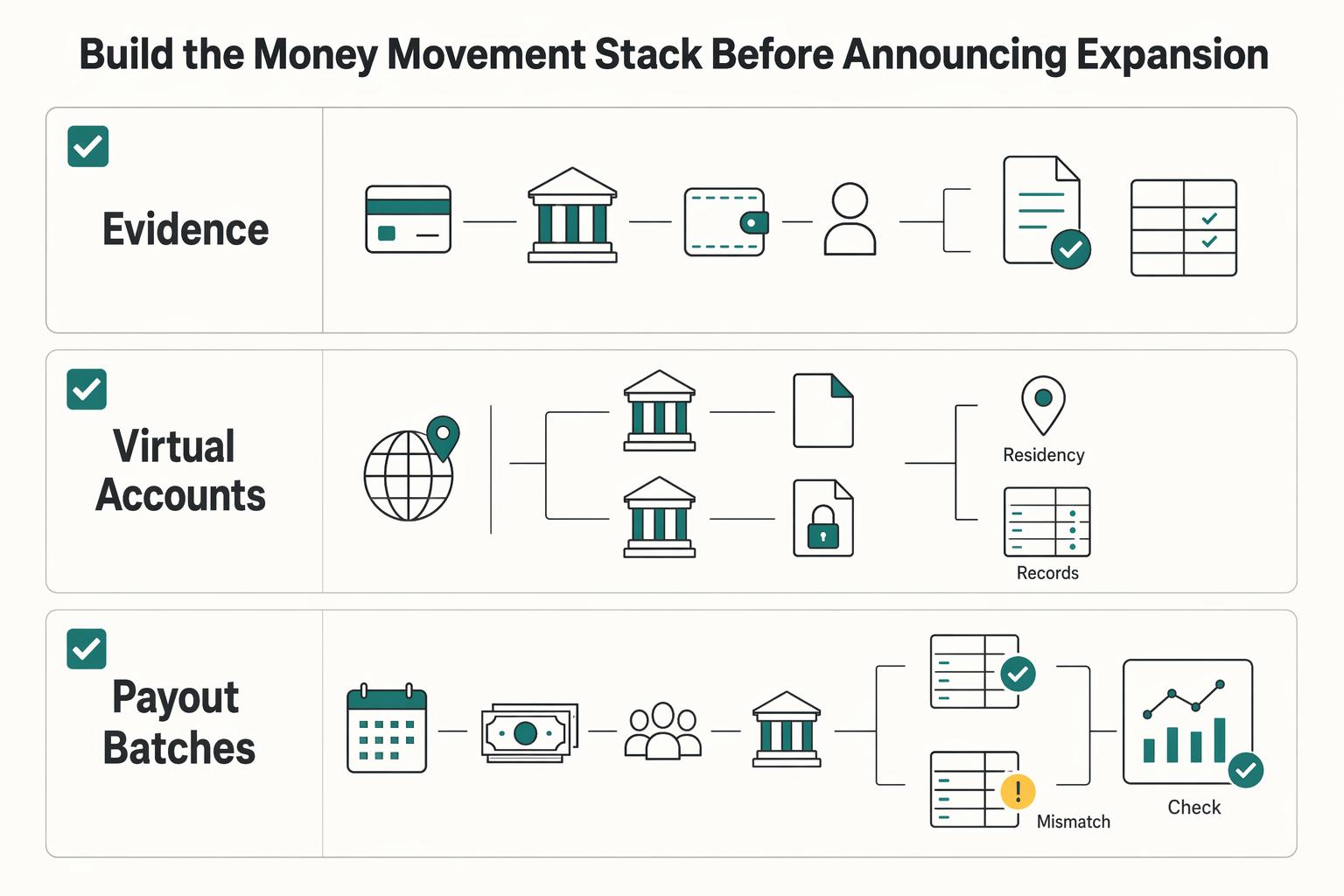
Build the money movement stack before announcing expansion#
Do not announce a new market until you can show, on one page, how money moves from buyer payment to translator payout and how exceptions are handled. If Finance and Ops cannot trace a transaction end to end without manual reconstruction, treat the market as pre-launch research.
| Stack element | What to map |
|---|---|
| Merchant of Record | Where responsibility sits, if used |
| Virtual Accounts | How incoming funds are matched to a customer, invoice, or contract, if used |
| Payout Batches | How a payee moves from approved to payable to paid, and who can hold or release a batch |
Map the operating model you plan to run, not the one in your GTM narrative. Then define the verification path with named owners: event/status updates (for example via webhooks or another event feed), durable finance records (for example in ledger journals or your finance system), and reconciliation checkpoints across product, payments, and accounting.
Watch the same failure modes every time:
- unmatched deposits caused by missing or inconsistent reference data
- payout holds that age into payables and support burden
- retry/idempotency gaps that create duplicate events or unclear payout state
Your launch artifact should be an evidence pack, not a slide: flow map, event list, reconciliation owner, exception-queue owner, and sample records for one clean payment and one failed payout. Related reading: Germany Freelance Visa Application Path for Freiberufler and Gewerbe.
What to do next before committing budget#
Use a two-step gate before you commit budget: approve a market only when the rate evidence is comparable and the market is operationally executable. Keep pricing-model tradeoffs visible while you do that.
| Pricing model | What the article says |
|---|---|
| Per-word | Easy to quote but may miss research, editing, and complexity |
| Hourly | Can fit flexible, ongoing work but may create time-tracking friction |
| Retainer | Provides fixed monthly payments for continuous work |
First, gate on data quality. Treat markets as comparable only when each rate has a clear pricing unit, source date, and normalization assumption; if any assumption is missing, mark that input as not decision-safe instead of forcing it into the forecast.
Second, gate on execution readiness. Run a light end-to-end test from onboarding to payout and confirm the records reconcile without manual patching; if they do not, keep the market in research status.
Publish a short internal memo with three attached artifacts:
- Normalized rate table by language pair, specialization, buyer channel, pricing unit, and conversion logic.
- Evidence confidence table showing which inputs are stronger and which remain weak.
- Country readiness checklist showing whether onboarding and payout steps are understood well enough to execute.
One source states there are several ways to charge for freelance work, and that model choice depends on industry, experience, and project type. Use the same distinctions in the table above when you write the memo.
Do not ignore overhead in budget assumptions. One published model (dated December 26, 2025) estimated fixed monthly costs around $11,700 (including $4,200 non-labor and $7,500 for an initial lead role), and modeled freelance translator payments as the largest variable cost at 220% of revenue in Year 1. Use this as an illustrative input, not a universal benchmark.
Before locking GTM timelines, do a light-touch commercial check with sales on near-term coverage by market and program, and keep any uncovered market as research-only.
Need the full breakdown? Read Freelance Sales Qualifying That Protects Your Time and Pipeline.
Frequently Asked Questions
What do freelance translators charge across hourly, per word, and daily or monthly models?
There are no defensible public ranges for any of those units, so do not treat one unit as directly comparable to another without clear assumptions. The useful move is to normalize each quote back to output and time: estimate words per hour and the translator's required hourly rate, then map that to hourly, daily, or weekly income needs. If those assumptions are missing, treat the quote as directional only.
Is there one average rate we can use for market entry planning?
No. The American Translators Association is explicit that there is no single right answer, and the cited guidance frames pricing as context dependent, including geography, living situation, experience, and specialization. For planning, segment assumptions by context and label weak inputs as low confidence instead of forcing one average.
Which is more reliable for expansion decisions: Upwork benchmarks, Reddit posts, or institutional pay frameworks?
Use public and community benchmarks as hypothesis inputs, then verify before committing budgets. At minimum, keep the source date, pricing unit, and workload assumption visible for each rate you use.
When should MTPE be priced and operated separately from full human translation?
Treat MTPE and full human translation as distinct scenarios unless you have documented assumptions that justify handling them together.
How should we compare language pairs when data quality differs by market?
Compare them only after normalizing units and tagging confidence. A per-word quote for one pair and an hourly anecdote for another are not decision-grade equivalents on their own. If a target market depends mostly on sparse anecdotal data, collect more direct quotes before setting margin assumptions.
What minimum compliance and tax checks should be in place before cross-border payouts?
Avoid treating one market's process as globally sufficient. Before launch, document required payee onboarding evidence, required tax details, and exception ownership for missing or inconsistent data. Then test the flow end to end with one payee before scaling.
Try a related tool
Researched and edited by the Gruv editorial team. Gruv builds cross-border billing, payouts, and finance-operations software for global businesses.
Sources
Includes 1 external source outside the trusted-domain allowlist.
- academia.edu/36653621/Industrial_relations_and_creative_w...trusted
- hci.princeton.edu/wp-content/uploads/sites/459/2025/05/2406.10...trusted
- irs.gov/individuals/international-taxpayers/figuring...trusted
- irs.gov/individuals/international-taxpayers/foreign-...trusted
- pure.port.ac.uk/ws/portalfiles/portal/82792611/In_search_of_...trusted
- reports-archive.adm.cs.cmu.edu/anon/s3d2025/CMU-S3D-25-117.pdftrusted
- wise.com/gb/blog/how-to-set-freelance-rates-and-negot...trusted
- askamanager.org/2026/03/ask-the-readers-what-do-i-need-to-kn...external
Educational content only. Not legal, tax, or financial advice.
Related Posts

Raising Your Rates: How to Do It Without Losing Clients
Before finalizing execution decisions, validate wording against guidance from [pon.harvard.edu](https://www.pon.harvard.edu/daily/negotiation-skills-daily/principled-negotiation-focus-interests-create-value/), [law.cornell.edu](https://www.law.cornell.edu/wex/mutual_assent), [hbr.org](https://hbr.org/2021/06/if-youre-going-to-raise-prices-tell-customers-why).

How to Price AI-Assisted Freelance Services
Protect cashflow first, then optimize upside. Late-payment risk rises when scope is unclear, approval ownership is loose, and payment terms are left until late in the process.
The 'Freelancer's Dilemma': Hourly vs. Value-Based Pricing
If you run a business of one, stop asking which pricing model is better in the abstract. Ask which [risk your business is taking on](https://njsba.com/wp-content/uploads/2023/07/WP-Time-vs-Value-Billing-Shifting-the-Risk2.pdf) for this project. The **hourly vs value-based pricing** debate becomes useful only when you frame it that way. Are you buying flexibility because the work is still uncertain, or trading that flexibility for a more predictable fee tied to a defined result?