
Quick Answer
Prioritize route resilience before unit price whenever payout volume is concentrated in a single corridor. Build one operating scorecard covering continuity risk, compliance effort, settlement predictability, and escalation ownership, then refresh assumptions monthly as paths and line limits shift. Treat unclear status trails as an operations warning, not a customer-data issue, and require request-to-outcome traceability before you scale traffic.
Why this is getting harder now and what platform teams can do about it#
If your product depends on cross-border payouts, this is an infrastructure and continuity problem first. The useful question is not the macro story; it is whether your payout routes stay usable under compliance controls and operational pressure.
Correspondent banking is the bank-to-bank access used to move payments when two institutions do not hold accounts with each other directly. CRS describes the basic pattern: when Bank A and Bank C cannot settle directly, they use an intermediary Bank B. That may sound like back-office plumbing, but it becomes an operational issue when one link gets slower, more restrictive, or harder to run reliably.
The planning lens for 2026#
For 2026 planning, focus on reliability, compliance burden, and payout continuity. Demand is not disappearing. CRS cites estimates of global cross-border payments growing from almost $150 trillion in 2017 to over $250 trillion by 2027. But higher demand does not guarantee stable operations on every route.
So this article stays operator-first: payout continuity, settlement predictability, exception handling, and evidence quality. The practical question is not only "Can we launch this market?" It is also "Can we keep it live when conditions change?"
Start with an honest view of uncertainty#
Public reporting can show trends, but it does not give you a complete, live, route-by-route view for every payout path.
Do not plan from commentary alone. Validate what is true in your own stack for each material corridor: provider path, recent settlement behavior, return or rejection visibility, and a clear escalation contact when a payout stalls.
One failure mode is ambiguity, not a full shutdown. Status can turn vague, timelines can widen, and returns can be hard to interpret. If your team cannot reconstruct path and status history without manual, vendor-by-vendor digging, you have an operational blind spot.
What you should leave with#
By the end of this piece, you should have three usable outputs: decision checkpoints, an evidence checklist, and escalation steps to protect continuity. The goal is to turn banking-chain risk into concrete product, finance, ops, and engineering actions before a corridor disruption reaches production.
If you want a deeper dive, read Global Payouts and Emerging Markets: 5 Regions Every Platform Should Prioritize.
What correspondent banking and de-risking actually mean in platform operations#
For platform teams, this sits inside core payout infrastructure. Correspondent banking is the bank-to-bank access that enables many cross-border payments, and de-risking is when that access is restricted or withdrawn across broad client categories instead of managed case by case.
Correspondent banking means formal relationships where banks provide payment services for each other. When your payout bank and the beneficiary bank do not hold accounts with each other, an intermediary bank may sit in the chain. In practice, each added link is another dependency in the payment path.
De-risking is often used broadly, but Treasury defines it more specifically as indiscriminate restriction or termination across broad categories, rather than a risk-based AML/CFT approach. That distinction matters operationally. A targeted compliance review is one problem. Loss of an entire relationship class or reduced line limits is a harder continuity problem.
In platform terms, reduced correspondent coverage can mean less continuity when issues appear and fewer practical backup routes. IFC also notes a concrete failure mode here: line-limit reductions and limited alternatives can reduce a bank's ability to serve customers.
This is not only a sanctions narrative. The evidence also points to AML/CFT obligations and the cost of meeting them. IFC reports that compliance requirements and related costs were difficult for participants to absorb, which helps explain why access can tighten even as cross-border demand grows.
Your users feel this at the edge when payout continuity weakens and remittance flows face more friction. A simple checkpoint is whether your provider can show the payment path and status history. If they cannot, you are operating on trust instead of evidence.
Related: Correspondent Banking Explained: Why Your International Wire is So Slow and Expensive.
Why access is tightening even when demand for payouts keeps growing#
Access is tightening because correspondent banks assess AML/CFT risk alongside other operating considerations. Where governance and illicit-financing controls are weaker, relationships are more likely to be restricted or terminated.
The pressure stack is risk plus economics#
BIS reports that correspondent banks have been paring back relationships for the past decade, with cross-border correspondent relationships down by about one fifth. BIS also says the retreat is uneven: jurisdictions with weaker governance and deficient controls to prevent illicit financing have lost more relationships.
For operators, this can show up as tighter conditions before full exits. A route can remain technically open while becoming harder to run reliably.
Public evidence supports a multi-cause explanation#
The World Bank analysis does not frame de-risking as a single-cause event. Its eight country case studies include a diagnostic on causes to terminate or restrict correspondent banking relationships, which supports a bundled risk-and-economics view rather than a one-variable story.
The downstream impact is real. Research on correspondent access shocks finds that when local banks lose correspondent services, their corporate clients, especially SMEs, face significant export declines, and those losses are only partly offset by domestic sales.
Treat access as route-level, not uniform#
Do not assume one global pattern. BIS is explicit that the retreat is broad-based but affects some countries more than others.
That makes corridor review a practical operating habit, not a theoretical exercise. Ask your provider for the active payment path, recent intermediary changes, and clear coded reasons for holds or rejections. If they cannot separate screening friction from relationship withdrawal, your fallback planning and pricing become guesswork.
For a step-by-step walkthrough, see How Intermediary and Correspondent Banks Change Payout Outcomes.
Where correspondent strain appears first in your payout funnel#
The fastest way to diagnose strain is to find where traceability weakens, not just the last error message.
Start with documented compliance outcomes, then test route health#
Start with explicit compliance evidence. If your provider can show a clear AML/CFT-based rejection, treat it as a compliance or data case. If the record is vague and the payment trail later weakens, keep route stress in scope.
Expect pressure between initiation and final settlement#
Pressure can appear after initiation and before final settlement. Correspondent relationships are used for cross-border transfer flow and can also support foreign-exchange settlement, and some payments require an intermediary bank when endpoint banks do not hold accounts with each other. That is why a payout can look fine at initiation and still fail before final settlement if access to correspondent routes tightens.
De-risking is concrete here, not abstract: documented failure modes include withdrawal of correspondent relationships and closure of money transfer operator bank accounts. Anchor your diagnosis to documented artifacts, such as relationship-withdrawal records, account-closure records, and trend/survey evidence over time.
Use return handling as a verification stage#
Returns can expose stress that was not visible earlier. Before you ask users to change beneficiary details, capture and compare:
- provider references at each recorded handoff
- full status transitions with timestamps
- settlement and reconciliation timing
- final reject or return text exactly as received
If the block is clearly documented as a compliance outcome, treat it as compliance or data. If the trail weakens after initiation and before settlement, investigate route availability first.
How to pick corridor strategy when data is incomplete#
When route risk is plausible and corridor data is incomplete, bias toward continuity first and price second in any corridor tied to concentrated revenue.
Use a single corridor scorecard so assumptions stay explicit and decisions stay consistent. Prioritize the stress signals you can verify in operations: fewer active correspondent relationships, reduced line limits, and limited alternatives.
| Corridor | Continuity risk | Compliance effort | Unit cost | Settlement predictability | Escalation path |
|---|---|---|---|---|---|
| Corridor A | High / Medium / Low | High / Medium / Low | High / Medium / Low | High / Medium / Low | Named owner, provider contact, treasury/compliance escalation, fallback trigger |
| Corridor B | High / Medium / Low | High / Medium / Low | High / Medium / Low | High / Medium / Low | Named owner, provider contact, treasury/compliance escalation, fallback trigger |
| Corridor C | High / Medium / Low | High / Medium / Low | High / Medium / Low | High / Medium / Low | Named owner, provider contact, treasury/compliance escalation, fallback trigger |
If volatility is high and revenue concentration is high, optimize for fallback depth and execution continuity before negotiating unit price.
If AML/CFT screening and compliance burden materially rises, tighten customer eligibility and documentation gates before scaling volume. Keep this risk-based and targeted, not a blanket restriction across broad client categories.
Treat external research as directional, not corridor-precise routing data. The World Bank and IFC evidence supports that access and compliance pressure can tighten, but it does not rank your exact country pair.
Label unknowns directly in the scorecard as assumptions, then review them on a fixed internal cadence (for example, monthly). At minimum, recheck partner coverage, line limits, settlement predictability, and whether your escalation path actually resolved recent issues.
This pairs well with our guide on Banking Partnerships for Fintech Platforms: How to Choose Between BaaS and MoR.
What evidence correspondent partners expect before they trust your flows#
When a correspondent partner questions your flow, trust is rebuilt with evidence quality, not more volume. Your pack should show who is transacting, why the payment exists, how AML/CFT controls were applied, and how exceptions were handled.
Under de-risking pressure, partners are expected to manage risk in a targeted way, and they often ask for similar data in different formats. Build a strong core set once, then adapt the packaging to each partner request.
Build the minimum pack first#
Start with a minimum pack that is current, consistent, and export-ready, then tailor it by partner:
| Pack item | What it should show |
|---|---|
| Customer identity/KYC records | Who is transacting |
| Transaction purpose data | Why the payment exists; consistent labels by use case |
| AML/CFT controls summary | How AML/CFT controls were applied |
| Exception and escalation records | How exceptions were handled |
Consistency is the real operating test. If onboarding, transaction purpose labels, and payment records describe the same flow in different ways, your credibility drops even if the documents exist.
Operational proof makes the pack credible#
Policy text alone is not enough. Partners may ask for operational proof, such as alert handling records, case documentation, and escalation history.
If a partner uses a structured KYC intake format, your system does not need to mirror it exactly. It does need to map quickly without manual reconstruction. A practical test is whether your team can pull one closed case and clearly show the trigger, reviewer decision, and supporting data.
Traceability also matters in payment data. Including stable identifiers such as an LEI in payment messaging can improve payment traceability during partner review.
Set ownership before the first escalation#
Set ownership by function before pressure hits:
- Compliance can own policy and control standards
- Operations can own exception handling and closure records
- Engineering can own traceability and status history
Use this as a checkpoint in normal operations: your team should be able to explain a rejected or returned payout from request to final status with minimal cross-team reconstruction. If that chain is broken, relationship risk rises, including potential loss of access to international payments clearing.
Related reading: Open Banking for Platforms: How to Use Account-to-Account Payments to Bypass Card Fees.
How to design routing and retries so outages do not become incidents#
Treat routing and retries as formal controls, not ad hoc ops decisions. In higher-risk corridors, that can keep a transient delivery issue from turning into a duplicate-payment or customer-impact incident.
The model is straightforward: maintain an explicit routing table, separate retry assurance from duplicate suppression, and define when automation should hand control to humans.
Keep a routing table that people can actually operate#
A routing table only helps if people can use it under pressure. Use a corridor routing table as a controlled routing artifact, similar to a forwarding table. For each corridor, define the primary rail, secondary rail, fallback criteria, retry policy, and customer-facing status state.
That table should sit inside a formal control structure: clear owner, reviewable changes, and visibility across compliance, ops, and engineering. Control rigor should match corridor complexity and risk exposure.
| Corridor | Primary rail | Secondary rail | Fallback criteria | Retry policy | Customer-facing status |
|---|---|---|---|---|---|
<corridor> | <primary route> | <secondary route> | <defined degradation signal> | <timer policy for non-terminal states> | <healthy/degraded status> |
A useful checkpoint is whether you can explain, for any payout in a degraded corridor, which routing version was active, why it was selected, and whether fallback was automatic or manually approved.
Retries need delivery assurance and duplicate suppression#
Retries should improve delivery assurance, but they must never create a second payout intent. Timer-based retries and duplicate suppression solve different problems, and you need both.
Design for known delivery behaviors: delayed acknowledgments, broken links, discarded messages, and reordered delivery. If a retry sends a new intent instead of replaying the same immutable intent under suppression rules, you have turned a reliability issue into a money-movement issue.
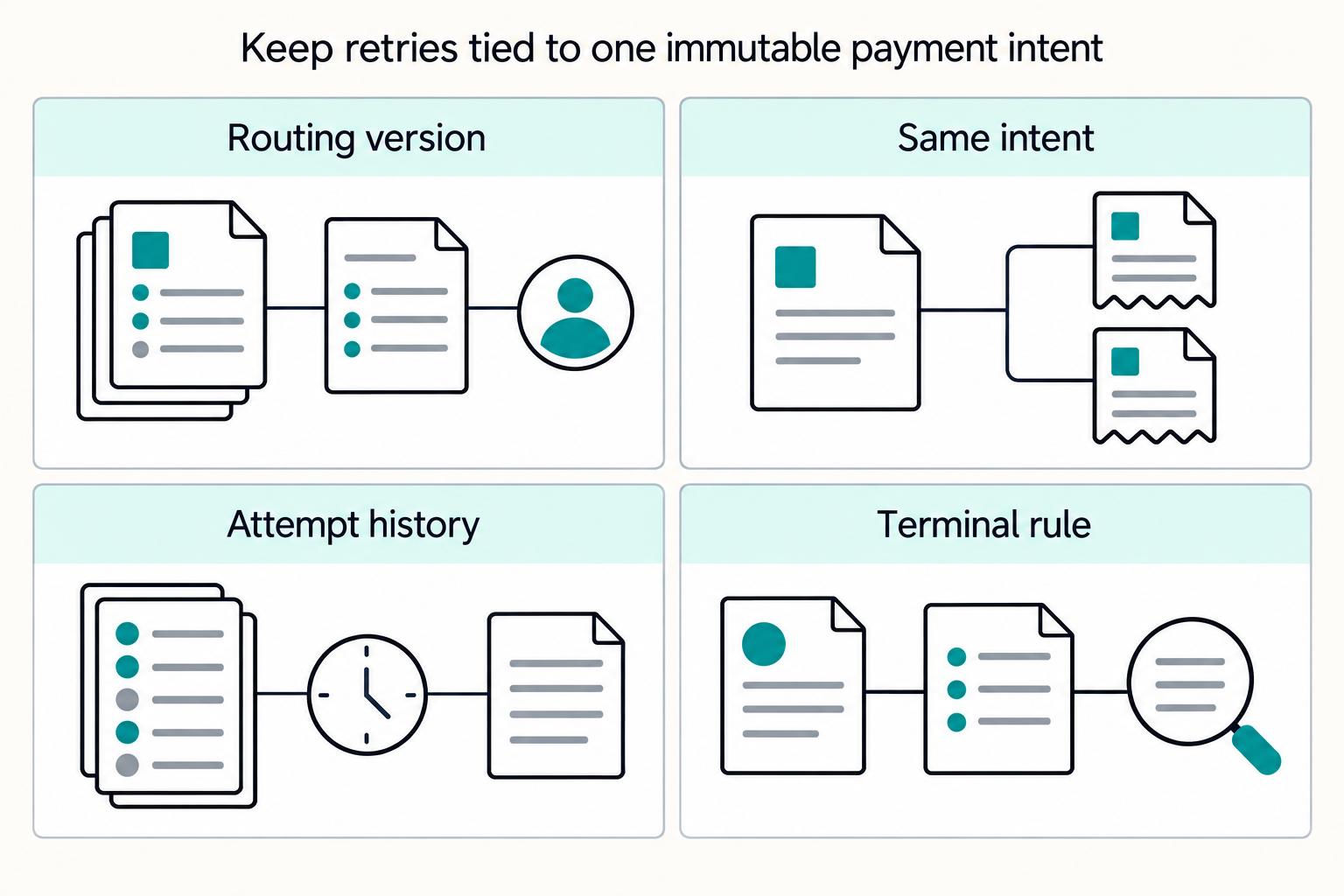
Your retry gate should enforce:
- one immutable payout intent ID across route changes and retries
- one attempt history with timestamps and state transitions
- one terminal-state rule that blocks replay after a final outcome
Shift early when a corridor degrades#
Define internal corridor-level degradation criteria in advance, then act on them consistently. When signals meet those criteria, shift eligible traffic to fallback and route higher-risk new payouts to review.
Do not use one global rule for every corridor. Controls should be commensurate with each corridor's routing depth, business complexity, and risk exposure.
Classify failure modes before you automate them#
The safest retry logic starts with classification. Do not treat every failed payout as "retry later." Separate failure behavior first so handling is predictable and auditable.
At minimum, distinguish between transient delivery behavior, terminal outcomes, and unclear states:
- delayed or missing acknowledgment
- broken-link or route-unavailable behavior
- discarded or overflow-like delivery failure
- reordered status or message sequence
- confirmed terminal outcome
This keeps retries safe, fallback decisions consistent, and customer status messaging aligned with what actually happened.
If you are operationalizing fallback criteria and safe replays, map your design to compliance-gated, idempotent payout execution in Gruv Payouts.
Early warning signs your corridor is degrading#
Do not wait for a hard outage. In cross-border payments, issues often appear first as more friction around data, documentation, and exceptions before delivery performance clearly breaks.
Watch the data burden first#
Start with required payment data and interoperability requirements. The FSB data-framework lens is useful because these frameworks define how data is collected and managed, what data must accompany a payment, and which standards support interoperability.
Use a corridor-level change log for required fields, format changes, reject reasons, and new documentation requested by intermediaries or partners. If similar payments start failing on newly required data or standards mismatches, treat that as a corridor warning worth investigating.
Treat internal friction as smoke, not proof#
Internal friction signals can be useful review triggers, not standalone proof of degradation. Items like rising investigation tickets, wider settlement timing spread, or more manual touches should be treated as hypotheses to test, not validated leading indicators.
Use those triggers to start a structured check across provider ops, compliance, reconciliation, and support. That cross-layer check matters because challenge signals surface differently by stakeholder layer. The MAS framing of commercial-bank challenges versus end-user challenges is a practical reminder that customer-visible friction can originate upstream.
Policy friction can signal cost pressure#
Rising compliance effort can be an early warning to take seriously. The IFC survey is directionally useful because it examines the relationship between increasing compliance costs and correspondent de-risking.
Treat repeated documentation pressure as a prompt for deeper review, not proof of structural corridor risk. External commentary can help you prioritize review, but your decision should rely on your own corridor evidence.
The first 30 days after a correspondent disruption#
In the first month, run the disruption as a capacity-and-risk event, not just a routing incident: stabilize what you can verify, then scale only what you can defend. Correspondent stress can include fewer active relationships, reduced line limits, and limited alternatives, which can make early recovery signals harder to interpret. Use the day ranges below as an operating framework, not a universally validated sequence.
| Day range | Focus | Grounded actions |
|---|---|---|
| Day 1 to 3 | Contain uncertainty first | Segment exposure by corridor, customer tier, and payout type; decide where to pause or cap higher-risk payout paths; build a corridor fact pack |
| Day 4 to 10 | Controlled fallback and tighter controls | Use controlled fallback routing for corridors and cohorts you can monitor closely; tighten AML/CFT controls where the disruption changes your risk posture; re-check KYC/KYB assumptions for higher-risk segments before restoring prior limits |
| Day 11 to 20 | Confirm usable capacity | Confirm active route coverage, line-limit constraints, cut-off behavior, and whether alternatives are durable or only exception-based; rebalance treasury and FX to the replacement path; reset service commitments using verified throughput across real payment cycles |
| Day 21 to 30 | Post-incident review and named controls | Separate correspondent constraints from internal compliance gaps and avoidable execution failures such as statusing, escalation, and exception handling; convert lessons into named controls |
Day 1 to 3#
Contain uncertainty first. Segment exposure by corridor, customer tier, and payout type, then decide where to pause or cap higher-risk payout paths and how to communicate customer impact.
Build a corridor fact pack before you make broad routing changes: what is rejected, what is delayed, what is stuck, and whether the pattern looks like route loss, line-limit pressure, or a compliance hold. Avoid both extremes: blanket freezes across unaffected flows, and open high-risk flows without current acceptance clarity.
Day 4 to 10#
Use controlled fallback routing for the corridors and cohorts you can monitor closely, and tighten AML/CFT controls where the disruption changes your risk posture. If flows move to new counterparties, re-check KYC/KYB assumptions for higher-risk segments before restoring prior limits.
Treat this phase as an operations-cost decision, not only a delivery decision. IFC findings indicate compliance and correspondent-banking difficulties are reported more often than pricing, FX, credit, macro, or reserve pressures, and related costs are difficult for banks to absorb. If fallback depends on heavy manual handling, throttle early instead of letting exception queues become the next failure point.
Day 11 to 20#
Do not confuse nominal availability with usable capacity. Confirm active route coverage, line-limit constraints, cut-off behavior, and whether alternatives are durable or only exception-based.
Rebalance treasury and FX to the replacement path you can actually run. Reset service commitments using verified throughput across real payment cycles, not optimistic partner assurances.
Day 21 to 30#
Close with a hard post-incident review and convert lessons into named controls. Separate what was outside your control, such as correspondent constraints, from internal compliance gaps and avoidable execution failures such as statusing, escalation, and exception handling.
Keep the risk narrative grounded in persistent pressure, not a quick-normalization assumption. The IFC findings published on 1 September 2017 (survey of over 300 banking clients in 92 countries) reported 27% noting CBR reductions in 2016, 72% facing multiple external challenges, and 78% expecting substantial compliance-spend increases in 2017.
How to message payout risk to customers without losing trust#
Use evidence-first status updates: be more specific than "bank delay," but never more specific than what you can verify. If a customer-facing state is not tied to a confirmed internal or partner signal, keep it unconfirmed.
| Update part | What to include |
|---|---|
| Current verified state | Only what your records and partner signals currently support |
| What is still unknown | State uncertainty directly instead of filling gaps with assumptions |
| What happens next | Name the next operational checkpoint that will change status |
| Customer options | Share only options you can verify are currently available |
For payouts with uncertain status, send a verified current state plus explicit uncertainty. Tell customers what is confirmed, what is still pending confirmation, and what checkpoint triggers your next update. Promise process, not outcome.
Treat source quality as a control point. If an upstream source is unavailable (for example, Error 503), treat that as an evidence gap, not proof. If text is auto-extracted and may contain errors, verify against the original before it drives customer copy.
Keep claims market-qualified across jurisdictions. Cross-jurisdiction context can be mixed, so avoid blanket statements when the impact is not fully confirmed.
The takeaway for platform builders#
Treat de-risking as ongoing infrastructure risk in cross-border payments, not a one-time compliance cleanup. BIS reports cross-border correspondent banking relationships declined by about one fifth over the past decade, and the retreat is broad but uneven across countries. For operators, that means exposure can vary by country and route even when the pattern is persistent.
For platform teams, resilience is the win condition. Strong AML/CFT controls matter, especially where governance and illicit-finance controls are already under scrutiny, but controls alone may not keep money moving. You also need clear statusing, fallback routing, and an escalation path built on evidence.
Use one practical checkpoint: can your team locate a payout in the lifecycle without reconstructing it manually? The grounded lifecycle is payment type, exchange rate, recipient details, verification, initiation, and tracking. When something fails, you should be able to identify the last confirmed step, the provider or bank reference you have, and what changed before the next status update.
Avoid broad reactions to narrow problems. Treasury's AMLA 2020 de-risking strategy states indiscriminate de-risking is not consistent with a risk-based AML/CFT approach. Apply that same discipline internally by narrowing decisions to the corridor, payment type, counterparty profile, and evidence you actually have.
Run route readiness on a fixed cadence, not only during compliance review:
- review meaningful corridors for continuity risk, recurring delays, and escalation quality
- refresh risk-control evidence and exception-handling records used by partners
- test fallback paths in controlled conditions before live outages
If you need to act now, start with one high-exposure corridor. Prove you can trace verification, initiation, and tracking, make statuses specific enough for support and customers, and confirm a fallback works. Then expand corridor by corridor.
When you are ready to pressure-test one high-exposure corridor, align on market coverage, policy gates, and rollout constraints with Gruv.
Frequently Asked Questions
Why is it getting harder to send money to some emerging markets even when demand is growing?
Demand growth does not guarantee stable bank access. CRS cites estimates of global cross-border payment value rising from almost $150 trillion in 2017 to over $250 trillion by 2027, while BIS reports that some provider banks are reducing correspondent relationships. When those bank-to-bank paths narrow, sending money can get harder even as volumes rise.
Is de-risking only about money-laundering risk, or also about compliance cost and economics?
It is not only an AML/CFT label. Treasury defines de-risking as broad, indiscriminate relationship exits, and says that approach conflicts with a risk-based AML/CFT framework. The relative role of compliance cost versus economics by corridor is not quantified here, but operational pressure from complex correspondent chains does make tracing illicit funds harder.
Who is affected first when correspondent relationships are cut?
Early impact often falls on users and businesses served through banks with fewer direct connections. CRS shows the dependency clearly: when two banks do not hold accounts with each other, they rely on an intermediary correspondent. Treasury also notes that restricted access can disproportionately harm low- and middle-income and other underserved communities.
What happens to payment behavior when formal banking channels shrink?
Treasury says de-risking can drive activity out of regulated channels and hamper remittances. That does not prove one uniform behavior shift in every corridor, but it does signal higher pressure on formal payout routes when access tightens. Treat that pressure as an operating risk and monitor it corridor by corridor.
Is correspondent de-risking a temporary cycle or a long-term operating constraint?
There is no single global answer here. A safer operating stance is to plan for possible recurring access constraints that can vary by corridor and over time, rather than assuming quick, universal normalization.
What should platform teams optimize first: cost, speed, or corridor resilience?
There is no universal order that fits every corridor. Where relationship availability is unstable, resilience may deserve heavier weight because low-cost or fast routes are less useful if access narrows. Set priorities corridor by corridor rather than applying one global rule.
How should we make decisions when corridor-level data is incomplete or lagging?
Use verified internal and partner-confirmed signals first, and label assumptions explicitly where evidence is incomplete. Recheck those assumptions on a fixed cadence as conditions change. To improve decision quality over time, prioritize better payment data quality, including tools like KYC utilities and LEI usage in payment messages.
Try a related tool
Researched and edited by the Gruv editorial team. Gruv builds cross-border billing, payouts, and finance-operations software for global businesses.
Sources
- bis.org/cpmi/publ/d147.pdftrusted
- bis.org/publ/qtrpdf/r_qt2003g.htmtrusted
- congress.gov/crs-product/IF10873trusted
- congress.gov/event/117th-congress/house-event/115101/texttrusted
- ecb.europa.eu/pub/euromoneymarket/html/ecb.euromoneymarket...trusted
- ecfr.gov/current/title-12/chapter-II/subchapter-A/par...trusted
- federalreserve.gov/publications/files/cbem-7000-202602.pdftrusted
- files.consumerfinance.gov/f/documents/bcfp_remittance-rule-assessment_...trusted
Educational content only. Not legal, tax, or financial advice.
Related Posts
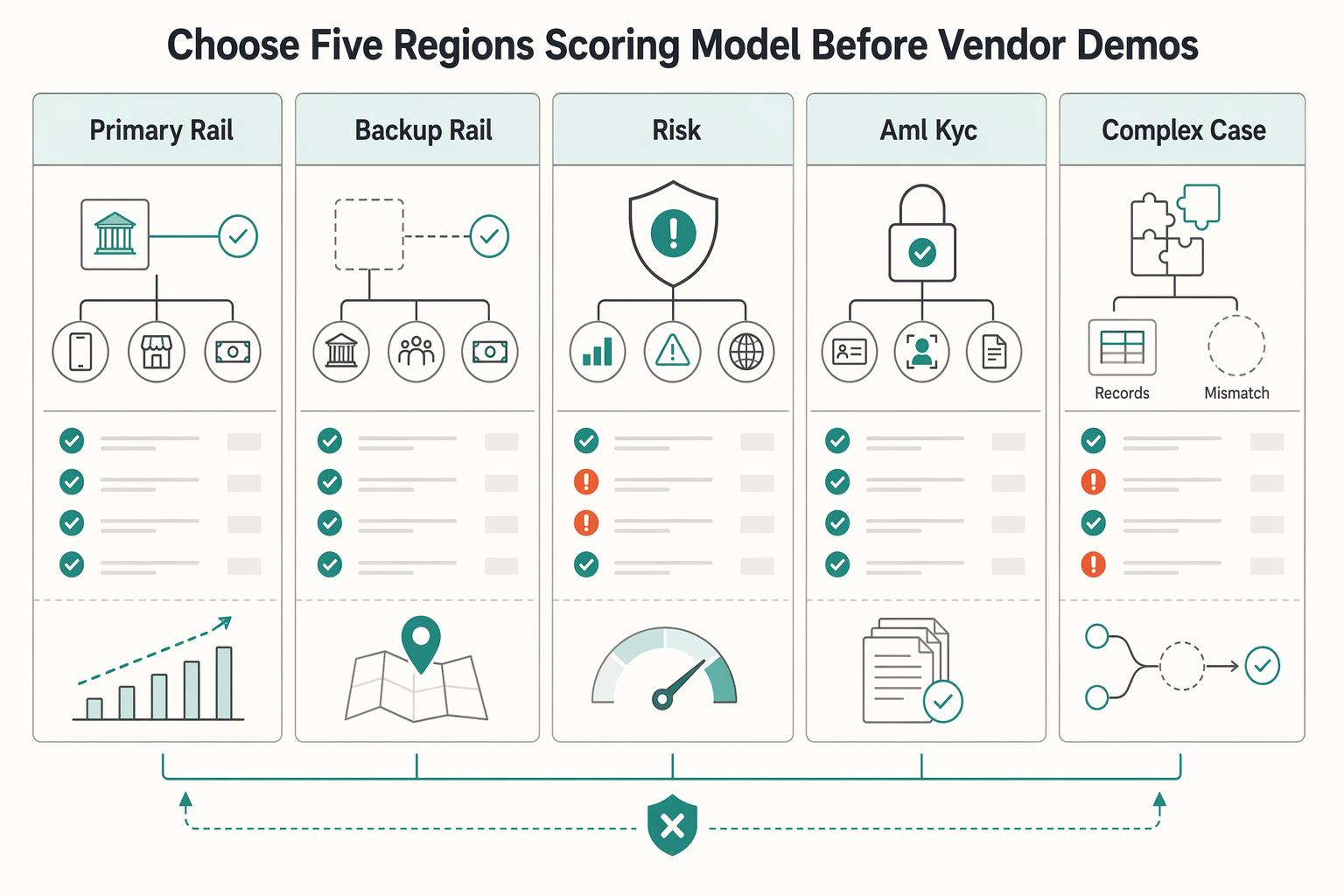
How Platforms Should Prioritize 5 Emerging-Market Payout Regions
If you are choosing where to launch cross-border payouts in 2026, start with what your team can actually run. Too many "top" lists lean on hype or market-cap tables. That may work for headlines, but it does not help with execution.
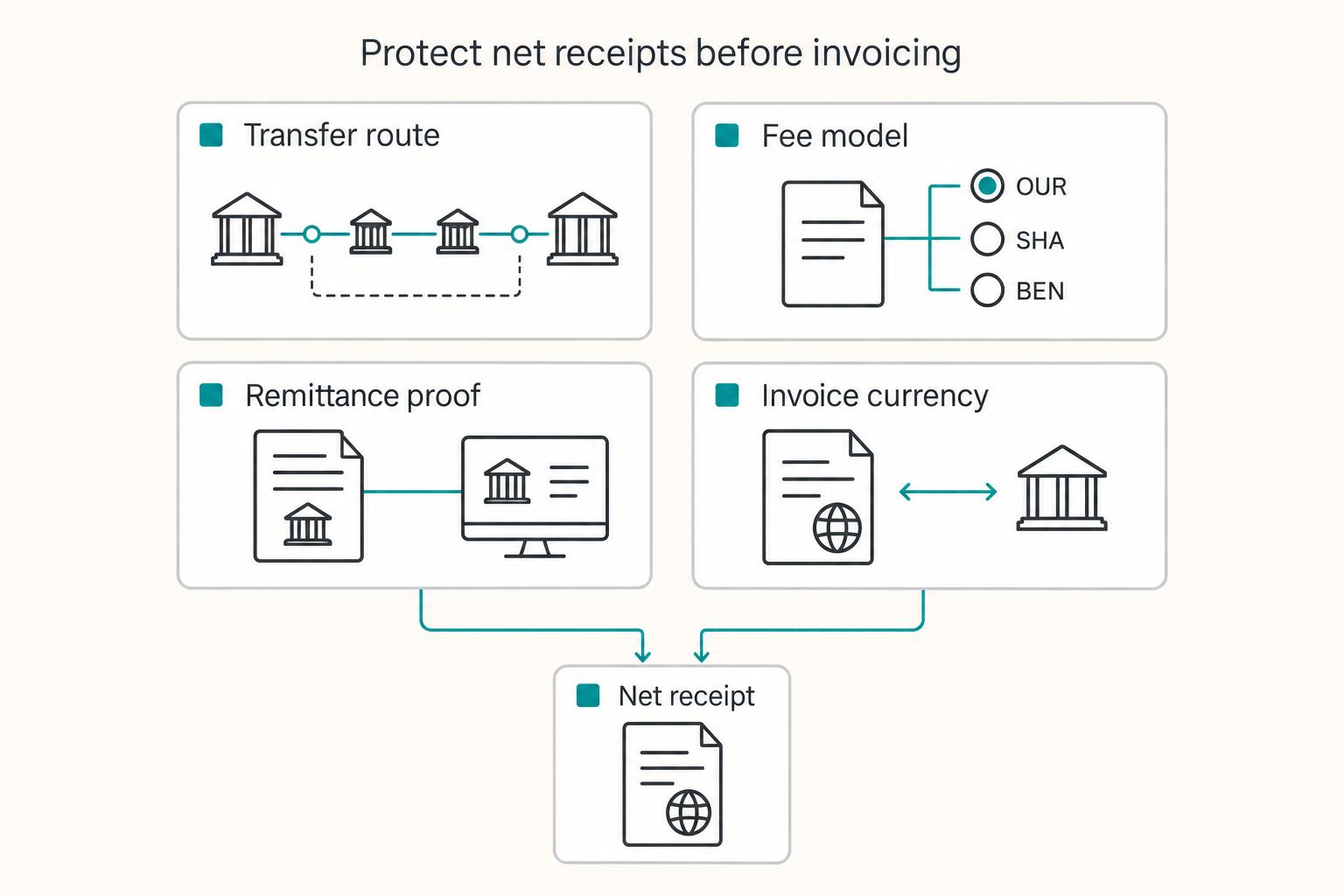
Why Your International Wire Arrives Late and Costs More
When a client says they paid but your money arrives late, lands short, or is hard to trace, that is a cash-flow risk, not a minor inconvenience. If the amount and timing are uncertain, planning your next moves gets harder.
The Best Way to Send Money to the Philippines from the US
If you need to **send money to philippines from us** on any regular basis, start with one number: how many Philippine pesos actually reach the recipient. The visible transfer fee matters, but it is only part of the cost. The World Bank is clear that remittance pricing is hard to compare because both fees and exchange rate margin shape the final result.