
Quick Answer
Use a churn rate calculator as an operating control, not a one-off metric check. Define one formula path, lock monthly or annual boundaries, and require reconciliation from frozen inputs before publishing. For platform finance and ops teams, the practical baseline is customers lost divided by customers at the start of the same period, with customer churn and revenue churn labeled separately. Benchmark only after those controls pass, because comparability depends on context.
How Platform Teams Use a Churn Rate Calculator#
A churn rate calculator is most useful when it sits inside your regular operating cycle, not as a one-time number check. For finance and ops teams, the sequence should stay the same every period: define the inputs, run the calculation, reconcile the result, compare it with the right context, and decide whether anything needs action.
Churn rate is the share of customers or recurring revenue you lost over a defined period, usually monthly or yearly. That sounds simple, but teams drift fast. Some people mean customer-count churn, which tracks how many customers left regardless of contract value. Others mean revenue churn, which measures the value lost. If you do not lock that distinction early, retention reporting and decision-making can start pointing in different directions.
This article stays practical. The goal is not to debate abstract definitions. It is to help you build a retention control you can run the same way every period and defend later. You will see where to standardize inputs, how to label period boundaries, what to reconcile before publishing, and what evidence should sit behind the final number.
The failure mode is simple. If two teams can enter the same start-period and lost-customer data and still produce different churn figures, you do not have a metric problem. You have a control problem.
Some points are well settled. Churn is consistently treated as a signal for customer experience, product-market fit, pricing weakness, customer satisfaction, and long-term scalability. It can also be calculated from either customer count or recurring revenue. Benchmarking is where things get messy. Some sources explicitly present multiple ways to calculate churn, and benchmark interpretation depends heavily on industry, business model, and customer segment. That creates a real operator risk. If you copy a headline benchmark without checking context, you can trigger the wrong intervention.
So the practical recommendation is to optimize for consistency before sophistication. Start with one approved definition, one period discipline, and one reconciliation path. Then benchmark carefully, with caveats attached and companion metrics nearby. In SaaS, you may see rules of thumb such as monthly churn below 2% or annual churn under 10%, but those are not universal targets, and sector spread can be wide. This article keeps coming back to the same decision checkpoint: what number you trust, why you trust it, and what you do next when it moves.
Define churn and retention in operator terms#
Set one canonical churn definition first, or your teams will report different truths from the same data.
In operator terms, churn rate is the share of customers or recurring revenue lost in a period, usually monthly or yearly, and retention rate is the inverse view of customers kept in that same period. If you start with 100 customers and keep 98, retention is 98% and churn is 2%. That result is only comparable over time when everyone uses the same period boundary and the same definition of who counts as lost, while excluding new customers or new recurring revenue won during that period.
Use your metric dictionary to lock the definition:
- whether you report customer churn (logo churn) or revenue churn
- the approved reporting period (for example, monthly or yearly)
- the exact rule for what counts as a "lost" customer
- that new wins are excluded unless a named method says otherwise
This is not just wording hygiene. Churn is a core health signal, and logo churn should be read alongside revenue churn rather than as a substitute. Keep the metric label explicit in dashboards and exports so product, finance, and ops are making decisions from the same measure.
For a step-by-step walkthrough, see How to Use a Community to Reduce Churn and Increase LTV.
Standardize the input contract before anyone uses a calculator#
Lock one input contract before anyone runs a churn calculation. Otherwise, teams can feed in different raw data, periods, and assumptions and still produce numbers that look equally valid.
Keep the contract in your metric dictionary and make it strict enough for monthly close. At minimum, define: start-of-period customers, customers lost during the period, end-of-period customers, whether new customers are tracked explicitly, the period label, and the business model context. A sound calculator workflow requires business model, raw data, metric definitions, and a time period before calculation.
Approve one schema and one reconciliation rule#
Use one name and one purpose per field:
| Field | What it means | Special handling |
|---|---|---|
| Start-of-period customers | Locked customer count at the opening boundary | Part of the minimum input contract |
| Customers lost | Customers that meet your approved "lost" rule in that period | Use the approved "lost" rule |
| End-of-period customers | Locked closing count for the same population definition | Treat as a verification field when new customers are not tracked |
| New customers tracked explicitly | Yes/no, with count stored when yes | If tracked, enforce start minus lost plus new equals end, after approved exclusions |
If new customers are tracked, enforce one reconciliation check: start minus lost plus new equals end, after approved exclusions. If new customers are not tracked in the calculation path, say that directly and treat end-of-period customers as a verification field.
Treat this as a control, not just math. The output should show formula, result, validation notes, and a documentation-ready metric glossary.
Compare tools before you accept cross-team numbers#
You can allow different tools, but require one source formula and one acceptable alternate derivation with written reconciliation logic.
| Tool | What the guidance covers | Field assumptions visible in excerpts | Operator stance |
|---|---|---|---|
| Amplitude | Confirm with vendor | Unknown | Do not assume a match to your contract until you map its fields |
| WebEngage | Confirm with vendor | Unknown | Map fields to your approved schema before accepting outputs |
| Omni Calculator | Confirm with vendor | Unknown | Use only after confirming formula path and period handling |
| Wall Street Prep | Confirm with vendor | Unknown | Accept only when inputs tie back to your contract and reconciliation notes |
Keep unknowns explicit when excerpt detail is incomplete.
Add validation gates before calculation#
Set hard checks before calculation:
| Validation gate | Rule |
|---|---|
| Customer counts | No negative customer counts |
| Period boundaries | Locked and identical across inputs |
| Customer IDs | No duplicate customer IDs in start or end snapshots |
| Customer status | One customer status per ID at the cutoff date |
Also separate reporting from investigation. Usage data alone can produce false positives, so do not let usage telemetry replace the reporting-contract number.
Store the approved schema with finance reporting artifacts so monthly close and board reporting use the same contract. If another team needs an alternate derivation, require written reconciliation logic and approval before publication.
For a broader operating view, see How to Calculate and Manage Churn for a Subscription Business.
Choose one formula path and lock period discipline#
Pick one labeled formula path for this metric and treat anything else as an explicit exception. A practical default is Customer Churn Rate = customers lost during the period / customers at the start of that same period. If a source system cannot support that path, document the alternate method and label it clearly.
Churn is defined over a period of time, so period discipline is part of the metric, not a reporting detail. Also keep customer churn and revenue churn separate in names and exports so they are not interpreted as the same calculation.
Lock the period before you calculate#
If your interventions run monthly, calculate monthly first from the closed monthly roster, then roll those approved results into quarterly or annual views. Do not back-solve monthly values from annual aggregates.
Use explicit titles everywhere:
- Monthly Churn Rate
- Quarterly Churn Rate
- Annual Churn Rate
Do not rely on hidden UI filter state to communicate period.
Keep new customers in the check, not in the shadows#
When new customers acquired is available, use it as a reconciliation aid unless your written policy explicitly uses it in the formula path. The core reconciliation remains: start - lost + new = end (after approved exclusions).
If you also report Customer Retention Rate, keep it explicitly labeled as a different path: end-period customers minus new customers, divided by starting customers, then multiplied by 100. If you publish both churn and retention, keep the period and customer population aligned and record that choice in the metric note.
Related reading: How to Negotiate a Higher Rate with a New Client.
Run a monthly close sequence for churn reporting#
Use a documented monthly close sequence before you publish churn, and treat it as an internal control policy. Follow a formal review-and-approval approach with clear transparency steps, but do not assume a churn-specific close method is already defined for you.
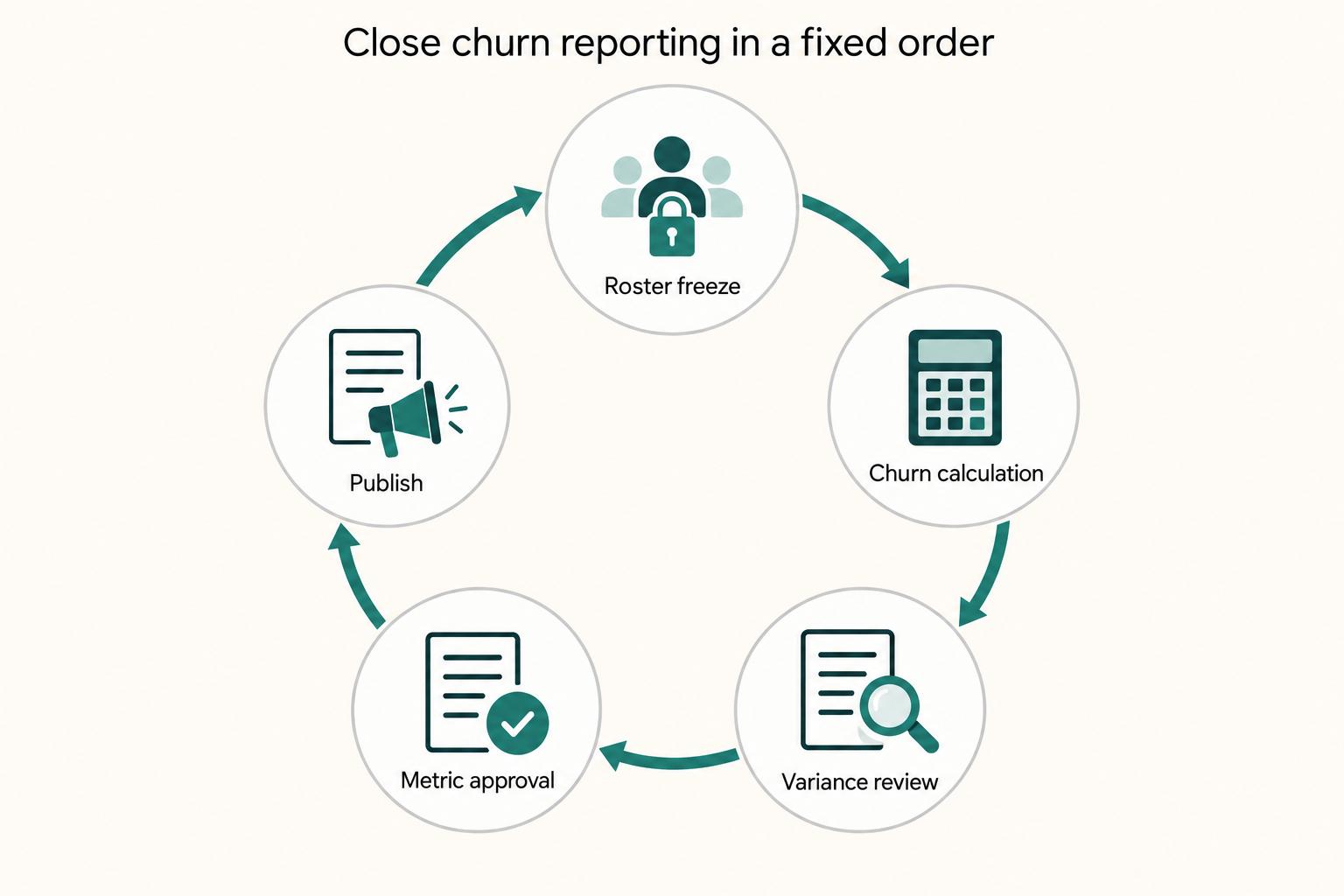
Set your order of operations in writing and run it the same way each month: freeze the reporting roster, run the churn calculation, reconcile variances, approve the metric pack, then publish. Keep metric definitions stable during the cycle so the reported number is reviewed against a fixed meaning.
Checkpoints that make the pack reviewable#
| Step | Owner | Evidence to attach | Pass/fail rule |
|---|---|---|---|
| Data extract and freeze | Product ops or data owner | Frozen roster export, extract timestamp, period boundaries, scope note | Pass if the monthly extract is closed and labeled |
| Formula run | Analytics or finance analyst | Calculation output, formula version, metric label | Pass if the approved formula path is used for the frozen period |
| Reconciliation | Finance owner | Reconciliation notes, exception log | Pass if variances are explained and dispositioned |
| Sign-off and publish | Finance + product ops | Approval record, final metric pack, audit trail links | Pass if published output matches approved artifacts |
Keep traceability explicit#
Require these artifacts in every close pack:
- Exception log
- Reconciliation notes
- Audit trail links to the frozen extract, calculation output, and sign-off record
If you use an internal alert threshold for churn movement, you can apply dual sign-off when that threshold is breached. That threshold is an internal policy choice and should be documented in the same reporting standard.
Benchmark churn without false confidence#
Use external churn benchmarks as directional context, not as targets. If a source is unclear about segment, period, or churn type, it is not strong enough to anchor a performance commitment.
Benchmark coverage is useful because published guidance consistently frames churn as varying by industry and customer segment. The risk is false confidence when headline numbers omit operating assumptions.
Match the benchmark to your business#
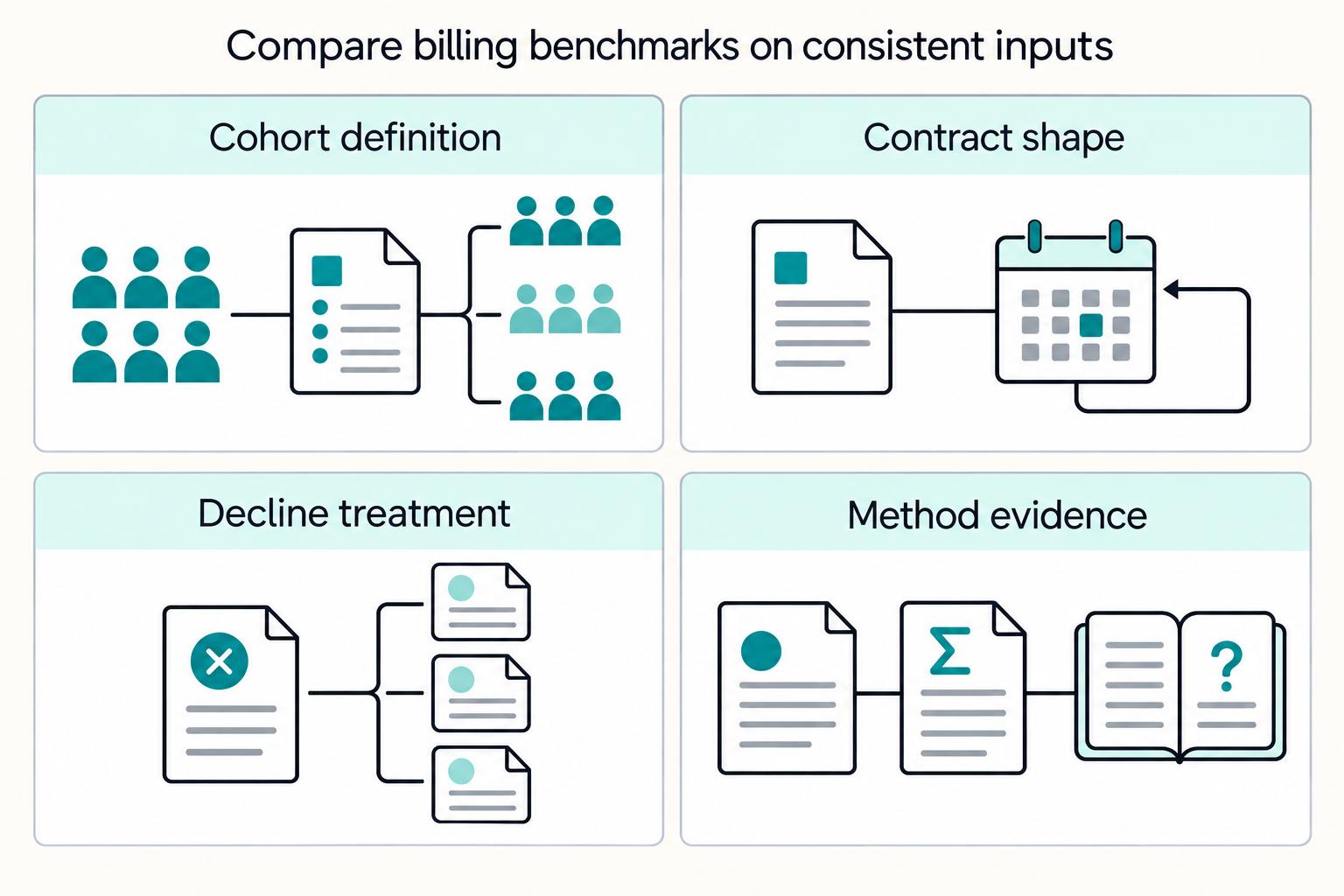
Before you compare your result to an outside number, confirm that you are measuring the same thing. In SaaS, churn is the share of customers who cancel in a defined period, but comparisons break when teams mix monthly vs. annual views, customer vs. revenue views, or different customer scopes.
| Check | What to confirm | Grounded note |
|---|---|---|
| Period | Monthly, quarterly, or annual | Comparisons break when teams mix monthly vs. annual views |
| Metric | Customer churn, retention, or a different metric | Confirm you are measuring the same thing before comparing |
| Churn type | Whether it separates voluntary churn from involuntary churn | Voluntary churn is customer-initiated cancellation; involuntary churn is subscription loss from payment failure |
| Scope | Industry and customer segment explicitly defined | Published guidance frames churn as varying by industry and customer segment |
Document those checks in writing before you use the comparison.
That third check is often where teams miss. Voluntary churn is customer-initiated cancellation. Involuntary churn is subscription loss from payment failure. If your losses are mostly involuntary, a benchmark based mostly on customer intent can send you toward the wrong fix.
Keep a benchmark note in the same metric pack from monthly close: source URL, page date, mapping notes, and assumption gaps. If the guide is dated December 16, 2025 or January 8, 2026, keep that date visible so reviewers can assess context and freshness.
Make the comparison economically real#
Treat churn improvement as meaningful only when the economics hold up. Review churn alongside Customer Lifetime Value, Average Revenue Per User, and Customer Acquisition Cost before you call the result a win.
Use a simple rule: if churn improves but CLV does not, or ARPU softens enough to offset the gain, treat the result as provisional. Apply the same caution if CAC rises while retention improves.
The common mistake is treating a benchmark as a universal "good" number. A calculator gives precision, but precision does not guarantee comparability. Use benchmarks to sharpen decisions, not replace context checks.
For benchmark context, see SaaS Subscription Billing Benchmarks: Churn MRR Expansion and Payment Decline Rates.
Connect churn to revenue quality and payment operations#
Treat churn as a revenue-quality signal, not just a retention score. When churn rises, read your revenue outlook more cautiously: lower churn is associated with better retention and more stable revenue, and retained accounts protect prior onboarding and process investment.
Read customer churn and revenue churn side by side#
Do not rely on one churn view in isolation. Customer churn and revenue churn are different calculations, and they should be interpreted separately. Reviewing both helps you see whether risk is broad across accounts or concentrated in higher-value revenue.
In your regular metric pack, keep the context next to the percentage: starting customer count, customers lost, and major plan or pricing changes that can affect comparability. A precise number without context is easy to misread.
Diagnose carefully before choosing an intervention#
Avoid jumping to a single cause when churn worsens. Start with what your records can support, and state uncertainty plainly when the data is incomplete. The goal is to make intervention decisions from evidence, not assumptions.
If your data supports it, separate churn paths and assign owners accordingly; if not, log that as a measurement gap. One-size-fits-all fixes are expensive and usually follow from diagnostics that were too shallow.
Related: Involuntary vs. Voluntary Churn on Platforms: How to Measure and Attack Both Separately.
Build exception controls for compliance and market variance#
Treat compliance variance as a defined exception source, not a footnote. If you operate across countries or program types, mark retention-affecting rules as conditional with labels like "when enabled," "coverage varies by market," or "program-specific" so output is not misread as pure product or pricing failure.
Add an exception layer for KYC, KYB, AML, and VAT gating in your monthly review, even when those controls sit outside the retention team. Focus on whether activation, renewal, or payout was blocked, delayed, or returned for more information. Verify with status-and-time evidence: requested, received, approved, rejected, resubmitted, paid out. If a lost account cannot be tied to those states, do not classify it as compliance-driven churn.
Handle cross-border tax-document flows the same way. If your platform requests W-8, W-9, or 1099-related information, keep that path program-specific and separate from product onboarding. For FEIE questions, keep eligibility narrow: foreign earned income, a foreign tax home, and a qualifying test are required. One qualifying path is the physical presence test: 330 full days in a 12-month period, and those days do not have to be consecutive.
Keep two guardrails explicit. FEIE does not remove filing obligations by itself; qualifying taxpayers still file and report income. FBAR timing can shift based on relief notices tied to specific events, so avoid hard-coding one filing timeline in support copy. Keep the evidence pack tight: market, program, document requested, blocker reason, and whether the account exited before resolution.
Conclusion#
A useful churn rate calculator is not just a formula box. Its value comes from standardizing what goes in, when you calculate it, how you reconcile it, and what action a change should trigger. If you do not lock those rules first, you will spend more time arguing about the number than using it.
A strong operating choice is simple: define one churn policy and keep every team on it. In practical terms, that means one metric definition, one approved formula, one close sequence, and one rule for how benchmarks are interpreted. A common formula anchor is customers lost during a period divided by customers at the start of that period. Your required fields should stay equally plain: "Starting customers" and "Lost customers." Keep the time period explicit every time, because a churn value without a monthly, quarterly, or annual label is easy to misread.
This matters because churn is not abstract reporting. High churn hurts revenue and profitability, and retaining an existing customer is widely treated as more cost-effective than replacing one. One cited figure says acquisition can cost up to five times more than retention. That is why your first control should be data quality, not benchmark hunting. If the underlying counts are unstable, every downstream comparison, retention analysis, or intervention choice will be unstable too.
Your first implementation step should be narrow and boring on purpose. Start small so you can prove the control before you widen it:
- Write the input contract for the metric, including the period boundary, start-of-period customer count, lost-customer count, and the exact source for each field.
- Add a monthly checkpoint table that confirms the roster is frozen, the lost count ties to the same period, and the published result has been reviewed before wider reporting.
- Only after those checks are passing consistently should you layer benchmark comparisons and response rules.
One practical checkpoint matters more than it seems: verify that the customer population used for the numerator and denominator is the same population for the same period. One failure mode to watch for is publishing a churn figure pulled from mixed snapshots or unlabeled date windows, which creates false movement and leads teams to chase the wrong problem. Another is expecting the calculator output to explain why customers left. It cannot. Customer churn is a normal part of the business cycle, so the job is not to eliminate it entirely, but to measure it consistently enough that follow-up analysis is credible.
If you take one action after reading this article, make it standardization. Get the inputs, period discipline, and checkpoint table stable first. Once that foundation holds, the metric becomes useful for decisions instead of just reporting.
Frequently Asked Questions
How do you calculate churn rate in one line?
Churn rate is the percentage of customers who end their relationship with your business during a defined time period. In practice, consistency matters most: use the same period and exclusion rules every time.
What inputs does a churn rate calculator need to be reliable?
At minimum, the calculator needs a clearly defined period and a count of customers who left during that period, tied to the base you are measuring against. To keep it reliable, lock the date window first and apply the same inclusion and exclusion rules each cycle. Keep new customers or new recurring revenue won during the period in a separate field rather than letting them affect the churn calculation.
Should new customers be included directly in churn calculations?
Usually no. The grounded rule here is clear: exclude new customers, or new recurring revenue, won during the period from churn-rate calculation. Using end-of-period totals that already include newly acquired accounts can make churn look lower than it was. If you track new logos for reconciliation, label them explicitly as reconciliation support, not as churn inputs.
How often should platform teams calculate churn rate?
Churn is typically tracked in recurring windows, usually monthly or yearly. Pick the period that matches how you operate, then keep that cadence consistent so trends are comparable over time.
What is the difference between churn rate and retention rate?
They are inverse views of the same customer behavior. Churn looks at the share of customers lost in a period, while retention rate looks at the share who renew over that same period. The practical check is to make sure both metrics use the same period boundary and customer population.
Can churn rate be negative?
Yes, but that usually applies to revenue churn, not customer-count churn. Negative churn happens when expansion revenue from existing customers, such as upsells, cross-sells, or price increases, exceeds the revenue lost from churn or downgrades. That means you should verify which lens you are using before reporting it. If someone says churn is negative, ask whether they mean recurring revenue churn rather than customer churn.
What is a good churn rate for a subscription business?
There is no universal good number, and benchmark claims need context. One cited SaaS example says monthly churn below 2% or annual churn under 10% is considered strong, but that is only meaningful with industry, business model, and segment context. Use those figures as directional context, not as a target copied blindly. If you need external comparison, pair it with your own retention and revenue trends, or review industry benchmarks before setting a threshold.
Try a related tool
Researched and edited by the Gruv editorial team. Gruv builds cross-border billing, payouts, and finance-operations software for global businesses.
Sources
Includes 1 external source outside the trusted-domain allowlist.
- cms.gov/files/document/cms-9884-f-2025-pi-rule-maste...trusted
- dhcs.ca.gov/Documents/NAIC_Key%20Comments%20Responses%20...trusted
- ferc.gov/sites/default/files/2020-08/AD16-15-000-Tran...trusted
- fincen.gov/report-foreign-bank-and-financial-accountstrusted
- irs.gov/individuals/international-taxpayers/figuring...trusted
- irs.gov/individuals/international-taxpayers/foreign-...trusted
- puc.pa.gov/media/1584/swe-phaseiv_evaluation_framework0...trusted
- churnzero.com/churnopedia/churn-rateexternal
Educational content only. Not legal, tax, or financial advice.
Related Posts

Churn Rate Benchmarks by Industry for Payment Platforms
If you run a payment platform, start with this assumption: there is no single churn benchmark you can safely copy from search results. Published benchmarks come from different market cuts, including broad industry datasets, B2B SaaS reports, subscription-app reports, and payment-method segments. These are not directly comparable without normalization.
How to Compare SaaS Billing Benchmarks Before Expansion
For expansion decisions, treat payment decline rate, churn, and expansion as one system, not three separate metrics. That gives product, finance, and GTM a view they can defend before rollout resources are committed. If you own the budget call, you need that view before your team starts treating one good month as a trend.
Involuntary vs Voluntary Churn on Platforms and How to Attack Each
Measure voluntary and involuntary churn separately. Treating churn as one number can fund the wrong fix. In a subscription business, **Voluntary churn** and **Involuntary churn** are different failures. One is a customer choosing to leave because price or value no longer works. The other is a customer dropping unintentionally because of a payment failure or technical issue.