
Quick Answer
Handle contractor financial data under California law by starting with a minimum credible control set, not a full privacy rebuild. Map intake points, disclose categories, purposes, and sold or shared status, set retention and purpose limits, classify recipients, and route rights requests through documented queues with verification and legal escalation when scope or recordkeeping conflicts exist.
How CCPA Applies to Contractor Financial Data#
Start with a minimum credible control set, not a broad privacy rebuild. If your team handles contractor, seller, or creator payouts and may process personal information tied to California residents, implement the duties the law states clearly, document where judgment is still needed, and avoid custom fixes until scope is confirmed.
Before you begin#
This is an operational guide for California privacy compliance, not legal advice. It is written for legal, compliance, finance, risk, security, and payments ops teams that have to implement the work in real product and payment flows. The goal is a defensible starting position, not a privacy theory exercise.
The CCPA regulations govern how you comply with the CCPA, and a violation of those regulations is treated as a violation of the CCPA itself. In practice, generic policy language does not help much if intake forms, payout tooling, or support processes collect data in different ways.
Start at the collection points you control#
Anchor your program to the collection points you control. At or before collection, the statute requires disclosure of the categories of personal information collected or used, the purposes, and whether that information is sold or shared. If sensitive personal information is collected, you must also disclose its categories, purposes, and sold or shared status.
For payout operations, start with the intake points that actually collect data, not just the public privacy notice:
- contractor onboarding screens
- payout setup forms
- support intake and macros
- manual operational intake for missing payment details
A practical checkpoint is to map each intake point and confirm you can show the category, purpose, and sold or shared status for the data collected there.
Set retention and purpose limits before tooling changes#
Document retention and purpose limits before you change tooling. The posted statute excerpt, effective 01/01/2025, requires stating how long each category of personal information, including sensitive personal information, will be retained.
Another common risk is adding new fields for edge cases, then reusing that data for an incompatible purpose without updated notice. The statute does not allow collecting additional categories or using data for incompatible additional purposes without notice, so escalate before you release the change.
Create a one-page baseline before moving on#
Treat this guide as an execution sequence, not a promise to resolve every open issue in one pass. The next sections move from scope and ownership into contracts, data flows, request handling, and escalation, including requests made directly or through an authorized agent.
Before moving on, create a one-page California baseline with collection points, data categories, purposes, retention position, and an owner for each decision. That gives operations and legal a concrete record to review and verify.
Confirm your scope before you design controls#
Set scope before tooling. If California resident personal information is in scope for your program, align your implementation to the current CCPA regulations, effective 1/1/2026, before you build forms, queues, or deletion logic.
Review your current baseline for gaps#
Assume older privacy assumptions are incomplete until you review them. The current regulations are organized around methods for submitting and handling requests to delete, correct, and know, related response timelines, opt-out preference signals, and recipient role contract tracks.
Run a quick stale check on your current baseline. If it only covers notice language, skips request handling, or does not account for recipient role contract checkpoints such as §7051 and §7053, route it for legal review before implementation.
Define request handling scope early#
Define request handling scope early, not after controls are built. Confirm which channels can receive requests to delete, correct, and know, and who owns intake, verification, exception review, and response operations across those channels. That scoping decision drives workload and control design, so capture ownership before you implement anything.
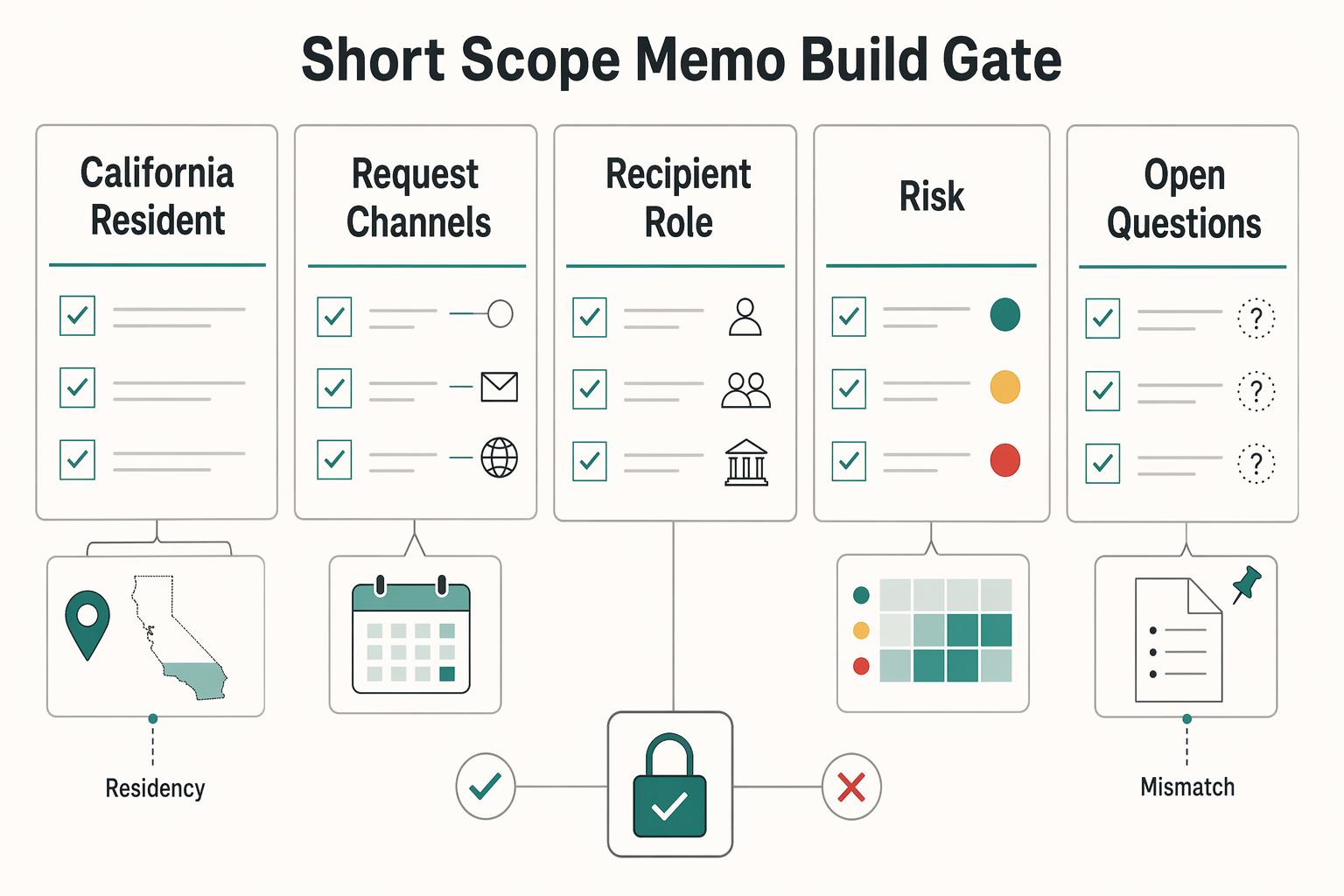
Use a short scope memo as the build gate#
Create a one-page scope memo as an internal go/no-go gate before tooling starts. Keep it short and specific:
- California resident data touchpoints in scope
- request channels for delete, correct, and know
- recipient role scoping issues that may require §7051 or §7053 contract review
- unresolved draft-rule risk questions for legal review (for example, cybersecurity-audit disclosure scope raised in public comment)
- open questions and named owners
Use legal sign-off on that memo as your internal build gate. If major flow gaps remain, pause and resolve scope first.
For a step-by-step walkthrough, see DAC7 for Platform Operators: Scope, Seller Data, and Controls for EU and Non-EU Platforms.
Prepare owners and evidence before touching systems#
Once scope is approved, put ownership and record-keeping in place before you touch forms, queues, or tooling. The CCPA regulations effective 1/1/2026 include Article 8 (Training and Record-Keeping), and weak ownership usually turns into weak records.
Gather the documents that drive decisions#
Collect the documents that drive control decisions: your current privacy notice, data retention schedule, incident playbook, and active Vendor Agreement and Data Processing Agreement (DPA) templates. If any are missing, outdated, or ownerless, pause the build.
Run a quick governance check. If you cannot identify the current approved version, approver, and approval date for each document quickly, fix ownership first.
Assign owners by decision type#
Assign owners by decision type, not just by department. A practical split can be legal for interpretation and contract posture, compliance for control design, operations for execution, and security for audit-readiness evidence. Treat this as your internal operating model, not a role assignment from the regulation.
Document a one-page responsibility map with primary and backup owners for request intake, verification review, exception handling, contract template updates, notice updates, retention decisions, and evidence retention.
Tie the prerequisite pack to the next regulation areas#
Tie your prerequisite pack to the regulation areas you will implement next so gaps show up before work starts. Tag each document to the control area it affects so missing pieces are visible before implementation.
| Article | Topic | Prework |
|---|---|---|
| Article 4 | Service Providers, Contractors, and Third Parties | Confirm contract templates are current before negotiations start. |
| Article 8 | Training and Record-Keeping | Define how approvals and change history will be preserved. |
| Article 9 | Cybersecurity Audit | Align security artifacts with privacy control decisions. |
Set up the evidence structure before tickets open#
Create your evidence structure before you open implementation tickets. Do not assume regulations prescribe folder names, but record-keeping is a defined control area, so treat contemporaneous proof for material control changes as an internal standard.
One compact structure:
- Policy and notice: current version, prior version, approver, approval date
- Implementation: ticket or change request, owner, linked requirement
- Validation: test output, reviewer notes
- Contracts: current template, redlines, final approval record
Use this checkpoint: can an independent reviewer reconstruct what changed, why, and whether it was tested without asking the original team?
Stop if ownership or approvals are still unclear#
If owner coverage or approval paths are unclear, stop before tooling work. Starting build work first usually creates avoidable rework when controls, contracts, or notices are reconciled later. If your team is using secondary summaries, verify decisions against the official California regulations before you finalize design choices.
If your platform also handles contractor or seller data in Europe, see GDPR for Marketplace Platforms: How to Handle Contractor and Seller Personal Data Compliantly.
Classify every recipient before you edit any contract#
Before you redline any agreement, assign each recipient of contractor or payout data one label: Service Provider, Contractor, or Third Party. Classify first, draft second, because CPRA distinguishes obligations by recipient role, and CPRA superseded CCPA on January 1, 2023.
Build a recipient map first#
Create a recipient map before touching templates. For each recipient, record vendor name, business purpose, data involved, owner, and exactly one role label: Service Provider, Contractor, or Third Party.
If one recipient appears to fit multiple roles, split by use case instead of blending labels. Your checkpoint is simple: legal should be able to review each row and give a clear yes or no without a follow-up just to decode the data flow.
Turn labels into a contract review matrix#
Do not jump from labels to clause edits. First build a short matrix so legal, compliance, and procurement can verify the right template path and required checks against official California materials and your compliance checklist.
| Recipient role | What this changes | Review points to verify in official text | Escalation sign |
|---|---|---|---|
Service Provider | Use the service provider contract path | Confirm role-specific contractual requirements in official text | Recipient asks for terms inconsistent with this role label |
Contractor | Use the contractor contract path | Confirm role-specific contractual requirements in official text | Recipient refuses role-specific commitments |
Third Party | Use third-party treatment | Confirm role-specific obligations in official text for this relationship type | Recipient cannot fit service provider or contractor constraints |
Include explicit review fields for the exact contract restrictions and any certifications your legal team requires for each role. Do not treat those points as resolved until legal confirms wording and applicability in official text.
Use a hard escalation rule#
If a vendor handling payout data does not cleanly fit Service Provider or Contractor constraints, classify it as Third Party and escalate to legal immediately. That is usually safer than using the wrong template and discovering the mismatch later.
Fix the common failure mode quickly#
A common failure mode is reusing one master privacy clause set for every vendor. The fix is role-based: rebuild the recipient map, redline from the correct template family by role, and reapprove templates with evidence.
Keep the evidence pack tight: current agreement, role-based redline, final signed version, approval record, and the map entry that explains the role decision.
Comments in CPPA rulemaking can help you spot classification risk, including distinctions between a company's business role and service-provider role. Treat those comments as non-binding input, not final contract authority.
For the contractor-side view of California privacy rights, see A Guide to the California Consumer Privacy Act (CCPA) for Freelancers.
Map contractor financial-data flows end to end#
After recipient classification, your next control is an end-to-end data flow map. You need it to answer CCPA notice and rights questions consistently without disrupting payouts.
Inventory every entry point, handoff, and exit#
Map the actual lifecycle, not just system names. Trace contractor data through onboarding, payout setup, payment execution, tax operations, and support handling, including manual spreadsheets and exception paths.
Go down to the data-element level for fields that affect money movement or tax reporting. App-level mapping can miss where bank, tax, or identity data is duplicated in notes, exports, or attachments and then missed during request-to-know handling.
Tag each flow to your CCPA purpose language. Keep that language aligned across your Notice at Collection, request-to-know responses, and day-to-day operations.
Separate payout-critical data from optional enrichment#
Split the inventory into two buckets: payout- and tax-critical data, and optional enrichment data. This keeps risk decisions explicit and avoids mixing convenience fields with payment-critical records.
For optional fields, decide whether to remove them from core payout paths or stop collecting them. If you keep them, document the business purpose and access boundaries so mixed-use records remain explainable during privacy reviews.
Link payment artifacts and tax artifacts clearly#
Treat payment and tax artifacts as connected but distinct. They can sit in different tools, with different owners and retention practices, even when tied to the same contractor.
Mark where tax support documents, withholding correspondence, and payment history intersect with your rights-response path. The goal is clear dependency mapping, not assumptions from a form label. Keep the evidence practical: intake forms, payout reports, tax case queues, support macros, and the retention schedule you actually use.
Verify four fields for every data element#
Use one checkpoint across the map: owner, purpose, retention rule, and downstream recipient for each material data element. This is an operational control, not a statutory schema claim.
If any field is missing, escalate. Compressed implementation windows have been raised in CPPA rulemaking comments, so complete mapping helps reduce reactive fixes after notice or rights issues appear.
Operationalize consumer rights without breaking payouts#
Once your data map is usable, route rights through staffed queues, not policy text. The core control is a documented notice and request-response process that tells operations what to do for each right, who approves edge cases, and what evidence is saved.
Build separate queues for each rights type#
Use distinct queues for Right to Know, Right to Delete, and Right to Stop Sale (Opt-Out) instead of one generic privacy inbox. Track non-discrimination checks across these queues as a required control because the output differs even when intake looks similar.
For each queue, define four items up front: what starts the internal clock, who verifies the requester or authorized agent, who signs off on the response, and what must be attached before closure. Keep the notice version shown to the user, intake payload, verification notes, response packet, and closure rationale in one case record.
A common failure mode is treating every request like deletion before facts are checked. That can create avoidable operational disruption and weaken your evidence of how requests are actually handled.
Route opt-out intake into one process and test it#
If your web or app receives opt-out requests through more than one channel, route them into the same operational path. Do not leave any intake path as a front-end flag with no case creation, suppression record, or audit trail.
Run a repeatable test. Trigger an opt-out request in a test environment, confirm capture at intake, confirm routing into the opt-out queue, and confirm downstream suppression where sale choices are enforced. Save the test date, owner, and evidence. If a request is received but cannot be matched reliably to the right account or profile, document the gap and escalate.
Hold unclear deletions and use a review path#
When a deletion request has unclear scope or verification gaps, do not run a broad delete just to clear queue volume. Route the case to documented review and use a defined response path.
That response should state what action was taken, what could not be completed yet, and who approved the decision. Keep the intake payload, verification notes, decision rationale, response packet, and closure record together in the same case file.
Keep one caution in view. 2025 public comments on proposed DROP rules raised overbroad deletion risk and verification or authorized-agent risks. Treat that as an operational warning sign, not final adopted rule text.
Add non-discrimination checks to payout operations#
Non-discrimination needs an operational control, not only policy language. Rights exercise should not silently trigger payout delays, support downgrades, fee changes, or account friction unless there is a separate documented basis.
A practical control is a periodic review of rights-request cases against payout holds and support escalations. If a privacy-requester tag is influencing risk or payment decisions, remove that path or restrict the tag to privacy operations. Keep evidence: the SOP, owner, one sample review, and remediation tickets.
Related reading: How Platform Operators Should Plan PCI DSS Level and Cost.
If your rights-request SOPs could affect payout timing or holds, map them to an auditable payout flow before rollout in Gruv Payouts.
Align notices and consent surfaces with real product behavior#
Treat notice copy as a statement of actual system behavior. Do not infer CCPA implementation requirements from external legal blog content here; the excerpt is a retail-law blog page with off-topic post listings, not regulation text. Use only what your product and controls can substantiate.
Tie each notice statement to a real data event#
As an internal drafting control, tie each notice statement to a real behavior: the data event, data element, recipient role, and retention outcome it describes. If you cannot trace a sentence to evidence in your own systems and records, rewrite it or remove it.
Keep the redline and evidence together so internal review is auditable: surface text, data map row, recipient classification, and retention record.
Make opt-out language executable#
Only publish opt-out language that users can actually complete through the path you describe. The route named in copy should resolve to the same internal handling path your team uses.
If behavior and copy diverge, remove the claim or escalate before release.
Synchronize web, onboarding, and support language#
As an internal consistency check, review web notices, onboarding prompts, and support macros together so they do not conflict. Treat this as operational hygiene, not a legal requirement established by the captured excerpts.
Consider running a recurring notice-to-system diff with product and legal, and log mismatches with clear ownership and remediation.
Rewrite vendor and contractor terms with role-specific clauses#
Use role-specific contract language, not one generic privacy addendum. If the role on paper is vague or mismatched, that ambiguity can show up later in notices and rights handling.
Build one clause matrix across your Vendor Agreement and Data Processing Agreement (DPA) templates, and route each recipient role decision through it before signature. Treat this as an operational control, not only a drafting task. If compliance, security, or payments ops cannot test a clause in practice, rewrite it.
Build a role-based clause matrix before template redlines#
Start from your existing recipient labels, such as Service Provider, Contractor, and Third Party. For each role, map where terms live, what use is allowed, and what post-signature evidence you expect.
| Recipient role | Template location | Drafting focus | Verification question |
|---|---|---|---|
Service Provider | Vendor Agreement plus role-specific DPA terms | Clear use boundaries, transfer conditions, and cooperation expectations | Can teams point to signed language that clearly limits use? |
Contractor | Vendor Agreement, DPA terms, and certification language only where your position depends on it | Same operational limits, plus certification handling where applicable | If relying on Contractor Certification, is the signed record tied to the current agreement version? |
Third Party | Vendor Agreement and sharing terms aligned to disclosures | Recipient category clarity and purpose alignment | Does contract role match notices and internal records? |
Version this matrix and keep the evidence together: current templates, prior redline, legal or compliance approval, and one executed example per role.
Keep your legal footing clear. The March 2024 CPPA material is draft, formal rulemaking had not yet started, and the text is subject to change. Use it to guide drafting discipline, not as final clause mandates. One useful anchor is draft section 7001, alongside Civil Code section 1798.140: third party categories should be specific enough to give meaningful understanding. Apply that same specificity to your role labels.
Write obligations operations can test under pressure#
Write terms so operators can answer practical questions quickly. Define what uses are allowed, what transfers are allowed, and who must cooperate on records and inquiries, including how certification is handled when relevant.
Do not rely on broad statements like "comply with applicable law" as the main control. Use role-specific boundaries that produce observable behavior.
Run a scenario check across real recipient types and ask security, compliance, and business owners the same question: what may this counterparty do with the data? If the answers differ, tighten the clause language.
Also check cross-document alignment. If the DPA is narrower than the commercial terms, onboarding language, or API usage documentation, resolve the conflict before signature.
Document retrieval constraints honestly. The CPPA draft includes an example where data may be kept only for legal or compliance purposes and not be searchable or readily accessible. If that limitation exists, reflect it in internal notes and rights-response planning rather than implying easy retrieval.
Escalate refusals instead of masking them with policy#
If a critical vendor refuses the role language your program requires, escalate. Do not paper over the gap with internal policy.
Use a short risk memo signed by legal and compliance that records: vendor, intended role, refused provisions, data involved, affected surfaces, compensating controls, if any, and accept or reject decision. If accepted temporarily, set an expiry date and owner for re-papering. That keeps risk acceptance explicit and helps prevent drift between contract language, product behavior, and public notices.
Add the 2026 control layer to existing CCPA programs#
Treat the 2026 layer as an operating-control update, not a notice-only refresh. The supported posture is additive: reflect Automated Decisionmaking Technology (ADMT), Risk Assessment, and [Cybersecurity Audit](https://cppa.ca.gov/regulations/pdf/ccpa_updates_cyber_risk_admt_appr_text.pdf) duties in workflows, evidence, and governance records, not only policy edits.
A secondary legal summary says the package was finalized in September 2025 and took effect on January 1, 2026, with impact across request handling, product design, internal controls, and data governance. Plan for process, evidence, and review changes accordingly.
Inventory outcome-changing decisions first#
Start by mapping decision logic that can materially affect consumer or user outcomes. Public comments on proposed updates caution against treating all AI as ADMT, so avoid over-labeling while still capturing decision points that need review.
For each flagged decision, record:
- business owner
- purpose
- key data inputs
- downstream effect
- whether and how a human can review or reverse the result
Define review and challenge operations where outcomes matter#
Where outcomes matter, document how disputed decisions are reviewed in practice. Current public materials here do not establish a final, specific legal format for human review, so keep this as an operator control and avoid inventing legal thresholds.
For each relevant use case, keep one decision record that shows:
- reviewer role
- evidence available to the reviewer
- challenge or escalation path
- retained case notes or equivalent artifact
Put risk assessments and cybersecurity audits on a versioned cycle#
Run Risk Assessment and Cybersecurity Audit as recurring governance artifacts tied to your privacy calendar. The available inputs support risk assessments for identifying and mitigating privacy risk, and also warn that poorly targeted cybersecurity requirements can add burden without matching security benefit.
Use existing evidence, including certifications or evaluations under ISO 27001 or SOC 2, as inputs, but not as automatic proof of full California compliance. Version outputs, log changes, and assign review dates.
Keep one control register that ties each duty to proof#
Maintain a single register that links each 2026 obligation to ownership and current evidence so teams do not drift across separate trackers.
At minimum, track:
- obligation (
ADMT,Risk Assessment,Cybersecurity Audit) - control owner
- current artifact version
- last review date
- next review date
- open issues or unresolved legal questions
Use this verification checkpoint: from any row, you should be able to reach the current artifact, the owner, and the next review date immediately.
If you are reviewing adjacent finance controls, see 1099-K Reporting Threshold After the IRS Delay: Control Updates for Platform Operators.
Set escalation triggers so teams know when to stop and ask legal#
After documenting your 2026 controls, set explicit stop signs so borderline calls are not resolved only in product or support queues. In California, that discipline matters because the CPPA has authority to implement and enforce the CCPA, including investigations and penalties.
Define hard triggers that pause local judgment#
Use hard triggers as internal mandatory escalation points in your governance process, such as:
- role ambiguity between
Service ProviderandThird Party - vendor pushback on privacy clauses your team requires
- unresolved conflicts between a consumer rights request and operational recordkeeping
- new sensitive data use in payout or onboarding logic
Treat ADMT-related changes with extra caution. The agency position is that ADMT requirements apply when ADMT is used for significant decisions, and commenters warned that broad scope could capture routine tooling (a point the Agency disputed). The Agency also removed explicit references to AI to simplify implementation, while AI-linked personal information processing can still fall under CCPA regulations. If a payout, fraud, or ranking feature starts replacing human decisionmaking, escalate before launch.
Add soft triggers to catch control drift early#
Soft triggers help you catch drift before it turns into a legal problem. Common internal signals include repeated manual exceptions, contradictory notice language, and recurring support confusion around consumer rights handling.
Not every support miss needs legal review. But repeated exception patterns or inconsistent explanations across teams should be treated as control drift, not a one-off training issue.
Use one reset rule for California launches#
Set a single internal decision rule: if two or more triggers fire in one quarter, run a legal and compliance reset before launching a new payout feature in California.
Keep that reset focused on the same control surfaces each time:
- notice language
- recipient classification
- consumer-rights SOPs
- contract language
- ADMT and sensitive data changes tied to the feature
Verification checkpoint: legal should be able to review the feature summary, affected data elements, recipient roles, draft notices, and unresolved decisions in one packet.
Keep an escalation log that survives review#
Maintain one escalation log with decision owner, date raised, trigger type, rationale, status, and remediation due date as an internal control. This prevents critical decisions from being scattered across tickets, emails, and contract threads.
If you cannot identify who accepted the risk, why, and by when remediation is due, the issue is not controlled.
Common mistakes in platform CCPA programs and how to recover#
The same breakdowns usually recur: consumer request handling, notice-to-system mismatch, and weak control design for higher-risk processing. If you see repeated escalations in one area, fix the control design first, then retest it against live operations instead of resolving tickets one by one.
| Breakdown | Recovery | Checkpoint |
|---|---|---|
| One control posture reused across very different processing activities | Rebuild a processing map first, then align controls for in-scope areas such as ADMT, cybersecurity audits, and risk assessments. | Each in-scope workflow has one assigned owner and one matching control path approved by legal or compliance. |
| Request workflows handled only in support queues once higher-risk processing is involved | Require legal and operations review for request cases tied to high-risk privacy or security processing. | Recent rights tickets should show traceable input from support, legal, and operations. |
| Notice drift | Pause notice copy changes until compliance or legal verifies each statement against live behavior across product flows, support handling, and request intake. | Use one review packet each cycle: current notice version, screenshots of live surfaces, sample request outputs, sign off with decision owner and date. |
Rebuild processing maps before touching control templates#
A recurring failure is reusing one control posture across very different processing activities. Recover by rebuilding a processing map first, then aligning controls for in-scope areas such as ADMT, cybersecurity audits, and risk assessments.
For each in-scope workflow, document:
- legal entity
- data received
- operational purpose
- internal owner
- risk scope rationale
- current control artifact version
Verification checkpoint: each in-scope workflow has one assigned owner and one matching control path approved by legal or compliance. If a workflow cannot operate within the proposed limits, escalate instead of forcing sign-off.
Add legal and operations checkpoints to consumer request cases#
Request workflows fail when they are handled only in support queues once higher-risk processing is involved. Recover by requiring legal and operations review for request cases tied to high-risk privacy or security processing.
Case packet minimum:
- requester identity evidence
- systems searched
- data categories found
- recordkeeping conflicts
- final response draft
Verification checkpoint: recent rights tickets should show traceable input from support, legal, and operations.
Pause notice edits until language matches production behavior#
Notice drift is a core risk because policy text can outrun what systems and teams actually do. That matters under updates described as effective January 1, 2026, which affect consumer requests, privacy notices, and user choice handling.
Recover by pausing notice copy changes until compliance or legal verifies each statement against live behavior across product flows, support handling, and request intake. For cybersecurity audits and risk assessments, treat stakeholder comment language as a risk signal and confirm final enacted requirements before locking implementation details. If the notice promises behavior that only works manually or inconsistently, either narrow the promise or fix operations before publishing new copy.
Use one review packet each cycle:
- current notice version
- screenshots of live surfaces
- sample request outputs
- sign off with decision owner and date
Related: IRS Form 1042-S for Platform Operators: How to Report and Withhold on Foreign Contractor Payments.
What to implement this quarter#
If you only complete six items this quarter, make them these: a defensible minimum control set aligned to the 2026 California regulation structure, with clear legal approval points and consistent rights handling.
| Priority | Action | Key detail |
|---|---|---|
| Confirm scope and legal sign-off | Document CCPA/CPRA scope for California in a one-page memo. | Include business units, approval date, approver, and named owners for notices and rights intake. |
| Finalize recipient classification and contract tracks | Assign each counterparty one role: Service Provider, Contractor, or Third Party. | Align templates to the correct track, §7051 for Service Providers and Contractors and §7053 for Third Parties. |
| Launch rights SOPs and intake routing | Define how requests are received and handled for Right to Know, Right to Delete, Right to Correct, Right to Opt-Out, and opt-out preference signals. | Include legal escalation and rationale logging when a delete request conflicts with record-keeping obligations. |
| Publish synchronized notices and verify behavior alignment | Keep Privacy Policy and Notice at Collection language consistent with actual product flows. | Test live flows, for example signup, payout support, and profile edits, and pause notice updates when product behavior and notice language diverge. |
| Add Article 9 and record-keeping items to one control register | Track Cybersecurity Audit as active under §7120, timing under §7121, and keep ADMT and Risk Assessment as legal-review tracked items until obligations are confirmed. | Anchor evidence under §7101 Record-Keeping with owner, proof artifact, last approval date, and next review date. |
| Stand up escalation logging with approval gates | Log trigger, decision owner, date, rationale, and remediation due date. | Set a regular review cadence, for example quarterly, as an operating discipline to identify repeat issues and fix underlying design gaps. |
Use the table above as the quarter's workplan, in that order. If scope is still unclear across payout, support, onboarding, or tax-adjacent data, resolve that before tooling changes.
When your legal and payments owners are ready to pressure-test this quarter's control plan against real operating constraints, contact Gruv.
Frequently Asked Questions
Does CCPA actually apply to platform operators handling contractor payout data?
Not automatically. Whether your platform has direct obligations depends on coverage and can also be affected by contractual obligations, so confirm applicability with legal. Older threshold summaries exist, and some coverage thresholds have been described as unclear.
What changed under CPRA that payment platforms should operationalize first?
CPRA amended the CCPA, and those amendments took effect on January 1, 2023. Listed rights include Know, Delete, Correct, Opt-Out, Limit, and equal treatment, so teams should prioritize request intake plus purpose limitation and data minimization across payout and support flows.
What must be in contracts with a Contractor versus a Service Provider?
This guide does not provide a definitive clause-by-clause rule for Contractor versus Service Provider contracts. Role classification and legal review should drive template choice, and a one-size-fits-all addendum should be treated as a risk until legal confirms role-specific fit.
Is Contractor Certification required in every vendor relationship?
No. The approved sources here do not establish that Contractor Certification is required in every vendor relationship. Treat certification as a role-dependent legal decision, not an automatic default.
How should teams handle Global Privacy Control (GPC) signals in real operations?
Detailed GPC handling rules are not established in this material. What is supported is that businesses subject to CCPA must provide methods for consumers to exercise their rights, so any rights signal your team accepts should be routed consistently through the rights process.
What should we do when a Right to Delete request conflicts with financial recordkeeping?
This guide does not provide a definitive legal rule for every delete-versus-recordkeeping conflict. Use an escalation path with legal review and a documented rationale for the final response, and avoid promising outcomes your records obligations may not support.
How should multi-market teams coordinate CCPA with GDPR controls?
The approved sources here do not define a single combined CCPA-GDPR operating model. Do not assume one notice, one rights workflow, or one exception rule satisfies both regimes by default. Coordinate through legal review and document where California and EU handling differ.
Researched and edited by the Gruv editorial team. Gruv builds cross-border billing, payouts, and finance-operations software for global businesses.
Sources
- cppa.ca.gov/regulations/pdf/cppa_regs.pdftrusted
- cppa.ca.gov/regulations/pdf/ccpa_updates_all_written_com...trusted
- federalregister.gov/documents/2022/08/22/2022-17752/trade-regula...trusted
- oag.ca.gov/sites/all/files/agweb/pdfs/privacy/ccpa-isor...trusted
- oag.ca.gov/sites/all/files/agweb/pdfs/privacy/ccpa-comm...trusted
Educational content only. Not legal, tax, or financial advice.
Related Posts

The Freelance Payment Penalty: A Modeled Audit of Platform Fees, FX Spreads, and Payout Delays
The money rarely disappears through a single, easy-to-spot fee. The real loss is stacked. A marketplace takes its commission, a processor adds a charge for international cards, a bank or payment company converts the currency at a spread, a platform holds the funds before release, and a wire sheds a little to intermediaries on the way in. Each layer looks defensible on its own, but the worker feels the combined result as a smaller deposit and a later payday.

How to Respond to a Subpoena for Business Records
Move fast, but do not produce records on instinct. If you need to **respond to a subpoena for business records**, your immediate job is to control deadlines, preserve records, and make any later production defensible.
A US Expat's Guide to Investing in UCITS ETFs to Avoid PFIC Issues
The real problem is a two-system conflict. U.S. tax treatment can punish the wrong fund choice, while local product-access constraints can block the funds you want to buy in the first place. For **us expat ucits etfs**, the practical question is not "Which product is best?" It is "What can I access, report, and keep doing every year without guessing?" Use this four-part filter before any trade: