Pick by hiring lane first: use Upwork when you need category breadth (including "Admin & support" and "AI & emerging tech"), use Fiverr for narrow output-first tasks, and use Mayple, Credo, or MarketerHire when specialist fit or strategic sensitivity is the bigger risk. Then run the same paid trial brief across shortlisted options with fixed acceptance criteria and a budget cap. Compare close rate, cycle time, and rework before committing more spend. That gives a practical answer for best freelancing websites 2026 without relying on popularity alone.
Start with fit, not popularity. The best freelancing websites 2026 for your team depend on what you are buying, how much variance you can tolerate, and how expensive a bad handoff will be once the work starts.
This is a buyer-side ranking, not a guide to building a freelancer profile. We are looking at platforms in the broad sense: marketplaces, job boards, and networks that connect freelancers with companies. The useful split is not "which site is biggest?" but "which platform type matches the skill band, pricing context, and management load of this hire?" There is no universal winner across all roles. A practical way to read the market is to separate three lanes:
Use these when you need range or multiple bids on a clearly bounded task. The main advantage is category breadth. One example shows role-specific hiring categories that go as far as chatbot developers, which is a good sign that you can search by concrete skill instead of only a generic title.
These matter when specialist fit is harder to source than applicant volume. The main advantage is tighter relevance. In Useme's guide published on 31 March 2026, niche platforms are explicitly called out as options that often outperform large general marketplaces for specialists. That is usually a better starting point when expertise mismatch is the main risk.
These sit closer to a managed talent network than an open marketplace. The main advantage is less screening work on your side. That does not automatically lower total cost, but it changes the math when leadership time is scarce and the role is too sensitive for a wide-open search.
We are also not going to treat every published ranking as equally trustworthy. One widely cited comparison page, updated February 27, 2026, says it tested each site's search engine, freelancer profiles, general pricing, and support, while also disclosing affiliate links. That is a useful reminder to separate observable platform mechanics from marketing gloss.
So the rule for the rest of this article is simple: choose by skill type and pricing context first, then pressure-test each option for coordination drag and execution risk. If a platform makes hiring feel fast but makes fit hard to verify, treat that as a warning sign rather than a convenience. Before you commit budget, check whether you can actually inspect profiles, pricing context, and support quality, because those details can shape downstream rework.
Keep geography out of platform selection unless the engagement depends on time-zone overlap, local payment rails, or in-person work.
Use this ranking if you are choosing a hiring channel with delivery and budget risk in mind, not just browsing popular platforms. It is for founders, revenue leaders, product teams, and finance operators deciding whether broad-marketplace range and speed are worth the tradeoff versus perceived tighter curation on networks like MarketerHire or Credo.
This is for teams that own spend, timelines, and mis-hire risk. If your core question is where to source a role without burning weeks on low-fit screening, this section is built for you. Buyer-side execution costs matter most here: coordination burden, handoff quality, and rework risk. As one practical signal of skill-band range, Upwork's resource pages link to role-specific hiring categories, including machine learning engineers.
This is not creator-led "start here" advice from YouTube, Reddit, or r/graphic_design. Those channels can be useful for anecdotes, but they usually do not model operational cost when a hire misses. We also do not treat creator-side trend reporting as buyer-side platform proof: a Forbes piece published on Mar 12, 2026 can add macro context, but figures like $83.1 billion in side-hustle income do not show which platform reduces mis-hire risk for a commercial brief.
Each platform is scored on five dimensions: talent fit by skill band, competition intensity, speed to fill, coordination burden, and downside risk from a bad hire. Fast sourcing only scores well if it does not increase execution risk later. A practical verification check is whether you can review role-specific categories, freelancer profiles, general pricing context, and support before committing. Website Planet explicitly states it tested sites on search engine, freelancer profiles, general pricing, and support, and shows a last-updated date of February 27, 2026.
Evidence strength is graded, not assumed. Website Planet provides a stated methodology and also discloses affiliate links ("this page contains affiliate links"), which helps interpret bias risk. By contrast, the captured Jobbers excerpt for this section is mostly consent UI text (for example, "Manage Consent"), so confidence there is limited and conclusions stay tentative.
Use this as a scoping table, not a performance ranking. In the provided grounding, only Upwork's category breadth and fee-transparency cautions are directly supported.
| Platform | Best for | Expected pay tier | Quality variance risk | Hiring speed | Management overhead | Use when | Avoid when |
|---|---|---|---|---|---|---|---|
| Upwork | Checking role-category breadth (its resource lists "Admin & support" and "AI & emerging tech") | Not established in the grounding pack | Not established in the grounding pack | Not established in the grounding pack | Not established in the grounding pack | You need coverage across very different role types and will run your own screening process | You need evidence-backed speed/quality benchmarks from this section alone |
| Fiverr | Not established in the grounding pack | Not established in the grounding pack | Not established in the grounding pack | Not established in the grounding pack | Not established in the grounding pack | You will validate fit, quality controls, and total cost directly in-platform | You need grounded comparative claims from this section before deciding |
| Freelancer.com | Not established in the grounding pack | Not established in the grounding pack | Not established in the grounding pack | Not established in the grounding pack | Not established in the grounding pack | You will validate fit, quality controls, and total cost directly in-platform | You need grounded comparative claims from this section before deciding |
| MarketerHire | Not established in the grounding pack | Not established in the grounding pack | Not established in the grounding pack | Not established in the grounding pack | Not established in the grounding pack | You will validate fit, quality controls, and total cost directly in-platform | You need grounded comparative claims from this section before deciding |
| Mayple | Not established in the grounding pack | Not established in the grounding pack | Not established in the grounding pack | Not established in the grounding pack | Not established in the grounding pack | You will validate fit, quality controls, and total cost directly in-platform | You need grounded comparative claims from this section before deciding |
| Credo | Not established in the grounding pack | Not established in the grounding pack | Not established in the grounding pack | Not established in the grounding pack | Not established in the grounding pack | You will validate fit, quality controls, and total cost directly in-platform | You need grounded comparative claims from this section before deciding |
A practical filter still applies before you commit budget: verify total fees and terms up front. The captured Jobbers guide (dated 20 December 2025) cites an FTC fee-disclosure rule it says is effective May 12, 2025, and also claims freelancers can pay over $1,200 annually on $5,000 monthly earnings in platform fees; treat those figures as source claims, not market-wide benchmarks.
For entry-level scopes, quick briefs, and repeatable tasks, start with high-liquidity marketplaces, but treat speed as procurement speed, not delivery certainty. A practical rule: start with Fiverr when the work is narrow and output-first; start with Upwork when you need more shortlist control before you commit.
| Platform | Best for | Top pros | Top cons | Use case |
|---|---|---|---|---|
| Fiverr | Narrow, deliverable-first tasks you can judge from the output alone | Low-friction buying and fast initial output for rapid tests | Quality variance is high, and vague briefs can turn a cheap order into rework | Fast-turn creative production, such as testing multiple ad visual or thumbnail directions before scaling spend |
| Upwork | Broader coverage when a small first task may expand into ongoing support | Wider role range and more room to filter before hiring | More screening time, more proposal noise, and the same variance risk common to open marketplaces | A small dev fix that could expand into maintenance, QA, or adjacent ops support |
| Freelancer.com | Same fast-turn, bid-heavy bucket | Not established in this evidence pack | Use extra caution; this evidence pack does not support platform-specific pros or cons | A concrete use-case profile is not supported in this evidence pack |
Best for: narrow, deliverable-first tasks you can judge from the output alone. Top pros: low-friction buying and fast initial output for rapid tests. Top cons: quality variance is high, and a vague brief can turn a cheap order into rework. Concrete use case: fast-turn creative production, such as testing multiple ad visual or thumbnail directions before scaling spend.
Best for: broader coverage when a small first task may expand into ongoing support. Top pros: wider role range and more room to filter before hiring. Top cons: more screening time, more proposal noise, and the same variance risk common to open marketplaces. Concrete use case: a small dev fix that could expand into maintenance, QA, or adjacent ops support. A useful breadth check is that Upwork's own resource spans categories from "Admin & support" to "AI & emerging tech."
Keep this in the same fast-turn, bid-heavy bucket, but use extra caution: this evidence pack does not support platform-specific pros, cons, or a concrete use-case profile for Freelancer.com.
Fast procurement can hide rework cost. If the brief is weak, acceptance criteria are unclear, or revision limits are implied instead of explicit, you can hire quickly and still lose the week. Protect first engagements with a small paid test, written success criteria, and clear revision boundaries. Related: The Future of Work is Freelance: Trends to Watch in 2026.
This is the middle lane: specialization matters, but you still need pricing and scope flexibility. Choose Mayple or Credo when expertise fit is the bottleneck. Use Upwork when scope changes week to week and budget agility matters most.
| Platform | Best for | Top pros | Top cons | Use case |
|---|---|---|---|---|
| Upwork | Specialist work that may shift across channels or deliverables | Strong selection and budget flexibility | More vetting time, proposal noise, and misalignment risk if the brief is weak | Hire for growth support when priorities can change weekly, and anchor the engagement to one primary metric such as pipeline volume, conversion rate, or demo requests |
| Mayple | E-commerce and channel-specific marketing when fit matters more than marketplace breadth | Narrower search and clearer specialization for e-commerce-focused needs | Less useful if you are still defining whether the work sits in growth, CRM, content, or analytics | Engage for a focused e-commerce objective and set one primary performance metric up front, such as purchase conversion, repeat purchase rate, or channel ROAS |
| Credo | Strategic consultants when the core problem is diagnosis, not execution capacity | Stronger fit when you need strategic direction before scaling delivery | Weaker fit for shifting mixed-scope execution tasks without a clear handoff plan | Bring in a consultant to diagnose a pipeline or content-performance issue, with explicit success criteria and owner-ready next steps |
Averi's roundup (October 8, 2025) frames the lane clearly: Upwork for selection + budget, Mayple for e-commerce, and Credo for strategic consultants. That is a practical way to decide in mid-market hiring.
Top pros: strong selection and budget flexibility. Top cons: more vetting time, proposal noise, and misalignment risk if the brief is weak. Use case: hire for growth support when priorities can change weekly, and anchor the engagement to one primary metric (for example, pipeline volume, conversion rate, or demo requests).
Top pros: narrower search and clearer specialization for e-commerce-focused needs. Top cons: less useful if you are still defining whether the work sits in growth, CRM, content, or analytics. Use case: engage for a focused e-commerce objective and set one primary performance metric up front (for example, purchase conversion, repeat purchase rate, or channel ROAS).
Top pros: stronger fit when you need strategic direction before scaling delivery. Top cons: weaker fit for shifting mixed-scope execution tasks without a clear handoff plan. Use case: bring in a consultant to diagnose a pipeline or content-performance issue, with explicit success criteria and owner-ready next steps.
Use Mayple or Credo when bad fit is the main cost. Use Upwork when change is the main cost.
Cost comparisons also need context: Jobbers says traditional platform commissions typically range from 10% to 20% of earnings, and Averi flags hidden costs like vetting time, onboarding effort, coordination overhead, misalignment rework, and failed hires. In this lane, weak ownership and poor fit usually cost more than the headline rate.
Before any paid trial, ask every candidate for the same four-part packet:
This makes comparisons cleaner on broad marketplaces and keeps specialist engagements tied to outcomes.
For developer hiring, The Best Code Editors for Web Developers in 2026 can help you inspect tool fit before you compare profiles.
When wrong-hire cost is high and leadership time is tight, pay for curation. Use MarketerHire for premium execution and Credo for strategic diagnosis; keep a marketplace lane in parallel when you need high experiment volume or constantly shifting scope.
Best for: premium talent when you know the function but want less screening overhead. Averi's October 8, 2025 roundup explicitly places MarketerHire in the "premium talent" lane. Top pros: less buyer-side filtering, stronger fit when speed and quality both matter, and less leadership time lost to weak matches. Top cons: weaker fit for low-cost experimentation, and a curated lane can feel rigid if scope changes week to week. Where paying more lowers total cost: a time-sensitive revenue push with a clear metric and low tolerance for misalignment. In that case, the bigger cost is often hidden overhead: vetting, onboarding, coordination, and rework.
Best for: higher-trust strategic scopes where you need the right diagnosis before scaling execution. Averi places Credo in the "strategic consultants" lane. Top pros: better fit for audits, prioritization, and channel direction; less generalist noise when path risk is high. Top cons: weaker fit for rapid execution tasks, and strategy-only work gets expensive if the handoff is vague. Where paying more lowers total cost: a high-stakes direction call where a wrong plan would trigger avoidable spend and rework.
The practical split is simple: reserve curated premium channels for problems where misalignment is expensive, and use marketplaces for lower-stakes tests and moving-scope execution.
Portfolio-heavy categories need the same proof standard: assess the work sample, acceptance criteria, and handoff plan before comparing price.
Low-competition channels help most when the bottleneck is winning qualified work, not finding any work at all. If lead volume is the problem, keep a major marketplace as your primary lane and test smaller channels in parallel.
Jobbers-style lower-competition channels. Treat Jobbers as a hypothesis, not a proven edge. Fewer competing freelancers may improve visibility, but discovery volume and quality controls can be less predictable. Use it when you want to test whether better signal per opportunity improves your win rate.
Upwork and Fiverr as major-platform lanes. Upwork is still a large general marketplace, and its category structure spans areas like AI, design, and development. That broad demand can help when top-of-funnel volume is thin, but higher-volume lanes can also introduce more noise and rate pressure. Keep these platforms primary when coverage matters more than selectivity.
If-then decision rule. If win rate is your main constraint, test lower-competition channels first. If lead volume is your main constraint, keep major marketplaces first and optimize your conversion process there.
Run a fixed pilot window before you reallocate budget. Compare close rate, sales cycle time, and rework rate across channels using the same offer, and log any pricing or proposal changes so you do not misread channel performance.
When location affects delivery risk, compare time zones, safety, and banking constraints before moving work off-platform.
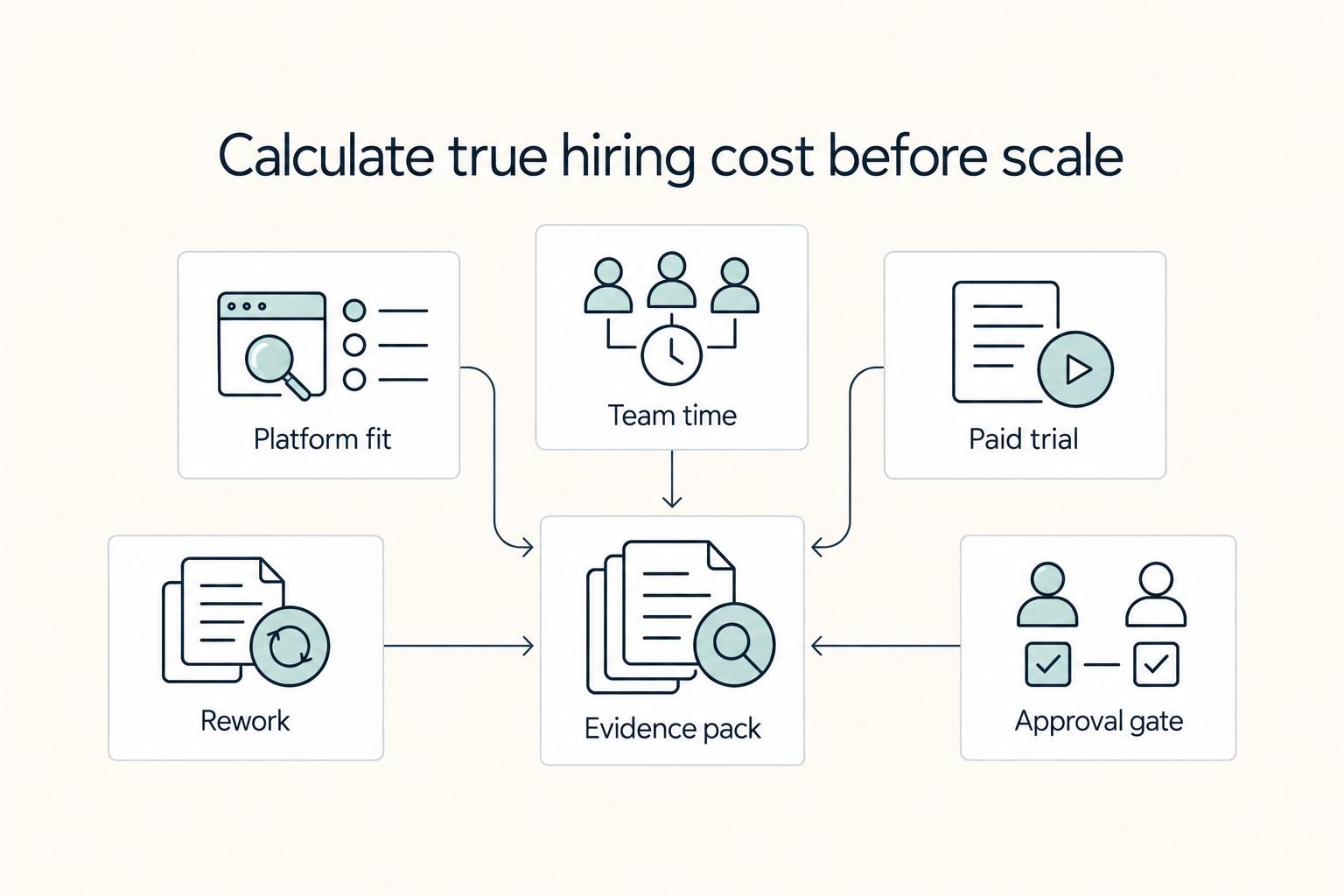
Treat true hiring cost as the decision number, not the headline rate. Useme's 31 March 2026 guide notes that the wrong platform can slow outcomes and affect both speed-to-work and achievable rates, so use a pre-commit checklist in a fixed order.
| Step | Focus | Key check |
|---|---|---|
| Platform shortlist | Start with fit, not popularity; keep niche platforms in consideration when the role is specialist | Verify the platform's official pricing page, payment methods, and safety features before approval |
| Role economics | Define expected output, internal owner time, likely revision load, and your maximum acceptable total cost if the hire underperforms | Include your team's labor, not just platform fees; even low-fee hiring workflows can require 4-6 hours of initial setup and 2-4 hours per hire ongoing |
| Small paid trial | Run one contained paid assignment before scaling spend | Lock acceptance criteria, revision limits, and handoff format in writing |
| Quality variance review | After the trial, review coordination load, onboarding burden, and where rework appeared | Keep an evidence pack: original brief, scope changes, message thread, final deliverable, and rework notes |
| Scale with approval gates | Increase budget only after delivery and budget owners both approve quality and true cost, including replacement risk | Treat LinkedIn, Reddit, and YouTube sentiment as input, not decision authority |
Key check: verify the platform's official pricing page, payment methods, and safety features before approval. Jobbers' 7 March 2026 guide warns fee structures change frequently, so do not budget from screenshots or forum posts.
Key check: include your team's labor, not just platform fees. Even low-fee hiring workflows can require 4-6 hours of initial setup and 2-4 hours per hire ongoing.
Key check: lock acceptance criteria, revision limits, and handoff format in writing.
Key check: keep an evidence pack: original brief, scope changes, message thread, final deliverable, and rework notes.
Key check: treat LinkedIn, Reddit, and YouTube sentiment as input, not decision authority.
For a step-by-step walkthrough, see Best invoicing apps with Stripe for freelancers and small teams in 2026.
The best freelancing website in 2026 is usually the one that fits your job design, budget band, and operating constraints, not the one with the most name recognition. Use popularity as a signal of supply, not as proof of fit. If you want a decision you can defend to finance, product, or leadership, tie it back to scope clarity, screening effort, and the cost of a bad match.
Keep a few closing rules in front of you so the choice stays practical:
Put narrow, easy-to-score tasks on marketplaces where speed matters and the deliverable is obvious. When scope may evolve or span multiple skill bands, a broader marketplace can make more sense, including platforms that show categories like AI & emerging tech. What matters is not brand prestige, but how much filtering control and coordination effort your team needs.
A broad article can help you build a shortlist, but it should not decide budget on its own. For example, Hostinger publishes a list of 25 freelance websites, dated Jan 13, 2026, which is useful for scanning the market. What matters here is evidence quality: a long list tells you what exists, not which option will lower rework or hiring drag for your specific use case.
Low-competition platform advice can be worth testing, but not trusting blindly. The visible Jobbers excerpt in this source set is mostly consent and cookie interface text, not strong evaluative detail, so it cannot support confident claims about platform quality. What matters is verification discipline: if a source cannot show its logic clearly, move it into the "test" bucket rather than the "commit spend" bucket.
Gigradar's framing around "free or less expensive" alternatives is a good reminder that price positioning alone is not enough. Run a small paid pilot with the same brief, budget cap, acceptance criteria, and handoff format across one or two shortlisted platforms, then compare close rate, cycle time, and rework. What matters is measurability: a cheap channel gets expensive fast if your team spends hours rewriting briefs, chasing revisions, or replacing a failed hire.
One red flag matters more than most: if you cannot assemble a basic evidence pack before kickoff, you are not ready to compare platforms fairly. Keep the brief, sample deliverable, success metric, message thread, final output, and rework notes. That gives you a commercial record of why a platform worked, why it failed, and whether the next dollar should go to a broad marketplace, a curated network, or a lower-cost alternative.
Related reading: Best Sales Enablement Tools for a Business-of-One in 2026.
There is no single verified winner for beginners, so do not treat any roundup as the answer. Pick the platform where your task type is easy to place, buyer support is visible, and the official pricing page is clear. That matters because even polished rankings can carry incentives: Website Planet says its list is based on testing and research, and also discloses affiliate links on the page last updated February 27, 2026.
Fiverr can be a practical choice when the brief is narrow, the output is easy to judge, and speed matters more than deep screening. A broad marketplace can be a better fit when you need wider hiring coverage or expect the role to change after kickoff. One public navigation includes categories like Development & tech and AI & emerging tech, which is a useful signal for mixed technical sourcing. If you are unsure, run the same paid trial brief on both and compare time to acceptable output, rework, and message quality.
They are worth testing, but not trusting blindly. The Jobbers scrape available here is too thin to prove ranking quality or marketplace reliability, so treat it as a hypothesis about visibility, not proof of better hiring outcomes. The practical check is a fixed pilot window with the same brief and budget cap, then measure close rate, cycle time, and rework against a larger marketplace.
Start with the work, not the brand. Open marketplaces can fit repeatable work and lower-risk scopes where you can define the deliverable tightly, while curated networks can fit specialist or higher-stakes work where a mismatch is expensive. A simple checkpoint is whether you can write a sample deliverable, success metric, and handoff format before you post the role.
The posted rate can be only one part of the mistake. Extra cost often shows up in your time: briefing, screening, onboarding, revision management, and replacement when the first hire fails. Keep an evidence pack with the brief, acceptance criteria, message thread, final deliverable, and rework notes, because vague scope is a common failure mode.
Use curated options when leadership time is expensive and the cost of a wrong hire is high. You may be paying for tighter matching and less screening work, which can reduce total cost even if the headline rate is higher. Stay with open marketplaces when you need lots of experiments, flexible scope, or a wider candidate pool before narrowing the field.
Sarah focuses on making content systems work: consistent structure, human tone, and practical checklists that keep quality high at scale.
Includes 7 external sources outside the trusted-domain allowlist.
Educational content only. Not legal, tax, or financial advice.

If you are looking for the **best author websites**, you probably do not need another gallery of attractive sites. **Short answer:** the best ones make the next step obvious, present you credibly, stay easy to maintain, and do not quietly decay between launches. Reedsy has a 13-example roundup, and Charlotte Duckworth Studio shares 22 sites for inspiration. Those are useful for taste and ideas. They are less useful when you need to decide what to publish first, what to cut, and what your site needs to do right now.

Before you scale cross-border freelance hiring, make one decision first: are you working from evidence you can actually use, or from broad trend claims that sound bigger than they are? That matters more than the headline. If your records are weak, fast sourcing can turn into compliance gaps or classification risk long before it becomes useful capacity.

For a freelance professional, the code editor is not a minor preference. It is the factory floor of your business of one, a core asset that shapes profitability, client trust, and your ability to keep operating well under pressure. Every minute spent fighting your tools, hunting for context, or repeating work that could be automated is time you cannot bill.