
Quick Answer
Pick from three lead options first: Mexico City for repeatable long-stay variety, Bangkok for fast first-month momentum, and Osaka for precision-focused food routines. Then pressure-test your choice before paying deposits. Use the article’s scorecard (food fit, stay practicality, relocation friction), run a first-week validation sprint, and keep a backup city active if safety, housing, or admin confidence is weak. Treat Lima and Marrakech as research-status options until city-specific evidence is verified.
Start Here and Pick Your Food City With Confidence#
Pick one city in one sitting, then move to your own practical checklist before booking. If your default style is slower city immersion, compare your choice against Best Digital Nomad Cities for Slow Travel. The goal here is food-focused city selection, not a definitive relocation plan.
| Step | Focus | What to note |
|---|---|---|
| Stay horizon | Short, medium, or longer | A place that works for a quick visit may feel different over time. |
| Primary win condition | Everyday variety, street-food density, or culinary craft depth | Conflicting priorities usually stall the decision. |
| Friction checkpoint | Top three unknowns | Budget fit, housing options, or daily logistics. |
| Red-flag rule | Food win vs practical fit | If one option wins on food but loses badly on practical fit, pause and compare your second choice before paying deposits. |
This shortlist is directional, not a scientific ranking. Many food-city lists are opinion-led, and some are openly personal takes. One list comes from a traveler reflecting on visits across more than 35 countries and five continents. Another is a social "Top 5 foodie cities" challenge post. That gives you signal, but limited certainty. Treat this as a starting point, then verify your constraints before booking.
Before you commit, run this quick decision pass and be explicit about what you still do not know:
- Define your stay horizon first: short, medium, or longer. A place that works for a quick visit may feel different over time.
- Set one primary win condition: everyday variety, street-food density, or culinary craft depth. Conflicting priorities usually stall the decision.
- Run a friction checkpoint: list the top three unknowns that could affect your plan, such as budget fit, housing options, or daily logistics.
- Apply a red-flag rule: if one option wins on food but loses badly on practical fit, pause and compare your second choice before paying deposits.
The source mentions are uneven:
- Paris: ranked first in one personal-memory list.
- Lima: included in a subjective "Top 5 foodie cities" social post.
- Bangkok: included in a subjective "Top 5 foodie cities" social post.
- Mexico City: included in a subjective "Top 5 foodie cities" social post.
If you want a food-first nomad base, choose the option that clears both your food bar and your practical bar, not the one with the loudest hype.
Who This List Is For and How to Score Cities#
Use this section if you are planning a real 3 to 12 month remote-work stay and want both strong food life and a workable day-to-day setup. Skip it if your only goal is the lowest rent or nightlife volume.
| Score area | Range | What it covers |
|---|---|---|
| Food fit | 0 to 40 | How well the city matches your eating goals, from daily variety to cuisine depth. |
| Stay practicality | 0 to 35 | How sustainable costs, connectivity, and neighborhood life feel for your intended stay. |
| Relocation friction | 0 to 25 | How quickly you can verify visa path, required documents, and first-month admin steps. |
With so many people trying to live and work abroad, city rankings get noisy fast. A practical decision usually comes down to reliable internet, safety, visa options, affordability, and then food quality layered on top. If you need a city-operations benchmark for daily routines, London, UK: A Guide for Expats and Remote Workers is useful as a comparison frame.
Score each city once, in one sitting:
- Food fit (0 to 40): How well the city matches your eating goals, from daily variety to cuisine depth.
- Stay practicality (0 to 35): How sustainable costs, connectivity, and neighborhood life feel for your intended stay.
- Relocation friction (0 to 25): How quickly you can verify visa path, required documents, and first-month admin steps.
Use these tie-breakers by timeline:
- 3-month stay: Break ties toward faster landing and lower setup drag.
- 12-month stay: Break ties toward repeatable food routines and admin predictability over novelty.
Use a numeric decision gate before deposits: target at least 70 of 100 total points, require 25 or more in food fit, and require 18 or more in stay practicality. However, if relocation friction drops below 12, keep a backup city active and pause final booking.
If visa or document certainty is your top constraint, favor setup clarity over culinary hype in Mexico or Thailand. For a practical documentation benchmark, review Thailand's Long-Term Resident (LTR) Visa for Professionals. Verify current requirements on official government sources before booking, because rules can change.
If culinary specialization is your top priority, weight cuisine depth more heavily in Japan or Peru, even if setup takes more effort. That tradeoff works if you accept a slower start and keep a timeline buffer.
If you want a deeper dive, read Hungary's White Card for Digital Nomads: A Complete Guide.
Compare the Top Foodie Cities at a Glance#
Read this as a decision scaffold, not a verified ranking table: only Osaka is explicitly named in a 2024 food-travel feature, so you should validate each city with your own checks before committing.
| City | Best for | Food strengths to test | Likely friction points | Ideal stay length (planning assumption) | Not ideal if |
|---|---|---|---|---|---|
| Mexico City | Long-stay optimizer | If salbute and panucho are priorities, verify realistic weekly access near your base. | Unknowns in housing, routine setup, and admin steps can delay a smooth start if unchecked. | Set after your first-week validation sprint. | You want fully confirmed routines before arrival. |
| Bangkok | First-time nomad | If Pad thai and Khao soi are must-haves, test repeatable access across your likely work/living zones. | Early convenience can hide gaps in Wi-Fi consistency and daily setup quality if you do not test broadly. | Set after your first-week validation sprint. | You prefer slower, less checklist-driven decision making. |
| Osaka | Culinary deep dive | Build around your target dining priorities; if Kobe beef is one, confirm fit with your monthly budget and routine. | Higher confidence is needed on costs, admin sequence, and day-to-day practicality before locking plans. | Set after your first-week validation sprint. | You need the lowest-friction setup path first. |
| Lima | Culinary deep dive | Define your must-eat categories first, then confirm everyday access near your intended base. | Visa/document uncertainty can stall decisions if not clarified before booking. | Set after your first-week validation sprint. | You are not ready to front-load paperwork checks. |
| Marrakech | Budget-sensitive explorer | Test whether your preferred meal rhythm is easy to sustain week over week. | Day-to-day variability may create drag if your process depends on rigid predictability. | Set after your first-week validation sprint. | You want highly fixed routines with minimal adaptation. |
If your scores are close, break ties with one checkpoint: choose the city where you can verify good Wi-Fi, fresh-food access, and document readiness in the same week.
Mexico City Wins for Everyday Variety and Long-Stay Momentum#
Treat Mexico City as the right long-stay pick only if your routine stays repeatable after month one and your risk checks stay current.
The fit is strongest for remote professionals who care about day-to-day meal repeatability, not just a short burst of standout meals. A long-stay nomad account describing 3,650 hotel nights across more than 120 countries reinforces the same practical test: can your weekly routine hold up over time?
Before you commit, run these pre-checks in one sitting:
- Rhythm check: Build a 14-day meal map across at least two neighborhoods, including weekday lunches and late workday dinners.
- Friction check: Confirm official travel guidance is current for the areas you plan to use, and timestamp your notes.
- Housing-food fit check: Shortlist housing only after mapping grocery access, commute time, and backup meal options for busy days.
- Decision gate: If food variety looks strong but your confidence on safety or operations is weak, delay deposits and keep a second city active.
The tradeoff is clear: the upside can be high, but conditions are not uniform and assumptions age quickly. A travel advisory tied to incidents in Jalisco, updated February 24, 2026, is a useful reminder to verify local conditions and keep your notes current.
Bangkok Wins for Street-Food Density and Fast Landing#
If first-month momentum matters most, Bangkok is a practical pick: you can get into a steady work-and-meal routine quickly.
It is a strong fit if you want immediate range rather than a long discovery ramp. One current city guide describes Bangkok as offering everything from top-end dining to street food, with transport that is cheap and easy to use. In a city of more than 8 million people across 1600 square kilometers, that mobility is a real day-to-day advantage.
Use this quick fit test before you commit:
- Access test: Build a 7-day meal map with two meal windows per day, then check if each option is reachable by public transport or a short ride.
- Mobility test: Confirm at least two transport options near your base, such as rail plus taxi, Grab, or tuk-tuk.
- Scale test: Keep month one focused on a primary zone and one secondary zone so weeknights stay manageable.
- Variety test: Add backup meal spots early so convenience does not narrow your routine too quickly.
The upside is speed: frequent local eating can start fast, and getting around is usually straightforward. The tradeoff is that convenience can pull you into the same few nearby places unless you plan for variety from the start.
Before you pay deposits, sanity-check neighborhood and transport assumptions against current city info (for example, a guide updated Feb 5, 2026).
On this shortlist, choose Bangkok when you need quick momentum; if you prefer slower, neighborhood-led depth, Mexico City may be the better fit.
Osaka Wins for Precision and Deep Culinary Craft#
If food precision and repeatable craft matter more to you than broad affordability, Osaka is the stronger pick.
Its advantage is focused culinary depth. A current food guide frames Osaka as a strong destination for food enthusiasts, highlights diverse offerings, and points to clear local anchors like takoyaki, okonomiyaki, and kushikatsu. For a multi-month stay, that makes it easier to build a routine around comparison and consistency, not just one-off novelty.
Use a focused first-month tasting plan:
- Takoyaki: Repeat it across neighborhoods to compare everyday consistency.
- Okonomiyaki: Revisit different spots to spot house-style differences and personal fit.
- Kushikatsu: Add it early so your rotation stays broad within a clear local food identity.
Freshness still matters. One referenced guide was published on August 15, 2024, so treat it as a starting point and verify what is currently open near your target neighborhood.
There is a real tradeoff: food depth is covered in detail, but do not assume that extends to budget thresholds, visa pace, or admin friction for Japan. Keep a separate pre-booking checklist for those non-food decisions.
On this shortlist, choose Osaka when food quality precision matters more than broad affordability. If your month one depends on faster setup and fewer unknowns, keep Osaka high for food value but not as the default first pick.
Lima and Marrakech Are High-Reward Picks With Different Tradeoffs#
Do not finalize either city yet. Keep both as high-upside options in research status until you complete a quick verification pass.
Verify food fit, long-stay fit, cost, safety, and admin realities for Lima and Marrakech directly before committing to either city.
- Lima (working hypothesis, not confirmed): Potential fit if you want a strong local food identity and clear meal-to-meal variation.
- Marrakech (working hypothesis, not confirmed): Potential fit if you want a dense market-driven food environment.
Before you rank either city, verify three current, city-specific items for each one: one practical stay item, one repeatable weekly eating-pattern item, and one neighborhood-fit item tied to your schedule. If that minimum is not met, defer booking and keep the city unranked.
Use This 90-Day Relocation Checklist Before You Book#
Use this as a planning template, not a legal framework: proceed only when food fit and relocation readiness both clear your minimum threshold.
| Days | Phase | Key items |
|---|---|---|
| 1-21 | Research and shortlist | Food fit, internet reliability, expected rent burden, and stay-path clarity. |
| 22-45 | Pre-departure paperwork pack | Passport validity check, accommodation proof, insurance record, and income evidence. |
| 46-60 | Arrival week setup plan | Internet test steps, backup workspace options, and a temporary housing spend cap. |
| 61-90 | First 30-day verification | Work stability, repeatable food routine, monthly burn rate, and a tax-admin hygiene check. |
Reliable internet, manageable costs, and a clear stay path should be tested early. For remote work, 25 Mbps download is a practical comfort benchmark, and rent is usually the biggest cost pressure.
- Days 1-21: Research and shortlist
Build a simple scorecard for each city: food fit, internet reliability, expected rent burden, and stay-path clarity. Keep only places you would realistically stay for at least a month.
- Days 22-45: Pre-departure paperwork pack
Prepare your core documents early: passport validity check, accommodation proof, insurance record, and income evidence. Keep visa-path notes as comparison logic only; if you use the Hungary White Card as a reference point, treat it as a benchmark, not a requirement template.
- Days 46-60: Arrival week setup plan
Define first-week actions before you fly: internet test steps, backup workspace options, and a temporary housing spend cap. Add a pass/fail check for week one so you can switch to a backup plan quickly if core conditions miss your baseline.
- Days 61-90: First 30-day verification
Verify real conditions against your plan: work stability, repeatable food routine, and monthly burn rate. For example, confirm your internet floor (25 Mbps or your own minimum) on at least 5 separate days in month one, then compare actual spend against your planned budget variance cap. Next, run a tax-admin hygiene check while records are fresh, including whether Home Office Deduction questions are relevant to your situation.
Common failure modes are predictable: choosing by food hype alone, skipping timeline buffers, and not setting a city-specific go/no-go date. Put that decision date on your calendar before you book.
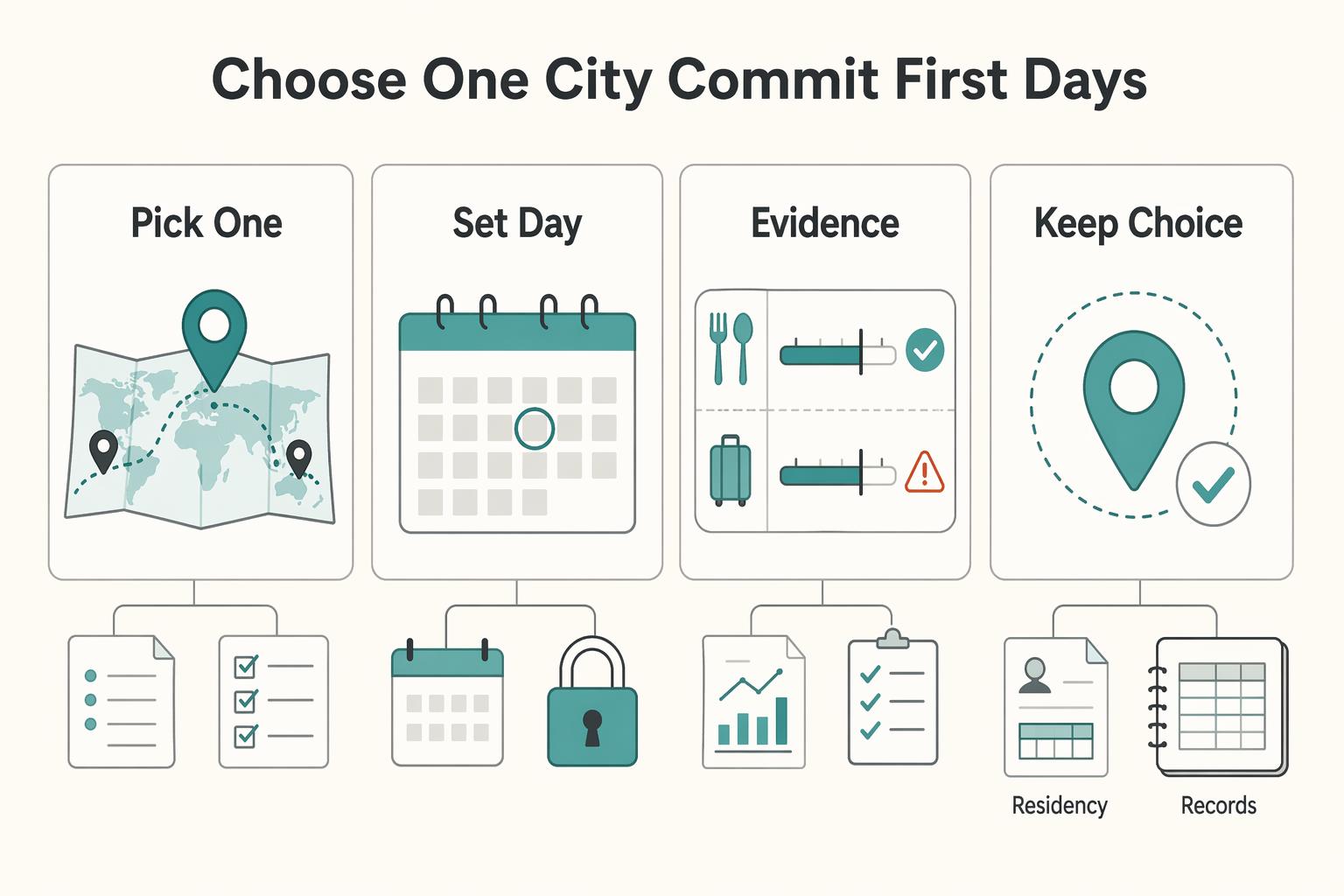
Choose One City and Commit to the First 30 Days#
Your best next move is to choose one city now and test it for 30 days against both bars: food fit and relocation fit. If it fails either bar, it is not your next base yet.
Recent reporting suggests the nomad map is shifting quickly, with large but non-official estimates of around 40 million people living this way and 60-70 countries offering some form of remote-work visa. More options can slow decisions, so use a fixed decision date and a fixed first-month plan.
- Pick one base from your shortlist. Commit to one city and pause every other option.
- Set day-30 pass/fail checks before booking. Define what must be true by day 30: reliable work setup, manageable monthly spend, and a food routine you can sustain week to week.
- Use a dated booking gate. Finalize flights only after your required documents, stay plan, and first-month budget notes are complete.
- Keep the choice personal. Even travelers with broad experience still choose one home base; prioritize your daily rhythm over online momentum.
Fill your comparison table, run your checklist, and lock your booking date. For a focused next step, review one targeted guide on tax positioning: Can Digital Nomads Claim the Home Office Deduction?. If your shortlist narrows to Portugal, use Lisbon vs Porto for Digital Nomads as a final side-by-side routine check.
Frequently Asked Questions
What are the best foodie cities for digital nomads right now?
Treat this as a practical shortlist, not an official global ranking. One community roundup grouped responses by popularity and dish picks, with clear mentions of Mexico City and Bangkok. Use that as a starting point, then apply your stay-length, visa, and setup checks before booking.
Is Bangkok or Mexico City better for food-focused nomads?
Choose based on eating style, not hype. The Bangkok option is tied to dish-specific pulls like pad thai, while the Mexico City choice appears in food-motivated picks like vegan tacos. If you want Thai-dish depth (including dishes like khao soi), start with Bangkok. If you want to focus on Mexico City-style taco exploration, start with Mexico City.
Which foodie nomad cities work best for long stays versus short stays?
Use a simple threshold: prioritize places you can test for about 30 days. One nomad account also notes that more time in a place can deepen the food experience, which supports longer stays when local depth is the goal. Short stays can still work, but they are better for sampling than for building a stable routine.
What paperwork should I prepare before relocating to a foodie city?
Before buying flights, organize your core records and confirm practical factors. Checks should include visa length, visa cost, internet quality, cost-of-living fit, and safety. The goal is to avoid a food-first choice that fails on basic relocation setup.
What should I verify in the first 30 days after arrival?
Use the first 30 days to confirm your setup works under normal work pressure. Check internet reliability and your real cost-of-living fit once daily routines start. Prioritize reliable daily conditions over a perfect-looking first month.
Is Osaka worth it if my top priority is daily food quality over lower-cost living?
This FAQ evidence set does not add new city-specific proof, so do not treat this as a hard ranking. If food quality is your top criterion, keep this option in consideration and run the same practical checks used elsewhere: visa terms, cost tolerance, and first-month setup stability. If those checks miss your threshold, choose the city that clears both food fit and relocation fit first.
Try a related tool
Researched and edited by the Gruv editorial team. Gruv builds cross-border billing, payouts, and finance-operations software for global businesses.
Sources
Includes 3 external sources outside the trusted-domain allowlist.
- academia.edu/50973375/Local_Food_and_Community_Empowermen...trusted
- academia.edu/33508368/A_Brief_History_of_User_Experience_...trusted
- holidaytourstravel.com/top-7-cities-perfect-for-digital-nomadsexternal
- nomadtravel.co.uk/blog/destination-guides/top-cities-for-foodi...external
- threads.com/@nivtravels/post/DU4Xrchk-7O/top-foodie-citi...external
Educational content only. Not legal, tax, or financial advice.
Related Posts

Hungary White Card Guide for Digital Nomads: Eligibility, Documents, Fees, and Timeline
Treat this like an audit, not a hope-and-pray submission. Your job is to decide whether your real-world setup fits the permit logic, pick the right filing route, then build one evidence pack that stays coherent even if someone reviews it line by line.

London, UK: A Guide for Expats and Remote Workers
Get two calls right early and the rest of the move gets easier: how you'll be in the UK, and where you'll work when conditions are less than ideal. Make those decisions before you lock dates or prepay a long stay. If you book first and sort the basics later, admin and work reliability usually collide in your first week.

Can Digital Nomads Claim the Home Office Deduction?
Claim the deduction only when your facts and records can carry it. With the home office deduction for digital nomads, the real decision is usually a three-way call: claim it, do not claim it, or pause and get help because your file is not ready.