

Quick Answer
Hungary's White Card is a residence permit for eligible third-country nationals who live in Hungary while keeping their employment relationship or company profit anchor outside Hungary. It fits remote workers whose work remains outside Hungary, but it does not allow gainful activity in Hungary or a share in a Hungarian company. A strong application needs consistent proof of work anchor, housing, and health coverage.
You're not looking for "visa vibes"-you need a White Card plan you can execute (and defend)#
Treat this like an audit, not a hope-and-pray submission. Your job is to decide whether your real-world setup fits the permit logic, pick the right filing route, then build one evidence pack that stays coherent even if someone reviews it line by line.
The goal is not "getting an application in." The goal is submitting a file you can defend without rewriting your story halfway through. If your actual work and ownership reality does not match the route, change course early and save yourself weeks of churn, rework, and follow-up loops.
What's official (and what's just chatter)#
If you want predictable outcomes, you need a strict source hierarchy. Not because other guides are "bad," but because they tend to blend rules, anecdotes, and channel-specific quirks into one confident-sounding narrative.
| Source | Role | How to use it |
|---|---|---|
| OIF | Authority for eligibility framing and residence permit rules | Treat OIF language as the definition of truth for what the permit is and what it is not |
| Hungarian diplomatic or consular mission | Sets the practical intake checklist for mission-abroad filings | Confirm appointment mechanics and document acceptance before fixing dates |
| EnterHungary | Electronic submission system | Keep records of every upload, version, and receipt |
| Third-party guides | Often blend rules, anecdotes, and channel-specific quirks | Ignore channel opinions until your exact filing conditions are confirmed |
Here is the hierarchy worth running:
- Official anchor #1 (rules and framing): OIF (the National Directorate-General for Aliens Policing) is the authority for eligibility framing and residence permit rules. Treat OIF language as your "definition of truth" for what the permit is and what it is not.
- Official anchor #2 (intake reality): If you file through a mission abroad, the Hungarian diplomatic or consular mission handling your case sets the practical intake checklist. This is where details like appointment mechanics and document acceptance can change your plan.
- Official anchor #3 (submission channel): EnterHungary is the electronic submission system. Treat it as a channel, not an authority. Your operator move is to keep your own records of every upload, version, and receipt, so you can prove what you submitted and when.
- Chatter filter (everything else): Third-party guides often present one channel as "the practical path." Ignore channel opinions until you confirm your exact filing conditions, because "easy for them" is not the same as "available for you."
This is how you stay grounded. Official rule first, then channel checklist, then your own documentation discipline.
Your decision, in one view#
This guide keeps coming back to one theme: the best plan is the one you can execute and defend. That starts with being clear about who does what in the system.
| Channel | What you can safely say | Your operator move |
|---|---|---|
| Hungarian consulate/mission | You may submit before a Hungarian diplomatic or consular mission in the country of your nationality, and in some cases where you are otherwise eligible to apply | Confirm mission-specific intake rules, appointment constraints, and document acceptance before fixing dates |
| EnterHungary | It is the online system used for electronic residence permit submission | Use it to submit clean files, then archive copies of everything you uploaded |
| OIF in Hungary | OIF is the immigration authority named in official residence permit guidance | If your case has in-country steps, verify exactly what must happen in person and when |
Notice the framing: you are not choosing "the best channel." You are selecting the channel your case can actually support, then planning for its constraints.
Outcome you want by end of this guide#
By the end, you should have three concrete outputs you can reuse:
- A one-sentence go or no-go decision you can explain without hand-waving.
- A reusable proof pack with consistent folder names and version control.
- A repeatable verification routine: official rule, then channel checklist, then final upload set.
If your plan survives those three tests, you are operating from process, not wishful thinking.
The White Card, defined (what it is and who it's for)#
The White Card is a residence permit pathway for eligible third-country nationals who live in Hungary while keeping their employment relationship or company profit anchor outside Hungary.
That framing is not branding. It is the core logic of the route. If your economic activity sits in Hungary, this is usually the wrong tool, and you will feel that mismatch everywhere: in your evidence, in follow-up questions, and in the strain of trying to "explain" something the category was not built to allow.
What the White Card actually covers#
Operationally, this permit is tied to remote work performed from Hungary while your verifiable work relationship remains outside Hungary.
Two restrictions shape almost every decision you will make:
- You do not pursue gainful activity in Hungary.
- You do not hold a share in a Hungarian company.
If either condition conflicts with your real plan, stop forcing fit. Choose a different route before you invest in filing costs, translation work, and scheduling.
Who counts as a "third-country national"#
In official phrasing, this generally means non-Hungarian nationals who are not persons with the right of free movement and residence, plus stateless persons. In practical terms, think "outside free-movement rights."
That distinction matters early because it changes what the "right process" even is. If you have free-movement rights, this path is usually not the first mechanism you should build around. If you are still comparing mobility options, use the global digital nomad visa index as a first-pass filter before forcing every question through the White Card.
White Card vs "digital nomad visa" language#
Many guides use "digital nomad visa" as shorthand. For planning, treat it as a residence permit framework with specific conditions, not a casual travel label. If your own notes still blur travel permission and residence status, clean that up with the same discipline you would use in a digital nomad visa vs tourist visa comparison.
The clean way to think about fit is to run a small set of decision questions and answer them using evidence, not vibes:
| Decision question | If "yes," this route may fit | If "no," pause and reassess |
|---|---|---|
| Do you work remotely rather than locally in Hungary? | Your day-to-day location can be Hungary while work remains external | You likely need a different permission type |
| Is your work anchor outside Hungary and documentable? | You can prove the core outside-Hungary relationship | The application will be hard to defend |
| Can you respect both hard restrictions? | Your plan stays compliant with the route logic | You are building avoidable denial risk |
The fastest win is not speed of submission. It is clarity of fit before submission.
The 10-minute fit test: decide fast if the Hungary White Card is the right tool#
Run this screen before you collect documents. If you fail one gate, do not keep "optimizing" the file. Change route.
| Gate | What must be true | Stop signal |
|---|---|---|
| Status | You are a third-country national | If your status is unclear, resolve that first; EEA citizens staying more than 90 days follow a separate registration certificate process |
| Work anchor | You have a verified employment relationship in a country other than Hungary and work from Hungary using an advanced digital technology solution | If your evidence proves only one element, the file is structurally weak |
| Red-line restriction | You do not take local gainful activity in Hungary | If your plan includes working for Hungarian clients or taking local gainful activity in Hungary, stop |
| Ownership restriction | You do not hold a share in a Hungarian company | If you hold a share in a Hungarian company, this route does not match |
| Proof readiness | Your proof is clean on work anchor, health coverage, and housing | If the story changes across documents or coverage, address, or date support is unclear, pause before filing |
The point of a fit test is to protect your time. The failure mode is spending weeks gathering paperwork for a setup the category does not actually support.
Gate 1 - Status (are you even in-scope?)#
Start with category accuracy. This route targets third-country nationals. If your status is unclear, resolve that first and do not build a timeline on top of uncertainty.
If you are an EEA citizen planning to stay more than 90 days in Hungary, there is a separate process that points to a registration certificate. Do not mix that pathway with this one.
Gate 2 - Work anchor (can you prove the core condition?)#
You need both elements to hold at the same time:
- A verified employment relationship in a country other than Hungary.
- Work performed from Hungary using an advanced digital technology solution.
If your evidence only proves one element, your file is structurally weak. Fix the weak side before you proceed, because no amount of "extra documents" will compensate for a missing core condition.
Gate 3 - Red-line restriction#
This route is not built for local gainful activity. If your plan includes working for Hungarian clients or taking local gainful activity in Hungary, treat that as a stop signal.
Gate 4 - Ownership restriction#
The same logic applies to company ownership in Hungary. If you hold a share in a Hungarian company, this route does not match that setup.
Gate 5 - Proof readiness (the three buckets to sanity-check)#
You only need a quick diagnostic here. Ask whether your proof is clean in three buckets:
| Proof bucket | What you need to show | Decision rule |
|---|---|---|
| Work anchor | A verifiable outside-Hungary relationship and clear remote-work framing | If your story changes across documents, you are not ready |
| Health coverage | Insurance evidence that aligns with your filing channel requirements | If coverage language or dates are unclear, fix this first |
| Housing | Accommodation evidence that matches checklist expectations | If address or date support is thin, do not lock long commitments |
Pass all five gates and you are in a workable zone. Fail one and you save time by pausing now.
Eligibility, disqualifiers, and the "gotcha" scenarios competitors skip#
Most failed cases are not mysterious. They come from mismatch between real setup and permit logic, then weak handling of disqualifiers.
Treat this section as risk control. Your job is to remove avoidable ambiguity before you submit, not to "explain it later" after a follow-up request forces you to.
Pick one eligibility route and build evidence around it#
Choose one route and commit your file to that narrative. Reviewers should not have to guess which story you are telling.
The easiest way to create confusion is to blend an employee story with an owner-manager story in the same submission logic without a clean, consistent set of documents. If your evidence does support both, keep the framing consistent and do not make the reviewer do inference work.
| Route | What must be true | Evidence theme |
|---|---|---|
| Employee route | You have a verified employment relationship in a country other than Hungary and perform work from Hungary using an advanced digital technology solution | "I am employed abroad, and my work setup remains external while I live in Hungary" |
| Owner/manager route | You hold a share in a company with verified profit in a country other than Hungary | "My company profits abroad, and my operational anchor is outside Hungary" |
A good test is this: could a stranger summarize your route in one sentence after reading only your core proof documents? If not, simplify.
Don't hand-wave the two hard restrictions#
Do not treat these as fine print. Treat them as structural boundaries you build your plan around:
- No gainful activity in Hungary.
- No share in a Hungarian company.
If your business model, client mix, or ownership structure pushes against either boundary, take that tension seriously before you file. You can sometimes "make a story work" on paper, but you cannot operate a year inside a category that fights your actual life.
Treat disqualifiers like a preflight checklist#
Run disqualifiers before filing, not after receiving follow-up questions. OIF guidance includes "shall not be granted" scenarios, including cases where the applicant holds a residence permit for studies.
Two additional operational constraints are easy to miss if you only read marketing summaries:
- Family members of a White Card holder or applicant are not granted family reunification residence permit on that basis.
- During validity and after expiry of this permit, no other residence permit may be applied for another purpose.
Also factor in extension risk posture. One Hungarian law firm highlights denials where authorities conclude the permit was used mainly for travel rather than for staying in Hungary. Whether or not you rely on that interpretation, the operational lesson is the same: your residency behavior should match your stated purpose, and your records should support that.
The application timeline (decision points → submission → travel) that prevents delays#
A clean timeline is not a calendar. It is a dependency map. Your sequence matters more than your speed because most delays come from missing prerequisites, not slow typing.
Think in phases: decide your filing route, build a decision-ready file, submit through the channel your case supports, then plan travel separately so you are not forced into expensive changes.
Phase 1: lock your filing route (abroad vs online)#
Route logic first, always. This decision determines where you submit, what the intake checklist looks like, and what kind of appointment bottlenecks you may face.
- If you do not hold a residence permit and cannot enter Hungary visa-free, submission must happen abroad.
- If you can enter visa-free, an online filing route is commonly described.
- For filing abroad, the Hungarian embassy or consulate serving your citizenship or habitual residence is generally the relevant channel.
Do not book major travel around assumptions. Confirm route reality first, then build dates you can defend.
Phase 2: assemble a "decision-ready" file#
This is the phase that determines whether the rest of the process feels controlled or chaotic.
Decision-ready means consistent. Names, passport details, dates, and addresses should match across forms, letters, accommodation documents, and financial proof. If your narrative shifts between files, you create a follow-up cycle where you spend time re-explaining what you meant instead of moving the procedure forward.
Decision-ready also means legible. A reviewer should be able to answer basic questions without zooming into blurry scans, hunting for the address, or guessing which version is current. You are not trying to impress anyone. You are trying to make assessment easy.
Phase 3: channel choice + appointment reality#
Channel choice is operational, not ideological. Pick the channel your situation supports, then plan around its constraints.
| Filing channel | Who it fits | What to plan for |
|---|---|---|
| Online (EnterHungary) | Applicants using electronic submission, often in visa-free entry scenarios | Potential in-person steps can still apply. Plan buffers for those |
| Hungarian consulate (kulkepviselet) | Applicants who must submit through a mission abroad | Mission-specific checklists, appointment queues, and document acceptance rules |
Before you lock travel, get clarity from the exact mission handling your case on what it currently accepts and how it wants documents presented. Small differences between channels can create large timing delays.
Phase 4: submit, track, and reduce variance#
Submission is not a single click. It is the start of tracking.
Your job here is to reduce variance: fewer surprises, fewer mid-process changes, fewer "we already uploaded that" moments.
- Save every receipt, reference ID, and upload confirmation.
- Avoid avoidable profile changes mid-process, especially address changes or work narrative changes.
- Expect biometrics at submission: a facial image is taken, and fingerprints are recorded for applicants over age 6.
Treat your submission log as an operations file, not admin clutter. If you cannot quickly answer "what exactly did we submit, and when," you will struggle under follow-up pressure.
Travel planning (separate from the filing step)#
Keep travel planning as a separate workstream on purpose.
Your filing route, appointment constraints, and document follow-ups can move on a different timeline than housing and flights. If you tie them together too early, you end up making expensive decisions to protect dates that were never guaranteed.
Build buffers so you are not forced into non-refundable choices while the procedure is still moving.
The documentation pack: build it once, reuse it for renewal (with templates that work)#
The single most effective move in this process is building one reusable documentation system. Build it once, keep it consistent, and update it as facts change.
A good pack does two things at the same time: it satisfies checklists and it tells one coherent story.
1) Identity & forms (baseline, but failure-prone)#
Treat identity documents and forms as your master data layer. If this layer is messy, everything downstream becomes harder.
- Keep a valid passport and the required photocopies ready for your channel.
- Use one canonical spelling, one date style, and one address format across the entire file.
- Complete forms for legibility and consistency. The residence permit form includes instructions about clear completion and a designated area for facial photograph.
This is where many avoidable errors originate. Not because the topic is hard, but because people treat it as "just admin" and skip the consistency work.
2) Remote work proof (make it explicit)#
Do not rely on implied meaning. State your work arrangement in plain terms so a reviewer does not have to infer your reality.
A one-page employer statement can cover role, duties, remote work permission, and expected duration while confirming the relationship sits outside Hungary. If you are not in a standard employee setup, your job is still the same: create equivalent clarity so the reviewer can connect your evidence to the core condition without guesswork.
When in doubt, aim for "obvious on first read," not "technically true if you interpret it."
3) Income & funds evidence (separate streams)#
Separate income proof from liquidity proof so each document has one job. This keeps your narrative clean and makes follow-ups easier to answer.
| Evidence bucket | What it supports | Safe default |
|---|---|---|
| Income | Regular earning pattern tied to your route | Evidence covering the relevant recent period. Appendix 9.18 refers to income for the six months immediately preceding submission |
| Funds | Available liquidity and stability | Bank or account statements kept separate from income narrative documents |
This separation also protects you from a common failure mode: trying to use one document to prove three different things, then being surprised when the reviewer asks for a clearer version.
4) Accommodation + health insurance (answer the checklist directly)#
This is a checklist-driven part of the file. The fastest path is to map your evidence directly to the wording you are expected to satisfy and remove interpretation risk.
For accommodation, be ready to prove legal title of residence at the stated place and align dates with your application. For insurance, show full coverage details for the relevant period, with language that is easy to assess.
If either area is unclear, you do not "explain harder." You replace ambiguity with cleaner documents.
5) Expect follow-ups-and make them easy#
OIF's White Card appendix states the authority may request additional documents to clarify the facts during the procedure. Plan for that from day one.
A follow-up request is not a failure. It becomes a problem only when you cannot respond quickly because your files are disorganized or inconsistent.
Use topic-based folders, keep a one-page index, and maintain a "latest upload" folder so you always know what has already been submitted. Fast follow-up response is not luck. It is file discipline.
Evidence requirements: what OIF actually asks for (and how to make your pack easy to assess)#
"Complete" is not the target. "Assessable" is the target.
Your file should let a reviewer answer the key questions without cross-referencing six unrelated PDFs or trying to reverse-engineer what your work arrangement "probably" is.
Match your proof to the two eligibility routes#
Before final upload, build a simple route map and confirm every document supports that map.
| What needs to be clear | What your file should show | What to include |
|---|---|---|
| Route identity | Employee path or owner-manager path is consistent across documents | Employment records or ownership and profit records for the non-Hungarian entity |
| Remote-work framing | Work or management is performed from Hungary using an advanced digital technology solution | A direct statement inside your core work proof |
| Self-support | You can support yourself during stay | Bank statements and/or employment contract evidence aligned with your route |
When each document answers one question, review friction drops. When documents try to answer everything at once, reviewers ask follow-ups because they cannot confidently conclude anything.
Accommodation evidence: make dates and address unmissable#
Do not make reviewers hunt for basics. Front-load essentials so the address and date range are visible immediately.
- Put address and date range on page one of accommodation materials.
- Include evidence of reservation and payment when required.
- Keep accommodation dates aligned with the period requested in the application.
This is not about being fancy. It is about removing "where is it?" friction from the assessment.
Health insurance: prove coverage in plain language#
Insurance should be explicit, not implied.
Provide documentary evidence showing access to comprehensive health insurance services covering all healthcare services, or evidence that healthcare costs can be covered. Make coverage dates visible without scrolling through fine print.
If your insurance document reads like marketing copy, your pack should translate it into assessment-friendly facts by making the relevant clauses easy to locate.
Operator-grade file discipline (so you can respond fast)#
File discipline is the difference between a manageable procedure and a stressful one.
- Use consistent file names that describe what each document proves.
- Avoid generic labels like "misc."
- Keep one index page with file name, purpose, date, and current version.
When a follow-up request arrives, you should be able to respond in minutes, not days. That is how you keep momentum.
Money, processing time, and "as-of 2026" verification (don't get trapped by outdated numbers)#
This is where stale guidance causes avoidable mistakes. Treat all quoted numbers as perishable until you verify them for your exact channel.
| Topic | What the article says | Verification move |
|---|---|---|
| Income threshold | Competitor content often cites fixed figures; one commonly repeated number is EUR 3,000 net monthly legal income | If the current minimum is not clearly stated on official OIF or EnterHungary pages, do not publish a hard requirement |
| Processing time | Some professional guides report a 30 to 60 day processing range | Use it as planning slack, not a commitment date |
| Fees and payment methods | Commonly reported figures include EUR 110 from outside Hungary, and HUF 39,000 in person or HUF 24,000 online via EnterHungary for in-country cases | Confirm current schedules and payment methods for your exact route |
| Translations/apostille | Requirements can vary by document origin and filing channel | Confirm with the authority or mission handling your case before paying for document work |
Your operating principle should be simple: if you cannot verify it on the official pages you are relying on, do not build a plan that depends on it.
Income threshold: publish only what you can verify#
You will see competitor content cite fixed income figures, often with a required six-month proof window. One commonly repeated number is EUR 3,000 net monthly legal income.
As of 2026-02-18
- If the current minimum is not clearly stated on official OIF or EnterHungary pages, say that plainly and avoid publishing a hard requirement.
- If you can verify an official figure, direct readers to the exact official page path and tell them to re-check before filing.
The goal is accuracy you can stand behind, not confident-sounding numbers that may be outdated.
Processing time: not a promise#
Some professional guides report a 30 to 60 day processing range. Use that as planning slack, not a commitment date.
Build your life plan so it does not collapse if the decision arrives earlier or later than expected. That means not aligning leases, flights, or client milestones to a single "expected approval week."
Fees and payment methods: verify by filing channel#
Fee reporting varies by channel and currency. Commonly reported figures include EUR 110 for applications from outside Hungary, and HUF 39,000 in person or HUF 24,000 online via EnterHungary for in-country cases.
Treat those as likely baselines until you confirm current schedules and payment methods for your exact route. What matters operationally is not just the amount, but where and how payment is accepted.
Translations/apostille: confirm requirements, don't assume#
Translation, legalization, and apostille requirements can vary by document origin and filing channel.
Make this a formal checkpoint with the authority or mission handling your case before you pay for document work. The cost is not just money. It is also time, and time is usually the tightest constraint in a well-run application plan.
After approval: the operational reality check (tax, Schengen travel, housing, and staying compliant)#
Approval is the start of operations, not the end of compliance.
If you want renewal to feel straightforward, run a simple monthly routine that keeps your residency behavior, records, and overall posture aligned with the category you are using.
Tax residency is the silent constraint#
Tax posture is often driven by where you actually live over time, not by permit branding. A widely used trigger is spending 183 days in Hungary in a calendar year.
If you are near that threshold, get tax advice tailored to your nationality and treaty context, then document your decision logic. The Hungary tax guide is a useful orientation layer, but your real operator habit is keeping your reasoning and records organized so you can explain your posture consistently later.
Schengen travel: plan like rules change#
Schengen movement can feel straightforward until permit timing, renewal, or pending status enters the picture.
Before each trip window, verify what your nationality and current status require, and keep your travel documents aligned with that reality. Treat every trip as something you plan from your current status, not from what you assume your status "should be."
Housing continuity: reduce friction#
Housing is operational risk. Not because renting is hard, but because mismatches between what you file and where you actually stay create administrative drag.
Treat housing as staged operations. Start with compliant accommodation you can document cleanly, then move to a longer arrangement when your permit timeline is clear. That reduces the chance you have to explain avoidable changes mid-process.
Payments continuity + renewal readiness#
Renewal readiness is mostly record quality. The goal is being able to reconstruct your year without hunting across platforms.
Keep payer names and payment descriptions consistent across contracts, invoices, and payouts where possible. Export platform statements and store receipts in one structure so you can rebuild history quickly if you need to.
After 1 year / extension#
One source states the permit is issued for up to one year and may be extended once by an additional year. Treat that as a planning signal, then verify current rules with the immigration authority before you build a long runway.
The operator mindset here is simple: keep a backup plan in case extension assumptions change, and do not let a single renewal path become your only possible future.
Your next steps: a compliance-first checklist you can run this week#
Treat this as an execution sprint. The aim is to move from "probably eligible" to a file you can defend under follow-up, without rebuilding it from scratch.
1) Do the 10-minute fit test (be brutally honest)#
Run the five gates without optimism bias:
- Confirm your status and route fit.
- Confirm your remote and electronic work anchor is documentable.
- Confirm no gainful activity in Hungary.
- Confirm no share in a Hungarian company.
If one item fails, pause and redesign before spending money. Speed is not the goal. Clean fit is.
2) Open a "White Card proof pack" and start collecting#
Create one folder structure and keep it stable. The win here is not collecting "more documents." The win is collecting the right documents, named consistently, that tell one story.
A practical starter set (adapt it to your channel checklist) looks like this:
- Employer statement covering role, duties, remote work permission, and duration.
- Salary and work certificate.
- Bank statements for up to the previous six months and/or regular income certificate from employer or tax authority.
- Accommodation confirmation and supporting ownership documentation where your checklist requires it.
- Travel insurance valid in the Schengen Area for at least the first 30 days, with EUR 30,000 minimum coverage where your checklist requires it.
- Submission receipts and appointment confirmations.
Expect follow-up requests and make your files easy to update. If you build for follow-ups now, you will not panic later.
3) Verify the moving parts "as of 2026-02-18"#
Do a same-day verification pass before submission:
- Confirm current disqualifier language.
- Confirm translation, apostille, and legalization expectations for your issuing country.
- Confirm current processing guidance and treat timing as a floor, not a guarantee.
Write down what you verified and when. Your future self will thank you when you need to reference the exact checklist version you built against.
4) Build your timeline backward from arrival#
Work backward from intended arrival and add buffers for appointment lead times, document issuance, translation or legalization work, and potential follow-up cycles.
A tight timeline without buffers is not efficient. It is fragile. Your objective is a plan that stays intact under normal variance.
5) If you're comparing options, cross-check before you commit#
If your options set is still open, compare routes before you lock dates and costs. Then pressure-test tax residency risk so your move plan and tax plan do not conflict.
The best final decision is the one you can operate for twelve months without constant rework.
Frequently Asked Questions
What is the Hungary White Card?
The Hungary White Card is a residence permit pathway for eligible third-country nationals who live in Hungary while keeping their work relationship anchored outside Hungary. In practice, it is designed for remote professionals whose economic base remains outside Hungary.
Is the Hungary White Card a visa or a residence permit?
Treat it as a residence permit framework, not as casual visa shorthand. What matters is whether your day-to-day work and residency behavior match the permit's conditions and restrictions.
Who is eligible for Hungary's White Card (and are EU/EEA citizens eligible)?
Eligibility centers on a verified employment relationship outside Hungary or ownership in a company with verified profit outside Hungary, with work or management carried out from Hungary using an advanced digital technology solution. The route targets third-country nationals. EU and EEA citizens generally use a different process.
Can I work for a Hungarian company on a White Card-or take Hungarian clients?
No. The route is built around no gainful activity in Hungary and no share in a Hungarian company. If your plan depends on Hungarian clients or local company participation, this is the wrong fit.
Can freelancers apply for the Hungary White Card?
Freelancers may fit only if their setup is organized through a company outside Hungary with verified profit, which aligns with the owner-manager route. The label matters less than whether your documents match the route's logic. If the structure is not clear, confirm it before filing.
What documents do I need for the Hungary White Card (and do they need translation/apostille)?
A common baseline includes a completed application form, the relevant appendix often referenced as Appendix 9.18, and a full copy of a valid passport. Your wider file should also support your work anchor, funds, accommodation, and insurance. Translation, apostille, and legalization requirements vary by jurisdiction and channel, so confirm them directly for your case.
How long does the Hungary White Card take to process, and can I travel in the Schengen Area while it's processing?
One published checklist states a minimum processing time of 30 calendar days, but timing should not be treated as a promise. Schengen travel during processing depends on nationality, filing route, and current status. Verify your exact situation before booking non-refundable travel.
Try a related tool
Researched and edited by the Gruv editorial team. Gruv builds cross-border billing, payouts, and finance-operations software for global businesses.
Sources
Includes 5 external sources outside the trusted-domain allowlist.
- enterhungary.gov.hu/ehtrusted
- enterhungary.gov.hu/ehtrusted
- oif.gov.hu/factsheets/white-card-residency-for-digital-...trusted
- airon.hu/service/white-card-digital-nomad-visaexternal
- airon.hu/service/white-card-digital-nomad-visaexternal
- hungaryvisa.org/visas/digital-nomad-visaexternal
- hungaryvisa.org/visas/digital-nomad-visaexternal
- lawyershungary.com/hungary-digital-nomad-visaexternal
Educational content only. Not legal, tax, or financial advice.
Related Posts
Budapest Digital Nomad Guide for 2026 Remote Professionals
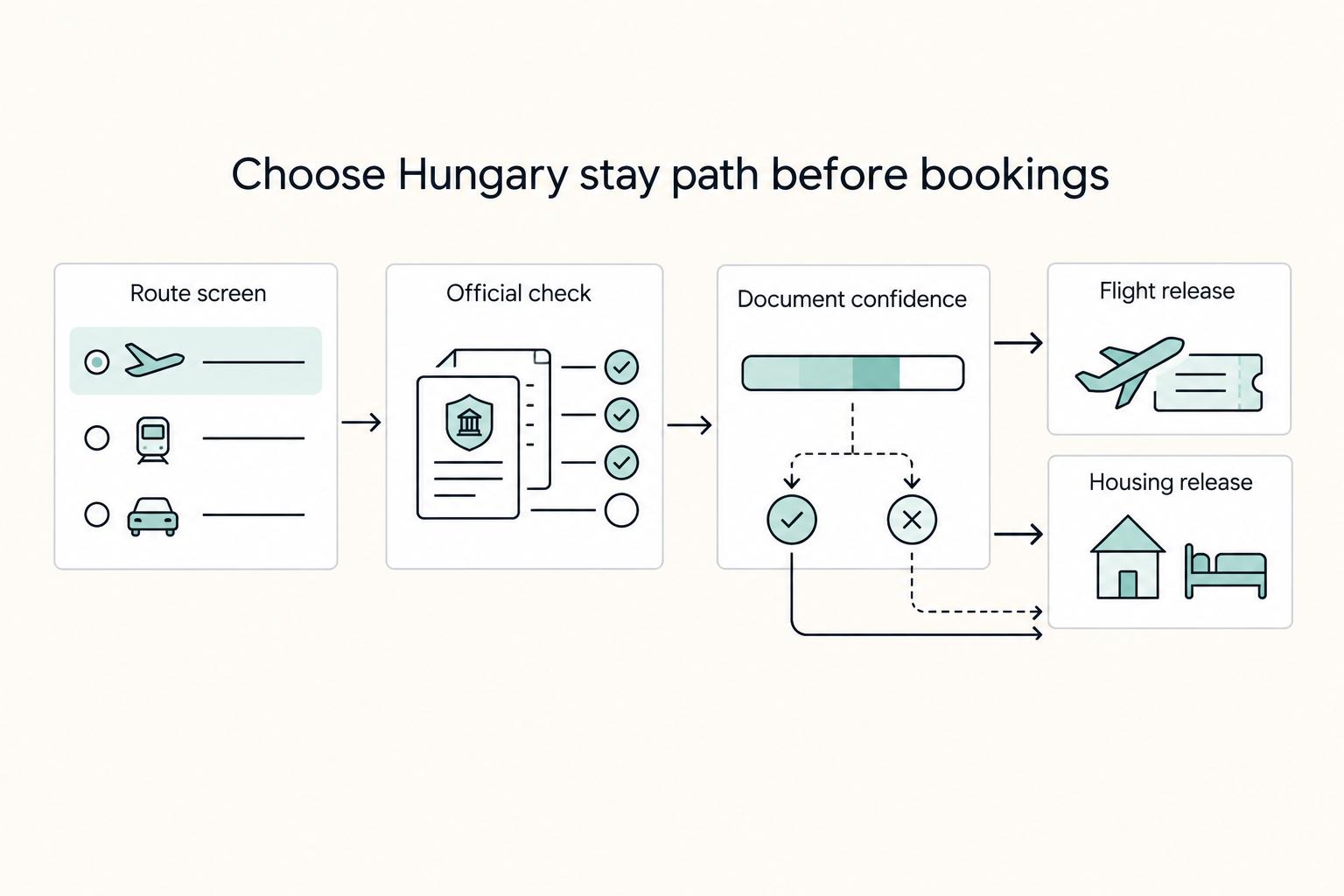
Your first decision is not where to live in Budapest. It is whether your Hungary stay route fits your passport, income, and remote work setup. Until that answer is solid, do not lock in nonrefundable flights or a long apartment contract.

The 2026 Global Digital Nomad Visa Index for 50+ Countries
Start with legal fit, not lifestyle filters. The practical order is simple: choose a route you can actually document, then decide where you want to live. That single change cuts a lot of wasted comparison work and stops you from falling in love with places that were never a real filing option.

Freelancer Tax in Hungary for Defensible Residency and VAT Decisions
Before starting a Hungarian business activity, check that your immigration status permits it and complete the required business registrations. In parallel, document your tax-residence facts and choose eligible income-tax and VAT treatments. These questions interact, but an unresolved residency issue does not suspend a registration, invoice or filing deadline.