
Quick Answer
Choose Porto if lower monthly pressure and a calmer weekly rhythm are your priority, and choose Lisbon if you need denser networking and event access. Then run a 7-day real-life test around work hours, errands, and commute patterns before you pay deposits. Keep housing outreach behind your Portugal Digital Nomad Visa (D8) document file so bookings do not move faster than your paperwork.
Start here and pick your city in 30 minutes#
Choose your city first, then build the rest of the move around that choice. When people reverse the order, housing research, admin prep, and booking decisions start pulling in different directions.
For a long stay, this is a weekday decision, not a weekend mood check. The Lisbon-or-Porto call for a digital nomad stay should reflect where you can work steadily, recover properly, and keep momentum for months.
Use social threads for prompts, not proof. Quick city comparisons can help, but only after you test them against your own budget limits, schedule, and stress tolerance.
What matters most is not which place sounds more exciting in the abstract. It is which one lets you repeat a normal Tuesday without unnecessary friction. Can you get through your real meeting load, handle errands, and still have enough energy left for exercise, social time, or rest? That is the long-stay question.
| Decision criterion | Lisbon | Porto | Confidence right now |
|---|---|---|---|
| Daily work tempo | One guide frames Lisbon as more energetic, which may suit people who want more activity | The same guide frames Porto as more charming, which may suit people who want a calmer rhythm | Medium: directional, needs personal test |
| Lifestyle feel | Commonly described as higher energy | Commonly described as more charming | Medium: subjective by person |
| Long-stay risk signal | Long-stay challenges can show up if routines and support are weak | Long-stay challenges can show up if routines and support are weak | High: fieldwork reports loneliness, social isolation, and career instability |
| What to verify before committing | 7-day trial around your real work hours and commute pattern | 7-day trial around your real work hours and social needs | High: direct personal validation step |
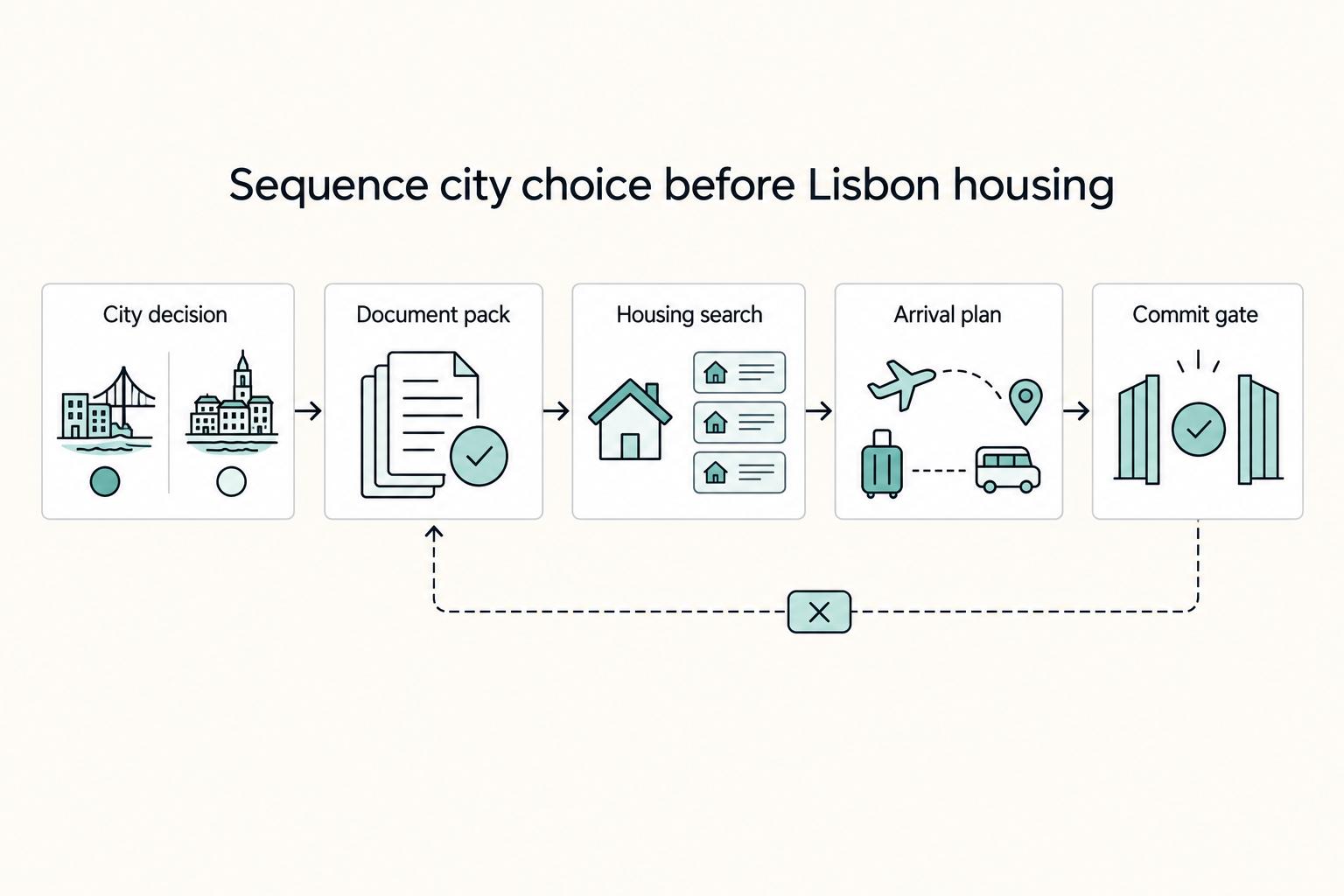
Use this sequence: city decision, then document pack, then housing and arrival timing linked to your visa and paperwork timeline. Before you compare neighborhoods, set two checkpoints:
- Write your non-negotiables on one page: housing ceiling, weather tolerance, social bandwidth, and commute tolerance.
- Stress test your choice against common long-stay failure modes such as loneliness, social isolation, and career instability.
During that quick decision window, stay focused on the criteria that can actually break the move. If a city creates too much rent pressure, too much movement friction, or too little support for the work rhythm you actually keep, that should outweigh any broad lifestyle claim. Once you lock the city, later decisions get cleaner because your shortlist, route testing, and document pack all point in the same direction.
A 30-minute decision works when you lock constraints first, make the call, and stop reopening the city debate every week. With that filter in place, the side-by-side comparison becomes much more useful.
Lisbon and Porto at a glance for long-stay nomads#
Start with the city more likely to protect your budget and weekday energy, then validate that hunch with a short live test before you book anything.
| Criteria | Lisbon | Porto | Confidence |
|---|---|---|---|
| Monthly cost pressure | Portugal-wide nomad guides cite about €1,400-€1,900 per month overall, but that is not Lisbon-specific and can shift by area and season. | Same limitation: the range is useful nationally, not a Porto-only number. | Medium for the national range; low for city-level budgeting until you price real listings. |
| Weather comfort | Portugal is often chosen for its warm climate, but city comfort is still seasonal and personal. | Same: Portugal-level climate appeal is supported, but personal comfort in Porto needs live testing. | Medium for Portugal-level direction; low for city-specific fit. |
| Transport coverage | Confirm with your mobile carrier. | Confirm with your mobile carrier. | Low; verify with your actual commute routes and times. |
| Walkability | Test Baixa and Alfama during your real workday pattern. | Test Ribeira during your real workday pattern. | Low; neighborhood experience is personal and not scored here. |
| Networking access | Lisbon is described as highly visited by nomads, with startup activity and plentiful coworking/cafes. | Porto is often described as more intimate in feel. | Medium for directional fit; low for personal outcomes. |
| Weekend escape options | Trial from Principe Real and Santos to see how easily your weekend routine starts. | Trial from Cedofeita and Bonfim using the same timing test. | Low; practical confidence comes from a live trial. |
Use the table to narrow the choice, not to make it for you. If one city looks better on paper, your next job is to test whether that advantage survives a normal workweek. A place that feels great during a relaxed afternoon can feel very different once you stack meetings, errands, and a bad night of sleep on top of it.
Run a 7-day simulation before committing: normal work hours, a backup workspace, and one weekend departure rehearsal. If both cities tie on lifestyle, decide by budget resilience and commute tolerance first.
When you run that simulation, do not behave like a visitor. Wake up on your usual schedule, take calls from the kind of environment you would actually use, and move through the area at the hours that matter for your job. Notice how hard it is to find a quiet backup spot, whether basic errands interrupt your work block, and whether you still like the area after a long day rather than after a leisure walk.
Small frictions start to show up here. If you keep needing a workaround for noise, a longer ride than expected, or a missing backup option when a cafe is full, that is useful evidence. For a long stay, the best city is often the one that feels slightly boring in the best way: simple to operate, easy to recover in, and stable enough that your work does not depend on good luck.
A useful way to read the table is to ask one question per row: what would actually happen to your week if this factor went against you? A vague positive, like "more energy" or "more charming," matters less than a concrete negative, like a route you would resent repeating or a housing range that would leave no monthly cushion. That mindset keeps the comparison practical.
If you want a deeper dive, read Lisbon Digital Nomad Guide 2026 for Long-Stay Move Sequencing. Once the high-level fit is clear, the next real filter is cost.
Cost pressure and housing reality by neighborhood#
Treat housing as a cash-flow decision first. If rent headroom is tight, the safer move is usually the city that leaves you more monthly cushion. If your budget can absorb higher upfront housing costs and you want denser networking access, Lisbon may still justify the premium.
In Lisbon, central one-bedroom rent is often cited around EUR 900 to EUR 2,000 per month. The bigger issue is move-in cash: upfront deposits can run 2 to 5 months, and utilities, internet, and insurance add to monthly spend.
Use neighborhood comparisons as a live test, not an assumption. In Lisbon, check Estrela, Principe Real, and Santos for access versus budget pressure. In Porto, use Cedofeita, Bonfim, and Campanha as your comparison set, but verify real listings directly before you decide.
Build each comparison from the same template so the headline rent does not fool you. Put rent, deposit, utilities, internet, insurance, and likely transport friction into one line for each option. A listing with a lower sticker price can still be the worse decision if it requires heavier move-in cash or adds daily movement friction that wears you down over time.
For outer Lisbon options like Benfica, Amadora, or Almada, do not assume lower sticker rent means lower total cost. Test your full weekday routine first to confirm the tradeoff. If the route only looks acceptable on a light day, it may not hold up once you add errands, calls, or an evening return.
Before signing, confirm in writing:
- Lease flexibility, renewal rules, and penalties.
- Deposit amount, release conditions, and exact return terms.
- Utility setup ownership, activation timing, and connection fees.
- Noise during your actual working hours.
- Transit reliability for your real daily route.
Also pay attention to timing. If apartment outreach moves ahead of paperwork readiness, you can end up making decisions under pressure. A place may look reasonable until you realize the deposit schedule, start date, and proof requirements no longer fit the rest of your move sequence. Ask for the practical details early, and if a term is only being discussed casually in messages, get it restated clearly before you send money.
For long stays, crossing 183 days may make you a tax resident, and setup commonly includes a NIF, local bank account, and proof of income. If two options feel close, pick the one that leaves more room after rent, deposit, and daily movement costs.
That extra room matters because housing pressure rarely stays confined to rent. It shapes how flexible you are if a connection fee arrives late, a utility setup drags, or a neighborhood turns out to need more paid movement than you expected. If one option gives you a cleaner month-one cash position and a simpler weekday routine, that is often the safer long-stay choice even if the other has more obvious appeal.
One practical habit helps here: compare neighborhoods only after you have written your hard cap and your expected move-in cash limit on the same page. That stops you from mentally approving a place based on monthly rent while ignoring the deposit hit or the true first-month cost. It also makes it easier to spot when a "good deal" is really just pushing strain into another part of the move.
Once you understand the housing picture, the next check is whether the city still works when weather and movement are less than ideal.
Weather, mobility, and daily routine fit#
Let routine reliability drive this part of the decision. If weather consistency affects your work output, test Lisbon first. If you prefer a smaller-city rhythm, test Porto first.
Lisbon is often described as warmer, including a Mediterranean climate profile. Porto is often described as smaller, and one travel account reported a rainy, cool November there. Use that as a planning signal, not year-round proof.
| Routine factor | Lisbon | Porto | Confidence |
|---|---|---|---|
| Weather fit for deep work | Often framed as the warmer option | Anecdotally can feel cooler/wetter in some periods | Low to medium (blog-level evidence) |
| Local transport cost floor | One-way local ticket listed at EUR 2.00 in one comparison | One-way local ticket also listed at EUR 2.00 in the same comparison | Medium (clear figure, single-source context) |
| Monthly transit budgeting | Monthly pass often cited at about EUR 40 for buses, metro, and trams | Verify current monthly-pass fare locally. | Medium for Lisbon, low for Porto parity |
| Day-to-day city feel | Better fit if you are comfortable with larger, busier city patterns | Smaller-city feel may reduce daily decision load | Medium (directional, preference-based) |
Routine fit is rarely about your best-weather day. It is about whether the city still works when conditions are less ideal and your energy is lower than planned. If weather or movement friction reliably disrupts exercise, grocery runs, or your ability to reach a quiet workspace, that becomes a work problem, not just a lifestyle note.
Before deciding, run one real test week: three workdays with your actual meeting load, exercise windows, errands, and one late-meeting day. Add one backup indoor workspace each day and one weekend route that matches your routine.
Your mobility check should include the errands people skip when they compare cities online. Do the grocery run. Check the route home after a late meeting. See whether you can handle a call day and a basic life-admin day in the same area without the whole plan becoming fragile. If those movements feel easy, the city is more likely to support you for months rather than just a few good days.
A useful test is the bad-week version of your schedule. Assume you are slightly tired, the weather is inconvenient, and your first-choice workspace does not work out. Which city still feels manageable? That answer is often more revealing than any general statement about sunshine, charm, or energy.
It also helps to notice what kind of friction each place creates. Some cities ask more from you in movement and navigation. Others ask more from you socially because the pace is quieter and you may need to create your own structure. Neither is automatically worse. The question is which one you can absorb without your work or recovery slipping.
After routine fit, the next tradeoff is professional rhythm: do you need more density around you, or more space to execute?
Career density versus calmer deep-work pace#
Let your next six months decide this section. Lisbon is often the stronger fit for connection-led growth, while Porto is often the better fit for execution-led deep work with lower cost pressure.
One 2026 city guide frames it plainly: if your priority is startups, events, coworking, and international networking, Lisbon wins. The same comparison places Porto in a deeper-work profile. Treat both as directional, since this evidence is mostly from private guide content and self-reported market snapshots.
| Decision factor | Lisbon | Porto | Confidence |
|---|---|---|---|
| Networking density | Higher concentration of events, coworking, and startup activity | Lower event density, more selective connection opportunities | Medium |
| Deep-work pace | More opportunities, but higher context-switch risk | Calmer rhythm that can support longer focus blocks | Medium |
| Budget pressure signal | 1-bedroom city-centre benchmark around ~EUR 1,371 | 1-bedroom city-centre benchmark around ~EUR 1,096 | Medium |
| Data quality | Benchmarks rely on self-reported snapshots | Same limitation on data quality | Medium for direction, low for final pricing |
Be honest about which risk matters more in your current phase: missed introductions or broken focus. People often choose a city for the version of themselves they hope to become, then spend months fighting the wrong environment. If your work depends on being in the room regularly, denser networking may be worth more pressure. If your work depends on shipping, writing, building, or maintaining a steady client load, calmer execution conditions may matter more.
Use this checkpoint before you decide:
- Write your month-six target in one line: deal flow growth or delivery consistency.
- Estimate how many in-person events you realistically need each month.
- Build a sample budget from city-centre rent benchmarks plus non-rent essentials.
- Set a weekly distraction limit, such as maximum evening events or travel nights.
Also test your own discipline against the city. A place with more events can be valuable, but only if you can still protect focus blocks. A place with less social density can be powerful, but only if you will actively create enough contact to avoid isolation. The better fit is not the city with the strongest brand. It is the city whose downside you can manage without constant self-correction.
This is where a lot of otherwise capable people get tripped up. They choose the denser city because it looks like opportunity, then discover that every week gets chopped into smaller pieces. Or they choose the calmer city for focus, then realize they never built a plan for the amount of human contact they actually need to stay motivated. You do not need the perfect city. You need the one where the tradeoffs are visible and manageable.
If your next six months are connection-led, Lisbon may justify the higher monthly pressure. If they are execution-led and cost control matters more than event volume, Porto is usually the cleaner call.
Once that work-style choice is made, the move becomes operational. The next step is to make your paperwork and timing support the same story.
Move timeline and paperwork sequence before you land#
The cleanest order is simple: decide your city first, complete your document pack second, then lock housing and arrival logistics. The main risk is letting apartment outreach move faster than your paperwork.
Practical move reporting describes two Portugal Digital Nomad (D8) paths, short stay and residency (long stay), so confirm which path you are pursuing before you finalize evidence. Treat that source as directional, not an official checklist.
| Step | What to lock | Why it comes now | Risk if skipped |
|---|---|---|---|
| 1 | City decision (Lisbon or Porto) | Sets your immediate planning context | You may prepare housing evidence that does not match your plan |
| 2 | Document pack | Gives you a complete file before time-sensitive bookings | Missing identity or income/work evidence can delay progress |
| 3 | Housing and arrival logistics | Lets dates follow document readiness | Lease or travel timing can outrun paperwork readiness |
Build the minimum evidence pack early, with digital and paper backups:
- Identity records: passport and core civil records you may be asked to provide.
- Income and work proof: recent statements and documents showing active work/income continuity.
- Accommodation evidence: the strongest proof you can secure for your planned arrival period.
- Contingency copies: duplicate scans in a second cloud location and one offline copy.
Once you choose the city, make every document tell the same story. Keep names, dates, work description, and accommodation details consistent across files. Small mismatches can create avoidable follow-up, especially when timing is already tight. A clean file is not just about having all the documents. It is about making them line up without explanation.
It also helps to keep the pack easy to resend. Store files in a simple structure, use clear names, and make sure your backup copy is readable without internet. That way, if you are asked to provide something again, you are not rebuilding the entire set from scattered folders and screenshots while also trying to finalize travel or housing.
Think of the city choice as the anchor for the rest of the file. If your accommodation evidence points one way, your schedule points another way, and your bookings are still moving, you create exactly the kind of ambiguity that slows people down. A tidy file reduces friction because the reviewer does not have to infer your plan from mixed signals.
Tax admin checkpoint for long stays#
If you expect a longer stay, get cross-border tax guidance before arrival month. For U.S. persons handling FBAR, FinCEN guidance says maximum account value is a reasonable approximation of the highest value during the year, amounts are entered in U.S. dollars and rounded up to the next whole dollar, and foreign-currency accounts are converted using Treasury rates for the last day of the calendar year. For spouse filing on one FBAR, the BSA e-file process allows one digital signature, and Form 114a is retained with your records.
That checkpoint matters because tax admin is easy to postpone until accounts are open and money is already moving. It is usually cleaner to set your recordkeeping approach early so you are not trying to reconstruct balances, signatures, or stored forms later from memory. Keep filed items and retained forms together with the rest of your move records.
If you are likely to open accounts, move funds, and stay long enough for tax questions to matter, do not leave your recordkeeping method undefined. Choose a simple approach before arrival month and keep using it. Consistency is what saves time later when you need to retrieve a figure, show a form, or reconcile a date.
Finalize document order before apartment outreach. If your file is incomplete, pause property decisions and close evidence gaps first. That discipline matters because the most expensive rework usually starts when this sequence breaks.
Mistakes that create delays and expensive rework#
The costliest delays usually come from decisions made before your constraints are clear. Use opinions for ideas, then validate them against your visa file, budget limits, and weekly routine.
| Failure mode | What gets missed | Rework trigger | Better checkpoint |
|---|---|---|---|
Picking a city from social threads alone (like r/digitalnomad or movingtoportugal2.0) | Your non-negotiables | You choose a location that does not fit your documented plan | Write a one-page constraints checklist before you shortlist |
| Choosing a neighborhood on price headline alone | Day-to-day movement fit | You commit, then reopen your housing search | Run your real weekly pattern first (workdays and errands) |
| Treating weather as cosmetic | Routine stability in less-ideal weeks | Your plan works on paper but not in practice | Build a bad-week version of your routine before committing |
| Committing before movement validation across Lisbon, Porto, Cascais, or Sintra | Practical travel fit for your actual week | You lock in a base that adds avoidable friction | Test the routes you will actually use before paying deposits |
Another common pattern is solving for excitement first and logistics later. That can work for a short trip. For a long stay, it often means paying to fix an avoidable mismatch. If a city or neighborhood only makes sense when everything goes right, it is probably not the cleanest base.
Paperwork mistakes can compound location mistakes. Practical guidance notes that the Portugal Digital Nomad Visa (D8), sometimes labeled D9 in online discussion, is intended for a longer-stay setup rather than a quick one-off trip, and applicants are expected to spend most of the year in Portugal. The same guidance often frames eligibility around monthly income, commonly cited at EUR 3,680 in simplified examples, with higher pressure for families, so confirm your evidence early. Portuguese bureaucracy can turn incomplete or mismatched files into rework.
Use one rule before paying deposits: if your city choice and D8 evidence pack are not aligned, pause housing commitments for a week.
Quick pre-commit check:
- Confirm your stay plan matches the visa path you are preparing.
- Confirm your income evidence is consistent across statements and contracts.
- Confirm your weekly movement plan matches where you plan to live.
- Confirm your decision is constraints-first, with online opinions only as tie-breakers.
Online threads are still useful when they help you spot questions you forgot to ask. They are much weaker as final proof that a city will fit your finances, paperwork, and routine. Any time you notice yourself comparing vibes before validating routes, noise, or document readiness, go back one step.
A common failure mode in practice is not one big error but a chain of small ones. A person picks a neighborhood because the listing looks good, assumes the route will be fine, sends a deposit before the file is complete, and only then notices that the start date, proof requirements, and weekly routine do not line up. Each individual choice can sound reasonable. Together they create expensive rework.
That is why the earlier sections keep returning to the same few checks. They are not there to slow you down. They are there to stop you from making a high-cost decision based on low-quality certainty. If you want to tighten visa details before booking, review the Portugal Digital Nomad (D8) Visa: A Complete Guide.
The decision checklist you can use today#
If you want the decision to stop spinning, score both cities now and pick the one that fits your budget and weekly routine with the least strain. Then confirm it matches your visa documentation without rework.
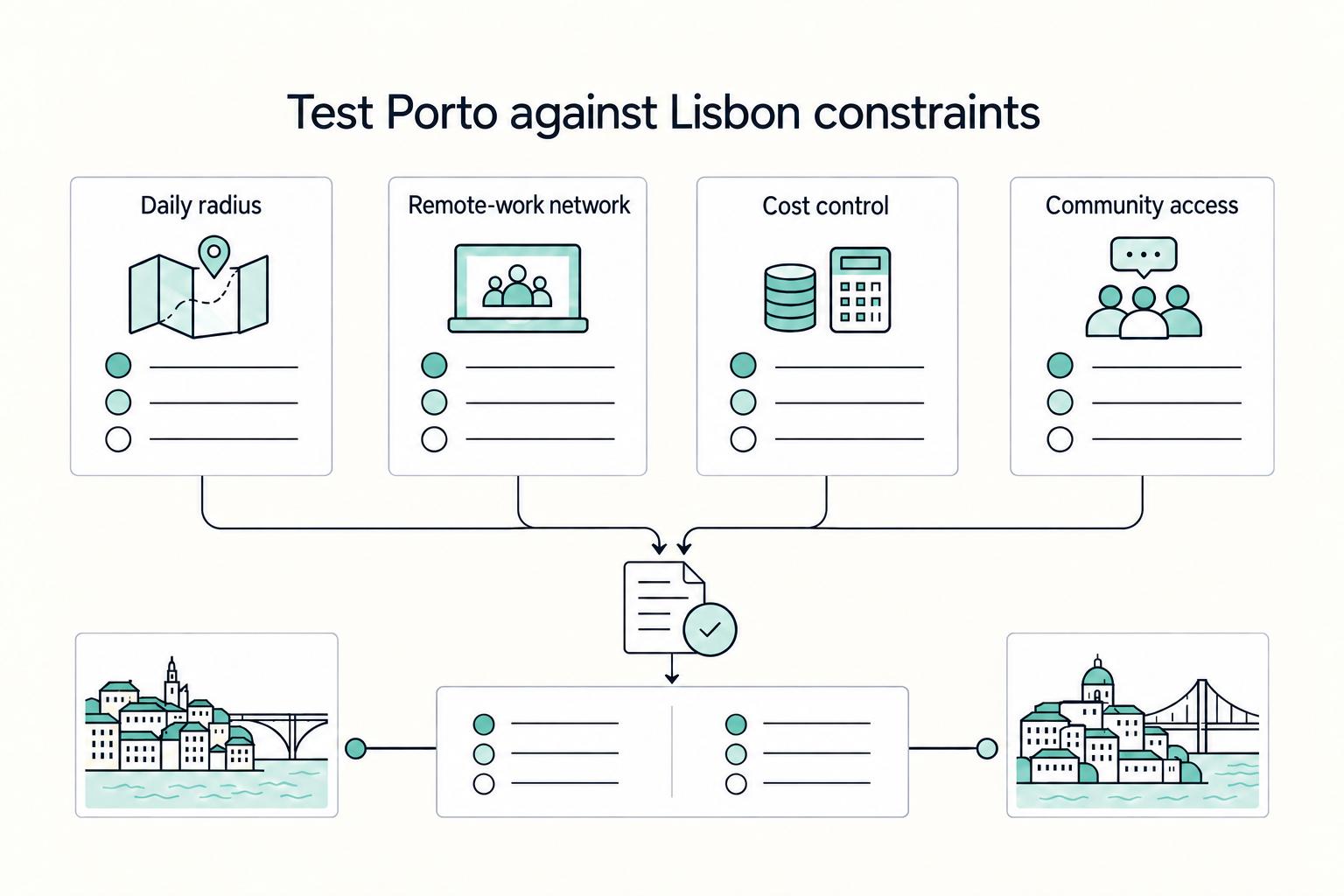
Start with four written non-negotiables: monthly housing ceiling, commute tolerance, weather tolerance, and networking priority. Keep each one measurable, and move any city that fails two of four to backup status.
| Criterion | Lisbon | Porto | Pass rule |
|---|---|---|---|
| Monthly housing ceiling | Score 1-5 | Score 1-5 | Must stay under your hard cap |
| Commute tolerance | Score 1-5 | Score 1-5 | Must fit your max one-way commute |
| Weather tolerance | Score 1-5 | Score 1-5 | Must support your weekly routine |
| Networking priority | Score 1-5 | Score 1-5 | Must match your target event cadence |
| Paperwork readiness | Score 1-5 | Score 1-5 | Must align with your D8 document file |
Scoring helps because it turns a vague city debate into visible tradeoffs. If you cannot explain why a city earned a score, do not count it yet. The point is not to build a perfect model. It is to force an honest comparison using the parts of the move that actually affect your day.
Test your actual week, not an abstract lifestyle. Score workdays, errands, exercise blocks, and a realistic weekend pattern you expect to repeat.
Before booking, run a documentation gate. The Portugal Digital Nomad Visa (D8) is commonly discussed as the D8 pathway, and practical eligibility framing starts with remote work and financial stability, often using about EUR 3,680/month as a starting marker. Treat that number as a guide, not a fixed rule, because requirements can vary by consulate and may change. Build your file in four buckets: identity, income/work, accommodation, and compliance.
Set a hard verification deadline within 72 hours:
- Confirm your neighborhood shortlist.
- Confirm all four document buckets are complete and internally consistent.
- Confirm booking dates only after the file is complete.
After you score both cities, write one sentence describing the most likely failure point for each. One city may be better for networking but tighter on monthly cushion. The other may be better for focus but weaker on event density. The better choice is usually the one whose downside you can manage without constant correction.
If one city clearly wins on budget and routine consistency, choose it even if the other feels more exciting. Commit to one primary city, one backup city, and a first-week setup plan. Your backup city exists to protect momentum if timing or housing changes, not to keep the debate open forever.
One detail that makes this checklist more useful is forcing yourself to write the evidence beside the score. If you give a city a 4 for commute tolerance, note which route you tested and what felt manageable. If you give a city a 2 for paperwork readiness, note what is missing. That keeps the scoring grounded in facts you actually checked instead of impressions that will change with mood.
Another good discipline is to separate hard fails from preferences. A hard fail is something like a housing number that breaks your cap or a commute pattern you know you will resent. A preference is something like wanting a busier atmosphere or a quieter street. When those get mixed together, people start treating small lifestyle preferences as if they matter more than the constraints that can derail the move.
For city-specific detail, use Porto, Portugal: The Ultimate Digital Nomad Guide (2025), then Browse Gruv tools to pressure-test your checklist.
Make the city choice once and execute the move cleanly#
This is a constraints decision, not a popularity vote, so make the choice once and move straight into execution.
Your advantage here is sequence. Finish the checklist, pick one primary city, and run each next step through a simple gate: does this reduce uncertainty or create it? If it reduces uncertainty, do it now. If it creates uncertainty, pause and verify first.
For visa planning, treat published requirements as a pre-check tool, not a guarantee. Criteria may be presented as fixed thresholds or formulas, but approval is still not automatic, so keep your timeline and documents in lockstep before you commit money.
Use this closeout sequence:
- Lock one primary city in writing.
- Complete your checklist and timeline verification before booking.
- Confirm document readiness before paying deposits or locking travel.
- Book only what your complete records can support.
- Draft a first-week setup plan for housing check-in, connectivity, and admin tasks.
Once you have chosen, stop reopening the comparison unless new evidence changes a real constraint. More browsing usually does not improve the decision. It just delays execution. Clean sequencing does more for a successful long stay than endless optimization.
The core thread through this whole choice is simple. Pick the city that supports your routine, confirm the numbers and routes, line up the paperwork, and only then commit money. That order sounds basic, but it is exactly what prevents the avoidable mistakes that turn a manageable move into a stressful one.
If you need execution depth, read one city guide and the visa guide, then proceed: the Lisbon digital nomad guide, Porto, Portugal: The Ultimate Digital Nomad Guide (2025), and Portugal Digital Nomad (D8) Visa: A Complete Guide. If you need country-specific support, Talk to Gruv.
Frequently Asked Questions
Is Lisbon or Porto better for digital nomads staying several months?
Choose the city that fits your weekly routine and paperwork readiness, not the one with louder online opinions. Both are on Portugal's west coast, so the real decision is daily fit: where you can work consistently, move easily, and keep costs predictable.
Which city is usually cheaper for a long stay?
Treat broad cost claims carefully unless you verify them with current listings and your own totals. Anecdotal comparisons often describe Lisbon as higher cost than other Portuguese cities, but that alone is not enough for a final decision.
Which city has better weather for year-round routine consistency?
This FAQ set does not include reliable weather evidence to declare a winner. Use a practical test: define your minimum routine for work, exercise, and errands, then check whether each city supports it in less ideal weeks.
Is Lisbon's transport advantage enough to offset higher housing costs?
This FAQ set does not provide reliable transport or housing-cost evidence to prove that tradeoff either way. Decide with your real schedule by estimating weekly time savings and comparing them against your expected housing difference.
Is Porto too quiet if I need networking and career momentum?
This FAQ set does not provide reliable evidence to confirm that. If your plan depends on frequent events and chance introductions, set a minimum monthly networking target and verify local opportunities before choosing.
How should I choose if my priority is walkability versus access to bigger city options?
Use a two-pass decision. First, score walkability for daily essentials. Then score access for higher-value trips. Lock the winner only after your visa paperwork (including D8, if applicable) and your first-week setup plan are written.
Try a related tool
Researched and edited by the Gruv editorial team. Gruv builds cross-border billing, payouts, and finance-operations software for global businesses.
Sources
Includes 1 external source outside the trusted-domain allowlist.
Educational content only. Not legal, tax, or financial advice.
Related Posts

Lisbon Digital Nomad Guide 2026 for Long-Stay Move Sequencing
Lisbon can still work well for remote professionals in 2026, but the smoother moves usually come from sequencing decisions well, not from moving fast. This is an execution guide, not a lifestyle brochure. The point is to help you avoid paying for the wrong apartment, booking the wrong timeline, or building your first month around assumptions that collapse on arrival.
Porto, Portugal: The Ultimate Digital Nomad Guide (2026)
This porto digital nomad guide is built for one job: help you relocate without breaking your income or your legal footing. You are not here for generic neighborhood hype. You are here to make clear decisions, assemble proof that holds up under review, and land in Porto with a weekly system you can actually run.

Portugal Digital Nomad Visa Decisions That Prevent D8 Delays
Start with verification, not paperwork. In this research set, some material is useful only as EU VAT context, not as D8 instruction, and mixing those categories is one of the fastest ways to build the wrong plan. We use the same separation rule in [Global Digital Nomad Visa Index](/blog/global-digital-nomad-visa-index) comparisons.