
Quick Answer
This Porto digital nomad guide shows how to relocate in 2026 without paperwork surprises: pick your legal lane first (Schengen short stay vs a longer-stay pathway like the D8), build one consistent documentation pack, and run a T-12-weeks-to-arrival timeline. After landing, prioritize reliable internet, then handle first-month admin like the NIF, banking access, and proof of address while keeping payments traceable and reconcilable.
Relocate to Porto without breaking your income or legal footing#
This porto digital nomad guide is built for one job: help you relocate without breaking your income or your legal footing. You are not here for generic neighborhood hype. You are here to make clear decisions, assemble proof that holds up under review, and land in Porto with a weekly system you can actually run.
Treat this like an operations manual. You pick a legal lane early, then you build one consistent documentation pack around that lane. After that, you execute a timeline that protects your calendar and your delivery capacity. Once you arrive, you run admin in controlled batches and keep your money flow clean enough to explain to a landlord, a bank, or an auditor in one sentence.
Written in the order you will actually execute#
This is written in the order you will actually execute. Each section unlocks the next, so you do not do work twice.
You will see a repeating pattern throughout: choose a path, freeze the story, collect proof that matches the story, and only then commit to things that are hard to unwind (leases, non-refundable travel, and anything that creates deadline pressure).
Key parts:
- Decision gates first: choose your stay path before you book non-refundable commitments.
- One document system: collect income, work, identity, and address proof in one coherent folder.
- Timeline discipline: work backward from arrival week and add buffers for delays.
- First 30-day admin stack: handle identifiers, proof of address, and access without killing work output.
- Payment operations: set up a traceable workflow so deposits, invoices, and records match.
- Cost model: run annual planning, not one-month optimism.
If anything conflicts, default to your specific Portuguese consular channel and the official procedure for your address.
The two outcomes you actually want#
You are solving for two outcomes at the same time. If either one fails, the move gets fragile fast.
| Outcome | What good looks like | What breaks it |
|---|---|---|
| Legal, stable stay | Your selected path matches your timeline, and your documents support one clear narrative | You choose a lane late, then patch contradictions under time pressure |
| Operational continuity | Housing, connectivity, payments, and admin stay predictable while you keep earning | You arrive with no proof system, no fallback rails, and no weekly execution cadence |
Hold every decision against these outcomes. If it damages either one, it is a bad trade even if it feels convenient in the moment.
Your safe default when anything feels unclear#
When advice starts to conflict, use one rule: the final authority is the Portuguese consulate or designated channel that covers your address. Procedures can vary by jurisdiction, even when the broad program name is the same. Your job is not to win an argument online. Your job is to meet the exact checklist that applies to your case.
If you are evaluating the D8 lane, keep a dedicated deep-dive reference open while you prepare your file. Treat this article as your system and that reference as detailed program context.
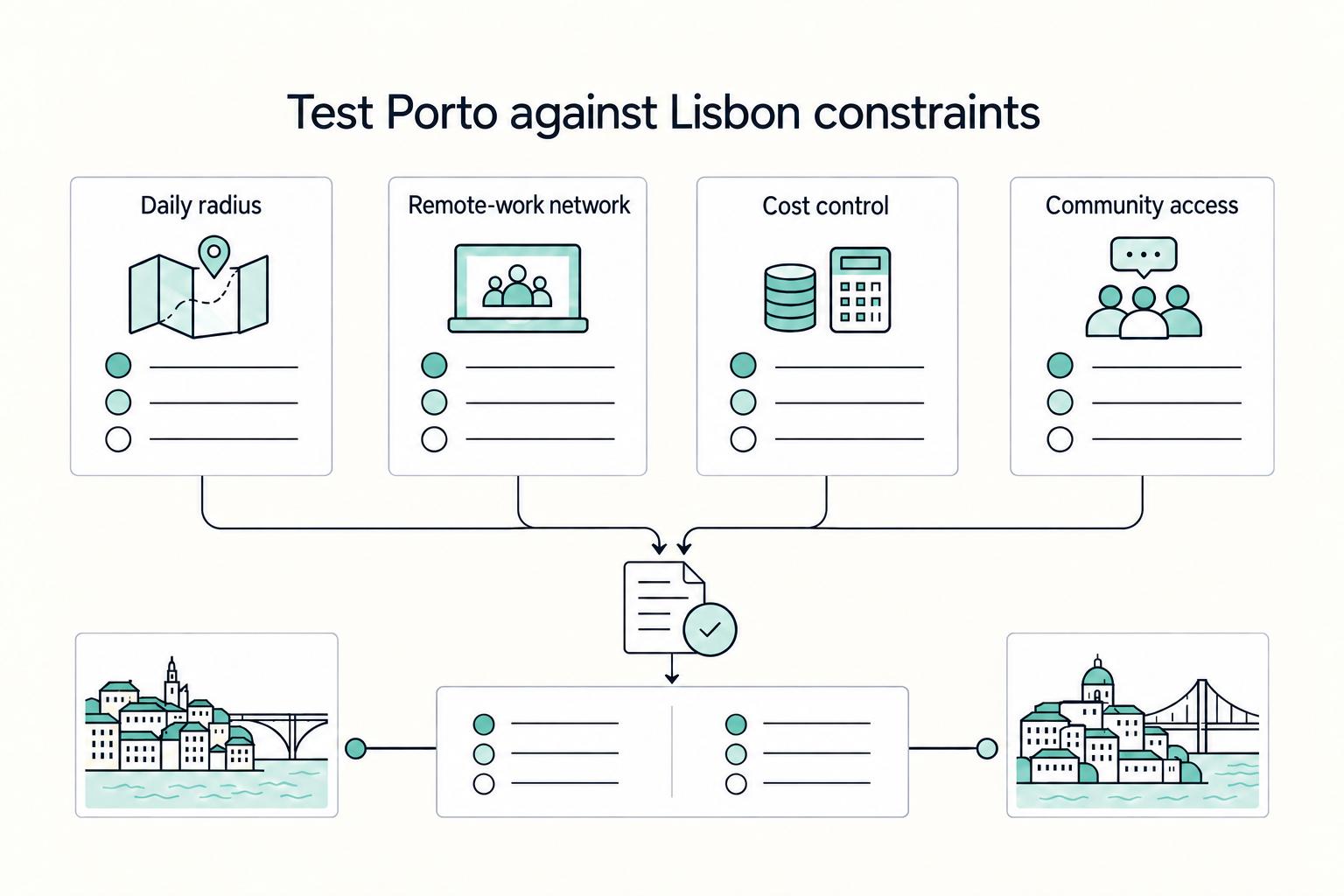
The Porto Fit Test: decide if Porto beats Lisbon for your specific constraints#
Pick the city that makes your normal week easier to run. Porto often wins when you want a tighter footprint and less friction in day-to-day routines. Lisbon often wins when you want the largest default pool of events, services, and remote-work density. If that choice is still open, Lisbon vs. Porto: A Digital Nomad's Dilemma is the right side-by-side before you lock the rest of the plan. Neither is universally better. The right choice is the one that supports your actual work cadence, not your imagined weekend.
Run this filter before you sink time into apartment viewings or paperwork plans.
| If you prioritize | Better default | Why |
|---|---|---|
| Smaller day-to-day radius | Porto | A tighter operating footprint can reduce weekly overhead |
| Largest remote-work gravity | Lisbon | Higher density usually means more off-the-shelf options |
| Tighter cost control | Porto | A smaller footprint can make spending decisions cleaner |
| Fast plug-and-play community | Lisbon | Larger communities can shorten social ramp-up time |
The point of the fit test is not to crown a winner. It is to make your tradeoffs explicit so the rest of your plan stays coherent.
Reality-check: match the city to your operating mode#
Before you lock a base, run a quick self-audit. Where do you do your best work: quiet mornings, late nights, split shifts? How many calls per week are genuinely high-stakes? How sensitive is your work to a noisy building, unreliable connectivity, or long commutes?
If you are testing Portugal, choose the city where you can execute your normal workweek with the least negotiation. Focus hours, groceries, calls, and recovery. If you are planning a longer stay, keep your city choice and your legal-stay choice separate in your head. Operations first. Paperwork second.
Community expectations matter too. If you need instant social density, Lisbon can feel easier. Porto can still be a strong base, but it rewards intention. You will get better results from repeatable routines than from random event hopping.
Community size, without hype#
Lisbon is often treated as the default remote-work hub. Porto usually feels smaller by comparison. That does not make Porto weak. It changes how you operate.
In a smaller scene, you do not win by going harder for two weeks. You win by showing up reliably. Pick one coworking rhythm, one recurring event, and one activity that keeps you healthy. Repeat them until people recognize you without an explanation.
A smaller scene can be an advantage if you value continuity over constant novelty. Compounding works in social systems the same way it works in business operations. Consistency beats intensity.
Your legal-stay decision gate: Schengen Area short stay vs Portugal Digital Nomad (D8) Visa#
Treat legal status as a hard fork, not a soft preference. Either your plan stays within Schengen short-stay limits, or you pursue a residence pathway such as the D8 for a longer base. This choice controls your timeline, your proof requirements, and how much risk you carry when plans shift.
Make this choice early. Every late pivot multiplies admin load and increases the chance your documents stop matching each other.
Define the terms once (so the rest stays legible)#
Keep the language tight so decisions stay clean.
- Schengen short stay (90/180): commonly allows up to 90 days within any 180-day period.
- Schengen Area context: participating countries have agreed to gradually remove internal border controls.
- Portugal Digital Nomad (D8) Visa: described as a residence visa for remote workers, freelancers, and independent contractors earning income from outside Portugal.
- Portuguese consulate: your local consular authority or designated processing channel can define specific procedural details for your case.
Sloppy terms lead to sloppy planning. Keep your labels fixed and your file gets easier to manage.
The legal-stay selector (operational, not theoretical)#
Use this selector before you commit to leases, prepaid housing, or non-refundable travel.
| If your plan looks like | Default lane | What you optimize |
|---|---|---|
| Defined short visit that fits limits | Schengen short stay | Flexibility and low admin complexity |
| Longer base with stability goals | D8 residence pathway | Durability, clearer long-range planning, and document readiness |
This is not about status signaling. It is about avoiding avoidable risk. A short stay is a calendar discipline problem. A longer base is a documentation and process discipline problem. Choose which one you are actually solving.
The failure mode most people create themselves: inconsistency#
Most failures are not caused by a lack of documents. They are caused by conflicting documents.
Common friction points look boring on paper and costly in reality: names differ across files, dates do not align, and the work narrative and income proof describe different realities. That forces reviewers (and later, banks and landlords) to guess. Guessing slows everything down.
Run one rule across your file: one person, one timeline, one story. If a document does not support that story, fix or replace it before submission. You are optimizing for reviewer clarity, not document volume.
Where rules vary (and how to stay safe)#
Program labels can look uniform while execution differs by jurisdiction. Treat broad guides as planning tools, not final authority. Your final checklist comes from your consular channel and official guidance for your route.
Build a simple date-control habit while planning. Track travel days, appointment windows, and document validity in one place. Dates will move. The goal is to keep the moving parts visible so you do not accidentally break your own plan while rescheduling.
The "Visa-Ready Documentation Pack": what counts as proof (and how to keep it consistent)#
A strong documentation pack proves three points with minimal ambiguity: you earn income, your work arrangement supports remote delivery, and your identity details stay aligned across every file. The goal is not volume. The goal is verification speed.
If a reviewer can map your story quickly, your process gets calmer. If they cannot, everything slows down and your timeline starts consuming attention you should be spending on paid work.
Build a reviewer-friendly folder (for clarity, not theater)#
Build the pack so it answers questions without a live explanation call.
- Create one master folder named by case and year, such as
D8_Portugal_YourName_2026. - Keep three subfolders:
Income,Remote_Work, andIdentity. - Use clear filenames with date-first formatting, for example
2026-01_Bank_Statement.pdf. - Keep a short index note at the top level that lists each file and what it proves.
This is not cosmetic. Under stress, people misfile things and submit the wrong version. A simple structure prevents self-inflicted errors.
What counts as proof (decision-grade)#
Use documents that match how you actually earn. Do not submit evidence that looks polished but is misaligned with your real earning model.
| Proof type | Common examples | Operator move |
|---|---|---|
| Proof of income | Payslips, bank statements, tax returns | Gather the last three months as one contiguous set |
| Proof of employment or business activity | Employer letter, business registration, client contracts | Choose evidence that reflects your real earning model |
| Proof of remote work arrangement | Contract terms or employer letter stating remote work | Make permission explicit so reviewers do not infer intent |
| Identity alignment | Passport or national ID details used across files | Keep spelling, formatting, and ordering identical |
A clean, narrow pack beats a large, noisy one. When you add documents, add them because they reduce ambiguity, not because you are trying to look thorough.
Consistency rules (non-negotiable)#
Use these rules as a submission gate before anything leaves your folder.
- Names match exactly across all documents.
- Dates do not contradict each other.
- Income evidence and remote-work evidence point to the same story.
- Address formatting stays consistent wherever it appears.
- File dates are recent enough to support your current narrative.
If you spot a mismatch, stop and resolve it. Small inconsistencies create large delays later, especially when you are already on a travel timeline.
Work backward from arrival: lock your legal path and proof first#
Work backward from arrival and protect sequence. Lock your legal path and proof first. Then commit cash to travel and housing. This order reduces regret and protects your earning capacity during transition.
| Phase | Window | Main move |
|---|---|---|
| Phase 1 | T-12 weeks | Pick short stay or residence pathway, then freeze the story |
| Phase 2 | T-10 to T-8 weeks | Confirm process details with the channel that covers your address |
| Phase 3 | T-8 to T-4 weeks | Use reversible housing decisions before a longer commitment |
| Phase 4 | T-4 to T-1 weeks | Build slack between documents ready and departure and keep fallback windows |
| Arrival week | Arrival week | Confirm reliable internet, establish a workable routine, and keep client delivery stable |
A practical timeline does not remove uncertainty. It prevents uncertainty from cascading into operational failure. Your aim is not a perfect plan. Your aim is a plan that stays stable when something slips by a week.
Phase 1: pick your legal lane, then freeze the story#
At T-12 weeks, make the one decision that controls everything else: short stay or residence pathway. Once chosen, freeze your narrative and align every document to it. The fastest way to burn time is to keep rewriting your story because your plan keeps changing.
| Plan type | Primary objective | Proof focus |
|---|---|---|
| Schengen short stay | Clean entry and exit discipline | Dates, funds, and a plan that clearly fits limits |
| D8 residence pathway | Reviewer-verifiable application | Consistent income proof and remote-work proof |
Do not run both strategies in parallel unless a formal fallback requires it. Split narratives create messy files and confusion when you are asked simple questions like "What is your plan and how long are you staying?"
Phase 2: handle "jurisdiction drift" early#
At T-10 to T-8 weeks, confirm process details with the channel that covers your address. This is where format expectations and procedural differences usually surface. Catching them early is the entire game.
The operational risk here is not that you forgot a document. It is that you built the right document in the wrong format, or anchored your plan to an assumption that does not match your channel. Early confirmation keeps you from rebuilding under deadline pressure.
Phase 3: de-risk Porto housing without trapping yourself#
At T-8 to T-4 weeks, use reversible housing decisions. Start with a flexible initial stay so you can verify building quality, call conditions, and neighborhood fit in person. Then move to a longer commitment only after you test your real weekly pattern.
This is not indecision. It is controlled risk management while legal and admin variables are still moving. Your goal is to avoid getting pinned by a lease while you are still discovering what you need for deep work, reliable calls, and recovery.
Phase 4: protect your calendar with buffers#
From T-4 to T-1 weeks, treat your calendar like a production system. The objective is simple: arrive with open loops minimized.
Buffers are how you prevent a small delay from eating a week of work. Build slack between "documents ready" and "departure." Assume appointments and approvals can become bottlenecks. Keep at least two fallback windows for critical tasks so you are not forced into a single-point-of-failure week.
If you do nothing else in this phase, do this: stop stacking major commitments onto the same days. Spread risk across the calendar.
Arrival week: stabilize earning first#
Your first week is not for perfect optimization. It is for continuity.
Confirm reliable internet, establish a workable routine, and keep client delivery stable while admin starts moving. Then execute legal and paperwork follow-through based on your chosen lane.
Income continuity is the anchor. Everything else supports it.
First 30 Days in Porto: your admin stack (NIF, bank access, proof of address)#
Your first month in Porto is a sequencing problem. You need enough official identity and address proof to unlock services, without turning every day into admin theater. Done well, this phase is boring. That is the target.
| Admin area | Main move | Detail |
|---|---|---|
| NIF | Treat it as foundational in your local admin stack | It is Portugal's tax identification number used across many official and financial interactions |
| Proof of address | Use one address format everywhere you can | Keep unit numbers, street formatting, and spelling stable across documents |
| Banking + payments | Build for access first with a bridge setup | Use a workable path to receive money, pay rent-related costs, and cover daily expenses while requirements are still being collected |
| Insurance | Match documentation to your current status | Keep one clear, current policy trail you can explain |
| Admin batching | Reserve two half-days per week for appointments and follow-ups | Track open admin items in one place with an owner and a due date, then close loops weekly |
The move here is to prioritize tasks that unlock downstream access, then batch the rest so you stay productive.
Start with the key term you'll hear immediately#
NIF (Número de Identificação Fiscal) is Portugal's tax identification number used across many official and financial interactions. Treat it as foundational in your local admin stack, not an optional extra.
Once this identifier is in place, other steps become easier to schedule, explain, and document.
What you need for a first pass (and why "proof of address" matters)#
For in-person NIF requests, prepare valid ID and proof of address, and plan for appointment constraints where applicable. The operational challenge is rarely complexity. It is mismatch.
Use one address format everywhere you can. Keep unit numbers, street formatting, and spelling stable across documents. A file that reads internally coherent moves faster than one that looks improvised, even when both contain similar items.
Before any appointment, run a preflight check you can repeat without thinking: identity document ready, address proof current, copies organized, and naming consistent across forms. This sounds basic. It is also where people lose hours.
Plan for access, not perfection (banking + payments)#
Do not build your first month around one perfect outcome, like opening a specific local bank account immediately. Build for access first.
You need a workable path to receive money, pay rent-related costs, and cover daily expenses while requirements are still being collected. A bridge setup protects continuity and reduces desperation decisions that create messy records later.
Keep payment references consistent from day one. If you change naming conventions every time you send an invoice or transfer, reconciliation becomes a cleanup project in month three.
Insurance: keep it compliant, keep it simple#
Treat insurance as part of your documentation discipline.
Match insurance documentation to your current status and keep records easy to retrieve. As your status changes, re-check what needs updating and make the update deliberately. The goal is one clear, current policy trail you can explain, not a stack of overlapping documents you cannot.
Batch admin so you keep earning#
Admin will expand to fill your week if you let it. Contain it.
Reserve two half-days per week for appointments and follow-ups, and protect your core delivery work on the other days. Track open admin items in one place with an owner and a due date, then close loops weekly so small tasks do not accumulate into chaos.
This cadence keeps bureaucracy boxed in and preserves your actual output.
Operate day-to-day like a pro: internet reliability, transport, winter dampness, and community#
After setup, your performance depends on routine reliability. Calls need to work, movement needs to stay easy, and your home environment needs to support sustained focus. Build these systems early so your energy goes into work, not recovery from preventable friction.
| Area | Main move | Detail |
|---|---|---|
| Call reliability | Test real calls from your apartment during actual working hours | Keep a backup path, such as a mobile hotspot, and validate coworking options for quiet-call consistency |
| Transport | Design around rail and transit instead of a car | CP describes Porto urban trains as serving 87 stations within a 60-kilometre radius and a 211-kilometre network across the Aveiro, Braga, Guimarães, and Marco de Canaveses lines |
| Airport planning | Standardize the setup that minimizes friction for repeated trips | Porto uses Francisco Sá Carneiro Airport (OPO, LPPR); Lisbon uses Humberto Delgado Airport (LIS, LPPT) |
| Winter dampness | Ventilate deliberately and address damp spots early | Keep key rooms warm enough to reduce cold-surface moisture |
| Community | Use recurring touchpoints rather than random event spikes | Weeks 1-2: commit to one coworking pattern and one recurring meetup; Weeks 3-4: add one recurring activity with repeat attendance |
Day-to-day operations are where good relocation plans compound, or collapse.
A "call reliability" setup you can trust#
Treat connectivity like critical infrastructure. If your calls fail, your credibility takes the hit, not your router.
Start by testing real calls from your apartment during actual working hours. Then set up redundancy so you can keep working when something breaks.
A simple reliability baseline:
- Test real calls from your apartment during actual working hours.
- Keep a backup path, such as a mobile hotspot, for outage protection.
- Validate coworking options for quiet-call consistency, not visual style.
- Maintain a simple incident plan so one failure does not erase a workday.
Make this boring and repeatable. Reliability is a reputation asset.
Transport: stay mobile without a car#
Porto can stay highly functional without car ownership if you design around rail and transit. This keeps overhead lower and avoids new logistics burdens.
CP describes Porto urban trains as serving 87 stations within a 60-kilometre radius. It also describes a 211-kilometre network across the Aveiro, Braga, Guimarães, and Marco de Canaveses lines. Operationally, that means you can design a wider weekly radius without adding car admin to your plate.
Build redundancy into your movement the same way you do for internet. Have more than one viable route to your recurring commitments so one disruption does not break your schedule.
Airport reality: plan travel like an operator#
Frequent travel turns airport choice into a system decision, not an occasional preference.
Porto uses Francisco Sá Carneiro Airport (OPO, LPPR). Lisbon uses Humberto Delgado Airport (LIS, LPPT). Travel planning guides often note Lisbon can be easier to reach from abroad because of a larger set of international connections, while Porto also offers international access.
Do not turn this into a city identity debate. Pick the setup that minimizes friction for repeated trips, then standardize your routine around it.
Winter dampness: make it operational#
Winter dampness can affect comfort and focus if unmanaged. Treat moisture control like routine maintenance, not a one-time fix.
Ventilate deliberately. Keep key rooms warm enough to reduce cold-surface moisture. Address damp spots early before they expand into bigger problems. If a unit shows persistent dampness signs, factor that into your housing decision instead of hoping habits will fully compensate.
Your environment is part of your productivity stack. If the environment drains you, your workday pays the bill.
Community: a 30-day social plan that compounds#
A smaller scene rewards consistency. Build a social system with recurring touchpoints rather than random event spikes.
A simple 30-day plan:
- Weeks 1-2: commit to one coworking pattern and one recurring meetup.
- Weeks 3-4: add one recurring activity with repeat attendance.
- Keep introductions short and clear about your work focus.
- Follow up quickly with one concrete next interaction.
This is how you create continuity. It also keeps social time from cannibalizing work time while you are still stabilizing.
Getting Paid While Living in Porto: a cross-border money workflow you can explain to a landlord, bank, or auditor#
Relocation becomes durable when your income operations stay clean. You want deposits that arrive predictably, records that reconcile without detective work, and documentation you can explain under scrutiny.
Design the money workflow before problems force you into improvisation. Improvisation is where "messy but fine" turns into "hard to explain."
The outcome you're building#
Regardless of worker type, you are building three outcomes:
- Traceability: every invoice or payslip can be matched to a bank transaction.
- Consistency: names, references, and amounts stay stable across systems.
- Explainability: each deposit can be described clearly in one sentence.
That is reconciliation in practice: comparing records so transactions match, then resolving timing differences, missing entries, or amount variances before they snowball.
The "clean money trail" system (freelancers + employees)#
A clean trail is not complicated. It is disciplined.
Start by separating flows. Keep business-related flows separate from personal spending flows so your records stay legible. Standardize references. Use consistent reference formats for invoices or payroll identifiers so deposits remain searchable and explainable. Reconcile on a schedule. Do it weekly, not randomly, so issues surface while they are still easy to fix. Store support where it can be followed. Keep supporting files in a place where a third party can follow the trail quickly.
If you do this, your money story stays stable even when your location changes.
FX and conversion planning (reduce surprises)#
Cross-border payments add variability. Plan for it, document it, and keep references readable.
| Risk | What it looks like | Operating response |
|---|---|---|
| Timing mismatch | Payer sends Friday, funds post later | Reconcile after expected settlement window |
| Amount variance | Deposit differs from invoice amount | Record fees or conversion effects so difference is explainable |
| Reference loss | Bank entry appears generic | Standardize memo fields so each payment is traceable |
You are not eliminating variance. You are eliminating ambiguity.
Failure modes (what to do when something breaks)#
When flows fail, respond with a protocol instead of ad hoc fixes.
- Late client payment: move to milestone billing cadence and confirm payment before the next deliverable phase.
- Returned or unclear transfer: verify sender name, account details, and reference format, then reissue with one clean identifier.
- Reconciliation gaps: flag immediately, collect evidence, and close within the same week.
Speed matters. Unresolved gaps become narrative problems later, especially when you need to prove what happened and when.
Cost of Living in Porto (2026): budgets, rent ranges, and the seasonality trap#
Your budget becomes decision-grade when rent is modeled first and everything else is layered on top. In the draft data, a single person baseline is estimated at €677.5 per month excluding rent. Rent ranges for a one-bedroom are shown as €700-€1,000 outside the centre and €900-€1,300 in the city centre.
Use those inputs to set a realistic operating floor before you commit to longer housing terms.
| Scenario (1BR) | Rent band | Baseline excl. rent | Minimum operating floor |
|---|---|---|---|
| Outside centre | €700-€1,000 | €677.5 | €1,377.5-€1,677.5 |
| City centre | €900-€1,300 | €677.5 | €1,577.5-€1,977.5 |
If your net monthly income only barely clears your floor, keep commitments flexible until your real spend pattern is confirmed. When your plan is tight, small surprises stop being small.
Rent is the lever (and the Porto vs Lisbon reality)#
Rent is still the strongest control variable. Porto can offer more breathing room than Lisbon in many cases, but that advantage only helps if the unit supports your working conditions.
Cheap rent that causes call failures, dampness issues, or long transit penalties is not actually cheap. You pay the difference in lost focus, missed work, and recovery time.
Choose by total operating fit, not headline rent alone.
The seasonality trap: plan for the year, not a month#
Draft context notes peak season in July and August, with lower accommodation rates commonly seen from November to March. One good month can create false confidence if you annualize from the wrong starting point.
Build a year view first. Then test whether your income, buffer, and housing terms still hold when conditions shift. Seasonality planning is not about predicting the future perfectly. It is about avoiding fragile assumptions that collapse the moment the calendar flips.
Neighborhood tradeoffs (operational, not aesthetic)#
Set decision criteria before viewings so you do not get pulled into style-led choices that hurt execution.
- Quiet-call reliability versus nightlife noise.
- Building robustness versus visual charm.
- Commute practicality versus cafe-based optimism.
- Moisture management versus short-term first impression.
During viewings, test real internet performance, mobile coverage in the unit, window seals, and visible dampness signals. Near the Douro River, ask directly how the property handles winter humidity and insulation.
Cost-control checklist (what operators do)#
Cost control is not deprivation. It is removing surprises.
Delay long commitments until the apartment and internet pass your tests. Keep a short-term fallback for gaps between stays. Hold an admin buffer for document fees, translation needs, and extra nights if timelines slip. Review spend weekly in the first two months so small leaks are corrected early.
This model takes minutes to run and gives you a defensible baseline for the full year, not just a good week.
Conclusion: your one-page Porto plan (safe defaults + next steps)#
Run this as a system, not a mood. Choose the correct stay lane, build one reviewer-friendly proof pack, execute a buffered timeline, and stabilize admin without sacrificing paid work. Keep your money trail traceable from day one. Do those consistently and relocation risk drops while confidence rises.
This porto digital nomad guide works because it prioritizes sequence and clarity over volume.
Your operating model (the only loop that matters)#
Keep this loop visible and repeat it whenever plans change:
- Pick your legal lane first.
- Align every document to one coherent narrative.
- Execute timeline phases with explicit buffers.
- Protect earning capacity while admin runs in batches.
- Reconcile payments weekly so records stay clean.
The loop is simple on purpose. Simplicity is what survives stress.
One-page execution checklist (copy/paste)#
Use this checklist as your weekly control panel.
- Stay rule decided
- Short stay plan aligned to 90 days in any 180-day period, or longer-stay national procedure selected and scheduled.
- Documentation pack complete
- Income proof assembled as a contiguous set. * Remote-work evidence explicit and aligned. * Identity details and address formatting unified. * Insurance documents current and retrievable.
- Timeline protected
- T-12 to T-8: lane choice and narrative freeze completed. * T-8 to T-4: procedural confirmation and reversible housing strategy active. * T-4 to T-1: buffers set for appointments and approvals. * Arrival week: connectivity and earning stability prioritized.
- First 30-day admin cadence active
- NIF process initiated with required ID and address proof. * Banking and payment bridge plan running. * Two half-day admin blocks scheduled weekly. * Open loops tracked with due dates and owners.
- Money workflow defensible
- IBAN and payment instructions standardized. * References consistent across invoices, transfers, and records. * Weekly reconciliation completed and variance notes logged. * Escalation protocol ready for late or failed transfers.
In draft context, as of July 1, 2025, NIF requests for citizens without a Portuguese Citizen Card are made through Portal das Finanças or in person by appointment. Treat that as a procedural checkpoint to verify for your route before execution.
Safe confirmation rule (don't outsource legal status to vibes)#
When a requirement changes legal status or eligibility, confirm it through the relevant Portuguese consulate and official guidance for your channel. Community anecdotes can help with preparation and expectations. They are not final authority.
This rule protects you from expensive confidence based on outdated or non-applicable advice.
Next steps (reduce uncertainty fast)#
Run these actions in order this week:
- Decide your legal lane and write it at the top of your planning doc.
- Build your documentation folder structure and run a consistency audit.
- Create a backward timeline from arrival week with two buffer windows.
- Define your first-month admin blocks and payment bridge plan.
- Re-check route-specific official requirements before locking non-refundable commitments.
Clarity compounds when execution is simple, scheduled, and documented.
Frequently Asked Questions
Is Porto good for digital nomads in 2026?
Porto can work well if you want a smaller scene and a tighter day-to-day footprint. Some guides describe Porto as safe, walkable, and generally reliable for Wi-Fi, but treat that as anecdotal and verify your setup (apartment internet, coworking, backups).
Porto vs Lisbon for digital nomads: which is better for remote work and admin?
Choose based on constraints, not vibes: community size, paperwork tolerance, and how often you need in-person services. One Porto guide notes the digital-nomad community is smaller than Lisbon's; beyond that, the "better" city often comes down to what you personally find easier to run day-to-day.
Do I need a visa to work remotely from Porto, Portugal?
If you enter under the Schengen short-stay regime, you can stay up to 90 days in any 180-day window across the Schengen Area. If you want to stay longer than 90 days, you move into national procedures rather than the short-stay Schengen framework.
What is the Portugal Digital Nomad (D8) Visa and do I qualify?
"Portugal Digital Nomad (D8) Visa" commonly refers to a pathway described as aimed at non-EU/EEA/Swiss remote workers and freelancers earning income from abroad. Eligibility depends on your nationality, income type, and the specific national procedure you apply through-use Portugal Digital Nomad (D8) Visa: A Complete Guide to walk the checklist carefully.
How much income do you need for Portugal's digital nomad visa?
Don't anchor on a blog-number. Income requirements and how authorities evaluate them can change and can vary by procedure, so confirm the current requirement in the official guidance for your application route before you plan your runway.
How do I get a NIF (Número de Identificação Fiscal) in Portugal?
NIF is Portugal's taxpayer identification number-your personal identifier for many official and financial activities. Portugal's tax authority notes it's required for everyday activities like employment, contracts, and opening bank accounts, and an individual NIF is a nine-digit number.
What's a solid way to get paid while living in Portugal (and avoid avoidable FX friction)?
Keep it boring and bank-readable: get paid into an account that can receive euro transfers and use IBAN correctly on invoices and client instructions. SEPA exists to make euro transfers under the same rules across the SEPA area; combine that with clean references (invoice numbers/payslip refs) so every deposit stays traceable when you reconcile.
Try a related tool
Researched and edited by the Gruv editorial team. Gruv builds cross-border billing, payouts, and finance-operations software for global businesses.
Sources
Includes 4 external sources outside the trusted-domain allowlist.
- nuin.northeastern.edu/wp-content/uploads/NUin-Portugal-Visa-Guide.pdftrusted
- amysuto.com/desk-of-amy-suto/working-remotely-in-porto-p...external
- legalclarity.org/portuguese-consulate-services-visas-citizens...external
- outsite.co/blog/digital-nomad-guide-to-porto-portugalexternal
- visas.pt/news/portugal-visa-jurisdiction-finderexternal
Educational content only. Not legal, tax, or financial advice.
Related Posts

Lisbon Digital Nomad Guide 2026 for Long-Stay Move Sequencing
Lisbon can still work well for remote professionals in 2026, but the smoother moves usually come from sequencing decisions well, not from moving fast. This is an execution guide, not a lifestyle brochure. The point is to help you avoid paying for the wrong apartment, booking the wrong timeline, or building your first month around assumptions that collapse on arrival.
Lisbon vs Porto for Digital Nomads
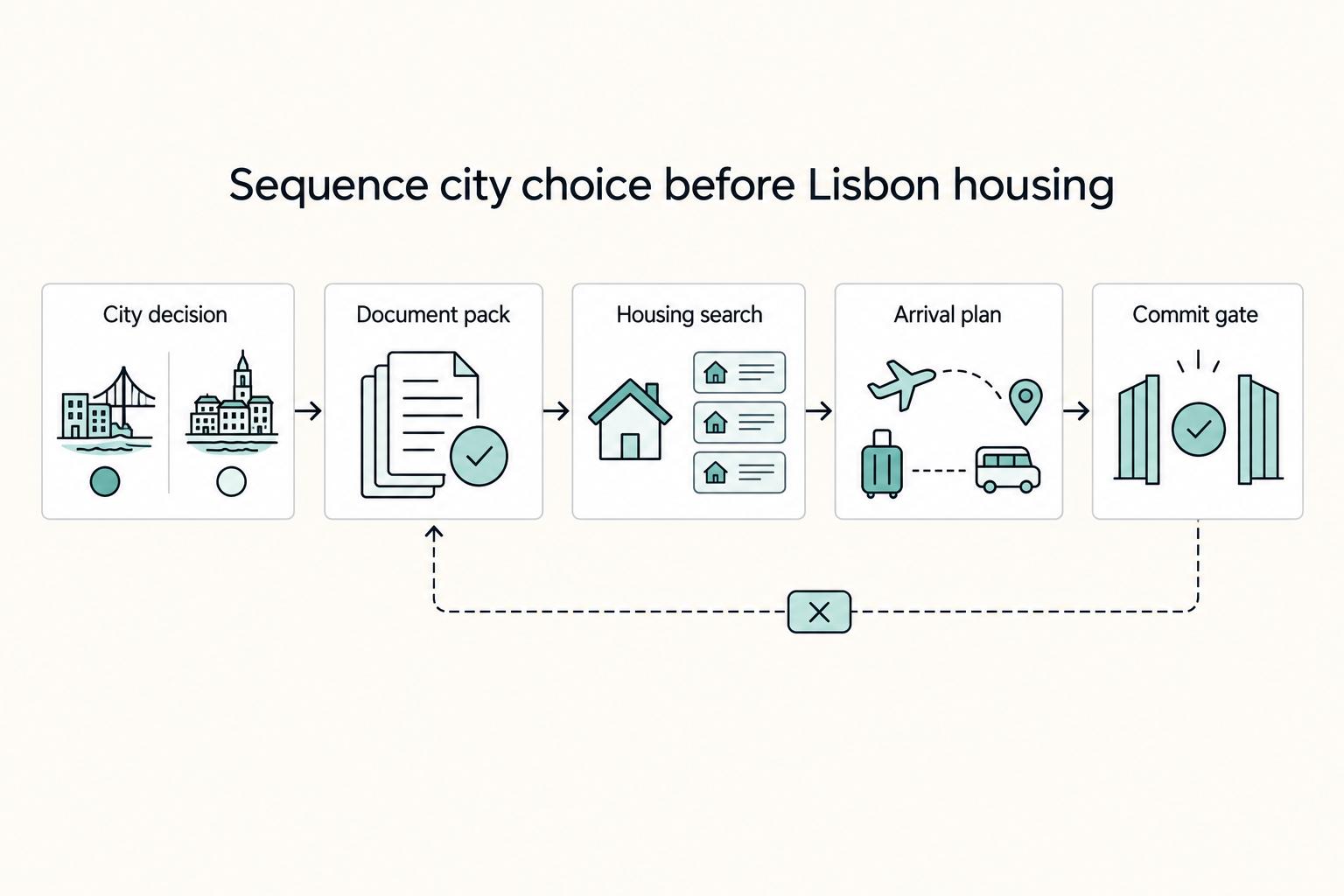
Choose your city first, then build the rest of the move around that choice. When people reverse the order, housing research, admin prep, and booking decisions start pulling in different directions.

Portugal Digital Nomad Visa Decisions That Prevent D8 Delays
Start with verification, not paperwork. In this research set, some material is useful only as EU VAT context, not as D8 instruction, and mixing those categories is one of the fastest ways to build the wrong plan. We use the same separation rule in [Global Digital Nomad Visa Index](/blog/global-digital-nomad-visa-index) comparisons.