

Quick Answer
Start with a phased deployment: assisted checkout first, bounded agent execution second, and broader autonomy only after controls hold in production. For agentic commerce, the minimum bar is clear delegated authority, tested fallback behavior for ambiguous outcomes, and an evidence pack that can reconstruct one disputed payment end to end. Treat KYC, KYB, AML, and VAT validation as confirmed capabilities per market-program pair, not assumptions.
How Agent Payments Work in Agentic Commerce#
The practical risk is not failing to understand AI. It is choosing the wrong market, checkout pattern, or money movement model too early, then finding out your controls, support load, and reconciliation logic do not hold up under real transactions.
This article uses that lens. It is a decision-oriented explainer for launching agentic commerce with operational controls, not a trend recap or a gallery of product demos. If you are a founder or operator, the useful questions are more concrete. Who is allowed to trigger payment steps? What evidence exists for each action? Which country and vertical create the fewest compliance surprises first? How quickly can your team unwind a bad transaction when an agent gets it wrong?
Public evidence says the category is moving from concept toward implementation, but the data is still thin and uneven. Stripe, for example, described the Agentic Commerce Protocol as a live standard for programmatic commerce flows between AI agents and businesses, and said in September that it had announced ACP. Mastercard's own material is similarly direct about the end state: AI shopping agents can do the shopping work and complete purchases on a user's behalf. That is enough to treat this as a real operating problem now, not a hypothetical one. It is not enough to assume the market has settled on one execution model, one liability pattern, or one clean set of adoption benchmarks.
That uncertainty matters because integration and support costs can be real. Stripe notes that supporting each new AI agent can take up to six months in some cases. Do not read that as a universal timeline, but it is a useful warning. Every new agent surface can create new approval logic, event handling, exception paths, and partner dependencies. If your team cannot explain why one launch path is easier to reconcile and govern than another, you are still too early to scale it.
The working recommendation is simple. Start with the launch decision, not the model headline. Pick the first country and vertical where you can verify approval boundaries, payment state changes, and dispute handling with the least ambiguity. If you do not yet know which party approves the final transaction step, or how you would reconstruct one purchase from request to settlement, stay in a more assisted mode until that is clear.
The sections that follow stay with those operator choices. They cover what this model means in payment terms, where autonomy should stop, which markets are worth entering first, and what controls have to exist before an agent is allowed to move money.
You might also find this useful: Fraud Prevention in Agentic Commerce When Bots Have Wallets.
Define agentic commerce in payment terms#
Treat this as a payment design term, not a branding term. If the AI only recommends products, fills a cart, or hands off to a normal checkout that the customer completes, you are still in assisted commerce, not true agent-initiated purchasing.
In practical terms, agentic commerce starts when an autonomous AI agent can move from discovery to transaction steps on a shopper's or business's behalf. Stripe frames the shift plainly: humans are no longer the only ones making purchases. JPMorgan describes the progression from discovery-only help, to web-crawling guest checkout, to direct agent-merchant protocols now emerging. That distinction matters because many offerings marketed this way are still not fully autonomous, and JPMorgan says many current iterations are not actually autonomous.
The clean split is this: agents can search, compare, decide, and execute within permissions that a human or business has already set. In a workable implementation, people or businesses define those permissions, approve exceptions, and own the customer-facing consequences when something goes wrong. Use a simple checkpoint for any purchase. Can you show who granted the agent authority, what instruction or policy triggered the action, and which auditable events prove the order and payment steps happened in sequence?
The boundary people often blur is autonomy versus unrestricted spend. They are not the same. If your team cannot verify the agent identity, the delegated scope, and the event trail after the fact, you do not have a credible payment implementation yet.
You will also see this language attached to real products and forecasts. Salesforce cites Gartner research projecting that 33% of enterprises will include agentic AI by 2028, up from less than 1% today. Read that as market direction, not proof that every platform offers the same transaction depth or control surface.
If you want a deeper dive, read Refunds in Agentic Commerce: How to Handle Cancellations Returns and Partial Fulfillment.
Compare assisted checkout and agent-initiated checkout#
If approval boundaries are still fuzzy, start with assisted checkout. It keeps the customer in the final payment step and gives you a cleaner authorization story while you prove reconciliation, support, and dispute handling. Agent-initiated checkout comes later, once delegated authority and transaction evidence are already solid.
The practical difference is not whether AI touched the purchase flow. It is who takes the final transaction step, and what you can prove afterward. Assisted checkout usually means the agent recommends, compares, fills a cart, or prefills details, then hands off to a normal checkout flow that the customer completes. Agent-initiated checkout begins when the agent can carry the task through payment steps on the user's behalf within defined permissions.
Recent product examples make that distinction easier to see. OpenAI described Instant Checkout in ChatGPT as a way to buy directly inside a conversation without visiting a merchant site, and Microsoft describes Copilot Checkout as a no-redirect experience while the merchant remains merchant of record. At the same time, protocol language is still emerging. One source describing ACP notes that it is documented, but not yet widely adopted across the broader ecommerce and AI network.
That changes your operator burden immediately. In assisted checkout, the main proof point is that the user completed checkout. In agent-led checkout, you need a stronger record: who delegated authority, what policy or instruction applied, what limits were in force, and which events show the payment moved through valid states in sequence. If that record is weak, support and dispute work get harder fast.
| Decision point | Assisted checkout | Agent-initiated checkout |
|---|---|---|
| Final payment step | Customer completes checkout | Agent can take transaction steps within permissions |
| Typical first use | Recommendation, comparison, cart build, prefill | Narrow purchase execution after controls are in place |
| Authorization story | User action at checkout is the clearest signal | Delegated authority has to be explicit and auditable |
| Control burden | Lower, because the checkout boundary is obvious | Higher, because approval policy, limits, and fallback logic must hold |
| Common failure mode | Drop-off before payment | Unclear authority or weak reconstruction after the fact |
| Good launch fit | Early rollout, unclear liability, or immature ops | Bounded pilot after approval, replay, and evidence controls are proven |
A useful rule follows from that comparison: do not treat full autonomy as the default upgrade path. If your team still relies on chat history, app logs, or provider dashboards to explain why a payment happened, keep the customer in the loop at checkout and earn your way into broader authority. The user can still set guardrails in budget, brand preference, and delivery rules while the agent works within them.
We covered this in detail in Subscription Commerce Growth Trends for Platform Builders Using the 76 Million Signal.
Pick your first vertical and country with an explicit matrix#
Once you decide how much autonomy to allow at checkout, the next decision is where to launch it. Start where compliance and payout rails are already stable, not where demand is loudest but documents, tax handling, and provider coverage are least predictable.
Use the matrix below as a conservative entry filter, not a legal map. The scores go up when you add cross-border payouts, U.S. taxpayers abroad, or foreign financial accounts that trigger extra tax reporting questions.
| Vertical and country starting point | Compliance friction | Payout complexity | Dispute burden | Data requirements | Tax-document lift | Launch call |
|---|---|---|---|---|---|---|
| B2B software or scheduled services, United States only | Low | Low | Low to medium | Low | Low | Best first launch |
| Managed services, United States demand plus one foreign delivery country | Medium | Medium | Medium | Medium | Medium | Launch only after provider and counsel verification |
| Marketplace or contractor payouts into one foreign country, especially where U.S. persons abroad are involved | High | High | Medium to high | High | High | Pilot only |
| Consumer or marketplace launch across multiple countries with mixed residency and foreign account exposure | Very high | Very high | High | Very high | Very high | Do not start here |
That table is intentionally blunt. If your first version needs country-by-country onboarding exceptions, custom payout handling, and tax-document support across multiple residency cases, you are not really testing demand. You are testing whether your ops team can survive ambiguity.
Treat KYC, KYB, AML, and VAT validation as verified capabilities#
KYC, KYB, AML, and VAT validation belong in your matrix, but only as confirmed provider or counsel-validated items, where supported. Do not assume market-by-market rules are established for those areas, so you should mark each target market and program as one of three states: confirmed, unsupported, or unknown.
That distinction matters more than a generic "yes, we support Europe" claim from a vendor. Your checkpoint is written confirmation of the exact onboarding path, supported entity type, payout country, and who owns screening and any required tax-document collection. If any of those answers are still conditional, treat that country as pilot-only.
Let tax complexity change your sequence early#
The clearest hard signal in this section comes from the U.S. cross-border tax layer. U.S. citizens and resident aliens abroad are generally taxed on worldwide income and must report taxable income. If they have foreign financial accounts, they must report those accounts to the U.S. Treasury Department through FBAR reporting.
| Tax topic | Trigger | Threshold or note |
|---|---|---|
| Worldwide income reporting | U.S. citizens and resident aliens abroad | generally taxed on worldwide income and must report taxable income |
| FBAR reporting | foreign financial accounts | must report those accounts to the U.S. Treasury Department through FBAR reporting |
| FEIE | qualifying individuals with foreign earned income who file a U.S. return reporting that income | physical presence test is 330 full days during 12 consecutive months; for tax year 2026, maximum exclusion is $132,900 per person |
FEIE does not make a foreign launch operationally simple. It applies only to qualifying individuals with foreign earned income who file a U.S. return reporting that income. Under the physical presence test, the person must be physically present in a foreign country or countries for 330 full days during a 12 consecutive months period, and those days do not have to be consecutive. For tax year 2026, the maximum exclusion is $132,900 per person, but qualification, filing, and recordkeeping still exist even when the exclusion is available.
That means your launch effort should go up any time your design touches U.S. persons abroad or foreign financial accounts. If your launch may also require additional tax-document workflows, raise your effort estimate again. Those workflows are not defined here, so do not assume your payment or marketplace stack covers them until your provider and tax adviser confirm ownership in writing.
Before approval, build a practical evidence pack that includes:
- written provider confirmation of country and program coverage
- counsel review of unresolved KYC, KYB, AML, and VAT validation questions
- a tax-operations note listing whether FBAR, FEIE, or other tax-document issues may arise, and who handles them
One red flag: do not treat an IRS practice unit PDF or similar summary as binding law. One IRS practice unit explicitly says it is not an official pronouncement of law and cannot be used, cited, or relied on as such.
The common failure mode is choosing the most exciting cross-border use case first, then discovering that every exception lands on support. If program eligibility is unclear, or regulator interpretation still depends on counsel, call that market a pilot, cap exposure, and earn your way into broader rollout.
Set the minimum control stack before agents can pay#
Once you have a conservative launch market, the next gate is controls. Do not let an agent initiate real money movement until you can show who approved the action, what limits applied, and how you would reconstruct the transaction if it is disputed.
That matters even more here because full agent flows can complete a purchase without the shopper opening a checkout page. In practice, you want a hard boundary between the orchestration layer, where the agent discovers and initiates, and the settlement layer, where value actually moves. If your team blurs those layers too early, small retries turn into real financial mistakes.
Start with a minimum stack, not a vague trust model#
Before the first live transaction, set a minimum stack that every payment attempt must pass. Keep it short enough to enforce and specific enough to audit:
| Control | Requirement |
|---|---|
| Approval policy | states what the agent can buy, under whose authority, and when human review is required |
| Spend and velocity limits | at the transaction, user, and time-window level, with clear deny behavior when a limit is unclear or missing |
| Fallback rules | for pricing changes, missing provider responses, or incomplete state transitions |
| Immutable audit records | the history of the request, approval, execution, and reversal cannot be silently edited after the fact |
If any of those items is still fuzzy, the stack is not ready.
A good checkpoint is simple: if support cannot answer "why did this payment happen?" from records alone, you are not ready for more autonomy. The common failure mode is relying on app logs, chat history, or provider dashboards as if they were a complete record. They are not. You need one internal trail that survives retries, outages, and team handoffs.
Make every transaction traceable end to end#
For each request, you should be able to follow a single chain from the original action through provider execution and into your books. That means keeping the request record, the approval result, the provider reference when one exists, every material state transition, and the related accounting record tied together in one explainable flow.
Make the test concrete. Pick one payment attempt and ask for these artifacts in one view: internal transaction ID, provider reference if one exists, timestamps for each state change, the final resolved status, and the related accounting entry or entries. If your team has to manually stitch those together from three tools and a spreadsheet, the control stack is still too weak.
Retry handling is where many teams get sloppy. One business action should map to one intended financial outcome. If a request times out and you retry, the second attempt should return the existing result or force a state check before anything new is created. Otherwise, ambiguous failures turn into real money errors.
Handle ambiguous outcomes before they become money errors#
The nastier failure mode is partial success: a provider may complete a step while your app sees a timeout and assumes nothing happened. Without a provider-state check and reconciliation before retry, a second attempt can create duplicate side effects or two conflicting stories about what actually happened. This is why your fallback rules need to say exactly what happens after ambiguity: check state first, then decide whether to resume, reverse, or stop.
Set one governance checkpoint before you expand autonomy: ops should be able to produce an evidence pack for a disputed transaction quickly and from records alone. That pack should include the original request, the approval decision, the applied policy or limit, the provider reference if one exists, the relevant state changes, and the internal accounting record. If you cannot do that on demand, delay the next rollout step.
For a step-by-step walkthrough, see Future Subscription Commerce Predictions for Platform Operators Through 2027.
Design money movement so operators can reconcile it#
Once you can trace approvals and retries, the next decision is sequencing. Design collection, internal accounting, balance allocation, and payout as one reconcilable chain, not as separate product features. That matters here because payment execution can be fast, while the hard part is proving authority, responsibility, and state after the fact.
Some operators are already dealing with that reality. Slash reports that AI agents have already spent over $1M in production contexts. Its broader point is the useful one: current finance systems were built around humans initiating, reviewing, and reconciling transactions, not software acting independently on sensitive financial data.
Put the ledger at the center#
Whether you use an internal ledger or another system of record, downstream balances and payouts should depend on recorded state changes, not on chat transcripts or whatever a processor dashboard last showed. Cockroach Labs makes the core point well: payments are state machines, not isolated events, and retries amplify inconsistency if you do not anchor them to one recorded business action.
That matters because payment execution itself is not the hardest part. One source frames the scaling constraint as trust and context across the steps before and around payment, not raw transaction speed. If your system can move money quickly but cannot explain who authorized the action, what state it reached, and what happened next, operators still cannot reconcile it.
Your checkpoint should be concrete. For one collected payment, you should be able to pull the payment record, the material state changes, the provider reference if relevant, the internal accounting entries, and any downstream payout reference without rebuilding the story from inboxes or screenshots.
Keep authority and responsibility attached to each step#
MIT Technology Review highlights master data management as the discipline of creating a single master record. In the agentic-commerce context, that means tracking who an agent represents, what it can do, and where responsibility sits when value moves.
Operationally, every state transition should still point back to a responsible party and an approved instruction. If finance, support, and risk teams each have a different answer to "who was this agent acting for?" you do not just have a reconciliation problem. You have an ownership problem.
Design retries and reversals before volume arrives#
Agentic finance makes concurrency more visible because the software can act faster and more often than a human approver ever could. That is why retry behavior deserves design attention before launch, not after the first dispute. If the system cannot tell a clean replay from a new instruction, reconciliation breaks first and customer trust follows.
A practical test is simple. Take one failed or disputed payment path and ask whether the internal record shows a coherent sequence from request to final state. If the answer depends on manual interpretation of multiple tools, the flow is still too brittle for broader agent authority.
Plan for refunds, chargebacks, and bot abuse before launch#
Treat post-payment operations as launch requirements, not cleanup work. If an agent can help choose products and initiate or complete payment, then refunds, disputes, and abuse handling are part of the product from day one.
The risk profile changes as autonomy rises. One legal analysis of agentic payments says fraud risk shifts from point-of-sale deception toward network compromise and scalable abuse. The same analysis argues that reduced direct human engagement weakens some familiar controls and concentrates more risk in the authentication and integration layers.
That should change how you roll this out. Do not wait for dispute volume to tell you what evidence you should have kept. Build the reversal path, cancellation path, and dispute pack before launch, then test them on messy cases rather than only happy-path purchases.
Liability is also not settled cleanly in the public material. Industry Q&A pages are already asking who takes on liability for payment fraud and what could become the biggest driver of dispute claims. The Consumer Bankers Association white paper goes further and says existing consumer-protection rules may have an uncertain application to agentic payments. That is a warning to avoid confident liability assumptions in your operating model.
Take bot abuse just as seriously. Agents can operate continuously, act instantly, and scale quickly, which means abuse pressure can rise without the natural friction of human pacing. Some market participants are positioning upstream blocking of transactions predicted to become friendly fraud or chargebacks as one possible tactic, but that is not independently validated here. Treat those claims as inputs to evaluate, not proof that the problem is solved.
A conservative pre-launch checklist is:
- define how refunds and cancellations are approved, recorded, and reconciled
- decide what evidence will support a dispute response
- identify where authentication and integration failures could create unauthorized or abusive activity
- set manual fallback paths for cases where authority or intent is unclear
If any of those answers still depend on ad hoc judgment, you are not ready for broad autonomy yet.
Roll out in phases with clear go and no-go checkpoints#
Phased rollout is not a sign that the model is weak. It is the normal way to introduce a system whose failure modes are still being discovered in production.
| Signal | Checkpoint |
|---|---|
| Go | legal and security review are complete enough for the specific launch scope |
| Go | support can reconstruct failed or disputed transactions from records, not from memory |
| Go | exceptions, retries, and partial failures have named owners and tested fallback paths |
| No-go | the flow works only on the happy path |
| No-go | one unexpected case causes the automation to break or leaves two teams arguing about state |
| No-go | no one can say how to pause, contain, or reverse the rollout if behavior drifts |
The governance problem alone is enough reason to stage this carefully. OpenAI's governance guide captures the real enterprise tension: teams want to build, legal wants to review, and security wants to audit. The operational question is not "can we demo this?" but "how do we get this into production safely?"
One practical rollout pattern is to expand authority only after each earlier mode is explainable:
- Assisted mode: the agent helps discover, compare, or prepare the transaction, but the customer still completes the payment step.
- Bounded pilot: the agent can take limited transaction steps in narrow use cases, with explicit permissions and clear human fallback.
- Broader rollout: expand only after governance, support, and finance teams can explain failures and stop automation cleanly when something unexpected happens.
That is not a universal industry standard. It is just a conservative way to keep control surfaces ahead of autonomy.
Keep your go and no-go checkpoints qualitative and operational. The point is being able to explain failures and contain them, not pretending you have more certainty than you do.
That last point matters because agent workflows are cyclical, not linear. They sense, reason, and act, then do it again. As a result, rigid automation tends to break the moment something unexpected happens. If your rollout plan assumes clean straight-line behavior, it is not ready for production.
Conclusion#
The safest way to read agentic commerce today is as an operations rollout problem, not a hype cycle victory lap. Public examples show real movement toward agent-led shopping and in-conversation checkout, but the evidence is still uneven, and some commonly cited sources were either inaccessible or not directly about payment operations.
That matters because borrowed certainty is expensive. If your business case depends on inaccessible McKinsey findings, thin shell-text excerpts, or sales-team metrics that do not actually address payment rollout, you are probably moving faster than your evidence supports.
A better approach is simpler. Start where the approval chain is clear. Keep the customer in the loop until delegated authority is explicit. Build one record that explains request, state, and responsibility end to end. Then expand only when support, finance, and risk teams can all reconstruct the same transaction without guesswork.
That is not the flashiest way to launch agentic commerce. It is the one most likely to survive first contact with real money.
Frequently Asked Questions
What is agentic commerce?
It is a commerce environment where autonomous AI shopping agents can act on behalf of consumers, not just help with search. In the examples cited, that can include researching options, comparing them, and completing purchases within defined parameters.
How is agentic commerce different from assisted checkout?
Assisted checkout still leaves the final payment step with the customer. Agent-initiated checkout allows the agent to take transaction steps on the user’s behalf within delegated limits. The operational difference is evidence: assisted flows usually rely on the user’s checkout action, while agent-led flows need a stronger record of authority, limits, and state changes.
Does autonomous checkout mean the user disappears from the process?
No. The more credible model is delegated action within defined parameters, not unrestricted autonomy. One cited framing is that users set guardrails like budget, brand preferences, and delivery rules, and the agent executes within them.
What should operators resolve before launch?
At minimum: how authority is granted, what controls gate payment actions, how retries and ambiguous outcomes are handled, what evidence supports disputes, and which country or vertical creates the least compliance ambiguity for the first rollout. Industry Q&A material also shows merchants already asking practical questions about how agentic payments work, what they cost, and who carries fraud liability.
Who carries liability if something goes wrong?
That is still an open operational and legal question in the available public excerpts. Some industry material explicitly asks who takes on liability for payment fraud, and the CBA white paper says existing consumer-protection rules may apply uncertainly to agentic payments. Do not build your launch plan on assumed liability outcomes that you have not validated.
Why pay attention to this now if the evidence is still early?
Because usage signals are moving even if the operating model is still unsettled. One FAQ source says 38% of U.S. shoppers used generative AI tools for online shopping in 2025, and cites AI-driven traffic to U.S. retail sites being up 805% year over year during Black Friday and Cyber Monday 2025. You do not need to assume the market is mature to recognize that the operational questions are arriving now.
Try a related tool
Researched and edited by the Gruv editorial team. Gruv builds cross-border billing, payouts, and finance-operations software for global businesses.
Sources
Includes 4 external sources outside the trusted-domain allowlist.
- cisa.gov/news-events/bulletins/sb25-237trusted
- irs.gov/individuals/international-taxpayers/foreign-...trusted
- irs.gov/individuals/international-taxpayers/figuring...trusted
- stripe.com/blog/agentic-commerce-suitetrusted
- about.ads.microsoft.com/en/blog/post/january-2026/conversations-that...external
- bitkom.org/sites/main/files/2026-03/whitepaper-ai-agent...external
- checkout.com/blog/agentic-commerce-questions-answeredexternal
- clever-age.com/en/agentic-commerce-and-instant-checkout-a-t...external
Educational content only. Not legal, tax, or financial advice.
Related Posts

Chargebacks in Agentic Commerce: Evidence Liability and Recovery Workflows for Platforms
For platform founders, the hard call is no longer just how to stop fraud. You also have to handle disputes where the payment was authorized, but the buyer later says the result was not what they meant to approve. That gap between "authorized" and "wanted" is where much of the new risk sits. It gets wider when an AI agent can browse, compare options, fill carts, and complete purchases on a customer's behalf.
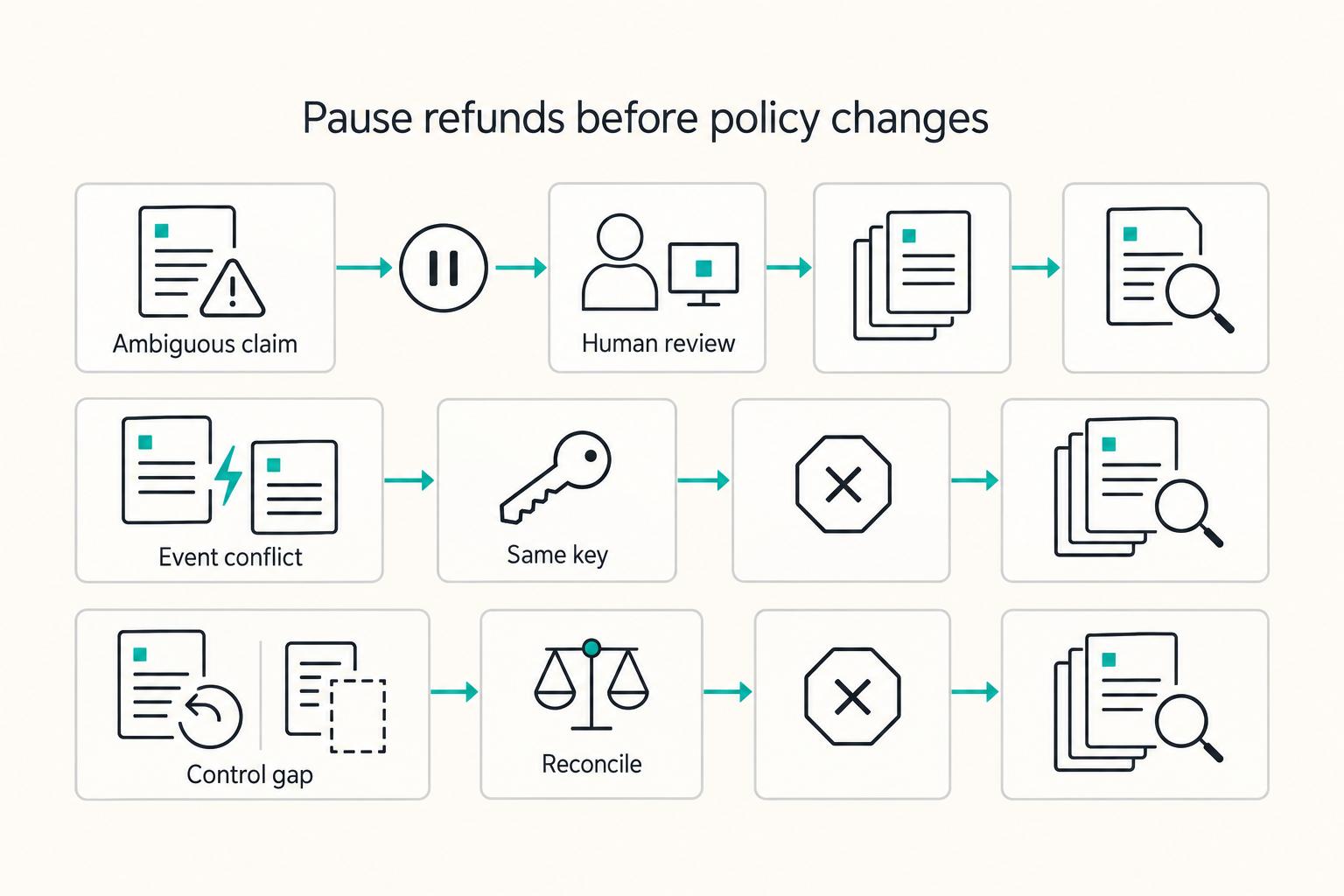
Refunds in Agentic Commerce With Approval Gates and Reconciliation Control
Treat **refunds in agentic commerce** as a post-purchase operating decision, not a payment reversal. Once AI agents can act on cancellations, returns, and other refund-related adjustments, the real work is deciding which cases can resolve automatically, which need preset limits, and which must stop for human approval.
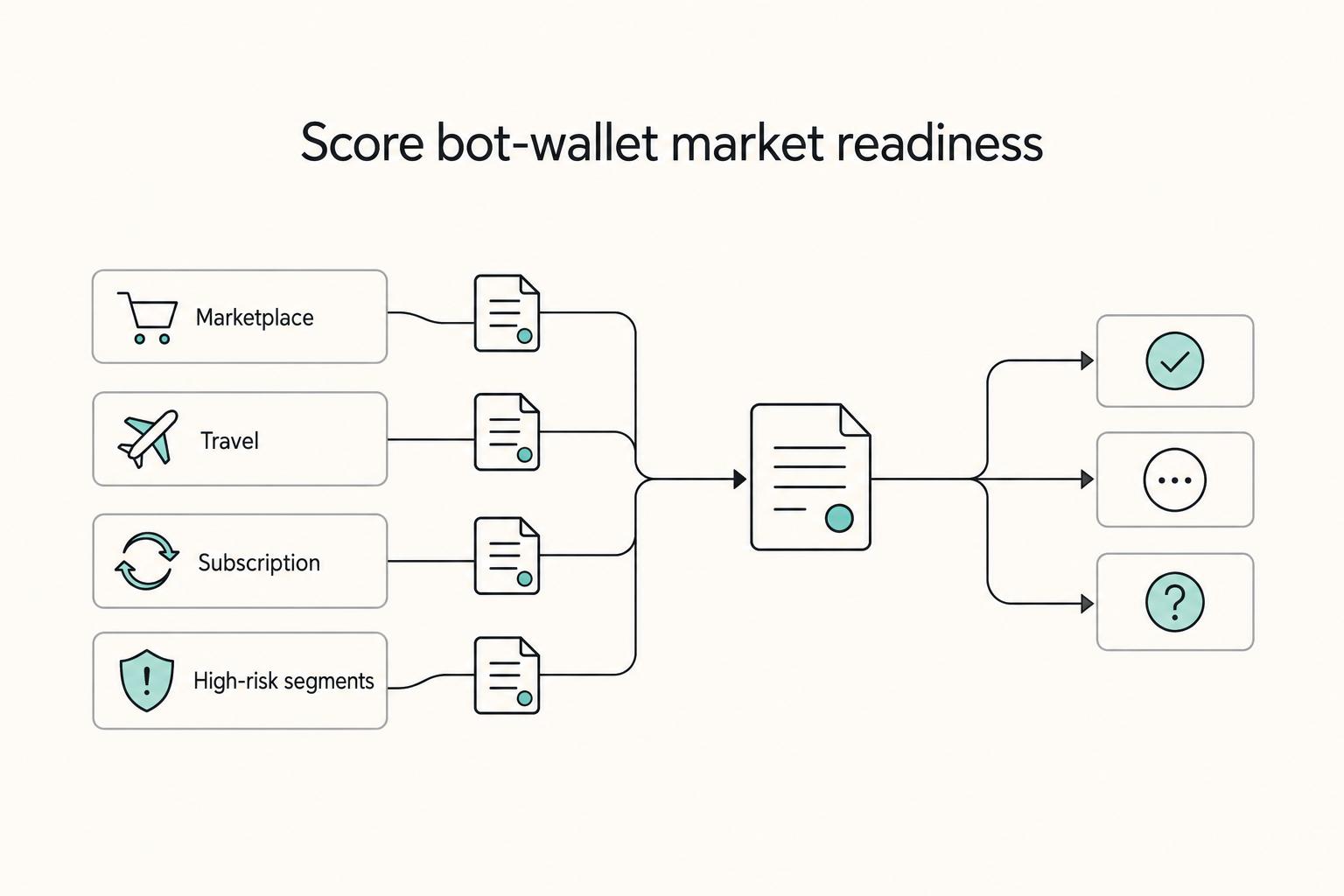
Agentic Commerce Risk Scoring: Detecting Abuse When Bots Control Wallets
Agentic commerce is moving quickly, and the controls around it are still evolving. If you treat fraud, compliance, and accountability as one generic risk bucket, you can make the wrong launch call even when demand looks strong. A corridor can look attractive commercially and still be weak operationally because provider coverage, control expectations, or accountability are not ready.