
Quick Answer
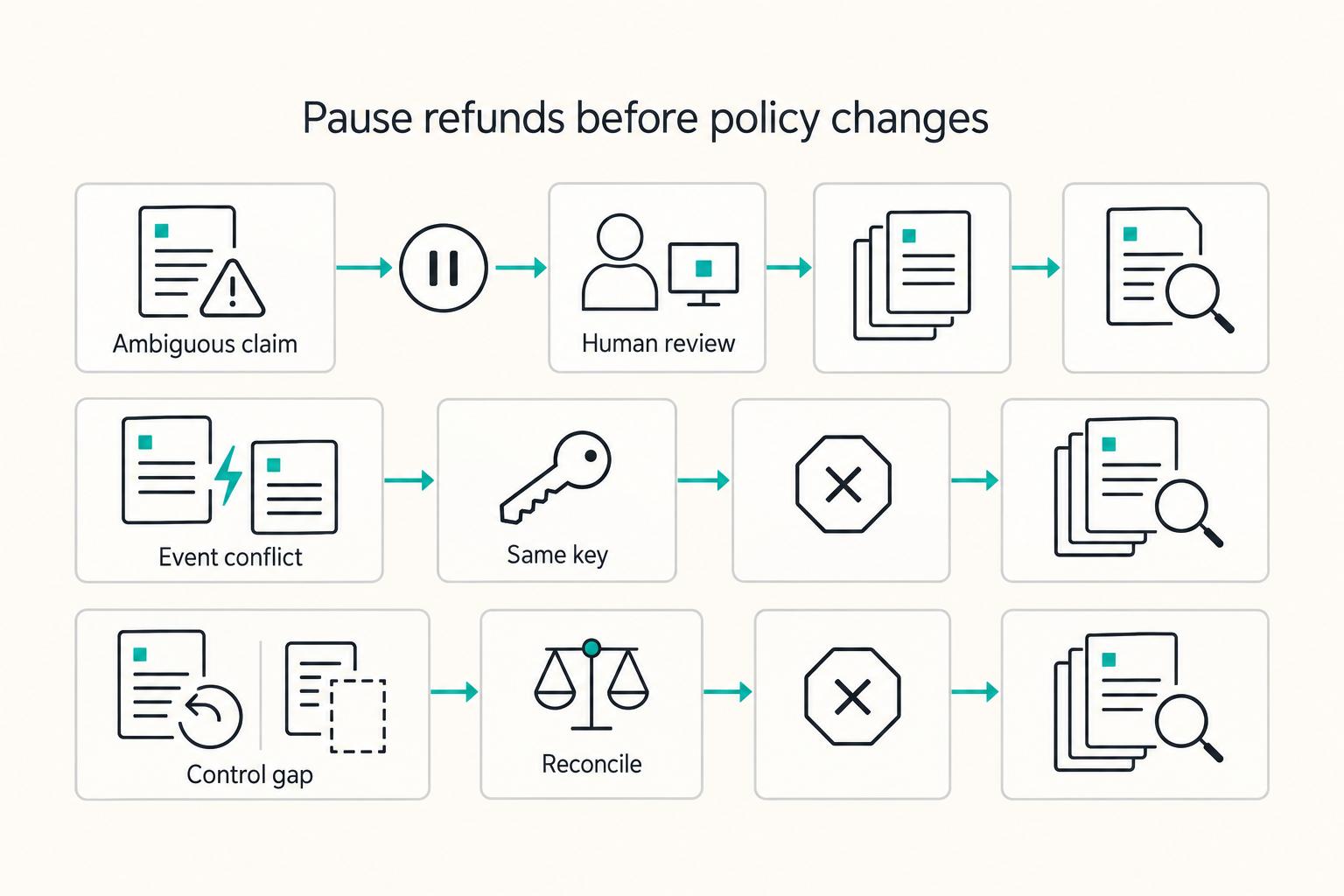
Use a gated decision model: define exchanges, full refunds, returnless resolutions, and returnless partial refunds before enabling automation. Route only complete cases, and require customer message, delivery state, return reason, and risk signals before settlement. Keep high-risk adjustments behind named approvers, especially when chargeback exposure is present. Launch by market only after each case can be traced from trigger to provider acknowledgement and final Ledger journals entry.
Treat refunds in agentic commerce as a post-purchase operating decision, not a payment reversal#
Treat refunds in agentic commerce as a post-purchase operating decision, not a payment reversal. Once AI agents can act on cancellations, returns, and other refund-related adjustments, the real work is deciding which cases can resolve automatically, which need preset limits, and which must stop for human approval.
That shift matters because the agent is not just sending money back. In current implementations, it can track order status, fulfillment updates, and adjustments such as refunds, returns, or cancellations. In practice, refund handling becomes a chain of decisions about remedy, evidence, settlement, and accountability. A cancellation before shipment, a damaged-item claim, and a category-specific claim should not follow the same path just because they can all end with money moving.
Choose the resolution paths first#
Start by designing a resolution model, not a refund button. The useful paths are broader than a full reversal: full refund, returnless resolution, and returnless partial refunds.
One of those options - returnless partial refunds - matters because public research points to a credible upside. One randomized field experiment involving nearly one million customers tested AI-generated returnless partial refund options against a traditional full-refund-after-return process. It reported a positive net profitability effect from the agentic approach.
The signal is meaningful, but the evidence is still early. The same study is described as one of the first large-scale causal evaluations in this area, so treat it as directionally strong, not universally portable. If you operate across multiple countries, categories, or channels, do not assume the same effect size or policy rule will hold everywhere.
Add human control from day one#
Keep human control in the design from day one. Public evidence does not support the idea that fully autonomous refunding is already the norm without guardrails. Many current setups still rely on human confirmation, preset limits, or role-based permissions, and some commercial systems restrict final refund adjustments to supervisor-level roles. That is a useful checkpoint: if your team cannot name who is allowed to finalize a high-risk adjustment, you are probably automating too early.
A common failure mode is letting the agent apply one policy across contexts where the business reality differs. Refund policies vary across products, categories, and channels, so the same damaged-goods claim may justify a full refund in one line of business, a returnless partial in another, and manual review somewhere else. If the policy does not reflect that variation, you can lose margin quickly or create inconsistent customer treatment.
Before you start#
Use this guide to make three decisions in order, before you automate anything:
- Define the resolution paths you will allow.
- Set where automation stops and approval begins.
- Require enough evidence and audit control to explain every outcome later.
If you do that well, you are not trying to automate everything. You are choosing the right remedy for each case while protecting margin, customer trust, and compliance readiness as you expand.
Define the refund operating model before you automate#
Set the remedy order before you automate: use an exchange-first posture where it is justified, then move to returnless partial, returnless, or full refunds based on your risk and economics.
Define the four resolution paths#
Define a fixed menu so the agent selects from known paths instead of improvising.
| Path | What it means |
|---|---|
| Exchanges | Replace the item instead of sending money back. |
| Full refund | Return the full amount paid. |
| Returnless Refund / Returnless Resolution | Issue a refund (or replacement) while the buyer keeps the original item. |
| Returnless partial refund | The buyer keeps the item and receives part of the amount paid back. |
Set the operating sequence#
Document the sequence you will enforce for each case: detection, classification, decision, settlement, then reconciliation in Ledger journals. Use it as a control layer, not just a process map: capture the trigger, assign case type and allowed remedies, record the approval, execute settlement, and confirm order-state synchronization plus journal consistency.
Use one checkpoint before further automation: if a case cannot be traced from request to settlement record to final ledger entry, keep it out of fully automated handling.
Split policy ownership before money moves#
Set ownership boundaries before agentic commerce can settle funds. Product policy should define which remedies are allowed by scenario, while payments ops should control settlement permissions, approvals, and merchant-of-record obligations. If your platform accepted the payment directly, it is responsible for refunds and chargebacks, so automation should not bypass payments controls.
Related: Agentic Commerce for Platform Operators: How to Prepare Your Payment Infrastructure for AI Agents.
Prepare the minimum inputs and evidence pack#
Before the agent sees a case, lock the minimum pack and keep incomplete cases in manual review.
Write policy rules before automation#
Start with fixed rules for Cancellations, Partial fulfillment, Chargebacks, and exception handling. Each rule should state the trigger, allowed remedies, override authority, and auto-settlement blocks.
| Rule area | Rule must state | Extra note |
|---|---|---|
| Cancellations | Trigger, allowed remedies, override authority, and auto-settlement blocks | Start with fixed rules before automation |
| Partial fulfillment | Trigger, allowed remedies, override authority, and auto-settlement blocks | Start with fixed rules before automation |
| Chargebacks | Trigger, allowed remedies, override authority, and auto-settlement blocks | Capture the issuer dispute reason and supporting documentation before response |
| Exception handling | Trigger, allowed remedies, override authority, and auto-settlement blocks | Operators should be able to explain whether an exception path was triggered |
For chargebacks, require capture of both the issuer dispute reason and any supporting documentation before response. If an operator cannot quickly explain why a case was classified, which remedies were allowed, and whether an exception path was triggered, the policy pack is still too vague.
Make evidence completeness a hard stop#
Make required evidence by case type a hard gate. At minimum, require customer message, delivery state, return reason, and relevant Risk scoring signals.
Adjust evidence by scenario: cancellation needs request timing plus order status; partial fulfillment needs promised vs shipped; chargeback files should group communications, receipts, policies, and system logs by type so review is traceable. If new evidence changes risk signals, stop autonomous settlement and re-review.
Map compliance and tax gates by market#
Pre-approve compliance and tax gates by market and program, and document where automation must defer. Do not treat KYC, KYB, AML, and VAT validation as interchangeable across markets.
| Item | Use or condition | Note |
|---|---|---|
| VIES | Check EU cross-border VAT registration | Account for the GB change in VIES effective 01/01/2021 |
| AML/KYB beneficial-owner procedures | Use in U.S. control design for legal-entity customers | Include written procedures under 31 CFR § 1010.230 |
| Form W-9 | Correct TIN to payers filing information returns | Document tax steps for refunds that change reporting records |
| Form W-8BEN | Submitted when requested by withholding agent or payer | Document tax steps for refunds that change reporting records |
| Form 1099 | Updates and recipient copies when required | Assign ownership |
| FEIE | Conditional escalation | Not automatic treatment |
| FBAR / FinCEN Form 114 | Only where relevant | $10,000 aggregate threshold |
Where relevant, use VIES to check EU cross-border VAT registration, and account for the GB change in VIES effective 01/01/2021. For AML/KYB in U.S. control design, include written procedures to identify and verify beneficial owners of legal-entity customers under 31 CFR § 1010.230.
Document tax steps for refunds that change reporting records: Form W-9 (correct TIN to payers filing information returns), Form W-8BEN (submitted when requested by withholding agent or payer), and ownership for Form 1099 updates and recipient copies when required. Keep FEIE as conditional escalation, not automatic treatment. Include FBAR steps only where relevant, with FinCEN Form 114 context and the $10,000 aggregate threshold.
Compare market and program constraints before choosing rollout countries#
Choose rollout countries only where refund execution is fully traceable and testable. If you cannot trace a refund from the trigger event to Ledger journals, keep that market in manual review.
Compare by country, vertical, and program#
Build your comparison at the country + vertical + program level, not country alone. Payment-method support varies by country, currency, product context, and API options, and provider catalogs are filtered by geography and currencies. A card-rail setup and a Virtual Accounts setup in the same country can have different refund constraints.
Use one table format for every candidate slice:
| Candidate slice | Refund method availability | Settlement timing | Compliance gates | Operational burden | Unknowns to clear |
|---|---|---|---|---|---|
| Card rails | Confirm support by country, currency, product, and API context | Map payout schedule and configured settlement-delay behavior | Record market/program checks already approved and the owner | Moderate when provider references map cleanly to internal records | List local rule gaps and provider-specific exceptions |
Virtual Accounts | Confirm the refund path is supported for this market/program | Verify how return timing and fund movement are represented | Record required market/program checks and owner | Higher when matching logic is less direct | Mark where local evidence or provider coverage is still unknown |
Payout batches | Confirm whether refunds net against payouts or need separate handling | Document batch cutoffs, posting lag, and visibility timing | Note added review gates by market/program | Higher when batch timing reduces case-level visibility | Mark unresolved batch-reference and reporting gaps |
If a row still says "it depends" without a written condition, that row is not launch-ready.
Model settlement before launch#
Treat settlement as a launch constraint, not a background detail. Payout timing varies by industry and country, and settlement delay can be configuration-dependent by program. If you reuse one market's timing assumptions in another, refund promises can drift from actual fund movement.
Design status handling for asynchronous behavior: event snapshots can be eventually consistent, delivery can arrive out of order, and retries can continue for up to 3 days. Use idempotency so retries do not create duplicate refund side effects.
Run one end-to-end trace before launch: decision event -> provider acknowledgement -> final Ledger journals posting. If that chain breaks at any step, autonomous refunds are not ready.
Write uncertainty into the rollout decision#
State uncertainty explicitly in the rollout decision. Cross-border supervisory and regulatory approaches vary by jurisdiction, and the FSB's 12 December 2024 recommendations call out inconsistent approaches across markets. That directly affects what can be safely automated.
Document where coverage varies by provider/program and where local evidence is still unknown. One industry commentary captures the operating reality: compliance and risk work is "multifaceted and idiosyncratic," and "There is no one-size-fits-all solution."
Keep the launch rule strict: if reconciliation cannot reliably match processor outputs to internal records, bank statements, and Ledger journals, do not launch autonomous refunds in that market.
Set autonomy tiers and approval gates that match risk#
Use three authority tiers before enabling autonomous refunds, and define the gates for each tier in advance. In agentic commerce, your merchant system still makes the final accept or decline decision, so each tier should map to a Risk scoring band, required evidence, and a Chargebacks escalation rule.
Define the three authority tiers#
Document the tiers first, then bind each one to a decision path that operators can audit.
| Authority tier | Typical risk posture | Required controls | Escalation trigger |
|---|---|---|---|
| Automatic decision | Low-risk band | Required evidence fields complete, no active dispute signal, traceable provider references, market/program refund path confirmed | Missing or conflicting evidence, or dispute signal appears |
| Agent recommendation with approval | Review band | Agent proposes outcome; named operator approves after evidence and policy checks | Policy mismatch, unclear evidence, or elevated dispute exposure |
| Human-led resolution | High-risk or ambiguous cases | Manual investigation, documented rationale, tighter evidence review, hold/deny available | High-risk score or dispute-linked case |
Example thresholds can help teams start calibration, not replace it. Some setups use review around 65 and blocking/escalation around 75, while Adyen shows a classic example where 100 blocks a transaction. Keep your actual bands market- and program-specific.
Tie each tier to evidence and dispute risk#
Treat evidence completeness and dispute exposure as hard gates. If required evidence is missing, contradictory, or changed in a way that breaks confidence, move the case out of auto approval and into approval or manual handling.
Use Webhooks as an operational checkpoint for dispute-related events, not just status updates. If dispute pressure is rising toward network monitoring thresholds, tighten routing and handoffs before loss rates worsen. For related controls, see chargeback controls.
Require traceability and safe retries#
Every auto-approved case should be traceable end to end: decision input, refund request, provider event via Webhooks, and final posting in Ledger journals. If you rely on ledger immutability, verify append-only or tamper-evident behavior in your implementation instead of assuming it.
Enforce Idempotent retries on retryable refund calls. Webhook-driven handlers can run multiple times, including concurrently, so repeated events must replay safely rather than create duplicate refunds. If duplicate or out-of-order replay is not proven safe, keep that path on approval or manual resolution until it is.
If you want a deeper dive, read Agentic Commerce Risk Scoring: Detecting Abuse When Bots Control Wallets.
Build the decision matrix for cancellation return and partial fulfillment cases#
Use a matrix that routes by case type, evidence quality, and downstream dispute risk, not gut feel. This keeps refund decisions consistent when customers challenge outcomes or when a chargeback follows.
Map case types to outcomes#
Start with four case rows and four outcome columns. Tie each row to the dispute condition you are most likely trying to prevent, without treating one network's labels as a universal rulebook.
| Case type | Exchange | Full refund | Returnless partial | Deny or escalate |
|---|---|---|---|---|
Cancellations | Use when the customer still wants the item and fulfillment is still controllable | Use when cancellation is valid and fulfillment can be stopped cleanly | Use only when part of the order can still be canceled and part cannot | Escalate when cancellation timing, shipment state, or identity is unclear; cancellation disputes are commonly linked to Condition 13.7 |
| Damaged or defective claims | Use when replacement is practical and abuse risk is low | Use when defect evidence is credible and replacement is not practical | Use for limited-value damage cases where a return is uneconomic | Escalate when evidence is weak or abuse patterns appear; defective/not-as-described disputes map to Condition 13.3 |
| Delayed delivery | Use only if replacement resolves the delay problem | Use when delivery failure is material and the customer no longer wants the order | Use when the customer will keep the order with compensation for delay | Escalate when delivery proof conflicts or shipment state is unclear; non-receipt disputes map to Condition 13.1 |
Partial fulfillment | Use when missing items can be shipped quickly | Use when missing items remove the order's core value | Often the best fit when some value was delivered but not all | Escalate when line-item records, substitutions, or fault allocation are disputed |
Two controls matter across all rows. If you promise a credit and do not process it, you create additional exposure under Condition 13.6 (credit not processed). Also, returnless partial refunds have large-scale experimental support (nearly one million customers), so they are a valid policy path to test rather than a rare exception.
Add one-minute decision rules#
Make rules operators can apply fast. If customer value is high, abuse risk is low, and evidence is complete, prefer exchange or returnless partial before defaulting to full payout. If fraud indicators are high, route to manual review instead of optimizing for speed.
Use criteria-based escalation in Risk scoring: when account, order, device, payment method, or claim patterns look off, the agent can recommend but a human should decide. This avoids preventable failures like weak-evidence partials that invite repeat abuse, unresolved delivery claims that drift into non-receipt disputes, or denied cancellations that later become cancellation disputes.
Check economics before production#
Before rollout, require each matrix row to track four fields: payout impact, support cost, expected effect on future purchase behavior, and strategic behavior risk. This keeps policy choices tied to operating outcomes, not just approval speed.
Validate on recent samples from each row. Confirm claim reason, fulfillment or delivery state, decision-time risk score, selected outcome, and proof that any promised credit posted. If dispute rates are trending toward the 0.75 percent threshold, tighten delayed-delivery and cancellation handling first because those rows can convert quickly into downstream Chargebacks.
Connect refund decisions to settlement reconciliation and payout systems#
A refund is not complete at approval; it is complete only after provider acknowledgment and a posted entry in Ledger journals.
Record refunds as event sequences#
Model each refund as a sequence, not a single status flip: decision event, settlement instruction, provider acknowledgment, then final ledger posting. This prevents cases from being marked "refunded" before the provider has accepted or completed anything.
If you are the Merchant of Record (MoR), you still own refund and chargeback handling in agentic checkout flows, and current guidance is to keep payments on existing PSP and settlement processes. Keep customer-facing status explicit between "approved" and "completed" (for example, approved_pending_provider) until a provider reference is returned.
Use an Idempotency-Key on every create or complete call. Safe duplicates should return the same result, and parameter mismatches should fail with idempotency_conflict and HTTP 409. If you cannot tie a provider-side action to one request, treat it as duplicate-refund risk.
Design for eventual consistency#
Build status surfaces for eventual consistency from day one. Webhooks can arrive out of order, and at least one major PSP states delivery order may vary, events are sent at least once, and redelivery can happen up to 8 retries.
Acknowledge webhook receipt first, then run business logic. This helps avoid retry pileups during validation or writes. Guard against older events overwriting newer states, such as moving a confirmed refund back to pending.
Use versioned state rather than last-write-wins. Store internal case ID, provider reference, event timestamp, webhook event ID, and journal entry ID together; if they conflict, stop auto-closure and route to review.
Adjust for modules that change the money path#
Implementation must change when the money path changes. With Virtual Accounts, returns may need to map to a virtual-account sub-ledger under one physical account, not just a top-level bank account record.
Payout batches add a downstream dependency when a refund changes seller, courier, or partner payouts. Hold or adjust those payouts until the refund is final and traceable by provider reference. Provider identifiers and limits differ, but references are required for status tracing (for example, PayPal payout_batch_id), and batch sizes vary (for example, up to 1000 grouped transfers in Wise and up to 15,000 payments per PayPal call).
For every resolved case, keep one auditable chain from request to decision, settlement instruction, provider reference, webhook history, and ledger export. If any link is missing, the case is not reconciled.
Handle common failure modes and recover without policy drift#
Policy drift usually starts when an exception is silently treated as the new default. When a refund flow breaks, first slow or pause automation, verify what happened in Ledger journals, and then adjust policy.
| Failure mode | Immediate response | Follow-up |
|---|---|---|
| Ambiguous damaged, delayed, or partial-fulfillment claims | Move the claim type from auto-approve to human approval or recommendation-only | Sample recent cases, compare the evidence pack to each decision, and retrain on corrected labels before restoring automation |
| Duplicate or conflicting events | Reuse the same Idempotency-Key on retries and treat idempotency_conflict with HTTP 409 as a stop signal | If provider status shows refunded but no matching entry exists in Ledger journals, hold closure and reconcile provider reference, event ID, and journal ID together |
| Compliance controls not program-ready | Keep refunds on a manual path until the controls are live | If a market lacks required onboarding fields, document collection, or validation logic, do not assume provider verification satisfies independent legal duties |
| Returnless abuse signals rise | Narrow eligibility by claim type, order value, customer history, or repeat-claim frequency | Monitor Chargebacks and dispute-reason trends by cohort |
-
Force a human gate when ambiguous claims start slipping through. If damaged, delayed, or partial-fulfillment claims begin showing more reversals or complaints, move that claim type from auto-approve to human approval or recommendation-only. Sample recent cases and compare the evidence pack to each decision, especially customer messages, delivery state, and
Risk scoringinputs. If noisy signals are driving approvals, retrain on corrected labels before restoring automation. -
Replay safely when events duplicate or conflict.
Webhookscan arrive out of order and at least once, so duplicate or conflicting events are expected. Reuse the sameIdempotency-Keyon retries, expect the same result for true duplicates, and treatidempotency_conflictwith HTTP 409 as a stop signal, not a retry trigger. If provider status shows refunded but no matching entry exists inLedger journals, hold closure and reconcile provider reference, event ID, and journal ID together. -
Pause expansion if compliance controls are not program-ready. Do not assume provider verification satisfies your independent legal duties. KYC, AML, and tax requirements vary by country, legal entity, and requested capabilities, and VAT IDs should be validated in VIES where relevant. If a market lacks required onboarding fields, document collection, or validation logic, keep refunds on a manual path until those controls are live.
-
Tighten returnless eligibility when abuse signals rise. Returnless programs can improve outcomes, but field evidence also shows strategic behavior risk. Narrow eligibility bands by claim type, order value, customer history, or repeat-claim frequency, then monitor
Chargebacksand dispute-reason trends by cohort. With 93% of retailers reporting fraud or exploitative behavior as significant, convenience gains should not outweigh a worsening dispute profile.
Conclusion#
Broad autonomy is not the goal. The practical target is controlled rollout: market-specific rules, explicit authority limits, complete evidence, and reconciliation you can explain from Webhooks to Ledger journals. If your team cannot walk a single case end to end, you are not ready to scale autonomous decisions.
Use this as a launch checklist, not a strategy slogan.
- Document market and program constraints first.
Confirm the exact KYC, AML, and VAT validation gates for each country and account setup you plan to support (and KYB where applicable). Those requirements change by location, business type, and requested capabilities, and AML implementation is jurisdiction-adaptive rather than one global template. If you operate in the EU and need VAT checks, use the VIES flow as the checkpoint because it queries national VAT registries at search time. Verify: for each launch market, you have an owner, the required checks are written down, and the approval path is clear before any refund authority is switched on. Red flag: a single shared checklist that ignores market or program differences.
- Approve a resolution matrix before you automate case handling.
Your team should agree on default outcomes for common cases (for example, Cancellations, returns, and Partial fulfillment), plus when to deny or escalate. This is where policy gets concrete: what evidence is required and which claim types are never auto approved. Verify: test the matrix against recent real cases and make sure two operators would reach the same outcome from the same evidence pack. Failure mode: policy drift, where exceptions slowly become the norm and no one notices rising operational or dispute risk.
- Set autonomy tiers with named ownership for decisioning.
Separate what can be auto approved, what needs agent recommendation plus approval, and what stays human led. Tie each tier to evidence completeness and escalation triggers, especially where risk is higher or the customer narrative is ambiguous. If a case is missing delivery state, return reason, or risk signals, do not let the model guess its way through. Verify: there is a named team or person who owns threshold changes and reviews edge cases, not just model output.
- Prove your event and reconciliation path before scaling volume.
Build for delayed, repeated, and even concurrent webhook calls. Idempotent retries matter because retry safety is what prevents duplicate financial side effects when handlers are called more than once. Your audit trail should connect the request, decision event, provider acknowledgment, any payout or settlement-batch mapping, the underlying balance transaction, and the final posting in Ledger journals. Verify: pick one completed case and trace it from customer request to ledger export without hand waving. Red flag: the case says "refunded" in product UI, but finance cannot match it to provider records or downstream status.
That is the standard to hold. The teams that keep control while automation expands are the ones that scale it well.
Frequently Asked Questions
What is the difference between autonomous refund processing and a standard refund automation rule?
A standard rule usually fires on fixed conditions. Autonomous processing evaluates an evidence pack, such as the customer message, delivery state, and risk signals, then chooses among approved outcomes, including returnless partial refunds where policy allows. The checkpoint is auditability: you should be able to trace the request, decision event, provider acknowledgment, and final posting in Ledger journals.
When should a platform choose exchange instead of full refund in agentic commerce?
There is no one universal rule. In practice, exchange fits cases where a replacement is likely to resolve the issue without clear abuse risk, while a refund is often cleaner when the order outcome itself failed and replacement is unlikely to restore trust. The red flag is forcing exchange after the customer has already provided clear evidence of a broken outcome.
Are returnless refunds actually profitable or just a CX tactic?
The strongest cited evidence says they can be profitable, not just a customer experience tactic. In a randomized field experiment involving nearly one million customers, AI-generated returnless partial refund offers increased payouts but still had a positive net profitability effect because they also reduced processing costs and improved long-term customer value. The tradeoff is real: the same study also found signs of strategic behavior, so you should monitor repeat-claim cohorts, not just satisfaction.
How much refund authority should AI agents have before human approval is required?
Do not set one blanket limit for all cases. A practical approach is to tie authority to risk-score bands and evidence completeness. For example, scores below 65 may qualify for auto-approval if the case file is complete, while scores at 65 or above route to manual review. Scores at 75 or above should trigger a tighter review path because that band is considered high risk in the cited scoring model. If your use case falls under rules that require human oversight, your design needs a real approval path, not just a post hoc audit.
What are the biggest abuse and governance risks in returnless partial refund programs?
The first risk is strategic behavior: customers can learn which claims produce money without a return and adapt accordingly. Another common governance risk is policy drift, where eligibility expands without close monitoring of dispute and margin signals. In practice, a strong control is narrow eligibility by claim type, order value, and customer history, then sampled review against the original evidence pack.
How should refund policy connect to chargebacks, risk scoring, and reconciliation?
Treat them as one chain, not separate teams. A chargeback reverses the original payment and can add dispute fees, so refund policy should connect to dispute prevention, Risk scoring, and reconciliation from provider reference to ledger entry. If dispute rates rise after a policy change, pause expansion and review the full flow and evidence quality. This is where a deeper chargeback process matters most in Chargebacks in Agentic Commerce: Evidence Liability and Recovery Workflows for Platforms.
Try a related tool
Researched and edited by the Gruv editorial team. Gruv builds cross-border billing, payouts, and finance-operations software for global businesses.
Sources
Educational content only. Not legal, tax, or financial advice.
Related Posts

Chargebacks in Agentic Commerce: Evidence Liability and Recovery Workflows for Platforms
For platform founders, the hard call is no longer just how to stop fraud. You also have to handle disputes where the payment was authorized, but the buyer later says the result was not what they meant to approve. That gap between "authorized" and "wanted" is where much of the new risk sits. It gets wider when an AI agent can browse, compare options, fill carts, and complete purchases on a customer's behalf.
Agentic Commerce Risk Scoring: Detecting Abuse When Bots Control Wallets
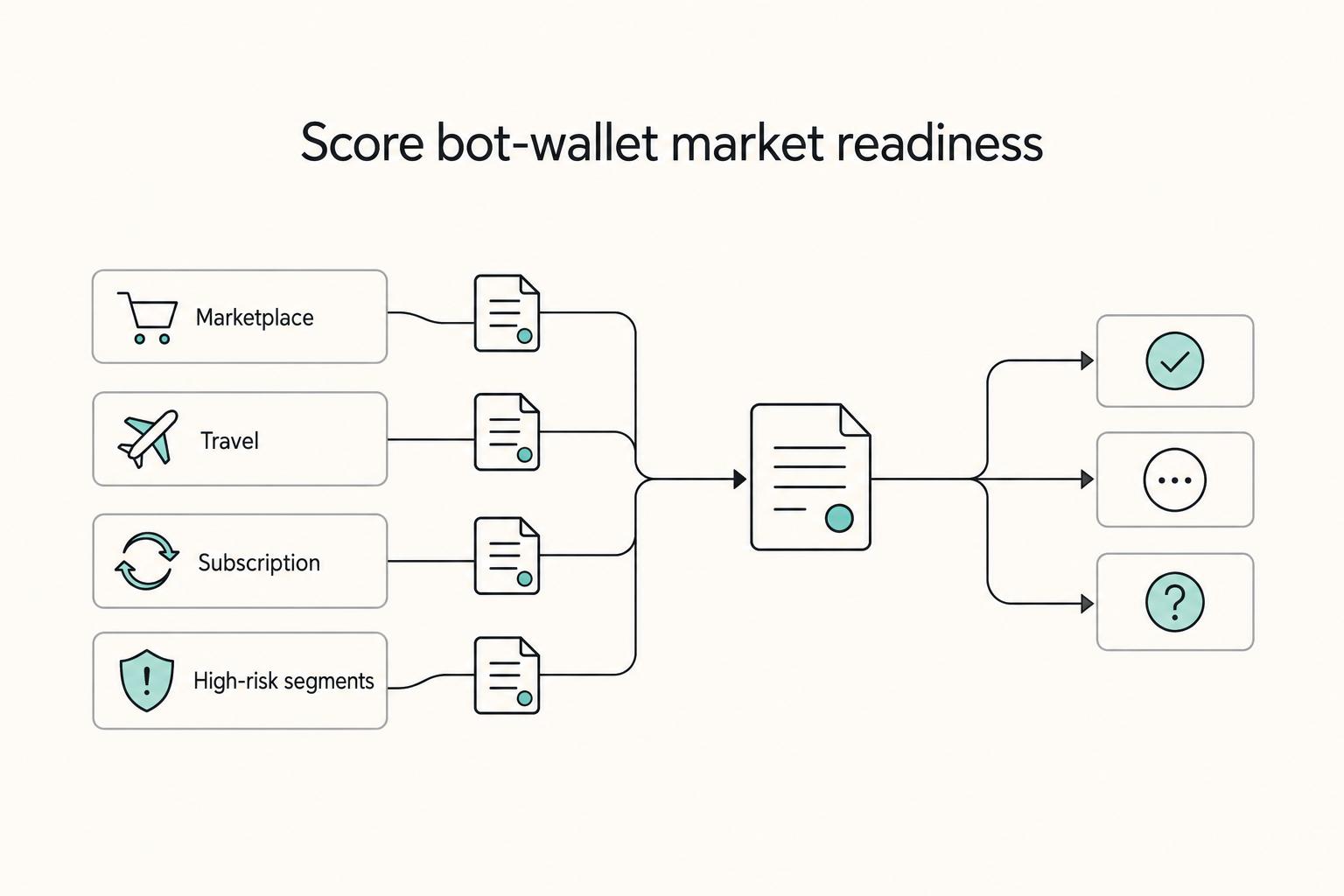
Agentic commerce is moving quickly, and the controls around it are still evolving. If you treat fraud, compliance, and accountability as one generic risk bucket, you can make the wrong launch call even when demand looks strong. A corridor can look attractive commercially and still be weak operationally because provider coverage, control expectations, or accountability are not ready.

Agentic Commerce for Platform Operators: How to Prepare Your Payment Infrastructure for AI Agents
Move now, but do not launch on hype alone. Agentic commerce is moving from concept into practical implementation. Your payment risk still comes down to the same core controls: who authorized the transaction, what the agent was allowed to do, and who is accountable when a transaction is fraudulent or incorrect.