
Quick Answer
Start by mapping who can tax you, then choose structure second. A territorial tax system for nomads can reduce local tax only when your residency facts, source treatment, and transfer behavior are documented and consistent. If those records are weak, a worldwide or residency-based position may be easier to defend even with more reporting. Use the article’s sequence: exposure map, jurisdiction checks, evidence pack, monthly controls, and early escalation when two countries may claim you.
How Territorial and Worldwide Taxation Work#
Start by mapping who can tax you before chasing lower rates. Territorial treatment can reduce tax drag in the right setup, but residency or income-source mistakes can erase that upside through multi-country filing complexity and double-tax risk. Compare countries only after you separate the core models.
| Model | What gets taxed | Common failure mode | Practical default |
|---|---|---|---|
| Territorial taxation | Income earned in-country; foreign-sourced income is often outside scope, with conditions | Assuming all foreign income is untaxed in every case | Confirm source and remittance treatment before relying on it |
| Worldwide taxation | Total income regardless of source | Underestimating global reporting obligations | Start from full reporting, then optimize lawfully |
| Residency-based taxation | Residents on global income; non-residents on local income | Becoming resident without updating filing position | Track residency status continuously |
Two pressure points matter early: time in country and money movement. Spending more than 183 days is often linked to tax residency, and moving foreign income into a country can trigger tax in some territorial setups.
This piece is for freelancers and consultants who want compliant, low-drama execution, not aggressive shortcuts. It compares territorial and worldwide treatment in plain language, then moves into concrete decisions and escalation points before filing season.
Territorial and Worldwide Taxation at a glance#
Compare these models by documentation risk first, then by tax outcome. For most freelancers and consultants, the safer default is the one you can prove with clean cross-border records.
| Model | What income is taxed | Common nomad failure mode | Documentation burden | Who this usually suits | Default move |
|---|---|---|---|---|---|
| Territorial taxation | Income earned inside the country; foreign income is often outside scope, with conditions | Assuming all foreign receipts are exempt, including funds later brought into the country | Medium: clear income-source proof and transfer or remittance records | People with mostly foreign clients and clear separation between local and foreign activity | Confirm source rules and remittance treatment before filing on this basis |
| Worldwide taxation | Income regardless of where it is earned | Missing offshore income streams or filing only part of global income | High: full global reporting with consistent annual records | People resident in countries that tax global income | Start from full reporting, then apply available relief under local rules or treaties |
| Citizenship-based taxation | In some cases, global income tied to citizenship (U.S. example) | Assuming moving abroad ends home-country filing duties | High: ongoing global reporting duties | Citizens in citizenship-linked systems | Treat home-country filing as non-optional, then plan locally |
| Residency-based taxation | Residents on global income; non-residents on local income | Relying only on day count and ignoring deeper residency tests | Medium to high: day logs, residence evidence, and tie-breaker support when needed | People with stable residency facts and clear move timing | Test residency status early and keep proof on permanent home and center of vital interests |
| Low- or zero-local-tax setup | Local tax treatment varies by jurisdiction | Assuming low or zero local tax means no filing, no records, or no exposure elsewhere | Medium to high when cross-border duties still apply | People with simple structures and low conflict risk | Treat low local tax as one input, not the whole decision |
Double-tax exposure can still happen under territorial taxation. A common conflict is residency versus source. One country treats you as resident and taxes worldwide income, while another taxes income it treats as local or taxes remitted funds.
Before you rely on a territorial outcome, verify three items: your current residency position, the destination country source-income rules, and remittance treatment. Do not treat the 183-day threshold as universal protection. If two countries can both claim residency, prepare tie-breaker evidence early, especially permanent home and center of vital interests.
Start with your tax exposure map before you pick a country#
Map your tax exposure before you choose a base. That tells you who can tax you, and on what basis, before you commit to visas, leases, and payment changes.
| Exposure anchor | Question to answer now | Risk if skipped | Evidence to prepare early |
|---|---|---|---|
| Citizenship-based taxation (where applicable) | If this applies, do you still need to file on worldwide income after you move (for example, as a U.S. citizen)? | You assume home-country filing ended when it did not | Prior returns, filing calendar, account reporting checklist |
| Current tax residency | Which country can already treat you as resident today? | Two countries claim residence in the same year | Entry or exit log, housing records, residency correspondence |
| Planned travel pattern | Could your movement pattern trigger a second residence claim? | Mid-year moves create competing residence positions | 12-month travel plan, visa timeline, address history |
| Income source and payer geography | Where is each income stream earned, and who pays it? | You claim foreign-source treatment without support | Contracts, invoices, payment trail grouped by client country |
| Tax treaties | Is there a treaty, and which relief path applies in your facts? | Relief is assumed but not available in practice | Treaty text, tie-breaker notes, relief method notes |
Tax treaties can reduce double taxation only when your facts and records match treaty language. They can assign taxing rights and provide relief through credits, exemptions, or reduced withholding. If two countries can both claim residence, tie-breaker rules apply, and permanent home is one listed criterion.
This is where territorial outcomes often get misread. Exposure can remain if another country treats you as resident and taxes worldwide income, or if your income-source position is weak on documentation.
Cross-border visibility has increased. One source reports that over 120 jurisdictions participate in automatic financial information exchange under CRS, so account and payment data may surface across borders.
Use this checkpoint before you pick a country:
- If two countries can plausibly claim tax residency, stop and verify the tie-breaker outcome before relying on territorial treatment.
- If treaty protection is unclear, take a conservative filing position for year one and optimize after your facts are stable.
- If U.S. citizenship-based taxation applies, keep U.S. filing as baseline and layer local planning on top.
Choose your base system from citizenship reality, not blog hype#
Start from obligations you cannot opt out of, then optimize locally.
| Starting reality | What to do first |
|---|---|
| U.S. filing exposure | Treat your return, Form 8938, and FinCEN Form 114 (FBAR) as baseline duties. |
| Non-U.S. residence exposure | Verify local residence-status requirements and keep clear records before optimization. |
| Local territorial planning | Keep local planning separate from unresolved home-country filing duties. |
If you are tied to U.S. filing, treat Form 8938 and FBAR as separate tracks. Form 8938 is attached to your tax return when specified foreign financial assets exceed the applicable threshold. Do not use one threshold as a universal rule, since thresholds differ by filing context, including joint filing and taxpayers residing abroad. If you do not need to file an income tax return for the year, Form 8938 is not required for that year.
Use this decision rule when choices conflict:
- If home-country obligations are heavy, prioritize documentation quality first and jurisdiction choice second.
- If local optimization depends on assumptions that foreign obligations ended, pause and verify first.
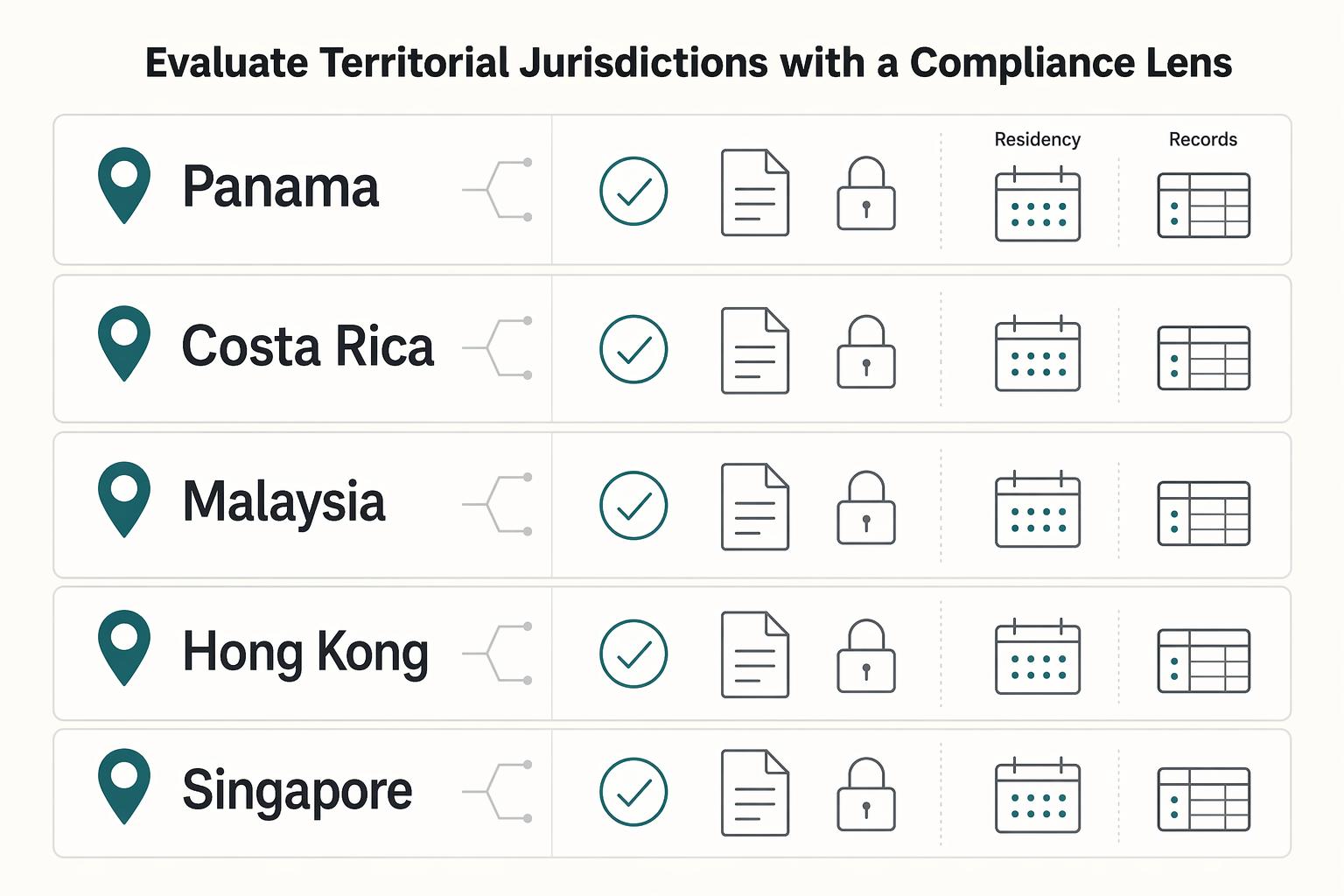
Evaluate territorial jurisdictions with a compliance lens#
Treat each option as a documentation-first decision. If key tax rules are not clear in writing, do not assume favorable treatment for foreign income. In 2026, low-tax relocation is more about structure and evidence quality than marketing claims.
| Jurisdiction | Legal clarity check first | Admin load check | Visa practicality check | Provisional call |
|---|---|---|---|---|
| Panama | Get written local-source definitions and treatment of foreign receipts | Confirm filing steps and required records for your status | Confirm your permit path supports your actual stay pattern | Hold until written confirmation is complete |
| Costa Rica | Verify how local-source income is defined for your fact pattern | Confirm what must be filed and when | Confirm visa conditions match your planned work pattern | Hold until written confirmation is complete |
| Malaysia | Verify source rules you will rely on before invoicing | Confirm compliance steps for your residency position | Confirm permit conditions and renewal friction | Hold until written confirmation is complete |
| Hong Kong | Verify source treatment and boundaries in writing | Confirm annual filing and record-retention expectations | Confirm visa terms align with your activity and timeline | Hold until written confirmation is complete |
| Singapore | Verify source treatment and any reclassification risk | Confirm reporting obligations tied to your status | Confirm visa conditions fit your work and travel cycle | Hold until written confirmation is complete |
| United Arab Emirates | Verify source and remittance treatment in your setup | Confirm compliance tasks across permits and tax filings | Confirm visa route supports your intended presence pattern | Hold until written confirmation is complete |
| Cayman Islands | Verify what is and is not treated as locally taxable in practice | Confirm ongoing record and reporting duties that still apply | Confirm status requirements for staying and operating | Hold until written confirmation is complete |
If you are using a Digital Nomad Visa, Friendly Nations Visa, Rentista Visa, or Destination Thailand Visa, do not assume automatic tax outcomes. A permit may let you stay, but tax treatment can still depend on local-source definitions, residency facts, and how funds move.
Require written confirmation on three points before treating any jurisdiction as low risk:
- How foreign receipts are treated when funds are brought into the country, including any remittance rules.
- How local-source income is defined for your exact client and work-location pattern.
- Which anti-avoidance provisions could reclassify income or reject your claimed position.
Do not rank Panama, Costa Rica, Malaysia, Hong Kong, Singapore, the UAE, or Cayman Islands by headline tax first. Rank them by rule clarity and document quality.
Test remittance, treaty, and anti-avoidance friction before moving#
Run a pre-move pressure test. If remittance rules, treaty mechanics (where relevant), or anti-avoidance exposure are unclear for your facts, do not rely on a low-tax outcome yet.
Not all territorial models behave the same way. Current market mapping separates pure territorial systems, remittance frameworks, and territorial systems with carve-outs. It also lists 29 jurisdictions with some foreign-income pathway, but only nine as strict territorial. Use that gap as a prompt to validate the mechanics before you move.
| Assumption to test | Scenario A: payment received abroad, then transferred locally | Scenario B: income earned while physically working in-country | Verification checkpoint |
|---|---|---|---|
| Foreign income stays outside local tax | Test whether transfer timing or destination changes treatment under remittance rules | Test whether local source or deeming rules could change treatment even with a foreign payer | Save controlling legal text and the exact clause relied on |
| Treaty position is usable (if applicable) | Test whether treaty access conditions are met before transfer or filing decisions | Test whether residence and source positions are both supportable in records | Save official guidance on eligibility and limits |
| Classification survives review | Test whether repeated transfers or relabeling could trigger reclassification | Test whether local activity could trigger anti-avoidance concerns | Save written advisor confirmation where text or guidance is ambiguous |
Keep one evidence pack per assumption with three artifacts: legal text, official guidance, and advisor confirmation when needed. Date-stamp each artifact for the filing year.
Decision rule: if one critical rule is still unclear, either defer the move or take a conservative first-year filing position. Adjust later only if confirmed guidance supports it. This is especially important while global tax rules remain under active multilateral negotiation.
Make the choice with scenario-based recommendations#
Choose the setup with the least filing ambiguity in year one, not the lowest headline rate. In practice, the safer path is the one where residency position, income-source treatment, and reporting duties all match records you can defend.
| Scenario | Recommended setup | Why this is the better call | Red flag that should pause the move |
|---|---|---|---|
| You want predictable compliance and steady paperwork | Prefer jurisdictions with clearer residency administration | Clear residence tests and filing rules reduce interpretation risk early | You are relying on a zero-tax story but cannot map exact residency tests and filing obligations |
| Most revenue comes from foreign clients and your residence position is well documented | Use territorial treatment only with strict source and remittance controls | Territorial systems can work when foreign-income treatment and transfer conditions are documented in advance | You assume all foreign receipts are exempt without checking remittance caveats or local source rules |
| You are a U.S. citizen and still exposed to citizenship-based taxation | Use a dual-layer plan: U.S. compliance plus local-country optimization | U.S. citizenship-based exposure can keep worldwide obligations active while abroad | You treat relocation alone as ending U.S. obligations |
Look beyond day counting alone. In some jurisdictions, center of vital interests, habitual residence, or domicile can matter as much as a 183-day count.
If two countries could plausibly claim you, plan conservatively for double-tax and compliance risk until your position is clearly supportable. Territorial treatment is a tool, not a blanket result, and some territorial frameworks include remittance conditions.
If you have U.S. exposure, keep the sequence strict: map U.S. obligations first, then optimize locally. Worldwide exposure can continue abroad, and ending that exposure requires formal renunciation.
Build a document pack that survives scrutiny#
Your filing position is only as strong as the records you can defend. Build one pack that ties residency evidence, income source, and payment flow together. If you are U.S.-linked, keep foreign-asset reporting inputs and valuation rules in that same pack.
For U.S.-linked filers, keep the valuation method explicit:
| Step | What to do | Article detail |
|---|---|---|
| Maximum value | Use a reasonable approximation of the greatest value during the year | Record each account maximum value |
| Conversion | Convert non-USD accounts into U.S. dollars | Apply this to non-USD accounts |
| Rounding | Round up to the next whole dollar | Example: $15,265.25 becomes $15,266 |
Keep the rest of the pack organized around the records below:
| Evidence area | Core records to keep | Why it matters | Verification checkpoint | Common failure mode |
|---|---|---|---|---|
| Residency facts | Residency permit, lease, utility bills, dated travel log | Supports where you lived and when | Dates align across permit, address proof, and travel entries | Day counts and address records conflict |
| Income source by client country | Signed contracts, invoices, statement of work, delivery evidence | Supports source treatment positions | Each invoice maps to a client country and work-location note | Invoices show a foreign client, but work-location proof is missing |
| Payment trail | Bank statements, payout reports, FX records, transfer references | Connects invoicing to funds received | Each payment can be traced to an invoice ID | Personal and business transfers are mixed |
| U.S. filing folder | Form 8938 inputs, FBAR account list, FinCEN value worksheet, FATCA support files | Reduces inconsistent U.S. foreign-asset reporting | Form 8938 and FBAR data are reconciled before filing | Assuming one form replaces the other |
Organize the pack by tax year, then client country, then account. If a payment cannot be tied quickly to a contract, invoice, and country tag, treat that as a control gap before filing.
For U.S.-linked filers, keep the annual folder strict. Form 8938 is attached to the annual income tax return when specified foreign financial assets exceed the applicable threshold. One cited trigger is an aggregate value above $50,000 for certain filers, and higher thresholds can apply for joint filers or taxpayers residing abroad. If you do not have to file an income tax return for the year, Form 8938 is not required. Filing Form 8938 does not remove a separate FBAR obligation when FBAR otherwise applies.
Apply FinCEN valuation rules consistently in the same folder. Record each account maximum value as a reasonable approximation of its greatest value during the year. Convert non-USD accounts into U.S. dollars, then round up to the next whole dollar. For example, $15,265.25 becomes $15,266.
A quarterly internal review can help catch gaps before filing season:
- Reconcile travel logs, lease period, and permit dates.
- Reconcile invoices to payment receipts and client-country tags.
- Refresh Form 8938 and FBAR worksheets with updated maximum values.
Treat document quality as a go or no-go control. If a core record set is missing, pause aggressive positioning and file conservatively until the pack is complete.
Run an in-year operating cadence to avoid year-end surprises#
Use a monthly cadence and escalate fast when facts change. That rhythm helps reduce year-end surprises.
| Cadence item | Timing | What to review |
|---|---|---|
| Physical work location | Each month | Where you physically worked |
| Visa alignment | Each month | Whether your visa status still matches that reality |
| Expected tax position | Each month | Whether your expected tax position still holds based on current facts |
| Money movement reconciliation | Before month-end | Match contracts, invoices, payouts, and currency conversions into one traceable chain |
| Tax-position check | Before month-end | Confirm your tax position still matches how money actually moved |
| Deeper review trigger | In-month when facts change | You add a client in a new country |
| Deeper review trigger | In-month when facts change | You work from a new country |
| Deeper review trigger | In-month when facts change | Your payment flow changes in a way that could alter your position |
| Deeper review trigger | In-month when facts change | Your cross-border tax position becomes uncertain |
Each month, run a simple yes-or-no check on:
- Where you physically worked.
- Whether your visa status still matches that reality.
- Whether your expected tax position still holds based on current facts.
Then reconcile money movement before month-end:
- Match contracts, invoices, payouts, and currency conversions into one traceable chain.
- Confirm your tax position still matches how money actually moved.
Trigger a deeper review in-month when facts change:
- You add a client in a new country.
- You work from a new country.
- Your payment flow changes in a way that could alter your position.
- Your cross-border tax position becomes uncertain.
Keep a written decision log for ambiguous calls, including facts, assumptions, treatment, open question, owner, and review date. If a decision could materially change your tax outcome, get professional tax advice before you lock your filing position.
Know the red flags that mean you should stop and get advice#
Stop and escalate when your filing position depends on assumptions you cannot clearly support, especially in your first year of foreign-asset reporting.
| Red flag | Why to pause | Escalate now when |
|---|---|---|
| You are unsure whether your specified foreign financial assets exceed the applicable Form 8938 threshold | Form 8938 applies when total specified foreign financial assets exceed the applicable reporting threshold. | You cannot clearly determine whether your total value is over the threshold that applies to you. |
| You are applying a single Form 8938 threshold to every filer | Form 8938 thresholds are not one-size-fits-all, and higher thresholds can apply to joint filers or taxpayers residing abroad. | Your filing decision depends on a threshold you have not confirmed for your filing status or residence context. |
| You plan to file Form 8938 and assume FBAR is automatically covered | Filing Form 8938 does not remove a separate FBAR filing obligation when FBAR is otherwise required. | You are unsure whether a separate FBAR filing is still required. |
| You cannot reproduce your FinCEN maximum account value method | FinCEN reporting uses a reasonable approximation of the greatest value during the calendar year, rounded up to the next whole U.S. dollar. | You cannot show the account-by-account logic behind your reported maximum values. |
For U.S. foreign-asset reporting, treat Form 8938 classification as a core checkpoint, not a formality. Form 8938 applies when specified foreign financial assets exceed the applicable threshold, and thresholds are not one-size-fits-all. Higher thresholds can apply for joint filers or taxpayers residing abroad. For certain domestic entities, the cited threshold in the instructions is $50,000 at year-end or $75,000 at any time.
Do not assume one filing replaces another. Form 8938 is attached to your tax return when required, and filing it does not remove a separate FBAR obligation when FBAR is otherwise required. If you do not need to file an income tax return for the year, you do not file Form 8938.
For FinCEN inputs, use one reproducible method for maximum account value. Use a reasonable approximation of the greatest value during the calendar year, then round up to the next whole U.S. dollar. For example, $15,265.25 becomes $15,266. If you cannot show that logic account by account, pause and get advice before filing.
Use payment operations that preserve compliance evidence#
If your payment trail is weak, your filing position is weak. You need to show how income was earned, received, converted, and moved, especially when foreign income is remitted.
| Policy gate | Required record | Rule |
|---|---|---|
| Payout control | Linked invoice key and country tag | No payout without a linked invoice key and country tag |
| FX entry control | Rate source, timestamp, and converted total | No FX entry without rate source, timestamp, and converted total |
| Personal-account transfer control | Recorded business purpose and related invoice keys | No transfer to a personal account without a recorded business purpose and related invoice keys |
| Month-close control | Payout totals and ledger totals reconcile | No month close until payout totals and ledger totals reconcile |
| Control point | Weak setup | Evidence-preserving setup | Why it matters |
|---|---|---|---|
| Invoice-to-payout link | Invoice and payout live in separate tools with no shared key | Each payout is tied to the related invoice and context notes | Keeps one traceable chain for income-source and residency narratives |
| FX conversion record | Only ending balance is saved | Keep source amount, converted amount, rate snapshot, timestamp, and transfer reference | Explains value changes during review instead of forcing estimates |
| Country tagging | One generic income bucket | Tag invoices and payouts by client country and where work occurred | Helps reduce conflict between territorial claims and worldwide-income exposure |
| Repatriation tracking | Transfers into local accounts are unlabeled | Flag transfers that bring foreign earnings into local accounts for review | Repatriated foreign income might be taxed in some territorial setups |
| Reconciliation export | Records are scattered across apps | Export one monthly packet linking invoices, payouts, FX, and ledger entries | Can speed advisor review and reduce correction risk |
Run a monthly verification drill: pick one invoice and rebuild the full chain quickly. You should be able to produce the invoice, payout confirmation, FX evidence, receiving account entry, and a residency day-count log (for example, 183-day tracking) where relevant.
Use policy gates so weak records do not enter your books:
- No payout without a linked invoice key and country tag.
- No FX entry without rate source, timestamp, and converted total.
- No transfer to a personal account without a recorded business purpose and related invoice keys.
- No month close until payout totals and ledger totals reconcile.
One common failure mode is clean invoicing with messy transfer behavior. That mismatch can increase potential double-tax exposure and make foreign-income treatment harder to defend if you cannot prove where work happened and how funds moved.
For freelancers using Gruv modules where supported, keep invoices, payouts, and documents aligned with shared references in one audit trail, then export that packet monthly instead of rebuilding at year-end. If you cannot produce two complete payment chains on demand, fix evidence controls before taking a more aggressive filing position.
Conclusion#
Choose the structure you can defend, not the one with the lowest headline rate. The strongest setup aligns three elements: how the tax model applies, what your residency facts show, and what your records can prove.
| Choice lens | What looks attractive at first | What holds up under review |
|---|---|---|
| Territorial taxation | Lower local headline tax, possible foreign-income relief | Evidence that income is foreign-sourced under local rules, plus records for local-source income that remains taxable |
| Worldwide taxation | Fewer assumptions about sourcing treatment | Can involve more reporting, with a clearer defense when records are complete |
| Citizenship-based taxation | Assumption that moving abroad ends filing duties | For U.S. citizens, worldwide tax exposure continues abroad unless citizenship is formally renounced |
Run this final checklist before expanding to more countries or clients:
- Confirm citizenship exposure before choosing a strategy.
- Validate sourcing treatment against local rules, not summaries or marketing claims.
- Confirm your records can reconstruct income source, account activity, and filing inputs when reviewed.
Test weak assumptions early:
- If your plan depends on foreign-sourced income treatment, verify it against local law and your actual payment flow.
- If treaty relief is part of your plan, treat it as targeted, not universal.
- If you are a U.S. citizen and your aggregate foreign account value exceeds $10,000 at any point in the year, check FBAR readiness early.
- If FBAR data is unclear, escalate before filing, since non-willful failures can trigger penalties up to $10,000 per report.
Practical rule: when facts are clear, optimization is safer. When facts are unclear, file conservatively and escalate early. Next step: run your checklist now, flag unresolved sourcing or residency assumptions, and get cross-border review while there is still time to adjust cleanly. For a broader refresher before your next filing cycle, revisit Digital Nomad Taxes in 2026 With a Defensible Filing Plan.
Frequently Asked Questions
What is a territorial tax system for nomads in practical terms?
In practice, it is not a low-effort shortcut. You still need a defensible residency and income record because cross-border overlap and double-tax risk can still happen.
Territorial taxation vs Worldwide taxation which one usually creates less compliance stress?
The lower-stress option is usually the one your facts can support cleanly. Even a lighter tax setup becomes stressful when residency facts and records are unclear.
Can I still face Double taxation in a territorial-tax country?
Yes. Double-tax risk can still exist in territorial contexts when more than one country may tax you.
Does crossing the common days-in-country threshold automatically make me a tax resident?
Spending more than 183 days is a common practical trigger and often leads to tax residency, but it is not automatic in every jurisdiction. Treat it as a high-alert threshold, then confirm local rules before filing.
What should I verify before I rely on Foreign-sourced income exemption?
Verify local rules first, then confirm your records consistently support your residency and income position. If key facts are unclear or documentation is inconsistent, treat any claimed exemption as uncertain and take a conservative filing stance until reviewed.
When do Tax treaties actually help, and when are they not enough?
If more than one country may tax you, treat treaty use as fact-specific and jurisdiction-specific, and do not assume treaty protection without professional review.
When should a freelancer escalate to a cross-border tax professional?
Escalate when more than one country may tax you, or when you are around or past the common 183-day threshold and your position is unclear. Escalate early if you are a U.S. citizen abroad, because U.S. tax obligations can continue alongside host-country taxes.
Try a related tool
Researched and edited by the Gruv editorial team. Gruv builds cross-border billing, payouts, and finance-operations software for global businesses.
Sources
Educational content only. Not legal, tax, or financial advice.
Related Posts

Digital Nomad Taxes in 2026 With a Defensible Filing Plan
With digital nomad taxes, the first move is not optimization. It is figuring out where you may be taxable, where filings may be required, and what proof supports that position.
Why RegTech Becomes a Defensible Compliance Moat
RegTech becomes a moat only when it makes compliance decisions easier to execute and defend. The buying decision comes down to one question: does this investment create durable capacity, or does it add overhead your team must carry?

The Freelance Payment Penalty: A Modeled Audit of Platform Fees, FX Spreads, and Payout Delays
The money rarely disappears through a single, easy-to-spot fee. The real loss is stacked. A marketplace takes its commission, a processor adds a charge for international cards, a bank or payment company converts the currency at a spread, a platform holds the funds before release, and a wire sheds a little to intermediaries on the way in. Each layer looks defensible on its own, but the worker feels the combined result as a smaller deposit and a later payday.