
Quick Answer
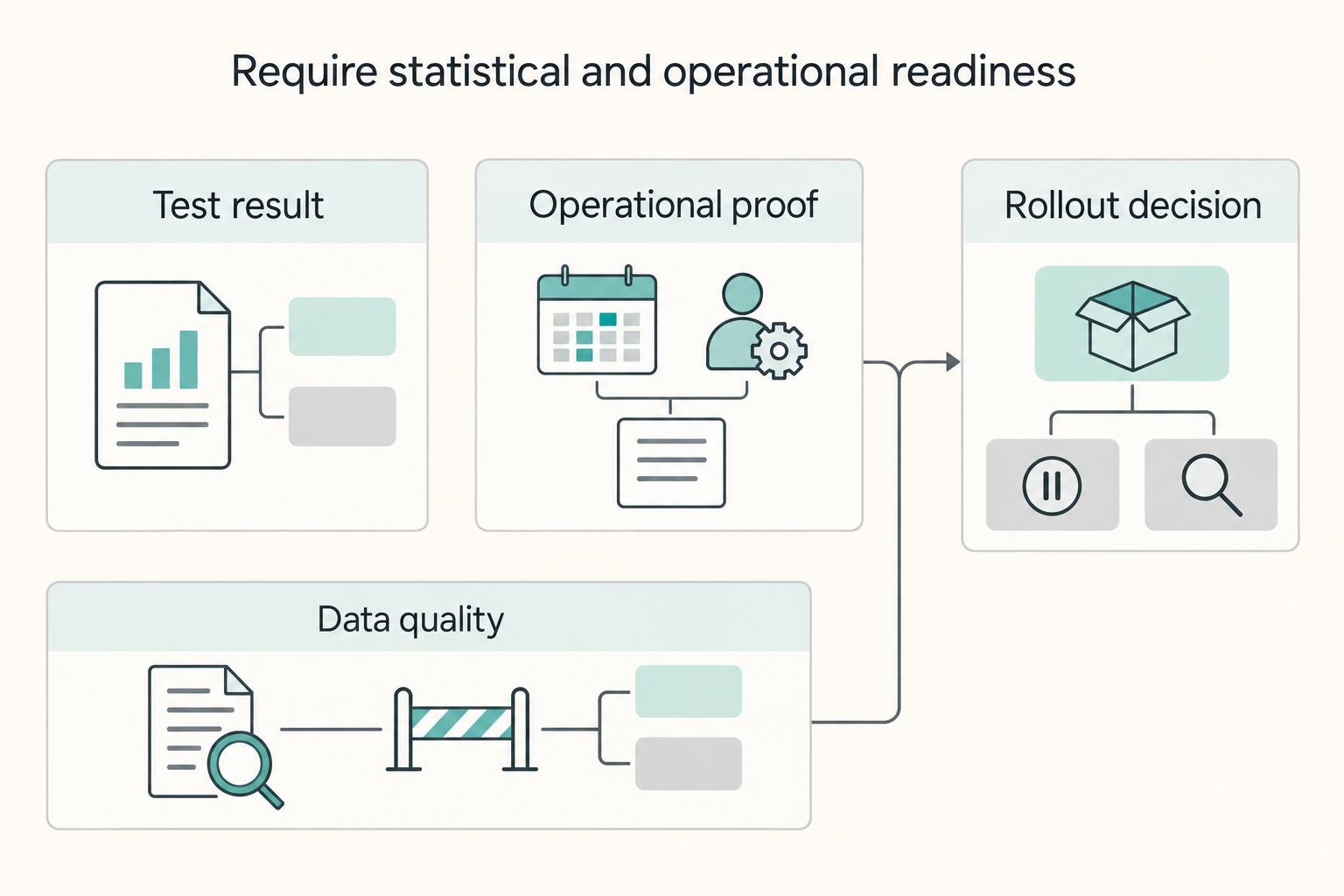
Choose the primary metric and randomization unit first. A binary conversion calculator needs assigned-unit and conversion counts; revenue needs per-unit outcomes and an appropriate variance model. Prespecify MDE, power, sidedness, sample target, stopping method and guardrails. Check allocation and measurement quality before interpreting the effect and uncertainty. Then verify the affected invoice, refund, settlement and ledger paths before rollout.
How to Plan and Read a Subscription Pricing A/B Test#
A pricing change is not automatically safe just because a calculator says the result is significant. In subscription businesses, the harder part is often turning that result into something product, finance, and operations can actually ship without creating downstream issues.
That is why it helps to treat a pricing A/B test calculator as a decision tool, not just a stats screen. At its core, A/B testing compares two versions against predefined metrics. In price testing, that usually means showing different prices to the market to improve revenue or customer outcomes. The method matters. Random assignment helps you attribute differences to the variation, and running control and variant at the same time reduces confounding effects that can muddy the read.
Clean calculations depend on clean assignment and measurement. If the event counted does not match the metric in the brief, or users switch variants during the test, a small p-value cannot repair the comparison. Check the experiment path before interpreting a result, then document how a supported price change will reach billing.
Before launch, name the product, finance and operations owners and write one primary success metric plus the guardrails that can prevent rollout. Decide whether the primary outcome is conversion, revenue per assigned account or contribution per assigned account. Those are different quantities and require analysis suited to their data.
The structure follows the life of the experiment. First, define the calculator terms so everyone is using the same language. Then set the actual business decision before you tune sample size or duration. From there, build inputs that reflect pricing risk, lock hypothesis direction and stop rules, run the test in an order that keeps the data usable, and only then evaluate the result for ship readiness.
If you work with complex pricing models, keep one extra caution in mind. Pricing logic may look simple in the experiment view and much messier in implementation. That does not mean you should avoid testing. It means you should verify the operational path with the same discipline you apply to the math.
Define the calculator terms before you trust the output#
Do not treat a Subscription Pricing A/B Test Calculator as a single verdict. Define the inputs first, then interpret the result.
| Term | Role | Key note |
|---|---|---|
| Subscription Pricing A/B Test Calculator | Pre-test analysis estimates sample size and test duration before launch; post-test evaluation checks whether the observed gap is strong enough to treat as a real signal | Use it in two phases, not as a single verdict |
| Minimum Detectable Effect (MDE) | Effect size the design aims to detect at chosen significance level and power | Set it together with control conversion rate, required sample size, and expected test duration |
| Weekly conversions | Used with baseline conversion to estimate test length | Keep baseline conversion and weekly conversions tied to the same business event |
| Statistical significance vs Statistical Power | Significance compares evidence with a prespecified null model; power is a pre-test probability of detecting an assumed effect | Common settings like 95% confidence and 80% power are input choices, not automatic proof you should ship |
Keep the denominator, event and maturity window consistent. A conversion calculator needs eligible assigned units and binary outcomes for both arms; customer revenue requires per-unit values, including zeros for non-buyers. Do not enter revenue dollars as conversion counts. For related pricing context, see usage-based pricing.
Worked example: conversion and revenue can point in different directions#
| Hypothetical arm | Assigned accounts | Paid conversions | Monthly price | Conversion rate | Gross first-month revenue per assigned account |
|---|---|---|---|---|---|
| A | 1,000 | 100 | $20 | 10% | $2.00 |
| B | 1,000 | 90 | $25 | 9% | $2.25 |
B has a conversion change of −1 percentage point, or −10% relative, while gross first-month revenue per assigned account rises $0.25, or 12.5%. Include every assigned account in the denominator. This illustration assumes one charge per conversion and no refunds or tax adjustments; revenue is not profit or bank cash. Fee, refund and retention outcomes need the same maturity rule in both arms.
For the conversion difference B minus A, an approximate unpooled 95% interval is −0.01 ± 1.96 × sqrt(0.10 × 0.90 / 1,000 + 0.09 × 0.91 / 1,000), or about −3.57 to +1.57 percentage points. This large-sample illustration assumes independent binary observations and does not support a conversion winner. It is not a revenue interval: analyze per-assigned-account revenue separately with a method suited to that distribution and the prespecified design.
Set the business decision before you set the math#
Set the ship rule before you set the math. If the decision is not written first, a clean-looking result can still turn into metric shopping or a rollout argument.
For billing experiments, put one decision sentence in the brief: "If Variant B wins under agreed checks, we will ship the pricing change to segment X." Name the segment, the owner, and the approver. The pricing AB test calculator should evaluate that decision, not create it after results are in.
What should the decision line say?#
Make it specific enough that someone can execute it or reject it. "Ship to new self-serve monthly signups in segment X" is practical; "adopt the better pricing" is not. If you cannot identify the exact audience, billing surface, and owner, you are not ready to run the test.
Before launch, confirm the segment in the decision sentence matches assignment, reporting, and rollout tooling. Testing one audience and shipping to a broader one breaks the decision logic.
How do you lock a primary metric and guardrails?#
Pick one primary outcome before setup and specify guardrails such as refunds, cancellation, payment failures and support burden. Fix their definitions, observation windows and thresholds in the brief. Supporting metrics can explain a result, but choosing a new primary metric after seeing the data changes the test.
| Item | What to document | Note |
|---|---|---|
| Decision sentence | "If Variant B wins under agreed checks, we will ship the pricing change to segment X"; name the segment, owner, and approver | The calculator should evaluate that decision, not create it after results are in |
| Primary metric | Pick one primary outcome before setup | Treat other metrics as supporting context |
| Guardrail | Specify guardrails and thresholds that can prevent rollout | Document it in the brief before launch |
| Segment definition | Confirm the segment in the decision sentence matches assignment, reporting, and rollout tooling | Testing one audience and shipping to a broader one breaks the decision logic |
| Experiment owner and approver | Name the owner and the approver before launch | If you cannot identify the exact audience, billing surface, and owner, you are not ready to run the test |
| Planned analysis date | Include the planned analysis date in the brief | Keep it in the lightweight decision pack |
This discipline matters because significance is central to planning, running, and evaluating A/B tests, and p-values are often misunderstood. Changing success criteria after seeing results changes the standard, not just the interpretation.
A lightweight decision pack is enough:
- decision sentence
- primary metric and guardrail
- segment definition
- experiment owner and approver
- planned analysis date
Where does the decision land in operations?#
Before launch, state where the decision lands operationally: invoicing behavior, possible payout-execution impact, and what month-end reconciliation must verify. The calculator does not replace those checks.
If multi-currency pricing or usage-based pricing is in scope, add a constraints note and verify those paths separately. If complexity is material, roll out to the tested segment first, then expand after the first close cycle is confirmed. For more detail, see A Guide to Usage-Based Pricing for SaaS.
Build pre-test inputs that match real pricing risk#
Set inputs to match decision risk, not test speed. If a pricing decision could affect settlement reporting, reconciliation, or finance review, use tighter assumptions and accept a longer run rather than a faster, noisier read.
For a binary paid-conversion test, use a planning tool such as CXL or ABTestGuide with baseline rate, MDE, power, significance level, allocation and arm count. Record the statistical method and whether the sample target is per arm or total. For revenue or contribution, use a method that models per-assigned-unit variation and any account-level clustering; a visitors-and-conversions tool does not estimate that uncertainty.
MDE is the effect size the design aims to detect at the chosen significance level and power. Tie it to a change worth acting on, while keeping that business threshold explicit. A 10% baseline with a 20% relative MDE means a 12% target rate: a 2 percentage-point change. Smaller effects usually need larger samples. An 80% power target describes the chance of rejecting the null if the assumed effect and model are true, not the probability an observed winner is correct.
| Scenario | Baseline conversion | Target MDE | Power | Confidence | Variant count | Weekly conversions | Sample size and duration impact | Audit details |
|---|---|---|---|---|---|---|---|---|
| Conservative MDE | Test-segment observed rate | Smaller change you would still ship | 80% starting point | 95% starting point | 2 (control + 1 variant) | Segment-specific actual weekly conversions | Larger sample, longer duration | Owner, approver, approval date, assumptions, planned analysis date |
| Aggressive MDE | Same segment baseline | Larger change only | 80% starting point | 95% starting point | 2 (control + 1 variant) | Same segment weekly conversions | Smaller sample, shorter duration, lower sensitivity to modest wins | Owner, approver, approval date, assumptions, planned analysis date |
| More variants added | Same segment baseline | Same as chosen scenario | 80% starting point | 95% starting point | 3+ variants | Same traffic split across more arms | Higher test cost because more users are exposed to variants; duration pressure often increases | Owner, approver, updated assumptions, revised analysis date |
| Evidence pack | n/a | n/a | n/a | n/a | n/a | n/a | n/a | Keep owners, approval date, assumptions, and planned analysis date for auditability |
Translate the sample target into eligible traffic, then add outcome maturity. For example, if the chosen method requires 4,000 accounts per arm, 1,000 eligible accounts a week split equally supplies 500 per arm weekly: eight weeks of recruitment. A 30-day outcome needs additional follow-up for the last cohort. These are hypothetical inputs, not a calculated universal sample minimum. Weekly conversions alone do not give recruitment speed unless their baseline denominator is known.
Pick hypothesis direction and stop rules before launch#
Commit the hypothesis direction and stopping method before traffic starts. For a fixed-horizon test, analyze at the planned sample and maturity point rather than stopping when p first drops below the threshold. If continuous monitoring is necessary, use a sequential method with valid stopping rules. Checking repeatedly with an ordinary fixed-horizon test increases false-positive risk.
Use a two-sided test when increases and decreases both matter. A one-sided test addresses a prespecified direction; do not select its direction after seeing results, and keep harm monitoring separate. More variants, repeated comparisons or selected segments require an appropriate multiplicity plan. Record what counts as a supported improvement, unacceptable harm or an inconclusive result.
Before launch, document:
- the control (Version A) and the pricing variant you are comparing
- the exact decision question the test is meant to answer
- the primary analysis method, significance threshold, sidedness and multiplicity treatment
- the decision point and who can approve any exception
If those rules are not pre-committed, luck can look like evidence.
Keep the signed-off analysis plan with the experiment record. A safety stop may protect customers without establishing a statistical winner; record that distinction and do not relabel the interrupted test as a successful pricing result.
Run execution in the right order so data stays usable#
After you fix stop rules, protect execution quality first. A test can look statistically clean and still be hard to trust if setup or analysis steps drift during launch.
Use one documented run order and follow it consistently in your own process: confirm assignment logic, verify event capture, launch control and variants, monitor ingestion health, then lock the analysis window. This is not ceremony: execution errors can skew findings, and early setup mistakes can make results hard to interpret later.
What needs to be true before you expose traffic?#
Choose the randomization unit before launch: often an account for subscription pricing, rather than each session. Keep each eligible unit in one stable experience, account for linked users or repeat observations in analysis, and carry consistent variant labels through analytics, billing and reporting.
Run a dry run with internal or synthetic traffic and inspect raw events, not only dashboards. If you cannot trace assignment and outcome signals clearly across control and variants, pause launch until that path is reliable.
How do you verify capture and protect data quality?#
Check that key events are arriving in the system you will use for analysis before full exposure. If your pipeline can retry or replay events, validate that repeat processing does not inflate outcome counts.
A practical check is to replay a small sample in a lower environment and compare counts before and after. If counts shift unexpectedly, resolve that issue before relying on experiment results.
What should stay in the failure register?#
Keep a short failure register in the same evidence pack as your analysis plan. Track at least:
| Issue | Risk | Affected area |
|---|---|---|
| Delayed or late-arriving events | Could miss the analysis window | Analysis window |
| Variant mapping mismatches | Could break the link between assignment and downstream records | Assignment and downstream records |
| Missing downstream fields | Could leave out fields needed for finance or reporting | Finance or reporting |
| Silent field/schema changes | Could alter interpretation without obvious dashboard errors | Interpretation and dashboards |
Monitor ingestion health during the run, but keep definitions stable. When the planned window closes, analyze that fixed slice and document any data-quality breaks instead of rewriting the story after the fact.
Validate post-test output with reliability checks first#
After you lock the analysis window, run post-test evaluation in this order: SRM, low-data warnings, then significance. A significant result is not practical if traffic distribution is unreliable or the sample is too thin.
Check Sample Ratio Mismatch against the configured allocation at the randomization unit. Small differences from 50/50 are normal; SRM is a statistically unexpected deviation given sample size. Use a prespecified diagnostic threshold and investigate assignment, exclusions, joins and missing events when it flags. Check sample adequacy and outcome maturity before reading the primary result. SRM passing does not prove that every other measurement assumption holds.
Use a compact results table so the team reviews reliability before declaring a winner. Keep it with your locked date range and raw counts.
| Significance status | SRM status | Low-data flag | Decision confidence note |
|---|---|---|---|
| Significant | Clear | No | Candidate only for a prespecified beneficial effect meeting the business threshold, with guardrails passed and raw counts, shown price and downstream billing reconciled |
| Significant | Positive | No or Yes | Non-practical. Resolve split/assignment/capture issues first, then rerun only after criteria are met |
| Not significant | Clear | Yes | Insufficient evidence. Do not call a winner; extend only if pre-approved |
| Not significant | Clear | No | No reliable winner. Keep control unless another pre-agreed business rule applies |
Treat the second row as a hard warning: significant + SRM-positive means the read is compromised until root cause is resolved.
Should you cross-check the output with a second tool?#
For a binary conversion outcome, re-enter the same assigned-unit and conversion counts in a second tool such as SurveyMonkey. Match sidedness, allocation, analysis slice and method. This catches input mistakes; it is not independent replication. Tools may legitimately differ if methods differ.
A practical checkpoint is to save the input/output record from both tools. If results disagree, stop and verify inputs and analysis slice before naming a winner.
For a revenue outcome, retain the per-assigned-account data and analysis specification. A second conversion calculator cannot validate a revenue confidence interval, retention effect or contribution-margin result.
Convert significance into a finance-ready ship decision#
After reliability checks pass, do not treat significance as the ship decision. Treat it as one gate, then decide whether the winning price is operationally ready for production posting, reporting, and close.
A p-value is the probability, under the null model and its assumptions, of a result at least as extreme as the one observed. It is not the probability the null is true or a winner is real. Compare it with the prespecified threshold, report the effect and uncertainty interval, and separately judge practical value and billing readiness.
How do you combine the stats read and the ops read?#
Use one combined decision view so teams cannot ship on significance alone. Keep KPIs tied to the test hypothesis and business goal, then require evidence for operational readiness.
| Significance state | Quality state | Operational readiness state | Ship decision |
|---|---|---|---|
| Supported beneficial effect meeting the prespecified business threshold | SRM clear, mature outcomes, adequate sample and guardrails passed | Ready | Approve a contained rollout, not a global one |
| Supported beneficial effect meeting the prespecified business threshold | SRM clear, mature outcomes, adequate sample and guardrails passed | Not ready | Hold rollout and fix downstream posting or reporting gaps first |
| Not significant | SRM clear | Ready or not ready | No ship decision from the test. Keep control unless a pre-agreed business rule says otherwise |
| Any result | SRM positive or low-data concern | Any state | Non-practical. Investigate data quality or collect more evidence before deciding |
| Harm or failed guardrail | Any significance state | Any readiness state | Reject or hold rollout under the prespecified harm rule |
For this table, define readiness across the downstream paths affected by the tested business model:
- Reconciliation: the tested price can be traced from billing output into ledger or reporting extracts without manual cleanup.
- Settlements: settlement or remittance reporting still carries the fields finance needs to separate test behavior.
- Payout execution, where applicable: commission, revenue-share or payout logic applies the intended amounts and identifiers; mark this path not applicable when the model has no payouts.
What if finance controls lag the stats?#
If stats are clean but controls are not, hold the rollout. A significant result with unresolved downstream posting or reporting gaps is not finance-ready.
Attach operational proof to the same evidence pack as your statistical read: locked window, raw counts, second-tool cross-check, and a short transaction trace across billing output, reporting, and ledger. If that packet is incomplete, the decision is incomplete.
When should you expand rollout?#
Even on "go," start with a contained segment and expand only after the first close cycle validates ledger and reconciliation behavior in production. This keeps risk small while you confirm real operating behavior.
Also document unknowns explicitly. A pricing AB test calculator is generic and may not capture pricing-specific assumptions. Apply the same uncertainty discipline: define the measured output, define the model, and note uncertain inputs so stakeholders do not over-trust a single score.
Conclusion#
Use the calculator to evaluate the metric and design it actually supports. Report effect size and uncertainty, not only a winner label. Planned power is a design property; post-test observed power does not establish that an observed result is true. Billing and rollout readiness need their own evidence.
Keep pre-test planning connected to post-test evaluation: primary metric, business threshold, allocation, sample target, stopping method and maturity window. Estimate duration from eligible traffic and required sample, including relevant business cycles and delayed outcomes. Six to eight weeks is not a universal test length.
After the planned window closes, check allocation and measurement quality, maturity and sample adequacy, then interpret the primary effect with its uncertainty. A low-data warning calls for checking the method and inputs, not substituting a universal conversion-count rule. If the interval still allows material benefit and harm, report the decision as inconclusive under the agreed rule.
The evidence pack is what keeps this from turning into a debate after the fact. Keep the chosen hypothesis direction, primary metric, planned sample target, analysis date, owners, and approval date in one place. That gives finance and operations something concrete to verify when the result comes in. Keep downstream reporting fields explicit so treatment and control outcomes can be reviewed separately.
One more rule is worth keeping. If outcomes may vary by market or program, confirm scope constraints before launch rather than after a "win." Real-customer pricing experiments are valuable precisely because they let you test before making anything permanent, but only if the scope is honest. If needed, narrow rollout first and expand only after the first close cycle proves the change behaves correctly. For teams with that complexity, this guide on multi-currency pricing is a useful next check.
Frequently Asked Questions
What does a pricing AB test calculator need at minimum?
For a binary conversion test, record eligible assigned units and conversions in each arm, the event definition, maturity window and analysis method. Planning also needs a baseline rate, MDE, significance level, power and allocation. Revenue tests need per-unit outcome data and suitable variance estimates. There is no universal minimum of 200 conversions per variant.
What is `Minimum Detectable Effect (MDE)` in subscription pricing tests?
MDE is the effect size the design aims to detect at the chosen significance level and power. Specify absolute or relative units: moving from 10% to 12% is 2 percentage points or 20% relative lift. Set it before launch and distinguish it from the smallest business benefit worth shipping.
When should I use a `one-sided test` instead of a `two-sided test`?
Use a two-sided test when either an increase or a decrease matters. A one-sided test evaluates one prespecified direction and needs a justified decision rule before results are seen. Never switch to one-sided testing to rescue a result. Harm guardrails still apply.
Why can a result be statistically significant but still risky to ship?
Statistical significance alone does not guarantee a reliable decision. If assignment is biased (for example, SRM) or the test is stopped too early, the observed difference can still be a weak basis for a go/no-go call.
What is `Sample Ratio Mismatch (SRM)` and what should I do if it appears?
SRM means observed allocation differs statistically from the configured split. Test counts at the chosen randomization unit, such as accounts, against expected counts; a chi-square diagnostic is common. Ratios alone and a universal p-value cutoff are insufficient. Use the prespecified diagnostic threshold, investigate missing events, joins, exclusions and assignment, and resolve the cause before interpreting effects.
When should we stop the test, and when should we extend `test duration`?
For fixed-horizon analysis, stop at the precommitted recruitment and outcome-maturity point, not the first significant dashboard result. Extensions need a prespecified rule. Continuous monitoring requires an appropriate sequential method; safety stops can protect users without declaring a winner.
Do generic tools like `ABTestGuide`, `CXL`, `Speero`, or `SurveyMonkey` cover billing operations decisions?
These tools can help plan or check the statistical comparison their inputs support. They do not verify invoice amounts, refunds, settlement fields, commissions or ledger posting. Keep operational sign-off separate, and use revenue analysis rather than a binary conversion calculator when revenue is the primary metric.
Try a related tool
Researched and edited by the Gruv editorial team. Gruv builds cross-border billing, payouts, and finance-operations software for global businesses.
Sources
Includes 5 external sources outside the trusted-domain allowlist.
- itl.nist.gov/div898/software/dataplot/refman2/auxillar/di...trusted
- abtestguide.com/calcexternal
- cxl.com/ab-test-calculatorexternal
- microsoft.com/en-us/research/articles/diagnosing-sample-ra...external
- microsoft.com/en-us/research/articles/patterns-of-trustwor...external
- surveymonkey.com/learn/research-and-analysis/ab-testing-signi...external
Educational content only. Not legal, tax, or financial advice.
Related Posts

How to Handle Multi-Currency Pricing for Your SaaS Product
Multi-currency SaaS pricing needs a clear customer price and a traceable path to cash. Separate the currency shown and charged from settlement and bank receipt before adding markets.

SaaS Usage-Based Pricing for Predictable Cashflow and Fewer Disputes
If you are considering **saas usage-based pricing**, treat it as an operations and collections decision first. Pricing works best when the usage unit can be measured, shown on the invoice, and explained by someone outside your product team.

How to Price a Bookkeeping Service for Small Businesses
**Step 1. Reset what a bookkeeping price is supposed to do.** A usable price is not just a number that sounds competitive. It should reflect the work required and how the engagement will actually run. Market comparisons help with context, but they do not replace a pricing strategy built around the real workload.