
Quick Answer
Handle a payment-data breach with one cross-functional incident path that contains exposure, preserves evidence, and keeps critical operations controlled. In the first four hours, validate the signal, open a time-stamped record, triage affected assets by business impact and data state, separate knowns from unknowns, and use a defined approval path for notices. Reopen payouts in phases only after reconciliation, credential changes, and documented remediation are complete.
What platform teams need to do first#
A data breach is an operations incident as much as a security incident. It can affect confidentiality, integrity, and availability at the same time, which changes how teams run critical operations.
This guide gives you a decision-ordered playbook from detection through recovery, with checkpoints you can audit later. For payment workflows, make containment and continuity choices explicit and cross-functional from the start.
Run one standard response path across teams. A consistent playbook keeps legal, security, operations, and communications aligned as facts change, instead of letting each function optimize in isolation.
From the first confirmed signal, run the response as a cross-functional command problem. Collect concrete artifacts while work is in motion, including forensic images where appropriate, evidence collected, and a written record of remediation steps.
Call out one failure mode early. Removing a malicious tool or blocking one access path is not enough if stolen credentials are still active. Until credentials are changed, exposure can continue while you are trying to restore normal operations. The emphasis here stays operational: contain exposure, preserve evidence, and reopen normal processing only when the control picture is clear.
Set scope and prerequisites before incident day#
Before an incident happens, lock three things: a written scope, one incident response process with shared response criteria, and a ready evidence pack template. Without that prep, early response time gets spent on scope and ownership disputes instead of limiting additional loss.
| Pre-incident item | What to define | Why it matters |
|---|---|---|
| Written scope | What your team will treat as a data-security incident, broad enough to cover operational, financial, and reputational impact | Avoids spending early response time on scope and ownership disputes |
| One process and one severity language | One standardized procedure across functions with clear response criteria and coordination or reporting thresholds | Prevents separate labels that slow approvals and communications |
| Standing evidence pack template | System owners, current data maps, escalation contacts, Legal Counsel and communications contacts, plus fields for forensic images, evidence collected, remediation steps, and credential-rotation status | Helps avoid declaring cleanup complete while compromised credentials are still active |
Step 1. Define scope in writing. State what your team will treat as a data-security incident. Keep it broad enough to cover operational, financial, and reputational impact, not just unauthorized disclosure. As a practical check, finance, ops, and engineering should reach the same in-scope decision from the same definition.
Step 2. Use one process and one severity language. Run one standardized procedure across functions so teams identify, coordinate, remediate, recover, and track mitigations the same way. Set clear response criteria and coordination or reporting thresholds up front. If teams improvise separate labels during an incident, approvals and communications will slow down.
Step 3. Prepare a standing evidence pack template. Include system owners, current data maps, escalation contacts, Legal Counsel, and communications contacts. Add fields for forensic images, evidence collected, remediation steps, and credential-rotation status. This prevents a common miss: declaring cleanup complete while compromised credentials are still active.
Your template should also make first actions explicit. Mobilize the response team immediately. Involve forensics, legal, information security, IT, operations, communications, and management. Preserve forensic integrity when isolating affected equipment. If people cannot tell who to call and what to preserve from the template, it is not incident-ready.
If you want a deeper dive, read Incident Response for Payment Platforms: How to Handle Outages and Data Breaches.
Map payment data and systems in priority order#
Prioritize your map by business impact and confidentiality exposure. Build it so your team can make containment decisions quickly, not just understand architecture.
Use NIST SP 1800-29 as the baseline: identify assets, and record where confidential data exists in storage, during processing, and in transit. Use that structure across every system in scope.
Rank assets by business impact first#
Set a tiered asset order based on what would cause the fastest operational, financial, or reputational damage if compromised or isolated. Keep that order explicit so finance, ops, and engineering can make the same first containment call under pressure.
For each asset, attach one plain-language consequence label that your operators already use, such as operational disruption, financial loss, or reputational harm. The goal is decision speed, not perfect taxonomy. If different teams pick different first assets to contain, your map is still too technical and not operational enough.
Tag exposure by data state#
Tag exposure by data state, not by system name alone. For each priority asset, note what data is stored, processed, and transmitted, and where exports or downstream copies exist.
Include tax-related records when they apply, especially FBAR support records. FBAR is FinCEN Form 114, and periodic account statements may be used to determine maximum account value, so statement stores and export paths should be visible on the map. This matters even more as FBAR deadlines approach (April 15th, with an automatic extension to October 15th). As a practical check, trace one high-risk record end to end across storage, processing, and transit. If you cannot, the map is not containment-ready.
Turn the map into containment actions#
Turn the map into a containment playbook entry for each top asset. Define the first action you would take, what it protects, and what operational side effect it may trigger.
Be specific about the response path, the isolation point, and what must keep running to avoid creating a second incident. A usable map gives each priority asset three fields: data state, business impact, and first containment option. Related: Improving Partner Experience by Improving the Payment Experience: What the Data Shows.
Assign command roles and decision authority#
Make decision authority explicit before an incident starts. When ownership is unclear, teams lose time deciding who does what, and communication splits into conflicting updates.
CISA frames incident response playbooks as a standard procedure set to identify, coordinate, remediate, recover, and track mitigations, with criteria and thresholds for coordination and reporting. Use that model to document decision rights, consultation paths, and escalation triggers in writing.
Build a decision-rights matrix#
Build your role matrix around decisions, not job titles. A RACI-style artifact can be enough, and the SEC companion material is a practical template input, not a mandate.
| Role | Primary ownership | Decision right to define in your playbook | Required consults to define |
|---|---|---|---|
| Incident Commander | Incident coordination and decision log | Containment direction and command cadence | Technical Lead, Business Impact Analyst, Legal Counsel |
| Technical Lead | Technical scope, containment execution, remediation evidence | Technical actions within approved change boundaries | Incident Commander for high-impact changes |
| Legal Counsel | Legal risk framing and notice language review | Legal approval workflow for external statements | Communications Lead, Incident Commander |
| Communications Lead | Internal/external update drafting and version control | Message preparation and release operations | Legal Counsel, Incident Commander |
| Business Impact Analyst | Critical business-process impact analysis | Business-impact recommendation workflow | Incident Commander, Technical Lead |
Keep this matrix in the incident evidence pack, with delegates and after-hours coverage named explicitly.
Define the key decisions that cannot drift#
Document key decisions so they are never ambiguous in a live event: who can authorize major operational pauses, who approves external notices, and who signs remediation completion.
Set one final decider for pause or resume actions, define who must be consulted, and log the scope, reason, timestamp, and review checkpoint each time. Define a single approval chain for external notice content and send timing so legal review, messaging control, and incident timing do not drift apart. Define closure sign-off criteria across technical remediation, business stability, and incident command closeout so "fixed" is verifiable, not informal.
Add escalation rules for critical control gates#
Add escalation rules for critical control gates in the same playbook so pressure does not create ad hoc exceptions. Treat this as an internal control rule: no temporary relaxation, bypass, allowlist, or manual override without a named approver, reason, scope, start time, and expiry.
Track each exception in a log that can answer four questions quickly: who approved it, what it touched, when it ends, and how rollback happens.
Test the first hour before you need it#
Test the first hour against a high-priority asset from your map. Confirm, without debate, who opens the incident log, who orders containment, who authorizes affected operational pauses, who approves the first update, and who owns the next decision checkpoint.
Use an incident response checklist format so role clarity is testable, not assumed. If answers change by meeting room, your authority model is still too informal.
Execute the first four hours with hard checkpoints#
In the first four hours, prioritize detection, logging, and containment over explanation. NIST SP 1800-29 emphasizes detecting an ongoing breach and starting response and recovery. Early choices shape operational, financial, and reputational impact.
Validate the signal and open the record#
Start with incident detection and analysis before broad messaging. Verify the trigger is credible, open a time-stamped incident log immediately, and assign an incident owner so updates stay coordinated.
Capture detection time, reporting source, affected-asset hypothesis, current severity, decision owner, and next checkpoint time in the log. Preserve fast-changing records early so later decisions are easier to defend.
Verify affected surfaces in business risk order#
Use a documented triage order and follow it consistently. The exact order should match your platform and risk profile, and the sequence should be explicit in your playbook.
| CIA area | Example signal | Record for each surface |
|---|---|---|
| Confidentiality | Unauthorized access risk | Named owner, current status, and next validation action |
| Integrity | Data or write anomalies | Named owner, current status, and next validation action |
| Availability | Service disruption | Named owner, current status, and next validation action |
Use the CIA lens while you triage. Unauthorized access risk affects confidentiality, data or write anomalies affect integrity, and service disruption affects availability. For each surface, record a named owner, current status, and next validation action.
Maintain a known versus unknown register#
Use a known-versus-unknown register to support breach risk and harm assessment. Update it at each checkpoint so confirmed facts and assumptions do not get blended into draft messaging.
Keep entries plain and time-stamped: confirmed facts, open questions, business assumptions, and customer-impact assumptions, each with an owner. If this turns into a discussion thread, it is no longer reliable as a checkpoint artifact.
Contain when compromise is plausible and scope is still unclear#
If active compromise is plausible and scope is still unclear, consider containing first, even if that creates temporary payout friction. This aligns with a detect-respond-recover flow and can reduce ongoing confidentiality and integrity risk while validation continues.
Choose the narrowest containment action that reduces live risk quickly, then keep validating. Before you expand recovery planning, make sure the incident log includes a named next-action owner, a bounded blast-radius hypothesis, and explicit customer-impact assumptions.
For a step-by-step walkthrough, see How to Handle a Data Breach in Your Freelance Business.
If you are turning this response plan into runbooks, use Gruv Docs to map checkpoints, idempotent retries, and status events into your operating flow.
Contain exposure without breaking payouts#
Containment should reduce unauthorized exposure quickly while limiting avoidable operational disruption. Use actions your team can execute and verify, then reassess at defined checkpoints as response and recovery continue.
Narrow and document the containment boundary#
Start with the systems and data tied to your current incident hypothesis. In the incident log, record what is in scope, what is still operating, who approved each action, and the next checkpoint time so decisions stay defensible under pressure.
Immediately report suspected incidents through your internal security incident response process. If normal communication channels are affected, switch to out-of-band contacts, including a printed contact list. Untested plans and outdated owner lists can slow containment when timing matters most.
Apply controlled restrictions and document each action#
Use containment actions your team can explain and execute cleanly. For each action, log the affected flow, the owner, the release condition, and the reassessment time.
If you cannot state what is being held and why, treat that as unresolved risk and escalate through the incident process. The goal is to reduce exposure while limiting avoidable business impact.
Run detect-assess-contain-mitigate checkpoints#
Containment is not a one-time decision. Revisit detection, assessment, containment, and mitigation at each checkpoint as new evidence appears.
At each checkpoint, confirm whether unauthorized exposure is still active and whether response and recovery actions are progressing. If uncertainty remains, keep containment in place and escalate.
Track containment side effects by impact type#
Keep a live register of operational, financial, and reputational impacts, each with an owner and timestamp. Review it at every incident checkpoint so response decisions reflect both exposure reduction and business impact.
Do not collapse these into one generic impact label. Separate impact types drive different follow-up actions and reduce avoidable secondary harm during response.
Decide notifications with known and unknown facts#
Once your containment boundary is stable enough to describe, stop improvising notices. Use one decision table for every draft. If counsel determines an applicable threshold is met, send a bounded notice even if technical certainty is still partial.
The failure to avoid is simple: treating a hypothesis as a confirmed fact, then retracting it while payout operations and support are still stabilizing.
Build a decision table before drafting messages#
Use a trigger-based table with clear thresholds, minimum facts, and sign-off owners. CISA's structure is useful here, and for private platforms it should be treated as guidance.
| Recipient type | Trigger condition | Minimum fact set | Owner sign-off |
|---|---|---|---|
| Relevant regulator, where counsel determines notice may apply | Counsel concludes the incident may meet applicable notice obligations | Incident ID, detection time, containment status, categories of personal data believed affected, confirmed facts, unknowns, next update time | Legal Counsel + Incident Commander |
| Affected individuals, where counsel determines notice may apply | Confirmed or credibly suspected impact to personal data linked to individuals | What happened in plain language, current understanding of data types involved, actions already taken, what people can do now, support channel, next update time | Legal Counsel + Communications Lead |
| Banks, processors, or payout partners | Their operations, exposure, or contractual duties may be affected | Affected integration or flow, current restrictions, transaction handling instructions, known impact window, next status checkpoint | Technical Lead + Business Impact Analyst |
| Internal executives and support leads | Customer impact, media risk, or operational disruption needs coordinated handling | Current facts, unknowns register, held-queue status, approved external line, escalation owner, next review time | Incident Commander + Communications Lead |
If a row cannot state both a trigger and a minimum fact set, it is not ready for release.
Separate confirmed facts from preliminary findings#
Use two explicit blocks in every notice draft:
- Confirmed facts: supported by logs, forensics notes, access records, or approved impact analysis.
- Preliminary findings: current hypotheses, scope estimates, and items still under investigation.
Keep the approval pack short and repeatable:
- timestamped incident summary
- known-versus-unknown register
- recipient-specific draft
- evidence references for each confirmed statement
- approval line for Legal Counsel, Communications Lead, and decision owner
Version every draft and display the last-updated time so only one current draft is in circulation.
Map regulator and individual decision points without overstating certainty#
If potential notice obligations exist, keep separate decision rows for regulators and affected individuals. This keeps your process ready while counsel determines whether notice obligations are triggered.
Use precise language:
- state that counsel is assessing whether obligations apply
- do not state notice is required until that conclusion is made
- do not promise timelines or completeness you cannot support
When scope is still developing, say the investigation is ongoing and give the next update time.
Send bounded notices when thresholds are met#
If counsel confirms thresholds are met, send a bounded notice with what is known, what is unknown, what has been done to reduce further exposure, and when the next update will be issued.
Also protect forensic integrity while communicating. Keep technical statements defensible, avoid overcommitting on root cause too early, and use a pre-release checkpoint with four checks:
- recipient row matched
- trigger met
- minimum fact set complete
- sign-off captured
Related reading: Beneficiary Data Requirements by Rail for Platform Payouts.
Protect ledger and settlement integrity during recovery#
Treat the ledger as a recovery source of truth. Integrity and availability failures can disrupt critical financial services and undermine confidence in the financial system if you reopen too early.
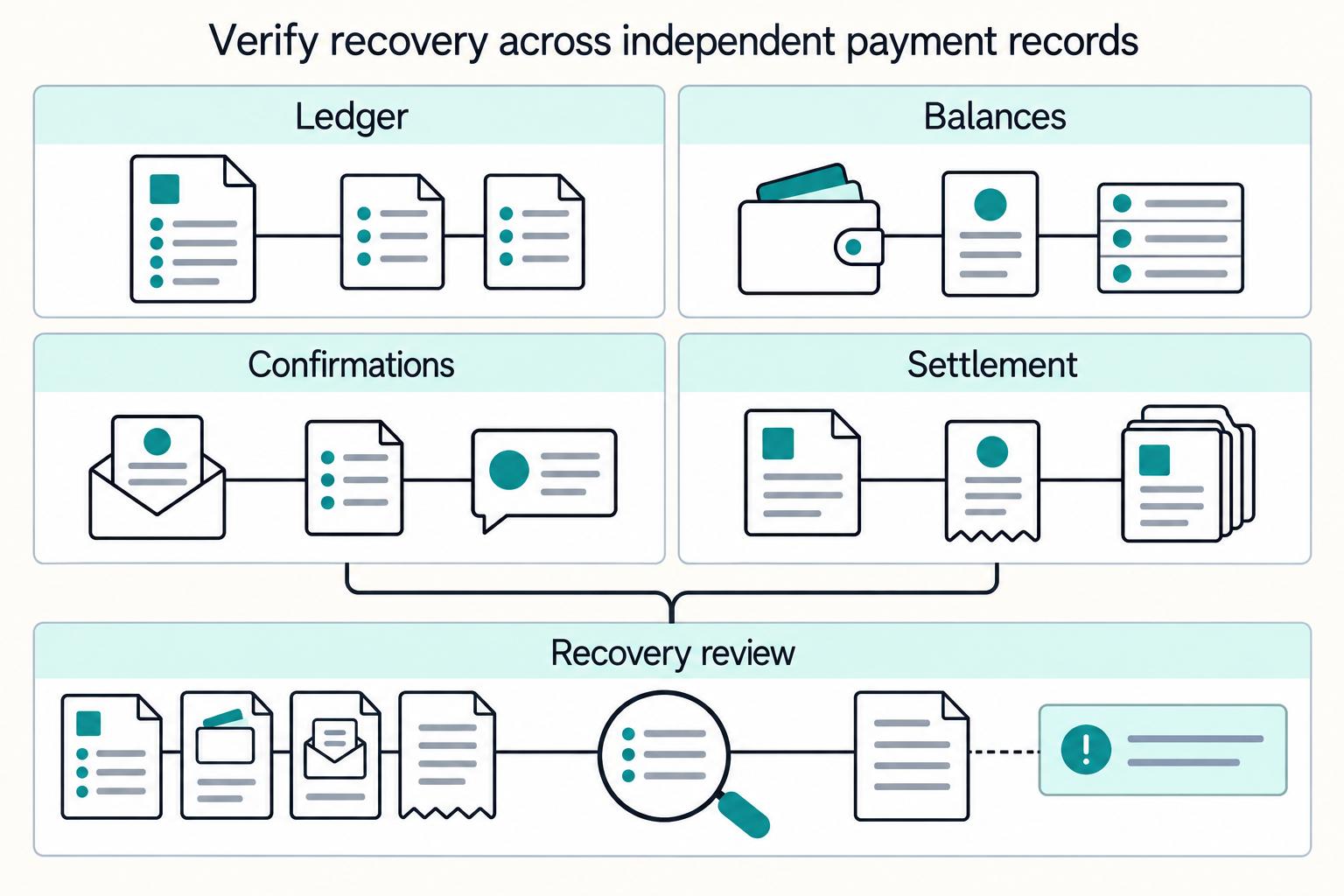
Reconcile wallet and balance projections against ledger postings at each recovery checkpoint, and hold throughput expansion until those views stay aligned. Run parallel verification across payment confirmations, settlement files, and payout state transitions so one clean signal does not hide another broken one.
Triage exceptions by your internal classes and clear them explicitly. Tie each recovery checkpoint to before, during, and after a cyber attack, and to your finance close controls. Treat external frameworks as informative reference points rather than automatic pass-or-fail gates.
Manage third-party dependencies and contract exposure#
When a vendor is involved in a Third-Party Data Breach, treat recovery as unproven until three views align: vendor facts, your telemetry, and your contract position with Legal Counsel. Use explicit thresholds for coordination and reporting so escalation decisions stay consistent.
Demand a testable vendor fact pack#
Use an incident response checklist and request facts you can verify: incident summary, containment status, affected connector or service, relevant time window, and confirmed data elements exposed or accessed. Ask the vendor to separate confirmed facts from unknowns, time-stamp each update, and provide the next update time when details are still unknown.
Review contract duties with Legal Counsel#
Use the executed agreement set, master terms, data and security addenda, statements of work, and amendments to identify obligations that apply now. Focus on applicable notification clauses, evidence-sharing rights, remediation commitments, and liability language so response decisions stay contract-aware.
Validate vendor claims against internal telemetry#
Before you restore trust in the vendor event stream, compare the vendor timeline and impact claims with your own logs and exception signals. If your telemetry contradicts the vendor account, treat dependency risk as unresolved and keep dependent flows constrained.
Apply a conservative dependency decision rule#
If vendor forensics are lagging and risk is material, consider temporarily constraining dependent flows, for example by rerouting or rate-limiting, until independent validation passes. Restore normal throughput only after vendor facts stabilize, internal checks no longer conflict, and open contract duties are addressed.
Reopen payouts with staged verification gates#
Reopen payouts in phases, and require evidence at each gate before you increase volume. Treat restoration as controlled recovery work, not a single switch flip.
Define a phased reopen plan with explicit stop points#
Use a staged sequence you can monitor and reverse if needed, for example: a narrower slice first, then larger batches, then broader routing. The sequence is your operating choice, not a universal rule.
For each phase, define scope in advance: corridors, counterparties, batch types, and time window. Assign an owner, start time, and a clear pause condition. If new reconciliation exceptions or unexplained status changes appear, hold the current phase and investigate before expanding.
Require gate evidence before moving forward#
Apply a consistent set of checks for every phase, such as control status, reconciliation status against thresholds you set internally, and coordination or reporting updates. Use consistent evidence, not judgment calls.
Record what was validated, when it was validated, and by whom. Keep a clear yes-or-no gate decision so another operator can review the reopen path later.
Re-verify sensitive-data protections before scale returns#
Before increasing throughput, confirm sensitive fields are still protected in the actual tools and files teams use.
Check operator views, exports, and downstream reporting for temporary access, debug exposure, or rollback side effects left behind during response. Document any exception and keep it in active remediation before expanding volume further.
Publish closeout evidence and keep a reopen path#
At phase completion and at full restoration, capture a short closeout summary: what happened, what was fixed, and what remains open. Include supporting artifacts such as incident notes, change records, validation results, and coordination records, and track actions with completion dates.
Keep an explicit incident reopen path after payouts resume. If later evidence shows unexplained variance or newly affected data surfaces, reopen immediately and route it through incident response instead of routine operations handling.
Fix common mistakes before they compound#
Once you have a staged reopen path, keep recovery errors from snowballing. Maintain a cross-functional command loop, sequence containment to preserve evidence, use a defined notice-approval path, and close only with documented validation.
Bring operations into the command loop#
Treat this as a cross-functional incident, not a security-only exercise. FTC guidance says to mobilize the breach response team right away, and that team may include operations, legal, information security, IT, and communications.
Use a checklist checkpoint before recovery decisions: name the operations owner, legal reviewer, and communications approver. If those roles are not assigned, pause expansion decisions.
Sequence containment instead of defaulting to a blanket stop#
Contain first with actions tied to affected scope, then expand only as facts stabilize. Isolate impacted systems or integrations, rotate exposed credentials, and take affected equipment offline while preserving forensic integrity.
| Containment action | Purpose | Handling note |
|---|---|---|
| Isolate impacted systems or integrations | Contain first with actions tied to affected scope | Expand only as facts stabilize |
| Rotate exposed credentials | Close the credential gap quickly | Systems remain vulnerable until stolen credentials are changed |
| Take affected equipment offline | Preserve forensic integrity | Do not power machines off before forensic experts arrive |
FTC guidance is explicit here: take affected equipment offline immediately, but do not power machines off before forensic experts arrive. Also close the credential gap quickly, because systems remain vulnerable until stolen credentials are changed.
Hold external messaging to a defined approval chain#
Keep external messaging under a single, defined approval route that includes legal and communications stakeholders so facts stay controlled as the situation evolves. Require each draft to separate confirmed facts, unknowns, and next-update timing.
California SIMM 5340-A includes prior review and approval of breach notice. Even if that specific process does not govern your team, the control pattern is still useful.
Close only after formal post-incident validation#
Do not treat containment as closure. Require an incident response checklist with action taken and date completed for each item, then validate closure against the NIST Cybersecurity Framework functions your team uses.
Your closure evidence should include remediation status, credential changes, forensic findings, and notification-approval records. SIMM 5340-A explicitly includes both "Incident Closure" and "NIST CSF Functions," which reinforces documented closure over verbal confidence.
Final takeaway and copy-paste checklist#
If you keep one operating rule, make it this: keep one shared incident record, one fact register, and one decision log from detection through closure.
- Step 1: Keep one incident record from start to finish.
Run the same owner structure and incident record across detect, respond, and recover. Standardized playbooks and checklists work best when all teams are working from one current record, not fragmented notes.
- Step 2: Prioritize confidentiality and integrity containment while keeping critical operations controlled.
Contain exposure first, then keep only controlled operations running. Document what is paused, what is allowed, and who approved each decision.
- Step 3: Separate knowns from unknowns in every update.
In executive, legal, and external drafts, label what is confirmed versus still under investigation. If a claim is not confirmed in the shared fact register, do not present it as settled.
- Step 4: Use your system of record as the recovery gate.
Do not treat "systems back online" as full recovery by itself. Reconcile operational records before declaring recovery complete, and track open exceptions until they are resolved.
- Step 5: Track third-party mitigation updates in the same checklist.
Treat vendor updates as inputs to your response record, not as closure by themselves. Restore full dependency only after containment and mitigation actions are documented and tracked to completion.
- Step 6: Close on documented remediation, not quiet signals.
Use a checklist with explicit fields such as Action Taken and Date Completed, plus clear owners and verification checkpoints. If remediation items are unowned, unverified, or incomplete, keep the incident open.
If you want a practical review of your incident-response recovery gates and control design, contact Gruv.
Frequently Asked Questions
What should happen in the first four hours of a payment-data breach?
Start immediately by mobilizing the breach response team, securing affected systems, and opening a time-stamped incident record. Early actions should prevent additional data loss and preserve evidence. If equipment is affected, take it offline, but do not power machines down before forensic experts arrive.
Who owns each decision across security, legal, communications, and finance operations?
Use a documented incident response structure as soon as the incident starts. Keep ownership cross-functional across technical response, legal, communications, and operations. If key owners are not clearly assigned, clarify decision ownership before any major external message or other high-impact decision.
How is a payment-data incident different from a generic data breach response?
The core response model is the same as any data breach response: use a defined playbook, secure systems quickly, preserve evidence, and track remediation to closure. The practical difference is the operational emphasis, because finance operations should stay in the response loop with legal, communications, and technical teams. This guidance does not set payment-specific pause or reopen thresholds.
When should we notify regulators or affected users if key facts are still unknown?
Involve legal counsel as soon as the incident is identified, because notification duties depend on applicable laws and jurisdictions. Work with counsel on notification timing while forensic facts are still being established. Communicate what is confirmed, what is still being investigated, and when the next update will be provided.
How do we contain risk without fully stopping payouts and settlements?
Use targeted containment first by isolating affected systems, taking impacted equipment offline correctly, and changing exposed credentials quickly. Credential theft risk continues until compromised credentials are changed. If scope is still unclear or containment is not holding, escalate restrictions through your incident owners rather than assuming normal flow is safe.
What is the minimum remediation evidence we need before we reopen normal payout volume?
Use a documented internal baseline rather than assuming one universal evidence package. At minimum, keep forensic evidence from affected systems, record remediation actions, document credential changes, and track completion in an incident response checklist with action status and date completed. Reopen only after those checkpoints show the incident is contained and recovery actions are complete.
Researched and edited by the Gruv editorial team. Gruv builds cross-border billing, payouts, and finance-operations software for global businesses.
Sources
- bsaefiling.fincen.gov/docs/XMLUserGuide_FinCENFBAR.pdftrusted
- cdt.ca.gov/wp-content/uploads/2025/10/SIMM-5340-A-Infor...trusted
- cisa.gov/sites/default/files/2024-08/Federal_Governme...trusted
- cisa.gov/sites/default/files/2024-12/CDM%20Data%20Mod...trusted
- dodcio.defense.gov/Portals/0/Documents/Library/CloudSecurityPla...trusted
- dodcio.defense.gov/Portals/0/Documents/Library/DevSecOpsTools-A...trusted
- federalregister.gov/documents/2024/06/03/2024-11116/regulation-s...trusted
- federalreserve.gov/frrs/regulations/guidance-on-section-165d-re...trusted
Educational content only. Not legal, tax, or financial advice.
Related Posts

The Freelance Payment Penalty: A Modeled Audit of Platform Fees, FX Spreads, and Payout Delays
The money rarely disappears through a single, easy-to-spot fee. The real loss is stacked. A marketplace takes its commission, a processor adds a charge for international cards, a bank or payment company converts the currency at a spread, a platform holds the funds before release, and a wire sheds a little to intermediaries on the way in. Each layer looks defensible on its own, but the worker feels the combined result as a smaller deposit and a later payday.

How to Respond to a Subpoena for Business Records
Move fast, but do not produce records on instinct. If you need to **respond to a subpoena for business records**, your immediate job is to control deadlines, preserve records, and make any later production defensible.
A US Expat's Guide to Investing in UCITS ETFs to Avoid PFIC Issues
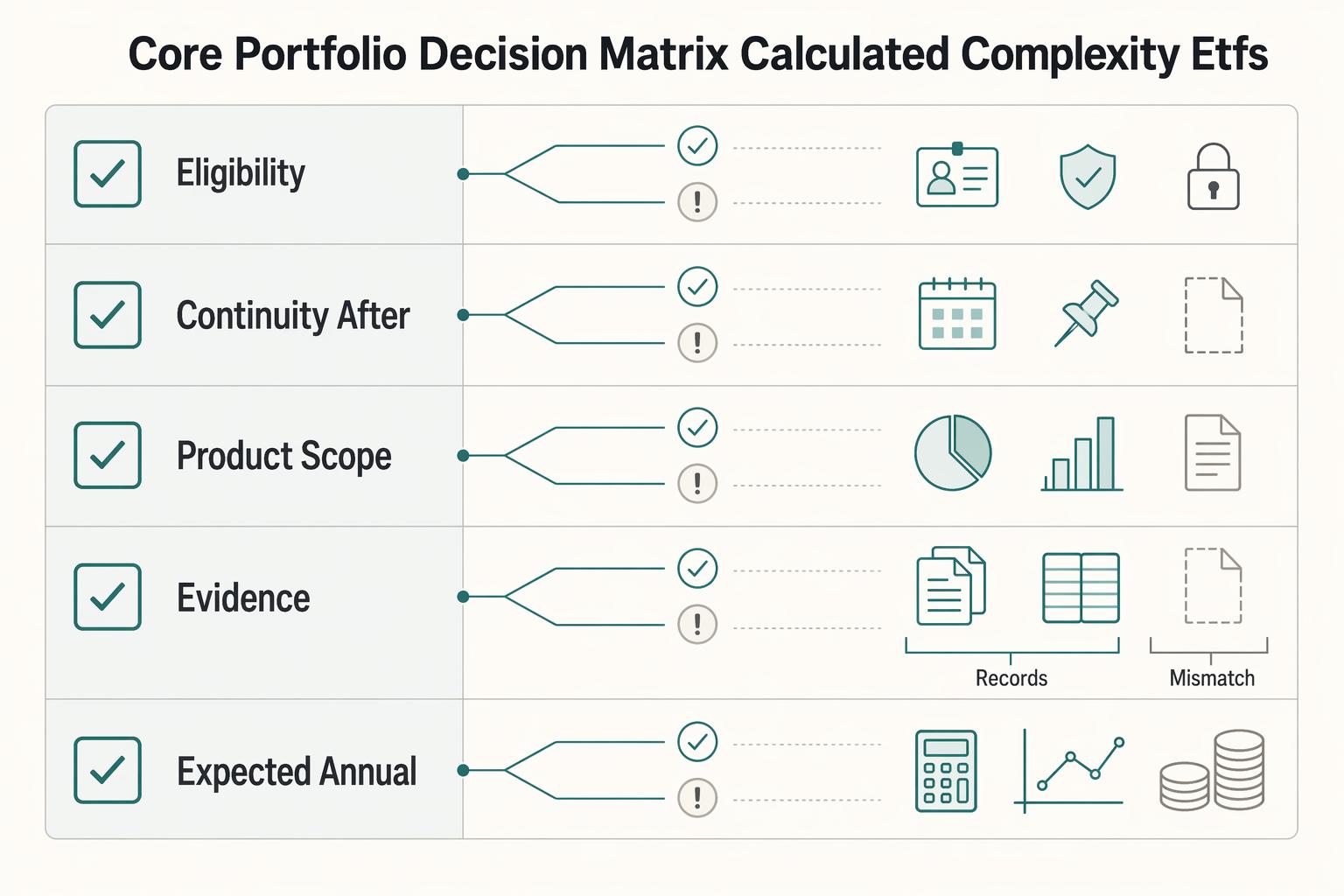
The real problem is a two-system conflict. U.S. tax treatment can punish the wrong fund choice, while local product-access constraints can block the funds you want to buy in the first place. For **us expat ucits etfs**, the practical question is not "Which product is best?" It is "What can I access, report, and keep doing every year without guessing?" Use this four-part filter before any trade: