

Quick Answer
Reconcile two links separately: internal activity to PSP balance movements, then PSP payouts to receiving statements. Preserve provider/account IDs, movement and payout references, entity, currency and dates. Book supported activity under your accounting policy while pending cash stays in clearing; investigate unexplained differences before approving affected entries.
Multi-PSP settlement reconciliation without month-end fire drills#
Match each provider’s settlement activity to your internal ledger and the receiving account. A useful close explains gross collections, refunds, fees, reserves and cash separately, so Finance can account for activity before a delayed payout reaches the bank.
Step 1. Confirm that this guide fits your operating reality. This guide is for platform teams working across more than one Payment Service Provider, market, currency, or legal entity. If you have one PSP, one settlement currency, and one payout account, you still need controls, but the reconciliation burden is usually smaller. Once you add multiple providers, the problem stops being just integration work. Operational complexity rises quickly, and different currency support can create close friction before you even get to fees or disputes.
Use one simple checkpoint at the start: list every PSP that can move customer money into a payout or bank deposit today. If your active providers do not all appear in one inventory with their payout destinations, you do not have the baseline for a reliable close yet.
Step 2. Anchor the promise in records that each team can verify. The core promise is straightforward: match your order data to PSP activity, then match that activity to cash movement. In practice, you need one traceable chain from your internal order or ledger record, to the processor-side transaction and settlement record, to the deposit line on a bank statement or equivalent cash account.
That shared trace matters because each team validates a different link. Finance needs posting logic it can defend. Payments ops needs to explain fees, disputes, holds, and timing gaps. Engineering needs to prove which raw file, API extract, or event produced the reconciled line. If one paid order cannot be traced through order ID, PSP transaction ID, payout or settlement reference, and bank statement reference, your month-end problem is already visible.
Keep one traceable evidence chain: raw PSP exports, transformed reconciliation lines, receiving statements, approval records and ERP posting references. The close should explain both settled cash and supported balances still held by the provider.
One early red flag is teams arguing about totals because they are comparing the wrong layer. Merchant processing activity is about settlement, not just customer checkout events. A payout may not equal same-day sales because fees, adjustments, reversals, disputes, and currency timing can affect settlement. If your close still depends on someone "knowing what usually happens" in a PSP dashboard, expect fire drills later.
Related close workflow: Month-End Close Checklist for Payment Platforms: Reconciling PSP Settlements Bank Statements and Ledger.
Set your close target and ownership model first#
Set your close target and ownership model before the cycle starts, or reconciliation decisions will drift during month-end.
| Close setup item | What to define |
|---|---|
| Definition of done | What counts as matched across your Internal Ledger, PSP reports, and Bank Statement |
| Unmatched items | How unmatched items are carried as explicit exceptions |
| Lane ownership | Finance owns GL posting rules and ERP posting outcomes; Payments Ops owns PSP exception triage; Engineering owns source completeness and ingestion integrity |
| Approval gates | Who reviews exceptions, who can approve a carry, and who can override unmatched items, including the conditions |
Step 1. Lock one definition of done. Pick one baseline method for this close cycle and document it up front. If you use a 3-way model, define what counts as matched across your Internal Ledger, PSP reports, and Bank Statement, and define how unmatched items are carried as explicit exceptions. Keep the criteria and exception support location written and shared before execution starts.
Step 2. Name one owner for each lane. Use explicit lane ownership so planning, monitoring, and coordination are clear in practice. A workable split is Finance owning GL posting rules and ERP posting outcomes, Payments Ops owning PSP exception triage, and Engineering owning source completeness and ingestion integrity. Avoid dual ownership of the same mismatch, because unresolved items tend to survive into posting.
Step 3. Set approval gates before posting. Decide in advance who reviews exceptions, who can approve a carry, and who can override unmatched items, including the conditions. Use a consistent evidence pack each time: PSP export or API extract, related Internal Ledger entry, Bank Statement line (or documented missing-cash note), and ERP approval record. If that chain is not quickly traceable, tighten the gate before close.
This matters even more across countries, where processor complexity plus country-specific regulation and data-security requirements raise execution risk when ownership is vague.
For a step-by-step walkthrough, see How to Handle Multi-Party Payments: Splitting a Single Transaction Across Multiple Recipients.
Prepare the data and controls before your first clean close#
Before you try to speed up close, make the data boring first: stable IDs, one cutoff rule, and documented status signals prevent most month-end noise.
Step 1. Build a source inventory by PSP and region. Create one inventory for Stripe, Adyen, PayPal, Redsys, Checkout, and Shopify across your active regions (for example North America, Europe, and LATAM). For each entry, record the source record, owner, legal entity, settlement currency, and expected bank account or Bank Statement destination.
For each provider, record the report type, merchant account, settlement currency, time zone and reporting period. Keep actual assessed fees alongside the account’s contracted fee schedule; a public price page is not a substitute for settlement activity.
| Provider | Useful close evidence |
|---|---|
| Stripe | Itemized automatic payout reconciliation, plus balance report for unsettled or manual-payout activity |
| Adyen | Settlement Details Report with transaction and merchant-payout entries; use applicable platform reports for balance-platform activity |
| Other PSPs | Account-specific activity and payout reports with stable references, actual fees and reserve/adjustment lines |
Keep payment, settlement and bank-posting dates in separate fields. Their differences can be expected and should not be erased by converting them to one date.
Step 2. Confirm required mappings before automation. Preserve provider, merchant account, movement ID, entity and currency on every PSP record. Add order, payout and bank references where they apply. Document why a reference is absent for account-level activity or pending cash; missing required identifiers remain investigation items.
Stripe’s payout reconciliation report groups balance transactions for automatic payouts. Use its itemized export and payout ID to connect charges, refunds, disputes and fees to the bank deposit. Manual payouts generally require balance reconciliation; instant payouts do not have an automatically identified transaction bundle.
Step 3. Verify compliance status signals that explain timing gaps. Do not infer KYC, KYB, or AML timing rules from policy text. Do require a reliable status field or evidence note when a hold or review affects expected cash movement, so Finance can classify the item correctly.
Step 4. Fix a reconciliation grain and cutoff standard. Choose daily bundles or intraday matching and document the reporting time zone and cutoff. Preserve the provider’s original timestamps and reconcile period boundaries explicitly. Validate a full day of provider activity and supported closing balances; match bank payouts separately as they arrive.
Related multi-currency workflow: How to Reconcile Multi-Currency Payouts Across Multiple PSPs in One Ledger.
Build a canonical order to PSP to cash mapping model#
Once IDs and cutoffs are stable, do not post from payout totals alone. Build one chain from sales order to PSP event to settlement component to bank cash, and carry that chain into Internal Ledger and GL-ready lines.
Step 1. Define the grain before mapping a provider. Store each PSP balance movement once under its provider, account and stable movement ID. Link sales-related movements to orders and settlement batches through mapping records. Some movements, such as reserve adjustments or account fees, have no order ID; classify them explicitly rather than inventing one. A payout can contain many orders, while one order can have separate captures, refunds or adjustments across batches.
Your Internal Ledger should answer two questions without manual reconstruction: what happened commercially, and why the bank received that exact amount.
Step 2. Split payout components before posting. Separate gross collections, refunds, provider fees, platform commission, reserve movements, disputes and adjustments. A reserve withholding is usually a balance movement rather than a new processing expense; classify it under your accounting policy. Account-level fees and adjustments also need stable identifiers and evidence even when no sale is attached.
For example, suppose a USD batch contains $10,000 of collections, $400 of refunds, $300 of fees, a $200 dispute debit and $500 newly withheld in reserve, with no other movements. The expected bank payout is $8,600. The reserve remains separately tracked as $500 held by the provider; it is not included in the $300 fee expense. This is a hypothetical reconciliation example, not a provider’s fee quote.
| PSP | What to record for payout cadence | Reference fields to preserve | Mismatch pattern to normalize |
|---|---|---|---|
| Stripe | Record the actual cadence configured for that account/market | PSP transaction, payout ID, settlement date, currency, bank reference | Add-on pricing drivers can change net outcomes for similar gross amounts |
| Adyen | Record the contracted cadence for the relevant account/entity | PSP transaction, payout or batch ID, settlement date, currency, bank reference | Normalize non-sales and timing components before comparing to order totals |
| PayPal | Record cadence by active market/entity and the fee page version reviewed | PSP transaction, payout or batch ID, settlement date, currency, bank reference, market context | Keep chargeback, dispute, and currency conversion lines separate |
| Redsys | Record the active cadence for the relevant country/entity setup | PSP transaction, settlement or batch ID, settlement date, currency, bank reference | Normalize provider/bank formatting differences before matching |
Step 3. Separate cash matching from accounting recognition. Keep supported amounts awaiting payout in the appropriate PSP clearing or receivable balance. Record sales, fees, refunds and liabilities according to the underlying event and your accounting policy; a missing bank deposit does not automatically prohibit those entries. Investigate unexplained differences, missing identifiers and uncertain entity ownership before approving the affected entry.
At month-end, reconcile the provider balance as well as the bank payouts: opening balance plus signed activity minus payouts equals closing balance, with reserves and pending funds identified separately. Do not sum different currencies before translating them under the applicable accounting policy.
Step 4. Attach an evidence pack to every bundle and make it reproducible. For each posted bundle, keep four artifacts together: raw PSP file/API extract, transformed reconciliation file, approval record, and ERP posting confirmation. The checkpoint is reproducibility: another reviewer should be able to rerun the bundle and reach the same posting result.
Related reconciliation model: 3-Way Reconciliation Explained: PSP Ledger vs. Internal Ledger vs. Bank Statement.
Choose your consolidation approach based on constraints not preference#
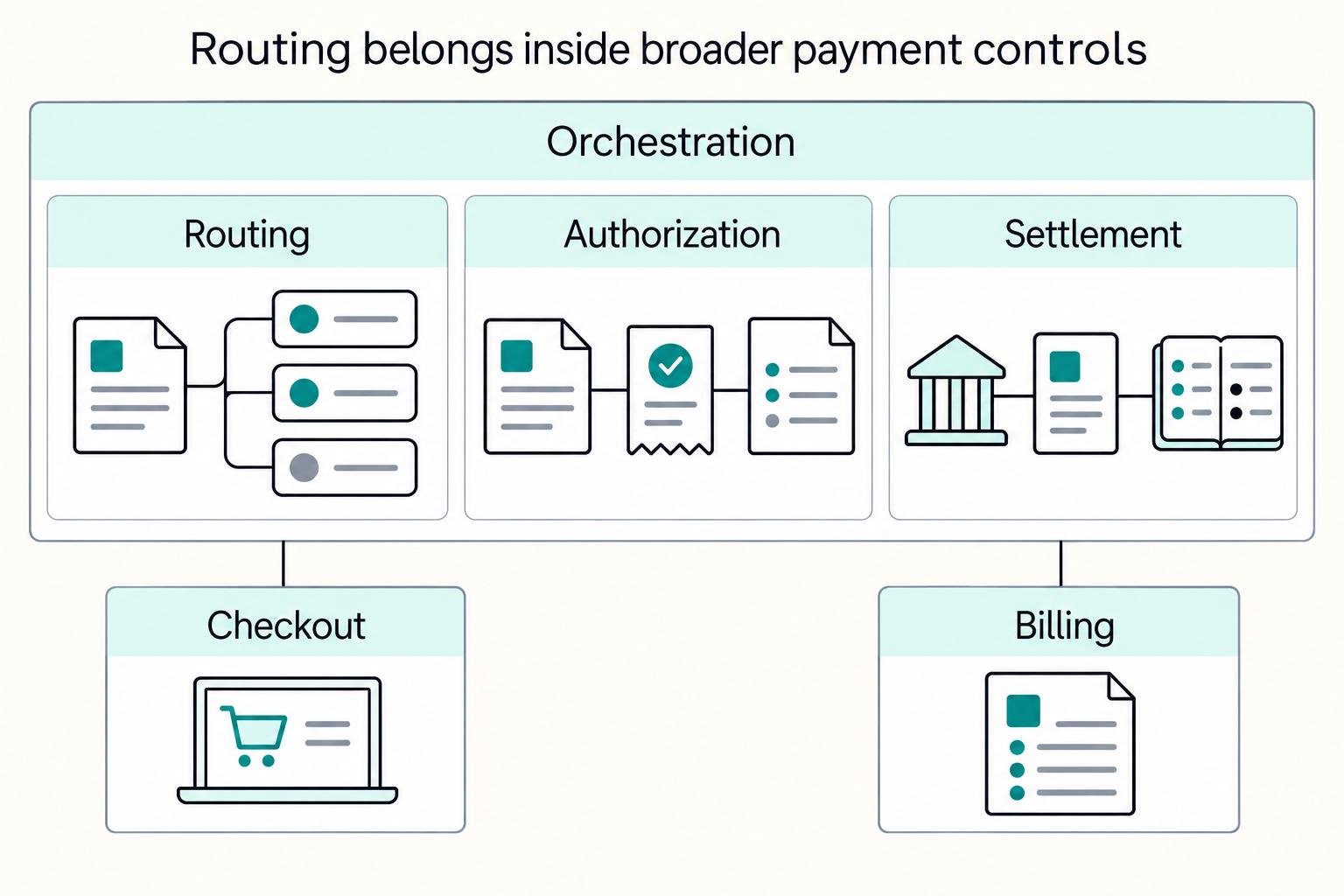
Payment orchestration changes how payments are routed and integrated; a receiving account changes where eligible payouts arrive. They can be used together. Choose based on the gap you need to solve: normalize fragmented provider data in the reporting layer, and consolidate cash only where each provider permits the destination for your entity and currency. Neither change replaces settlement reconciliation.
Before selecting a path, require documented evidence for each PSP and legal entity: payout destination rules, settlement currencies, payout currencies, account-holder validation requirements, and statement reference fields. Keep the same join keys from the previous section so the close remains testable: PSP transaction ID, payout or batch ID, currency, legal entity, settlement date, and Bank Statement reference when available.
If that evidence is incomplete, keep the decision open instead of forcing a consolidation direction. Proceed only when you can prove an end-to-end match from source payout data to receiving statement lines and posting artifacts for a pilot bundle.
Related: What Is Payment Orchestration? How Platforms Route Transactions Across Multiple PSPs.
Execute the daily close sequence with posting gates#
Once mapping is stable, run the same close sequence every day and treat it as a control, not a preference. The goal is a close you can rerun and explain before you post.
Stage feeds and confirm completeness#
Use a repeatable intake pipeline and record completeness for orders, PSP activity and receiving statements. These feeds can arrive independently; stage late deposits or reports without forcing a match. Run matching once the necessary records for the affected bundle are available.
Before you auto-match, confirm each intake file is in scope for the intended settlement date, legal entity, and currency. Confirm the join-critical fields are present and usable, including account identifiers, amount, currency, date, and reference numbers. If a deposit arrives but its corresponding PSP extract is missing, hold that bundle instead of forcing a partial match.
Gate every bundle before posting#
Apply approval to the affected accounting entry, not just the payout bundle. Keep identity, duplicate, amount and legal-entity breaks unresolved until corrected or posted to an explicitly approved suspense treatment. Supported activity can still be booked to clearing while cash is pending. Keep the raw extract, reconciliation file, reviewer approval and ERP reference together.
Keep required identity, amount and entity checks on the affected entry. A named owner alone cannot clear an unexplained break. Track unmatched cash separately and retain the evidence for any approved suspense entry.
Reprocess safely and publish daily status#
Assume late files and webhook retries will happen. Reprocessing should update the existing bundle identity rather than create duplicate GL impact.
Publish one daily status view by PSP and currency with four states: matched, unmatched, pending, and blocked. That keeps Finance, Payments Ops, and Engineering aligned on what can post now and where intervention is required. Related reading: Invoice Settlement for Platforms That Match Payouts and Close Disputes.
Triage exceptions with a signal-to-action matrix#
Use one signal-to-action matrix so detection leads to a consistent next step, owner, and communication path instead of case-by-case debate.
Classify the actual reconciliation break#
Classify missing reports, unlinked movements, unexplained amounts, duplicate imports, delayed cash and wrong-entity records. Record amount and currency, available evidence, an owner and the next action.
| Signal | What to decide immediately | Required output |
|---|---|---|
| Detection signal | Whether the item is an incident for this close cycle | Incident record with timestamp |
| Actors involved | Which team owns investigation and resolution | Named owner |
| Severity for close | Whether to pause posting or continue with controls | Posting decision + rationale |
| Communication need | Whether external communication is required | Communication action or explicit "not required" |
| Recurrence pattern | Whether this is a repeat issue | Problem-management candidate flag |
Route breaks to the right owner#
Finance resolves accounting treatment, Payments Ops requests missing provider information, and Engineering repairs ingestion or mappings. Set urgency from amount and close impact; a late report needs a different recovery path from duplicate GL entries.
Convert repeats into problem management work#
Keep a recovery log tied to your Internal Ledger and Bank Statement evidence so repeat failures are visible, not buried in daily commentary. When patterns repeat, move them into problem management and change/release/deployment work rather than treating them as permanent manual exceptions.
Keep tax and compliance balances distinct from cash timing#
Reconcile tax liabilities from sale and refund records, not from net PSP deposits. Keep the seller or filing entity, taxable amount, tax amount, currency and return period linked to the commercial event. A payout delayed by a compliance review does not by itself change the sale’s VAT treatment or cancel the liability.
When KYC, KYB or AML review delays release, retain the provider status and affected amount with the expected payout record. Separate supported provider balances from unexplained differences, and review their collectability under your accounting policy. Tax classification questions belong with the tax owner while Payments Ops resolves release timing.
Use this checklist to close faster with fewer surprises#
Use this order to keep close moving: completeness, mapping, exceptions, compliance impact, approval evidence, then summary.
| Checklist item | Key points |
|---|---|
| Confirm source completeness | Load Internal Ledger orders, PSP transaction and payout activity, and bank or EMI statement lines; keep a source file or API extract, load timestamp, and date or cutoff basis |
| Validate mapping integrity | Sample matched items across each provider for order ID, PSP transaction ID, payout reference, currency, and legal entity |
| Review the exception matrix | Unexplained required-ID, duplicate, amount or entity breaks block the affected entry unless an approved suspense treatment is recorded |
| Verify the compliance impact queue | Review KYC, KYB, and AML holds for payout-timing impact and mark the bundle as pending due to compliance timing when a hold delays release |
| Approve bundle postings with an audit trail | Approval record should show who approved, when, and which evidence pack was reviewed |
| Publish a close summary before moving on | List open risks, unresolved items, and next-cycle owners |
- Confirm source completeness.
For each PSP and settlement currency, load all three records: Internal Ledger orders, PSP transaction and payout activity, and bank or EMI statement lines. Make sure every expected payout bundle has a source file or API extract, a load timestamp, and a clear date or cutoff basis. If a payment is approved but cash is not yet in the account, do not assume ingestion failed. Approved payments can take days to appear in the bank as part of settlement timing.
- Validate mapping integrity.
Sample required identifiers by movement type and confirm the mapping to ERP entries. Sales-related movements need commercial references; account fees or reserve movements need their own classification and source reference. A matching net total cannot justify guessed identifiers.
- Review the exception matrix.
Document the affected entry and why it is blocked, supported in clearing, or approved to suspense. Keep owner and evidence on open items. For disputes, preserve both the contested transaction and actual balance debits or credits, status and response deadline; a dispute notice is not itself proof of the final loss.
- Verify the compliance impact queue.
Review KYC, KYB, and AML holds for payout-timing impact, not just operational status. If a hold delays release, mark the bundle as pending due to compliance timing, not as a broken reconciliation item. Do not leave compliance delays in unmatched queues without notes, or they will repeat next close.
- Approve bundle postings with an audit trail.
The approval record should show who approved, when, and which evidence was reviewed, including source extracts, transformed reconciliation lines and bank support or a documented pending balance. Keep dispute movements and assessed fees separate, then link any later reversal to the original event.
- Publish a close summary before moving on.
End with one report listing open risks, unresolved items, and next-cycle owners. Tie each open item to the missing evidence or action needed, such as a late bank line, a mapping defect, or a dispute outcome not yet linked to settlement and fees. Linking dispute outcomes to settlements and fees helps Finance close faster.
Start with one provider and one currency: reconcile its opening balance, activity, payout and closing balance, then retain the evidence so another analyst can reproduce the result.
Frequently Asked Questions
What is multi-PSP settlement reconciliation in practical terms for a platform finance team?
It connects internal commercial records to PSP activity and PSP payouts to receiving statements. Explain gross collections, fees, refunds, reserves and net cash, and reconcile supported provider balances that remain pending at close.
What are the three records we must match every day to run true 3-Way Reconciliation?
Use internal activity, PSP reports and bank or EMI statements. Link sales-related movements to orders, then payouts to statement lines; account-level adjustments may have no order. Pending cash remains a supported open balance rather than a completed bank match.
Why does one PSP payout rarely equal the sum of same-day customer sales?
A payout can combine transactions from several sale dates and include refunds, disputes, fees, reserve movements and adjustments. Match the reported batch components to its net amount, then match that payout to bank cash. Same-day gross sales and same-day deposits measure different things.
When should we choose Payment Orchestration over routing to a Multi-Currency EMI Account?
Use orchestration when payment routing or integration is the operational gap, and normalize reports when fragmented data is the close problem. Consider a shared receiving account when providers support it for your entities and currencies. These approaches can coexist; neither removes the need to reconcile each provider.
What conditions must be true before routing Stripe, Adyen, and PayPal payouts into one UK EMI Account?
Confirm that each PSP accepts the receiving account for the account-holder entity, destination country and settlement currency. Check beneficiary-name requirements, supported account details and payout references. Pilot a payout from each provider and trace it to a statement before moving all cash to one account.
Which exceptions should block GL posting versus be carried to the next close cycle?
Unexplained identity, duplicate, entity and amount breaks block approval of the affected entry or require an approved suspense treatment. A supported payout awaiting bank arrival can remain in PSP clearing while underlying activity is booked. Keep the owner, dated evidence and next action for every open item.
Where can FX still hit P&L even after we centralize payout destinations?
FX can arise when transaction, settlement, payout and functional currencies differ. Preserve original amounts and currencies, provider conversion amounts and fees, and the rate used for accounting translation. Centralizing destinations does not eliminate these differences.
Try a related tool
Researched and edited by the Gruv editorial team. Gruv builds cross-border billing, payouts, and finance-operations software for global businesses.
Sources
Includes 2 external sources outside the trusted-domain allowlist.
Educational content only. Not legal, tax, or financial advice.
Related Posts

Month-End Close for Payment Platforms with PSP Settlement Control
Month-end close often breaks down when PSP settlement is treated as a side reconciliation. For payment platforms, settlement is often the clearest record of what cash should have moved, so it should drive the close rather than being checked after journals are drafted. If you run close across multiple PSPs, you need that settlement record to lead the review before your team starts defending journal entries.
What Is Payment Orchestration? How Platforms Route Transactions Across Multiple PSPs
Payment orchestration coordinates payment providers, routing decisions, attempt history and operational reporting through a shared control layer. It becomes useful when checkout traffic needs more than one PSP and separate integrations make outcomes harder to explain. One integration can simplify access; it does not automatically settle funds or reconcile every connector.

3-Way Reconciliation Explained: PSP Ledger vs. Internal Ledger vs. Bank Statement
Three-way reconciliation explains processor activity through your internal postings and the resulting booked bank movement. The records have different granularity, so the goal is a supported bridge between them rather than identical totals on the same date.