

Quick Answer
Yes. Launch mixed cart only after you prove the checkout and back office can handle it together. Keep the order summary explicit about what is charged now versus what renews, then validate cart-type routing in Recharge and your ecommerce checkout path. Confirm Stripe or WooCommerce setup actually creates the recurring record after payment, and document who owns mixed-order refunds. If those checks fail in live testing, delay rollout and fix operations first.
Treat this as a monetization decision first and a UX decision second#
Treat this as a monetization decision first and a UX decision second. Putting a one-time product and a subscription product into one checkout can simplify the buy path, but it also changes how revenue is presented, processed, refunded, and explained when something goes wrong.
A mixed cart is a cart that contains both recurring and non-recurring items. Major platforms already support that model directly. Stripe Checkout allows a single checkout session with subscription items and one-time items together. WooCommerce Subscriptions has a Mixed Checkout setting for the same basic behavior. Recharge has separate guidance for processing and refunding mixed carts. That matters because this is not just front-end polish. The checkout can look like one transaction to the customer, while downstream processing and refunds still follow different paths.
The commercial upside is real, but it is easy to overstate. Vendor guidance, including Recurly's, presents combined checkout as a way to improve customer experience, raise average order value, and support retention. Those are legitimate upside areas. They are not proof that a mixed cart setup will improve margin in your business. If the only clear benefit is convenience, while your team still handles refunds, recurring billing questions, or order exceptions manually, assume the economics are still unproven.
Start with disclosure. One common failure mode is simple: the recurring amount is not clearly shown in the order summary. That is not a cosmetic issue. When buyers cannot tell what they pay now versus what recurs later, confusion and extra support or refund requests can follow. The practical check is to inspect the actual live checkout, not just design mocks, and confirm that the first payment and the recurring charge are both impossible to miss.
Then look at post-purchase handling. Recharge's own documentation treats processing and refunding mixed carts as a distinct operational topic. Take that as your cue to ask harder questions before launch. Can your stack create the subscription reliably after payment? Can support see which line was one-time versus recurring? Can finance trace both parts of the order when refunds or exceptions happen? If you cannot answer those with evidence, do not assume checkout simplicity will survive contact with operations.
This explainer stays focused on that decision. It will help you decide whether a single transaction checkout improves the quality of revenue, what to verify before rollout, and where current platform guidance is useful versus where you still need your own proof.
Related: Hybrid Billing Models: How to Combine Subscriptions with Usage-Based and One-Time Charges.
Build the right mental model before you build the checkout#
Treat mixed cart checkout as a billing model decision, not just a convenience feature. It is one order flow where a buyer purchases a one-time product and a subscription product together, even though downstream handling can still split by cart type.
Stripe Checkout supports mixed carts in mode=subscription with recurring and one-time line items. Recharge routing depends on the integration: its Recharge Checkout guide covers BigCommerce, while the Shopify Checkout Integration processes both one-time and subscription orders through Shopify Checkout. Record your actual integration before adopting a cart-routing rule.
Treat the order summary as a contract surface. Show what is due now, what renews, the cadence and the renewal date in distinct labels. Check the actual checkout and confirmation for each cart type so a blended total cannot hide the ongoing commitment.
This is why mixed cart belongs in your hybrid billing model, not as a cosmetic checkout tweak. You are combining charge types in one buying moment, which changes how you measure AOV and CLV and how you design reconciliation and cancellation workflows. If finance cannot trace one-time and recurring components cleanly, or support cannot clearly explain ongoing billing, fix the operating model before rollout.
Decide if mixed cart will improve margin and not just top-line conversion#
Mixed cart is worth launching when margin upside is likely to survive operational reality, not just lift checkout conversion. It can raise revenue and order value, but only if refunds, support handling, and reconciliation are ready for orders that combine recurring and non-recurring items.
| Expected upside | Expected costs | Operational constraints |
|---|---|---|
| Higher average order value (AOV) when a buyer adds a one-time item with a subscription | More billing and cancellation questions when charges are not understood | Ledger and reporting must separate one-time and recurring components for reconciliation |
| Better attach rate on add-ons and bundles | Refund handling gets more complex when mixed-order refunds must be processed in the subscription system path | Finance needs a repeatable reconciliation workflow and clear exception ownership |
| Higher CLV when mixed-cart cohorts show repeat behavior over time | More post-purchase work for failed recurring charges and follow-up | Support needs a defined cancellation workflow for the recurring portion |
If your main upside is convenience, but refunds and cancellations are still manual, defer launch. A smoother checkout is not enough if finance and support absorb the complexity later.
The strongest use case is when you already sell both one-time and subscription products and can measure contribution margin by order type. In that setup, start with cohorts that already show repeat behavior instead of rolling out to everyone.
For mixed carts using Recharge Checkout on BigCommerce, the documented refund path runs through Recharge. Shopify Checkout Integration uses Shopify Checkout instead. Confirm the transaction owner and refund path in the integration you actually operate.
Start with a baseline you can compare after launch#
Capture a baseline before you change checkout so you can attribute impact instead of guessing. At minimum, track the following:
| Metric | How to use it |
|---|---|
| AOV | Track it for the order types you plan to test |
| CLV | Track it for likely mixed-cart cohorts |
| Support ticket mix | Track billing confusion, refunds, and cancellations |
| Checkout abandonment | Track it to spot new friction |
Keep the baseline tied to the same cohort or product scope as your launch. Then run a live mixed-cart test end to end: order creation, recurring activation, refund path, and reconciliation trace. If any step fails, pause launch.
For the pricing-model choice behind this checkout pattern, see Choosing Between Subscription and Transaction Fees for Your Revenue Model.
Choose a processing architecture that matches your platform constraints#
Choose the checkout architecture your platform can run reliably, then make cart-based routing explicit before launch. If routing changes by cart contents, treat that as an operating rule with test coverage, not hidden branch logic.
| Path | How it processes the cart | What to verify before launch | Main risk |
|---|---|---|---|
| Recurly Purchase endpoint | Recurly supports a single consolidated purchase call and can sum subscription and one-time line items into one gateway transaction | Recurring line is clearly visible in the order summary, subscription creation succeeds after payment, and one-time vs recurring entries post to the correct ledger buckets | Assuming one gateway transaction automatically means downstream accounting is correct |
| Recharge integration | Recharge Checkout on BigCommerce handles recurring and mixed carts; Shopify Checkout Integration processes one-time and subscription orders through Shopify Checkout | Identify the integration, verify subscription creation and document its refund owner | Applying legacy or different-platform routing and refund instructions to the wrong integration |
| Custom checkout or WooCommerce flow | Stripe Checkout supports one-time and subscription payments; mixed carts require mode=subscription. WooCommerce can group subscriptions by billing schedule | Customer can see what is charged now vs later, expected subscription object(s) are created, and webhook-driven posting reconciles correctly | You own routing logic, webhook timing, and object mapping across plugins and payment rails |
Make the cart composition rule explicit#
Recharge’s guide distinguishes Recharge Checkout on BigCommerce from Shopify Checkout Integration. Test recurring-only, mixed and one-time-only carts against your integration, including the refund path.
If your routing differs by cart type, put that rule in internal ops docs and QA scripts before rollout. Also test cart-edit scenarios where a recurring line is removed late, because that is where hidden fallback behavior usually appears.
Write order-of-operations in buyer sequence#
Document the flow in the same order your customer experiences it:
- Check cart composition.
- Route to the correct checkout path.
- Record authorization/capture behavior for that path.
- Confirm subscription creation after successful payment.
- Process post-payment events through webhooks and verify downstream posting.
For Stripe, process Checkout and subscription lifecycle events together with current provider state. Checkout completion does not always prove payment success, particularly for delayed methods or trials. Verify payment status and the subscription’s intended state before fulfillment or accounting release.
For the retention and expansion lens, use Customer Lifetime Value Optimization for Subscription Platforms: 7 Operational Levers.
Design checkout transparency that reduces confusion before payment#
Make recurring terms explicit before payment or buyers will misread what renews and when. In mixed carts, the order summary should clearly separate what is charged now from what continues later.
Make recurring terms obvious#
In any checkout with one-time and subscription items, show recurring details on a distinct line: recurring amount, billing cadence, and first charge timing. Also state what happens after the one-time item is fulfilled, so the buyer can tell whether only the subscription continues.
Avoid a blended total that obscures the recurring amount. Use separate labels for one-time and recurring charges, and test whether a buyer can identify the next renewal amount and date from the displayed summary.
Capture recurring consent before charging#
Identify the disclosure and consent requirements that apply to your customers and subscription flow. Show the recurring terms clearly before the payment action, capture the required consent and retain evidence; a higher-ticket-only acknowledgment is not a substitute for required consent.
Check applicable law and your current processor or card-network subscription requirements. In the U.S., the FTC’s 2024 amended Negative Option Rule was vacated; do not use its original compliance dates as current launch gates. Review ROSCA and applicable state rules for your flow, including disclosures, consent and cancellation.
QA copy across every checkout variant#
Transparency usually breaks at the implementation layer, not in design mocks. Validate the same recurring disclosure quality across Shopify, WooCommerce, and hosted or embedded checkout variants.
Build a small evidence pack for each path:
| Evidence item | What to capture |
|---|---|
| Cart and final order summary screenshot | Capture the cart and final order summary |
| Recurring terms, policy link, and submit area screenshot | Capture the recurring terms, policy link, and submit area |
| Desktop and mobile confirmation | Confirm that one-time and recurring lines remain visually distinct on desktop and mobile |
If routing changes by cart composition, test both branches. Mixed carts and non-recurring-only carts can follow different checkout paths, and transparency copy can drift between them.
Put finance and ops controls in place before scaling volume#
Do not scale a mixed cart offer until finance can trace one order from payment through subscription creation, invoicing, and payout. In practice, record the one-time component and the recurring component separately in your ledger, even if the customer saw one total.
Record the order, payment, subscription and invoice references, with one-time and recurring lines distinguished. Finance should determine the accounting treatment for the actual contract and service periods; the presence of separate invoice lines does not by itself establish separate performance obligations.
| Control point | What to verify | Common exception |
|---|---|---|
| Payment event | Receipt exists and amount matches the expected initial charge | Charge captured but order total posted incorrectly |
| Subscription record | Recurring object was created in the platform state your team treats as valid | Payment succeeded but no subscription was created, or retries created duplicates |
| Invoice state | Recurring side has an invoice in the state finance expects, including finalized if that is your posting trigger | Subscription exists but invoice is missing or not finalized |
| Payout match | Charge appears in the settlement batch or payout report | Bank payout cannot be tied back to source transactions |
Run this as an exception queue, not just a dashboard. If amounts mismatch, a subscription is missing, or invoice state never reaches your expected trigger, ownership and next action should already be defined.
Document refund and cancellation handling for the deployed integration. Recharge Checkout on BigCommerce requires its mixed-cart refunds through Recharge; do not apply that instruction automatically to Shopify Checkout Integration. Define how an unpaid invoice is resolved alongside cancellation without making invoice payment an unconditional barrier to a legally required cancellation.
Set an exception-reporting cadence for launch, then relax it only after error rates are consistently stable. Include mismatched amounts, missing subscription records, invoice-state failures, duplicate webhook processing, and payout mismatches. Stripe can retry undelivered webhook events for up to three days, so idempotent handling and already-processed checks are core controls, not nice-to-haves.
Account for compliance and cross-border constraints early#
Compliance timing, not checkout conversion, is what usually breaks launch promises in cross-border mixed-cart flows. For Gruv use cases, map KYC, VAT validation, and payout-eligibility gates before you promise activation speed, especially when a successful order triggers downstream disbursements.
In connected-account flows, check the provider’s actual capability and payout status, verification requirements and deadlines. A successful order does not prove payout eligibility. Distinguish your internal hold policy from provider restrictions and keep the required information current.
| Gate | What to verify | Why it matters |
|---|---|---|
| KYC | Required information is complete and the account is eligible to accept payments and send payouts | A paid order does not guarantee payout readiness |
| VAT validation | For EU cross-border cases, confirm VAT registration status through VIES when relevant | Supports tax-treatment checks and reduces avoidable manual review |
| Payout holds | Check whether payouts are paused due to missing tax-status or other required account information | Growth should not promise timelines ops cannot meet |
For EU cross-border cases, use VIES as a validation step, not a universal timing predictor. Treat VAT validation as one input into the decision, not proof that checkout-to-payout timing will be smooth in every flow.
If you use a Merchant of Record, be specific about the tradeoff: MoR can shift tax and dispute burden, but coverage still varies by market and program. Apply the same rule to Virtual Accounts and similar capabilities: onboarding eligibility does not guarantee full product availability in every market.
Document fallback flows before launch. If MoR or Virtual Accounts are unavailable in a target market, decide in advance whether to route through your standard entity, delay payout, or disable that path. In customer and partner copy, keep qualifiers like "where supported" and "when enabled" so activation promises match operational reality.
Implement the integration sequence with failure handling and proof points#
Treat checkout as the trigger, not the source of truth, and advance state only from confirmed async signals. Implement the sequence in this order: validate the checkout payload, send idempotent create and update POSTs, process webhook events, then post ledger state and generate reconciliation exports from confirmed records.
For Stripe mixed carts, the first release checkpoint is request shape: mode=subscription with the correct line_items pricing payload for one-time and recurring items. Keep your cart routing deterministic and testable, because processing paths can differ by platform and cart composition in integrations like Recharge.
Make create and update calls retry-safe#
Use a stable idempotency key and parameters for retries of the same Stripe POST intent. Keys can be pruned after at least 24 hours, so retain an internal intent record beyond that window. Reconcile a timeout against provider state before creating a new Checkout or subscription request.
Treat webhooks as asynchronous truth#
Use authenticated webhooks to update lifecycle state, with duplicate and out-of-order handling. Query the current provider object when delivery is missed or an event conflicts with stored state; a webhook stream alone is not guaranteed complete or ordered.
Stripe automatically retries live webhook delivery for up to three days. Store applied events, acknowledge duplicates and use provider-object reconciliation for missed notifications. Keep UI-success-but-unconfirmed records pending until authoritative payment and subscription state is established.
Release proof points#
Validate each release against four checks using real records:
| Proof point | What it validates |
|---|---|
| Mixed-cart success rate | Success across intended routing paths |
| Recurring setup success | Checkout completion to confirmed subscription state |
| Refund and cancellation correctness | Correctness across one-time and recurring components |
| Reconciliation completeness | Completeness across payment, subscription state, and export rows via shared IDs |
If one check fails, fix sequence integrity before scaling volume.
Conclusion#
Mixed cart checkout is worth doing only when it improves revenue quality and keeps the buying terms obvious. If it lifts checkout completion but leaves customers unclear about what renews, or leaves finance guessing which records belong together, you have not really improved the business.
That is the decision rule. Recurly's positioning points to higher AOV and stronger retention as the upside, but those gains matter only if the model holds up after payment. Visa has documented how recurring-charge confusion turns into call volume, complaints, write-offs, and card reissuance costs. So the bar is not whether conversion moved. It is whether margin quality improved without adding hidden support and reconciliation drag.
The practical next step is a scoped launch, not a full rollout. Build a simple decision table that forces three checks side by side: expected upside by cohort, customer transparency at checkout, and operational readiness after the order is placed. Then pair that with a short verification pack your team will actually use:
- Transparency check: the order summary clearly distinguishes the immediate charge, the recurring amount, the billing cadence, and what continues after the first transaction.
- State check: webhook events confirm the subscription was created or changed, and retries use idempotency so a timeout does not create duplicate effects.
- Finance check: payout reconciliation breaks each payout into transaction-level detail so finance can match payment activity, subscription state, and exceptions during close.
Check market, provider and program eligibility before expanding a cross-border payout path. Separate checkout tax handling from connected-account verification and payout availability. Include fees from the actual country and account agreement; a single quoted cross-border percentage is not a universal mixed-cart cost.
Scale only after the signals are boring in the best way. You want stable webhook handling, clean transaction records, payout or bank reconciliation that finance can close without manual detective work, and support tickets that show customers understand the charged-now, billed-later logic. Watch especially for failure modes like payout.failed exceptions or duplicate create attempts after retries. If those stay controlled in the pilot, mixed cart can be a strong monetization move. If not, keep the rollout narrow until the backend is as clear as the checkout.
For marketplace-specific recurring revenue design, see Marketplace Subscription Monetization: How to Add Recurring Revenue.
Frequently Asked Questions
What is mixed cart checkout in plain terms?
A mixed cart contains both recurring and non-recurring items. In practice, that means a buyer can purchase a one-time product and a subscription product in the same checkout, even if backend handling differs after checkout.
Do mixed carts and non-recurring-only carts always process the same way?
No. Routing depends on the integration. Recharge Checkout on BigCommerce handles recurring and mixed carts, with one-time-only carts using the ecommerce checkout; Shopify Checkout Integration sends one-time and subscription orders through Shopify Checkout. Test each cart type and refund path in your actual deployment.
What must be visible before a customer pays?
Show the amount due now, recurring amount, cadence, first renewal timing and what continues after the one-time item. Capture the consent required for your flow before charging. The FTC’s 2024 amended Negative Option Rule was vacated; review current federal and applicable state requirements rather than relying on its original implementation dates.
What are the biggest implementation risks?
The main risks are unclear recurring charges, untested routing and incorrect post-sale handling. For example, Recharge Checkout on BigCommerce and Shopify Checkout Integration have different processing arrangements. Confirm which system holds the transaction and can issue its refund, and test delayed payment, subscription creation and cancellation as well as immediate success.
When should a team delay mixed cart rollout?
Delay if your reconciliation is still fragile, if recurring disclosures are not obvious in the checkout UI, or if support cannot reliably explain and resolve mixed-order refunds and cancellations. A good red flag is when finance cannot tie payment records, subscription state, and refund actions back to the same order or checkout ID without manual digging. Another is when your support team lacks a written exception path for charged-now, billed-later complaints.
What should teams measure first after launch?
Start with AOV, CLV trend by cohort, checkout abandonment near transparency elements, and support tickets tagged to recurring billing confusion. That mix matters because mixed carts are often positioned as an AOV and retention lever, while CLV tells you whether the model is improving long-term value rather than just first-order revenue. Track those against a pre-launch baseline, and review the actual orders that triggered confusion so you can see whether the issue was copy, routing, or refund handling.
Try a related tool
Researched and edited by the Gruv editorial team. Gruv builds cross-border billing, payouts, and finance-operations software for global businesses.
Sources
Includes 3 external sources outside the trusted-domain allowlist.
- docs.stripe.com/payments/checkout/how-checkout-workstrusted
- docs.stripe.com/webhooks/process-undelivered-eventstrusted
- europa.eu/youreurope/business/taxation/vat/check-vat-n...trusted
- ftc.gov/news-events/news/press-releases/2026/03/ftc-...trusted
- ftc.gov/legal-library/browse/statutes/restore-online...trusted
- developer.shopware.com/docs/products/extensions/subscriptions/guide...external
- netsuite.com/portal/resource/articles/ecommerce/cart-aban...external
- recurly.com/blog/mixed-cart-checkout-subscriptionsexternal
Educational content only. Not legal, tax, or financial advice.
Related Posts
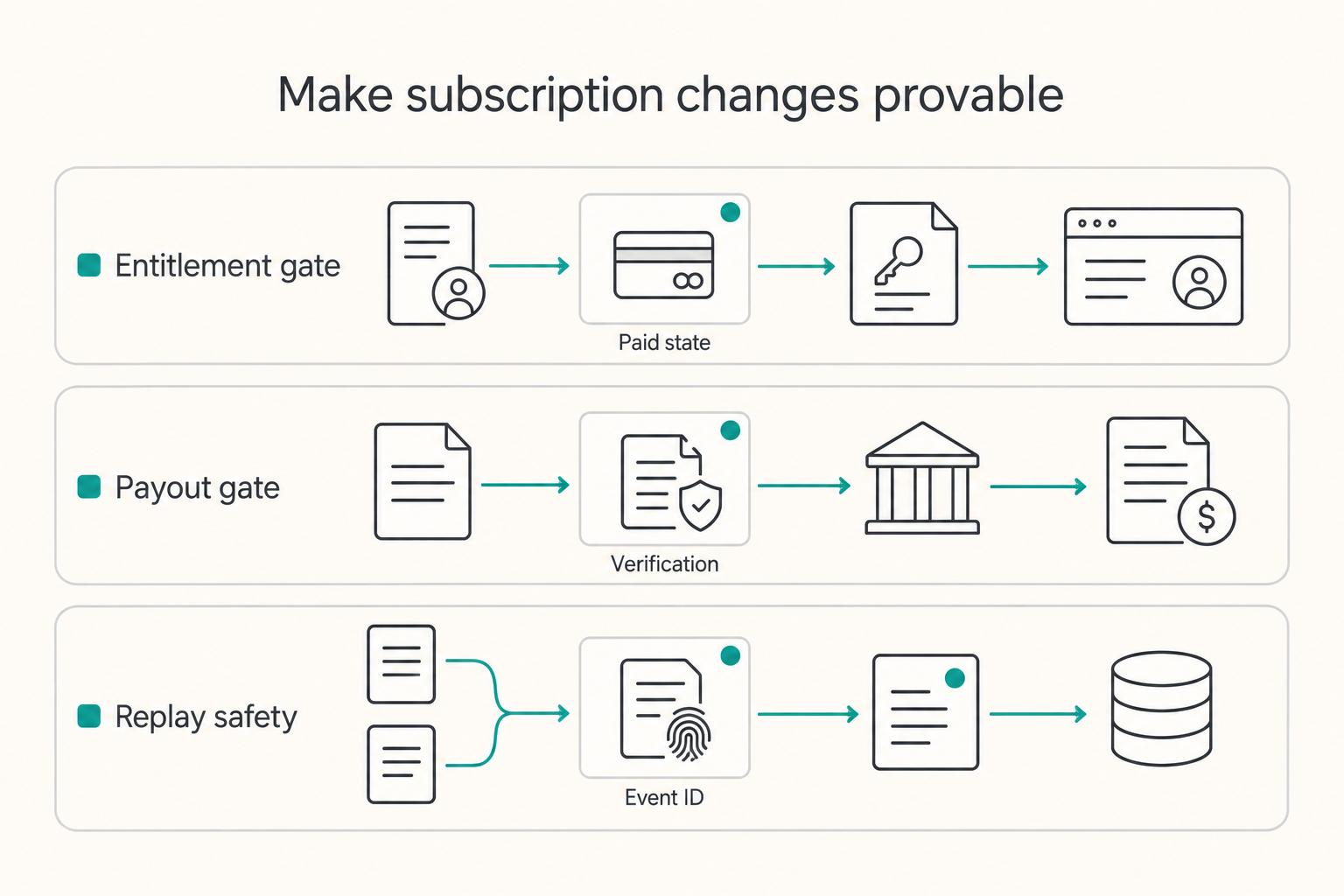
Marketplace Subscription Monetization: How to Add Recurring Revenue
Treat a Subscription Revenue Model as an operating decision first and a pricing decision second. Recurring fees can turn uneven sales into steadier monthly revenue, but in a cross-border marketplace they also expose entitlement logic, country-specific payout constraints, and tax responsibility gaps quickly.

Hybrid Billing Models for One Invoice and Clean Reconciliation
**Hybrid billing combines recurring subscription fees, usage-based charges and one-time fees in the same offer.** Design the catalog, usage controls and invoice traceability together so finance can reconcile what customers buy and use.
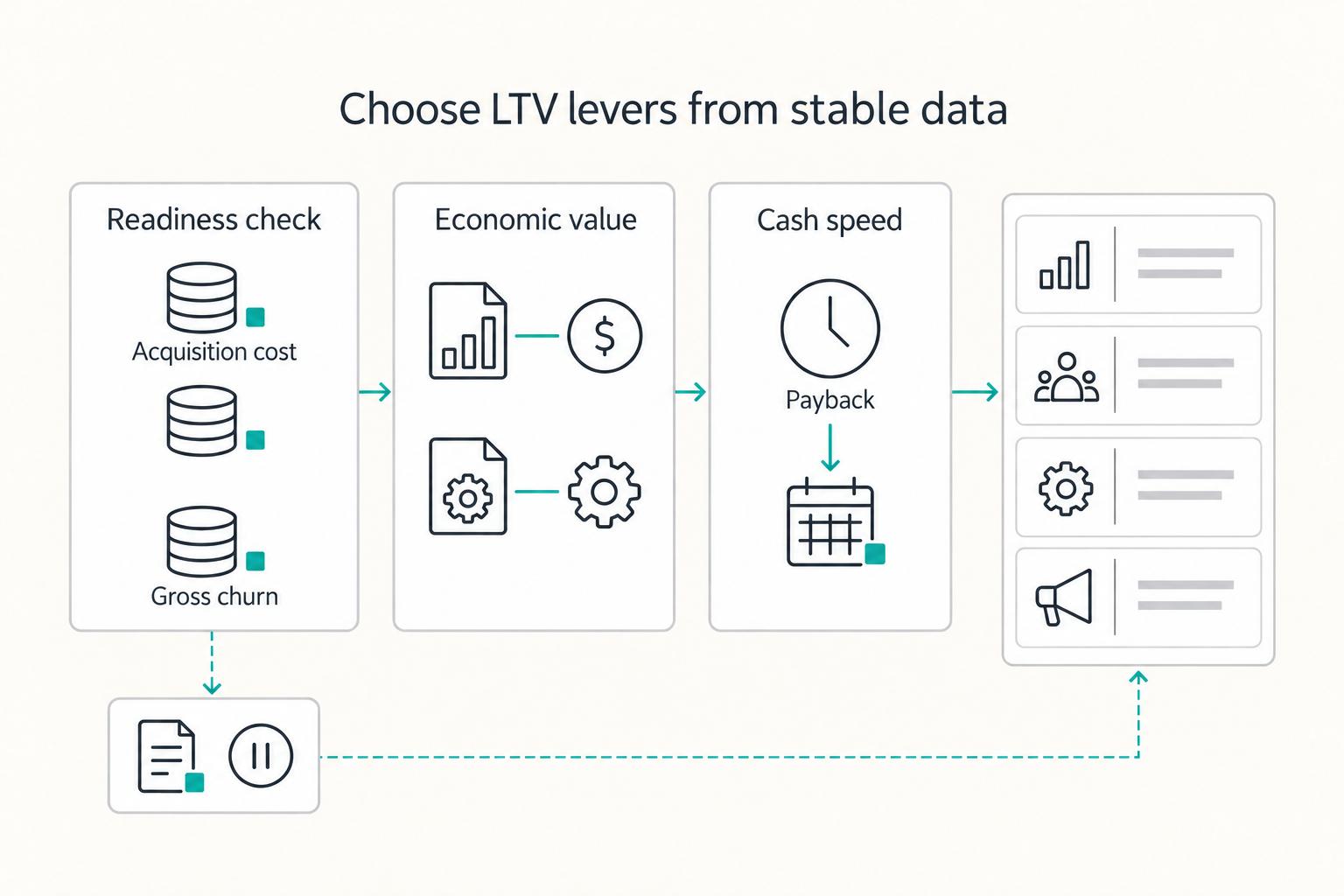
Customer Lifetime Value Optimization for Subscription Platforms Using 7 Operational Levers
For a subscription platform, Customer Lifetime Value is first a unit economics question. It rises or falls based on how reliably you turn acquired demand into recurring revenue over time. It also depends on how much of that revenue you retain and the margins behind it.