
Quick Answer
Yes. Metered billing works when you can track a clear Usage unit and explain every invoice line without ambiguity. The article recommends choosing model structure first (fixed, variable, or hybrid), then locking Billing cycle rules, Overage behavior, and customer visibility before rollout. If buyers prioritize predictability, keep a Base fee and add Usage fee components instead of going fully variable. If your team cannot trace usage records to final charges, delay launch and fix the meter.
How metered billing works#
Metered billing sounds simple. You charge for what customers use. The hard part is everything underneath that sentence. You need to decide what counts as usage, record it consistently, and turn it into an invoice a customer will trust.
Teams get tripped up here. You will see overlap between usage-based billing, pay-as-you-go billing, and consumption-based pricing, and in practice people often use those labels interchangeably even though they are not always exactly the same. This guide stays focused on the operator question instead: what are you measuring, what are you charging for, and which commercial model fits that reality?
For buyers, the appeal is easy to understand. They want flexibility and a bill that reflects actual use. In straightforward cases, that means charging for activity such as API calls made or data stored instead of relying only on a fixed monthly fee. But that flexibility only works when the meter is clear and the invoice logic is easy to explain.
So this is not a glossary. It is a decision guide for founders, revenue leaders, product teams, and finance operators choosing between subscription billing, pay-as-you-go billing, and a hybrid pricing model based on what they can reliably measure and bill.
Before you go further, use one basic checkpoint: can product, finance, and support answer the same question the same way? What exact usage unit is being tracked, and where does that record live? If your team cannot point to the system or data source that monitors and records usage, usage pricing is not ready to launch.
The usual failure is not the rate card. It is a weak meter. If customers cannot predict what will be counted, or your team cannot verify why an invoice shows a certain charge, the model gets harder to operate. The sections that follow stay close to the real decisions: when is a fixed subscription anchor better? When is pay-as-you-go defensible? When does a hybrid model make sense? And what launch checks catch billing problems before customers do?
Decide if metered billing fits your revenue model#
Choose the model based on value signal and budget predictability, not trend pressure. If customer value rises with a measurable Usage unit like API calls, data transfer, or application access, metered billing is usually defensible. If that link is weak, keep a stronger Subscription billing anchor.
- Map price to a clear usage metric.
Ask a blunt question: when a customer uses more, are they getting more value, or just generating more activity? Metered billing works best when consumption and cost are clearly connected and the usage metric is easy to explain. Verification checkpoint: product, finance, and support should define the same Usage unit in one sentence and point to where it is recorded for each billing cycle.
- Separate fairness complaints from budgeting complaints.
If deals stall on "we barely used it," your flat subscription may feel mismatched to usage. Flat-rate pricing can miss at both ends: too high can push away low-usage customers, and too low can become unprofitable when usage climbs. If deals stall on "I can't budget this," the issue is predictability, not metering alone.
- Use a Hybrid pricing model when usage is real but volatile.
When usage varies a lot across accounts or swings month to month, a Hybrid pricing model can be safer than pure per-unit pricing. Keep a Base fee for stability and add a Usage fee so price still reflects consumption. If you include Overage, make the invoice logic explicit so customers can see what is fixed, what is measured, and what exceeded the included amount.
- Limit downside for budget-sensitive buyers.
If buyers need stricter monthly predictability, keep the subscription layer stronger and reduce variable exposure. Use bundled tiers, a Spending limit, or tighter Overage behavior instead of fully open-ended monthly variance. Some metered designs also use usage limits, and some reduce per-unit price after usage thresholds, but only add threshold complexity if your team can explain when rates change and how customers will see it before invoicing.
The practical rule is simple: if pricing conversations keep stalling on underuse, move closer to usage pricing. If they keep stalling on budget uncertainty, add floors, caps, or bundled capacity before removing the fixed fee.
For a step-by-step walkthrough, see How to Dispute Billing Errors Under the Fair Credit Billing Act.
Compare fixed, metered, and hybrid models before you ship pricing#
Put fixed, metered, and hybrid on one page before launch, then decide where you want the pain: forecast pressure, invoice volatility, or limited expansion upside. If expansion revenue is strategic and your telemetry is dependable, metered or hybrid is usually the better fit. If event data is still hard to defend in disputes, keep recurring billing until consumption tracking is reliable.
Step 1 Score the three models on decision-critical traits#
Use familiar category language from tools like Stripe Billing, Chargebee Billing, or DealHub, but make the choice based on your own operating constraints. Pick the model your finance team can forecast, your support team can explain, and your product can meter consistently.
| Model | Forecastability | Expansion upside | Invoice volatility | Trust test |
|---|---|---|---|---|
| Recurring billing | High | Low to Medium | Low | Clear when the billing cycle, included entitlement, and renewal amount stay stable |
| Metered billing | Low to Medium | High | High | Works when the usage unit, timing, and any tiered thresholds are visible before invoicing |
| Hybrid pricing model | Medium to High | Medium to High | Medium | Strong when base fee and usage fee are separate, plain-language line items |
Use the table as a decision aid, not a universal rule. Fixed plans can still expand through seats or add-ons, and hybrid can still become confusing if threshold logic gets too complex.
Step 2 Model margin under growth, not just headline price#
Compare models under growth scenarios, because that is where weak economics usually show up. Fixed plans can hide heavy-use accounts, while pure pay-as-you-go can struggle when cost per usage unit is unstable or charges fragment into many small transactions.
| Pricing context | Fees listed |
|---|---|
| Stripe Standard | 2.9% + 30¢ per successful domestic card transaction; 1.5% for international cards; 1% for currency conversion; 0.5% for manually entered cards |
| Stripe Connect ("you handle pricing") | You are responsible for processing fees, plus $2 per monthly active account and 0.25% + 25¢ per payout sent |
| Managed Payments | 3.5% per successful transaction; additional charges can apply for subscription payments |
Use real fee mechanics, not assumptions. The Stripe Standard, Stripe Connect, and Managed Payments figures above show where margin can move as usage, payout activity, and transaction shape change.
Verification checkpoint: rerate one light, one typical, and one heavy account under each model after processing fees, payout fees, and expected support load. If economics only work on the average account, your downside is still under-modeled.
Step 3 Stress-test invoice trust before publishing#
Pricing that works in a model can still fail if customers cannot predict or verify charges. Ask two questions: can the customer estimate the bill before invoice close, and can your team explain variance in one screen or one email?
Start with billing cycle design. Then review tier thresholds so customers can see when rates change, how pricing applies, and where progress is visible before close. If support needs to reinterpret threshold logic from a sales deck, documentation is not launch-ready.
Run a sample invoice pack for a light, median, and heavy account. Include terms, a threshold example, and the usage evidence you would use in a dispute. If those examples are not plain-English explainable, delay launch.
If you are designing a usage-priced SaaS offer, A Guide to Usage-Based Pricing for SaaS goes deeper on packaging and pricing decisions.
Define your usage unit before you set prices#
Set the usage unit before you set the rate card. The unit is what makes the consumption-to-cost link feel transparent or confusing.
Pick a primary unit customers immediately understand#
Choose the activity that best reflects actual usage. Keep it concrete: examples like data stored or API calls made are easier for customers to understand than abstract internal metrics.
If customers cannot quickly tell what is being measured, the invoice can still feel arbitrary even when the math is accurate.
Pressure-test whether the unit feels predictable in real usage#
Test the unit against light, typical, and heavy account patterns before launch. The practical check is simple: does the charge rise with usage in a way a customer could roughly predict?
If the answer is no, revisit the unit before debating pricing levels.
If you are comparing billing systems, Subscription Billing Platforms for Plans, Add-Ons, Coupons, and Dunning covers the platform capabilities teams often need alongside usage billing.
Set billing cycles and limits that prevent bill shock#
If invoices are surprising customers, fix charge mechanics before headline price: make the billing window easier to read, define overage and cap behavior clearly, and give customers pre-invoice visibility.
Step 1 Align the Billing cycle with how usage accumulates#
Pick a cycle that makes normal usage look normal, not like a late-cycle spike. Pressure-test one light, one typical, and one heavy account across a full cycle, then compare projected charges mid-cycle and near close.
If a customer looks stable early and suddenly looks out of control at the end without any unusual event, your cycle design or alert timing needs work.
Step 2 Define Overage, Usage cap, and Spending limit behavior before launch#
Write the exact rules customers will encounter: overage rates, any grace behavior, and whether a usage cap or spending limit triggers alerts only or service interruption. If service can stop, say that directly. If it will not, explain what happens instead and who is notified.
| Control | Define before launch | Documentation |
|---|---|---|
| Overage | Exact overage rates and any grace behavior | Customer-facing rate card with threshold examples |
| Usage cap | Whether it triggers alerts only or service interruption | Contract or order-form language |
| Spending limit | Whether it triggers alerts only or service interruption | Contract or order-form language |
The FCC's redacted file includes more than 600 consumer stories about data-cap impacts. It is not a representative sample of all providers, but it is a clear signal that unclear cap mechanics can create trust and budget stress. One cited complaint describes a $120 a month bill, a 1.2 tb's limit, 10 dollars every 50 gb in overages, and another 30 dollars for an "unlimited option."
Keep one dispute-ready evidence pack:
- customer-facing rate card with threshold examples
- cap and spending-limit behavior in contract or order-form language
- internal screenshots or logs showing when alerts fired and what usage total triggered them
Step 3 Add pre-invoice visibility tied to Tiered pricing#
Show customers current usage, threshold crossings, and projected charges before invoicing closes. With tiered pricing, this is often where bill shock starts, because threshold jumps feel bigger than per-unit math.
Set alerts before the limit, near the limit, and at projected overage risk. If support is already handling surprise-bill tickets, tighten alerts and add a softer cap before you change price.
Implement consumption tracking and invoicing in the right order#
Sequence mistakes usually show up as disputes, leakage, or both. Run the flow in this order: event capture, validation and deduplication, rated usage, invoice draft, reconciliation checks, then invoice finalization. Kong describes the same foundation from usage events through invoicing and settlement, which is a useful implementation model even when your stack differs.
| Stage | Key action | Control point |
|---|---|---|
| Event capture | Record usage events first | Do this before any charge is calculated |
| Validation and deduplication | Clean and deduplicate usage events | Idempotency is mandatory so retries or delayed events do not create a second Usage fee |
| Rated usage | Apply pricing after events are validated and aggregated into billable meters | Store the rating logic version used for each run |
| Invoice draft | Draft invoices before sending | Review exceptions before finalizing |
| Reconciliation checks | Verify usage, contract terms, and invoicing agree to the same source of truth | Run this before invoice finalization |
| Invoice finalization | Finalize after draft review | Retain draft and final invoice snapshots for each Billing cycle |
Step 1: Capture events, then validate before rating. Record usage events first, then clean and deduplicate before any charge is calculated. Idempotency is mandatory: if retries or delayed events replay, they should confirm prior processing instead of creating a second Usage fee.
Step 2: Rate validated usage and keep rule history. Only apply pricing after events are validated and aggregated into billable meters. Store the rating logic version used for each run so you can reconstruct why a past invoice line looked the way it did.
Step 3: Draft invoices, reconcile, then finalize. Before sending, verify usage, contract terms, and invoicing agree to the same source of truth. Orb's monthly-close example (tallying 80 customers and sending by the 4th day of the month) is not a universal benchmark, but it reinforces the control point: draft first, review exceptions, finalize second.
Step 4: Keep cycle-level evidence and test explainability. For each Billing cycle, retain usage events, dedup/validation outcomes, rating logic version, and draft/final invoice snapshots. Your checkpoint is simple: finance and support should be able to explain any Usage-based billing line item in plain language, including what was counted, which rule was applied, and why retries did not duplicate charges.
If that explainability test fails, pause rollout. A line item you cannot explain is a revenue risk, not just a support issue.
Launch prerequisites and ownership checklist#
Do not launch until ownership and rollback are explicit in writing. The goal is simple: if pricing is wrong, you can catch it fast and fix it before it becomes a customer trust issue.
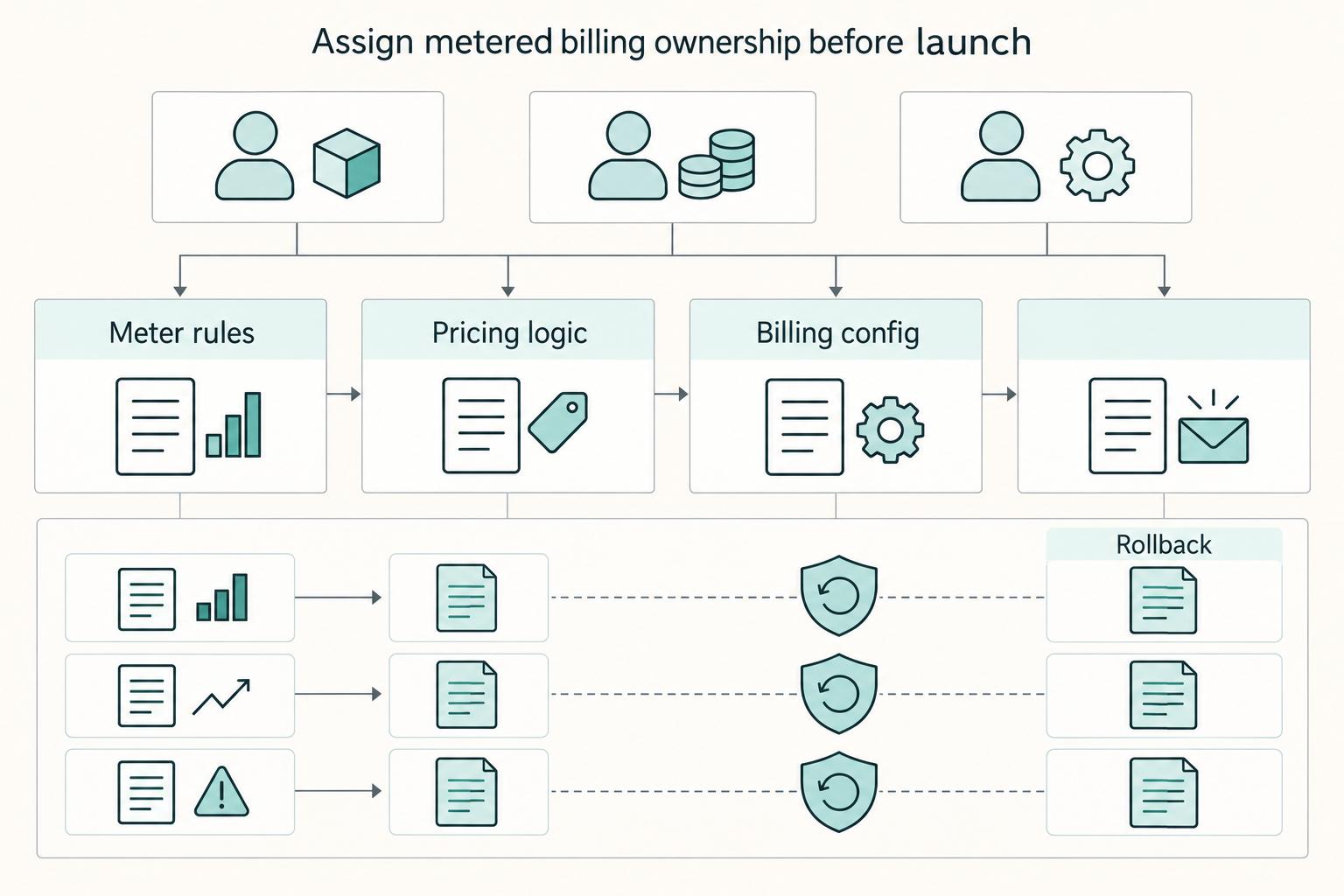
Step 1 Assign named owners before you change production pricing. Set one owner in product for the meter spec and usage rules, one in finance for pricing logic and invoice treatment, and one in billing ops for configuration changes and customer communication. Put Tiered pricing updates under change control, not ad hoc approval. Verification point: for every Base fee, Usage fee, and Overage rule, each owner can state who approves it, where it is configured, and how customers are notified.
Step 2 Prove your billing stack can express your terms without manual patching. In sandbox, test the exact charge mix: fixed recurring charge, usage charge, and overage behavior when a customer crosses a threshold mid-cycle. If the model only works when finance edits invoices manually after export, it is not launch-ready. If Stripe is in your payment path, separate billing logic from payment costs: Stripe standard pricing states no setup, monthly, or hidden fees, card fees such as 2.9% + 30¢ affect margin, and Managed Payments adds 3.5% per successful transaction on top of standard processing fees (with additional charges for subscription payments).
Step 3 Publish the launch artifact pack. At minimum, ship four documents: meter spec, dispute policy, alert thresholds, and a rollback plan for pricing configuration errors. The meter spec should define what counts, what does not, correction handling, and which source event fields support audit. The dispute policy should define the evidence pack you review, alerts should cover unusual usage jumps and draft invoice outliers, and rollback should name who can freeze new pricing and restore prior configuration if the first draft invoice is wrong.
Common metered billing mistakes and fast recovery paths#
With the current evidence pack, you still cannot credibly publish a definitive list of common metered billing mistakes or recovery playbooks. The safer move is to keep this section tied to validated internal patterns from your own usage, invoicing, and dispute records.
- Confirm exact definitions for
Usage unit,Overage,Usage cap,Spending limit, andBilling cyclewith your billing platform's official documentation before publishing hard rules. - Do not treat the July 2000 FTC document as current SaaS metered-billing operating guidance; it is a staff report, not an official Commission position.
- Keep this section focused on validated internal patterns, not generalized "best practice" claims.
Related: Metered Billing Architecture: How to Track Units Aggregate Usage and Trigger Invoices in Real Time.
Conclusion#
Do not force metered billing into your pricing because it sounds modern. Choose the model that fits your value signal, your buyer's budgeting needs, and your team's ability to measure and explain charges with finance-grade confidence.
-
Step 1 Confirm one auditable
Usage unittied to customer value. If the unit does not map cleanly to what customers believe they received, disputes are more likely. The verification check is straightforward: product, finance, and support should be able to trace one source usage event to one invoice line item and explain it in plain English. -
Step 2 Choose between
Subscription billing,Metered billing, and aHybrid pricing model, then write down the tradeoff explicitly. When usage truly varies and pricing needs to reflect both customer consumption and your own costs, usage-based charging is often defensible. If buyers need tighter monthly predictability, keep a stronger subscription anchor or a hybrid structure so budgeting stays manageable. -
Step 3 Define
Billing cycle,Overage,Usage cap, andSpending limitbehavior before you launch. Variable charges are easier to accept when the rules are visible and consistent. Avoid relying on only one control: a cap without clear notice can feel abrupt, and alerts without a customer-set limit can still leave room for surprise charges. -
Step 4 Validate
Consumption trackingand invoice explainability end to end before broad rollout. Kong breaks billing-grade architecture into 4 layers: usage events, meters and aggregation, rating and price models, and invoicing and settlement. Two checks matter most here. Retries must be idempotent so you do not double-charge, and rate limiting must stay separate from billing measurement because those serve different purposes. -
Step 5 Launch with clear customer communication and a defined recovery path for billing surprises. Show example bills or charge scenarios that reflect a real billing cycle instead of relying on a simple headline rate. Also decide in advance who reviews disputes, what evidence you will use to verify a charge, and how you will correct a bad invoice if a meter, aggregation rule, or price mapping fails.
If you can pass those five checks, you are not just shipping pricing. You are launching a model your customers can understand, your finance team can reconcile, and your support team can defend without improvising. If you cannot pass them yet, delay the rollout and fix the meter, the rules, or the communication first. Related reading: Retainer Subscription Billing for Talent Platforms That Protects ARR Margin.
Frequently Asked Questions
What is metered billing in one sentence?
Metered billing charges customers based on actual usage instead of a flat monthly fee. In plain terms, they pay for real activity such as API calls made or data stored.
Is metered billing the same thing as usage-based billing?
Usually, yes. It is also commonly described as usage-based or consumption-based billing, so most teams use those labels interchangeably unless they need to distinguish a specific packaging detail.
Is metered billing always pay as you go, or can it include a base fee?
It does not have to be pure pay as you go. A common setup is a hybrid model with a base fee that includes some usage, then overage fees once the included amount is exceeded. If your buyers care about budget predictability, a hybrid setup can be a practical starting point before a fully variable plan.
What are common usage units for SaaS and platform products?
Common units are measurable product activity, such as API calls made or data stored, and other resource consumption your product can track reliably. The right unit is one your team can trace from a source event to an invoice line item without ambiguity. If product, finance, and support cannot explain one disputed charge in plain English, the unit definition likely needs refinement.
How do overage, usage caps, and spending limits actually work together?
Overage is the extra charge after included usage is consumed. A usage cap sets a hard or soft limit on consumption of a resource, while threshold alerts notify customers as they approach that limit, and a spending limit lets them control how much they are willing to spend. Do not rely on one control alone if you want to reduce bill shock. A cap without alerts feels abrupt, and alerts without a customer-set limit can still leave room for surprise.
How do billing cycles and tiered pricing interact in practice?
There is no single universal rule here; the interaction depends on your platform and plan design. Document how usage is counted and how thresholds are applied within each cycle, then validate invoice previews for edge cases before launch.
Who should avoid metered billing, at least for now?
Teams may want to delay it if buyers need strict monthly predictability, usage is highly volatile, or tracking is not dependable yet. Those cases often benefit from a stronger subscription anchor or a hybrid package with a base fee and clearer spending controls. If support is already handling surprise-bill complaints and your commercial docs still hide overage math, fix that first before expanding usage pricing.
Try a related tool
Researched and edited by the Gruv editorial team. Gruv builds cross-border billing, payouts, and finance-operations software for global businesses.
Sources
- chandlerazpd.gov/wp-content/uploads/2026/03/GO-Oct-2025-Updat...trusted
- cpuc.ca.gov/-/media/cpuc-website/divisions/energy-divisi...trusted
- docs.cpuc.ca.gov/PublishedDocs/SupDoc/A2410014/8142/566246464...trusted
- docs.cpuc.ca.gov/PublishedDocs/Published/G000/M580/K322/58032...trusted
- documents.dps.ny.gov/public/Common/ViewDoc.aspxtrusted
- energy.gov/sites/default/files/2022-10/federal-metering...trusted
- fcc.gov/sites/default/files/Data-Cap-Complaints-Reda...trusted
- ferc.gov/sites/default/files/2020-06/OrderNo.719.pdftrusted
Educational content only. Not legal, tax, or financial advice.
Related Posts

SaaS Usage-Based Pricing for Predictable Cashflow and Fewer Disputes
If you are considering **saas usage-based pricing**, treat it as an operations and collections decision first. Pricing works best when the usage unit can be measured, shown on the invoice, and explained by someone outside your product team.
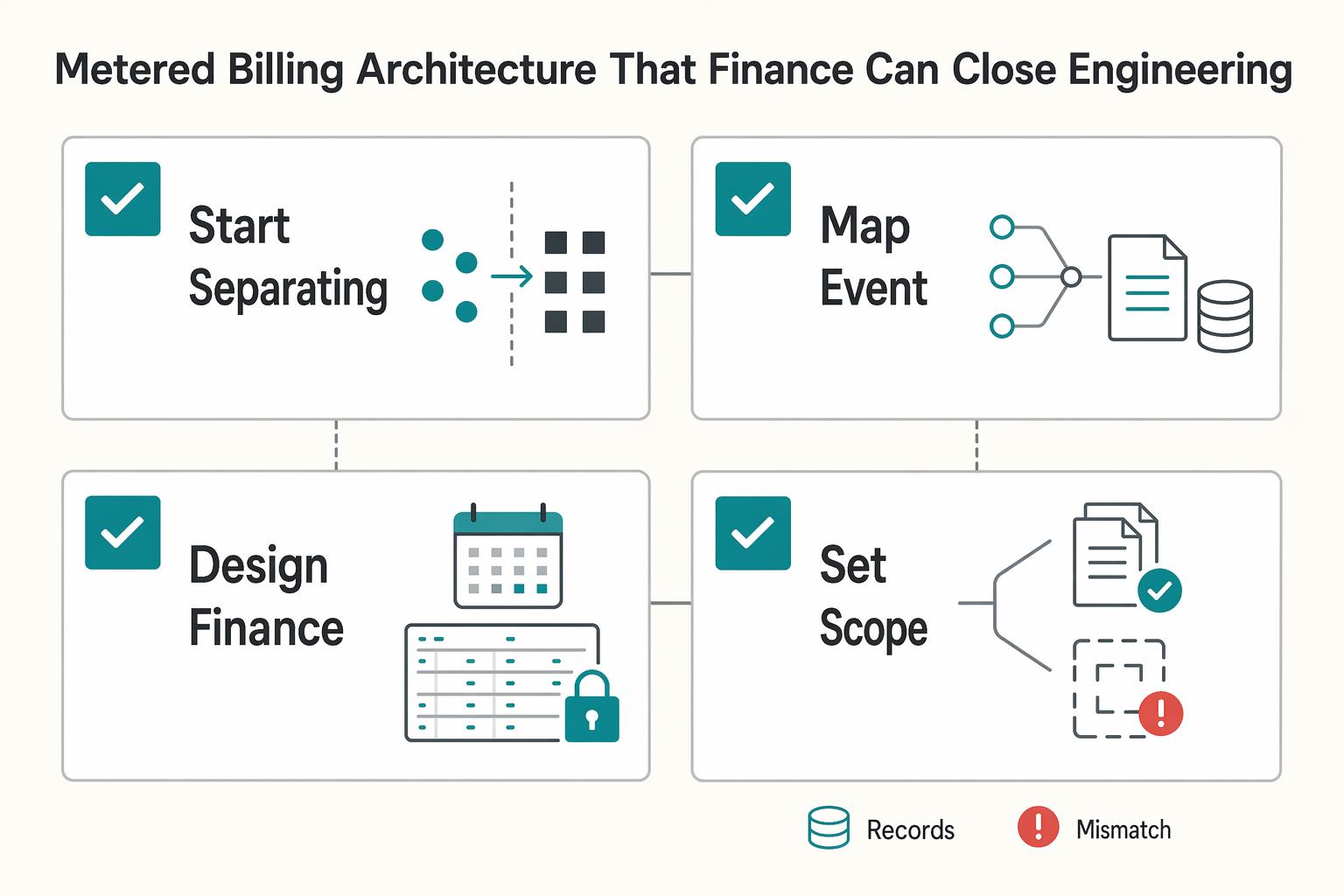
Metered Billing Architecture That Keeps Finance and Engineering Aligned
Real time often belongs in usage capture, not in issuing an invoice for every event. A common requirement is to record consumption as it happens, then turn that usage into charges on a defined billing cycle or another explicit trigger.
Subscription Billing for Media Publishing with Metered Paywalls and Gifts
Treat this as a contract and access problem first, not a pricing-page tweak. For teams working through subscription billing in media publishing with metered paywalls and bundles, the common challenge is getting product, finance, and engineering to agree on exactly when access starts, pauses, resumes, and ends. If your team cannot explain that in plain language before launch, you are not ready.