
Quick Answer
Yes, keep fiat as the default and add a stablecoin route only for verified corridors where settlement lag or rail coverage is the real bottleneck. Start with one pilot cohort, then require an evidence pack on every payout: policy state, provider reference, ledger entry, and exception code. If failures are mostly KYC, KYB, AML, or missing tax documents, fix those first. Use market examples like KB Kookmin Card on Avalanche as directional context, but make expansion decisions from your own close-cycle reconciliation results.
Why a Hybrid Rollout Works#
A hybrid payout approach is usually a question of coexistence, not replacement. You keep your fiat rails, add a stablecoin option where it solves a real operations problem, and avoid forcing every contractor, creator, or seller into a wallet-first experience.
That framing matters because teams often get pulled into the wrong debate. The useful question is not "should we go crypto?" but where an extra settlement rail reduces payout friction enough to justify the added product, compliance, finance, and support work. In practice, some platforms may keep fiat as the default and expose a stablecoin option only for eligible users and corridors where speed, availability, or recipient preference clearly improve.
There is also an early boundary to settle. A February 17, 2026 companion submission to the U.S. SEC describes a "critical boundary between payment utilities and yield-generating investment contracts" and labels its own design patterns as non-normative. That is not a rulebook. It is a useful operating test. Keep the product clearly in the payment category, and avoid wrapping it in anything that starts to look like yield, treasury, or cash management unless you are prepared for a very different risk profile.
This article follows that practical line. We will work through product UX, engineering order of operations, KYC and AML gates, reconciliation, and the country or program caveats that can break an otherwise sensible rollout. The goal is not to make stablecoin payouts sound inevitable. It is to help you decide when a hybrid model is worth the added surface area and when fixing fiat onboarding, compliance, or payout routing will get you more value with less risk.
One red flag up front: do not treat public market examples as proof that your version is ready. Commentary can show direction. For example, QED Investors published a post on April 3, 2026 framing stablecoins as complementing existing payment systems, which can be a useful mental model. But public excerpts do not prove production outcomes, coverage depth, or operational maturity for any specific card, wallet, or chain-linked program.
If you are evaluating this now, start with two checks before you build anything. First, verify where your current payout failures actually come from: rail reach, settlement speed, KYC review delays, or recipient setup friction. Second, ask finance what evidence they need to reconcile fiat and wallet payouts in the same close cycle. If you cannot answer those two points with real data and an evidence pack, a second rail will usually create more exceptions than it removes.
If you want a deeper dive, read Xero + Global Payouts: How to Sync International Contractor Payments into Your Accounting System.
Want a quick next step while you evaluate a hybrid payout system with stablecoin options? Try the free invoice generator.
What a hybrid payout system is and is not#
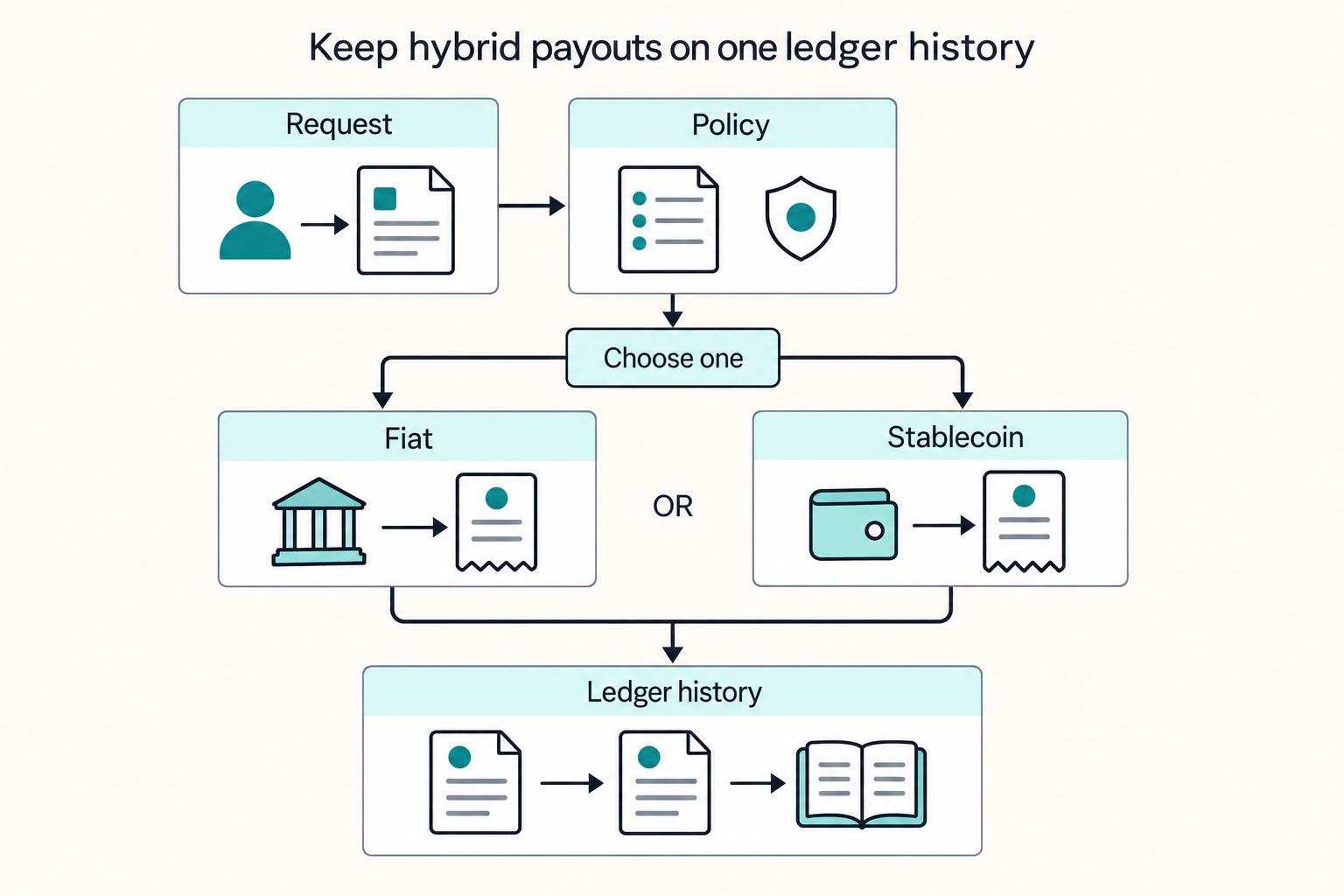
A hybrid payout system is one payout operation with two settlement paths: fiat and stablecoin. You keep both rails under one control surface so approvals, compliance checks, status visibility, reporting, and reconciliation stay consistent.
It is not "replace banks with wallets." Keep familiar bank and credit card flows where they already work, and add an optional digital wallet route for eligible users. In practice, stablecoin sits at the settlement layer under existing payment frameworks, not as a replacement for identity verification, dispute resolution, or merchant protections.
Define the minimum scope early:
- funding and top-up
- payout orchestration and rail selection
- settlement execution
- ledger posting
- exception handling
Treat wallet payouts as part of the same operating model, not a sidecar. Otherwise you create split views and manual exception work between bank and onchain transfers. Public examples such as KB Kookmin Card on Avalanche can signal direction, but public excerpts do not prove production coverage or operational outcomes.
For a step-by-step walkthrough, see Xero Integration for Payout Platforms: How to Sync Contractor Payments with Your Accounting System.
Decide when hybrid is worth adding#
Add a second settlement path only when rail reach or settlement timing is the real friction, not onboarding or compliance. If delays mostly come from missing documents, failed identity checks, or bad beneficiary data, a stablecoin option adds complexity without fixing the root cause.
Run a hard check on your last 60 to 90 days of failed, returned, and manually reviewed payouts. Tag each case by reason: KYC, KYB, AML review, tax document missing, bank account mismatch, unsupported corridor, slow settlement, or recipient preference. If policy and document failures lead, fix those first. If rail availability, settlement lag, or cross-border returns lead, hybrid is easier to justify.
| Corridor and user segment | Dominant friction | Decision | Why |
|---|---|---|---|
| Domestic, banked recipients with low exception volume | Onboarding gaps, name mismatches, missing tax or entity docs | Stick with fiat only | A new rail does not solve KYC or beneficiary data quality issues |
| Cross-border contractors or sellers who are fully verified but face slow or unreliable bank settlement | Rail availability and settlement speed | Add optional USDC/USDT | Stablecoin can complement existing rails at settlement while core controls stay in place |
| Digital-native creator or contractor cohorts already using wallets, with weak fiat coverage in that flow | Recipient preference plus poor local banking experience | Design wallet-first for that selected flow | This can fit how that cohort already gets paid, with fiat fallback and shared controls |
Fix the real bottleneck first#
Diagnose first, then route. Stablecoins can move value quickly, but identity verification, disputes, and acceptance still rely on broader infrastructure. The practical question is not whether you can pay onchain, but what is actually failing now.
If your recipients are stuck in pending because KYB is incomplete or tax setup is missing, prioritize KYC, KYB, AML, and document collection before payout routing changes. Use one checkpoint: each payout attempt should already carry a clean policy state, beneficiary details, and a clear hold reason code. Without that, you create two exception queues instead of one.
Choose by platform type#
Use explicit rules by payout program:
| Program | Fiat-first case | Wallet/stablecoin case |
|---|---|---|
| Marketplace payouts | Sellers are already banked and existing dispute/protection workflows matter more than speed | Add opt-in USDC or USDT only for verified cross-border cohorts that repeatedly hit bank delays or unsupported routes |
| Contractor payroll-like flows | If friction is document readiness, sanctions review, entity verification, or tax onboarding, stay fiat and fix operations first | If contractors are compliant and cross-border timing is the real issue, add an optional wallet path only after finance can reconcile bank and wallet settlements in the same close cycle |
| Creator disbursements | If creators still expect bank deposits and support volume is high, keep wallet payouts optional and narrow | If the cohort is already wallet-oriented and most friction sits in local bank withdrawals, a wallet-first subprogram can fit |
Weigh the opportunity cost honestly#
Hybrid adds real near-term work across engineering, finance, and ops. You need routing logic, ledger and status handling, recipient preference management, reconciliation workflows, and stronger exception support.
The potential benefit is real too, but only when the added rail solves current failure points or gives recipients a payout option they will actually use. Traditional rails can leave a timing gap between earnings and deposits; a March 18, 2026 Digital Transactions commentary cited merchants spending 20 to 50 hours per month reconciling those gaps. Treat that as directional context, not proof for your program.
Use this rule: if your top pain is compliance, fix compliance first. If your top pain is settlement speed or corridor coverage, pilot hybrid on one verified cohort before expanding.
Related: Stablecoin Payouts for Platforms: How to Disburse USDC to Contractors Globally.
Design the stack so users feel no disruption#
If you add a stablecoin option, keep the user journey stable. Default to existing fiat methods and show stablecoin or digital wallet only when the recipient is eligible and has explicitly chosen it. The rail change should solve a payout problem, not create new setup friction for recipients.
Stablecoins can support near-instant settlement, cross-border movement, and programmable money behavior. But payment operations still run across fragmented rails, intermediaries, and delayed settlement in many corridors. Build the stack so users feel continuity while you improve settlement where it actually helps.
Separate the decision points#
Keep payout handling as distinct stages so each decision is auditable:
- request intake
- policy checks
- rail routing
- provider execution
- ledger finalization
For each payout, you should be able to trace one path from request to final ledger posting. When routing and ledger logic blur together, teams end up with conflicting statuses across product, support, and finance.
Make retries boring#
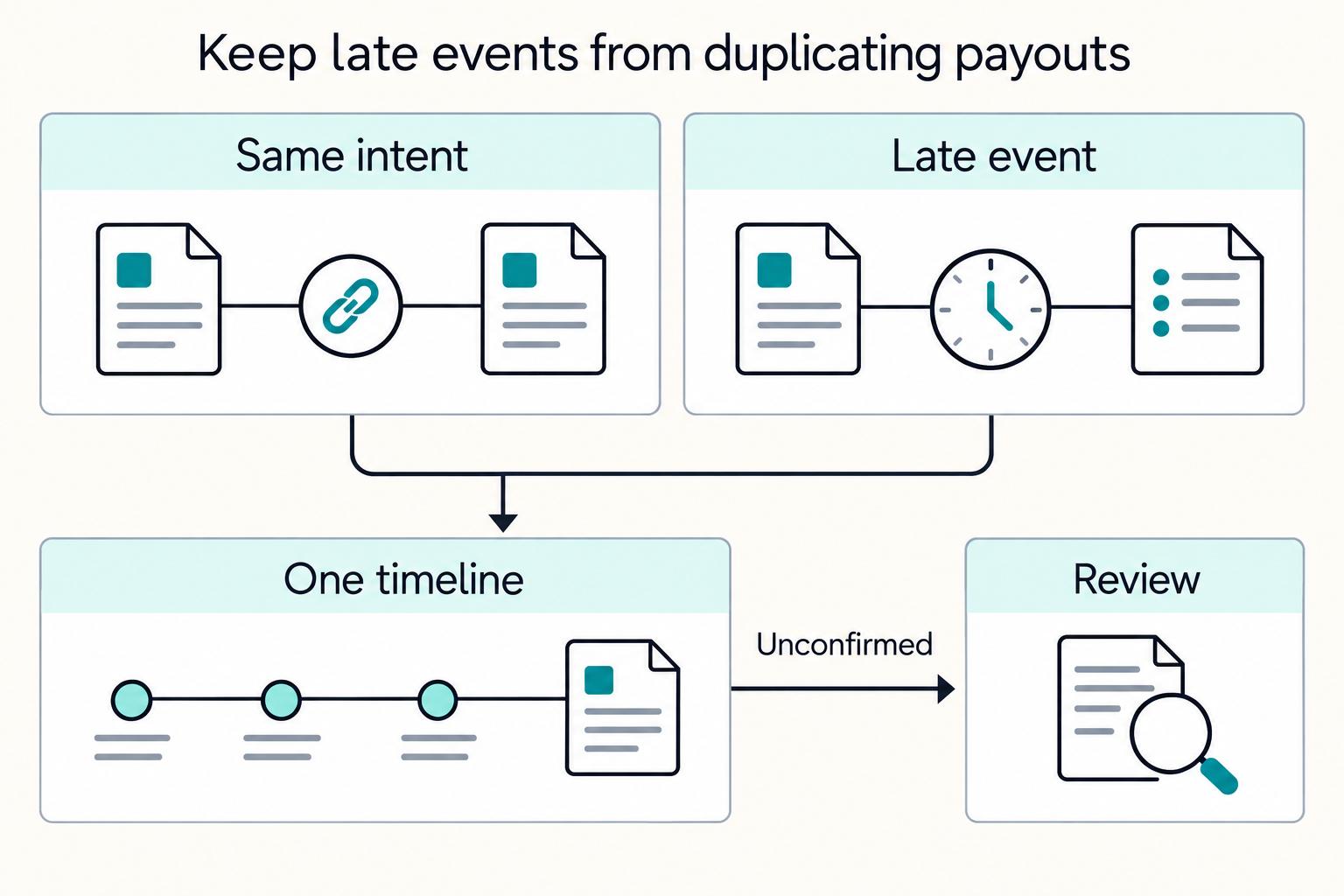
Retries should resolve to the same payout intent, not create a second payout. Whether the destination is a bank account or wallet, duplicate requests and webhook replays should confirm or advance state, never duplicate a finalized transfer.
Before launch, test duplicate API calls, replayed webhooks, and late provider acknowledgments. The expected result is one external payout, one final journal path, and one recipient-visible status trail.
Let the ledger own the truth#
Treat wallet pages, payout history, and recipient status as projections of ledger events, not separate sources of record. Apply that consistently across bank payouts, credit card-linked flows, and stablecoin-linked transfers.
This matters when part of your stack still depends on batch processing while another path settles faster. If all payout views derive from ledger events, you can add or change rails without changing what "paid," "failed," or "returned" means.
Put compliance and tax controls in the transaction path#
Your policy layer should decide payout permission before any rail moves funds. In a hybrid setup, run the same transaction-path checks across bank payouts, wallet payouts, and manual overrides, while allowing rule variants by market, program, recipient type, and payout method.
Keep KYC, KYB, AML, sanctions, and any enabled velocity checks tied to the payout intent, not only to onboarding data. If a recipient's entity, destination, program, or volume pattern changes, re-check against the active program rules before routing.
Make tax and document requirements explicit#
Tax and document controls should be explicit, attached to the transaction, and easy to review. For each payout, record what artifact was required, what was on file, and whether it was current enough to proceed.
| Record item | What to capture |
|---|---|
| Approver | Who approved it, or whether it auto-approved |
| Rule fired | Which rule fired, including the market or program variant |
| Attached artifact | Which tax or identity artifact was attached at approval time |
| Manual override | Whether an exception was manually overridden, and by whom |
| Document handling map | Map by entity type and program, for example W-8, W-9, Form 1099, and VAT paths where the program supports them |
At minimum, capture the items above and map document handling by entity type and program (for example, W-8, W-9, Form 1099, and VAT paths where your program supports them). Keep those decisions in-system rather than in inboxes or notes.
Handle cross-border tax notes carefully#
Treat FEIE and FBAR as program-dependent handling topics, not universal legal conclusions. The IRS states FEIE applies only to qualifying individuals with foreign earned income, and the income is still reported on a U.S. tax return.
If you surface FEIE guidance, keep it narrow and factual. The physical presence test references at least 330 full days in a 12-month period, and those qualifying days do not have to be consecutive. The IRS also notes that the nature and purpose of a stay abroad can matter for the tax home test, so collect only the evidence your program needs and route edge cases to tax review instead of auto-deciding eligibility. For 2026, the maximum exclusion is $132,900 per person, but payout destination or wallet choice alone is not an eligibility decision.
Apply the same discipline to FBAR: it is a reporting topic that may matter for some users, not a blanket rule. FinCEN publishes FBAR information, including disaster-related filing extensions, which reinforces that outcomes are fact-specific and time-sensitive. If your team references IRS practice-unit material internally, mark it as reference-only; the IRS says those materials are not official pronouncements of law and cannot be relied on as such.
Related reading: Building a Virtual Assistant Marketplace with Operable Payout and Tax Controls.
Engineer settlement and reconciliation before scale#
Settlement and reconciliation design is what makes a hybrid payout program trustworthy at month-end, not just fast at send time. Define posting order, exception queues, and export requirements before you expand corridors or payout methods.
Chainalysis frames this phase directly: execution is the hard part, and early pilots need to integrate with existing banking systems while success is defined before the first transaction. In practice, that means you should always be able to show what is settled, what is pending, and what is in review without reconstructing events from inboxes or screenshots.
| Path | What should count as receipt | Posting timing implication | Main exception queue |
|---|---|---|---|
| Fiat rails | Provider or bank reference tied to the payout instruction or settlement event | Separate initiation from final settlement; keep pending until the rail confirms settled, returned, or held | Returns, held funds, unmatched bank deposits |
| USDC path | Provider or wallet-service transaction reference plus your configured confirmation rule | Do not treat request creation as final; post pending first, finalize after confirmation rule is met | Delayed confirmations, destination review, unmatched inbound funding |
| USDT path | Same control pattern as other token paths, with token-specific configuration | Keep journal logic consistent, but do not assume identical provider handling across tokens | Delayed confirmations, stale FX quote reviews, compliance holds |
| DAI path | Same control pattern as other token paths, verified against supported treasury/provider setup | Keep ledger states aligned with fiat and other token payouts so close stays comparable | Confirmation delays, liquidity review, unmatched top-ups |
This table is intentionally conservative. Inherent settlement behavior differences across USDC, USDT, and DAI are not established, so treat token handling as configurable controls rather than fixed assumptions.
Set the posting order on purpose#
Use a clear internal sequence: provider reference received, ledger journal posted, payout status updated, reconciliation export generated. Treat this as an operating design choice, not a universal standard.
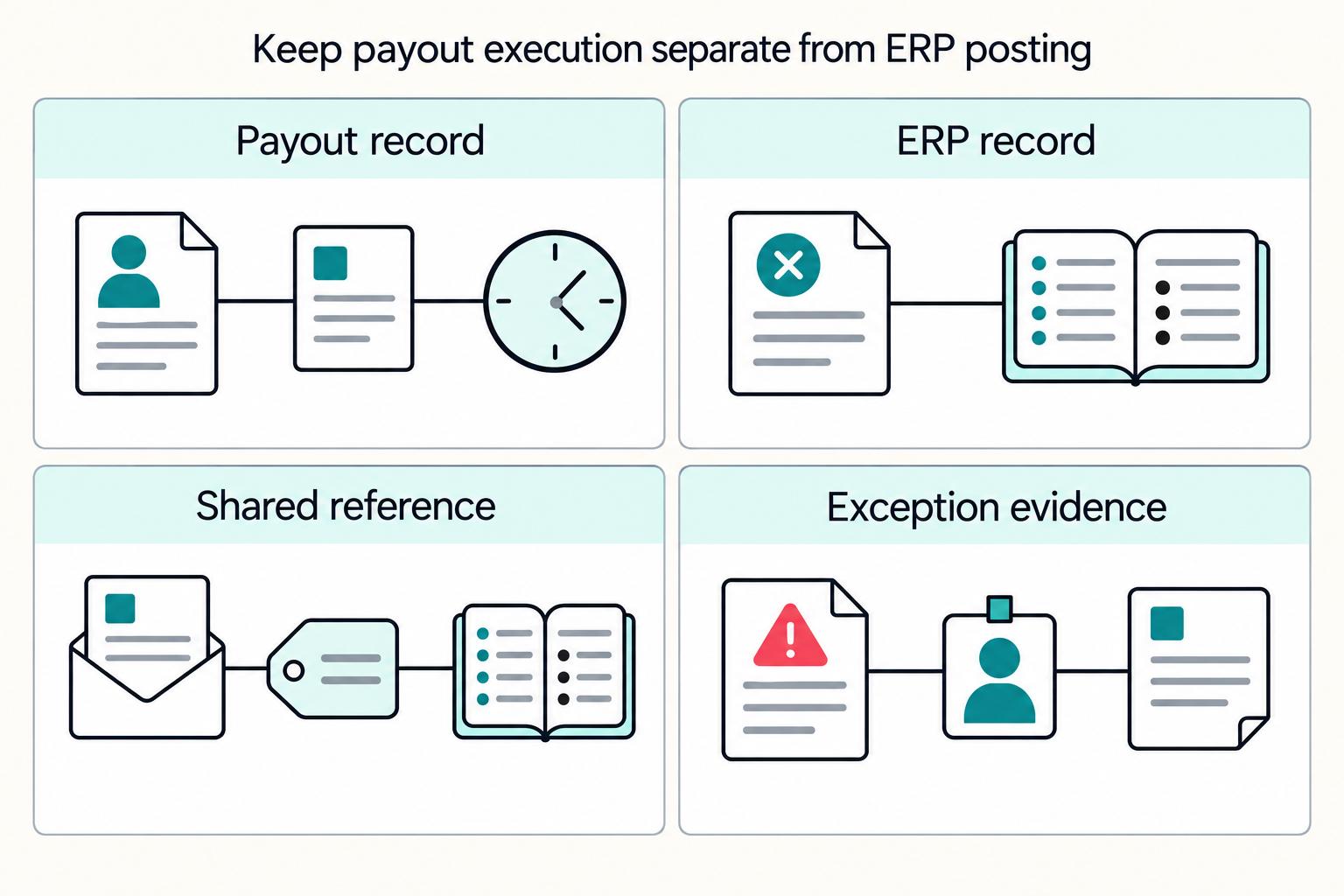
That order keeps support-facing status aligned with accounting reality. A practical check: each exported reconciliation line should map to one internal payout ID, one provider reference, and one journal entry pair without manual lookup.
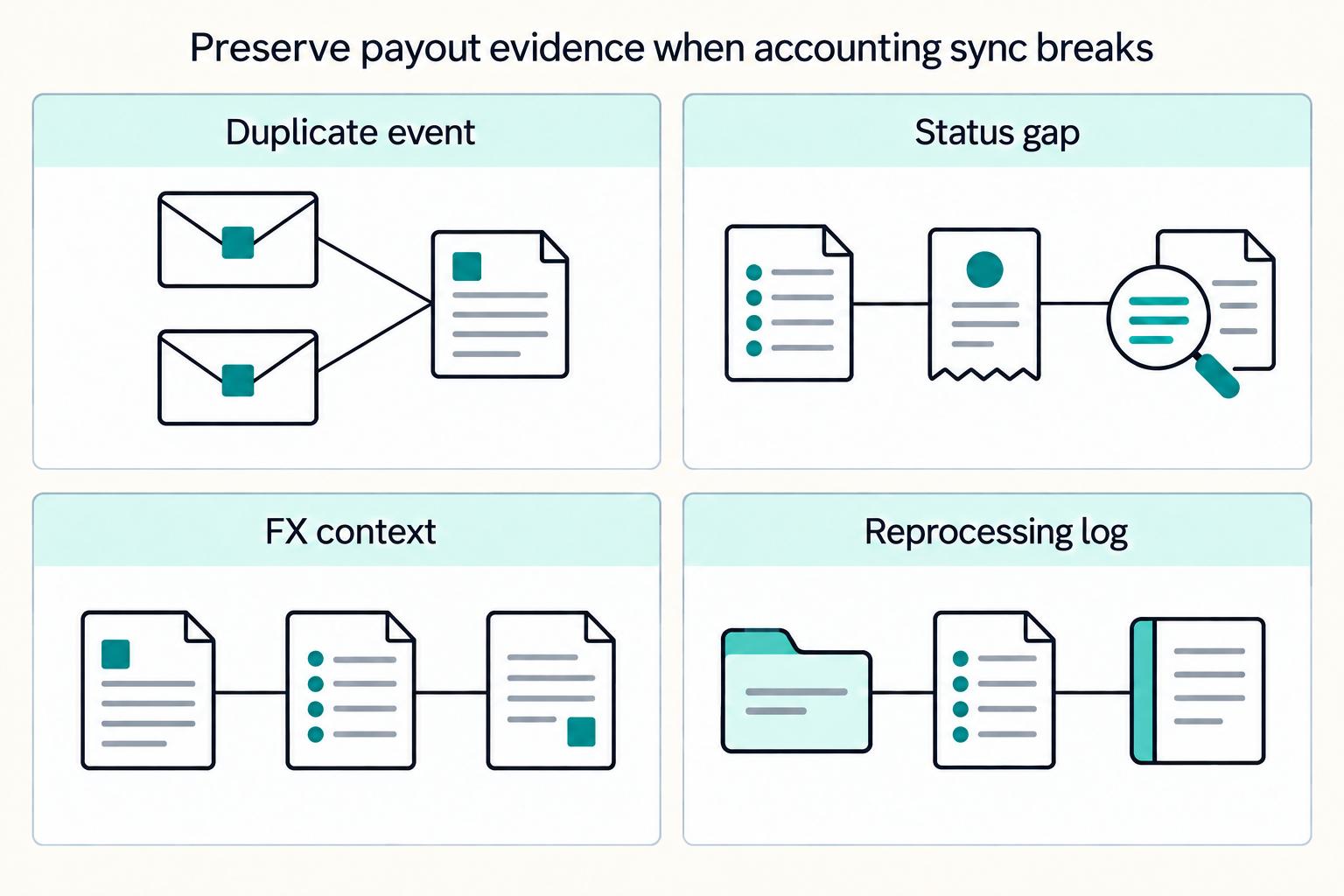
Keep exports simple and complete: payout ID, provider reference, recipient ID, rail type, amount, currency or token, status, timestamp, and exception code when present. If pending or reversed items are not self-explanatory in the export, exceptions will spill into support.
Treat exceptions as first-class accounting events#
Unmatched deposits should move into suspense, not available balance, until evidence is complete. Delayed confirmations should remain pending, with no manual "paid" override from initiation alone. Stale FX quotes should be time-boxed and re-accepted or recalculated after expiry. Held or returned funds should create reversal or hold journals with provider reason codes linked to the original payout record.
The SVB-USDC de-peg context is a resilience reminder: market stress can happen while operations still need to close cleanly. Reserve transparency and liquidity controls can improve visibility and response, but they do not guarantee uninterrupted convertibility, par value, or market access in stressed conditions. Your treasury view, payout states, and reconciliation evidence still need to stay consistent when conditions are volatile.
You might also find this useful: ERP Integration for Payment Platforms: How to Connect NetSuite SAP and Dynamics to Your Payout System.
Roll out in phases with clear ownership#
Once reconciliation is reliable, expand in phases, not by enthusiasm. Start with a narrow USDC opt-in, assign one owner per function, and require phase exit checks before you widen access.
A phased launch keeps product choice, execution logic, and close readiness aligned while volume is still inspectable. As directional context, Sokin described its March 17, 2026 launch as access for select clients first, with a phased rollout through 2026 and shared approvals, compliance, reporting, and reconciliation tools across traditional currency and stablecoin activity. Treat that as direction, not proof your own thresholds are ready.
Phase the rollout deliberately#
| Phase | Action | Guardrail |
|---|---|---|
| Phase 1 | Run one corridor pilot with USDC available only to recipients who actively opt in and meet eligibility rules; keep fiat as the default | Keep the scope narrow while production controls are inspected |
| Phase 2 | Expand to broader recipient cohorts | Only after Phase 1 controls hold in production |
| Phase 3 | Optimize routing and cost | Only after you can clearly explain pending, returned, and manually touched payouts |
Make ownership explicit#
| Function | Owner focus |
|---|---|
| Product | Recipient choice, eligibility presentation, and when fiat remains the default |
| Engineering | Routing, idempotency, replay safety, and status transitions |
| Finance ops | Reconciliation, exception review, and close readiness |
Before each launch or expansion, keep a short evidence pack: corridor list, eligibility rules, payout status map, sample reconciliation export, exception queue definitions, and one named approver per function.
Use hard checkpoints, not market sentiment#
Use phase-specific go/no-go checks: payout success rate, exception aging, support ticket categories, and reconciliation completion. Review them after real volume, not demos. A practical bar is whether finance can reconcile the pilot path in the same close cycle as fiat without creating a side spreadsheet.
The Block and CoinMarketCap can be useful directional signals for market movement. They should not set your launch threshold; your own pilot evidence should.
Red flags that mean stop and fix first#
Stop expansion if control outcomes are inconsistent or finance cannot close fiat and stablecoin activity together with audit-ready evidence.
The first hard stop is compliance inconsistency. Supporting both rails does not fix mismatched KYC/AML outcomes by itself, and a manual override that bypasses normal audit history is a control gap, not a scale issue. For the same case type, confirm the same rule version, approver record, and supporting artifact appear across both rails.
The second hard stop is close readiness. Finance should be able to reconcile fiat and stablecoin payouts in the same close cycle from evidence-quality exports, including payout and ledger references, status and timestamps, exception reason, and exception clearance record. If those fields are incomplete on one rail, pause rollout.
Use public material as directional input, not proof. The February 17, 2026 SEC companion submission discusses Evidence Packs and evidence manifests, but it is explicitly non-normative; treat it as a control design cue, not binding rule text. Do not treat commentary, vendor positioning, or single-article analysis as program-level validation for architecture decisions.
Conclusion#
The practical answer is coexistence, not replacement. A strong hybrid payout strategy keeps your fiat rails in place, adds stablecoin options only where they remove a real corridor problem, and holds both paths to the same control bar. That lines up with the broader direction in current research. Public and private forms of money can coexist, and the future is not the displacement of traditional finance but a hybrid model where regulated banks remain critical on-ramp and off-ramp intermediaries.
That matters because market momentum is easy to misread. Stablecoins may now be a significant part of the global monetary structure, but that does not make a wider rollout automatically sensible for your platform. The better question is narrower and more useful: in this specific corridor, for this recipient segment, does an optional coin rail reduce payout friction enough to justify the added policy, treasury, and reconciliation work?
The sequence is still decision-first. Qualify one live corridor, define policy gates, prove reconciliation, then expand in phases with explicit stop or go checkpoints. A strong verification test is simple: you should be able to trace one payout end to end without manual reconstruction, from approval to policy result to provider reference to final ledger entry and reconciliation evidence. If that chain breaks on the wallet path, you do not have a scaling problem yet. You have a control problem.
A common failure mode is not just a failed transfer. It is a split truth where finance, compliance, and support each see a different status when a payout is retried, delayed, or pushed into an exception queue. That is where teams can confuse added choice with real readiness. If your market coverage, off-ramp assumptions, or program rules still require manual interpretation, keep fiat as the default and limit the new rail to a tightly scoped pilot until your evidence pack survives close review.
If you are evaluating a hybrid payout approach with Gruv, keep the next step concrete. Map one active payout corridor to this outline, confirm market and program coverage, and test with audit-ready artifacts before broad rollout. Ask for proof that matters operationally, not just a polished demo: policy checks in the transaction path, consistent payout states across fiat and wallet options, and exports finance can use for the same close cycle. If those checks pass, scale by corridor and recipient cohort. If they do not, pause expansion and fix the controls first.
Need the full breakdown? Read Building a Payout Ledger with Double-Entry Bookkeeping for Platform Financial Records.
Frequently Asked Questions
What is a hybrid payout system with stablecoin in practical platform terms?
It means you keep your existing fiat payout paths and add a wallet-based option for eligible recipients who want it. Stablecoins are designed to hold a stable value by pegging to another asset, often aiming to stay close to US$1. The important point is that the coin path complements your current payout operation, not replaces it.
When should we add stablecoin options instead of improving fiat rails first?
Add the option when you can define a narrow pilot problem and a clear success measure, not as a catch-all fix for broader operational issues. The initial pilot scope is often what determines whether the program succeeds. Keep the pilot tight and define success metrics up front so you can tell whether the new rail created real value.
What are the minimum components we need before launch?
You need coordinated ownership across compliance, payments, treasury, risk, and engineering before you need more features. Because execution is usually the harder phase, set clear responsibilities, operating handoffs, and performance metrics before launch.
Can we preserve our current payout UX while adding USDC or USDT options?
Yes. A hybrid approach means stablecoin rails complement existing payment systems, not replace them. Keep the fiat experience intact and add a clearly scoped stablecoin option where your policies and operations can support it. Avoid fragmented payout status across systems, since integration challenges are a known risk.
What are the biggest operational risks in hybrid payout systems?
The big ones are regulatory uncertainty, integration challenges, and counterparty risk. Also plan for day-two execution: once live, you need clear metrics and cross-team operating ownership to evaluate whether the stablecoin rail is delivering meaningful value.
What is still unknown from current market examples like KB Kookmin Card and Avalanche?
They are useful as market signals, not proof that your program will work the same way. Treat outside examples as directional context only, and make launch decisions from your own pilot scope and performance metrics.
Try a related tool
Researched and edited by the Gruv editorial team. Gruv builds cross-border billing, payouts, and finance-operations software for global businesses.
Sources
- downloads.regulations.gov/TREAS-DO-2025-0070-0206/attachment_1.pdftrusted
- fdic.gov/system/files/2024-06/2020-request-for-info-s...trusted
- fincen.gov/report-foreign-bank-and-financial-accountstrusted
- irs.gov/individuals/international-taxpayers/foreign-...trusted
- irs.gov/individuals/international-taxpayers/figuring...trusted
- pmc.ncbi.nlm.nih.gov/articles/PMC12883517trusted
- sec.gov/files/ctf-written-sec-submission-fcck-compan...trusted
- sec.gov/files/stablecoin_regulatory_framework.pdftrusted
Educational content only. Not legal, tax, or financial advice.
Related Posts
Xero + Global Payouts: How to Sync International Contractor Payments into Your Accounting System
Treat this as a disbursement-sync problem, not a receivables setup task. Xero has clear ways to help customers pay invoices and, in some cases, to pay certain supplier bills. That is not the same as running outbound contractor payouts across countries, currencies, and payout methods end to end.
Stablecoin Payouts for Platforms Disbursing USDC to Global Contractors
**Step 1. Set the operating model before you talk about speed.** This guide is for platform operators shipping stablecoin contractor payouts in production, not for freelancers choosing a wallet. The core stance is simple: approve compensation in USD, use a stablecoin as the settlement rail, and treat controls as product requirements from day one. Stablecoins are built to behave like money, and businesses already use them for supplier payments, cross-border invoicing, and treasury movement. That makes stablecoin payouts worth a look, but only if your payout process is as disciplined as your fiat process.
ERP Integration for Payment Platforms: How to Connect NetSuite, SAP, and Microsoft Dynamics 365 to Your Payout System
Connecting NetSuite, SAP, or Microsoft Dynamics 365 to a payout system is more likely to hold up over time if you do three things from day one: prevent duplicate payouts, keep transaction-to-payout records traceable, and avoid brittle point-to-point integration debt.