
Quick Answer
Yes - implement prorated billing as a revenue control policy, not a generic fairness setting. Start by separating events like upgrades, downgrades, cancellations, and mid-cycle starts, then map each event to one billing action and one owner. Configure tooling only after those rules are approved, and verify real invoices show period coverage and adjustment reason clearly. Keep finance documentation aligned with ASC 606 treatment for credits, reversals, and partial periods.
Start With a Clear Proration Policy#
Prorated billing is a policy choice inside subscription billing, not just a courtesy setting. When a customer signs up, ends service, or changes plans partway through a billing cycle, you are deciding how to charge for a partial service period. You are also deciding how much revenue to carry forward, credit, or collect now.
Step 1 Define the billing event before you define the math#
At its simplest, proration means billing for a partial period of service rather than a full cycle. That matters because mid-cycle changes happen: a new signup on day 12, a plan upgrade on day 18, or an account closed before renewal. A common approach is to charge or credit based on the exact days left in the cycle.
The harder problem is not the formula alone. It is trying to apply one vague rule to several different events. A mid-cycle upgrade, a downgrade, and an end-of-service request can all involve partial time, but they do not have the same commercial intent. If you cannot state the rule for each event in one sentence, you are not ready to configure it.
Step 2 Tie the policy to the revenue metric you actually care about#
This deserves founder, product, and finance attention because it sits directly in the path of Annual Recurring Revenue: the predictable yearly revenue expected from subscriptions, renewals, and upgrades. Recurring payments are the transactions themselves. Subscription billing is the broader process that manages those transactions across the customer lifecycle.
So the question is not "Should we be fair?" You should. The better question is where that fairness should show up: immediate credits, next-renewal adjustments, smoother upgrades, or cleaner invoices. Proration can be fair for the customer and accurate for revenue. It can also be more complex to implement.
Step 3 Set your implementation scope before you touch tooling#
Before launch, take one sample upgrade in the middle of a monthly billing cycle and verify two things. First, confirm the day-count method produces the expected partial charge. Second, inspect the invoice output and make sure the adjustment is clear enough for customers and support to understand quickly.
Ahead: decision rules for each event type, the setup order that avoids messy rework, the edge cases that can quietly create credits, and a copy-and-paste execution checklist. In a subscription economy measured at $928 billion in 2022 and forecast at $4.6 trillion by 2031, small billing rules are not back-office trivia. They are product and revenue decisions with customer-facing consequences. For more on failed payments, see A Guide to Dunning Management for Failed Payments.
What prorated billing controls in your revenue model#
Proration controls how revenue moves when customers change service mid-cycle: into an immediate charge, a credit, or a potential refund path. In practice, that policy shapes revenue protection, dispute risk, and billing complexity as much as the formula itself.
Step 1 Tie each rule to one outcome before you choose the math#
Set the goal for each event first, then choose the math. For mid-cycle changes, decide whether the rule is meant to protect recurring revenue, reduce invoice disputes, or remove friction in plan changes.
Use a quick calibration check: on a $100/month plan with a 30-day cycle, a halfway start produces a $50 partial-period charge. That check is useful only when your policy for that event is to bill for service used in-period.
Step 2 Split policy by event type, not by generic fairness language#
Do not use one blanket rule for every change. Mid-cycle events include upgrades, downgrades, cancellations, and new sign-ups, and each can justify a different treatment.
Write each rule explicitly so operations and support can apply it the same way every time. If the rule is vague, over-crediting and avoidable exceptions become much more likely.
Step 3 Validate transparency and operational impact before launch#
Billing accuracy and transparency support customer trust and proper revenue recognition, so review invoice output, not just calculations. Your practical test is simple: can your support team explain each prorated line item without rebuilding the math manually?
If that answer is no, expect more disputes and heavier order-to-cash overhead. If you manage recurring billing on a marketplace, Building Subscription Revenue on a Marketplace Without Billing Gaps covers adjacent control issues.
Prerequisites and data to prepare before you configure anything#
Before you configure anything, lock ownership, event labels, and expected invoice outputs in one shared working file.
| Setup item | What to define | Documentation detail |
|---|---|---|
| Owners | Proration policy, invoice presentation, and support exceptions | Put each decision in writing with one owner |
| Event labels | Mid-cycle upgrade, mid-cycle downgrade, seat addition, cancellation, and billing-date shifts | Keep labels consistent across product logic, billing configuration, and support macros |
| Test pack | Plan catalog, billing-cycle definitions, sample invoices, and expected prorated charge outputs | For each case, document start state, change date, cycle dates, expected line items, and expected total |
| Accounting signoff | How credits, reversals, and partial-period adjustments are recorded | Keep finance signoff next to the test pack before launch |
Step 1 Assign owners for policy, invoicing, and exceptions. Put three decisions in writing with one owner each: proration policy, invoice presentation, and support exceptions. Use clear boundaries so product, finance, and billing ops are not making overlapping calls on credits, refunds, or one-off handling.
Step 2 Freeze your event list and labels first. Define the exact events your team will handle, for example mid-cycle upgrade, mid-cycle downgrade, seat addition, cancellation, and billing-date shifts, and keep those labels consistent across product logic, billing configuration, and support macros. If labels are broad or inconsistent, testing and approvals drift.
Step 3 Build a source-of-truth test pack. Include the plan catalog, billing-cycle definitions, sample invoices, and expected prorated charge outputs for each scenario. For each case, document start state, change date, cycle dates, expected line items, and expected total so support can explain the invoice without rebuilding calculations by hand.
Step 4 Confirm accounting documentation before launch. Align with finance on how credits, reversals, and partial-period adjustments are recorded for your revenue-recognition process. Keep that signoff next to the test pack so billing behavior and documentation stay in sync once invoices go live.
Choose your proration policy by scenario before you touch tooling#
Set proration rules by event before you touch settings so one generic default does not govern upgrades, downgrades, cancellations, and mid-cycle starts.
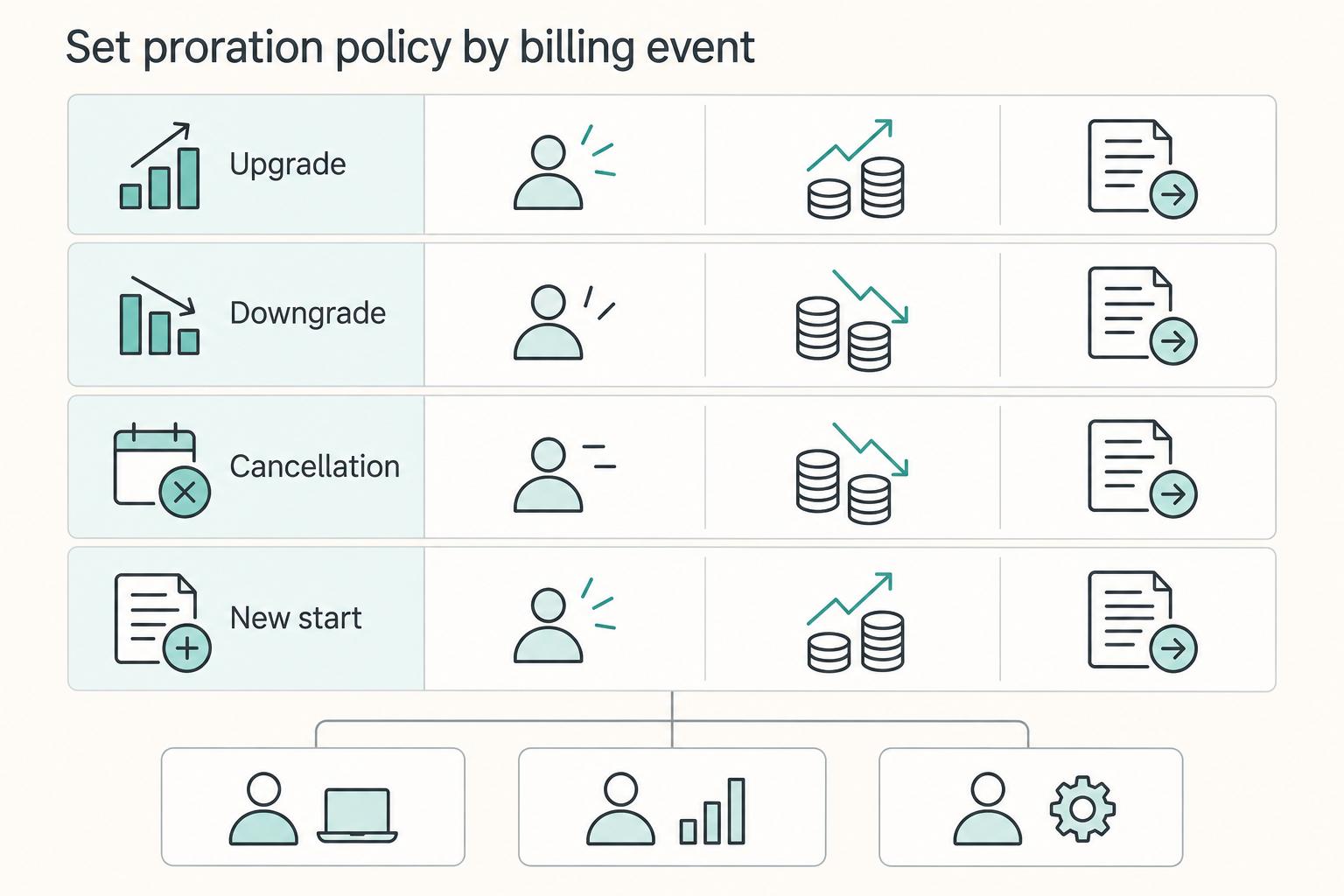
Step 1 Build a decision matrix for each change event. Use one matrix with four columns: event, customer impact, ARR impact to watch, and default billing action. The goal is simple: product, finance, and billing ops should agree on each row before settings, invoice copy, or support macros are touched.
| Change event | Customer impact | ARR impact to watch | Default billing action |
|---|---|---|---|
| Mid-cycle upgrade | Customer gets more value immediately | Delayed collection if you wait | Charge the prorated difference immediately |
| Mid-cycle downgrade | Customer pays less | Over-credit risk if credits are too loose | Apply the lower price at next renewal by default |
| Cancellation / end service | Customer stops current or future service | Refund and dispute exposure from inconsistent handling | Use one cutoff rule, one access rule, and one unused-time rule |
| New sign-up mid-cycle | Customer starts partway through a period | Underbilling if first-cycle treatment varies | Charge only for the portion of the period used |
A row is ready only when support can explain it in one sentence and billing ops can reproduce it in one test case.
Step 2 Set your default for upgrades and downgrades. Default upgrades to immediate prorated charges, since that matches the value timing and common proration handling. For example, moving from $10/month to $30/month halfway through the month should create an immediate prorated difference, not a full new monthly charge.
For downgrades, set the default to next-cycle effect unless there is a documented retention reason for immediate credit. This keeps exceptions controlled instead of turning into routine credit leakage.
Step 3 Lock cancellation policy in plain language. Write cancellation rules as fixed defaults, not ticket-by-ticket judgment. Define the same-day cutoff, whether access continues through the current period, and whether unused time becomes a credit or no refund.
Then mirror the same wording across checkout terms, billing policy text, invoice language, and support macros so customers get one answer everywhere.
Step 4 Add explicit exception controls for enterprise and hybrid models. Enterprise terms and usage-based billing hybrids need a clear gate: no non-standard proration unless the approved commercial term is documented with owner and effective date.
For hybrid pricing, separate subscription proration from usage charges so the recurring change and metered component are handled under their own terms. If you need a design refresh on that split, see A Guide to Usage-Based Pricing for SaaS and The Best Tools for Managing Subscription Billing.
Configure billing logic and invoicing in the right order#
The safest implementation order is fixed: map events to rules first, set adjustment math second, finalize invoice rendering third, then write customer and support messaging. If you do this out of order, you usually get clean-looking invoices that still reflect the wrong business intent.
| Order | Configuration step | What to confirm |
|---|---|---|
| 1 | Map each change event to one billing action | Define the trigger, owner, and effective timestamp for each event |
| 2 | Set proration timing and adjustment behavior | Lock immediate or deferred treatment, debit or credit, and post-change billing-cycle anchor |
| 3 | Configure invoice line items for clarity | Show what changed, when it changed, and whether each line is a charge or credit |
| 4 | Write notifications and support macros | Match customer-facing language to the final invoice wording and effective date |
| 5 | Verify output and add duplicate-event controls | Compare expected adjustment, final invoice lines, and customer message, then prevent the same event from posting twice |
Step 1 Map each change event to one billing action. Define the trigger, owner, and effective timestamp for each event: upgrade, downgrade, end service, seat change, and billing-date shift. Keep one event-to-action mapping per scenario before you touch invoice layout.
A practical reference point is the documented billing flow in systems like WHMCS, where ordering logic comes before invoicing and payment. Use that same sequence for subscription changes so invoice behavior reflects stable trigger logic.
Step 2 Set proration timing and adjustment behavior. Before invoice design, lock how each event behaves: immediate or deferred, debit or credit, and post-change billing-cycle anchor. The key checkpoint is alignment: finance, product, and billing ops should predict the same amount and timing for the same test case.
Step 3 Configure invoice line items for clarity. Render debits and credits as explicit lines, not one blended "adjustment" label. Customers should be able to see what changed, when it changed, and whether each line is a charge or credit.
Include fee-model awareness while you do this. On Stripe processing, each successful domestic card transaction is 2.9% + 30¢; on Managed Payments, there is an additional 3.5% fee per successful transaction. Extra successful transactions from avoidable retries or fragmented adjustments can erode margin.
Step 4 Write notifications and support macros after invoice output is final. Match customer-facing language to the exact invoice wording and effective date. Give support the same phrasing plus one internal note field for approval context on any non-standard credit.
Step 5 Verify expected vs actual output, then enforce duplicate-event controls. Run representative cases in test environments and compare expected adjustment, final invoice lines, and customer message for each event type. Then add idempotent handling in your application layer so retrying the same plan-change event does not post a second charge or credit.
This sequence is strict for a reason: proration failures usually come from configuring invoices and messaging before event logic is fully defined. For platform-level context, see Subscription Billing Platforms for Plans, Add-Ons, Coupons, and Dunning.
Handle edge cases that quietly leak margin#
Edge cases should be explicit policy, not ad hoc exceptions. Define them before automation so the same input gets the same billing outcome.
| Edge case | Policy default | Control point |
|---|---|---|
| Multi-change cycles | Set order of operations and document when later changes no longer affect billing | Use one effective-time standard and route true collisions to manual review |
| Rounding and minimum adjustments | Set one rounding approach and one rule for very small debits or credits | Apply both consistently across billing logic, invoices, and support responses |
| Subscription vs usage charges | Keep time-based subscription proration separate from metered usage calculations | Use clear line-item separation to reduce ambiguity and lower the risk of accidental double-crediting |
| Jurisdiction and revenue recognition | Review customer-facing billing terms and revenue recognition treatment together | Document approved policy variants so support, finance, and billing operations apply the same rule set |
Step 1 Define precedence for multi-change cycles#
When seat addition, downgrade, and cancellation can occur in one cycle, set a clear order of operations and document when later changes no longer affect billing. Use one effective-time standard, and route true collisions to manual review instead of auto-posting conflicting adjustments.
Step 2 Document rounding and minimum-adjustment treatment#
Set one rounding approach and one rule for very small debits or credits, then apply both consistently across billing logic, invoices, and support responses. This keeps low-value residuals from turning into noisy invoice activity and avoidable ticket volume.
Step 3 Separate prorated subscription charges from usage charges#
For hybrid models, keep time-based subscription proration separate from metered usage calculations. Clear line-item separation reduces ambiguity, keeps exceptions intentional, and lowers the risk of accidental double-crediting. For deeper design guidance, see A Guide to Usage-Based Pricing for SaaS.
Step 4 Align policy language with jurisdiction and revenue recognition#
If customers span jurisdictions, review customer-facing billing terms and revenue recognition treatment together so they do not conflict in execution. Document any approved policy variants so support, finance, and billing operations follow the same rule set.
Set finance controls and verification checkpoints#
Finance controls only work when each proration rule is traceable from policy to system behavior and reviewed on a recurring cadence. Without that trace, invoice handling drifts into inconsistency, and small process gaps compound into delays and weaker financial visibility.
Step 1 Publish a control sheet that people actually use#
Use one working control sheet for proration decisions, owners, system settings, and audit evidence. Keep it operational, not archival, so anyone can trace a rule from policy to invoice output quickly.
| Control field | What to document |
|---|---|
| Policy rule | The exact decision your team approved |
| Owner | Who is accountable for ongoing accuracy |
| System setting | Where the rule is enforced in the billing stack |
| Expected output | What should appear on invoices or credits |
| Monthly evidence | The records used to verify behavior still matches policy |
If that trace cannot be done quickly, you do not have a reliable control.
Step 2 Reconcile billed vs expected outcomes on a monthly cadence#
Run a monthly reconciliation by change type and compare posted billing outcomes to expected outcomes from your policy logic. Focus on pattern drift, not just isolated errors.
Automate high-volume, low-variability matching work, and keep human review for exceptions. This split reduces noise and makes it easier to catch real issues, especially when settings or tool behavior change.
Step 3 Turn recurring disputes into system or policy fixes#
Treat repeat billing disputes as control signals, not one-off refund requests. Review top dispute reasons with billing ops and finance, then decide whether to change policy language, invoice copy, or configuration.
A simple checkpoint: for each recurring dispute theme, show what changed and how you verified the result. If your billing, support, and finance systems are not aligned, repeated manual credits will keep eroding margin and visibility.
Common mistakes and how to recover fast#
Most leakage comes from a few repeatable mistakes. The fastest recovery is to separate event rules, verify invoice output, handle downgrade credits deliberately, and make invoice adjustments easy to read.
-
Split rules by event type instead of treating every change the same. Mid-cycle changes do not carry the same risk, and one generic rule can either overcharge customers or leave money on the table. Define expected charge behavior and invoice behavior per event so ownership and outcomes are clear.
-
Use invoice QA with a fixed scenario set when billing logic changes. Even when the configuration math looks right, invoice output can still be confusing. Validate expected calculation, line-item wording, and posted totals across representative upgrade, downgrade, closure, and tax scenarios before rollout.
-
Treat downgrade credit timing as a policy decision, not a default. Proration is common when service duration is shorter than the standard period, but credit timing still affects outcomes. If immediate credits are creating leakage or confusion, test deferring them to renewal and monitor revenue and dispute patterns across the next cycles.
-
Rewrite invoice descriptors so customers can self-audit quickly. Confusing line items and tax errors can trigger disputes. Show the covered period, the plan change context, and the adjustment reason in one view so someone can understand the charge without digging through account history.
Conclusion#
Treat prorated billing as a revenue control decision, not just a fairness feature. A practical way to protect both margin and trust is to do three things in order: define rules by event type, configure tooling to match those rules, and keep checking real invoices against expected outcomes.
Step 1. Document the rule before you automate it. Write your policy by event type, not as one generic statement. At minimum, spell out what happens on a mid-cycle upgrade, downgrade, cancellation, and new sign-up, including whether the customer is charged now, credited at renewal, or given end-of-period access. That single document is what keeps support, product, finance, and billing ops from making conflicting exceptions.
Step 2. Configure billing logic and then verify invoice output. Set the platform rules first, then inspect the invoice line items those rules create. Your checkpoint is simple: for each event type, compare the expected partial-period charge or credit with the actual invoice output, and make sure the invoice shows the covered period and adjustment reason clearly. If the math is right but the invoice is unclear, disputes can still rise.
Step 3. Test edge cases before customers find them for you. Run scenarios where more than one change lands in the same billing cycle, especially combinations of upgrades, downgrades, cancellations, and new sign-ups. Validate that partial-period charges and credits follow the documented rule and that the calculation method is applied consistently. A common failure mode is applying adjustments inconsistently across similar events.
Step 4. Align finance documentation to revenue recognition. Pro rata recognition is about matching income to the period you deliver the service, and it is commonly treated as foundational to ASC 606 reporting. That does not mean billing logic alone makes you compliant. Finance should document how partial periods, credits, and reversals are treated, and keep the related evidence pack close: event record, invoice, credit note if one exists, and approval trail for exceptions.
Step 5. Review variance and dispute data every month. Look at billed versus expected deltas by change type, plus the top reasons customers challenge invoices. If one rule keeps generating confusion, tighten the policy instead of solving it through one-off refunds. Accuracy and transparency support customer trust, and they also protect reporting quality.
Copy and paste this into your operating notes:
- Document proration policy by event type: mid-cycle upgrade, downgrade, cancellation, new sign-up
- Configure rules in billing tooling and validate invoice outputs
- Run edge-case tests for multi-change billing cycles
- Align finance documentation to revenue recognition and ASC 606
- Review monthly variance and dispute data, then tighten rules where confusion appears
Frequently Asked Questions
What is prorated billing in plain terms?
Prorated billing means adjusting what a customer owes when their contract changes during a billing cycle. The goal is simple: bill only for the portion of service the customer actually had access to. Common triggers include upgrades, downgrades, early cancellations, and added seats.
How do you calculate a prorated charge for a mid-cycle upgrade?
A common method is day-based: full period price divided by days in the cycle, multiplied by the applicable days. One grounded example is a $90 monthly plan over 30 days, which comes to $3 per day, so 21 billable days equals a $63 charge. For a mid-cycle upgrade, teams often apply that same day-based logic to the incremental difference between the old and new plan for the remaining days. Then they verify that the invoice clearly shows the covered period and adjustment reason.
When should you prorate immediately versus charge at next renewal?
Proration can be reflected immediately on invoices when a contract change happens mid-cycle. Beyond that, this guide does not define one universal timing rule, so teams should set timing by event type in billing policy and apply it consistently.
How should mid-cycle downgrade credits be handled to avoid revenue leakage?
This guide does not set a universal downgrade-credit rule. A practical approach is to define when credits are immediate versus deferred, then keep clear records for exceptions: the event record, credit amount, related invoice, and approval trail.
What changes when prorated billing is combined with usage-based billing?
The core proration idea is the same: adjust charges when contract terms change mid-cycle. Some billing platforms support recurring, usage-based, and sales-negotiated contract models, so your policy should clearly define which charges are prorated and how adjustments appear on invoices.
Does prorated billing affect revenue recognition under ASC 606?
It can, because revenue recognition focuses on matching income to the period the service is delivered, not just when cash is collected. Pro rata recognition is commonly presented as important for accurate reporting and ASC 606 compliance. This is still a policy-and-accounting implementation question, so finance should document how credits, reversals, and partial periods are treated before billing ops automates invoice logic.
Try a related tool
Researched and edited by the Gruv editorial team. Gruv builds cross-border billing, payouts, and finance-operations software for global businesses.
Sources
- caloes.ca.gov/wp-content/uploads/Recovery/Documents/FEMA-P...trusted
- federalregister.gov/documents/2026/03/27/2026-05959/regulatory-c...trusted
- federalreserve.gov/reportforms/formsreview/FR_Y_14_Q_draft%20in...trusted
- leginfo.ca.gov/pub/07-08/bill/asm/ab_0051-0100/ab_88_bill_2...trusted
- leginfo.ca.gov/pub/07-08/bill/sen/sb_1451-1500/sb_1498_bill...trusted
- sec.gov/Archives/edgar/data/1862733/0001104659220106...trusted
- stripe.com/resources/more/prorated-billing-101-what-it-...trusted
- stripe.com/en-sg/resources/more/prorated-billing-101-wh...trusted
Educational content only. Not legal, tax, or financial advice.
Related Posts

SaaS Usage-Based Pricing for Predictable Cashflow and Fewer Disputes
If you are considering **saas usage-based pricing**, treat it as an operations and collections decision first. Pricing works best when the usage unit can be measured, shown on the invoice, and explained by someone outside your product team.
The Best Tools for Managing Subscription Billing
**Protect cashflow by selecting for recovery and control first, then layering convenience features.**
A Guide to Dunning Management for Failed Payments
If you run recurring invoices, failed payments are not back-office noise. They create cashflow gaps, force extra follow-up work, and increase **Involuntary Churn** when good clients lose access after payment friction.