
Quick Answer
Build a remote agency innovation culture by treating it as an operating system, not a brainstorming exercise. Use clear owners, a fixed rhythm of Innovation Hours and Innovation Sprints, and simple controls like risk checks, rollback triggers, and documented decisions. Then review outcomes each cycle with a small KPI stack so innovation improves delivery quality instead of disrupting client work.
Build a Remote Agency Innovation System That Survives Real Client Work#
Run your remote agency innovation culture through a one-week system with named owners, fixed Innovation Hours and Innovation Sprints, and simple controls that protect delivery quality and client trust. Start here before you tune metrics or tooling. Execution discipline comes first, because remote culture alone does not create better ideas.
If you are running lean, treat yourself as the CEO of a business-of-one and build a system that still holds up when client work is heavy. In 2026, that still means protecting delivery while you create room for better ideas.
You already feel the tension. You want stronger innovation, but you cannot let experiments spill into missed deadlines, unclear decisions, or scope confusion. Treat this as an agency management problem, not a motivation problem. Build an operating rhythm your team can run even during busy delivery weeks.
Nicholas Bloom, a Stanford economist, summarizes hybrid outcomes clearly in BLS coverage of hybrid work productivity: "Hybrid work is a win-win-win for employee productivity, performance, and retention." Location alone does not determine innovation outcomes. Operating design does.
In a hybrid experiment with more than 1,600 workers, employees working from home two days per week matched office peers on productivity and promotion likelihood. In that same experiment, resignations fell by 33 percent.
The core lever is process quality. A Harvard Business Review summary of remote-work research states that "some monitoring methods can foster openness, collaboration, and innovation, while others lead employees to disengage and withhold new ideas." That matches large-scale evidence from over 61,000 Microsoft employees. It shows collaboration networks can become more siloed when teams run all remote without deliberate bridge building.
| Step | Action this week | Verification point |
|---|---|---|
| Step 1 | Assign roles. Name one innovation owner, one decision approver, and one delivery safeguard. | Everyone can name who decides, who executes, and who blocks risky tests. |
| Step 2 | Set cadence. Run one Innovation Hour for idea intake, then one Innovation Sprint selection session. | You leave each meeting with ranked ideas and clear owners, not notes only. |
| Step 3 | Define controls. Require a hypothesis, risk check, and rollback trigger before kickoff. | Every approved test has start criteria, stop criteria, and a decision date. |
| Step 4 | Review outcomes. Close the week with keep, kill, or revise decisions. | You publish one short log of outcomes and next actions. |
Imagine a strategist flags a recurring handoff delay and a developer spots the same pattern in support messages. Your system merges both signals into one scoped test with one owner and one deadline.
If you want to tighten manager routines next, use Performance Management for Remote Teams: A Guide for IT Agencies.
Set the Prerequisites That Keep Experiments From Colliding With Client Delivery#
Clear ownership, documented evidence, and risk gates keep experiments from colliding with client delivery.
With the operating rhythm in place, lock in the prerequisites that keep experiments from colliding with client delivery. The goal is repeatable execution, not ad hoc idea chasing.
Align on one rule before you start: every experiment must leave a clear record and a clear owner.
Psychological Safety means people can raise ideas, questions, concerns, and mistakes without fear of punishment or humiliation. Support it structurally by assigning a backup reviewer who can challenge plans without blame, while the accountable lead keeps decisions moving.
| Step | Action | Verification point |
|---|---|---|
| Step 1 | Define week one scope and owner. Name one accountable lead and one backup reviewer for feedback quality. | Team members can state who decides, who reviews, and what this first rollout covers. |
| Step 2 | Prepare your operating artifacts: a decision log, an experiment tracker, and a visible Audit Trail in your team workspace. | You can reconstruct who approved each idea, what changed, and why. |
| Step 3 | Set risk controls for sensitive client changes. If work touches regulated or financial flows, apply risk-based CDD/KYC and AML checks where required. | No high-risk experiment starts without documented identity and risk checks where relevant. |
| Step 4 | Confirm an authoritative system of record for approved experiments and outcomes. | Everyone updates one record, so status disputes disappear quickly. |
| Step 5 | Pre-block calendar windows for Innovation Hours and one Innovation Sprint, then protect those blocks from routine fire drills. | The cadence stays intact during busy delivery weeks. |
Imagine a strategist proposes a faster client onboarding step during Innovation Hours. Your backup reviewer spots an AML risk, the lead narrows scope, and the team ships a safer test in the same sprint.
For distributed coordination patterns, see How to Manage a Global Team of Freelancers.
Diagnose Where Innovation Is Actually Breaking Right Now#
Audit idea flow, prioritization, execution speed, and leadership follow through before you blame remote work.
With owners, controls, and calendar blocks in place, run a hard diagnostic on how the system behaves. You are looking for evidence, not opinions.
Start with mixed evidence, not remote culture assumptions. Great Place To Work data from 4,400 employees suggests that having influence over work location strongly affects retention intent. Only 55% reported a healthy work environment. The same analysis found remote workers were 19% more likely to report a psychologically and emotionally healthy workplace.
At the same time, Return-to-Office (RTO) pressure has increased, with major employers like AT&T, Starbucks, and Nike tightening office expectations in public. The takeaway for an agency is simple: diagnose innovation outcomes through management quality, not just office policy headlines.
| Failure point | What to pull from your recent cycle | Diagnostic question |
|---|---|---|
| Idea flow | Missed ideas from Innovation Hours, duplicate suggestions, unanswered proposals | Do people submit ideas, or do they self-censor? |
| Prioritization | Stalled decisions, unclear owners, backlog churn | Do you choose based on impact and risk, or loudest voice? |
| Execution speed | Started tests with no ship date, delayed handoffs, blocked dependencies | Do approved ideas become shipped experiments quickly? |
| Leadership follow through | Abandoned decisions, reversals with no rationale, missing updates in the Audit Trail | Do leaders close loops and publish decisions consistently? |
- Step 1: Pull proof. Extract missed ideas, stalled tests, and abandoned decisions from your Audit Trail and team notes.
- Step 2: Score bottlenecks. Mark each failure point as low, medium, or high friction based on visible evidence, not vibes.
- Step 3: Stress-test assumptions. Compare your pattern with current RTO narratives from Starbucks, AT&T, and Nike, then ask what truly maps to your team size and client model.
- Step 4: Commit one fix. Choose one corrective action for the highest-friction point and assign one owner for the next Innovation Sprint.
Imagine your team says, "we need better ideas," but your log shows strong idea volume and weak decision closure. That points to leadership follow through, not creativity.
If you need tighter manager routines after this diagnostic, use Performance Management for Remote Teams: A Guide for IT Agencies.
Run Innovation Hours and Sprints Without Hurting Delivery#
Run Innovation Hours and Innovation Sprints on a fixed cadence with async prep, live decisions, and capacity-aware planning to protect client work.
Once you know where the system breaks, the fix is not more meetings. It is a cleaner rhythm: ideas come in asynchronously, decisions happen live, and delivery stays protected.
Use this as a starting cadence, then tune it to your workload and team size. If you use Scrum mechanics, keep Sprint cycles fixed (one month or less), run them continuously, and use a clear Definition of Done before counting any experiment as complete. Start collaboration asynchronously, then use live sessions for focused decisions.
| Ritual | How to run it | Verification point |
|---|---|---|
| Weekly Innovation Hours | Collect ideas async first, then review top items live | Every idea includes owner, problem, hypothesis, and expected impact |
| Biweekly Innovation Sprints | Select a small test set and assign deadlines | Each test has one accountable owner and a clear Definition of Done |
| Monthly keep or kill review | Review shipped outcomes and decide continue, revise, or stop | No experiment stays active without a documented decision |
- Step 1. Collect asynchronously. Ask contributors to submit ideas before meetings using a short template. Expected outcome: more equitable participation and cleaner input across time zones.
- Step 2. Decide live in a short window. Use a strict agenda and prioritize by impact, risk, and capacity. Expected outcome: clearer decisions and faster handoff.
- Step 3. Assign owners and deadlines immediately. Put every approved item into the sprint board before the session ends. Expected outcome: no orphaned ideas.
- Step 4. Anchor communication in consistent update norms. Use concise written updates in your internal channel and keep documentation current so async work stays reliable. Expected outcome: clear visibility without extra status meetings.
- Step 5. Protect billable delivery. Cap sprint scope using recent velocity, known dependencies, and planned time off before kickoff. Expected outcome: innovation stays additive, not disruptive.
Imagine a strategist posts an async idea before Innovation Hours. A designer and PM sharpen it overnight. The team approves one small test in the live session and assigns an owner that day. That is disciplined innovation.
For distributed execution patterns, see How to Manage a Global Team of Freelancers.
If you want a deeper dive, read How to Set Up a Limited Company in Ireland. Want a quick next step for “remote agency innovation culture”? Try the EU VAT number validator.
Who Owns Decisions and Which Gates Keep Innovation Safe?#
Assign one final decision owner per experiment and enforce risk gates before changes touch money movement or customer trust.
With cadence in place, decision ownership is what keeps you fast. Without it, you get decision bottlenecks, rework, and delayed delivery.
In a distributed team, unclear ownership slows innovation and creates avoidable loops. Use a DACI-style rule where one Approver makes the final call, the team lead drives execution, and specialists supply evidence and risk notes. Keep these rights visible in your sprint board so accountability is operational, not implied.
| Role | Decision right | Required input | Verification point |
|---|---|---|---|
| Founder | Approves strategic or client risk tradeoffs | Team lead recommendation and specialist risk notes | One named approver appears in the decision log |
| Team lead | Decides sprint scope and sequencing | Capacity, client commitments, dependency map | No experiment enters sprint without owner and due date |
| Specialist | Recommends method and control checks | Domain evidence from ops, legal, or finance | Risk checklist completed before approval |
Run compliance first when risk changes#
- Step 1. Classify risk before approval. Mark experiments as low, medium, or high risk based on money movement and customer exposure. Expected outcome: the team sends only relevant work through compliance gates.
- Step 2. Trigger KYC, KYB, and AML checks where relevant. KYB focuses on business entities rather than individuals. If work affects legal entity onboarding, include beneficial ownership procedures under 31 CFR 1010.230 in covered financial institution contexts. Expected outcome: you balance speed and control with a compliance-by-design posture.
- Step 3. Assign dedicated compliance ownership. Put a real reviewer on transformation work instead of part-time coverage. Expected outcome: fewer late blockers and clearer approvals.
Log every decision and map payment impact#
- Step 4. Record an Audit Trail for every approved experiment. Audit Trail is the record of who accessed systems and what actions they took. Log rationale, approver, rollback trigger, and final outcome in one place. Expected outcome: you can explain, reverse, or defend any change quickly.
- Step 5. Map global payment changes to Merchant of Record flows. Merchant of Record (MoR) handles seller-of-record tax obligations, but market coverage can vary and some countries can be blocked by sanctions and policy rules. Expected outcome: experiments ship with clear market boundaries.
Imagine a specialist proposes a checkout change in an Innovation Sprint. The team lead routes it through the right gate, the founder approves the risk call, and the Audit Trail captures each decision before rollout.
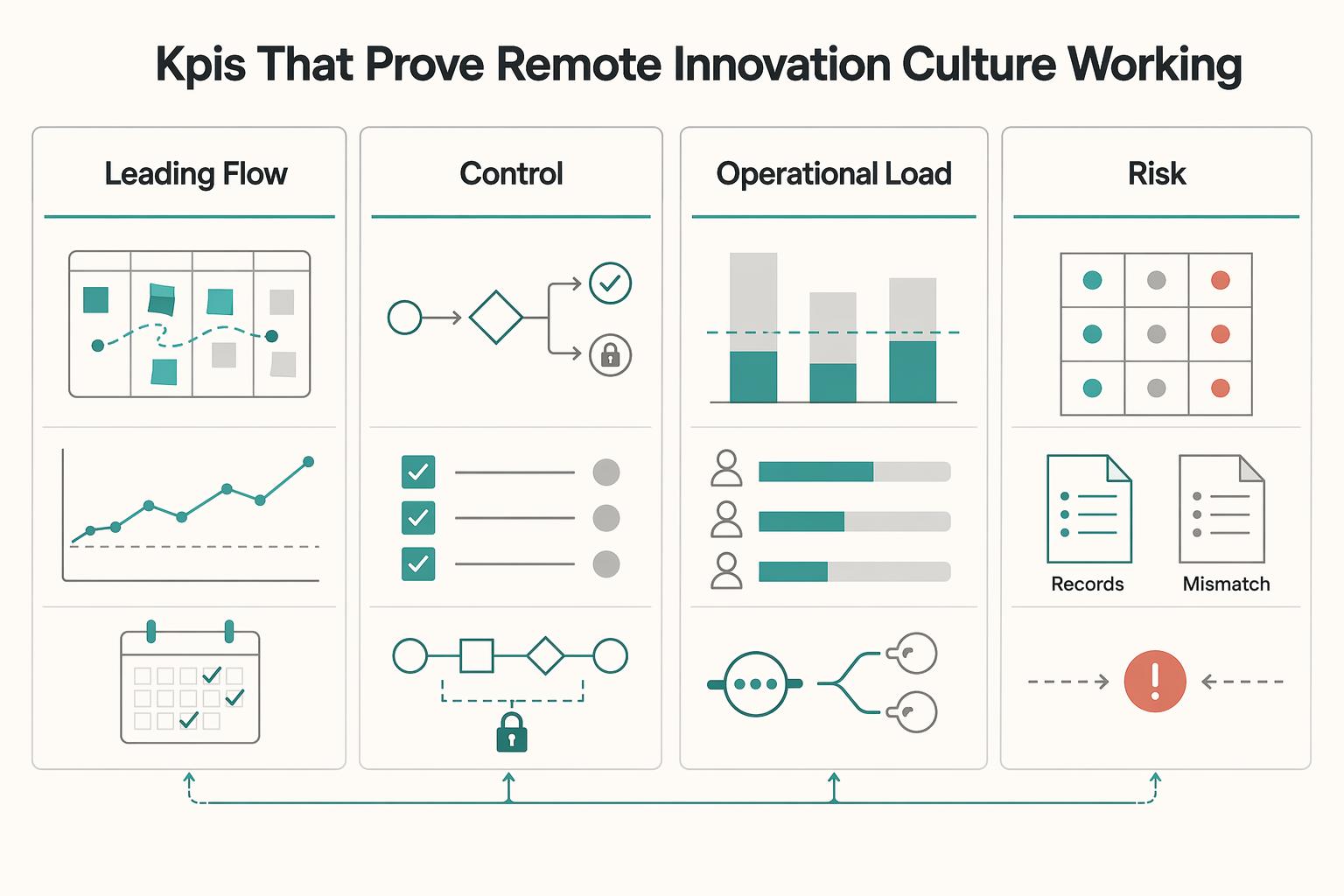
KPIs That Prove Your Remote Innovation Culture Is Working#
Use a small KPI stack that tracks flow, quality, and operational load so you can tune the system each sprint.
Once decision rights and gates are in place, measurement tells you whether the system is helping or just adding overhead.
| KPI group | KPI | Why it matters | Verification point |
|---|---|---|---|
| Leading flow | Idea to test cycle time, test completion rate, decision latency per sprint | Shows whether your innovation routines create momentum | You close each sprint with trend direction and blocked-cause notes |
| Quality control | Rework rate, client-impact incidents, experiments with complete auditable evidence | Shows whether speed creates quality debt | You log incident links and evidence completeness for every test |
| Operational load | Manual follow-up volume, webhook event outcomes, Ledger reconciliation gaps | Shows whether process changes reduce operational drag | You compare before and after counts in one dashboard |
| Payout risk | Payout Batches status mix and exception reasons | Catches innovations that shift burden to ops | You review processing, posted, failed, returned, and canceled outcomes weekly |
DORA frames five delivery metrics as both leading and lagging indicators. Use that logic here. For technical changes, map your sprint scorecard to change lead time, change fail rate, and deployment rework rate so innovation stays tied to stable execution.
- Step 1. Track flow first. Measure cycle time, completion, and decision latency from idea submission to shipped test. Expected outcome: you spot bottlenecks early and fix handoff friction fast.
- Step 2. Track quality second. Monitor rework, client-impact incidents, and auditable evidence coverage for each experiment. Expected outcome: you prevent fast but fragile changes.
- Step 3. Instrument asynchronous outcomes. Use Webhooks to capture real-time events and use your Ledger as an immutable, auditable system of record. Expected outcome: you confirm real behavior change, not meeting-room optimism.
- Step 4. Watch payout exceptions closely. Investigate failed and returned payouts first, because destination data quality is a common driver of returns. Expected outcome: you protect margin and reduce downstream cleanup.
- Step 5. Benchmark context without overfitting. Pew reports 75% of remote-capable workers work remotely at least some of the time, and 46% say they would likely leave if remote options disappear. Use this as workforce context, not causal proof of innovation performance.
Imagine your team ships a new handoff rule and celebrates faster approvals. Webhook telemetry shows event outcomes clearly, but returned payouts rise. You keep the speed gain, tighten destination-data checks, and protect both innovation and trust.
For review cadence and accountability rituals, use Performance Management for Remote Teams: A Guide for IT Agencies.
Common Failure Patterns and Fast Recovery#
When remote innovation slips, it is usually execution drift, so recover by tightening ownership, safety, and evidence in the next sprint.
Use your KPIs to spot drift early, then run a clean recovery loop instead of relitigating culture.
| Failure pattern | What you see | Recovery move | Verification point |
|---|---|---|---|
| Ritual theater | Innovation Hours run, but nobody ships | Assign one owner before session close, add a due date, and review in the next sprint | Approved ideas consistently have an owner, deadline, and outcome |
| Fear based silence | Team withholds risks or dissent | Run no-blame post-mortems and ask for contributing causes, not culprits | Team logs risks earlier and discussion quality improves |
| RTO whiplash | Return-to-office debates replace execution | Redirect discussion to pre-agreed output metrics and decision rules | Sprint decisions reference KPI movement, not location arguments |
| Control debt | Teams skip checks and lose traceability | Restore Audit Trail discipline and, where checks are missing, pause selected high-risk tests until gates return | High-risk work resumes after governance checks pass |
| Tool chaos | Teams store decisions across scattered docs | Centralize decisions in one Ledger-like record and one dashboard, with clear owners and review cadence | Everyone reads the same status and acts from one record |
Run a practical recovery loop#
- Step 1. Enforce owner accountability. Close every Innovation Hours session by naming one accountable owner for each approved test. Expected outcome: you get more shipped work and less symbolic activity.
- Step 2. Rebuild Psychological Safety fast. Hold a short blameless review after misses and require visible learning logs. Expected outcome: people raise concerns early without fear, and your next Innovation Sprints start with better assumptions.
- Step 3. Stop location debates from hijacking execution. Treat RTO discussion as context, then return to cycle time, completion rate, and rework signals. Expected outcome: the team spends energy on delivery behavior.
- Step 4. Restore control before scaling experiments. Reconfirm your decision gates, ownership map, and Audit Trail fields before approving new high-risk changes. Expected outcome: you reduce avoidable surprises while keeping pace.
- Step 5. Consolidate your operating record. Keep one single source of truth for decisions, evidence, and outcomes in a Ledger-style workspace, backed by role clarity and regular review. Expected outcome: everyone acts on shared facts instead of fragmented updates.
Imagine a strategist proposes a new client onboarding test, but the team splits updates across chat, docs, and task boards. You centralize the record, run a blameless review after the first miss, and assign one owner at close. Momentum can return faster, and trust can follow.
For stronger review cadence after recovery, use Performance Management for Remote Teams: A Guide for IT Agencies.
Copy and Paste One Week Launch Checklist#
Launch in one focused week by pairing daily decisions with clear ownership, risk gates, and shared evidence.
This is a practical week-one rollout you can repeat. Use it as a one-week template, then adapt timing to your team and jurisdiction while keeping scope small and decisions explicit.
| Day | Action | Required artifact | Verification point |
|---|---|---|---|
| Day 1 | Set roles, decision rights, and one accountable owner for Innovation Hours and Innovation Sprints | Role map with owner and backup | Every active test has one named owner |
| Day 2 | Publish one experiment template | Hypothesis, risk check, approver, Audit Trail link | No idea enters review without all fields |
| Day 3 | Run first Innovation Hours block with async idea collection before live review | Prioritized idea list | Team approves a small set with owners |
| Day 4 | Run first risk gate for regulated or money movement work | CDD and AML risk-flag checklist | Higher-risk ideas move only after gate review and required jurisdiction-specific checks |
| Day 5 | Start one small Innovation Sprint and wire event updates | Webhook events plus single-source-of-truth record | Team sees status updates without manual chasing |
| Day 6 | Review wins, misses, and blockers | Payout batch and merchant-of-record dependency notes | You identify operational load before scale |
| Day 7 | Finalize next sprint backlog and publish a team update | Closed items, carry overs, recovery actions | Backlog reflects evidence, not opinions |
Execute each day with clear checks#
- Step 1. Assign ownership early. Use DACI-style clarity so one approver and one executor drive each decision. Expected outcome: faster decisions and less drift.
- Step 2. Standardize input quality. Force one template for every proposal. Expected outcome: cleaner comparisons and fewer stalled reviews.
- Step 3. Separate idea generation from decision time. Collect async first, then decide live. Expected outcome: clearer decisions with broader participation.
- Step 4. Apply a risk-based compliance gate. Use CDD and AML risk flags where work touches sensitive flows, and apply jurisdiction-specific checks as required. Expected outcome: safer experimentation with fewer surprises.
- Step 5. Capture asynchronous outcomes. Webhook is an HTTP endpoint that receives events, so use it to trigger status updates and log outcomes in one single source of truth. Expected outcome: less manual follow-up.
- Step 6. Reconcile payout impact before scaling. Treat payout groups as settlement batches and review exception patterns before expanding scope. Expected outcome: fewer surprises during scale.
- Step 7. Recommit the sprint backlog. Close abandoned items clearly and move only evidence-backed work forward. Expected outcome: consistent execution.
Imagine you run this plan with a small distributed team and spot a payout dependency on Day 6. You tighten the gate, update the backlog on Day 7, and keep momentum while managing risk.
If you need support structures for distributed execution, review How to Manage a Global Team of Freelancers.
Turn Culture Into an Operating Advantage#
You create an operating advantage when you treat culture as a repeatable system, not a louder brainstorming session. You now have a launch checklist. The next move is to run that checklist as a recurring operating loop so innovation improves output quality while protecting delivery stability.
- Step 1. Diagnose bottlenecks. Run a team health check on a quarterly cadence, identify the top three friction points, and assign clear owners to each improvement plan.
Verification point: every bottleneck has an owner, a next action, and a review date.
- Step 2. Run cadence with intent. Use Innovation Hours for focused idea intake and decision making, then move approved work into Innovation Sprints where teams inspect outcomes and adapt quickly.
Verification point: each sprint item has a scope, owner, and ship-or-stop decision.
- Step 3. Enforce gates without killing speed. Keep the environment safe enough for people to raise risks early, then require tracking and governance checks before changes touch client data, tax exposure, or compliance-sensitive workflows.
Verification point: your log shows decision rationale, risk notes, and approval before execution starts.
- Step 4. Measure outcomes, not activity. Track cycle time, completion consistency, rework, and client-impact signals in one agency management view. Teams that run improvement plays regularly have reported performance gains in the 15-20% range, but your goal is steady trend improvement in your own context.
Verification point: you can explain what improved, what regressed, and what you will change next cycle.
- Step 5. Recover fast when drift appears. If a meeting slips into Return-to-Office (RTO) debate or idea theater, redirect to agreed metrics, assign ownership, and restart with tighter scope.
Verification point: drift triggers a decision and reset in the same cycle.
Hypothetical scenario: your team leaves an Innovation Hour energized but without ownership. You appoint a lead, log the required checks, and move the idea into an Innovation Sprint so client delivery stays stable.
Adopt this checklist this week. Then, in the next cycle, tighten controls, automate evidence capture, and keep raising your standard for disciplined innovation.
Frequently Asked Questions
Does remote work reduce innovation, or is leadership and process the bigger issue?
Remote work alone does not decide innovation quality. Outcomes tend to follow how teams are managed, how decisions are made, and how consistently teams inspect and adapt. Workforce patterns also vary: in Pew’s March 2023 survey of teleworkable U.S. workers, 35% were fully remote and 41% were hybrid, which is why process design matters more than location assumptions.
How do you build innovation culture in a remote agency without hurting client delivery?
Build it like any other system: clear cadence, explicit ownership, and hard limits on scope. Run Innovation Hours and Innovation Sprints on a fixed rhythm, and cap active tests so client commitments stay protected. When a new workflow idea shows up, assign one owner, set one decision date, and run a small test before expanding.
What should an Innovation Hour include so it produces usable decisions instead of loose brainstorming?
Innovation Hours are most useful when they end in clear decisions, not just idea collection. Use async intake before the call so each submission arrives with a clear problem, hypothesis, owner, and next action. Use live time to decide, surface risks, and challenge assumptions in a psychologically safe way so people can take interpersonal risks without fear.
How often should remote agencies run Innovation Sprints, and what minimum rules should they follow?
No universal frequency fits every agency. Pick a fixed-length sprint your team can sustain, and keep each sprint to one month or less as an upper bound for consistency. Minimum rules should stay consistent each cycle: explicit role accountability, a clear sprint goal, and an end-of-sprint review to inspect outcomes and adapt.
Who should own innovation decisions in a remote agency, founders or team leads?
Do not spread final decisions across a committee. Set guardrails at the leadership level, and let day-to-day ownership sit with whoever has explicit authority in your operating model. The practical rule is what matters: one named decision owner per sprint item, visible in the log.
What KPIs best show that remote innovation culture is improving outcomes?
Use a mixed KPI set, not a single metric, so you can see both output quality and customer outcomes. Track trend direction over time with indicators tied to quality and customer impact, and avoid one universal target across every team. For implementation structure, see Performance Management for Remote Teams: A Guide for IT Agencies.
How should agencies document innovation decisions for accountability and audit readiness?
Keep one single source of truth that records decision owner, rationale, risk notes, and final outcome for every test. Update it during the sprint, not after the fact, so the team operates on current evidence. Pair it with short no-blame review notes so learning stays fast and psychological safety does not erode.
Try a related tool
Researched and edited by the Gruv editorial team. Gruv builds cross-border billing, payouts, and finance-operations software for global businesses.
Sources
Includes 1 external source outside the trusted-domain allowlist.
- bls.gov/opub/btn/volume-13/remote-work-productivity.htmtrusted
- library.hbs.edu/working-knowledge/four-steps-to-build-the-ps...trusted
- newsroom.haas.berkeley.edu/research/when-everyone-works-remotely-commun...trusted
- sloanreview.mit.edu/article/driving-remote-innovation-through-co...trusted
- atlassian.com/work-management/knowledge-sharing/documentat...external
Educational content only. Not legal, tax, or financial advice.
Related Posts
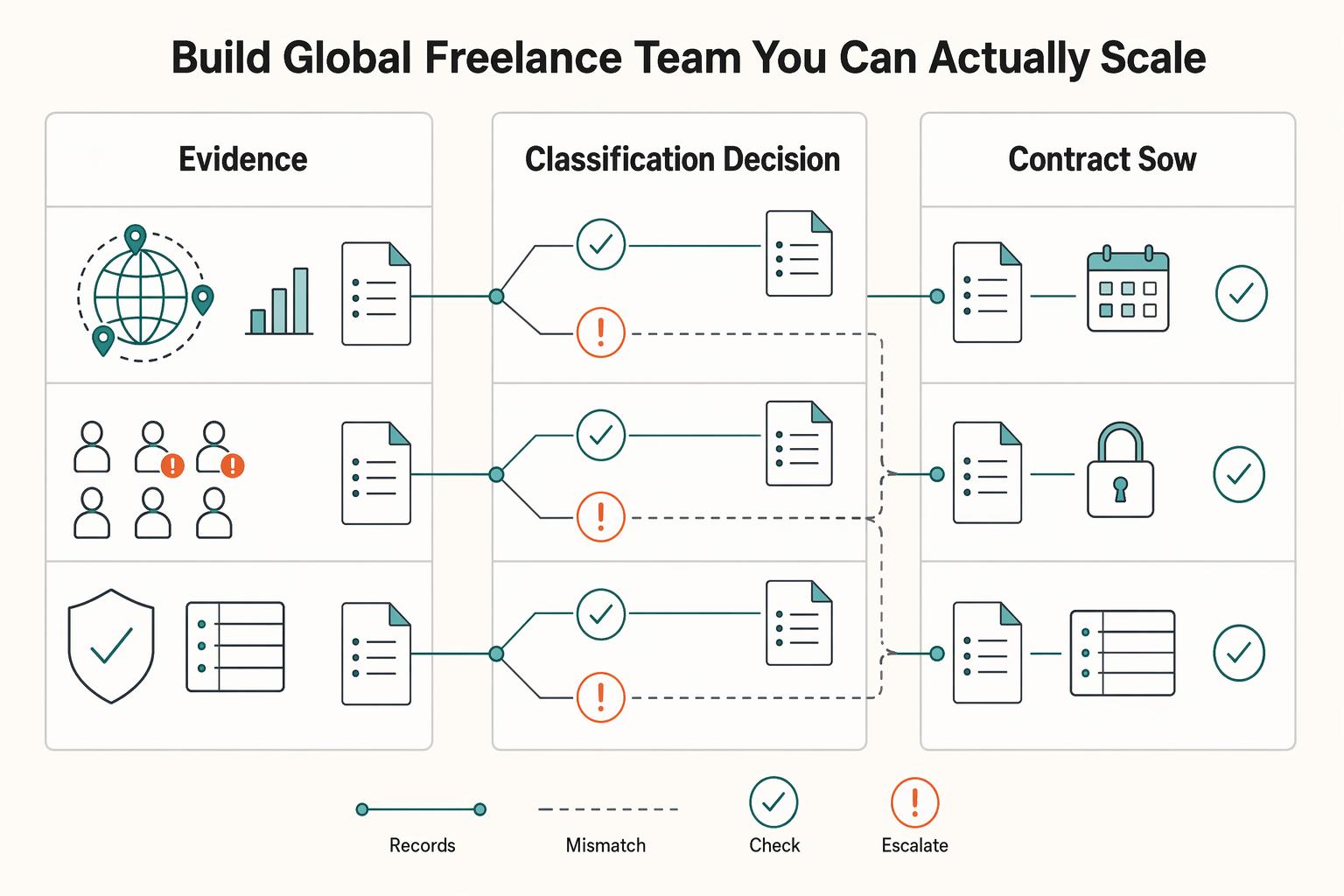
How to Manage a Global Freelance Team Without Compliance Gaps
If you want to manage a global freelance team without constant cleanup, use the same intake-to-payout process for every engagement and save an artifact at each gate. Common failure points are instinct-based classification, vague scope, and payments approved in chat with no audit trail.
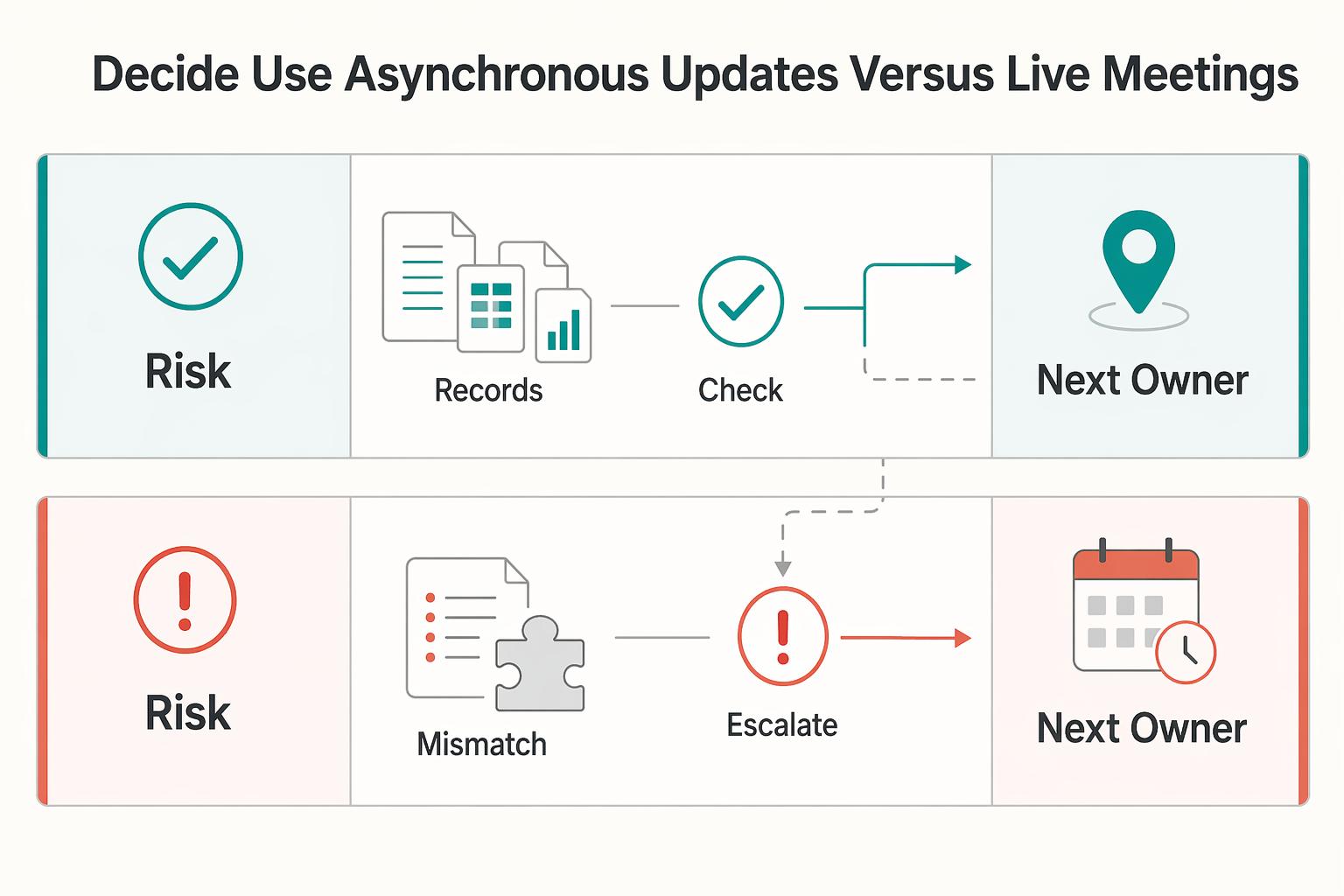
Remote Team Performance Management for IT Agencies
If your remote team performance management feels inconsistent, the problem is often not distance itself. It is ambiguity. Performance breaks down when expectations, feedback, and decisions live in chat history or manager memory instead of a written record you can review. In remote and hybrid teams, documented expectations and [outcome-based measures](https://www.opm.gov/telework/tmo-and-coordinators/performance-management) matter more than office visibility, so your first move is to make the standard visible.
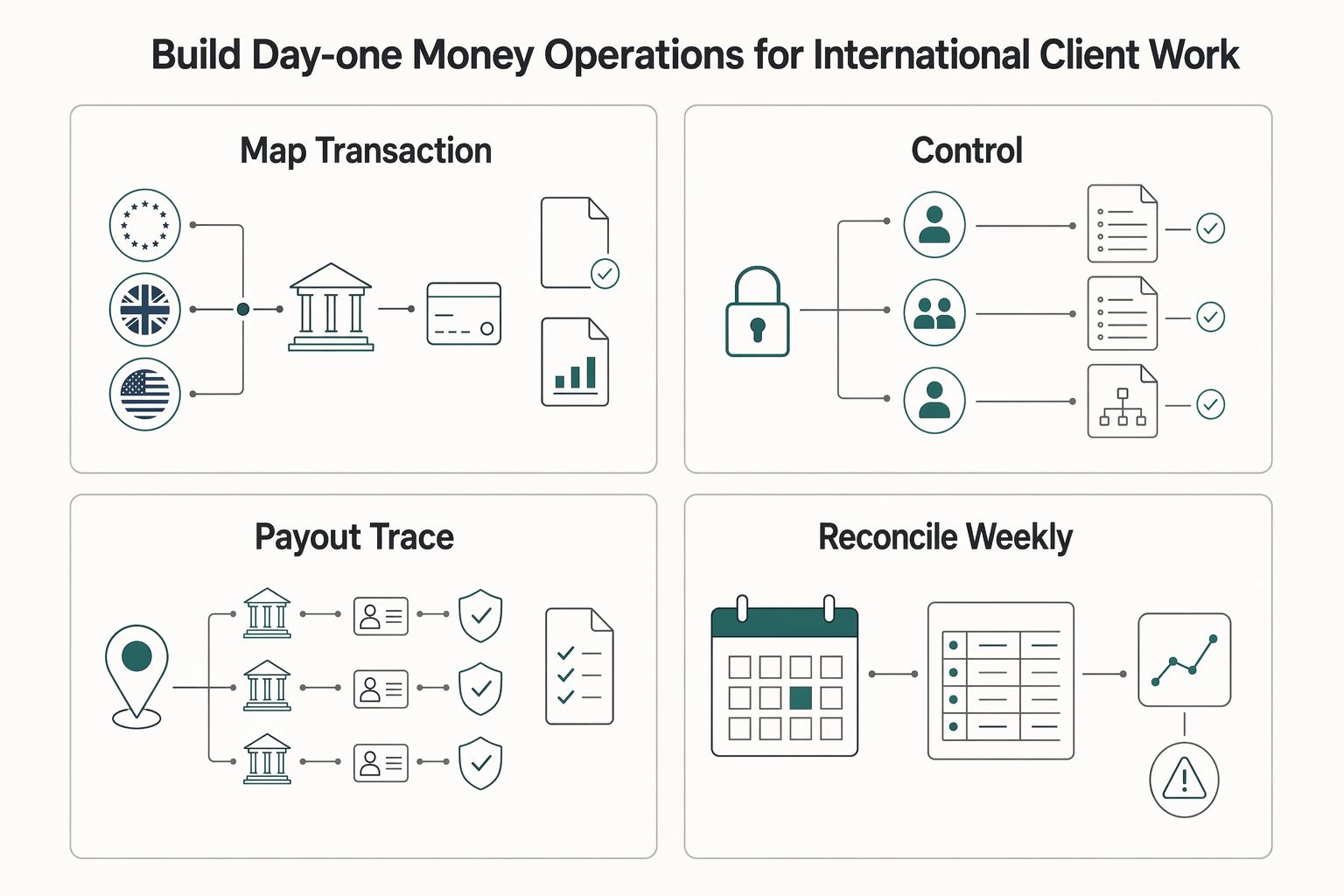
How to Set Up a Limited Company in Ireland
Work in two tracks and keep them separate: complete CRO formation first, then handle post-setup registrations. That order reduces duplicate edits and missed follow-ups.