

Quick Answer
Start with a corridor pilot and treat public numbers as directional only. In the article’s grounded set, Backstage reports about $50-$150 an hour, but that range is explicitly context-sensitive to engagement type, pay type, experience, and scope. Before pricing rollout, separate editing from motion work, keep hourly/day/project inputs unblended, and document source, capture date, scope notes, and confidence. Then test one lane such as United States-United Kingdom or California-Mexico before scaling.
What Freelance Video Editors and Motion Designers Charge in 2026#
If you are looking for one clean global answer on freelance video editor rates, this is not that article. The more useful question is narrower: do you have enough evidence to launch pricing in a specific market corridor, or are you still looking at noisy public signals that should not carry a go decision?
That distinction matters because the public market is messy by default. One pricing blog published on May 14, 2025 says editors typically charge $20 to $60 per hour, and gives project examples from $100 for simple edits to more than $5,000 for complex commercial work. Useful? Yes, as a signal. Reliable enough to set a cross-border rate card for every buyer, editor, and scope type? No. Another vendor page says many video production companies do not publish prices at all. That helps explain why operators end up piecing together numbers from marketplace pages, vendor pricing pages, and YouTube advice.
It also helps to stop treating "video editor" as a single job with a single cost shape. Editors and motion designers are adjacent scopes that may need separate pricing treatment. If motion work is included, assume from the start that the editing line and the motion line may need separate benchmarking before they are blended into one offer.
The goal here is to turn uneven public inputs into a benchmark you can actually use for market entry in your target corridor. That means translating raw numbers into something decision-ready. Pricing unit, role scope, turnaround expectations, revision burden, and corridor context all need to be attached to the number before it becomes operationally useful. A public rate without that context is just a rate signal, not a benchmark.
A good early checkpoint is simple: for every rate input you keep, record the source, capture date, pricing unit, scope notes, geography if stated, and a confidence label. If you cannot tell whether a number refers to hourly work, a day rate, or a fixed project fee, do not blend it into your model. A common failure mode in this category is mixing unlike pricing units, then discovering margin pressure once revision rounds, rush turnaround, or motion-heavy work shows up.
Success here is not "finding the right average." It is leaving with a go or no-go decision you can defend: predictable unit economics, compliant payout execution, and audit-ready records from quote to settlement. If you can reach that standard, you are not just collecting market chatter. You are building a benchmark that can survive launch. For related operating detail, see Managing a Global Team of Video Editors with Frame.io.
What a usable benchmark means for this category#
A usable benchmark is not a pile of public numbers. It is a comparison set you can price from because each input is normalized, scoped, and weighted well enough to support a launch, hold, or redesign decision.
- Rate signal: a public number with limited context.
- Benchmark: a comparable rate with context attached, including pricing unit, role scope, geography (when known), revision burden, and turnaround expectations.
- Decision threshold: the condition that changes your next move, such as launch, hold, or redesign.
Evidence quality matters. AIR's 2025 rate guide is closer to benchmark logic. It says its ranges were based on survey data, interviews, and industry research from 2024 and early 2025, using 280 usable submissions and 50 interviews, and converting some project submissions into hourly equivalents to align the dataset. Use that as structured input, not as a globally representative rate source.
The biggest failure mode is unit mixing. Hourly, day rate, and project fee are not interchangeable unless scope, revision rounds, and delivery speed are normalized. If a role combines editing and motion work, split those into separate cost lines first, then blend them only after you can see which line drives margin risk.
What the evidence says and where confidence breaks#
The evidence is enough to confirm that public rate ranges exist, but not enough to set rollout pricing with confidence. The stronger pages still need independent verification, while the weaker inputs are single-person or adjacent-niche opinions.
The Jobbers guide shows this clearly. It is published on 3 February 2026, but says its figures are based on public sources from early 2025. It also states the content is not legal, financial, or professional advice and tells users to independently verify numbers. That makes it transparent informational data, not decision-ready benchmark input.
The Quora result is a second signal, not a benchmark. It includes opinion-style guidance like $30/hour (limited portfolio/references) and $50/hour (more established experience), but the answer is marked 10y old and appears in an adjacent design thread rather than dedicated video-editor market benchmarking.
How to weight the main SERP source types#
| Source type | Transparency | Sample quality | Operational usefulness | Confidence |
|---|---|---|---|---|
| Upwork | No Upwork rate page is captured in this section's grounded pack | Unknown here | Not usable from this section alone | Low for current decision use |
| No Reddit evidence is grounded in this section | Unknown here; often anecdotal unless scope is explicit | Useful for hypotheses, weak for pricing decisions | Low | |
| Facebook Groups | No Facebook Group evidence is grounded in this section | Unknown here | Better for language and objections than benchmarks | Low |
| YouTube (including Colleen Edits) | No YouTube evidence is grounded in this section | Unknown here | May help packaging ideas, not rollout pricing alone | Low |
The key distinction is not platform type. It is inspectable framing. A dated, scoped, self-limited source is still imperfect, but it is more usable than an anecdotal post with no sample method.
What is known and what is still missing#
The split is straightforward:
| Item | Status |
|---|---|
| Public SERP inputs can show rate bands | Known |
| At least one source explicitly labels its data as informational and requiring independent verification | Known |
| At least one source provides personal hourly advice with visible age and no transparent market sample | Known |
| Geography mix | Unknown |
| Seniority definitions | Unknown |
| Workload assumptions | Unknown |
| Revision burden and turnaround terms | Unknown |
Decision rule: if most inputs are anecdotal and unsegmented, do not set rollout pricing yet. Run a scoped pilot first, then price from observed acceptance and delivery cost.
Choosing hourly, day-rate, or project pricing without margin surprises#
Choose the pricing model that matches scope certainty, because margin usually breaks where scope, revisions, and acceptance criteria are vague.
Frame.io's baseline still applies here: there is no one-step formula for editor pricing. In practice, use time-based pricing when the brief is still moving, and use project pricing only when scope and completion criteria are explicit. Quora guidance makes a similar practical point: hourly and project methods can be comparable if the contract clearly defines what will be delivered and when it is complete.
| Pricing model | Use it when | Main margin risk | What to lock down before quoting |
|---|---|---|---|
| Hourly | Scope is uncertain or likely to change | Time overruns become disputes if tracking is weak | Time logging method, approval cadence, who can approve extra hours |
| Day rate | Work is concentrated into production blocks | A "day" gets interpreted differently by each side | What a billable day includes, the working window, and spillover handling |
| Project fee | Deliverables and completion criteria are well bounded | Revisions and added asks erode margin | Exact deliverables, included revisions, turnaround, completion criteria, change-order language |
The core tradeoff is revision risk. If iteration is likely or direction is still shifting, avoid fixed pricing unless revision limits and change-order triggers are explicit.
For cross-border setups, including California-Mexico and United States-United Kingdom hiring paths, do not assume one model is always correct. Choose the format that creates the clearest record for approvals, scope changes, and payment follow-through if disagreements appear.
Before committing, confirm how invoices, approval states, and payout status events will be tracked. If those states are unclear, fixed project pricing usually adds avoidable risk.
Market variables that actually move rates by corridor#
Reliable corridor-level rate conclusions require additional market data. The available sourcing skews toward internship and job-search contexts, so treat this section as a data-quality checkpoint, not a pricing benchmark.
| What the data supports | How to use it | Confidence impact |
|---|---|---|
| Listings are sourced from Handshake | Use postings as directional role signals only | Low for rate benchmarking |
| Users are told to pick one Position Type and one Interest Area | Use this to keep role labels consistent when classifying entries | Useful for categorization, not pricing |
| Academic-credit internships require coordinator review after securing the internship | Keep internship-admin details separate from market-rate evidence | Not a rate signal |
For corridor analysis, keep any United States, United Kingdom, and Mexico conclusions in a provisional bucket until you have direct pricing evidence for matched scope and terms. If your evidence is mostly job-search content, do not infer corridor multipliers from it.
When corridor constraints are unclear, benchmark conservatively and test demand response with a narrow pilot before publishing broader pricing.
Compliance and payout constraints that competitors skip#
A rate benchmark is not launch-ready until compliance and tax dependencies are explicit, not assumed. This guide's strongest supported constraints center on U.S. tax reporting (including FEIE rules) and FBAR timing resources, while KYC/KYB/AML, W-8/W-9/1099 workflows, VAT treatment, and payout-rail mechanics still require separate policy confirmation.
| Constraint area | Grounded takeaway | What to do before rollout |
|---|---|---|
| FEIE eligibility and reporting | The exclusion applies only if the person is a qualifying individual with foreign earned income, and they still file a U.S. tax return reporting that income. For 2026, the maximum exclusion is $132,900 per person. | Do not treat "I use FEIE" as a substitute for your onboarding documentation flow. |
| Physical presence test | The test applies to U.S. citizens and U.S. residents; it uses 330 full days in foreign countries during a period of 12 consecutive months, and the 330 days do not have to be consecutive. | Keep this as individual tax-treatment context, not as a shortcut for your payout process. |
| FBAR | FinCEN treats FBAR as reporting for foreign bank and financial accounts and provides a filing due-date resource, including extension notices. | Route FBAR questions to qualified tax handling instead of ad hoc support answers. |
| KYC, KYB, AML; W-8, W-9, Form 1099; VAT; Merchant of Record / Virtual Accounts / Payout Batches | Confirm with the relevant authority. | Mark these as required implementation dependencies and confirm ownership and timing before you promise first-payout dates. |
If your team cannot clearly state what is verified, what is pending, and who owns exceptions, your benchmark is still provisional. For corridor-level operating examples, see How a freelance video editor can compliantly work for a California-based company while living in Mexico and How a US-based Marketing Agency can pay a UK-based video editor compliantly.
Build the decision packet before you commit GTM resources#
Treat this as an evidence-based decision, not a pricing opinion. Before you spend GTM resources on a rate card, document where each number came from, which assumptions shaped it, and who approved the recommendation.
A strong packet can be compact, but it must be traceable so different teams can review the same recommendation with the same context.
| Artifact | What it should contain | What to check before approval |
|---|---|---|
| Benchmark source log | Each rate input, capture date, role scope, pricing unit, and confidence note | Can every rate be traced to an original source capture, and are units comparable |
| Assumption register | The normalization choices used to compare inputs | Are assumptions explicit enough for another operator to challenge or reproduce |
| Launch-risk checklist | The key launch dependencies already reviewed for the first market you plan to test | Is this specific to your first launch context rather than a generic template |
| Failure-response plan | Owner, escalation path, and handling steps when execution does not match plan | Is each failure state assigned to one accountable owner |
Verification gates that matter#
Run these three checks before any external pricing announcement:
| Gate | What it checks | Timing |
|---|---|---|
| Source confidence review | Separate strong inputs from weak anecdotal ones | Before any external pricing announcement |
| Assumption review | Confirm the recommendation still holds if key assumptions are challenged | Before any external pricing announcement |
| Operational sign-off | Confirm the recommendation can be executed as planned in a pilot | Before any external pricing announcement |
Traceability and implementation notes#
Every recommendation should map line by line to supporting evidence and a confidence label. If a number cannot be traced back to a specific captured source, it should not drive launch pricing.
For implementation readiness, document how your system will represent status changes and retries before the pilot launches so exceptions are visible and recoverable.
Related reading: Freelance Sales Qualifying That Protects Your Time and Pipeline.
Pilot sequence for a first launch corridor#
Run a narrow pilot before any broad rollout: one corridor, one role mix, and one pricing model. Use it to test whether your assumptions hold in real operations, not to prove a global pricing position.
| Pilot element | Grounded setup | Pilot limit |
|---|---|---|
| Corridor | Run a narrow pilot in one corridor; start with a single lane, such as United States to United Kingdom or California to Mexico | One corridor |
| Role mix | Keep role scope tight; do not blend pure editing and motion-heavy work in the first cohort unless your benchmark already separated them | One role mix |
| Pricing model | Use one explicit model for the cohort: hourly, day rate, or project fee; keep sellers from switching models during the test | One pricing model |
Start with a single lane, such as United States to United Kingdom or California to Mexico, and keep role scope tight. Do not blend pure editing and motion-heavy work in the first cohort unless your benchmark already separated them. If scope varies, you cannot tell whether misses came from corridor choice, role definition, or pricing format.
Keep the pilot small enough to diagnose#
Use one explicit model for the cohort: hourly, day rate, or project fee. Keep sellers from switching models during the test.
Public anecdotal pricing is useful context, but it is weak launch evidence. In the same thread (4 answers), suggested pricing ranges from a basic $100 case to less than $500 overall and certainly less than $1,000 depending on needs. Treat that as a signal that pricing is market-dependent, not as a corridor benchmark.
Before you send the first quote, document:
- the pricing unit being tested
- the revision policy (included vs extra)
- the approval path from quote to invoice to payout
Track friction where pilots usually break#
Log each engagement with dates, exceptions, and handoffs so the trail is auditable. In practice, track onboarding and payout steps where your process touches KYC, AML, W-8/W-9, and Payout Batches.
By first invoice approval, you should be able to confirm whether required documents were complete, payout instructions passed on first submission, and any manual intervention occurred. If that trail is not reconstructable from ticket, form, and payment events, the pilot is under-instrumented.
Promotion rule for broader rollout#
Promote only after this lane shows stable execution against your own pilot assumptions. If exceptions cluster in one step, pause expansion and fix that step before adding a second corridor.
For a step-by-step walkthrough, see Philippines Freelance Market Analysis for Cross-Border Teams.
Conclusion#
The practical takeaway is simple: do not hunt for one universal number and call it a market benchmark. Build an evidence-weighted view instead, mark what you know with confidence, and say clearly where uncertainty still sits.
That matches the strongest signals here. Frame.io is direct that there are no quick universal answers for editor pricing, and CineSalon makes the same point from another angle by noting that rates vary as much as the work itself. That variability is not noise you can wish away. It usually comes from multiple factors, including editor experience and how settled the pricing structure is for the kind of work you are buying.
So the better benchmark is not a single figure. It is a small decision packet you can defend. At minimum, each rate input should carry three labels: source type, confidence level, and the assumptions needed to compare it. A public marketplace guide, a Reddit thread, and a creator video should not carry the same weight. One useful checkpoint is to date-stamp every source review and recheck the underlying page before you use it. The Arkansas writing guide makes the point plainly: you cannot rely on an embedded citation being up to date.
A safer way to make expansion calls is to keep pricing tied to real operating constraints instead of anecdotal threads. In practice, that means treating rate assumptions and execution effort as one decision, not separate conversations. If your quoted rate only works when hidden exceptions or rework stay invisible, your benchmark is too optimistic. That is the failure mode to watch for.
A good next step is narrow and measurable:
- Pick one corridor, one role mix, and one pricing unit.
- Run a limited pilot with explicit assumptions on scope, revisions, and approval.
- Capture where reality broke the model: source confidence gaps, extra revision time, or invoice exceptions.
Then update your benchmark before you scale. If the pilot confirms both the price and the operating effort, you have something you can roll out with more confidence. If it does not, that is still a win, because you found the cost of being wrong while the test was still small.
Frequently Asked Questions
What are freelance video editor rates?
Backstage reports that video editing rates usually fall around $50-$150 an hour. Backstage also says pricing depends on engagement type, pay type, editor experience, and project scope, so treat that range as directional rather than a decision-ready benchmark.
Why do numbers from Upwork, Reddit, and Facebook Groups conflict so much?
Pricing shifts with engagement type, pay type, experience, and scope, so context-free numbers from Upwork, Reddit, or Facebook Groups should be treated as signals, not final pricing inputs.
When should an operator use hourly pricing instead of day rates or project fees?
This guide does not establish a rule for when hourly pricing is better than day rates or fixed project fees. It only supports that public hourly signals exist and that pricing outcomes vary by engagement type, pay type, experience, and scope.
What can be benchmarked confidently from public sources, and what remains unknown?
You can benchmark that at least one public source reports an hourly signal of $50-$150 and explicitly ties rate changes to engagement type, pay type, experience, and scope. You cannot confidently infer a single "right" commercial rate from that signal alone.
Which compliance requirements most often disrupt cross-border editor payouts?
This guide does not provide evidence on cross-border compliance failure patterns, tax-form requirements, or payout operations. No specific compliance disruption can be asserted here.
How should teams validate rates before expanding into a new country corridor?
The supported evidence here is limited and non-formulaic, so it should not be treated as a country-ready benchmark by itself. Use it as directional context, then validate rates with your own clearly scoped commercial inputs.
What should you do with extreme public pricing examples?
Treat them as evidence of variance, not market averages. The Quora example that a two-minute video could be $300 a minute to $100,000 a minute is useful mainly because the responder also says pricing is not formulaic, so it should not anchor a rate card.
Try a related tool
Researched and edited by the Gruv editorial team. Gruv builds cross-border billing, payouts, and finance-operations software for global businesses.
Sources
- catalog.stchas.edu/mime/media/8/1131/2016-2017%2BSCC%2BCollege%...trusted
- cncc.edu/documents/25-26/25-26_Catalog_Addendum_B.pdftrusted
- faculty.marshall.usc.edu/lan-Luo/Look%20the%20Part.pdftrusted
- fincen.gov/report-foreign-bank-and-financial-accountstrusted
- georgiasouthern.edu/colleges/arts-humanities/departments/music/f...trusted
- georgiasouthern.edu/academics/continuing-professional-education/...trusted
- irs.gov/individuals/international-taxpayers/figuring...trusted
- irs.gov/individuals/international-taxpayers/foreign-...trusted
Educational content only. Not legal, tax, or financial advice.
Related Posts
How a Freelance Video Editor in Mexico Can Work Compliantly With a California Company
A California company working with a video editor in Mexico can benefit from schedule overlap, but it also creates two compliance risks you need to manage from day one: worker classification and permanent-establishment tax exposure. Same-day collaboration can be a real advantage in some California-Mexico pairings. Cross-border convenience does not reduce legal or tax risk.
How a US-Based Marketing Agency Can Pay a UK-Based Video Editor Compliantly
Think of pricing, tax onboarding, and payment rails as one decision chain, not three separate admin tasks. Set pricing from scope certainty, complete W-8BEN onboarding before the first invoice, and choose the rail by settlement and reversal risk. In a US agency-to-UK-contractor workflow, that sequence reliably reduces approval delays and post-payment friction.
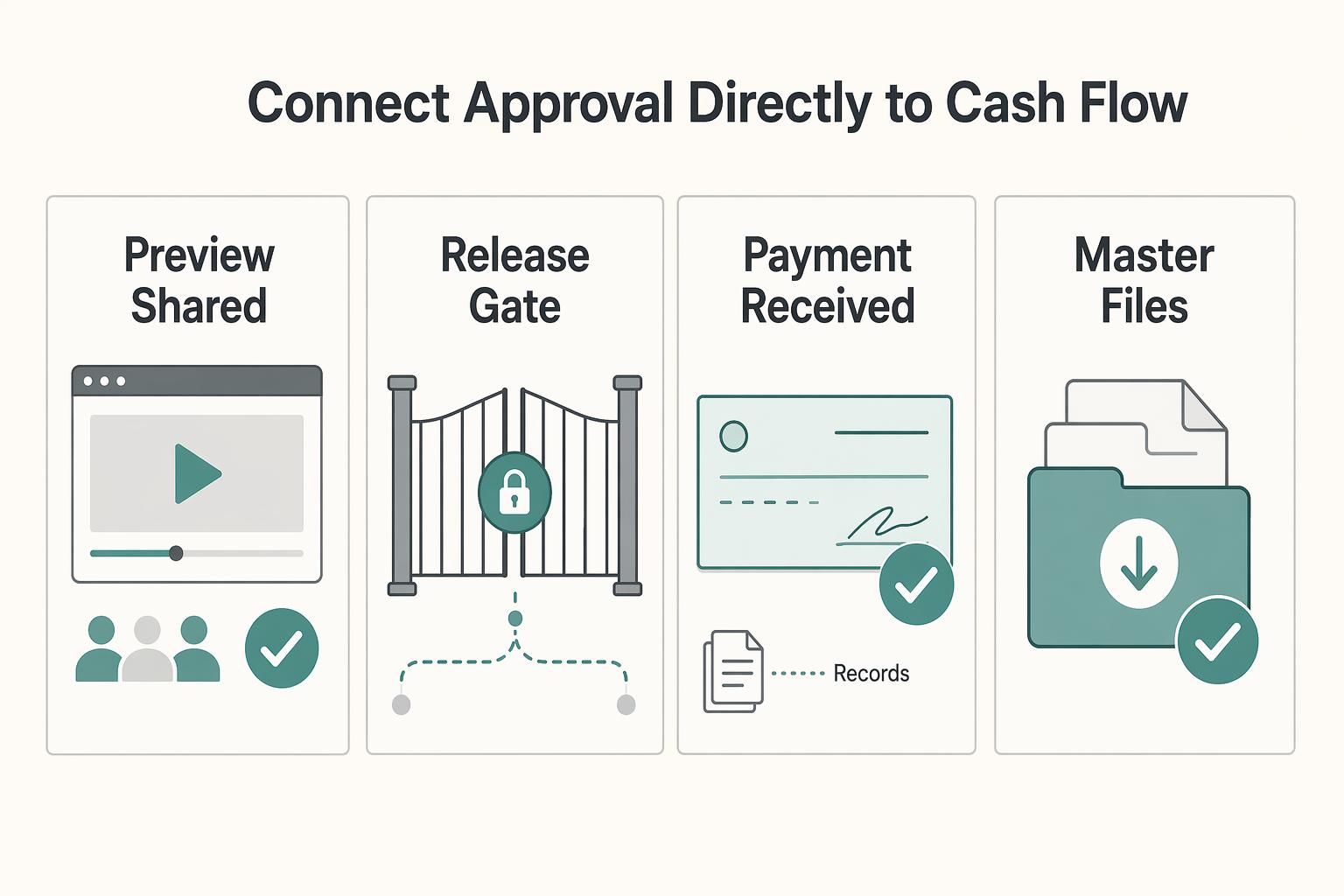
Managing a Global Team of Video Editors with Frame.io
A stray client comment in an email or a casual remark on a video call can feel harmless. In practice, it is often the first crack in your project record. When a client ghosts your final invoice or says a major change was never approved, your review history stops being background context and becomes evidence.