
Quick Answer
A US-based marketing agency can pay a UK-based video editor compliantly by following one sequence: choose a pricing model that matches scope stability, complete W-8BEN and vendor onboarding before the first invoice, and pick the payment rail based on settlement, reversal, dispute, and FX risk. Keep the agreement, vendor profile, and invoice fully aligned so AP can process the file without exception handling.
Treat pricing, tax onboarding, and payment rails as one decision chain#
Think of pricing, tax onboarding, and payment rails as one decision chain, not three separate admin tasks. Set pricing from scope certainty, complete W-8BEN onboarding before the first invoice, and choose the rail by settlement and reversal risk. In a US agency-to-UK-contractor workflow, that sequence reliably reduces approval delays and post-payment friction.
Payment trouble often starts well before the payment itself. A common break happens when scope is still vague, the invoice does not match how the work was approved internally, or AP receives a tax record that does not line up with the vendor profile it is about to pay. By the time money is due, the file may already look inconsistent.
That is why this playbook works best in order. First, decide how the work will be priced based on how stable the scope really is. Next, make sure the tax record and vendor setup are accepted before anyone sees invoice #1. Then choose the payment rail based on timing, finality, dispute exposure, and who controls conversion.
If you treat those as separate admin tasks, you create three chances for the same job to be described differently. If you treat them as one chain, each later step confirms the one before it. The agreement tells the client what they are buying. The onboarding record tells AP who it is paying. The invoice tells AP what approved work is now due. The payment rail determines how much settlement certainty you have once the money leaves their side. When those pieces point in the same direction, approvals tend to move more cleanly.
Step 1 Choose the pricing model from scope stability#
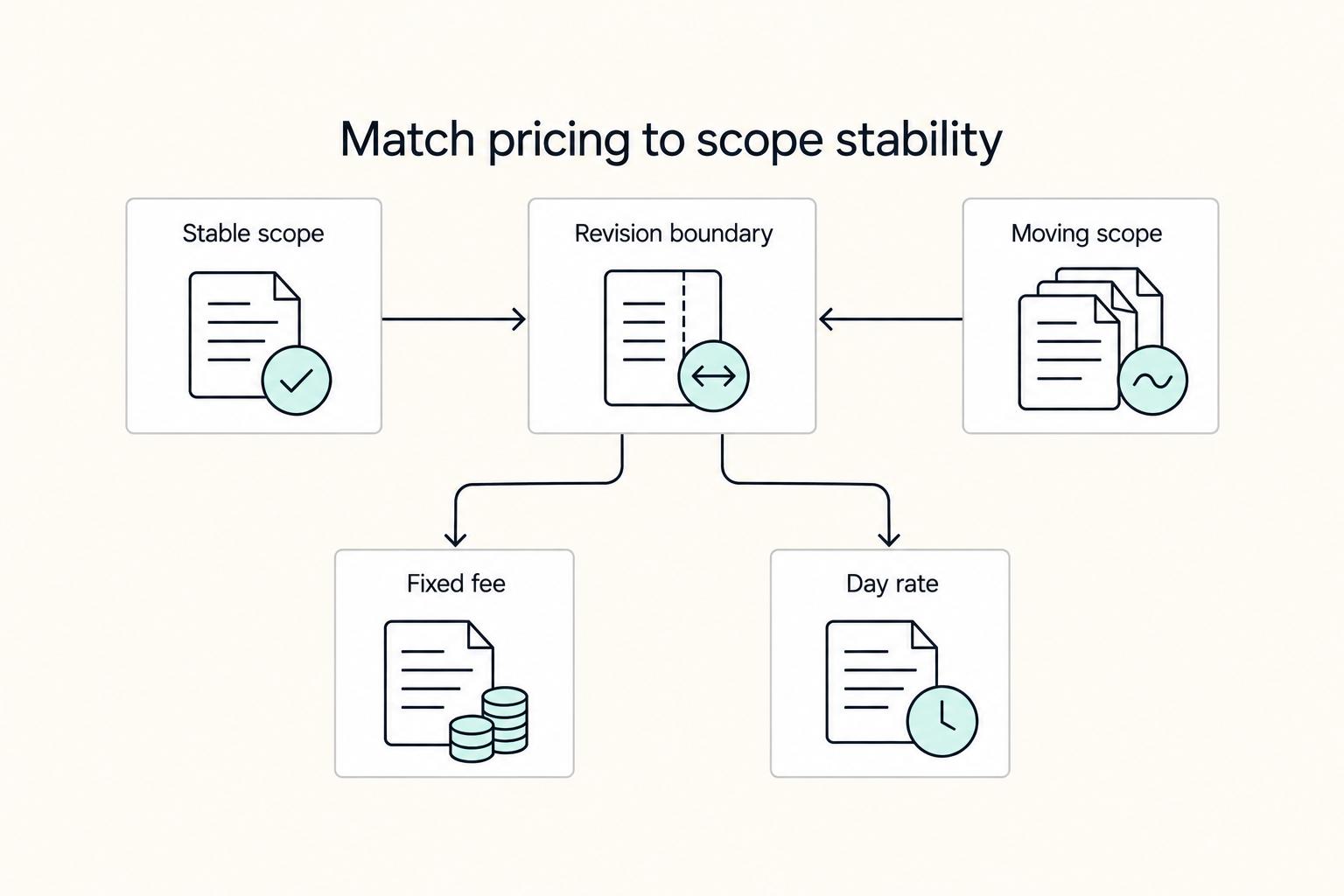
Choose pricing by how predictable the work is, not by habit. A fixed fee works when deliverables and revision boundaries are clear enough up front. Hourly or day rate often works better when the scope, duration, or review load is still moving.
| Model | Use when | Buyer control action |
|---|---|---|
| Hourly | Scope is still moving or cannot be estimated accurately at kickoff | Set a reporting cadence so usage is visible before invoicing |
| Day rate | The client needs concentrated availability for reviews, calls, and rapid iterations | Define what one booked day includes and what triggers another day |
| Fixed fee | Deliverables, handoff, and included revision rounds are reasonably definite | Write scope boundaries and revision limits into the agreement before work starts |
The key decision is not what you prefer to quote. It is how much uncertainty still exists when the work is approved. If the brief is still being shaped, if multiple internal reviewers are likely to appear, or if the buyer wants flexibility on direction, hourly or day rate often fits the reality better. If you force that situation into a fixed fee, you may be taking on hidden scope risk that can surface later as unpaid review cycles, vague rework, or pressure to absorb delays you did not cause.
On the other hand, fixed fee can work well when the client can define the output clearly enough that both sides can tell when it is done. The more concrete the handoff, the easier it is to keep the commercial record aligned later. A strong fixed-fee setup usually makes it obvious what the deliverable is, what format will be handed over, what revision rounds are included, and what falls outside the agreed work. That clarity helps not only with the client relationship but also with internal approval on the buyer side, because the invoice can mirror the same language without improvisation.
If uncertainty is still high, do not force it into a fixed fee. Put change-control triggers in writing: a new deliverable, an extra revision round, delayed consolidated feedback, or a material brief change should trigger a new quote, another day, or an added hour block.
That step matters because some invoice disputes are really scope disputes that AP discovers late. A project lead may approve one thing in the work order, but the invoice later describes something broader. Or the agreement may say fixed fee for a defined package while the actual working process looks more like open-ended availability. When that happens, AP is left trying to process a file that contains mixed commercial signals. The fix is not better invoice wording alone. It is choosing the pricing model that reflects how the work will actually unfold.
Use this verification test: a third person should be able to read the agreement and invoice and understand what was bought without asking either side. If that is not true, pricing risk is still buried in the deal.
Take that test literally. Imagine the file being reviewed by someone who did not attend the kickoff call, does not know the creative history, and only has the agreement, work order, and invoice in front of them. Can they tell whether the client bought a set of deliverables, a block of time, or reserved availability for a defined period? Can they see what was included and what would require an additional approval? If not, the file is still relying on memory, context, or goodwill rather than a clear commercial record.
For hourly work, the main control is visibility. The client should know how usage will be reported before the invoice lands. That does not mean turning the arrangement into bureaucracy. It means agreeing on a simple pattern that makes hours unsurprising. For day-rate work, the main control is boundary setting. The client should know what one booked day covers, whether that means review windows, live collaboration, rapid iterations, or concentrated production time. For fixed fee, the main control is containment. The client should know what is in scope, what counts as a revision round, and what kind of brief change reopens pricing.
A common failure mode is using fixed-fee language in the agreement and then working in an open-ended, service-on-demand way. Another is quoting day rate without saying whether the day is tied to delivery output, availability, or both. Another is billing hourly while giving no reporting rhythm, then expecting the invoice alone to explain usage. None of those are fatal if corrected early, but they become much harder to fix once the work is complete and the buyer is trying to reconcile approval history with a bill.
You can avoid most of that by making the pricing basis visible in every document the client will rely on later. If the scope is fixed, say so consistently. If the arrangement is time-based because the brief is still moving, say that consistently too. Your goal is not to sound more formal. It is to remove ambiguity before that ambiguity reaches AP.
Before onboarding, run this quick pricing-to-approval check:
- Confirm your agreement language and invoice language describe the same deliverable.
- Confirm your revision and change-control triggers are written in one place.
- Confirm your pricing basis can be reviewed without call notes or side messages.
If a long day-rate setup starts to look like staff-style control over your schedule and methods, pause and review the arrangement. This misclassification guide is a practical next step.
That is especially worth watching when a short project turns into recurring booked days with close control over when and how you work. The commercial label alone does not clean up a working pattern that has drifted. If the structure begins to resemble staff-style control, the right move is not to keep polishing invoices. It is to review the arrangement itself before the paperwork around it hardens. Once the commercial terms can pass that test, clear tax onboarding before AP ever sees invoice #1.
Step 2 Complete W-8BEN onboarding before the first invoice#
Complete onboarding before AP sees your first invoice. According to IRS Form W-8BEN instructions, Form W-8BEN is the foreign-individual status form used for US withholding and reporting. You give it to the payer or withholding agent, not the IRS, and if requested, you should submit it even when you are not claiming a reduced withholding rate.
| Order | Action | Why it comes here |
|---|---|---|
| 1 | Submit W-8BEN | Complete onboarding before AP sees the first invoice |
| 2 | Confirm AP-required vendor-profile fields in writing | Clarify the payee record AP expects to use |
| 3 | Get written confirmation that W-8BEN is on file and invoice field requirements are clear | Make sure the tax record and invoice requirements are accepted before billing |
| 4 | Issue the invoice | Send the invoice after the onboarding record is accepted |
That timing matters more than many freelancers expect. If the first invoice arrives before the tax record is accepted, AP may have to stop the file and ask questions that should have been resolved earlier. What looks like a small delay can turn into a longer approval loop because the issue is no longer just missing paperwork. It becomes uncertainty about whether the vendor profile, tax record, and invoice belong to the same payee record the client is allowed to pay.
Use this sequence:
- Submit W-8BEN.
- Confirm AP-required vendor-profile fields in writing.
- Get written confirmation that W-8BEN is on file and invoice field requirements are clear.
- Issue the invoice.
The practical benefit of that order is simple: by the time the invoice appears, AP is not being asked to decide what the right payee record should look like. AP already knows. That reduces back-and-forth on details that feel minor on your side but can matter a lot inside the payer's workflow. For example, the legal name may appear one way in the vendor record and another way on the invoice, or the address format may differ enough to trigger manual review.
Make sure your records match exactly across the W-8BEN, vendor profile, and invoice, including name, address, and related identity fields. Small mismatches can trigger manual review, especially if withholding reporting comes into play later.
Exact matching is not a cosmetic preference. It is an operational control. When AP reviews a file, it is looking for signs that the tax record, vendor profile, and invoice all refer to the same party and the same payment setup. If one document uses a shortened name, another uses a different address format, and the invoice adds inconsistent details, the file starts looking less reliable even when the underlying work is legitimate. The more closely those records align, the easier it is for the payer to move the invoice through routine processing instead of exception handling.
It helps to think in terms of one approved identity package. The W-8BEN, vendor profile, and invoice should not each tell a slightly different version of who you are. They should read like copies of the same administrative truth. If AP tells you a specific field must appear in a certain way, mirror that instruction consistently rather than trying to improve it ad hoc on the next invoice.
Keep one evidence file together: the agreement, W-8BEN, AP confirmation, invoice, and payment record. If withholding appears, pause routine processing, confirm the basis used, and preserve the gross, withheld, and net amounts with the related correspondence. If Form 1042-S is issued later, store it in the same file.
That file is useful even when everything goes smoothly. It gives you one place to check what was agreed, what was submitted, what AP accepted, what was billed, and how the payment settled. If something changes later, you are not reconstructing the history from scattered emails, portal uploads, and bank notifications. You can see the full path from onboarding to settlement in one place.
It also helps when the issue is not an outright rejection but a quiet slowdown. Sometimes AP does not say the file is rejected. It simply stops processing until a mismatch is clarified. If you already have the complete record together, you can answer much faster. You can compare the invoice to the accepted vendor record, resend the written confirmation that the W-8BEN is on file, and show exactly what was approved without relying on memory or separate message threads.
Timing matters here. W-8BEN is generally valid through the end of the third succeeding calendar year, and change-in-circumstances updates generally need notice within 30 days. Verify current treatment before filing or payment, because W-8BEN supports the process but does not by itself guarantee a specific withholding result.
That last point matters because it is easy to assume that once a W-8BEN is accepted, withholding questions are permanently closed. In practice, the form supports the payer's process, but it does not remove the need to verify current treatment if facts, payee details, or payer requirements have changed. The better habit is to treat the onboarding record as something that must remain coherent with the current payment file, not as a one-time upload you can forget forever.
If you have a long-running relationship with a client, it is still worth checking the basics before any major invoice cycle. Confirm that the vendor profile being used is the same one AP intends to pay from. Confirm that invoice field requirements have not changed. Confirm that any updated payment instructions still align with the approved payee record. This is not about creating more admin. It is about preventing a routine payment from being pushed into exception handling because one part of the file aged out of sync with the rest. With onboarding settled, choose how money moves based on the risk you can tolerate, not on what feels familiar.
Step 3 Choose the payment rail by risk profile, not familiarity#
Choose rails by settlement behavior, reversal or dispute exposure, and the FX control point.
| Rail | Settlement behavior | Main exposure | Best fit |
|---|---|---|---|
| ACH | Moves in batches through the ACH system | Returns and reversals are part of the rule framework, so do not treat it as wire-final | Routine invoice cycles with lower timing pressure |
| Fedwire USD wire | Immediate, final, and irrevocable once processed | More process and cost friction may be acceptable for certainty | Larger or time-critical payments where finality matters most |
| Platform or card-funded route | Often convenient to start | Dispute exposure; card billing disputes can involve a 60-calendar-day written notice window | Smaller convenience-led payments where this risk is acceptable |
The rail choice should follow the commercial and onboarding choices, not replace them. A convenient platform does not fix a mismatched invoice. A wire does not make a vague scope clearer. And ACH being routine does not mean it should be treated as if it carries the same finality as a wire. Each rail has a different risk shape, so the right question is not "what do people usually use?" but "what happens if something goes wrong after release?"
ACH may fit well when the payer runs standard invoice cycles and neither side needs immediate, irreversible settlement. In those cases, the routine nature of the process can be an advantage. But you should still treat it as a rail with its own return and reversal profile. If your client talks about ACH as if it were equivalent to wire-final payment, that is a sign to slow down and make sure both sides mean the same thing.
Fedwire is often the right fit when certainty matters more than convenience. If the payment is larger, if timing is tight, or if you simply do not want post-release ambiguity about settlement status, stronger finality can justify more friction. That friction can include more process, more internal approvals, or greater cost sensitivity, but the point is that the tradeoff is explicit. You are choosing certainty, not just a more formal-looking method.
Platform or card-funded routes can be useful when ease of setup matters and the payment itself is modest enough that the dispute risk is acceptable. The mistake is assuming that convenience at the start means low risk after release. In reality, these routes can create a different exposure profile from direct bank payment. If the client is funding your invoice through a card-backed system, both sides should understand that the convenience comes with a dispute framework.
Before confirming the rail, use this checklist:
- Is final settlement more important than convenience for this payment?
- Can both sides tolerate return, dispute, or chargeback exposure after release?
- At what stage is the payment approved and paid, USD, GBP, or both?
- Who controls the USD-to-GBP conversion timing?
If those answers are not clear, the rail decision is not complete.
The FX point is often under-discussed even when both sides think the payment terms are settled. You need to know not only the invoice currency but also where conversion happens and who controls that moment. If one side expects to approve in USD but the receiving side expects a GBP amount after conversion, confusion can follow. That confusion is usually about what exactly was paid, what fees were deducted, and whether any variance belongs to the payer, the receiving bank, or the conversion step.
That is why "we can pay however is easiest" is not a complete payment term. Ease for one side may mean uncertainty for the other. Before the invoice is queued, make sure both parties know the settlement path, payout currency, fee handling, and conversion control point. If any of those are still loose, the payment rail discussion is not finished.
If you want a deeper dive, read How to Pay US-Based Freelancers from the UK.
Pre-invoice checkpoint#
Before any invoice enters approval, run these four pass or fail controls. If one fails, stop and fix it first. This is where the earlier decisions turn into a usable payment file.
| Checkpoint | What to confirm | Key evidence |
|---|---|---|
| Align the commercial record | Agreement, PO or work order, and draft invoice use consistent scope language, revision logic, and pricing basis | Project lead compares the file before approval |
| Confirm onboarding is accepted | W-8BEN is on file, required invoice fields are confirmed, and the vendor profile matches the invoice identity details | AP confirmation in writing |
| Lock the rail and FX terms | Settlement path, payout currency, fee bearer, and who controls USD-to-GBP conversion timing are explicitly agreed | The file answers how money moves, in what currency, who bears fees, and who decides conversion timing |
| Build one payment file | Commercial, tax, AP confirmation, invoice, and settlement proof stay together | One payment file with the five document groups |
This is not extra bureaucracy layered on top of the work. It is the point where you test whether the agreement, onboarding record, and payment instructions are coherent enough to survive review by people who were not involved in the original deal. If you skip this stage, you may only find gaps once the invoice is already stuck in approval.
Step 1 Align the commercial record#
Pass: the project lead can compare the agreement, PO or work order, and draft invoice and see consistent scope language, revision logic, and pricing basis across all three. Fail: any mismatch appears, for example, fixed deliverables in one document but open-ended hourly terms in another.
Use the same micro-test as before: a third person should be able to tell what was bought without asking either side. If not, route it back for correction and reissue before approval. Owner actions are straightforward: the project lead confirms agreement and PO alignment, and the editor updates the invoice wording.
This is the moment to catch drift between what was sold and what is being billed. A lot of drift happens innocently. The brief changes informally. Feedback rounds expand. A project that began as a defined package becomes a looser collaboration. The problem is not that the work evolved. The problem is billing from the evolved reality while the approved documents still describe the original one. When AP compares the invoice to the work order, it may look like a mismatch even if everyone on the creative side understands how the project changed.
To avoid that, compare the core scope, revision, and pricing language directly. If the agreement says fixed fee for defined deliverables, the invoice should not read like an open-ended time charge. If the arrangement is hourly because the brief was moving, the supporting documents should not imply that a completed deliverable package was purchased at a fixed amount. Your goal is to make the invoice feel like a clean continuation of the approved commercial record, not a reinterpretation of it.
If something is off, do not try to explain the gap informally in email and hope the file survives. Correct the record. That may mean updating invoice wording, asking for a revised work order, or reissuing the invoice so that the file tells one coherent story. A small correction at this stage is usually easier than trying to rescue an invoice that has already entered approval with conflicting descriptions.
Step 2 Confirm onboarding is accepted#
Pass: the AP contact confirms in writing that W-8BEN is on file, required invoice fields are confirmed, and the vendor profile matches the invoice identity details. Fail: W-8BEN was sent but not acknowledged, requirements are still verbal, or vendor-profile details do not match the invoice.
W-8BEN goes to the payer or withholding agent, not the IRS. If the payer or withholding agent requests it, submit it even when you are not claiming reduced withholding. Verify current requirements before submission, and confirm the form is still current. It is generally valid through the end of the third succeeding calendar year unless a change in circumstances requires an update within 30 days.
The key word here is accepted, not merely sent. A common mistake is treating upload or email delivery as the same thing as onboarding completion. It is not. Until AP confirms that the tax record is on file and the vendor profile is usable, you still have an open dependency that can block payment later. Written confirmation is the release gate because it turns assumption into evidence.
Also make sure your invoice identity details match the profile AP actually intends to pay. If you have changed address details, payment instructions, or profile data in the meantime, do not assume the old setup still governs the next payment. Verify that the current vendor record and the current invoice are aligned before the invoice enters approval. That single check can prevent avoidable back-and-forth.
Where possible, ask AP to confirm not only that the form is on file but also that invoice field requirements are clear. That matters because some payment delays are not caused by the tax form at all. They are caused by missing invoice fields, inconsistent payee details, or a portal record that was never fully completed. By getting those requirements in writing before billing, you reduce the chance of discovering format problems after the work is already done.
Step 3 Lock the rail and FX terms#
Pass: before queueing the invoice, both sides explicitly agree on the settlement path, payout currency, fee bearer, and who controls USD-to-GBP conversion timing. Fail: rail expectations differ, for example, ACH versus wire, or charge allocation is undefined (BEN, OUR, or SHA).
If timing and settlement certainty matter, Fedwire has stronger finality characteristics. For routine, lower-pressure runs, ACH may fit better, but treat these rails as different risk profiles rather than interchangeable defaults.
This step is less about banking jargon and more about avoiding mismatched expectations. If the client expects to send ACH on the usual cycle but you are expecting a wire because timing is tight, you do not have a payment term yet. If the invoice is in USD but the receiving side expects the sender to absorb certain transfer costs, that needs to be explicit before the invoice goes in. If one side thinks conversion will happen on their side and the other thinks it will happen on yours, you still have an open risk point.
The easiest way to test this is to ask whether a neutral reviewer could answer four questions from the file alone. How will the money move? In what currency will it arrive? Who bears the relevant fees? Who decides when conversion happens? If the answer to any of those is "it depends" or "we discussed it on a call," the payment instruction set is not locked yet.
When you do agree the rail, avoid mixing provisional language into the same invoice cycle. Do not say "wire if possible" when the payment really needs wire certainty. Do not assume a platform payment can be switched later without operational consequences. Decide the path before approval so the payer can route the invoice correctly the first time.
Lock these three fields before release:
- Your rail and currency in the same written approval thread.
- Your fee owner and FX-control owner in the same payment instruction.
- Your settlement-proof path before AP starts final approval.
Step 4 Build one payment file#
Keep one payment file with five document groups: commercial, tax, AP confirmation, invoice, and settlement proof. In practice, that means the agreement or work order, W-8BEN, AP written confirmation, the invoice with a unique invoice ID and clear service description, and the payment record once funds move.
| Document group | Include | Article example |
|---|---|---|
| Commercial | Approved commercial record | Agreement or work order |
| Tax | Onboarding tax record | W-8BEN |
| AP confirmation | Written acceptance from AP | AP written confirmation |
| Invoice | Bill for the approved work | Invoice with a unique invoice ID and clear service description |
| Settlement proof | Evidence that funds moved | Payment record once funds move |
This is an operational control, not a legal filing rule, and it makes exceptions much easier to resolve. That includes cases where withholding appears later and Form 1042-S can sit with the gross, withheld, and net records. If records are still mixed across personal and business accounts, this guide helps clean that up.
Think of this file as the single source of truth for the payment. If a project lead asks what was approved, the answer is there. If AP asks whether the tax record matched the invoice, the answer is there. If withholding appears later, you are not searching through old inboxes to reconstruct what happened. The file already contains the documents that explain the payment from start to finish.
A good payment file also makes ownership clearer. If the issue is commercial, you can see it in the agreement or work order. If the issue is onboarding, you can check the written AP confirmation and vendor profile details. If the issue is settlement, you can compare the invoice to the payment record. That separation matters because it stops everything from being treated as a vague "payment problem" when the real cause is usually narrower.
The more this turns into repeat business, the more valuable this control becomes. It creates a clean archive of how each payment was approved and settled, which makes later comparisons much easier. If a new invoice gets held, you can quickly compare it to a prior clean file and see what changed.
You might also find this useful: How Australian Agencies Can Pay US Contractors With Lower Risk.
Before first-invoice approval, prepare a clean tax packet and AP-ready fields with this W-8 form generator.
Exception paths#
If the file fails the pre-invoice checkpoint, treat it as an exception, not routine processing. Classify the issue, get AP's reason in writing, correct or document the file, and resume only after AP confirms the record is coherent.
The important habit here is not to improvise around the blockage. Once a file has failed one of the pre-invoice controls, it needs a controlled fix. Informal explanations, quick verbal assurances, or partial resubmissions can make the file harder to understand because they create multiple competing versions of the same record. Exception handling works best when you slow the process down just enough to identify the actual failure point and repair it directly.
| Exception type | Trigger to pause | Action to take | Working owner |
|---|---|---|---|
| Missing tax fields | AP says the tax record is incomplete or cannot be approved yet | Ask AP for the exact missing fields in writing, update only those items, then get written confirmation the record is usable | Contractor or onboarding owner, with AP confirming closure |
| Invoice-data mismatch | Invoice details do not match the approved vendor profile | Reject and reissue the invoice, or update the vendor record only as AP instructs in writing; do not rely on verbal approvals | Contractor corrects; AP confirms match |
| Withholding triggered | Payment advice shows a deduction, or AP states withholding was applied | Request AP's written basis, preserve a complete evidence pack, and avoid assumptions until the file is complete | Contractor or finance gathers records; consider escalation if basis remains unclear |
These categories are useful because they stop everything from collapsing into one vague complaint. "Payment delayed" is not a diagnosis. "Missing tax fields," "invoice-data mismatch," and "withholding triggered" are diagnoses you can actually work with. Each one points to a different control point in the file, a different kind of evidence, and a different next step.
Step 1 Classify the exception#
Use one label only: missing tax fields, invoice-data mismatch, or withholding triggered. Do not move forward until AP provides a written problem statement that a third person can understand.
One label only matters because mixed labels create mixed fixes. If AP says the tax record is incomplete, treat that as a tax onboarding issue until shown otherwise. If the invoice does not match the vendor profile, treat that as a record mismatch. If payment advice shows a deduction, treat that as withholding triggered. The moment you blur those categories, you start fixing symptoms instead of the record that actually failed.
Ask for a written problem statement in plain operational terms. You are looking for something specific enough that someone outside the original email chain could understand what is blocking the file. "Needs review" is not enough. "Invoice name does not match vendor profile" is usable. "Tax record incomplete" is usable if AP also identifies what is missing. A clear written statement becomes the basis for the next corrective step.
Step 2 Freeze routine flow#
Pause approval, payout, and resubmission while the exception is open. Resume only after AP confirms the corrected record is accepted. This pause protects you from creating version confusion.
If you keep resubmitting invoices, sending alternative payment details, or revising unrelated fields while AP is still identifying the issue, you can end up with several overlapping records and no clear indication of which one is current. Freezing routine flow keeps the file stable long enough to fix the actual blocker.
It also changes the tone of the process. Instead of chasing payment through repeated nudges, you are asking AP to confirm what must be true for the file to return to normal processing. That keeps the conversation operational rather than emotional, which is especially useful when timing pressure is high.
Step 3 Correct the file, not the symptom#
Fix the actual record that is blocking payment. For missing fields, request the exact blocking data point. For mismatches, either reissue cleanly or update the vendor profile exactly as AP instructs in writing, then verify that the invoice, vendor profile, and AP confirmation all match.
This is where discipline matters most. If the invoice is wrong, fix the invoice. If the vendor profile is incomplete, complete the profile. If the mismatch comes from different identity details across documents, make them consistent. Do not patch around one error by changing an unrelated document and hoping AP can infer the rest.
Clean correction usually means choosing one path and documenting it. Either reissue the invoice so it matches the approved record, or update the approved record in the way AP specifically requests, then make sure the invoice mirrors that update. Avoid half-fixes, such as keeping the old invoice live while also asking AP to treat a new email note as the controlling instruction. That is how files become hard to audit and easy to delay.
After any correction, run the same coherence test again. A third person should be able to read the corrected file and understand who is being paid, for what, and through which approved payment path. If that is still not true, the file is not ready to resume.
Step 4 Build the withholding evidence pack#
If withholding appears, keep one evidence set: the invoice, payment confirmation, tax onboarding record, AP correspondence, any payer-issued tax document when available, and a gross, withheld, and net reconciliation. If local tax handling is needed, verify current treatment before filing. For cleaner records, use Separating Business and Personal Finances: An Important Step for LLCs.
The main goal here is preservation before interpretation. When withholding appears, people often jump straight to deciding whether it was right or wrong. The first job is simpler: make sure the record is complete. Save the approved invoice and the payment advice showing the deduction. Save the onboarding tax record used in setup, the correspondence explaining what AP believes happened, and the settlement records showing gross, withheld, and net amounts. If additional tax documents are later issued, store them with the same file rather than separately.
That evidence pack gives you a stable base for any later review. Without it, the facts can become fuzzy very quickly, especially if the deduction appears after a period of routine payments. A clean reconciliation between the approved invoice and the settled amounts is what lets you see whether the issue is merely documentary, a payer processing choice, or something that may need specialist attention.
Step 5 Apply the escalation rule#
Most missing fields and clean mismatches can be fixed operationally. If sourcing, treaty interpretation, or the withholding basis is still disputed after AP's written explanation, stop using informal workarounds and move to specialist review before marking the file closed.
This rule keeps you from normalizing unresolved uncertainty. If AP has identified a straightforward missing field or a simple mismatch, correct it and close the file. But if the issue is still about the basis for withholding after the payer has explained its position in writing, you are outside routine invoice administration. At that point, repeated invoice edits or portal changes are unlikely to solve the real issue.
The practical discipline is to mark a file closed only when the record is coherent, not merely when the payment has moved in some form. A payment that cleared through a workaround can still leave you with a messy administrative trail. Clean closure means the commercial record, tax record, invoice, and settlement result all make sense together.
Related: Best Way for a German Agency to Pay a US-Based Freelancer.
Frequently Asked Questions
Where should I submit a W-8BEN?
Submit the W-8BEN through the payer's documented onboarding channel. Ask AP or vendor onboarding to confirm in writing the exact destination and the vendor profile it will be tied to. Before first invoice approval, make sure the form name, payee name, address, and entity details match that vendor record.
Can withholding still happen after a W-8BEN is on file?
Yes. If withholding appears after a W-8BEN is on file, treat it as an exception and ask AP for the written basis. Then reconcile the gross, withheld, and net amounts against the approved invoice, and escalate if sourcing, treaty treatment, or entity form remains unclear.
Should I invoice in USD or GBP?
There is usually no universal winner. Use the currency the payer can approve cleanly and keep FX responsibility explicit. Confirm who controls conversion timing, who bears fees, and whether the receiving account and vendor profile support that currency without exception handling.
What should I do if withholding appears anyway?
Treat it as an exception immediately and keep one complete evidence set. Preserve the invoice, payment confirmation, W-8BEN record, AP correspondence, payment advice showing the deduction, any withholding statement you receive, and a gross, withheld, and net reconciliation tied to the invoice. Do not reissue a lower invoice just to force processing.
What is the safest pre-approval sequence before the first invoice?
Use it as an operational checklist: complete onboarding before sending the first invoice for approval. Confirm AP-required fields in writing, submit the requested tax record, verify the vendor profile, then issue an invoice that matches the approved payee and payment details. Treat written AP confirmation that the record is usable as the release gate, and if details change, update or reissue exactly as AP instructs in writing.
Try a related tool
Researched and edited by the Gruv editorial team. Gruv builds cross-border billing, payouts, and finance-operations software for global businesses.
Sources
Includes 2 external sources outside the trusted-domain allowlist.
Educational content only. Not legal, tax, or financial advice.
Related Posts

How LLC Owners Separate Business and Personal Finances
For an LLC, separating business and personal money is best treated as a weekly habit, not a one-time bank setup. It keeps records cleaner, cuts month-end cleanup, and creates clearer boundaries as the company grows.

What to Do If You've Been Misclassified as an Independent Contractor
Treat this as a protection problem first, not a label debate. If your work was treated as an independent contractor arrangement even though the relationship functioned differently, your first goal is to protect pay, rights, and records while you choose the least risky escalation path. You can do that without making accusations on day one, which often keeps communication open while you document what happened.

How to Pay US-Based Freelancers from the UK
Your ability to attract and keep strong US freelance talent depends less on budget than on how you operate. Strong freelancers often work like serious one-person businesses, and they start evaluating you from the first interaction. Compliance and payment handling are not back-office details. They are early proof that you will be easy to work with, careful with details, and worth prioritizing.