
Quick Answer
Yes, this setup can be compliant when you design it upfront and run it the same way every month. Pick the engagement model first, then align contract terms and daily behavior so AB 5 control signals and Mexico’s subordinated-work test are handled in parallel. Put IP assignment in signed writing, set limits on who can represent your company, and require invoice checks such as CFDI fields where used before any payout is sent.
The Untapped Talent Next Door (And the Hidden Risks)#
A California company working with a video editor in Mexico can benefit from schedule overlap, but it also creates two compliance risks you need to manage from day one: worker classification and permanent-establishment tax exposure. Same-day collaboration can be a real advantage in some California-Mexico pairings. Cross-border convenience does not reduce legal or tax risk.
This setup is most useful when your workflow depends on frequent revisions and same-day feedback. Check overlap by the editor's actual location instead of assuming one "Mexico time." Mexico has four standard time zones. While California shares a time zone with Baja California, most of Mexico ended daylight saving time on October 30, 2022, and some border municipalities follow different rules.
The first risk bucket is worker classification. Mexico's labor framework centers on trabajo personal subordinado (subordinated personal work for pay), so the practical issue is how the relationship operates day to day, not just what the contract calls it. California's AB 5 framework, effective January 1, 2020, flags similar control and integration signals. That is why this matters for California teams managing AB 5 issues.
The second bucket is tax exposure through establecimiento permanente (permanent establishment). Under Mexican tax law and the U.S.-Mexico treaty framework, risk can arise from a business footprint in Mexico, and representation authority is a key trigger. Use this quick check before you draft anything:
- Are you setting the editor's hours or directing how work must be done instead of focusing on deliverables?
- Are they integrated into your internal operations as if they were staff in your usual course of business?
- Can they represent your company externally or habitually conclude contracts in your company's name?
If any answer is yes, pause and structure the engagement before you move forward. The next three steps follow a practical order: choose the engagement model, document it correctly, then build payment and tax handling around that structure so your paperwork and real-world practice stay aligned. For related background, see Tax Residency in Mexico: Beyond the Temporary Resident Visa.
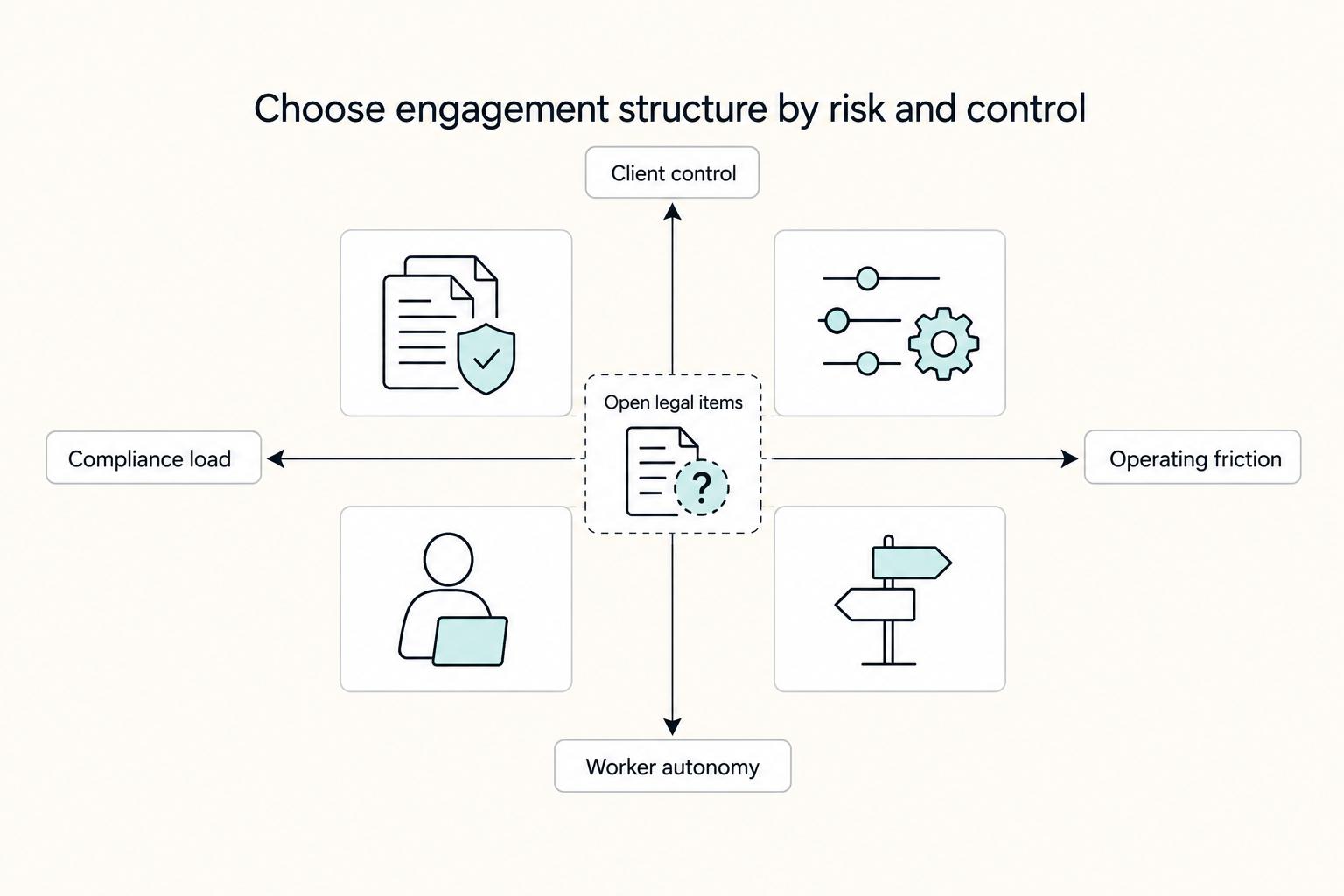
Step 1: Choose Your Engagement Model: A Risk vs. Control Framework#
Start here: the engagement model determines how much control you keep, how much compliance work stays with your team, and how much operational friction you create later. Use this as a first-pass comparison, then confirm the details in your contract chain and day-to-day process. Treat Mexico-specific legal and tax outcomes as open items until you verify them separately.
| Engagement model | Your control over the work | Compliance ownership | Onboarding speed | Payment and admin overhead | Who carries misclassification and tax exposure |
|---|---|---|---|---|---|
| Direct with an individual editor | High day-to-day control | Often more hands-on for your team, depending on contract and practice | Varies with your internal vetting and approvals | Depends on your internal process and payment setup | Contract- and conduct-dependent; do not assume outcomes without review |
| Through an agency or intermediary | Medium to high, depending on how hands-on you stay | Shared and contract-dependent | Varies by vendor intake and contract readiness | Shared between you and vendor, based on scope split | Shared and contract-dependent, not automatic |
| Through a production partner | Lower control over the individual, higher control over outputs | Partner manages delivery operations; your vendor contract still governs your side | Varies with scoping and kickoff readiness | Lower individual handling, with added vendor-management work | More buffered from direct individual management, but still contract- and conduct-dependent |
Direct engagement#
Choose direct engagement when you want a tight creative loop and can manage scope, approvals, and documentation consistently. It becomes riskier when your team manages the editor like internal staff while the paperwork describes an outside vendor relationship.
The safeguard is to define deliverables, revision limits, timelines, acceptance criteria, and decision rights in writing so the agreement does not rely on constant ad hoc instructions.
Agency or intermediary#
This model works when you want help with sourcing and operations but still want influence over style and output. A common failure mode is assuming the intermediary absorbs risk when its legal role is vague or the signed documents do not clearly assign responsibility. Before you rely on an intermediary, check:
| Check | What to confirm |
|---|---|
| Legal role | Exact legal role, such as recruiter, staffing intermediary, agency, or production partner. |
| Contract chain | Who signs with whom and what subcontracting rights exist. |
| Liability | Liability allocation and exclusions. |
| Invoicing alignment | Invoicing entity versus contract party consistency. |
| IP transfer path | If IP ownership matters, the documented transfer path from creator to final rights holder. |
If those points are unclear, do not assume the intermediary is absorbing risk.
Production partner#
A production partner makes the most sense when you are buying a defined output and want one accountable vendor interface. The tradeoff is lower control over the individual contributor. Risk can return if your team still directs that individual inside the partner's delivery structure as if they were your own editor.
To keep the structure clean, use a tight scope, named deliverables, clear acceptance criteria, revision boundaries, and one partner-side point of contact.
The pattern across all three models is straightforward. More direct control can mean more internal compliance handling, while more intermediary structure can mean more vendor diligence. Once you choose the model, the next step is to build contracts and operating rules that actually match it. For another cross-border example, see How a US-based Marketing Agency can pay a UK-based video editor compliantly.
Step 2: Make the Contract and Your Actual Practice Match#
Do not sign a recycled California contractor template. For this arrangement, the contract has to match both the written terms and the way you actually work. California tests control in the contract and in practice, and Mexico can treat the relationship as employment if the work is subordinated personal work for pay. Treat the contract as an operating control file, not just a pricing document.
Step 2.1 Verify the paper stack before signing#
Use this pre-sign matrix and make sure each control has records you can produce later.
| Contract control | Risk prevented | Primary compliance owner | Documentation to retain |
|---|---|---|---|
| Governing framework and worker-status language: independent services, output-based scope, no authority to bind your company | Reduces misclassification/control risk on paper, but cannot fix contradictory day-to-day conduct | Shared; your company owns drafting and operating guardrails | Signed master agreement, statement of work, final redline/version history |
| IP assignment chain from the actual creator, and through any intermediary | Prevents broken ownership chain; U.S. copyright transfer needs signed writing | Shared; you must verify the full chain to the final rights holder | Signed assignment clause or assignment doc, any subcontractor assignment, deliverable acceptance record |
| Invoicing and tax-document workflow, including who invoices, CFDI handling where applicable, and foreign-payee documentation | Prevents payment disputes and weak tax records | Editor or intermediary issues invoices; your company owns intake and retention | Invoice workflow, CFDI copies where applicable, Form W-8 when relied on, payment confirmations |
| Payment timing and California freelance written-contract controls where applicable | Reduces payment-timing disputes and written-contract failures | Your company | Written contract, payment schedule, proof of payment, retained contract copy, at least 4 years if FWPA applies |
One check you should make is FWPA scope. Materials indicate that from January 1, 2025, covered freelance services at $250+, including aggregated contracts over the prior 120 days between the same parties, require a written contract. If no date is stated, payment defaults to no later than 30 days after completion, and the hiring party retains the contract for at least 4 years. Do not treat Mexico residence alone as automatic inclusion or exclusion.
Step 2.2 Test independence before signing and during delivery#
If you want independent-contractor treatment, your behavior has to match your contract. Before signing, confirm that:
| Stage | Control point | What to confirm |
|---|---|---|
| Before signing | Scope | You are buying defined deliverables, deadlines, acceptance criteria, and revision limits, not open-ended labor time. |
| Before signing | Work method | The editor controls hours, location, and method, subject to delivery commitments. |
| Before signing | Tools | The editor uses their own tools, except limited access needed to complete work. |
| Before signing | Contract terms | The contract avoids exclusivity, employee-style titles or reporting lines, and employee-policy language. |
| Before signing | Payment basis | Payment is tied to milestones or accepted deliverables, not attendance or shift coverage. |
| During delivery | Supervision | Do not run daily staff-style supervision if the contract says the editor controls how the work is performed. |
| During delivery | New asks | Route new asks through scope updates, not an internal task queue that mimics employee management. |
| During delivery | Approval focus | Approve outputs and revisions, not online presence or constant availability. |
| During delivery | Relationship drift | If the relationship drifts toward full-time dependency, reassess and rewrite the structure. |
| During delivery | File support | Match invoices to scope and acceptance records so your file supports the independent-services model. |
After kickoff, keep the operating pattern consistent:
- Do not run daily staff-style supervision if the contract says the editor controls how the work is performed.
- Route new asks through scope updates, not an internal task queue that mimics employee management.
- Approve outputs and revisions, not online presence or constant availability.
- If the relationship drifts toward full-time dependency, reassess and rewrite the structure.
- Match invoices to scope and acceptance records so your file supports the independent-services model.
Step 2.3 Design the role to reduce permanent-establishment signals#
PE risk is mostly a role-design problem, not just a drafting problem. Mexico tax law can treat PE as a place of business where activities are carried out, and can also treat dependent-agent patterns as PE risk when someone habitually concludes contracts (or plays the principal contracting role) in your name. Set the boundary early and keep it consistent in titles, communications, and actual authority. In practice, that means:
- No authority to sign customer or vendor contracts in your name.
- No habitual role in concluding contracts or finalizing commercial terms in your name.
- No external representation as your Mexico office or legal representative.
- On external calls, keep the role tied to production or creative execution, and route legal, commercial, and signature matters to your California team.
The pattern to avoid is an external editor who looks, sounds, or acts like your local enterprise representative.
Step 2.4 Use a Merchant-of-Record as a decision branch, not a default#
Depending on the provider's legal setup and scope, an MOR may help with parts of contracting, payment administration, and document collection. It can be useful operationally, but it is not a compliance shortcut.
It may shift part of the contracting and payment administration workload. It does not automatically shift worker-classification exposure, labor-law exposure, or PE exposure created by your own management behavior or authority signals.
Even with an MOR, keep these core records on file:
- Your signed contract with the MOR.
- The MOR's defined legal role and subcontracting rights.
- The full IP assignment chain from creator to final rights holder.
- Invoice and payment records.
- Tax documentation you rely on.
Before work starts, you should be able to produce a signed agreement, a scoped SOW, a payment timetable, a signed IP transfer path, and a written rule on who can direct work and who can represent your company externally.
For a step-by-step walkthrough, see A Deep Dive into the US-Mexico Tax Treaty for Remote Workers.
Before you lock terms, draft a clear cross-border baseline you can review with local counsel: Use the freelance contract generator.
Step 3: Engineer Your Financial Workflow: From Payments to Process#
Once the contract matches the relationship, your next control point is money movement. The goal is a repeatable payment-to-delivery process, not the fastest possible transfer. Keep one rule: no payout without a matching acceptance record, a validated invoice, and stored proof of payment.
If you optimize only for speed, you can create avoidable failures such as invoice mismatches, unclear acceptance, weak records, and disputes over what was delivered. In a cross-border arrangement, process discipline is a core control.
Step 3.1 Choose a payout route by control quality, not marketing claims#
Pick a route based on whether you can predict payout outcomes, reconcile each payment quickly, and defend the record later.
| Route | Total landed payout predictability | FX transparency | Reconciliation effort | Invoice and tax-document handling | Dispute handling | Liability allocation |
|---|---|---|---|---|---|---|
| Direct bank transfer | Define all deduction points and the expected recipient amount before release. | Require a clear FX basis in the payment record; if unclear, treat it as a control gap. | Set beneficiary validation, reference standards, invoice matching, and confirmation storage before rollout. | Define who collects and stores invoice and tax documents before release. | Document reject/return workflow and escalation path with your bank before first use. | Confirm who pays for rejects, recalls, and correction work. |
| Payout platform | Use only if the approval flow shows recipient amount and charges before release, and you can save that record. | Save the FX details shown at approval time for each payout. | Verify transaction IDs, exports, and field consistency before relying on automation. | Confirm whether invoice and tax docs can be attached or linked per payout. | Check terms for holds, reversals, and account review events. | Confirm what the platform covers versus what stays with your team. |
| Merchant-of-Record route | Confirm how contracting, invoicing, and payouts connect, and what the creator receives before release. | Confirm what FX information is visible and retained in exportable records. | Use only if you can export complete records consistently. | Verify what is collected, retained, and exportable. | Review the escalation path for payout errors and contested amounts. | Do not assume full risk transfer; verify service-agreement boundaries. |
Two red flags should stop you immediately:
- You cannot clearly state the expected recipient amount and what could reduce it.
- Finance needs email threads to reconcile a payout.
Step 3.2 Run the same monthly sequence every cycle#
Use the same sequence every time so the paperwork matches the work and the payment.
| Step | Action | Record |
|---|---|---|
| 1 | Confirm milestone acceptance. | Match the deliverable to scope, revision limits, and acceptance criteria. Record dated approval in your project system. |
| 2 | Validate invoice and required documents. | Confirm the legal payee name, amount, currency, and payment instructions match approved records. Collect required billing and tax documents before release. |
| 3 | Release payout only against the approved invoice. | Use a unique payment reference linked to the invoice and milestone. Recheck route, account, amount, and currency at send time. |
| 4 | Archive proof of payment with the same milestone file. | Store the transaction ID, confirmation or receipt, and payout summary if available. Keep one evidence set: scope, acceptance, invoice, proof of payment. |
| 5 | Pause on exceptions and route them formally. | If deliverable, invoice, or payment details do not match, stop the payout and log the exception. |
Run the sequence in that order every cycle. If any detail fails to match, stop the payout and log the exception rather than clearing it informally.
Step 3.3 Use collaboration tools to reduce specific operational risks#
The right tools matter only if they reduce a known failure mode. Use them for that purpose, not because they sound organized.
- Task and milestone tracker: can reduce handoff ambiguity by showing what was requested, what was approved, and what changed.
- Central file storage with version history: can reduce wrong-version delivery risk and clarify final asset ownership and handoff.
- Frame-accurate review tooling: can improve feedback traceability by tying comments to exact timestamps or frames.
- Searchable team messaging: can improve communication accountability by keeping decisions, approvals, and change requests in auditable threads.
If you keep only one discipline from this section, keep this one: money moves only when acceptance, invoice, and payout proof are linked in the same record trail. If you want a deeper dive, read Moving From Hourly to Project-Based Rates.
Conclusion: From Transactional Hiring to Strategic Partnership#
The real advantage is not just access to talent. It is a process you can defend with records.
- Confirm what the source is.
Verify that the page is for SB-600 ("Maintenance of the codes") in the 2003-2004 session.
- Use the status timeline as your checkpoint log.
The bill page shows Introduced, Amended Assembly (02/20/03), Enrolled (05/20/03), Chaptered (06/30/03), and Version (07/14/03), plus Bill Analysis navigation.
- Flag out-of-scope compliance conclusions.
This excerpt is metadata and navigation, so it does not by itself resolve misclassification, permanent-establishment, contract-clause, or payment/invoicing compliance analysis.
What this changes for you is simple. You can verify bill stage and dates from this page, but cross-border freelancer compliance guidance needs additional sources.
For separate AB5 background, see A Guide to California's 'AB5' Law for Independent Contractors.
If you need additional operational guidance, review Merchant of Record options.
Frequently Asked Questions
How serious are misclassification and permanent-establishment risk?
They can be high-risk issues, and you should assess them separately by jurisdiction. In California, classification defaults to the ABC test unless a valid exception applies, including a possible business-to-business path under Labor Code Section 2776 if its conditions are actually met. In Mexico, you need to test whether the relationship looks like subordinated personal work for pay and whether the person habitually concludes contracts or plays the principal role leading to contract conclusion, which can raise PE exposure.
Does AB5 apply if the editor lives in Mexico?
Do not assume yes or no based only on residence. AB 5 is framed around workers in California and took effect January 1, 2020, so you need a California classification analysis under the ABC test and any applicable exceptions. Run that in parallel with a Mexico analysis, because Mexico labor law applies nationally within Mexico.
What is the best way to pay a freelancer in Mexico?
Use the method that gives you the strongest audit trail, not just the fastest transfer. Before release, collect and match the signed contract, milestone acceptance, invoice, payout instructions, and any payer-requested tax form such as Form W-8BEN. If CFDI is used, verify recipient RFC, service description, total amount, payment form, and related fields. Retain acceptance, invoice, payment confirmation, and withholding analysis for at least 3 years as a baseline, and longer where specific tax-record rules require it.
What if some work is done in the United States?
Pause and re-check withholding before payment, because sourcing can change when services are performed in the U.S. The IRS generally sources personal service income where services are performed, and U.S.-source nonemployee compensation is reportable on Form 1042-S with a 30% baseline withholding framework, subject to treaty reduction where applicable. For treaty background, see How to Legally Avoid Double Taxation: A Freelancer's Guide to Tax Treaties.
What contract language matters most for IP ownership?
Get IP transfer terms into a signed writing before the first delivery cycle. U.S. copyright transfer rules require a written, signed transfer, so do not rely on payment records or informal email understandings. Make the agreement explicit on assignment scope, source files, final exports, and handoff conditions tied to acceptance and payment.
What onboarding documents and execution steps should I actually use?
Keep a compact file set and verify identity consistency before money moves. At minimum in this workflow, keep the signed contract, payee legal name, invoice details, payout instructions, and required tax or billing details, then confirm the contract party, invoice issuer, and receiving account align. If names or entities do not match, stop the payout and document the exception first.
Try a related tool
Researched and edited by the Gruv editorial team. Gruv builds cross-border billing, payouts, and finance-operations software for global businesses.
Sources
- bis.gov/search/resultstrusted
- cdph.ca.gov/Programs/HRB/pages/businesspros_copy(1).aspxtrusted
- democrats-financialservices.house.gov/uploadedfiles/chrg-117hhrg47479.pdftrusted
- ftb.ca.gov/file/business/industries/worker-classificati...trusted
- irs.gov/individuals/international-taxpayers/foreign-...trusted
- irs.gov/businesses/international-businesses/mexico-t...trusted
- labor.ca.gov/employmentstatus/abctesttrusted
- legacy.trade.gov/guide_to_exporting.pdftrusted
Educational content only. Not legal, tax, or financial advice.
Related Posts

How Freelancers Can Legally Avoid Double Taxation With Tax Treaties
Classify the tax problem before you touch a return. If your income is mostly personal service fees across borders, this guide fits. If your issue is C corporation profits and shareholder dividends, you are solving a different problem.
Moving From Hourly to Project Rates Without Hurting Cashflow
The right pricing model matches uncertainty and cashflow risk. It should fit how clearly the work can be defined, approved, and defended, not just what you are used to selling. Hourly billing gives you room to work while requirements are still moving. Fixed project pricing gives the client stronger budget clarity once deliverables are stable enough to pin down.
Tax Residency in Mexico for Nomads Beyond the Temporary Resident Visa
Start with one conservative call: are you likely becoming a Mexican tax resident this year, and what evidence supports that call today? That decision shapes the rest of your year. If you skip it, every later task turns reactive, from local tax planning to U.S. filing choices.