
Quick Answer
Start with a city-by-city decision process: map every fee line, separate legal instrument types, and verify payout traceability before launch. For food delivery platforms pay restaurant partners commission splits settlement decisions, the article’s direct recommendation is to avoid single-rate assumptions and require evidence that links checkout disclosures, merchant acceptance, and final statement output. Use New York City and Illinois enforcement context as risk signals, then approve rollout only when finance, legal, ops, and product can all audit the same order path without guesswork.
How Restaurant Partner Payouts Work Across Cities#
A launch market is not viable just because the headline commission looks workable. In food delivery, what a restaurant actually receives can shift once you account for local rules, layered fees, and legal risk tied to weak disclosures or shaky consent records.
Use that lens for the rest of this guide. You are not trying to answer whether delivery demand exists in the United States. You are trying to answer a harder operator question: after fees, adjustments, and compliance overhead, does a city still produce predictable partner payouts and acceptable margin for your business?
A good early warning sign is a model that depends on one neat commission number. Real payout reporting can be messier. Beyond base commission, settlement data can include delivery charges, refunds, tax-related line items, and other adjustments. If your economics only work when those items are ignored or smoothed away, you do not have a market thesis yet. You have a spreadsheet assumption.
Legal risk belongs in the same decision, not in a separate bucket. In late 2024, the Federal Trade Commission and the State of Illinois filed a complaint against Grubhub entities alleging, among other things, violations of Section 5(a) of the FTC Act, ROSCA, and the FTC Impersonation Rule. That is not a finding of liability, and it does not tell you what every city allows on fees. It does tell you something important for launch planning: platform risk is not only about how much you charge. It can also involve how fees are presented, what merchants agreed to, and whether you can prove it later. Use the rest of the article to build a simple go or no-go test:
-
Map the full fee stack by city. Treat commission caps as one input, not the whole model. Compare commission, delivery, refund, tax-related, and other adjustments instead of relying on a single blended take rate.
-
Separate city rules from legal events. A local cap changes the pricing room you have. A complaint or other dispute history changes how much disclosure, contract, and audit discipline you need.
-
Verify payout predictability before launch. The checkpoint that matters most is whether finance, ops, legal, and product can all trace an order from fee disclosure through merchant acceptance to settlement output without hand-waving.
One practical recommendation up front: build a city evidence pack before you commit product or go-to-market resources. At minimum, include the current local rule text, your proposed merchant terms, screenshots of fee and menu-price disclosures, and a short memo on active legal risk signals. A common failure mode is copying assumptions from one city into another and discovering too late that your payout mechanics, not your demand forecast, are what break the launch.
What to prepare before you compare markets#
Prepare a standardized evidence pack before finance models any city. Otherwise, you are comparing assumptions, not markets.
| Prep item | Include | Evidence |
|---|---|---|
| Evidence pack per city | Current commission-cap legal text; known settlement or dispute history; documented restaurant-facing practices; assumed payment flow model | If modeling split payment, state that commission is retained first and net funds are remitted later |
| Contract and disclosure inputs | Proposed partner terms; onboarding consent flow; fee disclosure copy; menu-price disclosure copy | Exact screen, terms version, and acceptance record behind each fee line |
| Non-negotiables | Target contribution margin; acceptable legal exposure; tolerance for payout variability | If a market works only after relaxing those thresholds, treat it as a no-go signal |
| Owners and sign-off artifacts | One owner each in ops, legal, product, and finance | Legal memo; approved onboarding screens; settlement logic note; finance sensitivity sheet |
-
Build one evidence pack per city. Use the same structure each time: current commission-cap legal text, known settlement or dispute history, and documented restaurant-facing practices from relevant platforms. Include your assumed payment flow model, because settlement interpretation changes by model. If you are modeling split payment, state it plainly: commission is retained first and net funds are remitted later.
-
Lock contract and disclosure inputs before modeling. Put proposed partner terms, onboarding consent flow, fee disclosure copy, and menu-price disclosure copy in the same pack. Legal and product should be able to point to the exact screen, terms version, and acceptance record behind each fee line.
-
Set non-negotiables up front. Define target contribution margin, acceptable legal exposure, and tolerance for payout variability before city comparisons begin. If a market works only after relaxing those thresholds, treat that as a no-go signal rather than a spreadsheet adjustment.
-
Assign owners and sign-off artifacts. Name one owner each in ops, legal, product, and finance, and require a sign-off artifact per function, for example a legal memo, approved onboarding screens, a settlement logic note, and a finance sensitivity sheet. This keeps launch decisions tied to evidence instead of memory.
Related reading: How Photo and Stock Image Platforms Pay Photographers with Royalty and Licensing Payout Models.
Map the real fee stack instead of using one headline commission#
Treat this as a hard gate: if your margin only works under one base-commission assumption, pause launch and complete full fee-stack sensitivity first.
Platform commissions are not just a pricing line. They can reduce incentives to expand curbside operations, so fee design can change restaurant-side operating decisions, not just your take rate.
Break every fee into its own model line#
Model fees at the line-item level for each city: commission, credit card processing fees, service fees, small order fees, and any enhanced services fee. Do not collapse these into one blended number early.
For each line, require evidence for four fields: what the fee is, who pays it, where it is disclosed, and how it appears in settlement math. If any field is unclear, mark it unresolved instead of filling it with assumptions.
Classify each fee by payer, disclosure, and cap exposure#
Use one template across all candidate cities and all three platforms, DoorDash, Uber Eats, and Grubhub, based on current terms, onboarding screens, and statement samples in your evidence pack.
| Fee type | Payer (verify) | Disclosure location (verify) | Rule exposure (assess) |
|---|---|---|---|
| Commission | Restaurant | Partner agreement, onboarding terms, merchant statement | Commission-cap exposure to assess |
| Credit card processing fees | Restaurant or mixed | Partner terms, pricing appendix, settlement statement | May sit outside headline commission; verify locally |
| Service fees | Customer, restaurant, or mixed | Checkout UI, partner terms, merchant communications | Delivery-fee or related local limits to assess |
| Small order fees | Customer | Checkout UI, fee labels, help content | May interact with delivery-fee limits; verify locally |
| Enhanced services fee | Depends on package/add-on | Pricing schedule, add-on terms, invoices | Often mis-grouped with base commission; verify locally |
Keep version control strict. Save the exact terms version, exact screen, and exact statement sample used for each row.
Compare platforms without inventing certainty#
Do not assume a fixed fee map by platform. Classify charges as mandatory, elective, or conditional from the live documents in your pack for the specific city and setup you are modeling.
Use one decision rule across markets: if your contribution economics clear only after you collapse the stack into a single "base commission," do not launch yet. Finish fee-line sensitivity first so your model is defensible when pricing assumptions meet actual payout outcomes.
Separate law changes from settlement events before forecasting payouts#
Once your fee stack is mapped, treat legal inputs the same way: classify each event by what it is before you model impact. Pricing rules, enforcement complaints, and settlements can all change risk, but they do not change payout economics in the same way.
Classify each legal item by instrument type#
Before forecasting, bucket each legal item by instrument type: commission-cap law change, settlement, or enforcement complaint. This keeps you from modeling a conduct or disclosure dispute as if it automatically resets allowable pricing structure.
Use the filing itself as your checkpoint. In the evidence pack, the Grubhub matter is a complaint for permanent injunction, monetary judgment, civil penalty judgment, and other relief brought by the Federal Trade Commission and the People of the State of Illinois, with alleged violations including Section 5(a) of the FTC Act, ROSCA, and the Impersonation Rule. Model that as an enforcement action, not as a settlement outcome.
Track jurisdiction and case posture separately#
Track jurisdiction and case posture in separate fields, not buried in notes. A practical rule: each entry should show jurisdiction, document type, named parties, and remedy sought. If a row cannot answer those four points, keep it out of payout forecasting until it can.
Do not use one legal headline as a proxy for every city. If a model generalizes across jurisdictions from a single event, mark it invalid and rebuild by city.
Keep case names case-specific until verified#
Keep case names such as Lynn Scott LLC, et al. v. Grubhub Inc. as case-specific records until you verify court, claims, and procedural posture from the docket. Do not treat a case name as shorthand for a broader market trend.
Related: Affiliate Network Payout Structures: Performance-Based Commission Models for Publisher Partners.
Rank city launch options with a go or no-go scorecard#
Do not pick a launch city on headline margin alone. Start where disclosure obligations are explicit and monitorable, even if near-term take rate is lower.
Score each city on the same four dimensions#
Use one scorecard for every city, for example 1-5, where 1 is low risk/friction and 5 is high risk/friction, and require an evidence link for each score.
| Dimension | What to score |
|---|---|
| Fee-stack ceiling risk | Risk that rules or fee design compress what you can charge or retain |
| Legal and disclosure burden | Product/legal effort needed to show mandatory charges clearly and keep them current |
| Payout predictability | Expected stability of settlement timing and dispute volume |
| Merchant adoption friction | Difficulty of onboarding restaurants to terms, disclosures, and operating expectations |
Do not treat these as equal by default. If fee presentation is still unresolved, weight legal/disclosure burden higher. The FTC fee-rule FAQ explicitly asks which mandatory fees must be included in a displayed total price; if you cannot answer that with product artifacts, the city is not launch-ready.
Use New York City and Chicago as anchor cases#
Use New York City and Chicago as calibration anchors, but for different risk signals.
- New York City: pressure-test city-specific rule tracking and keep law changes separate from complaints or settlements.
- Chicago / Illinois: pressure-test enforcement sensitivity. In the Grubhub complaint, the plaintiffs are the Federal Trade Commission and the People of the State of Illinois, with alleged violations including Section 5(a) of the FTC Act and the Illinois Consumer Fraud and Deceptive Business Practices Act.
Do not infer city fee caps, liability findings, or settlement terms from that complaint. Use it as an enforcement-risk signal for pricing transparency and merchant-facing conduct.
Apply vetoes before approving any weighted score#
Apply hard red flags before final ranking. Treat these as no-go conditions until resolved:
- unclear pricing transparency ownership in customer and merchant flows
- weak restaurant onboarding consent evidence
- unresolved menu-price disclosure ownership across product, ops, and legal
Approve a city only when the evidence pack is complete for that market: current fee presentation artifacts, merchant-facing disclosure artifacts, and auditable consent/disclosure ownership. If evidence is incomplete, defer launch and prioritize the city with clearer obligations and better auditability.
Design settlement windows and payout cadence with reconciliation in mind#
Start conservative: set payout cadence by risk tier, and make the ledger your source of truth for release decisions. If payout timing sits in ad hoc ops notes or PSP exports, you lose auditability when a restaurant questions a statement.
Step 1. Define settlement policy by tier before promising speed. Group partners by evidence-backed risk signals, then document when orders are eligible for payout review for each tier. The goal is explainable payouts, not the fastest cycle. Before widening cadence, require a clear owner, a written release rule, and statement fields that match what restaurants will see.
Step 2. Keep one posting sequence and use it everywhere. Use a single order of operations: order close, fee allocation, reserve/hold handling, payout release decision, exception review, then merchant statement generation. Treat this sequence as a control, not a preference, so finance, support, and merchant statements reconcile to the same event trail.
Step 3. Add checks for delayed adjustments before release. Refunds, service-fee adjustments, and post-order fee disputes often arrive after initial posting. Route those into a review queue, and require a second release check when merchant net proceeds change. If you cannot trace an adjustment from order record to statement period, do not increase payout frequency.
Step 4. Tighten monitoring where legal risk is active, then tie it to close. Where enforcement pressure is active, shorten dispute-monitoring and disclosure-audit loops before expanding payout cadence. In Illinois, the FTC and the People of the State of Illinois filed the Complaint for Permanent Injunction, Monetary Judgment, Civil Penalty Judgment, and Other Relief against Grubhub; treat that as a risk signal for tighter controls, not as an adjudicated finding. Then connect payout controls directly to month-end close and PSP reconciliation using the same cutoffs, adjustment codes, and exception logs. If those records diverge, pause cadence expansion and fix the evidence trail first. For a practical template, see Month-End Close Checklist for Payment Platforms: Reconciling PSP Settlements Bank Statements and Ledger.
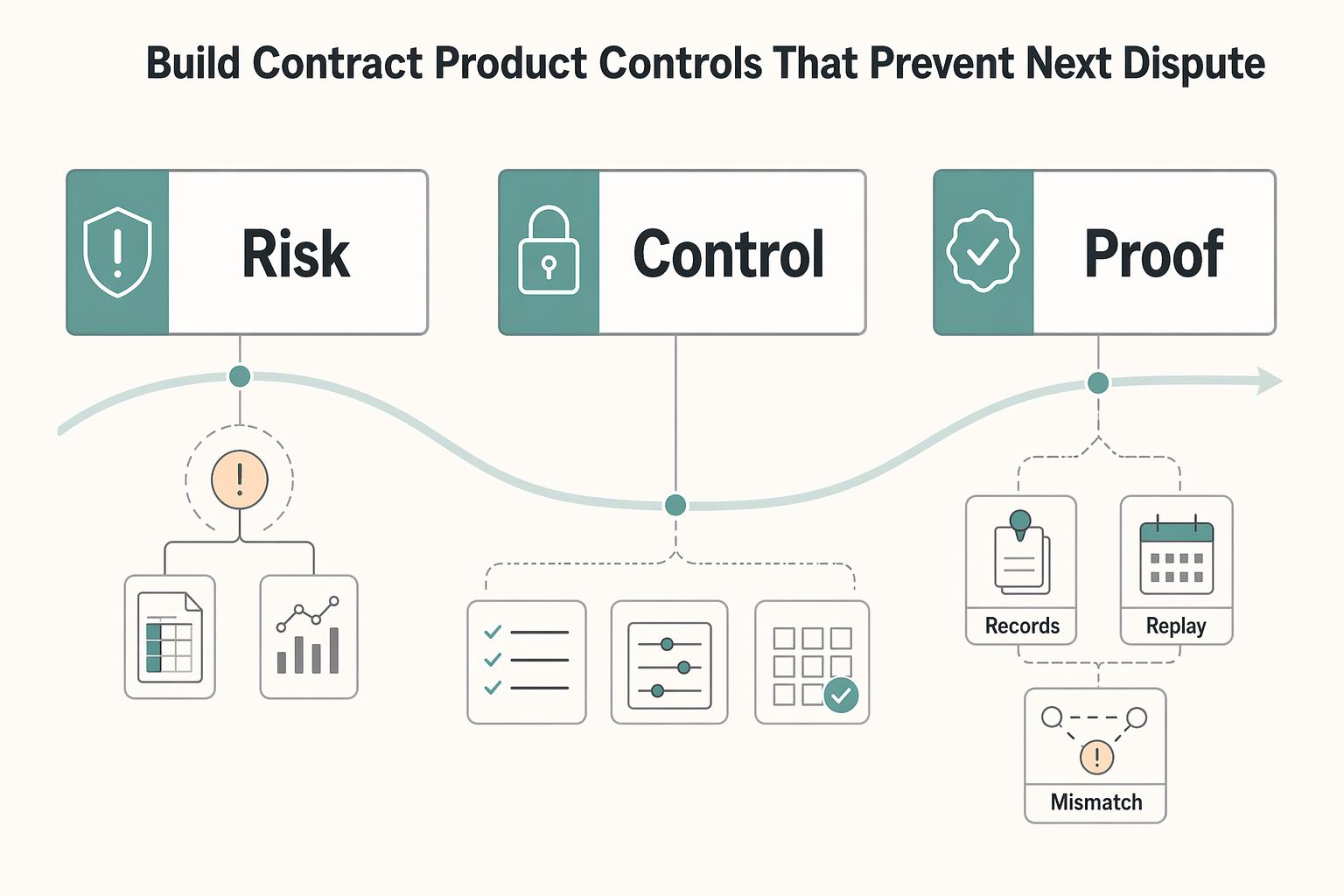
Build contract and product controls that prevent the next dispute#
Prevent disputes by defining disclosure ownership in writing and enforcing it in product controls. Clean payout math alone will not hold if fee presentation, menu-price presentation, and onboarding records drift across teams.
Step 1. Write clear ownership into partner terms. State who owns fee presentation, where fee and menu-price disclosures appear, and who approves updates before they go live. Keep this explicit so sales, ops, and product are not relying on verbal handoffs.
Step 2. Make onboarding consent reconstructable. Capture a timestamped acceptance record with the exact terms version and disclosure text shown to the restaurant account at acceptance. If you cannot replay what was accepted, disputes become interpretation instead of evidence.
Step 3. Keep fee labels unambiguous across surfaces. Use consistent, specific labels in checkout, confirmation, and statements so platform charges are not confused with tax or municipal lines. Small payment-flow choices materially affect outcomes, and weak checkout flows increase confusion and drop-off.
Step 4. Use one release gate for disclosure-sensitive changes. When ownership is shared, require one approval gate that reviews contract language, onboarding terms, menu-price presentation, checkout labels, and statement output together. This is especially important in higher-control payment setups, where added control can come with more complexity, cost, and risk.
We covered a similar control pattern in How Legal Platforms Pay Interpreters and Court Reporters.
Common mistakes that derail rollout and how to recover#
Even with strong release gates, rollouts still fail when uncertain or unofficial inputs are treated as production truth. Recover by resetting jurisdiction checks, fee visibility, evidence quality, and payout timing.
| Mistake | Recovery | Checkpoint |
|---|---|---|
| Porting one market model into another | Rebuild each city model from that market's own legal and operating inputs; keep statutory rules separate from settlement behavior | Verify informational copy against an official legal edition before using it for launch decisions |
| Approving economics from partial fee reporting | Require full fee-stack reporting in one view and validate it against real statement outcomes before sign-off | If finance cannot trace order-level charges to net merchant payout, treat the model as incomplete |
| Weak dispute evidence for onboarding and disclosures | Keep audit logs that reconstruct what the merchant accepted and what fee detail appeared for the relevant period | Run one replay test on a live merchant before launch |
| Setting payout cadence from forecasts alone | Start conservative, then relax windows only after exceptions and reconciliation breaks stabilize | Use observed cycle performance, not optimism, to speed up payouts |
Mistake 1: Porting one market model into another. Recovery: rebuild each city model from that market's own legal and operating inputs, and keep statutory rules separate from settlement behavior in your planning logic. If a legal input came from an informational copy, verify it against an official legal edition before using it for launch decisions.
Mistake 2: Approving economics from partial fee reporting. Recovery: require full fee-stack reporting in one view and validate it against real statement outcomes before sign-off. If finance cannot trace order-level charges to net merchant payout, treat the model as incomplete.
Mistake 3: Weak dispute evidence for onboarding and disclosures. Recovery: keep audit logs that let you reconstruct what the merchant accepted and what fee detail appeared for the relevant period. Run one replay test on a live merchant before launch. If you cannot reproduce consent and statement detail, your record will not hold up.
Mistake 4: Setting payout cadence from forecasts alone. Recovery: start conservative, then relax windows only after exceptions and reconciliation breaks stabilize. Forecasts are uncertain and can carry unexpected costs, so use observed cycle performance, not optimism, to speed up payouts.
For a step-by-step walkthrough, see How Annotation and Data Labeling Platforms Pay Workers Under Piecework and Compliance Constraints.
Conclusion#
Use this as your final go or no-go check. If you cannot pass all five steps with evidence, do not commit launch spend, promise restaurant payout timing, or assume the unit economics in your model will survive contact with the market.
- Confirm applicable local pricing rules before you price anything.
Pull the current rules in your target jurisdiction that affect commissions, delivery fees, or other fee lines, then save the source and date you relied on. The point is not to memorize every ordinance. It is to prove your model reflects the actual jurisdiction you are entering. A common failure mode is copying one market's assumptions into another and discovering too late that only one fee line was constrained.
- Validate the full fee stack, not the headline commission.
Rebuild one completed order from customer checkout to restaurant statement and tie every deduction back to signed terms and statement labels. If your economics only work when you model a single base commission, stop there and redo the math. The real risk is usually hidden in layered charges, not the advertised rate.
- Separate legal-risk signals from pricing-law constraints.
Treat local pricing rules and case activity as different inputs. A pricing rule may change what fee structure is allowed, while a complaint can change what you need to disclose, document, or monitor. For example, the FTC and the People of the State of Illinois brought a complaint against Grubhub that includes Section 5(a) allegations and seeks permanent injunctive and monetary relief. That is a serious disclosure and conduct signal, but it is not a substitute for checking each jurisdiction's pricing rules.
- Lock auditable disclosure controls before onboarding restaurants.
Your evidence pack should include versioned contract terms, timestamped onboarding consent, the exact fee disclosure shown at acceptance, and the fee/price disclosure text that applied at that moment. Verify that the merchant statement uses the same fee names the restaurant accepted. Red flag: you have a signed agreement but cannot reproduce the screen, language, or version the partner actually saw.
- Approve settlement windows only after reconciliation is stable.
A payment gateway may automate split payments, but automation does not prove your payout logic is right. Start with a conservative settlement cadence and release faster payouts only after order-level reconciliation, delayed adjustment handling, and dispute monitoring are consistently clean. The checkpoint that matters is simple: can finance trace an order through fee allocation, any refund or adjustment, and the final restaurant payout without manual guesswork? If not, hold the rollout and fix that before scale.
Frequently Asked Questions
What is included in a food delivery platform commission split?
Usually it is not just one commission percentage. Restaurant payout can be reduced by the base platform commission plus other restaurant-facing charges. A useful check is to trace one completed order from checkout to the merchant statement and confirm every deduction ties back to signed terms and statement detail.
How can total restaurant-facing fees exceed a capped delivery fee?
A cap on one fee line does not automatically cap every other deduction tied to the order. Delivery-app pricing can be layered, and industry reporting has noted that apps can charge multiple fees that are not always readily apparent. If your model assumes a city's capped delivery fee limits the full fee stack, treat that as a red flag and rework the math.
Do legal settlements change how restaurants are paid or only how platforms disclose fees?
It depends on the settlement terms, so do not assume a settlement rewrites payout mechanics by itself. What the cited Grubhub reporting clearly supports is pressure around fee transparency and presentation. In practice, test both outcomes: whether statement presentation changes, and whether any contract or fee-application logic changes with it.
What is the difference between commission cap legislation and a class action settlement?
They are different risk buckets and should be analyzed separately. Settlement reporting focuses on hidden-fee allegations and transparency-related practice changes; it does not, by itself, define local commission-cap limits. If you mix those into one "legal risk" bucket, you can miss whether your main issue is fee-cap math, disclosure quality, or both.
Which disclosures reduce risk around hidden-fee allegations?
A practical low-risk setup is one you can reproduce later. Keep versioned fee disclosures and onboarding consent records with timestamps, then make sure the merchant statement uses the same fee labels the partner accepted. A common failure mode is having the current contract on file but no clear record of what the restaurant actually saw when it agreed.
How should founders compare New York City, Chicago, and other markets before launch?
Compare them city by city, not by analogy, and separate three inputs: current local commission-cap rules, settlement/disclosure risk, and the real fee stack shown to restaurants. Do not assume New York City, Chicago, and other markets behave the same without verifying current rules and statement disclosures. If a market's rules or disclosure ownership are still unclear, delay launch there before you promise a payout cadence you may need to unwind.
Try a related tool
Researched and edited by the Gruv editorial team. Gruv builds cross-border billing, payouts, and finance-operations software for global businesses.
Sources
- bers.nyc.gov/assets/dca/downloads/pdf/about/PublicComment...trusted
- federalregister.gov/documents/2024/12/10/2024-27836/defining-lar...trusted
- ftc.gov/business-guidance/resources/rule-unfair-or-d...trusted
- ftc.gov/sites/default/files/documents/reports/staff-...trusted
- govinfo.gov/content/pkg/CHRG-116hhrg44090/html/CHRG-116h...trusted
- leginfo.ca.gov/pub/95-96/bill/sen/sb_0951-1000/sb_975_bill_...trusted
- nyc.gov/assets/dca/downloads/pdf/about/PublicComment...trusted
- sec.gov/Archives/edgar/data/1792789/0001193125203049...trusted
Educational content only. Not legal, tax, or financial advice.
Related Posts
How Real Estate Platforms Pay Agents Commissions and Handle Closing Disbursements
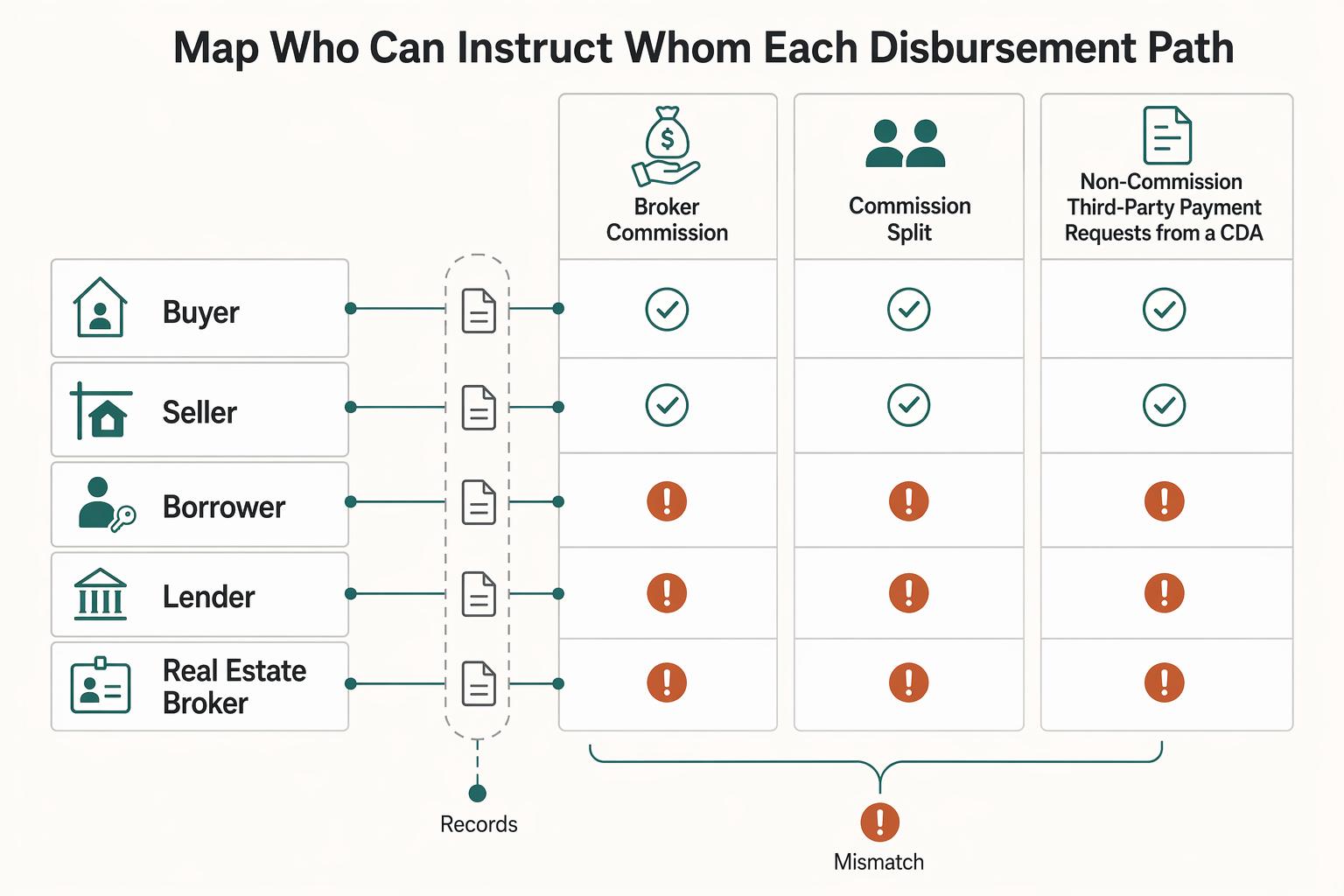
At closing, the controlling question is who can lawfully instruct the escrow holder to release trust funds. In California, the June 30, 2025 guidance from the Department of Financial Protection and Innovation and the Department of Real Estate makes the boundary clear. An escrow agent disburses trust funds based on the written escrow instructions of the principals to the transaction, not solely on a broker's request at closing.
Affiliate Network Payout Structures for Publisher Commissions
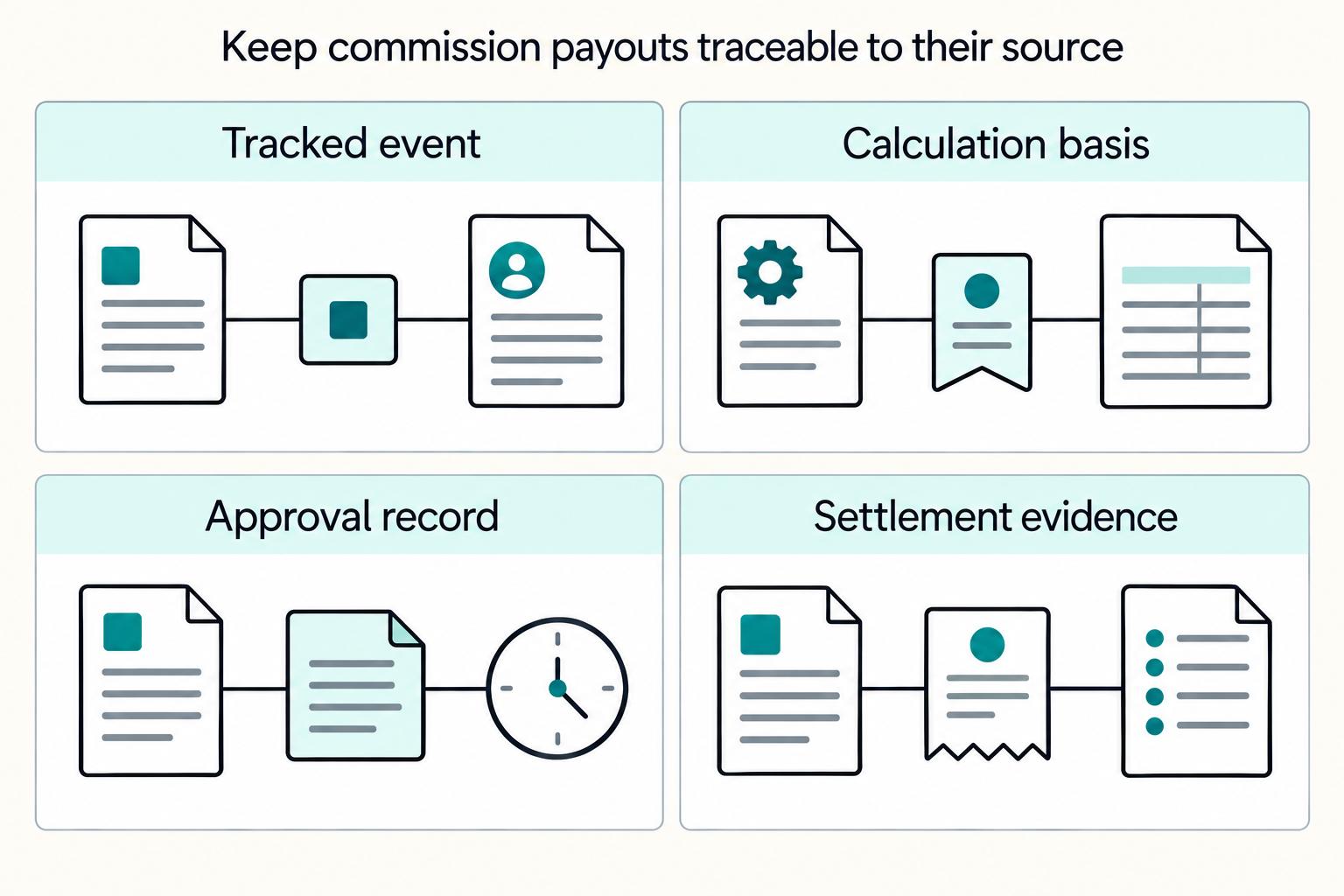
Commission design is an operating decision, not a pricing footnote. The structure you choose affects what behavior you reward and the economics of the program. It is easy to announce rates. It is much harder to define a model that still holds up once reversals, edge cases, and partner questions start showing up.

Month-End Close for Payment Platforms with PSP Settlement Control
Month-end close often breaks down when PSP settlement is treated as a side reconciliation. For payment platforms, settlement is often the clearest record of what cash should have moved, so it should drive the close rather than being checked after journals are drafted. If you run close across multiple PSPs, you need that settlement record to lead the review before your team starts defending journal entries.