
Quick Answer
Decide by verification, not by label. For a UK payment platform, keep Small Payment Institution versus Authorised PI as a provisional choice until current FCA material confirms your exact perimeter under the Payment Services Regulations 2017. Treat AIS and PIS roadmap items as immediate stop-go checkpoints, and require one signed service-and-funds-flow memo before filing. Mark each assumption as confirmed, inferred, or unverified, and escalate to legal review when teams describe the same flow differently.
How to Decide Between Small PI and Authorised PI#
If you are choosing between Small Payment Institution and Authorised Payment Institution, confirm current Financial Conduct Authority requirements before treating any comparison point as settled. For platforms paying contractors, sellers, or creators in the United Kingdom, align compliance, legal, finance, and risk on one shared fact base before anyone treats a filing path as settled.
Treat claims about permissions, thresholds, fees, capital, reporting depth, timelines, or handbook obligations as unverified until you confirm them against current Financial Conduct Authority materials.
Some HMRC and business-structure points are well-established, for example:
- HMRC says you tell HMRC by registering for Self Assessment, and late notification after 5 October 2025 can lead to a penalty for the prior tax year shown as 6 April 2024 to 5 April 2025.
- Filing without reactivating an existing Self Assessment account may delay the return.
- A National Insurance number is required before starting Self Assessment registration.
- Sole traders are personally responsible for business debts, while company owners' debt responsibility is limited to their financial investment.
Use that contrast as your operating rule. If a statement would change your licence choice, control scope, or launch timing, put it on an explicit unverified list until it is checked against current FCA sources. That helps you avoid both underbuilding and unnecessary control buildout.
We covered this in detail in 8 Resilient Compliance Controls for Payment Platforms in 2026.
At-a-glance comparison for Small PI and Authorised PI#
If your roadmap could include Account Information Services (AIS) or Payment Initiation Services (PIS), treat that as a stop-go verification point before assuming Small Payment Institution (SPI) is viable. The defensible working view is simple: SPI is the lower-volume PI category, Authorised Payment Institution (API) is the authorised PI route for payment-service activities, and the key decision details still need live Financial Conduct Authority confirmation under the Payment Services Regulations 2017.
| Criteria | Small Payment Institution | Authorised Payment Institution | Verification required now |
|---|---|---|---|
| Legal status | Secondary source describes SPI as a PI category for lower transactional volumes. | Supported as a company authorised by the FCA to carry out payment-service activities such as executing payment transactions. | Yes. Financial Conduct Authority should confirm current status labels, route, and scope. |
| Permitted services | Treat scope as potentially narrower and verify service-by-service; do not rely on broad secondary summaries. | Supported as an authorised route for payment-service activities, with exact permissions still requiring confirmation. | Yes. Financial Conduct Authority should confirm permissions for your exact product perimeter. |
| AIS and PIS scope point | Do not assume SPI coverage or exclusion for AIS/PIS without FCA confirmation. FCA shows a separate path for a registered account information service provider, and one secondary source conflicts on PIS. | Potentially a candidate if your roadmap includes broader regulated payment functionality, subject to confirmation. | Yes. Financial Conduct Authority is the source owner, and this is a stop-go check. |
| Control burden | Lower burden is a common assumption; confirm the specifics with the FCA. | Secondary source describes stricter capital, governance, and compliance requirements. | Yes. Financial Conduct Authority should confirm current prudential, governance, and control expectations. |
| Reporting depth | Ongoing reporting should be assumed, but depth is not confirmed. | Ongoing reporting should also be assumed; relative depth versus SPI is not quantified here. | Yes. Financial Conduct Authority. A reporting-requirements area exists; confirm the SPI/API split directly with the FCA. |
| Scale implications under the Payment Services Regulations 2017 | Planning fit for smaller, stable scope. | Planning fit where you need broader permission headroom. | Yes. Financial Conduct Authority must confirm current thresholds, trigger points, and limits. |
| Current fees and thresholds | Confirm current fees and limits with the FCA. Do not model on guessed costs. | Confirm current fees and limits with the FCA. Do not model on guessed costs. | Yes. Financial Conduct Authority is required for current fees, thresholds, and filing facts. |
| Wrong-choice risk | Under-licensing risk: building or launching into unsupported scope, then needing perimeter reset or permission change. | Overbuilding risk: higher governance, compliance, and evidence cost earlier than needed. | Yes. Financial Conduct Authority for scope confirmation. Internal owners should price rework risk on both sides. |
The practical rule is simple. If your product team is discussing bank-connect features, payment initiation, or anything adjacent to AIS or PIS, freeze SPI/API assumptions and get a perimeter answer first. The main failure mode is not paperwork delay. It is engineering and commercial execution built on the wrong regulated-service map.
A simple internal readiness check is whether your memo can clearly map to FCA's operational paths: applying to become an EMI or PI, varying permissions, limitations or requirements, and reporting requirements. If that mapping is unclear, the status choice is not ready to lock.
What the status decision changes in practice#
The status decision is operational before it is administrative. Do not lock a registration or authorisation path until you have a defensible perimeter view, named owners, and evidence that matches how your platform actually moves money.
Do not assume this guide provides a precise legal summary of Regulation 14 or a definitive Small PI versus Authorised PI rule split. Use Regulation 14 and PSR 2017 as live verification points with counsel, not as shorthand assumptions in planning documents, and recheck filing expectations against the FCA's payment services regulations.
| Practical question | What to do now |
|---|---|
| How should we treat the status choice? | Treat both routes as decisions that require a current legal perimeter check and an operating model you can evidence. |
| What is the core control artifact? | Keep one controlled service-and-funds-flow memo, and require sign-off before filing or launch. |
| What is the first warning sign? | If product, legal, compliance, finance, and risk describe the same flow differently, the status decision is not ready. |
Once you frame the decision properly, the next step is making ownership explicit.
Map ownership clearly#
Use a clear internal split: compliance owns interpretation, legal owns perimeter, finance owns evidence quality, and risk owns escalation. This is a practical control model, not an FCA-mandated allocation.
| Function | Owns | Consistency check |
|---|---|---|
| Compliance | Interpretation | What service you provide; where customer money moves; who owns change decisions |
| Legal | Perimeter | What service you provide; where customer money moves; who owns change decisions |
| Finance | Evidence quality | What service you provide; where customer money moves; who owns change decisions |
| Risk | Escalation | What service you provide; where customer money moves; who owns change decisions |
Use one consistency check. Can each owner answer the same three questions the same way: what service you provide, where customer money moves, and who owns change decisions? If not, pause the status decision and resolve the mismatch first.
Plan ongoing control ownership#
Detailed FCA handbook obligations vary by section. Keep the implementation rule simple: assign an owner, keep an evidence trail, and define an escalation path for each area.
Where teams usually slip#
Teams slip when status is treated as a filing choice and controls are left for later. A common failure pattern is weak evidence quality: inconsistent flow descriptions, records that cannot be reproduced, and issue handling outside controlled processes.
That risk is not theoretical in this sector. The Treasury consultation referenced six recent PI/EMI insolvency cases. Three started in 2018, and only one had returned funds to customers at that point. Do not finalize status until both the legal route and the operating evidence are ready.
Need the full breakdown? Read Cash Flow Forecasting for Payment Platforms for Payout Go/No-Go Decisions.
Product scope limits that affect platform architecture#
Your architecture should follow a documented perimeter decision, not lead it. Service-boundary rules for payment-platform features require FCA confirmation, and a definitive Small Payment Institution versus Authorised PI feature split needs specialist legal advice.
| Scope item | Use now | Working rule |
|---|---|---|
| Account Information Services (AIS) | Legal-perimeter checkpoint | Keep in a controlled queue until legal and compliance confirm scope and ownership |
| Payment Initiation Services (PIS) | Legal-perimeter checkpoint | Keep in a controlled queue until legal and compliance confirm scope and ownership |
| CP22/7 | 2022/23 proposal-stage planning context | Use only for fees and applicability context, then separate proposal-stage assumptions from final policy outputs |
| Authorised Payment Institution vs Authorised Electronic Money Institution | Counsel-led distinction | Record uncertainty explicitly, pause irreversible product decisions, and use an internal sign-off gate before release |
Treat any roadmap item that resembles Account Information Services or Payment Initiation Services as a legal-perimeter checkpoint before build or launch. Keep those items in a controlled queue until legal and compliance confirm scope and ownership.
Use CP22/7 only as 2022/23 proposal-stage planning context on fees and applicability, not as a perimeter rulebook. A practical control is to map your business to the relevant chapters using Table 1.1, then separate proposal-stage assumptions from final policy outputs so architecture and cost planning do not drift.
Where teams compare Authorised Payment Institution and Authorised Electronic Money Institution, keep that distinction counsel-led in this workflow. The practical move is to record uncertainty explicitly, pause irreversible product decisions, and use an internal sign-off gate before release.
Decision rules by platform growth scenario#
While the core facts are still moving, do not lock a final Small Payment Institution versus Authorised Payment Institution decision. Set a working direction, document assumptions, and define clear escalation triggers for specialist legal advice when permissions, volumes, or legal responsibilities are unclear.
| Growth scenario | Working direction | Main upside | Main tradeoff | Escalate for specialist advice when |
|---|---|---|---|---|
| Early-stage, single-use-case UK platform | Start with the simplest path that fits current facts, and record what must stay true | Faster setup and simpler records | Choosing the wrong path early can force a perimeter reset or permission change later | The team cannot clearly explain what regulated service is being provided |
| UK scale-up with more ownership or governance complexity | Bring forward Authorised Payment Institution analysis before processes harden | Broader permission headroom and clearer governance planning | Higher governance, compliance, and evidence cost earlier than needed | Legal responsibilities or control ownership are being interpreted differently across teams |
Roadmap includes Account Information Services, Payment Initiation Services, or adjacent regulated functionality | Confirm the perimeter early and do not assume the narrower route applies | Avoids late product-scope surprises | Requires a stop-go legal check before build or launch | Any part of the product perimeter is described differently across teams |
Across all scenarios, your checkpoints matter more than the label you prefer.
Use simple if-then rules#
If your roadmap includes Account Information Services or Payment Initiation Services, treat the status choice as an immediate checkpoint. If product, legal, compliance, finance, and risk describe the same flow differently, do not file. If current fees, thresholds, or permissions would drive runway or go-live dates, verify them directly with the Financial Conduct Authority first.
| Situation | Rule | Reference |
|---|---|---|
Roadmap includes Account Information Services or Payment Initiation Services | Treat the status choice as an immediate checkpoint | AIS/PIS scope point |
| Teams describe the same flow differently | Do not file until one shared perimeter statement exists | What service you provide; where customer money moves; who owns change decisions |
| Fees, thresholds, or permissions drive budget or launch timing | Verify them directly with the Financial Conduct Authority first | Confirm current fees and thresholds with the FCA |
If you start on the narrower path and your needs change, plan the move deliberately. It is usually easier to change direction when your assumptions and triggers are documented.
Keep the tradeoff explicit#
The core tradeoff is lower immediate burden versus future migration cost. Status choices affect both control scope and legal responsibilities, so "switch later" is only controlled if triggers and ownership are already written down.
A practical checkpoint is record discipline: keep dated records so returns can be completed correctly, and keep one shared assumptions log for the current structure choice. If teams are not working from the same records, the decision is not ready.
Failure modes to catch early#
Scope drift is the main operational failure mode. Incremental changes to business setup can change tax treatment or legal responsibility without anyone formally reopening the decision.
Process mismatch is the second. Filing against the wrong route, or filing with unresolved source questions, can create avoidable delay. Confirm filing path, source baseline, and ownership before each filing step.
Working rule: use a lighter initial path only when facts are stable and documented. Otherwise, escalate earlier for specialist advice and fuller analysis.
Evidence pack to prepare before FCA engagement#
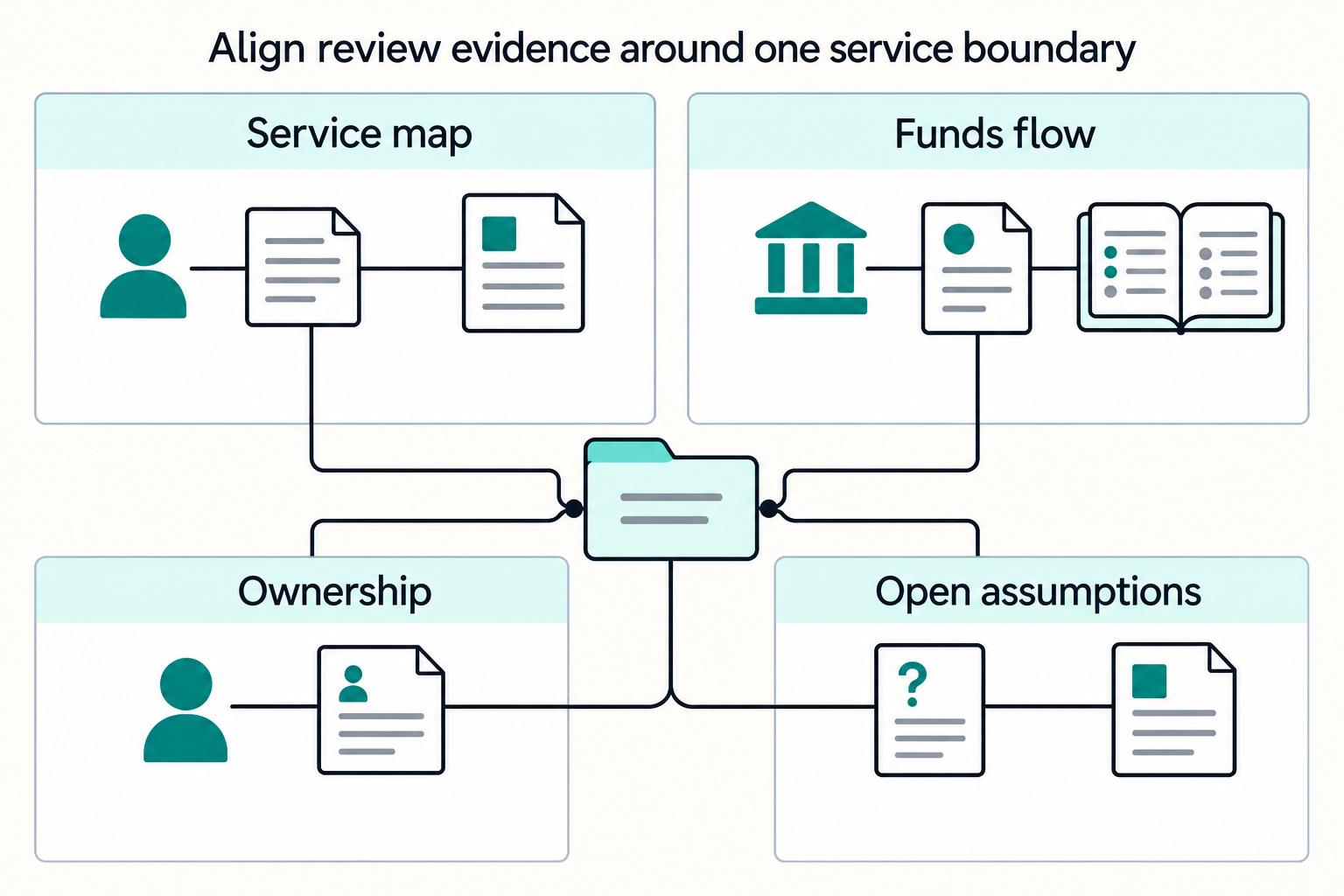
Before any FCA engagement, prepare one evidence pack that lets legal, compliance, finance, and risk describe the same perimeter in the same terms. If you cannot get to one shared perimeter statement, pause and fix the record before any filing step.
You do not need a large dossier. You need a dated, internally consistent pack that answers four questions: what service you provide, how funds move, who owns each obligation, and which regulatory references support your interpretation.
Internal minimum pack and what each item should show#
| Evidence item | What it should show | Primary owner | Verification checkpoint |
|---|---|---|---|
| Service map | Product steps, user actions, counterparties, and where regulated activity may arise | Product with legal/compliance review | Every live and near-term feature maps to one plain-English description |
| Customer-funds flow map | How funds move from payer to payee, including receive, hold, transfer, and reconcile points | Finance and operations | One real transaction can be traced end to end across ledger and bank steps |
| Governance ownership map | Ownership for perimeter interpretation, reporting, complaints, AML dependencies, and escalation | Compliance, legal, risk, finance | Each obligation has a named owner and deputy |
Control narrative aligned to Payment Services Regulations 2017 | How controls support the operating model described in the maps | Compliance with operations input | Scope language matches the service map and funds-flow map |
| Compliance matrix | The references you rely on, including confirmed handbook and regulation references in your source set (for example SUP and regulations 109/120 cited in FCA 2025/38) | Compliance | Each reference is linked to a process, owner, and evidence artifact |
| Assumptions register | Items marked confirmed, inferred, or unverified against FCA materials | Legal and risk | Each open item has source link, review date, and escalation trigger |
Consistency across documents is the control. If product, finance, and legal are describing different versions of the same activity, filing risk is already high.
Build the compliance matrix as an operating document#
Build the matrix as something your team can actually use, not a static appendix. Use five fields: reference, why it matters to your model, owner, supporting evidence, and status. Keep unclear points visible as unverified instead of smoothing them into confident language.
Use version checkpoints. FCA 2025/38 cites regulations 109 and 120 of the Payment Services Regulations 2017, amends modules including SUP, and comes into force on 7 May 2026. If any part of your pack relies on earlier handbook text or summaries, flag it and revalidate before filing.
Assumptions register and pre-submission quality gate#
Keep the assumptions register simple: assumption, status (confirmed/inferred/unverified), FCA source checked, date checked, owner, and impact if wrong. Then apply a strict internal quality gate before filing: legal and risk sign the same perimeter statement, and compliance confirms alignment across the service map, funds-flow map, and compliance matrix. This is an internal control, not stated here as an FCA filing prerequisite.
Run two final checks. Walk through one real payment journey plus one edge case, for example a refund or failed payout. Then confirm all evidence items use the same "as reviewed" date and source set. If dates or source baselines differ, resolve that drift before submission.
For a step-by-step walkthrough, see Sanctions Screening for Payment Platforms Before Payout Release.
Ongoing control stack after registration or authorisation#
Once registration or authorisation is live, the real test is simple: can you produce usable evidence consistently and escalate cleanly when controls fail? In practice, that means a compact operating stack: event-driven notifications, scheduled reporting, complaints governance, and finance records tied to real payment events.
Control cadence that works in practice#
Run one shared cadence across compliance, finance, and operations so reportable events, periodic tasks, and internal issues are handled consistently. The aim is not more meetings. It is one operating rhythm that teams can evidence.
| Control lane | Practical operating rhythm | Evidence to retain | Decision rule |
|---|---|---|---|
| Incident and material-change reporting | Event-driven triage when an incident or material change is identified | Incident log, change assessment, escalation record, affected-customer analysis | If reportability or materiality is unclear, escalate to compliance and legal before treating it as routine |
| Periodic reporting | Calendar-based cycle with named owners for data production and sign-off | Reporting calendar, source-data working papers, sign-off record | If source data changes mid-period, document the change before submission |
| Complaints governance and dispute handling | Continuous intake, with trend reviews on a fixed cycle | Complaint register, dispute notes, root-cause actions, closure evidence | If the same complaint pattern repeats, treat it as a control issue, not only a service issue |
Policy volume is not the point. Each lane needs a trigger, an owner, and evidence, and your forms and process details should be revalidated against current FCA materials before use, including the FCA's reporting and notifications route for payment services firms.
Incident reporting and failure containment#
For API and AEMI models, build incident and third-party reporting discipline into day-to-day operations. The excerpted PS26/2 timeline is clear: published on 18 March 2026, effective on 18 March 2027, with a 12 months preparation window.
Containment should cover both failure directions: your own service failures and provider-originated failures. If a key control fails, pause the affected payment flow. Document when it started, what transactions were affected, and whether the origin was internal or third-party. Then escalate through risk and legal. This matters operationally because the data here shows that in 2025, more than 40% of cyber incidents reported to the FCA involved a third party.
Regular finance artifacts and AML defensibility#
Keep a regular finance evidence pack even when there is no active regulator request. Retain records that let you explain why payments were released, held, reversed, or manually overridden.
Use a traceability check: one real transaction, plus one edge case such as a refund or failed payout, should be traceable through ledger movement, bank steps, exception handling, and final outcome. Weak ownership and incomplete closure records can become failure points and make complaints handling harder.
For AML and customer-risk gates, tie each gate to a clear rationale in your AML framework: what risk it addresses, what evidence supports it, who can override it, and how the override is recorded. That approach stays aligned with the review areas highlighted in the excerpts, including governance, safeguarding, financial resources, AML controls, and outsourcing oversight.
Hidden costs and common failure modes#
The biggest cost surprise is often not the initial setup step. It is the work of turning a compliance decision into an operating model teams can run without repeated rework.
Teams may budget for visible support and still underestimate internal work. Building compliance frameworks from scratch is time-consuming, costly, and easy to get wrong.
| Hidden cost area | What teams often assume | What can add time and spend | Practical checkpoint |
|---|---|---|---|
| Building from scratch | A custom framework is straightforward to assemble internally | Iteration and corrections can expand timelines and cost | Start from a structured compliance foundation instead of a blank page |
| Hidden compliance gaps | Major issues will be obvious early | Gaps may surface later, after documents and workflows are already in motion | Add explicit gap checks early and revisit them before sign-off |
| Template implementation | Ready-to-customize templates remove most effort on their own | Templates still need adaptation and ownership to work in practice | Assign owners for adapting templates to your operating model |
| Execution consistency | Policy text alone is enough | Inconsistent execution creates avoidable rework | Define trigger, owner, evidence, and escalation for each key control |
Those costs often show up together, which is why weak early decisions get expensive quickly.
Where teams usually get caught#
A common and costly failure mode is trying to build compliance frameworks from scratch without a solid foundation.
That can look efficient early, then gaps appear and force rework across procedures, controls, and operations.
Use one hard rule: do not approve an approach on assumptions alone. Revalidate assumptions, mark each one as confirmed or unverified, and assign clear ownership for the final compliance perimeter statement.
Policy references are not executable controls#
Another failure mode is policy text without execution detail. Referencing standards in policy documents can still fall short if teams have not defined who acts, when they act, what evidence is retained, and how escalation works.
That is how a compliance gap appears in practice: the policy exists, but execution is inconsistent under pressure. A simple test helps: for each key reference, can the team state the trigger, owner, evidence, and escalation path in plain English?
Confirm exact regulatory wording on safeguarding and control consequences from current FCA materials before relying on it.
The recommendation#
Treat hidden cost as a design input, not a cleanup task. Build the compliance foundation early, translate policy references into owner-level execution steps, and close gaps before they spread into broader rework.
Multi-market expansion and when to escalate#
Cross-border licensing outcomes are not automatic. You cannot assume that Authorised Payment Institution status in the UK automatically covers a launch in another jurisdiction, a new regulated service type, or a material change in customer-funds handling. Treat expansion as a point for specialist revalidation, not as an automatic extension of the original UK approval case.
| Path | What you gain now | What remains unconfirmed | Practical recommendation |
|---|---|---|---|
| Stay with your current UK PI posture | Continuity for UK planning | No confirmation that UK status carries into another jurisdiction or new service type | Keep UK planning separate from non-UK assumptions and re-check the legal basis before launch |
Consider an Authorised Electronic Money Institution route later | A placeholder for future planning discussions | No supported comparison here on permissions, migration, or suitability | Do not treat this as a default next step without specialist validation |
| Consider local licensing in each target market | A jurisdiction-by-jurisdiction planning frame | No supported rule here on where local licensing is required or how it interacts with UK status | Build entry plans on jurisdiction-specific advice, not on the UK file alone |
While you escalate, keep one grounded operational checkpoint in view: if expansion changes business structure, remember that structure affects tax treatment and legal responsibilities, and HMRC expects records such as bank statements or receipts.
For internal governance, keep escalation language clearly internal. HM Treasury and FCA trigger rules for cross-border expansion require direct confirmation. If a new-market memo is mostly a lightly edited UK memo, pause and revalidate before launch.
30-60-90 day implementation checklist#
Use this 90-day plan as internal readiness discipline, not as proof of FCA requirements. FCA-facing timing, reporting, or sign-off expectations are not established, so any FCA-facing timing, reporting, or sign-off expectation here remains unverified.
| Phase | Internal focus | Completion signal | Verify with FCA |
|---|---|---|---|
| Days 1-30 | Lock perimeter statement and draft evidence pack | One current perimeter statement, service map, funds-flow map, and named owners for key reporting and complaints obligations | That these owner assignments or documents meet FCA expectations |
| Days 31-60 | Dry-run controls and escalation paths | Incident path tested end to end, policy gates reconciled against applicable AML obligations, and exceptions logged with owners | Any FCA-required incident timing, reporting format, or test standard |
| Days 61-90 | Decide filing readiness | Filing-readiness memo, legal challenge session, and a written list of unresolved items for regulatory clarification | That these artifacts are formal FCA requirements |
| Go/no-go | Single cross-functional decision | Compliance, legal, finance, and risk sign the same decision record and accept the same open issues | That joint sign-off is mandated by the FCA |
Proceed only when all four functions align on one decision record. Otherwise, treat the outcome as no-go until assumptions are reconciled.
If you want this checklist to run as a repeatable operating process with clear status handoffs and traceable records, review the implementation patterns in Gruv Docs.
Final recommendation for compliance, legal, and finance owners#
Choose the licence path for the product you expect to run in 18 months, not just this quarter. Use the Small PI path only when scope is genuinely tight and stable. If expansion, new payment flows, or perimeter uncertainty is already visible, consider moving early to the authorised track and escalate for legal review before build choices harden.
A simple decision rule#
| Decision signal for the next 18 months | Lean Small PI | Lean Authorised PI track |
|---|---|---|
| Product scope | One stable payouts use case, with no planned regulated-service additions | Multiple service changes or likely perimeter movement |
| Expansion pressure | UK-first, with limited change expected before the next review cycle | New jurisdictions or material scale-up already on the roadmap |
| Perimeter certainty | Legal and compliance agree the service map is narrow | Open questions on AIS, PIS, or funds-flow changes |
| Cost of being wrong | Revisit later would be inconvenient but manageable | Rework would delay launch, expansion, or partner onboarding |
If you are already debating AIS or Payment Initiation Services features, do not treat the small-PI route as a harmless interim step. Current UK eligibility for those services under the small-PI path is not settled here, so escalate instead of assuming.
Make the choice a controlled commitment#
Document this as an operating commitment with named owners, evidence, and escalation triggers before launch:
- Compliance owns the assumptions register and source log for FCA-dependent claims.
- Legal owns the perimeter statement and escalation decisions when scope or customer-funds flows change.
- Finance owns evidence quality, retention, and the decision record for accepted operational burden.
- Risk owns the launch gate and the rule that unresolved perimeter issues block go-live.
For the Authorised PI path, keep controls practical and owned. The FCA points firms to conduct of business, complaints handling, and reporting and notifications. If no owner can explain notifications, reporting, and complaints evidence, filing readiness is incomplete.
Use the FCA date references as context, not current-rule proof. The page points firms to view revised Handbook content by setting the date to 13 January 2018. The page excerpt also shows first published and last updated as 22/09/2017. Revalidate date-sensitive requirements with current FCA material before submission or launch.
Final recommendation: choose Small PI only when the perimeter is stable and the downside of later migration is acceptable. If your roadmap already points to broader services, expansion, or unresolved regulated features, lean toward the authorised track now, document why, and confirm the route with legal review.
When your team is ready to validate rollout assumptions against your payout flow and control model, contact Gruv.
Frequently Asked Questions
What is the practical difference between `Small Payment Institution` registration and `Authorised Payment Institution` authorisation?
The practical difference is scale and evidence burden, not just the label. Third-party guidance describes Small Payment Institution status as capped at €3 million average monthly transactions, while Authorised Payment Institution status is described as allowing unlimited volumes. Treat both points as items to verify directly with the Financial Conduct Authority before filing. The same guidance also says API applications are assessed across six criteria: governance, capital, safeguarding, AML controls, business model viability, and systems and controls.
Can a small PI provide `Account Information Services` or `Payment Initiation Services`?
Whether a small PI can provide Account Information Services or Payment Initiation Services requires specialist legal advice and direct FCA confirmation. Account Information Services and Payment Initiation Services are regulated payment services, but the specific eligibility rules for a small PI need primary-source FCA confirmation before choosing the small PI path.
Are the PSD2 re-registration and re-authorisation deadlines still current requirements or historical context?
Treat those deadlines as historical context unless current FCA material confirms they are still active requirements. Whether PSD2 transition deadlines remain current today is not established. Verify the latest FCA position before relying on older articles, internal notes, or vendor summaries.
Which minimum controls should exist regardless of PI status under `SUP 15`, `SUP 16`, and `DISP`?
There are no FCA-confirmed minimum controls under SUP 15, SUP 16, or DISP to rely on here, so no definitive regulatory checklist can be stated. Treat this as a direct-FCA-confirmation item with specialist legal advice before relying on any SUP/DISP control baseline.
When should a payment platform escalate to specialist legal advice before choosing a licence path?
Escalate before choosing a licence path when your model may involve AIS or PIS, projected volumes may approach the small PI cap, or the proposition could move toward e-money. One third-party guide states that a payment institution cannot issue e-money. Also escalate if your application narrative or documentation is fragmented. Third-party sources describe substantial authorization failure risk, including a reported rise from 1 in 14 (2021) to approximately 1 in 5 (2023). Verify that point with the FCA before relying on it.
What key data points are still unknown and must be verified directly with the `Financial Conduct Authority`?
Several decision-critical points need direct verification from primary FCA material. That includes small-PI eligibility for AIS/PIS, whether PSD2 re-registration or re-authorisation deadlines are still active, current application fees, and current thresholds or capital expectations for your exact service mix. You should also verify widely cited third-party figures before locking budget or launch plans. That includes €3 million average monthly transactions, £20,000 to £125,000 initial capital, and 3-6 months vs 6-12 months timing. If those numbers drive staffing, runway, or go-live dates, confirm them directly with the FCA first.
Try a related tool
Researched and edited by the Gruv editorial team. Gruv builds cross-border billing, payouts, and finance-operations software for global businesses.
Sources
- bpc.edu/wp-content/uploads/2025/07/2024-2025-Academi...trusted
- dhs.gov/termstrusted
- epa.gov/sites/default/files/2020-07/documents/c_allc...trusted
- eur-lex.europa.eu/legal-content/EN/TXT/HTMLtrusted
- fsa.usda.gov/Internet/FSA_File/2-cp_r15_a68.pdftrusted
- govinfo.gov/content/pkg/GOVPUB-GP3-c74b22294aea561733285...trusted
- govinfo.gov/content/pkg/FR-1985-04-30/pdf/FR-1985-04-30.pdftrusted
- hhs.iowa.gov/media/17280/downloadtrusted
Educational content only. Not legal, tax, or financial advice.
Related Posts

The Freelance Payment Penalty: A Modeled Audit of Platform Fees, FX Spreads, and Payout Delays
The money rarely disappears through a single, easy-to-spot fee. The real loss is stacked. A marketplace takes its commission, a processor adds a charge for international cards, a bank or payment company converts the currency at a spread, a platform holds the funds before release, and a wire sheds a little to intermediaries on the way in. Each layer looks defensible on its own, but the worker feels the combined result as a smaller deposit and a later payday.

How to Respond to a Subpoena for Business Records
Move fast, but do not produce records on instinct. If you need to **respond to a subpoena for business records**, your immediate job is to control deadlines, preserve records, and make any later production defensible.

A US Expat's Guide to Investing in UCITS ETFs to Avoid PFIC Issues
The real problem is a two-system conflict. U.S. tax treatment can punish the wrong fund choice, while local product-access constraints can block the funds you want to buy in the first place. For **us expat ucits etfs**, the practical question is not "Which product is best?" It is "What can I access, report, and keep doing every year without guessing?" Use this four-part filter before any trade: