
Quick Answer
Start by proving residency facts, because canadian deemed departure tax analysis depends on whether and when someone became a non-resident. Then sort assets into in-scope, excluded, or review-needed, and only after that lock values and filings. Use one controlled package tying Form T1243 to Schedule 3, with T1161 reviewed where departure-date property value may exceed CAD 25,000. Decide on Form T1244 deferral only when documentation is strong, since weak support can turn a liquidity choice into penalties and rework.
Confirm Canadian tax residency before departure planning#
Before you plan for the Canadian deemed-disposition rules that can apply when you leave Canada, first confirm whether you are an emigrant for Canadian income tax purposes. That status drives everything that follows. If you keep residential ties, you may still be treated as a factual resident. If you are resident in a treaty country, you may instead be treated as a deemed non-resident, which is subject to the same rules as an emigrant.
Start in this order. Determine your non-resident date. Identify which property is in deemed-disposition scope and which items are excluded. Then map the reporting steps, such as Form T1243 and Schedule 3, with Form T2061A where an election applies. You should also plan the notice steps with Canadian payers and financial institutions once you become an emigrant.
This introduction is Canada-focused and grounded in CRA guidance. It gives you a clear sequence, decision checkpoints, and a documentation checklist, while showing where specialist advice is worth getting early.
This pairs well with our guide on Tax Implications of a Canadian Owning a US LLC.
Start with the core rule and why it exists#
The core rule is this. When you cease to be a resident of Canada for income tax purposes, Canada can treat certain property as if you sold it at fair market value immediately before departure, even if no sale happened. That is what drives the Canadian departure tax, so treat it as a residency offboarding event, not a year-end cleanup task.
This boundary matters because Canadian income tax liability depends on residence status. Residents are generally taxed on worldwide income, while a Non-resident of Canada is generally taxed only on Canadian-source income. The deemed-disposition rule can trigger tax on gains that accrued before departure.
The practical risk is a liquidity mismatch. Tax exposure can arise without sale proceeds. Your first checkpoint is residency evidence, not valuation. Confirm significant and secondary residential ties first, especially where the dwelling place is located and where a spouse or dependants live. That analysis helps determine whether the rule is triggered.
If the residency break is real, open the file immediately while the facts are still easy to prove. Waiting until return-prep season raises execution risk, including missed property reporting where the fair market value of property you own on departure exceeds $25,000 and potential penalties of up to $2,500.
Need the full breakdown? Read What Is a Tax Home for US Expats and Why It Matters.
Pin down residency status before any tax calculation#
Do not model departure tax until you know whether the person actually became a Non-resident of Canada and on what date. If Canadian tax residency is wrong, the rest of the filing logic can be wrong too. That includes whether emigrant rules apply and what filing path follows.
Start with a facts file using residential ties. CRA's position is that leaving Canada is not enough on its own. The person must also sever residential ties. A key checkpoint is whether they gave up their home in Canada and established a permanent home in another country. If they leave but keep ties in Canada, they are usually treated as a factual resident, not an emigrant.
Build the residency file before the valuation file#
Answer these three questions first, then gather records that answer them in real time, not from memory later:
- What happened to the Canadian dwelling place?
- Where are the spouse or dependants living?
- What facts show the person established a permanent home or otherwise became resident in the new country?
Use contemporaneous records, not assumptions. If your file shows only travel dates, it is usually too thin for a reliable residency conclusion.
Get the departure date right#
Treat the effective non-resident date as a core tax control, not an admin field. CRA says non-resident status is usually determined by the latest of:
| Timing factor | Date effect |
|---|---|
| Date the person leaves Canada | CRA says non-resident status is usually determined by the latest of this date |
| Date the spouse or dependants leave | CRA says non-resident status is usually determined by the latest of this date |
| Date the person becomes a resident of the new country | CRA says non-resident status is usually determined by the latest of this date |
| Resettling in a country lived in before Canada | CRA says non-resident status is usually the date they leave Canada |
- the date the person leaves Canada
- the date the spouse or dependants leave
- the date the person becomes a resident of the new country
CRA also notes an exception. If the person is resettling in a country they lived in before Canada, non-resident status is usually the date they leave Canada.
Escalate mixed facts early#
If residential ties remain, pause and escalate before you do tax modeling. The same applies where treaty residence could matter. CRA says someone who is also resident in a treaty country may be a deemed non-resident, and deemed non-residents follow the same rules as emigrants.
Once status is established, follow through operationally. If Canadian accounts or payment streams remain, CRA says the person must notify Canadian payers and financial institutions that they are no longer a resident of Canada.
With status and date settled, the next job is working through the rest of the departure file.
For a step-by-step walkthrough, see Canada Non-Resident Tax for Freelancers Working With Canadian Clients.
If your team manages frequent cross-border moves, use this tracker to keep residency evidence and date changes organized before filing logic starts: Tax Residency Tracker.
Classify assets into taxed, excluded, and review-needed buckets#
Do not jump from the departure date straight into valuations. First sort each asset into a provisional bucket only: taxed, excluded, or review-needed. Do not lock the label unless you have Canadian primary-source support for it.
Canada-specific asset exclusions require confirmation with your Canadian tax adviser. OECD working-paper context on asset treatment and exit-tax issues is preliminary and not official Canadian filing guidance. Use it to frame questions, not to fix reporting positions.
Use bucket labels as draft status, not legal conclusions#
Taxed means you have Canadian primary-source support that the asset is in scope for deemed-disposition analysis. Excluded means you have Canadian primary-source support that it is out of scope. If that support is missing, keep the asset in review-needed.
| Asset or category raised in the file | Likely treatment | Draft reporting impact | Evidence needed | Escalation trigger |
|---|---|---|---|---|
| Asset already matched to a Canadian primary-source in-scope rule | Provisional taxed | May affect the draft reporting position | Canadian rule text, asset description, ownership, departure-date value support | Rule citation is missing, outdated, or not a clear match |
| Canadian real or immovable property | Confirm with the relevant authority; do not auto-exclude | Could change the draft reporting position | Canadian primary-source support, title or property records, applicability memo | Team relies on checklist habit without cited source support |
| Canadian resource property | Confirm with the relevant authority; do not auto-exclude | Could change the draft reporting position | Canadian primary-source support plus records showing the legal right held | Property label is used loosely or legal nature is unclear |
| Timber resource property | Confirm with the relevant authority; do not auto-exclude | Could change the draft reporting position | Canadian primary-source support and records tying facts to the cited rule | No written analysis connects asset facts to the cited category |
| Registered plans (RRSP, RRIF, RESP, TFSA, PRPP) | Confirm with the relevant authority; do not assume exclusion | Could change the draft reporting position | Canadian primary-source support, plan statements, registration details, ownership records | File only says "registered account" with no supported treatment analysis |
| Assets with unclear legal characterization or other special-rule arguments | Review-needed by default | Could change the draft reporting position | Legal characterization memo, source support, entity or business records, fact tie-out | Decision depends on undocumented facts or an incomplete legal category |
Verify support before locking any bucket#
Maintain one asset sheet with the asset name, owner, departure-date status, provisional bucket, and source used. Add a support type field with only:
- Canadian primary source
- Secondary commentary
- Unsupported
If an item is not backed by a Canadian primary source, keep it provisional. Also mark out-of-scope materials as background only. A U.S. EPA vehicle standards comment letter, for example, is not evidence for Canadian deemed-departure asset classification.
Escalate when uncertainty changes the draft reporting position#
Apply one control rule. If unresolved classification would change the draft reporting position, escalate before filing.
That is a filing-quality safeguard, not a legal test on its own. Before finalizing, reconcile the inventory, draft reporting package, and support memo. Any mismatch without a clear written reason stays review-needed until specialist review is complete. If a possible special rule might narrow scope, test that before you spend time and money on valuation work.
Related: A guide to the 'exit tax' when leaving Canada as a self-employed professional.
Apply special rules that narrow scope before you overbuild#
Run a scope check before you order appraisals or build calculations. General cross-border tax and residential-status risk signals are relevant, but do not assume Canadian deemed departure-tax special-rule mechanics are established. Treat unresolved rule questions as review-needed and escalate.
Use tax and residential-status issues as a gate#
Before major decisions, build a file from documents you can verify now:
- current tax and residential-status facts tied to intended use
- available tax returns
- mortgage statements on existing property
- financing assumptions (for example, limited lender access for nonresident buyers, potential 30% down payment expectations, a cash path funded from one account for at least 90 days, or Canada-side financing with a U.S. cash purchase to reduce exchange-rate surprises)
If the records are incomplete, keep the item review-needed and escalate. In cross-border files, expert advice before decisions is safer than relying on memory.
Treat named forms and exceptions as cited-position issues, not shortcuts#
If anyone relies on a specific form or special-rule exception, require primary-source support and a written fact-to-rule memo. The label alone is not analysis.
Contrast operating paths before valuation#
| Scenario | Early focus | Valuation timing |
|---|---|---|
| Financing dependent | Confirm lender feasibility and required documentation first | Start after financing assumptions are supportable |
| Cash purchase path | Confirm account-history and funds-traceability requirements first | Start after funds documentation is stable |
Practical recommendation#
Cross-border tax and residential-status issues can change the outcome, and financing can be a major roadblock. Expert review before major decisions is often safer than rebuilding the file later.
Once scope is stable, shift to traceability: can each number be tied back to verified facts and support?
Related reading: Form 8812 child tax credit guide for U.S. expats.
Build the valuation and documentation pack auditors expect#
A defensible departure file is more than a completed set of forms. It is a valuation pack where each conclusion can be traced back to facts. For this work, keep the file so a reviewer can quickly see why an asset was included, excluded, or marked review-needed, which date controlled, and what support backs the number.
Lock the date before you lock the value#
Do not finalize valuation support until the non-resident timing date is confirmed. CRA says non-resident status is usually based on the latest of:
- the date you leave Canada
- the date your spouse or common-law partner and dependants leave Canada
- the date you become a resident of the country you settle in
Before accepting final appraisals, confirm that latest-of date in writing and keep the underlying facts in the file. If those facts change, the valuation date may change too.
Build the minimum evidence per asset#
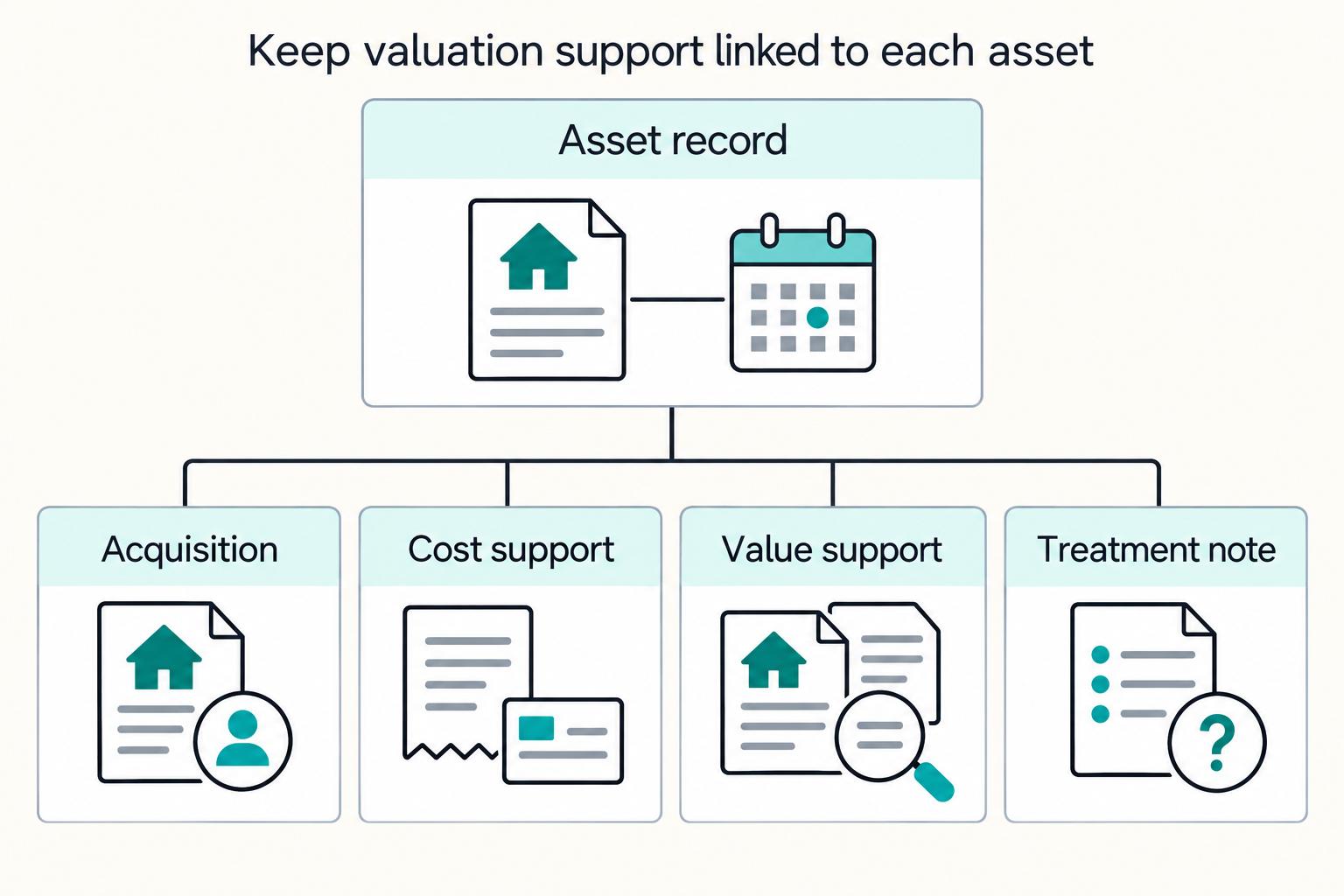
Work asset by asset, not only from a summary sheet. For each one, keep enough support to show ownership history, value, and treatment.
| Evidence item | What it should show | Why it matters |
|---|---|---|
| Acquisition date support | When the asset was acquired and by whom | Supports ownership history and scope decisions |
| Cost support | The cost figure used and the records behind it | Supports the starting point for tax calculations |
| Value support | The value used at the departure timing date, with dated support | Makes the value conclusion reviewable |
| Classification rationale | Why the asset was treated as reportable, excluded, or review-needed | Keeps treatment decisions clear during review |
Use a consistent asset name or ID across the inventory, valuation support, and return package so tie-outs are straightforward.
Make every number traceable to the filing set#
Add a simple cross-reference in your working file showing where each asset is reflected in the departure return package. Then run a formal reconciliation against the departure return before signoff.
The common failure mode is a clean-looking form set with weak backup. That creates audit friction because residency status and intent are fact-driven. If residential ties were kept, or a vacant home was retained after departure, expect more questions and keep that evidence with the valuation file. After the valuation pack is in place, keep the forms moving in one controlled order so they do not drift apart.
File in the right order so forms do not contradict each other#
Use one internal filing sequence and one shared fact pattern across the full package. The CRA material here supports the need for adequate books and records. Treat this sequence as an operating control, not as a legal rule.
Use a single working order (internal control)#
| Working step | Settle this first | Then use it in |
|---|---|---|
| Residency and dates | Confirm the departure-residency position used by the team | Common dates and status across the package |
| Property inventory | Build one final asset list and flag open items as review-needed | Consistent property population in all relevant forms |
| Values and support | Lock support for each reported amount | Draft amounts used across forms and return workpapers |
| Core forms | Draft each in-scope form from the same locked facts | One consistent filing package |
| Final return package | Pull from the settled dates, property list, and amounts | Final submission set |
| Optional elections (if used) | Consider only after core figures are stable | Election analysis and filing decisions |
Treat Form T1244 as downstream of stable numbers#
From a control perspective, prepare Form T1244 (Election to Defer the Payment of Tax on Income Relating to the Deemed Disposition of Property) only after the underlying numbers are stable. This is an internal dependency check, not a claim about a CRA-mandated sequence or legal dependency.
Run cross-form tie-out checks before release#
- Date consistency: one departure date across all working papers and filed forms.
- Property consistency: one final property population across the inventory and related forms.
- Amount consistency: values and descriptions align across forms and return workpapers.
Assign one owner for final tie-out#
Assign one person to own the final cross-form reconciliation so version drift does not get missed between teams. This is a control recommendation, not a CRA requirement.
The visible CRA audit-manual chapter is marked under review, and it shows a last update in November 2024. It also notes that external hyperlinks are not guaranteed current. Keep your own dated tie-out record clear and complete so the file remains defensible if guidance wording changes.
Once the numbers and forms are stable, the next decision is commercial rather than mechanical: pay now or defer.
Decide between paying departure tax now or electing deferral#
Once your deemed disposition numbers are stable, the practical choice is simple. Pay now for a cleaner close, or file Form T1244 (Election to Defer the Payment of Tax on Income Relating to the Deemed Disposition of Property) to preserve liquidity and accept more compliance burden.
| Path | Best fit in practice | Main tradeoff |
|---|---|---|
| Pay now | You can fund the tax without straining the move, or your documentation is not yet strong | Simpler administration, but less cash available |
Elect deferral on Form T1244 | Liquidity is tight and your valuations and reporting are strong, with any required security lined up | Preserves cash, but depends on timely filing, correct reporting, and security where required |
If no deferral is used, departure tax is generally due by 30 April of the year after departure. If deferral is used, file Form T1244 with the departure return for the emigration year, with a normal filing deadline of 30 April. Available guidance indicates deferral can continue until actual disposal of the asset or repatriation to Canada and, when the election conditions are met and adequate security is in place, unpaid departure tax does not accrue interest.
Deferral is not automatic. Late filing, weak security, or valuation and reporting errors can invalidate the election and lead to immediate payment demands with interest and penalties.
Use this decision rule:
- Liquidity tight + strong records: deferral is a reasonable option to evaluate.
- Liquidity tight + weak records: fix the records first. Do not rely on deferral if valuation or reporting support is still weak.
- Liquidity not tight: paying now may be lower-friction.
Security planning becomes central when departure tax owing may exceed CAD 16,500. For former Quebec residents, the excerpts show about CAD 13,777 to CAD 13,777.50, so confirm the current amount before filing. If you may cross these levels, plan early and confirm the current threshold and security requirements before filing.
Whether you pay now or defer, keep a separate list of what is still uncertain. That tells you whether the file is ready to sign.
If you want a deeper dive, read A Guide to Canada's 'Departure Tax' on Emigration.
Track what is still uncertain and when to escalate#
Add platform-grade controls for finance and payments teams#
If finance or payments teams touch the file, convert the tax analysis into operating controls before payment treatment or filing positions are locked. The objective is simple. Residency status, reporting, and payout decisions should come from documented checkpoints, not scattered messages after funds move.
Start with named owners and approval gates. Assign one owner to residency fact collection, one to tax review, and one to final finance sign-off so tax status is not inferred from payout notes or HR comments.
Turn tax steps into approval controls#
Use a short, fixed sequence before year-end positions are finalized:
| Control step | What it covers |
|---|---|
| Residency facts confirmed | Travel days and residential-ties evidence, including items such as bank accounts, memberships, provincial health card, and driver's license where relevant |
| Tax review approved | Documented, case-specific conclusion on resident versus non-resident status |
| Finance sign-off completed | Ledger treatment, payment coding, and withholding or reporting assumptions tied to the tax review |
| Evidence pack retained | Support stored in one place, not split across HR, payroll, and email |
Keep the evidence pack audit-ready: decision memo, travel calendar, supporting ties evidence, payout history, and any legal or advisor note used for the position. If you used CRA plain-language pages, label them as informational and do not treat them as a substitute for legal authority; retain any legal authority or professional advice used for the final filing view.
Link controls to the records reviewers will actually use#
Traceability can break down when tax support is disconnected from payment records. Link filing support directly to ledger-backed entries and payout history so reviewers can move from the residency conclusion to the amounts without rebuilding the file.
| Control record | What it should link to | What to verify |
|---|---|---|
| Residency review record | Travel days and residential-ties evidence | Dates align with payroll and platform activity |
| Payment treatment record | Ledger entries, payout history, withholding settings | Coding matches approved tax status |
| Filing support record | Draft filing support, advisor memo, issue log | Assumptions match the approved residency position |
Add a mandatory manual review when someone is approaching the 183-day mark in Canada, since presence at 183 days or more may affect residency status.
Use policy gates where your platform supports them#
If your payments stack supports policy holds, use them when required documentation or residency approvals are incomplete. Treat this as an internal risk control.
A common failure mode is assuming treaty relief ends employer obligations. It may not. Payroll reporting and withholding duties can still apply even when employee income is treaty-exempt. Build controls that ask both questions: "Is tax due?" and "Is reporting still required?"
Add a monthly mobility checkpoint#
Run a monthly exception review for globally mobile users. Focus on rising Canada workdays, new Canadian payment activity, address changes, and newly documented secondary ties.
This cadence is an internal control choice, not a statutory requirement, but it helps teams catch residency and reporting risk before year-end. A short monthly report to finance, covering days in Canada, payout activity, missing tax documents, and cases nearing the 183-day mark, can be enough to surface issues early.
The point of these controls is to stop preventable rework. They help catch sequencing errors earlier.
You might also find this useful: A Guide to Setting Up a US LLC from Canada.
Avoid the mistakes that create the most expensive rework#
The most expensive rework happens when teams calculate first and prove scope later. Use this order every time: confirm when Canadian residency ended, classify property in scope, then complete reporting.
| Mistake | Article guidance |
|---|---|
| Making the property-scope decision too late | Decide early, against the same asset inventory used for deemed-disposition work, which assets are in or out of deemed-disposition scope, not after Form T1243 is drafted |
| Treating exclusions as automatic | CRA says deemed disposition applies to most property, with specific exceptions, including Canadian real or immovable property, Canadian resource property, timber resource property, and certain registered plans and related interests; document why each excluded asset is out of scope |
| Treating elections as a substitute for core support | The core file still has to hold up on property classification, FMV support, and reporting support for Form T1243 and Schedule 3; Form T2061A is an additional compliance step, not a fix for weak records |
| Finalizing numbers before residency facts are locked | If residency timing and facts are still uncertain, pause; changing that conclusion late can force simultaneous revisions across the property population, valuation date, and filing package |
Mistake 1: making the property-scope decision too late. Decide early, against the same asset inventory used for deemed-disposition work, which assets are in or out of deemed-disposition scope, not after Form T1243 is drafted.
Mistake 2: treating exclusions as automatic. CRA says deemed disposition applies to most property, with specific exceptions, including Canadian real or immovable property, Canadian resource property, timber resource property, and certain registered plans and related interests. But do not treat those labels as the end of the analysis. Document why each excluded asset is out of scope, especially where the analysis relies on the statutory concept of an excluded right or interest under subsection 128.1(10).
Mistake 3: treating elections as a substitute for core support. The core file still has to hold up on property classification, FMV support, and reporting support for Form T1243 and Schedule 3. If you elect to include certain excepted property in your deemed dispositions, Form T2061A is an additional compliance step, not a fix for weak records.
Mistake 4: finalizing numbers before residency facts are locked. Deemed disposition is tied to ceasing Canadian residency, so if residency timing and facts are still uncertain, pause. Changing that conclusion late can force simultaneous revisions across the property population, valuation date, and filing package.
Conclusion#
The cleanest outcome on Canadian deemed departure tax comes from sequence and evidence quality, not from rushing into calculations.
Follow this operating order:
- Confirm residency status and date first. Determine whether the person is an emigrant for income tax purposes or still a factual resident because residential ties remain in Canada, then settle the non-resident date before valuation work.
- Classify assets before doing the math. Identify what is in scope, what may be excluded, and what needs specialist review. If the short-term resident rule might apply, test that early.
- Flag filing triggers early. If reportable-property fair market value at departure may be more than
>$25,000 CAD, treatForm T1161as an active filing question. - Build support for each position. Keep records that show how you reached the departure date, the fair market values at departure, and each asset treatment.
- Tie forms consistently. Use the same departure date and asset population across the departure-year
T1,Form T1243,Schedule 3, andForm T1161if required.
Only after those steps should you decide whether to pay in the departure year or explore deferral. A practical next step is to run one internal readiness check against your filing and evidence checklist before filing.
If you need to operationalize these controls across payouts, approvals, and audit trails, align your workflow with Gruv's team here: Contact Gruv.
Frequently Asked Questions
What is Canadian deemed departure tax in plain terms?
It is the tax exposure that can arise when you stop being a Canadian resident for income tax purposes and certain property is treated as if you sold it at fair market value and immediately reacquired it. No actual sale has to occur for this rule to apply. If you leave Canada but keep residential ties in Canada, CRA says you are usually still a factual resident, so the departure analysis may not start yet.
Which assets are usually excluded from a deemed disposition?
CRA says deemed disposition applies to most property, but its public guidance lists exceptions that include Canadian real or immovable property, Canadian resource property, and timber resource property. That is not the full list. For completeness, CRA points to the definition of an “excluded right or interest” in subsection 128.1(10), so do not assume an asset is out of scope without documenting why.
Which forms do I typically need when leaving Canada (`T1243`, `T1161`, `T1244`)?
Form T1243 is used to calculate and report deemed-disposition capital gains or losses, and those amounts then flow to Schedule 3. Form T1161 (List of Properties by an Emigrant of Canada) may also need review based on your facts. Filing-mechanics or eligibility details for Form T1244 are not covered here, so treat that as a specialist-review item rather than assuming it applies.
When is departure tax generally due, and when does a deferral election make sense?
This guide does not establish a single payment due-date rule for all emigrants. It does indicate that non-resident status is usually determined by the latest of three dates (when you leave Canada, when your spouse or dependants leave, or when you become a resident of your new country), and that timing drives the departure analysis. If you are considering deferral because cash flow is tight, settle the non-resident date, the in-scope property list, and the deemed-disposition numbers first, then get advice on whether an election is available and appropriate.
What does the property reporting threshold for `Form T1161 (List of Properties by an Emigrant of Canada)` mean in practice?
A practitioner source states that if the fair market value of the property you own when you leave Canada is more than $25,000, property reporting is required. The same source says failing to report can lead to a penalty of up to $2,500. In practice, use that threshold as an early check on your departure-date asset inventory, then confirm the current form instructions before filing because the CRA threshold text is not quoted here.
How does the `Short-term resident rule` change what gets taxed?
It can narrow the property subject to deemed disposition in limited-residency cases, including cases where the time-limit test is met (resident in Canada for 60 months or less during the 10-year period before emigration). If that issue might apply, check it early because it can change what you need to value and report. Treat detailed eligibility criteria as a review item and confirm them with the CRA or a qualified adviser.
What evidence should I keep to support values, exclusions, and filing positions?
Keep records that support when you ceased Canadian residency, each asset’s fair market value at that time, and why you treated the property as in scope, excepted, or uncertain. Retain the working papers that tie your asset list to Form T1243, Schedule 3, and any T1161 filing or other election you make. The goal is not just completed forms, but a file that shows how you reached each position.
Try a related tool
Researched and edited by the Gruv editorial team. Gruv builds cross-border billing, payouts, and finance-operations software for global businesses.
Sources
- bea.gov/sites/default/files/methodologies/nipa-handb...trusted
- cbp.gov/trade/north-american-free-trade-agreement/gu...trusted
- cga.ct.gov/2003/TOB/h/pdf/2003HB-06721-R00-HB.pdftrusted
- ecfr.gov/current/title-19/chapter-I/part-10trusted
- energia.pr.gov/wp-content/uploads/sites/7/2024/04/20240408-...trusted
- fema.gov/sites/default/files/2020-07/guidelines-wind-...trusted
- govinfo.gov/content/pkg/USREPORTS-353/pdf/USREPORTS-353.pdftrusted
- govinfo.gov/content/pkg/GPO-HJOURNAL-2018/pdf/GPO-HJOURN...trusted
Educational content only. Not legal, tax, or financial advice.
Related Posts

A Guide to Canada's 'Departure Tax' on Emigration
If you hear the term **canada departure tax**, think capital-gains rule, not a fee you pay to leave the country. It can apply when you stop being a Canadian tax resident. CRA may treat you as having a **[deemed disposition](https://www.canada.ca/en/revenue-agency/services/tax/international-non-residents/individuals-leaving-entering-canada-non-residents/dispositions-property.html)** of certain property even if you did not sell anything.
Leaving Canada as a Self-Employed Professional: A Departure Tax Playbook
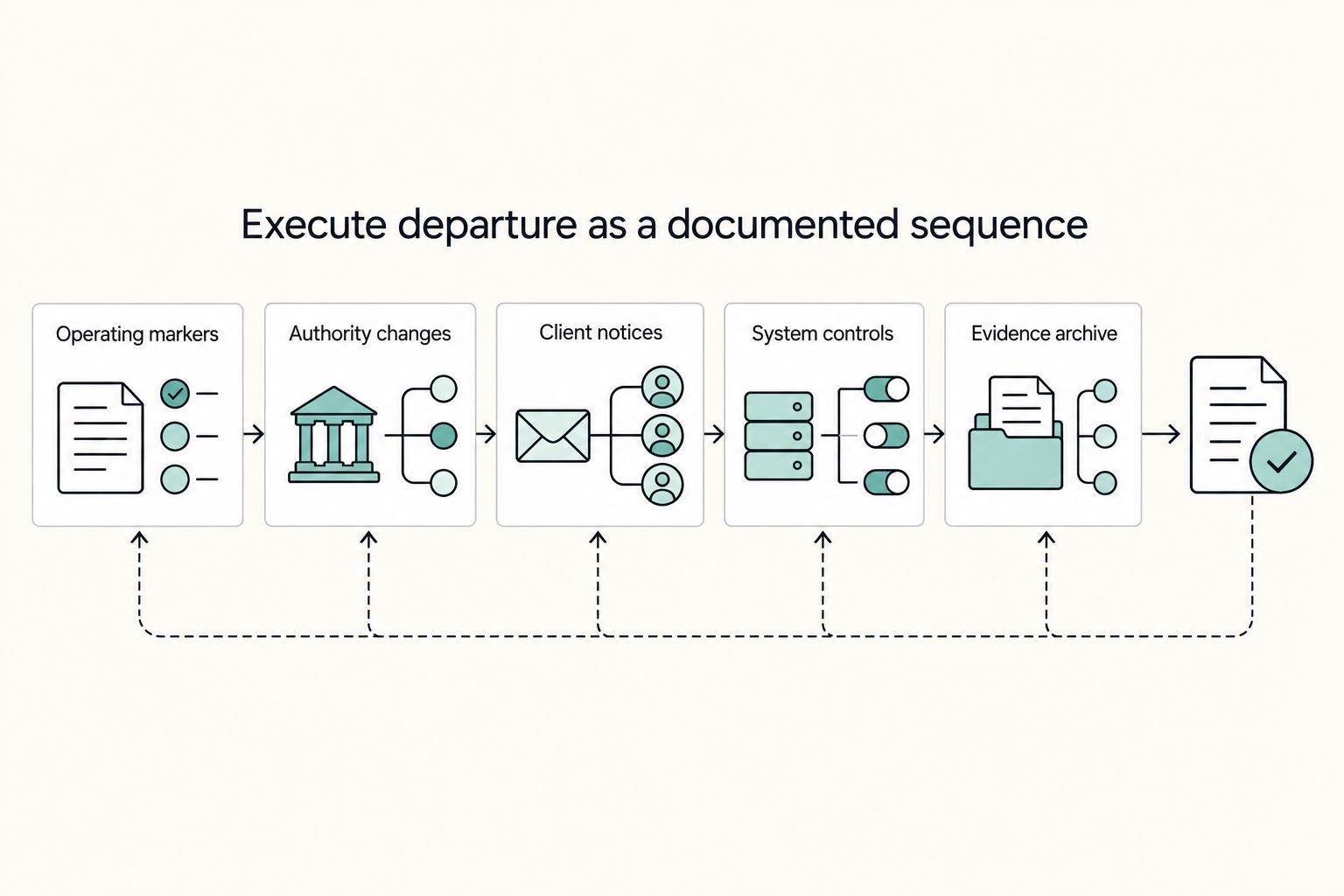
Leaving Canada as a self-employed professional is a business project, not a last-minute tax filing task. The biggest mistake is treating departure tax as something to sort out when the return is due. Real control starts well before you leave, when you still have time to pin down your residency date, classify assets properly, and build the evidence behind each filing position. This playbook breaks the process into three phases so you can replace uncertainty with an organized, defensible plan.

How Canadians Can Set Up a US LLC Without Tax Surprises
If you are considering a U.S. LLC as a Canadian, decide structure before you form anything. That one sequencing choice keeps tax and compliance decisions deliberate instead of reactive.