
Quick Answer
Start by confirming residency under CRA’s case-by-case approach, then classify each Canadian payment stream before setting invoice terms. For canada non-resident tax, the highest-risk mistake is finalizing billing or filing while withholding treatment is still unclear, including Regulation 105 situations for services rendered in Canada. Use T4058 and the non-resident package only after status and income character are defensible, and escalate early when facts conflict.
How to sequence residency, payment classification, and withholding before invoicing Canadian clients#
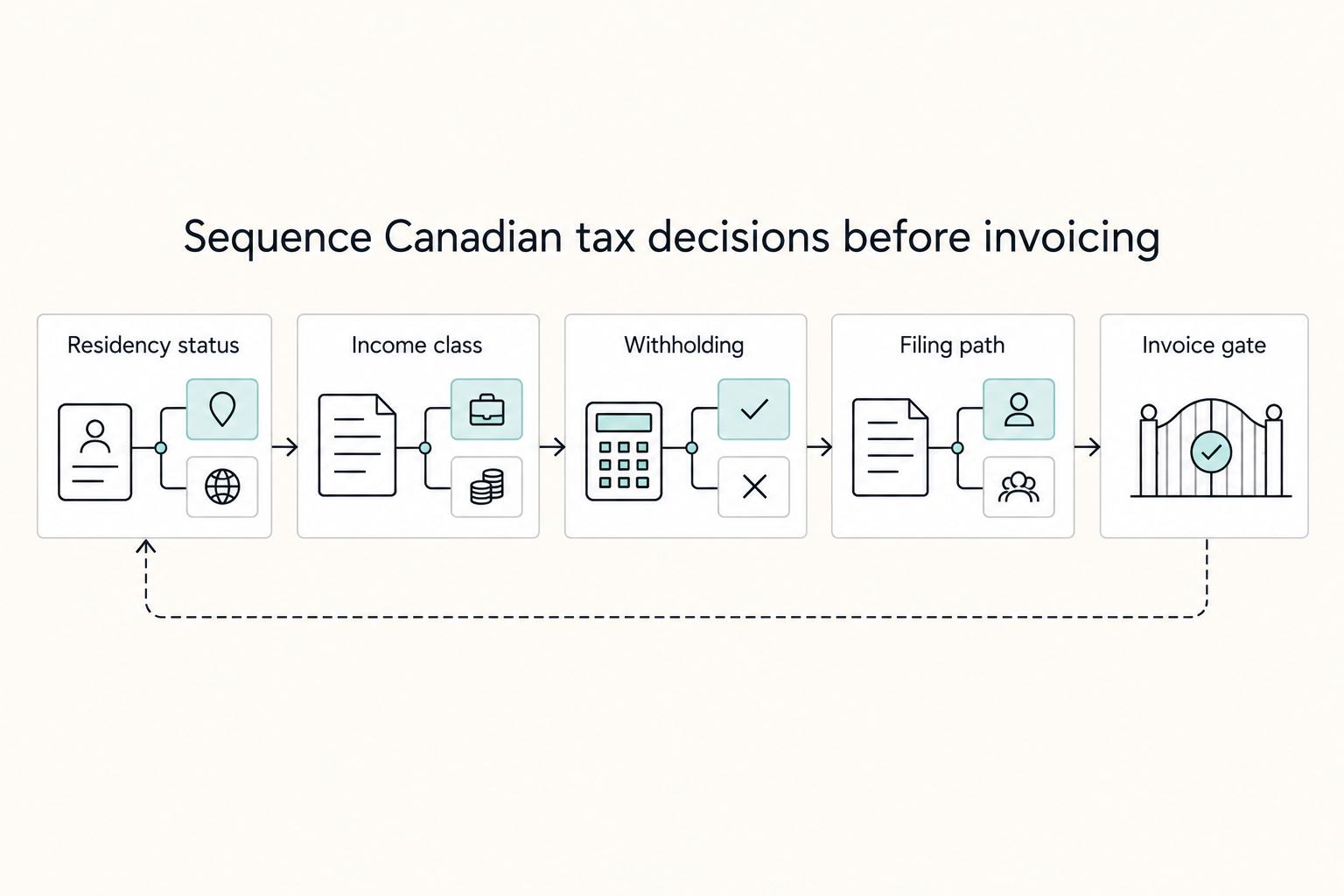
For freelancers handling Canada non-resident tax issues, the safest order is simple: confirm residency first, classify income second, sort out withholding third, and only then finalize filing. Start there because CRA says your tax obligations depend on your residency status, and that status can change from year to year. Use this sequence:
- Confirm whether your facts support non-resident treatment or point to a more complex residency case.
- Classify each Canadian-source payment stream, because CRA says Canadian income received by a non-resident is generally handled under either Part XIII tax or Part I tax.
- Confirm withholding before payment, including telling Canadian payers your non-resident status and country of residence so the correct amount can be deducted.
- Finalize filing workflow, forms, and records only after those steps are settled.
A key judgment is income type, not just the fact that a Canadian client paid you. CRA says both the tax type and whether a return is required depend on the type of income you receive.
If your facts are mixed, stop and sort that out before you push ahead. If you have residential ties in Canada or you sojourned in Canada for 183 days or more in the tax year, treat that as a branch point and get advice before you file or rely on payer assumptions.
Use this guide as a working checklist. Keep your facts documented. Keep CRA's non-resident filing materials handy, including the 2025 Income Tax and Benefit Guide for Non-Residents and Deemed Residents of Canada.
Start with residency status before you calculate any tax#
Start with residency status, not rates, forms, or withholding. CRA says your tax responsibilities and filing requirements depend on this classification, so everything that follows can become unreliable if this step is wrong.
A Non-resident of Canada and a Deemed non-resident of Canada are separate outcomes. Confirm which one applies, especially if your facts are mixed.
Use CRA's fact pattern test first#
CRA's residency analysis is case by case. Start with the full fact pattern: your residential ties with Canada, plus the length, purpose, intent, and continuity of your time inside and outside Canada.
That is the right starting point in CRA guidance, with tax treaty position checked when relevant. Do not use the 183-day rule as a stand-alone test, because day count is assessed with other conditions and treaty status.
What to verify before you move on#
Before you classify any Canadian-source income, make sure you can support:
- where you normally, customarily, or routinely live
- your days in Canada for the tax year, including whether you were under 183 days or 183 days or more
- the facts behind your treaty position, if a treaty applies
If the facts are unclear, Form NR74 can be a practical checkpoint for requesting CRA's opinion on whether you would be considered a deemed non-resident. It is an opinion step, not a guaranteed final outcome.
Avoid jumping into withholding setup or return prep just because a payer wants paperwork. If residency is wrong, your withholding setup, filing path, and documentation can all drift off course. If you want a deeper dive, read the digital nomad tax guide.
Are you a Non-resident of Canada or a Deemed non-resident of Canada#
Do not decide this from day count alone. Use this order: confirm where you normally live, assess your Residential ties in Canada, then test treaty residency under the relevant Tax treaty. If those checks point in different directions, treat the file as high risk and pause before filing.
CRA's position is that residency status drives tax obligations and filing requirements, and that all relevant facts in your case must be considered. Your goal is a defensible classification, not a fast label.
Use the sequence in this order#
| Step | What you are testing | What to verify now | Red flag |
|---|---|---|---|
| 1 | Where you normally live | Where you normally, customarily, or routinely live | No clear usual home base |
| 2 | Significant residential ties in Canada | Whether significant Canadian ties exist and remain active | You claim to live abroad, but ties in Canada still look strong |
| 3 | Treaty residency context | Whether you are considered a resident of another country that has a tax treaty with Canada | Treaty position is asserted, but not clearly tied to your facts |
| 4 | 183-day context | Whether you were under 183 days or at or over 183 days in Canada | Day count is being used as a stand-alone conclusion |
Where mixed facts become a stop point#
Treaty analysis is the key checkpoint when steps 1 and 2 do not resolve the file. If your facts suggest both strong Canadian ties and long physical presence, stop, document your assumptions, and escalate before filing.
Use Form NR74 when the facts stay unclear. CRA presents it as a way to request CRA's opinion on whether you would be considered a deemed non-resident of Canada.
Write a one-page status memo before filing#
Before you move from status to income classification, write a one-page memo for your preparer or reviewer that includes:
- your chosen classification
- the core facts in date order
- your day count for the year
- your treaty position, if applicable
- the documents supporting each point
- unresolved issues or assumptions
If you cannot explain the classification clearly on one page, your file likely needs review before filing.
Classify each payment stream into Part XIII tax or Part I tax#
Classify Canadian-source income stream by stream, rather than forcing one treatment across a full invoice. For each stream, make a provisional call between Part XIII tax and Part I tax, because withholding, reporting, and rework risk can differ across those two buckets.
One contract can produce different payment types. CRA's framing is broad: Canadian income received by a non-resident is generally subject to Part XIII tax or Part I tax. In practice, that means it can be safer to classify each line separately when a contract produces more than one kind of payment, rather than forcing one bucket onto the whole invoice.
Split the payment before deciding the bucket#
Start with the contract terms and the purpose of the payment, then map that to invoice lines and payment records. If a payment covers different legal or commercial reasons, keep those components separate until you can support a final treatment.
If your documents do not show the split clearly, treat that as a risk signal. It can make it harder for the payer to withhold correctly and harder for you to defend the treatment later.
Working comparison table#
| Income stream | Likely bucket | Default withholding tax behavior | What remains unknown without treaty detail |
|---|---|---|---|
| Amount that clearly matches a CRA-listed Part XIII income type | Part XIII tax | CRA states Part XIII tax is deducted from covered income types. A cited baseline is 25% on amounts paid or credited by a Canadian resident to a non-resident, subject to exceptions not covered here. | Whether a treaty changes the result, whether the payment is correctly characterized, and whether an exception applies |
| Amount from Canadian-source activity that does not clearly match a covered Part XIII type | Potentially Part I tax, pending confirmation | This does not provide a specific default withholding percentage for Part I. Do not assume 25%, and do not assume no withholding. | Whether the income character is correct and what withholding or filing consequences follow |
| Mixed contract with separate lines where at least one line may fit Part XIII and another may not clearly fit a covered Part XIII type | Could split across both buckets | Withholding may need to be handled line by line. | Whether the split is supportable, whether treaty relief applies to any line, and how each line should be reported |
| Undescribed lump sum, settlement, or catch-up payment tied to a Canadian payer | Unknown until documented | No reliable default applies. Confirm with the relevant authority. | What the payment is for, whether it relates to earlier streams, and which bucket applies |
Tie each call to CRA guidance and your payment records#
For each classified line, keep a short note linking the contract clause, invoice description, payment record, and the CRA reference you used for the call. Keep it specific and easy to audit.
Before payment, confirm how the Canadian payer is treating each stream. CRA explicitly says the right deduction depends on giving Canadian payers the relevant non-resident facts. If a line is being treated as Part XIII, confirm the expected withholding and whether it will be reported on an NR4 information return.
Treat unclear classifications as pending, not final#
Mixed invoices and vague payment descriptions create rework. Part XIII program operations are built around withholding, remitting, and reporting, and they include assessment and reassessment activity.
Use a simple classification sheet next to your status memo: amount, date, payer, contract clause, provisional bucket, expected withholding behavior, CRA reference, and any open treaty question. If a line cannot be traced to both documentation and a rule reference, keep it marked as pending. For a related discussion, read A guide to the 'exit tax' when leaving Canada as a self-employed professional.
Confirm withholding tax treatment before you invoice or get paid#
Treat withholding as a pre-payment check, not a year-end cleanup task. Before you send a final invoice, confirm in writing how the payer will handle each line item, because that decision affects what you actually receive.
Once you have a provisional Part XIII versus service-income classification, confirm the right baseline for that specific payment type. For non-employee services rendered in Canada, CRA cites paragraph 153(1)(g) and Regulation 105, with 15% withholding on the gross amount paid. Do not assume treaty-reduced, exempt, or nil withholding unless the payer can document the position and has CRA written notification when required.
Get the payer's position in writing#
If your memo says you are non-resident and the work is Canadian-source, do not rely on verbal confirmation. Ask the payer to confirm the rule they are applying, the gross base used for withholding, and the reporting slip they will issue.
Pause your invoice terms if either of these shows up:
- the payer says withholding does not apply because they are not a Canadian company
- the payer claims treaty relief but cannot show supporting paperwork
CRA guidance says every payer, including a non-resident payer, must withhold and remit as required for covered payments. CRA also states that if written notification for a waiver or reduction has not been obtained, required withholding remains mandatory.
Know which baseline question you are asking#
For lines treated as Part XIII, confirm which Part XIII treatment the payer is applying and whether any treaty position is actually documented. For non-employee service fees rendered in Canada, confirm Regulation 105 handling and 15% gross withholding.
Under Regulation 105, withheld amounts are remitted by the 15th of the following month. The payer must also issue and file T4A-NR slips regardless of amount paid or tax withheld, with the deadline by the last day of February of the following year. If deduction or remittance is missed, CRA may assess the outstanding amount plus interest and penalty.
What to confirm before you finalize invoice terms#
Before you finalize invoice terms, get short written confirmation, by email or contract addendum, covering:
| Item | Confirm | Why it matters |
|---|---|---|
| Line items | Payment classification for each line item | You want the treatment fixed before payment, not reconstructed later |
| Withholding | Whether withholding applies, and the baseline rate used | Withholding changes what you actually receive |
| Waiver or reduction | Whether CRA written waiver or reduction notification exists | CRA states required withholding remains mandatory if written notification has not been obtained |
| Reporting slip | Which slip will be issued, and when | You need this to reconcile your records and filing |
| Reimbursements | Whether reimbursements are included in the withholding base | Do not assume reimbursements are outside the withholding base |
Do not assume reimbursements are outside the withholding base. CPABC has reported that CRA's administrative stance changed so certain subcontractor fee reimbursements made after September 30, 2024 became subject to withholding.
If the payer will not document the handling, delay final invoice terms until treatment is clear. That is usually lower risk than fixing withholding assumptions after payment.
Handle Regulation 105 waiver requests before contract cashflow breaks#
Treat the Regulation 105 waiver decision as a pre-payment cashflow control step, not post-payment cleanup. Once a payer classifies your fee under Regulation 105, check the waiver path before you lock invoice timing or net cash assumptions.
Use a practical sequence#
Use this working order of operations. It is operational, not a CRA legal sequence:
| Step | Action | Detail |
|---|---|---|
| 1 | Review the contract and scope | Confirm where services will take place in Canada; if services are in one area, the application should go to the TSO/CoE serving that area, and if services span multiple locations, a complete application may be filed with any TSO/CoE serving one of those locations |
| 2 | Confirm the payer's process and payment cutoff | Ask what they need, and by when, before releasing payment on a reduced-withholding assumption |
| 3 | Check the treaty-based waiver route | These guidelines are used only for Regulation 105 waiver applications requesting treaty relief, and you must substantiate treaty-country residency and entitlement to treaty benefits |
| 4 | Finalize invoice terms | Do this only after steps 1 through 3 align; if the waiver path is unclear, do not price or time invoices as if withholding will be reduced |
The key is sequencing: confirm the service location, confirm the payer's cutoff, confirm whether the treaty-based waiver route actually fits, and only then lock invoice timing.
Late waiver handling can become a failure mode. Payment can move first, withholding can be applied, and you may be left reconciling slips and records afterward.
Keep one narrow exception in context. CRA's simplified waiver process in this material is for self-employed non-resident artists and athletes expecting no more than CAN$15,000 in the calendar year, not general freelance service work.
If your treaty position and the payer's process conflict, escalate to a cross-border tax professional before payment is released. That is especially true where the dispute depends on fixed base or permanent establishment issues that these guidelines are not intended to determine.
For a step-by-step walkthrough, see Canada Tax Rules for Self-Employed Residents and Non-Residents.
Pick the right CRA filing package and forms the first time#
Once status, income classification, and withholding are set, choose the filing package that matches those decisions. Start with two facts first: your residency status for the year and the type of Canadian income you received. For 2025, T4058 applies if you were a non-resident or deemed non-resident for all of 2025. Whether you must file still depends on your income type.
CRA's basic rule is straightforward: non-resident Canadian income is generally taxed under Part XIII or Part I, and filing is income-type dependent. Do the status check first, the income-type check second, then choose documents.
| CRA item | What it is | When to use it | Practical checkpoint |
|---|---|---|---|
| T4058: Non-Residents and Income Tax | Status and tax-treatment guide | Use if you were non-resident or deemed non-resident for all of 2025 | Read scope and "do not use this guide" situations before relying on it |
| Income Tax and Benefit Guide for Non-Residents and Deemed Residents of Canada | 2025 guide in the package | Use to decide whether you need to file and how to complete the return | Go to "Who has to file a return" before preparing forms |
| Income Tax and Benefit Return (in the package) | The return you file if your facts point to a filing requirement | Use only after status and income type point to a filing requirement | Confirm your Part I versus Part XIII path is consistent with what you file |
| Schedules/worksheets referenced by the package | Supporting forms that may apply based on your facts | Use only what the package instructions require for your case | Do not assume resident-filing attachments apply; follow package instructions |
| Form T2203 (multi-jurisdiction cases) | May be relevant in some fact patterns | Verify only if your facts require it | Not confirmed exactly where it appears in this package, so check the 2025 package instructions directly |
Treat the package as a bundle, not one form#
The Income Tax Package for Non-Residents and Deemed Residents of Canada is the full set. In practice, work from the Income Tax and Benefit Guide for Non-Residents and Deemed Residents of Canada and the return documents included with that package.
Before you start filing, open the guide and confirm "Who has to file a return." That step helps you avoid filing based only on having Canadian-source income when your income type may not require a return.
Also watch the exclusion cases. CRA says not to use T4058 in some situations, including if you moved permanently to Canada or emigrated from Canada in 2025.
Verify submission method early#
Confirm your submission route early, not after drafting the return. Online filing eligibility or restrictions (including NETFILE) are not confirmed, so verify the method directly before you finalize.
Build a documentation file that survives a CRA review#
Build one evidence pack before you file so each material tax position is easy to trace to facts, records, and the rule context you used. In Canada's self-reporting system, CRA reviews and audits are used to verify amounts claimed on returns, and a review is usually narrower than an audit.
Use four working folders#
Use four working folders in a practical workflow, not a CRA-mandated format.
| Folder | What to keep | Why it matters |
|---|---|---|
| Status proof | Residency status notes, residency-supporting records, timeline documents | Supports the status position used in your filing |
| Income classification | Contracts, invoices, payment records, notes on income source and withholding treatment | Shows how each payment stream was classified |
| Withholding records | Payer withholding confirmations, slips or statements, and related correspondence | Helps reconcile your return with payer and third-party reporting |
| Filed forms | Final return, schedules or worksheets, submission confirmations, copies sent to CRA | Proves what was filed and when |
Run traceability checks before submission#
Before you submit, test each material position two ways: which document supports the fact, and where the rule context is documented in your working papers.
Then run a mismatch check and reconcile payer-reported amounts, withholding records, and return totals. Differences between returns and third-party data are a known documentation risk signal.
Keep payer communications and a dated decision log#
Do not keep only final forms. Save payer emails that confirm withholding treatment, timing, and any later changes.
Also keep a short dated decision log for material judgment calls: issue, facts known at the time, treatment chosen, supporting document, and open uncertainty. That record is practical protection when questions come later or carry across multiple years.
If you need a Certificate of Residency for cross-border use, confirm the required format first. A standard CRA certificate is not accepted by every foreign tax administration, and the certificate may be requested by a foreign tax administration or payer. Turn your status memo and evidence folders into a repeatable workflow with Gruv's tax documentation workflows.
Avoid the mistakes that trigger penalties and rework#
Avoidable rework usually comes from doing the right tasks in the wrong order. Settle your tax position and evidence first, then forms, then filing. CRA states that if you do not comply with requirements and regulations under the Income Tax Act, one or more penalties may apply.
Mistake 1: Choosing forms before status is settled#
Do not choose your filing package before you can defend the position you are taking. Write a short status memo first with your position, supporting facts, and what is still uncertain. If your forms folder is more complete than your status folder, pause and fix that before filing.
Mistake 2: Treating all Canadian-source income as one bucket#
Do not code all Canadian-source income the same way by default. For each payment stream, document the tax treatment you are applying, and tie that note to the contract, invoice, and payment record. Even with one client, different payments should not be grouped together without checking the nature of each one.
Mistake 3: Assuming payer handling was correct#
Do not leave key payment-record checks to year-end cleanup. Confirm the payer's handling in writing before you finalize your return, including what was withheld and how the payment was recorded on their side. If the explanation is vague, treat the position as unresolved until the records are clear.
Mistake 4: Keeping weak records that cannot support your position#
Weak records turn manageable issues into penalty risk and rework. CRA's penalty categories include failure to file penalties and penalties for false statements or omissions, so your status memo, payment-treatment notes, payer communications, and filed forms need to line up.
If you operate through a corporation, check corporate-specific exposure separately. CRA lists penalties for non-resident corporations, and its T2 checkpoint references line 233 on page 2. On that CRA page, a corporation is "large" when total taxable capital employed in Canada, including related corporations, is over $10 million.
CRA also says it may consider cancelling or waiving penalties and interest in some cases. Treat that as possible relief, not your plan. The safer approach is simple: settle your position first, verify payment records before filing, and keep records that clearly support your filing decisions.
Keep Canada filing separate from home-country reporting duties#
A complete CRA filing does not complete your U.S. compliance. If you are a U.S. filer, run Canada and U.S. reporting as parallel tracks that can share evidence but still need separate forms and checkpoint reviews.
Do not treat a finished Canadian return as proof that U.S. obligations are done. Keep U.S. items like FBAR (FinCEN Form 114) and Form 8938 on their own checklist. Use one evidence pack, then split execution into two lists:
- Canada list: CRA-side records and filings.
- U.S. list:
- Do you have a U.S. income tax return filing requirement this year? * If yes, does Form 8938 apply, and is it attached to that annual return by the return due date, including extensions? * Are foreign financial accounts separately reportable on FinCEN Form 114, even if Form 8938 is filed?
Check Form 8938 and FBAR as separate decisions#
Do not collapse Form 8938 and FBAR into one checkbox. Form 8938 is not a standalone filing; it is attached to an annual return. Filing Form 8938 also does not remove any FinCEN Form 114 requirement.
| Item | What the article says | Key distinction |
|---|---|---|
| Annual U.S. return | First verify whether you have a U.S. income tax return filing requirement this year | If no U.S. income tax return is required for the year, Form 8938 is not required for that year |
| Form 8938 | It is attached to an annual return and covers specified foreign financial assets, including financial accounts maintained by a foreign financial institution | It is not a standalone filing; a baseline trigger of aggregate value exceeding $50,000 applies for certain U.S. taxpayers, but filer category controls the exact threshold |
| FinCEN Form 114 (FBAR) | Foreign financial accounts may be separately reportable | Filing Form 8938 does not remove any FinCEN Form 114 requirement |
For Form 8938, verify scope before you file. It covers specified foreign financial assets, including financial accounts maintained by a foreign financial institution, while some accounts are excluded, including certain accounts maintained by a U.S. payer. A baseline trigger of aggregate value exceeding $50,000 applies for certain U.S. taxpayers, but filer category controls the exact threshold. If no U.S. income tax return is required for the year, Form 8938 is not required for that year.
This pairs well with our guide on A Guide to Canada's 'Departure Tax' on Emigration.
Conclusion#
The lowest-risk approach is to lock the decision order: confirm residency status, classify each Canadian-source income stream, confirm withholding treatment, then file using the CRA package that matches your facts.
Start with status. Confirm whether you are a non-resident or deemed non-resident, using CRA's definitions and any treaty position that applies. If your facts point in different directions, treat that as a risk signal and escalate early instead of forcing certainty.
Once status is clear, keep the scope tight. Non-residents are generally liable for Canadian tax on Canadian-source income. Review each payment stream one by one, note why you treated it as Canadian-source or not, and flag anything that still depends on treaty interpretation.
Treat withholding as an execution checkpoint, not a year-end surprise. A 25% rate may apply to some non-resident income streams, and treaty provisions may reduce withholding in some cases, so confirm the payer's treatment and verify any treaty-based position.
Before filing, verify the return path itself. CRA's T4058 is scoped to people who were non-resident or deemed non-resident for all of 2025, and CRA also flags situations that should use a different package. Use the package instructions that match your case.
Keep a clean evidence file: residency reasoning, payer communications, treaty support, and the filing instructions you relied on. If residency or treaty treatment is unclear, get qualified tax advice early.
If your treaty position, withholding setup, or cross-border filing stack is still unclear, use Gruv's Contact page to confirm the next operational step in your workflow.
Frequently Asked Questions
Who qualifies as a non-resident of Canada for tax purposes?
CRA describes a non-resident as someone who normally, customarily, or routinely lives in another country and is not considered a resident of Canada. One listed condition in CRA’s non-resident criteria is staying in Canada for less than 183 days in the tax year, alongside the broader residency facts. If you are otherwise resident in Canada but a tax treaty treats you as resident in another country, you may be a deemed non-resident instead.
Do non-residents pay Canadian tax on all income or only Canadian-source income?
Non-residents are generally taxed on income from sources in Canada. CRA also says both the tax type and the return-filing requirement depend on the type of income received. A practical first step is to identify each Canadian-source payment and classify it.
How do I know whether income falls under Part XIII tax or Part I tax?
CRA’s baseline is that Canadian income received by a non-resident is generally subject to either Part XIII tax or Part I tax. Which one applies depends on the income type, so classification comes before filing decisions. If the income characterization is unclear, verify it against CRA guidance before you file.
Is withholding tax always 25% for non-residents?
No. The 25% rate is the headline for amounts taxable under Part XIII. CRA also notes that 25% applies to taxable amounts paid or credited to persons in non-treaty countries. But treaty reductions or other rules can change the result, and CRA says treaty rates and exemptions should be checked regularly. Tell the Canadian payer your non-resident status and country of residence so the right amount is deducted. The payer or withholding agent is responsible for withholding and remitting Part XIII tax at the correct rate.
Do I need the Income Tax Package for Non-Residents and Deemed Residents of Canada?
Maybe. CRA’s T4058 says it is for individuals who were non-resident or deemed non-resident for all of 2025. It also directs some users to the Income Tax Package for Non-Residents and Deemed Residents of Canada. Use the package instruction that matches your residency and treaty position rather than defaulting to a standard resident path.
When should I ask for professional help instead of filing on my own?
There is no single trigger in these CRA excerpts for when you must hire a professional. Consider getting help when your core facts are unclear or disputed. That includes cases where residency status is uncertain, you sojourned in Canada for 183 days or more, a treaty-residence result may apply, or you cannot confidently classify income under Part XIII versus Part I. Escalate when the payer’s withholding treatment does not match your understanding. In those cases, getting the position checked early can be safer than correcting it after filing or remittance.
Try a related tool
Researched and edited by the Gruv editorial team. Gruv builds cross-border billing, payouts, and finance-operations software for global businesses.
Sources
Includes 3 external sources outside the trusted-domain allowlist.
- ecfr.gov/current/title-50/chapter-VI/part-679/subpart-Atrusted
- irs.gov/businesses/international-businesses/canada-t...trusted
- irs.gov/businesses/corporations/do-i-need-to-file-fo...trusted
- oag.maryland.gov/resources-info/Documents/pdfs/Opinions/1925/...trusted
- scholarship.law.ufl.edu/cgi/viewcontent.cgitrusted
- canada.ca/en/revenue-agency/services/tax/international...external
- canada.ca/en/revenue-agency/services/forms-publication...external
- mondaq.com/advicecentre/content/5786/what-is-cras-regul...external
Educational content only. Not legal, tax, or financial advice.
Related Posts

Digital Nomad Taxes in 2026 With a Defensible Filing Plan
With digital nomad taxes, the first move is not optimization. It is figuring out where you may be taxable, where filings may be required, and what proof supports that position.

Ho Chi Minh City Digital Nomad Guide for a 30-Day Move (2026)
Ho Chi Minh City is a strong base if your priority is keeping work momentum while relocating. You get density, plenty of places to work from, and a social scene that can help you settle quickly. It is a weaker fit if your best days depend on calm streets, easy walking, and long stretches of quiet. In practice, Saigon tends to reward people who want convenience and activity more than retreat pace.

The Best Video Editing Software for Freelancers
**Choose the best video editing software based on the workflow you can repeat under pressure, not the tool that looks most impressive on YouTube.** You are the CEO of a business-of-one, and your editor is part of your delivery infrastructure. When a client changes scope, sends a new batch of footage, or asks for "one more revision," your editor stops being a creative playground and becomes a system you either trust or fight.