
Quick Answer
To control departure tax when leaving Canada as a self-employed professional, start planning about 12 months before you move. Build a defensible asset register, support your ACB and FMV, document a supportable residency end date, classify exceptions carefully, and decide whether to pay or defer through Form T1244. Clean filing and post-departure status maintenance help keep later CRA risk manageable.
Leaving Canada as a self-employed professional is a business project, not a last-minute tax filing task. The biggest mistake is treating departure tax as something to sort out when the return is due. Real control starts well before you leave, when you still have time to pin down your residency date, classify assets properly, and build the evidence behind each filing position. This playbook breaks the process into three phases so you can replace uncertainty with an organized, defensible plan.
Phase 1: The Pre-Departure Audit (Your 12-Month Strategic Countdown)#
Phase 1 is about evidence and classification, not rushed tax prep. Start about 12 months out so you can prove your residency cutover, sort each asset correctly, and support every number you may later report.
12 months out#
Your first deliverable is a master asset register you can defend. For each holding, capture the legal owner, location, personal versus business link, acquisition year, adjusted cost base (ACB) support, fair market value (FMV) support, and your current classification.
Your travel date may differ from the tax-residency end date. CRA generally uses the latest of your departure, your spouse or common-law partner and dependants leaving, and becoming resident in the destination country. Resettling in a country where you lived before Canada can have a different rule; retained ties and treaty residence also require review. Use the resulting date consistently for valuation and filing.
| Asset bucket | What to collect now | Why it matters for departure tax exposure | What goes wrong if docs are weak |
|---|---|---|---|
| Deemed-disposition candidates (most property unless an exception applies) | Acquisition year, ACB support, acquisition expenses, FMV support near departure date, ownership records | These holdings can create reportable deemed-disposition gains for Form T1243 and Schedule 3 | You cannot support ACB or FMV, gains are misstated, or assets are omitted |
| Likely exceptions (for example, Canadian real or immovable property, Canadian resource property, timber resource property, and qualifying Canadian business property carried on through a PE in Canada) | Title or location evidence, business records, PE facts where relevant | Exceptions depend on facts, not labels | Assets are treated as exempt without proof, then reclassified later |
| Business-linked intangibles or closely held interests needing specialist review | Contracts, shareholder documents, financials, IP records, prior valuation work | CRA valuation guidance treats closely held securities and intangible property as fact-sensitive | Informal estimates are hard to defend when value depends on judgment |
| Disclosure classification | Separate T1161 exclusion and threshold tags from T1243 tax-treatment tags | An asset can be disclosed without being subject to automatic departure deemed disposition | Using one exemption flag for both forms omits reportable property |
9 months out#
At this stage, decide which assets need more than a spreadsheet. Formal valuation is often the safer path when value is hard to observe, the amount is material, or your tax result depends on judgment-heavy facts.
| Triage question | Practical read |
|---|---|
| Is there a clear market price and complete records? | Formal valuation may be optional, but keep strong evidence |
| Is the asset closely held or intangible (for example, goodwill or IP)? | Formal valuation is usually prudent |
| Is treatment based on an exception that depends on facts? | Build a proof file and get specialist review if the facts are not clean |
If the facts are not clean, get specialist review before you lock in a position. For each material asset, your file should include:
- Acquisition year support
- ACB support: acquisition cost and expenses plus applicable subsequent adjustments; retain the adjustment history, not only purchase records
- FMV support as of the expected departure date
- Legal or contract documents that affect ownership or transfer
- Prior valuation memos or appraisals, if any
- Current-year CRA form instructions for the forms you expect to file
If your spreadsheet is clean but the backup evidence is thin, you are not ready. Schedule 3 reporting depends on supportable acquisition year, proceeds, ACB, and outlays or expenses.
6 months out#
Now turn the audit into a cash-flow choice: pay now or elect deferral. Form T1244 is a deferral election, not tax cancellation. CRA states that later actual dispositions can trigger payment of some or all deferred tax.
| Item | Practical impact |
|---|---|
| Form T1244 | Deferral election, not tax cancellation |
| Pay now | Lower future compliance friction, higher immediate cash use |
| Defer | Preserves liquidity, adds tracking, deadline, and possible security requirements |
| Election timing | April 30 of the year after emigration |
| Security | Required when federal tax on deemed-disposition income is more than $16,500 (or $13,777.50 for former Quebec residents); provincial or territorial security can also be required. Arrange acceptable security with CRA before April 30. |
On paper, the tradeoff is simple: paying now reduces later administration, while deferral preserves liquidity but adds tracking and deadline risk.
Bring in a cross-border tax professional now if any of these apply:
- Your residency cutover date is unclear because residential ties are not cleanly severed
- You hold closely held shares, goodwill, IP, or other judgment-heavy business assets
- Your ACB records are incomplete or hard to reconstruct
- You are relying on the Canadian business property or PE exception
- You may qualify for the short-term resident rule (resident in Canada for
60 months or lessin the prior10-yearperiod)
3 months out#
By this point, your file should be decision-ready, not still in discovery mode. Hand your advisor one package with the asset register, ACB and FMV support, exception analysis, valuation support, departure-date memo, and draft form mapping for T1243, T1161, and T1244 as relevant.
If that package is still incomplete three months out, treat it as a real risk signal. You have fewer planning options, more filing pressure, and weaker support if CRA asks questions later.
The Permanent Establishment Question: Your Business's Clean Break#
Your move may not be a clean break if your business footprint remains tied to Canada. Treat this as a facts-and-evidence test. If your post-move setup still shows meaningful Canada-side operating signals, do not assume the business has fully exited.
Use the treaty with your destination country where one applies. The U.S.–Canada treaty is relevant to a move to the United States, with residence, permanent establishment and business profits considered separately; it is not a universal framework for every destination.
Quick facts triage (not a legal conclusion)#
No single item below decides PE on its own. Use this table to prioritize what needs review and documentation.
| Post-move scenario | What to verify now | Practical read |
|---|---|---|
| You still have Canadian clients | Where work is actually performed, contract and invoice setup, any remaining Canada-side operations | By itself, this does not prove or disprove PE |
| Someone in Canada can negotiate or sign for the business | Current authority map, approval flow, who has contracting power in practice | Higher-priority review item |
| You keep a Canadian office, studio, or home workspace tied to the business | Lease or ownership, business use, public-facing business details | Higher-priority review item |
| Canada-based support still handles admin or client-facing tasks | Scope of work, limits on authority, client communication trail | Outcome depends on the full fact pattern |
Map your facts before final tax conclusions#
Before you lock in a tax conclusion, map your situation to the treaty buckets above and document what changed, what did not, and what evidence you have.
This helps you avoid overconfidence from any single fact. If your position depends on treaty interpretation, get case-specific advice before you rely on it.
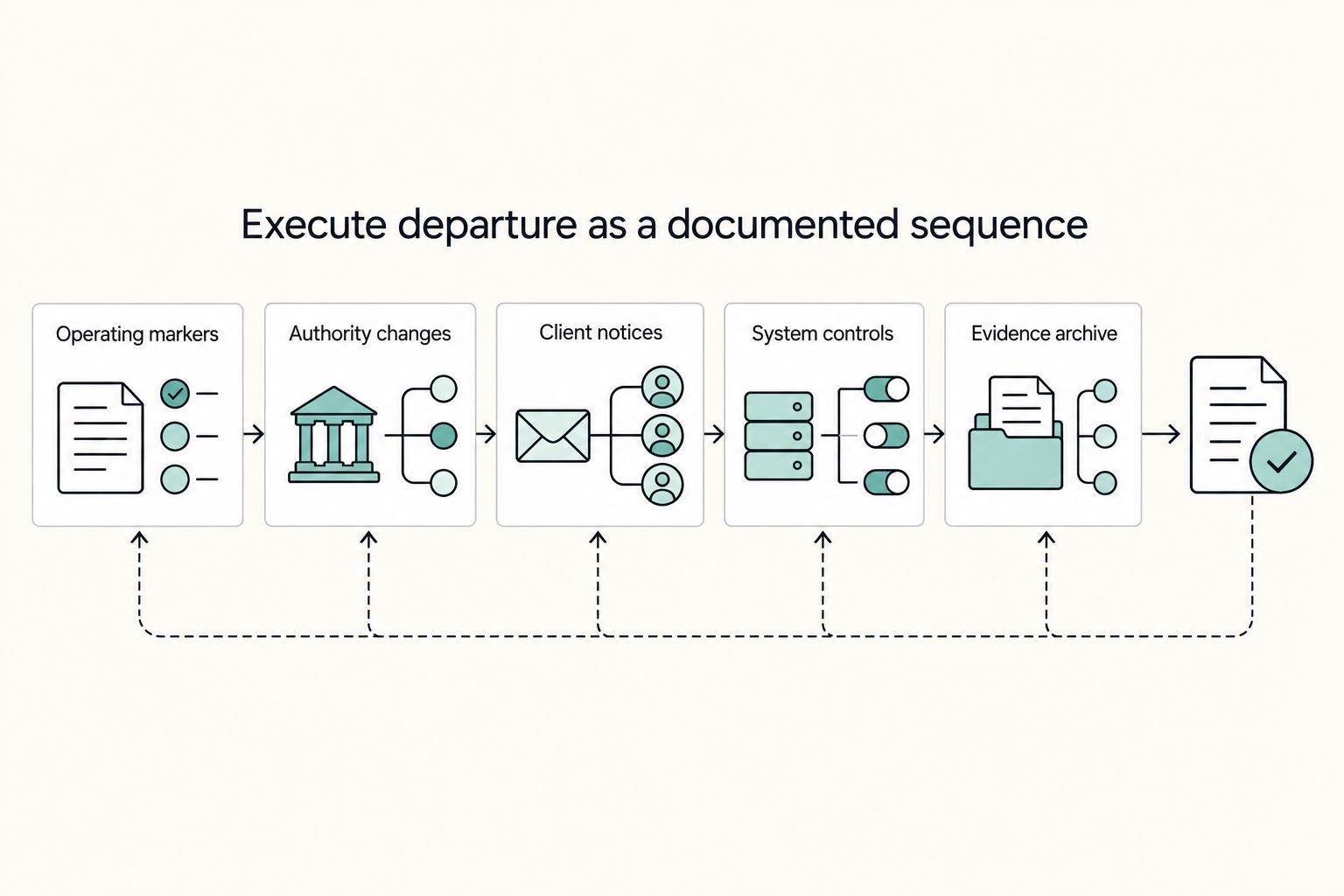
Execute the clean break as a documented sequence#
Once the facts are mapped, carry the clean break through in a sequence you can prove later.
| Step | Action | Evidence to retain |
|---|---|---|
| 1 | Update or close Canadian operating markers that no longer match reality | Keep dated records |
| 2 | Remove Canada-side contracting or approval authority where appropriate | Save internal evidence of the change |
| 3 | Notify clients and counterparties in writing of operating-address and authority changes | Retain delivery proof and amendments |
| 4 | Update physical and digital operations, including workspace access, records location, and system or admin control | Preserve dated artifacts |
| 5 | Archive one evidence file | Registrations or updates, notices, authority records, and public-facing snapshots |
Keep the evidence aligned with the actual operating changes. For uncertain individual residence, consider an NR73 request for CRA’s opinion with your adviser; it is not a substitute for the facts or a business permanent-establishment analysis.
If you want a deeper dive, read the digital nomad tax guide.
Phase 2: The Departure Year Filing Position (Your Execution Checklist)#
This is where the planning becomes a filing position you can defend. In your departure year, you need to do three things cleanly: set a supportable non-resident date, move valuation work into the right forms, and keep evidence showing that your facts and filings line up.
Step 1. Set your non-resident date using CRA tie rules#
Confirm the residency end date from your ties, destination residence and any applicable treaty. Apply CRA’s usual latest-of rule and check its resettlement exception rather than using your flight date automatically.
Start with the major ties: home, spouse or common-law partner, and dependants in Canada. Then build one dated evidence folder that supports your tie-severance timeline, including housing and family changes, notifications to payers and financial institutions, and other tie changes.
Your output:
- decision: one written departure-date memo with any assumptions called out
- filing prep: status notes for any Canadian payers and financial institutions you need to notify as a non-resident
- proof retained: one dated evidence folder with the records behind your date position
Escalate now if the facts are mixed, the records are incomplete, or residency is ambiguous. This is the point to discuss whether an NR73 opinion request fits your case.
Step 2. Classify assets before you touch the forms#
Classify assets before you touch the forms. When you cease Canadian residency, CRA treats certain property as deemed disposed of at FMV on departure. Your asset inventory is now a filing input, not just planning work.
Tag each item as included, excluded, or needs review. If any business-property exclusion depends on a Canadian permanent-establishment analysis that is not clear, pause and escalate instead of forcing a conclusion.
Your output:
- decision: asset-by-asset include, exclude, or review tags with reasons
- filing prep: a final deemed-disposition working set tied to departure-date FMV
- proof retained: valuation support and review notes for each tagged item
Step 3. File the forms your facts require#
File what your facts require, not a generic departure bundle.
| Return or form | Purpose | Required inputs | Depends on prior valuation work | Timing note |
|---|---|---|---|---|
| Departure-year T1 package | Final return for the year you ceased residency, using the province or territory package tied to where you resided when you left | Departure date, income details, Schedule 3 data where applicable | Yes, if deemed-disposition gains or losses apply | Usually June 15 following the year for qualifying self-employed taxpayers, while tax payment remains due April 30; confirm current-year exceptions and weekend/holiday treatment. |
| Form T1243 | Report deemed-disposition property amounts on ceasing residency | Property list, departure-date FMV, gain or loss calculations, inclusion or exclusion decisions | Yes | File with your departure-year return |
| Form T1161 (if triggered) | Disclose specified property owned at departure when CRA trigger conditions are met | Property list and FMV data | Usually yes | Due by your filing deadline even if no T1 return is otherwise required. |
| Form T1244 (if electing deferral) | Elect to defer tax on deemed-disposition income linked to T1243 | Deferred tax amount, related property data, security analysis if applicable | Yes | Election and acceptable security arrangements by April 30 following emigration; do not wait for a later self-employed return deadline. |
Your output:
- decision: exact form set required for your facts
- filing: completed forms mapped to the same inventory dataset
- proof retained: form copies, working papers, and submission confirmations
Step 4. Reconcile the numbers end to end before submission#
Before submission, reconcile the numbers from end to end. CRA states that T1243 gains and losses flow into Schedule 3. Your file should tie from inventory to T1243 to Schedule 3 to the final return. Use this final checklist:
- every inventory item is tagged included, excluded, or reviewed, with a reason
- each T1243 entry ties to valuation support and your departure-date position
- T1243 totals agree to Schedule 3 amounts
- T1161 uses the same register but its own exclusion rules, distinct from T1243 deemed-disposition treatment.
- submission confirmations and any non-resident notifications are saved in your evidence file
Your output:
- decision: reconciliation passed or blocked
- filing: submit only after traceability checks clear
- proof retained: one complete audit trail for facts, forms, and filings
You might also find this useful: A Guide to Canada's 'Departure Tax' on Emigration. Before you file your departure-year package, keep your residency evidence and filing milestones in one place with the tax residency tracker.
Phase 3: Post-Departure Compliance (Protecting Your New Freedom)#
After leaving Canada, treat compliance as an annual non-resident maintenance cycle, not a one-time task. Each year, confirm that your facts still support emigrant or deemed non-resident treatment, and make sure your Canadian accounts and payers still reflect that status.
Start with the highest-impact control: status coding. If you keep Canadian accounts or receive amounts paid from Canada, notify Canadian payers and financial institutions that you are non-resident, request written confirmation, and save it in one dated compliance folder.
| Annual control area | Recommended annual check | Common failure point | Verify with current rules |
|---|---|---|---|
| Residency status | Reconfirm whether your facts support emigrant, factual resident, or deemed non-resident treatment | Assuming last year's status still applies after life changes | Review current residential ties and treaty-residence facts |
| Payers and financial institutions | Reconfirm your non-resident status is on file with all relevant Canadian payers and institutions | Resident coding remains on file | Verify non-resident coding and contact details are current |
| Filing trigger check | Review whether you owe Canadian tax or want a refund for the year | Skipping a return review | Confirm whether a Canadian return is required based on your year-end position |
| Timeline evidence | Keep dated records for departure date, family departure timing, and settlement-country residence timing | Missing support for your non-resident start-date position | Verify your records are complete and consistent |
Annual non-resident operations checklist#
Non-resident compliance usually fails on process, not intent. Before each year-end, make sure responsibility and proof are clear.
- Reconfirm your residency-status position based on current ties.
- Reconfirm non-resident status coding with Canadian payers and financial institutions.
- Review whether a Canadian return is needed because you owe tax or want a refund.
- Keep dated records that support your status and timeline.
What to keep doing and what triggers review#
Steady maintenance matters more than one-time paperwork. Keep your status details current, and pause for review before any change that could affect residency treatment.
| Type | Item | What to do |
|---|---|---|
| Keep doing | Institution updates | Keep your non-resident status and contact details current with each institution |
| Keep doing | Compliance folder | Keep records of notices and provider confirmations in your compliance folder |
| Mandatory pre-action review | Residential ties | Any change that strengthens your residential ties to Canada |
| Mandatory pre-action review | Family location | Any change in spouse, common-law partner, or dependant location |
| Mandatory pre-action review | Treaty residence | Any case where treaty residence could determine whether you are treated as deemed non-resident |
Keep doing:
- Keep your non-resident status and contact details current with each institution.
- Keep records of notices and provider confirmations in your compliance folder.
Treat as a mandatory pre-action review:
- Any change that strengthens your residential ties to Canada
- Any change in spouse, common-law partner, or dependant location
- Any case where treaty residence could determine whether you are treated as deemed non-resident
Your annual ties-monitoring framework#
Run a yearly ties check and document it. Your file should show your intent to live outside Canada and whether your facts still match that position. Track and retain:
- Home status, for example whether you gave up your Canadian home and established a permanent home elsewhere
- Spouse, common-law partner, and dependant location
- Evidence tied to your non-resident timeline, including departure date, family departure timing, and residence in the country where you settled
- Any change that could increase factual-resident risk
If facts change materially, consider cross-border tax advice before finalizing filing decisions.
For a step-by-step walkthrough, see Canada Tax Rules for Self-Employed Residents and Non-Residents.
Conclusion: Treat your departure as a facts-and-evidence project#
The core idea is simple: treat your departure as a facts-and-evidence project, not a travel-date assumption. In Phase 1, you establish whether you actually ended Canadian tax residence by documenting the residential ties you severed and the new ties you established abroad.
In Phase 2, you turn that evidence into a filing position. You identify property that may be treated as disposed of at fair market value even without a sale. You separate items that may be excluded from immediate deemed-disposition treatment based on your facts. Then you build the departure-date property list and valuation support behind the return. That matters because if reportable property exceeds $25,000, missing required reporting can lead to penalties of up to $2,500.
After filing, keep institutions and payers informed of your non-resident status and monitor retained ties. If you used the Home Buyers’ Plan, check the special non-resident repayment or income-inclusion rule before filing.
- Finalize departure filings: complete departure-year reporting and keep your departure property list and FMV support together.
- Confirm post-departure setup: keep dated evidence of severed Canadian ties and new ties abroad, and update relevant institutions where needed.
- Schedule post-departure monitoring: review retained Canadian assets and other time-based compliance checkpoints.
Escalate to a cross-border tax professional when residency facts are unclear, your assets are complex, or your reporting obligations are uncertain. This is ongoing compliance, not a one-time filing. Good discipline now is what keeps later risk manageable.
Frequently Asked Questions
Do you owe departure tax just because you left Canada?
No. Leaving physically does not by itself end Canadian tax residence. Residential ties, destination residence and any applicable treaty matter; CRA’s usual latest-of timing rule has a resettlement exception. Determine the date from your actual facts. Action: Document your proposed departure date, test it against CRA's latest-of rule, and keep a dated file of your housing, family-location, and settlement evidence.
What is Form T1161, and do you file it even if no tax is payable?
T1161 can be required with no departure tax payable. Test the C$25,000 threshold after its exclusions: cash and bank deposits, specified registered plans and interests, qualifying short-term-resident property, and each personal-use item worth less than C$10,000. Canadian real estate may still belong on T1161 even though excluded from automatic deemed disposition. File by your filing deadline, including when no T1 is required. Action: Prepare one departure inventory with asset descriptions, FMV support, and your T1161 and T1243 filing decision before you file your departure-year return, and re-check current CRA thresholds and penalties.
Which assets are taxed now, exempt now, or taxed later?
You need an asset-by-asset classification because deemed disposition applies broadly, but CRA lists important exceptions. Use this quick map: Private company shares; Often taxed now under deemed disposition, unless an exception applies on your facts; Keep defensible FMV support and review later taxable Canadian property exposure Registered accounts such as RRSP or RRIF; Exempt now from immediate deemed disposition; Later withdrawals can face non-resident withholding, possibly changed by treaty Canadian real estate; Exempt now from immediate deemed disposition; Rental income and a later sale can still be taxed in Canada Canadian business property (including inventory) carried on through a PE in Canada; May be exempt now if it fits a CRA exception; Ongoing Canadian-source income can remain taxable later Action: Maintain separate tags for deemed disposition, T1161 disclosure and later Canadian tax; these categories can overlap. Keep valuation evidence and the reason for each treatment.
How does this work if you are self-employed?
If you are unincorporated, first confirm that you actually ceased Canadian residence. Then check whether any Canadian business property falls within the CRA exception tied to business carried on through a permanent establishment in Canada. If you own a corporation, you also need to assess share-level departure exposure and whether ongoing Canadian operations create PE and treaty issues that are fact-specific. Treaties can limit Canadian tax on business income to PE-connected income, but that outcome is conditional and not safe to assume. Action: Document where work is performed and whether any fixed Canadian business location remains, then get specialist cross-border review unless your facts show a clean break.
Are RRSPs or your Canadian home hit immediately?
Usually not under immediate deemed-disposition treatment. CRA's exception list includes registered plans like RRSPs and RRIFs and Canadian real or immovable property, but later withdrawals, rental income, or a sale can still be taxed under non-resident rules. The risk is confusing "not taxed now" with "no future Canadian tax exposure." Action: Keep your non-resident status current with institutions and payers, and confirm the current withholding and filing path before any withdrawal, rental year, or sale.
Can you defer paying the departure tax?
Yes, potentially, if you elect correctly. CRA provides Form T1244 to defer payment of tax related to deemed-disposition amounts reported on T1243, and any security requirement depends on current CRA rules and your deferred amount. Deferral can help cash flow, but it increases tracking and documentation burden. Action: File the election by April 30 of the following year and arrange required security with CRA before that date. Keep the election, acceptance correspondence and property tracking separate from your later return-filing deadline.
Try a related tool
Researched and edited by the Gruv editorial team. Gruv builds cross-border billing, payouts, and finance-operations software for global businesses.
Sources
Includes 2 external sources outside the trusted-domain allowlist.
Educational content only. Not legal, tax, or financial advice.
Related Posts

Digital Nomad Taxes in 2026 With a Defensible Filing Plan
With digital nomad taxes, the first move is not optimization. It is figuring out where you may be taxable, where filings may be required, and what proof supports that position.

Ho Chi Minh City Digital Nomad Guide for a 30-Day Move (2026)
Ho Chi Minh City is a strong base if your priority is keeping work momentum while relocating. You get density, plenty of places to work from, and a social scene that can help you settle quickly. It is a weaker fit if your best days depend on calm streets, easy walking, and long stretches of quiet. In practice, Saigon tends to reward people who want convenience and activity more than retreat pace.

A Guide to Canada's 'Departure Tax' on Emigration
If you hear the term **canada departure tax**, think capital-gains rule, not a fee you pay to leave the country. It can apply when you stop being a Canadian tax resident. CRA may treat you as having a **[deemed disposition](https://www.canada.ca/en/revenue-agency/services/tax/international-non-residents/individuals-leaving-entering-canada-non-residents/dispositions-property.html)** of certain property even if you did not sell anything.