
Quick Answer
A Canadian owning a U.S. LLC can face U.S. tax exposure, filing obligations, and double-tax risk, so the structure is not usually simple or low risk by default. If your activity reaches a U.S. trade or business level, effectively connected income and required filings can come into scope. Treaty relief is fact-specific, and filings may still apply even when no U.S. tax is due.
Why a U.S. LLC Can Create Tax Complexity for Canadians#
A U.S. Limited Liability Company (LLC) can look simple for a Canadian freelancer, but the tax treatment is usually not simple. Canadians, including individuals and corporations, can face U.S. tax liability if they carry on a U.S. trade or business.
Treat this as a 30-minute go or no-go process, not entity hype. If you searched for canadian owning us llc tax, the better first question is whether you can defend your tax position before your first U.S. invoice goes out.
Scope matters. This article is for Canadian tax resident individuals (including solo consultants) and corporations serving U.S. clients. It is general guidance, not individualized legal or tax advice, and it does not cover partnership or trust fact patterns.
One reason to slow down is the U.S. trade or business threshold. The activity level required can be relatively low, so U.S. exposure can begin earlier than people expect. Another common error is assuming no U.S. tax means no U.S. filing. Filing obligations can still apply even when there is no U.S. tax liability, and late filings can still be expensive.
Use these checks before you form anything:
- Confirm core facts: Canadian tax residency, client locations, and where services are performed.
- Test U.S. exposure using your actual delivery pattern, not an ideal future setup.
- Review treaty assumptions early: the Canada-U.S. treaty is designed to reduce double taxation and clarify income treatment, but it does not replace fact gathering.
If any gate is unclear, pause and involve a cross-border tax advisor before major U.S. contracts are signed.
Define the terms before you choose a structure#
Define terms first, then choose the entity. In cross-border planning, labels can affect who reports income, when tax may be due, and which filings may apply.
Use these working definitions before comparing options:
- Disregarded entity: for U.S. federal income tax, a single-member LLC may be treated as disregarded.
- Double taxation (in this article): the same economic income can be taxed in both countries when classification or timing does not align.
- Effectively Connected Income (ECI): income connected to a U.S. trade or business for a non-U.S. person.
- U.S. trade or business (practical test): activity in pursuit of profit that is considerable, continuous, regular, and substantial.
The practical risk is a classification and timing mismatch. Practitioner guidance describes cases where IRS treatment of a single-member LLC and Canadian treatment do not line up cleanly, which can increase double-tax risk.
ECI and the U.S. trade or business test are key gatekeepers for U.S. exposure. The test is fact-dependent and ongoing through the year, and the activity threshold can be relatively low. If income is effectively connected to a U.S. trade or business, U.S. federal tax and filing obligations can come into scope.
Quick checkpoint before formation or first invoice:
- Map each revenue stream to a label: entity treatment, disregarded treatment (if single-member LLC), ECI risk, and expected filer.
- Attach evidence for each label: where services are performed, who signs contracts, where clients are located, and where delivery happens.
- Mark unknowns clearly. If core items remain unclear, pause and escalate.
Practical rule: if you cannot explain whether a specific revenue stream could meet the U.S. trade or business test, you are not ready to pick the structure.
Why this structure creates friction for Canadians#
The friction is usually timing plus documentation. If you cannot align who is taxed, where, and when, double-tax risk rises quickly.
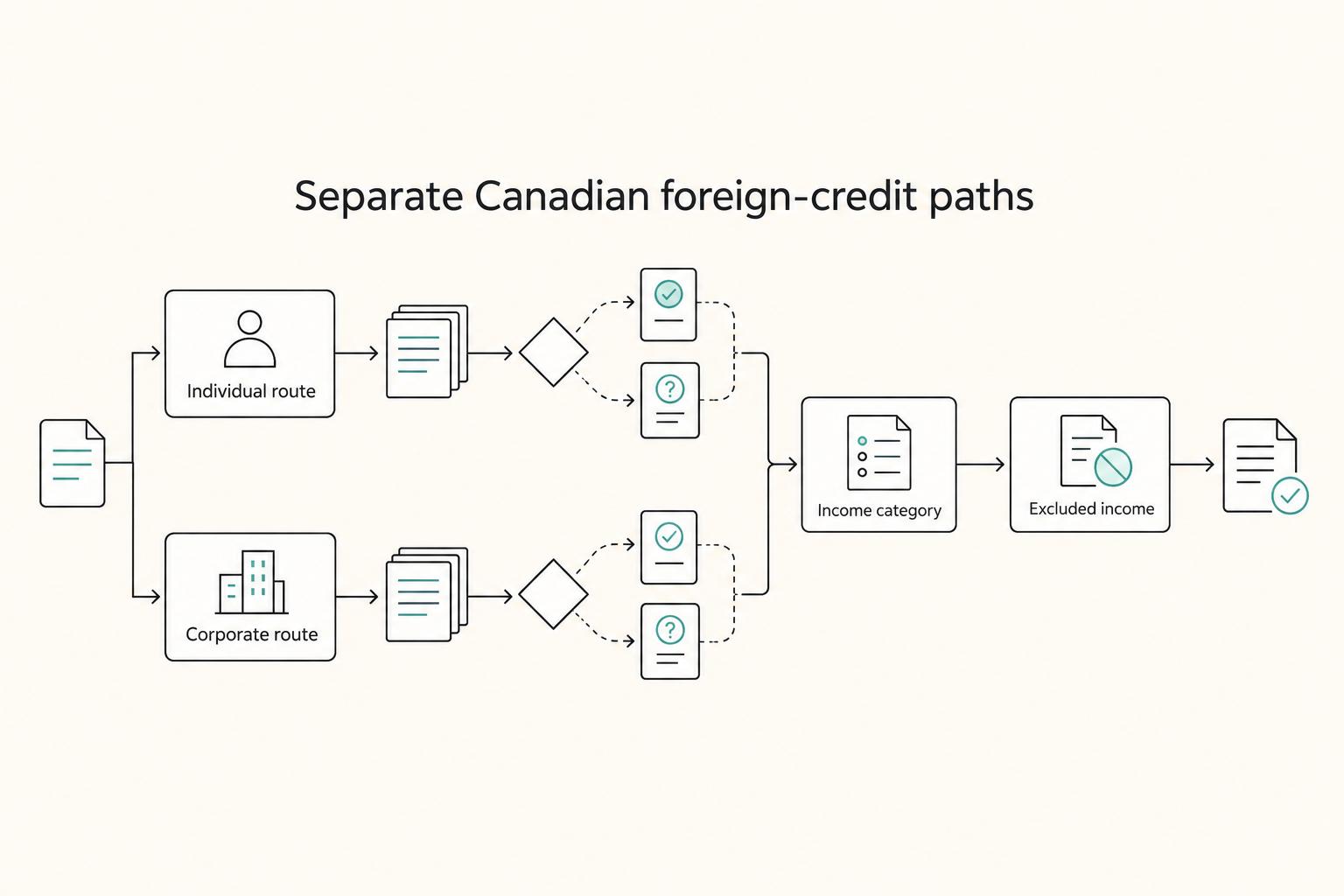
| Item | Article guidance |
|---|---|
| Individuals, estates, and trusts | Use Form 1116 |
| Corporations | Use Form 1118 |
| Form 1116 by income category | Separate forms are required by income category |
| 2025 Form 1116 | Part IV lines 25 through 32 are required even when only one Form 1116 is filed |
| Excluded foreign earned income or housing costs | You generally cannot claim a foreign tax credit on the excluded amount |
In practice, pressure often appears when the foreign tax credit is claimed. The credit is meant to reduce double taxation, but it works only when required conditions are met, including qualifying foreign taxes and required tests. Miss one requirement and you can still face tax in both places.
Execution details matter. Individuals, estates, and trusts use Form 1116, while corporations use Form 1118. For Form 1116, separate forms are required by income category. The 2025 instructions also require Part IV lines 25 through 32 even when only one Form 1116 is filed.
Timing can also create problems. When income and related foreign taxes are reported in different periods or categories, you may need additional analysis before assuming relief.
Excluded income is another trap. If foreign earned income or housing costs are excluded for U.S. purposes, you generally cannot claim a foreign tax credit on that excluded amount.
Use this checkpoint before treating the structure as low risk:
- Map each revenue stream to who is taxed, where, and in which tax year.
- Confirm the U.S. filer and likely credit form: Form 1116 or Form 1118.
- If Form 1116 applies, assign income categories clearly.
- Flag excluded income so you do not assume a credit that is not available.
- If you cannot clearly map tax person, place, and timing, treat the setup as high risk and escalate.
Make a 30-minute go or no-go decision#
Make this a go only if your facts support it now, not only at setup. Before filing any entity paperwork, confirm Canadian residency facts, test likely U.S. trade or business exposure, and check whether your reporting plan still works as facts change.
| Gate | What to verify | Article note |
|---|---|---|
| Gate 1 | Confirm residency facts, then test U.S. exposure | A new contract or delivery pattern can change the result in the same tax year |
| Gate 2 | Validate treaty reliance before formation | If treaty reliance is unclear for your exact facts, pause and escalate before first invoice |
| Gate 3 | Compare compliance fit before defaulting to a structure | If one option works only with repeated caveats, treat that as a no-go until those caveats are resolved |
Gate 1 confirm residency facts then test U.S. exposure#
Treat this gate as pass or fail. If your U.S. customer activity could amount to carrying on a U.S. trade or business, plan for U.S. exposure. The test is fact-dependent and ongoing during the year, so a new contract or delivery pattern can change the result in the same tax year. If you are carrying on a U.S. trade or business, exposure is tied to effectively connected income, and filing obligations can still apply even when no U.S. tax is due.
Gate 2 validate treaty reliance before formation#
If your plan depends on treaty relief, verify it before formation. The Canada-U.S. Income Tax Convention can matter, but treaty treatment depends on your facts and structure. If treaty reliance is unclear for your exact facts, pause and escalate before first invoice.
Gate 3 compare compliance fit before defaulting to a structure#
If filing simplicity and clean reporting are priorities, compare alternatives before defaulting to one structure. Do a side-by-side based on expected filings in your fact pattern and day-to-day compliance burden. If one option works only with repeated caveats, treat that as a no-go until those caveats are resolved.
Practical rule: if any of the three gates is unclear, pause formation and escalate to cross-border counsel before first invoice. For location context, see our 30-day Ho Chi Minh City move guide.
Compare structure choices with a conservative bias#
Use a conservative bias. Choose a structure only when you can explain the tax logic clearly under your facts, not because formation looks easy.
That bias is practical because core corporate tax anchors are often hard to pin down. Even at a high level, source of income and corporate residence can be difficult to define. When those anchors are unclear, downstream planning can become less certain, so use this as a decision worksheet rather than a ranking table.
| Structure | Treaty access | Canadian corporate tax interaction | Owner-level reporting complexity | Exit consequences |
|---|---|---|---|---|
| U.S. Limited Liability Company (LLC) | What must be true for your plan to work, and what is still unverified? | Which treatment assumptions are confirmed vs pending? | Which filing and reporting steps are confirmed vs unclear? | Which exit assumptions are confirmed vs untested? |
| C-Corporation | What must be true for your plan to work, and what is still unverified? | Which treatment assumptions are confirmed vs pending? | Which filing and reporting steps are confirmed vs unclear? | Which exit assumptions are confirmed vs untested? |
| Limited partnership | What must be true for your plan to work, and what is still unverified? | Which treatment assumptions are confirmed vs pending? | Which filing and reporting steps are confirmed vs unclear? | Which exit assumptions are confirmed vs untested? |
Scenario check: if your facts involve uncertain income sourcing or uncertain corporate residence, treat that as a signal to validate more assumptions before choosing a structure.
Recommendation: prefer the option with fewer unresolved assumptions and a clearer explanation path across your full filing plan.
Apply treaty rules without false confidence#
Treaty outcomes for a U.S. Limited Liability Company are fact-specific. Do not rule treaty protection in or out without document-level verification.
Use the full legal stack, not one document. The Convention was done in 1980 and amended by a protocol signed in 2007, with a related Senate report ordered printed in 2008. The U.S. Treasury Technical Explanation is presented as official guidance, and Canada is stated to subscribe to its contents. That same document also says it is not a complete guide and that earlier technical explanations remain official for provisions that were not amended.
Treat Article IV, Paragraph 6 as a verification gate#
If your analysis turns on Article IV, Paragraph 6, use it as a checkpoint, not a shortcut. Operative language is not provided here, so confirm full treaty materials before relying on any treaty position for invoicing, withholding expectations, or year-end filing decisions.
Keep a compact evidence pack before first invoice:
- Full Convention text used for your analysis.
- The amending protocol materials.
- The current Technical Explanation for amended provisions.
- Earlier technical explanations for unamended provisions.
- A short advisor memo mapping each conclusion to controlling text.
Treat treaty eligibility as fact-specific, not checkbox-based. Re-test your memo whenever core facts change.
Check U.S. state exposure before your first U.S. sale#
Run state analysis before first revenue, even if your federal position looks clean. Federal planning alone may not resolve state exposure, and California can tax nonresidents on taxable income from California sources, including services physically performed in California.
Start with status and facts. California residency is a facts-and-circumstances test. A nonresident is someone who is not a California resident. A part-year resident may be taxed on worldwide income during the resident period plus California-source income during the nonresident period. Residency conclusions should reflect the full fact pattern, not just an address.
Build a pre-revenue state nexus screen#
Use this as a risk screen, not a legal conclusion list:
| Factor | What to record |
|---|---|
| Residency status by period | Nonresident or part-year resident |
| Service location | Where services are physically performed, including any work performed in California |
| California-source income | Income tied to California sources during nonresident periods |
| Worldwide income | Worldwide income received during California resident periods |
| Tax computation | California taxable income multiplied by an effective tax rate |
- Your residency status by period (nonresident or part-year resident).
- Where services are physically performed, including any work performed in California.
- Income tied to California sources during nonresident periods.
- Worldwide income received during California resident periods.
- How California tax is computed for nonresidents or part-year residents (California taxable income multiplied by an effective tax rate).
Keep one evidence file with dates, locations, contracts, and who performed each service.
California Franchise Tax Board warning example#
Example: you are a Canadian consultant, you rely on treaty analysis for federal planning, and you sign a large California engagement with onsite delivery. California-source income can arise to the extent services are physically performed in California, so you may still need a separate California analysis even when your federal plan seems settled.
Execution rule: before signing a large U.S. contract, record which states you screened, which facts you tested, and why your conclusion was reasonable on that date. Use FTB Publication 1100 as a baseline and refresh your memo when residency or service-location facts change.
Build your filing map and compliance calendar#
Build the filing map now, then review it monthly. For each line, assign required, not required, or pending review, plus an owner and a decision date.
Map filings by fact pattern#
Keep two tracks: return filings and foreign account or asset reporting. You can list U.S. federal return, Form 5472, and Form T1134 as decision lines, but keep Form 5472 and Form T1134 marked as pending fact-pattern review until structure, ownership, and transactions are documented.
| Filing line | Decision to record now | Monthly evidence to keep |
|---|---|---|
| U.S. federal tax return | Whether a return is required and who files | Ledger, revenue detail, owner transactions |
| Form 5472 | Pending fact-pattern review only (not determined here) | Entity structure, related-party agreements, and payments |
| Form T1134 | Pending fact-pattern review only (not determined here) | Ownership chart and affiliate details |
| Form 8938 | Whether Form 8938 reporting is triggered | Foreign account and asset list and balances |
| FBAR (FinCEN Form 114) | Whether separate FinCEN reporting is required | Account and signatory records and balances |
For Form 8938, keep the rules explicit. It is attached to your tax return. Certain U.S. taxpayers with specified foreign financial assets exceeding $50,000 must report those assets. If no income tax return is required, Form 8938 is not required. Filing Form 8938 does not replace FBAR, so keep those as separate checkpoints.
For tax years beginning after December 31, 2015, include a specified domestic entity review checkpoint. A closely held domestic corporation can fall into that category, so keep Form 8938 valuation threshold checks on your annual review list.
Set a month-by-month cadence before deadlines#
- Week 1: close books and reconcile accounts.
- Week 2: review estimate assumptions and foreign asset tracking.
- Week 3: update filing-map statuses and support schedules.
- Week 4: advisor review, decision-log updates, and escalation.
Failure mode to avoid: waiting until year-end to clean it up. That usually leaves missing support, unclear balances, and rushed cross-border decisions.
Prepare an advisor handoff package that gets answers fast#
A fast advisor handoff is a structured packet plus a short issue log. That gives your advisor a clear filing posture without reconstructing records first.
Send a minimum evidence packet#
Use one folder with a one-page index showing file name, tax year, and short note. Include:
- Entity documents and any filed tax elections.
- Ownership chart with owners, percentages, residency, and effective dates of changes.
- Client contracts and amendments.
- Invoice log with invoice date, service period, client location, amount, and payment date.
- Bank statements tied to receipts, owner draws, and transfers.
- Prior U.S. federal return history, including extensions and key schedules.
Before sending, note any gaps you already see, such as missing files, unmatched amounts, or unclear dates, directly in the index.
Add an issue log before the first call#
Make open items explicit in a simple table with issue, current assumption, missing fact, owner, and deadline. Include:
- Potential ECI triggers you want reviewed.
- Treaty positions you are considering, marked as tentative.
- Foreign tax credit mismatches or uncertainties.
For foreign tax credit posture, document whether the same income may be taxed by both the U.S. and a foreign country or U.S. possession. Also document whether you are treating foreign taxes as a credit or deduction. In most cases, a credit is more advantageous than a deduction. Individuals, estates, and trusts use Form 1116, while corporations use Form 1118. If Form 1116 is used, track income by category because separate Form 1116 filings are required by category.
Require a one-page memo before final decisions#
Ask for a one-page written memo with four blocks:
- Recommended structure.
- Assumptions relied on.
- Filing list.
- Red-flag facts that would change the recommendation.
Require the memo to state your foreign tax credit position. Confirm whether foreign earned income or foreign housing exclusion was used, because excluded income cannot also support a foreign tax credit. For 2025 Form 1116 filings, ask the advisor to confirm Part IV lines 25 through 32 are completed even when only one Form 1116 is filed.
Keep records audit-ready from day one#
Audit-ready records are what keep your filing position defensible. For a foreign-owned U.S. LLC, treat each cash movement as potential filing evidence, and flag anything you cannot trace from agreement to invoice to bank activity before quarter close.
Build a filing-linked evidence pack#
Keep one quarterly folder with consistent file names using date, counterparty, amount, and purpose. Maintain transaction-level support for revenue, distributions, owner draws, and cross-border transfers so an advisor can validate positions without rebuilding the quarter.
- Signed contracts, invoices, and payment confirmations for client revenue.
- Support for distributions and owner draws, with approval notes and bank proof.
- Cross-border transfer records with sending account, receiving account, and business purpose.
- Capital contribution records and deposit evidence.
- Company expenses paid personally, plus reimbursement status.
- Prior U.S. federal return files and current-year working schedules.
Keep this standard tight because routine movements can be reportable. Practitioner guidance for foreign-owned LLCs says initial capital contributions and some owner-paid company expenses can trigger Form 5472 reporting. It also notes that annual IRS reporting may still apply even when activity is minimal.
Reconcile legal activity to books every quarter#
Run a quarterly reconciliation before filing season so gaps are fixed while facts are fresh.
- Export the quarter's invoice register, payout detail, ledger activity, and bank statements.
- Tie invoice totals to deposits by month and document timing differences.
- Match owner-related entries to supporting files and mark missing evidence.
- Add unresolved items to the issue log with owner and decision date.
Do not let unresolved entries roll forward. CPA guidance describes potentially significant per-form exposure for Form 5472 non-compliance and notes increased enforcement attention since 2017.
Use Gruv outputs where enabled, then confirm scope#
Where enabled, Gruv can help keep invoice, payout, and ledger records traceable for advisor handoff. Use exports as an evidence index, and keep underlying contracts, invoices, and payment artifacts in the same quarter pack.
Coverage varies by market and program, so confirm what your setup captures before relying on it for filing decisions. Classification can also differ across jurisdictions: a single-member LLC may be treated as a disregarded entity for U.S. federal tax, while the Canada Revenue Agency may view the LLC as a foreign corporation. If your treatment map is unclear, escalate before the filing deadline.
Red flags that mean stop DIY and escalate#
If you cannot document a consistent foreign-asset filing decision, stop DIY and escalate before filing.
Hard stop signals#
- You cannot explain in writing why each foreign account or asset line is filed or not filed.
- You are unsure whether Form 8938 applies because the applicable threshold test is incomplete.
- You are treating Form 8938 and FBAR as if one filing replaces the other.
- Your foreign-asset reporting items are late, missing, or unresolved.
Form 8938 is attached to your income tax return, not filed by itself, and it depends on whether your specified foreign financial assets are above the applicable threshold. IRS guidance includes a $50,000 threshold in some cases, and Form 8938 instructions also include a $75,000 at-any-time threshold for specified domestic entities. If no income tax return is required for the year, Form 8938 is not filed for that year.
Filing Form 8938 does not replace FBAR when FBAR is otherwise required. For FBAR, FinCEN expects maximum account value to be a reasonable approximation of the highest value during the year, reported in U.S. dollars and rounded up to whole dollars, for example $15,265.25 becomes $15,266. If you cannot show that calculation clearly, escalate before filing.
Conclusion#
Treat a U.S. LLC as a decision that should be fact-checked and documented before you scale. The real decision is not whether an LLC is good or bad in general. It is whether your activity can be explained consistently across U.S. federal and state rules before you scale.
Most problems start with sequence: entity setup should follow activity mapping. Use the activity-level model first, then decide whether entity formation is needed.
Use this go or no-go checklist:
- Re-run three decision gates with current facts, not old assumptions: activity-level mapping, state exposure screening, and entity-choice validation.
- Screen state exposure before each large U.S. contract, especially when inventory, fulfillment partners, or third-party sales support are involved.
- Build a filing map for the next year so each filing has an owner, timing window, and required records.
- Get written advisor guidance that states assumptions, open issues, and the facts that would change the recommendation.
Keep both failure modes in view. One is late state nexus exposure. Published examples describe notices arriving three years later, including six-figure back taxes, penalties, and interest after inventory sat in a U.S. warehouse channel. The other is over-filing, where businesses spend thousands on U.S. federal returns that were not required for their actual activity level.
Final decision standard: if your structure cannot be explained on one page across your activity level, U.S. federal treatment, and state rules, redesign it before growth makes mistakes more expensive.
Frequently Asked Questions
Is a U.S. LLC usually tax-efficient for a Canadian tax resident freelancer?
Not usually by default. U.S. exposure can begin once your activity reaches a U.S. trade or business level, and that threshold can be relatively low. Even if U.S. tax due is reduced or zero, filing obligations can still apply.
Why can a Canadian owner face double taxation with a U.S. LLC?
Double-tax risk can arise when U.S. and Canadian treatment or timing does not line up cleanly. If income is effectively connected to a U.S. trade or business, U.S. federal exposure can come into scope. Incomplete filings or relief positions can leave the same income taxed twice in practice.
Does the Canada-U.S. treaty automatically protect LLC income?
No. Treaty relief is fact-specific and should be validated before formation or filing. If your plan depends on treaty treatment, get a written cross-border position first.
Can I owe U.S. state tax even if federal treaty relief reduces U.S. federal tax?
Yes, potentially. State nexus can still arise based on your facts even if the federal position looks clean. The article notes a published example linking inventory in a third-party Los Angeles warehouse to a California nexus notice.
What actually triggers U.S. filing requirements for Canadians serving U.S. clients?
A core trigger is carrying on a U.S. trade or business, which can create both tax exposure and filing duties. Filing requirements may still apply even when no U.S. tax is in the end payable. Practitioner guidance for Canadian-owned single-member LLCs also points to Form 5472 with a pro forma Form 1120 filing package.
What is the lowest-stress structure to consider if I want fewer cross-border surprises?
Usually the structure you can explain consistently across U.S. federal, U.S. state, and Canadian treatment before first revenue. Do not pick an LLC just because setup looks simple. Favor the option with a clear filing map and fewer unresolved assumptions.
When should I stop DIY and hire cross-border tax counsel?
Stop when you cannot explain your position consistently across jurisdictions or document why each filing decision was made. Escalate when state nexus facts appear and you still do not have a written state filing position. Do the same if Form 5472 obligations are late, missing, or unclear near deadline.
Try a related tool
Researched and edited by the Gruv editorial team. Gruv builds cross-border billing, payouts, and finance-operations software for global businesses.
Sources
Educational content only. Not legal, tax, or financial advice.
Related Posts

Digital Nomad Taxes in 2026 With a Defensible Filing Plan
With digital nomad taxes, the first move is not optimization. It is figuring out where you may be taxable, where filings may be required, and what proof supports that position.

Ho Chi Minh City Digital Nomad Guide for a 30-Day Move (2026)
Ho Chi Minh City is a strong base if your priority is keeping work momentum while relocating. You get density, plenty of places to work from, and a social scene that can help you settle quickly. It is a weaker fit if your best days depend on calm streets, easy walking, and long stretches of quiet. In practice, Saigon tends to reward people who want convenience and activity more than retreat pace.
How to Create a YouTube Channel to Showcase Your Freelance Skills
Treat this like a business decision, not a creator identity project. Your goal is to publish videos that attract qualified inquiries instead of random attention.